

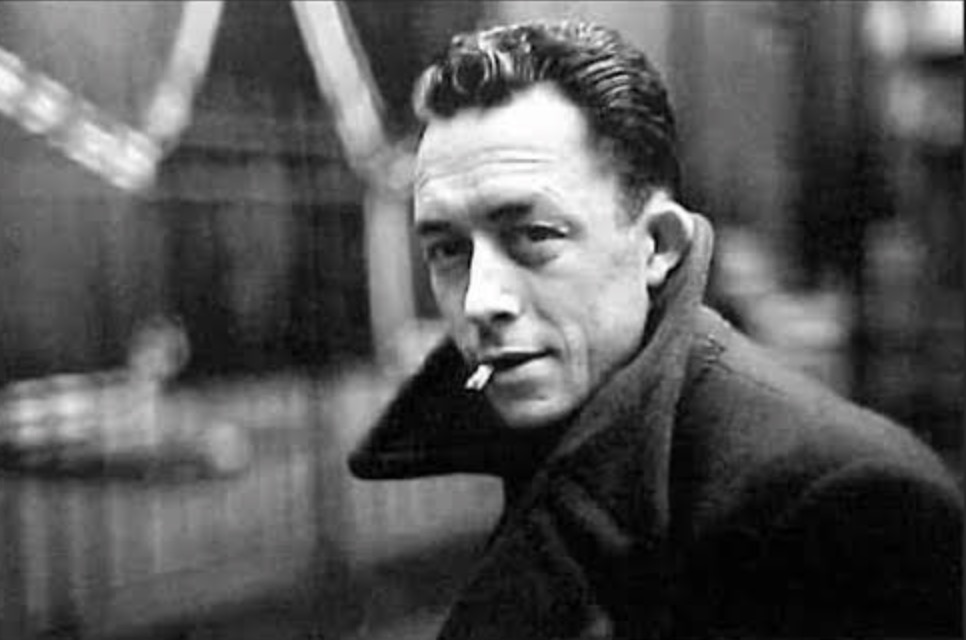
I sometimes joke with friends that one reason I have remained reasonably sane during this troubling period in American history is that I spent so much time reading existential writers in college. The line usually gets a laugh, but there is some truth in it.
During my senior year at Washington College, I spent a semester working one-on-one with J. David Newell, then chair of the philosophy department. My independent study focused on Albert Camus, and we read much of his work over several months, including The Stranger, The Plague, and The Myth of Sisyphus. I was young enough (20) to find his ideas “cool”, but without any sense of what a truly tormented world might actually look like in 2026.
Camus resisted being labeled an existentialist, but he wrestled with many of the same questions. In simple terms, how do we live when the universe offers no clear explanation for suffering, injustice, or death?
As J. David taught me, Camus called this conflict the absurd. We want life to make sense. We want suffering to have an explanation and justice to prevail. But the world promises none of those things.
For Camus, recognizing that fact was not a reason for despair. It was a reason to live fully, care for others, oppose injustice, and find meaning in the life directly in front of us.
I was reminded of all this recently while listening to a BBC podcast about Camus. A guest scholar quoted a passage from his essay “Return to Tipasa” that immediately flashed me back to that independent study. Camus wrote that he had been placed halfway between misery and the sun:
“Misery kept me from believing that all was well under the sun,
and the sun taught me that history was not everything.”
I remembered the passage, but it reached me differently this time. At twenty-one, it had been a useful way to understand Camus. Now it sounded more like practical advice.
In this context, I take Camus’s use of “history” to mean the great machinery of public events unfolding around us. War, ideology, political violence, corruption, cruelty, raw stupidity, and all the other forces that can make an individual feel small and powerless.
Camus sometimes described his outlook as a Mediterranean philosophy. Sunshine, the sea, the physical world, friendship, beauty, and laughter were not side benefits of a life lived amid suffering. They were part of his answer to despair. History mattered deeply to him, but he refused to grant it ownership of the entire human experience.
For the past 12 years, I have walked almost every day from my home in Easton’s historic district to the Rails-to-Trails path and eventually to John Ford Park.
There is one point on that walk that surprises me almost every time. I move through a familiar town park and then, with almost no warning, the landscape opens onto an Eastern Shore field. Route 50 is less than 100 feet away, but the change is so sudden that it always feels like a small reveal. The town gives way to open land, the horizon widens, and for a moment, I am taken out of whatever argument, deadline, or bit of bad news has been occupying my day.
Nothing has been solved. The news has not improved. The world is no less troubled than it was a few minutes earlier. But when that field appears, I find myself returned to the present.
Perhaps that is what Camus meant by sunshine.
It is not a suggestion to look away from suffering. It is a reminder that suffering does not have a monopoly on reality. The world contains cruelty, but it also contains fields, friendships, work worth doing, unexpected beauty, and the kind of laughter that briefly takes control of the entire body.
Those things do not erase history. They simply remind us that history is not everything.
Every so often, an old writer comes back from the black hole of memory and gives us a new way to arrange our thinking. Camus did that for me this week. He reminded me that we can remain fully aware of the storms around us without surrendering the rest of life to them.
And perhaps, every now and then, it helps to notice the field.


