

When one reaches a certain age, it becomes difficult, if not downright impossible, to not contemplate one’s own mortality. One minute, you’re walking along under blue skies, and the next, you’re face-to-face with a human being’s starkest reality: you will die. That’s harsh enough, but what makes it mean-to-the-bone is that there is no universal age for this phenomenon to occur. One of my writing pole stars, Norman McLean, wrote about his “Biblical allotment of years—three score and ten.” Actuaries—the professionals who make their living by calculating risks for insurance companies—have now set the bar for American men at 75.8 years, but the truth is mortality sets its own rules, has its own timetable. I’m now 77 years old, well on the sunset side of my life’s continental divide, and, maybe because I’m out in Montana, the landscape that Norman McLean loved so dearly, I’m beginning to discern my own horizon. That’s not a maudlin statement. It’s just a fact and I’m OK with it.
Before I go any farther, let me confess that in a few days, I’m scheduled to receive a new left knee. I still have all my original parts, but they’re beginning to wear out so I guess it’s time to start replacing them, or at least this particular one. Knee replacement surgery is common enough these days, but it’s still a milestone for me, so I imagine some of this mortality musing weighs more heavily on my mind than I give it credit.
But back to Montana. The West is old. Our own mark on this country is but a second gone on history’s atomic clock. Native peoples have been here much longer, but even they are relative newcomers to the mountains, rivers, lakes, and valleys that are the real time-keepers out here. Yes, they change, too, but they also endure in a way we do not. They are the sentinels and out here, they are more visible than what we see back east. In fact, it is impossible not to notice these landforms or to take them for granted. Awestruck, we pass through them, but they remain, commanding and impassive.
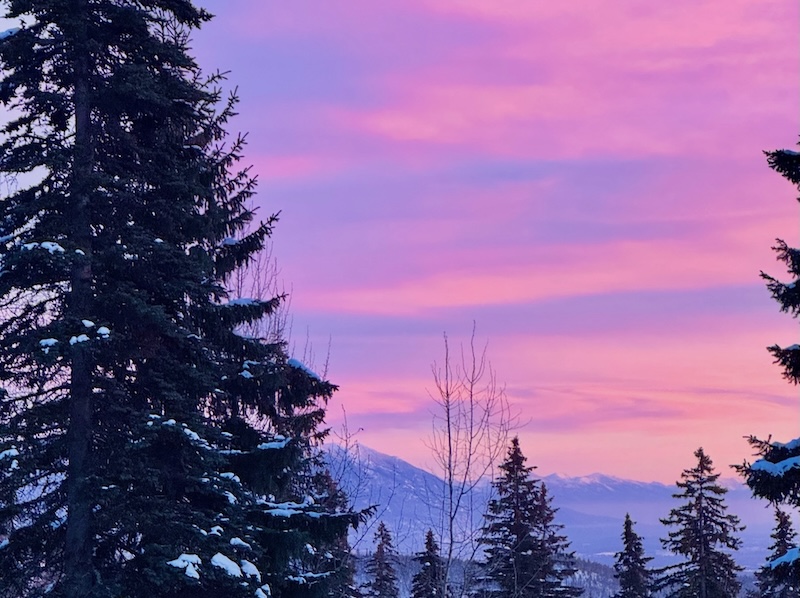
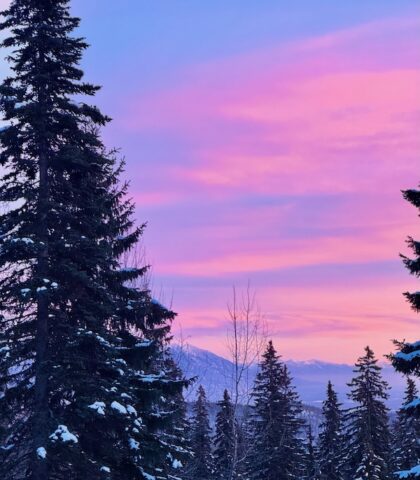
As far as I know, we are the only living species with the capacity to contemplate the span of our lives. On the sunrise side of our years, we don’t give a passing thought to our time together. But over here on the sunset side, I’m learning to appreciate the lost art of savoring moments: the laughter of children, the power of family, the evening light that paints these snow-covered peaks in etherial hues of pink and gold.
The irony in all this is, of course, that we only become aware of the passing of time when there is precious little left of it. I do not fear the other side of the last mountain; I just wonder what it looks like. Norman McLean didn’t write his first novel, “A River Runs Through It,” until he was 70 years old. That book defied literary norms because it blended separate genres of memoir, fiction, and narrative non-fiction. In the last decades of his life, he came to understand that writing, like life, is more about discipline than genius. He took great comfort in all that Montana had to offer him—its mountains, its rivers, its rising trout. Here is what he came to understand:
“Eventually, all things merge into one, and a river runs through it. The river was cut by the world’s great flood and runs over rocks from the basement of time. On some of the rocks are timeless raindrops—under the rocks are the words and some of the words are theirs.”
I think I’m beginning to understand.
I’ll be right back.
Jamie Kirkpatrick is a writer and photographer who lives on both sides of the Chesapeake Bay. His editorials and reviews have appeared in the Washington Post, the Baltimore Sun, the Philadelphia Inquirer, the Pittsburgh Post-Gazette, the Washington College Alumni Magazine, and American Cowboy Magazine. His most recent novel, “The Tales of Bismuth; Dispatches from Palestine, 1945-1948” explores the origins of the Arab-Israeli conflict. It is available on Amazon and in local bookstores. His newest novel, “The People Game,” is scheduled for publication in February, 2026. (It’s available for pre-order now on Amazon.) His website is musingjamie.net.
Write a Letter to the Editor on this Article
We encourage readers to offer their point of view on this article by submitting the following form. Editing is sometimes necessary and is done at the discretion of the editorial staff.