


Happy Mystery Monday! Can you guess what is pictured in photo #1?

The answer to last week’s mystery is the carpel of a tulip tree, Liriodendron tulipifera, pictured in photo #2.
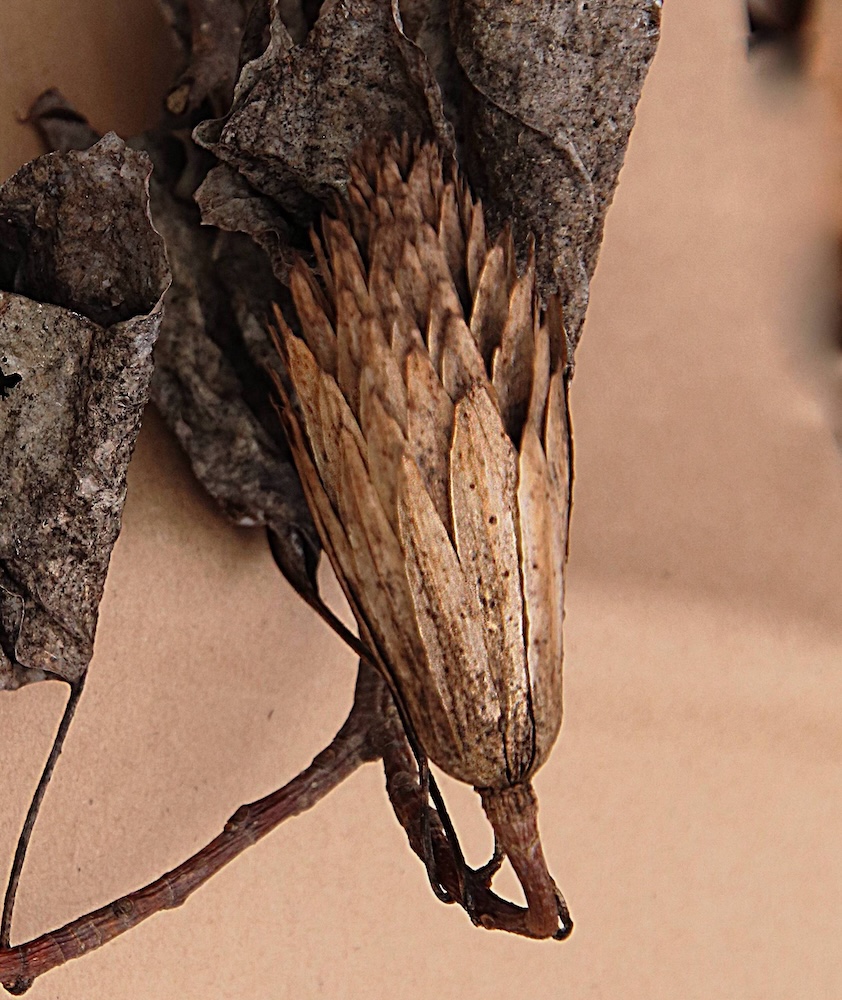
One of the most iconic hardwoods of eastern North America, the tulip tree, Liriodendron tulipifera, is known for its tall, straight trunk and narrow crown—traits that make it instantly recognizable in the forest. In Summer droughts, these trees often act as “drought indicators,” shedding yellowing interior leaves as a survival strategy when soil moisture drops.
Its Spring flowers, though often hidden high in the canopy, are among the most striking of any native tree: yellow-green with an orange band at the base of each petal and shaped like miniature tulips. Many people first notice them only when the petals fall to the ground. By late Summer and Fall, the flowers give way to upright, cone-shaped clusters of dry, woody carpels—structures that resemble carved wooden flowers. These cone-like fruits persist into Winter before gradually releasing their winged seeds to the wind.
A single mature tulip poplar can produce tens of thousands of viable seeds, and seedfalls of over a million per hectare are not uncommon. Yet despite this abundance, Liriodendron seeds require a lengthy process to germinate, including prolonged cold stratification followed by warm, moist conditions. Long-lived, stately, and ecologically important, the tulip tree remains one of the defining trees of eastern forests.
Mystery Monday is sponsored by the Spy Newspapers and Adkins Arboretum.
Write a Letter to the Editor on this Article
We encourage readers to offer their point of view on this article by submitting the following form. Editing is sometimes necessary and is done at the discretion of the editorial staff.