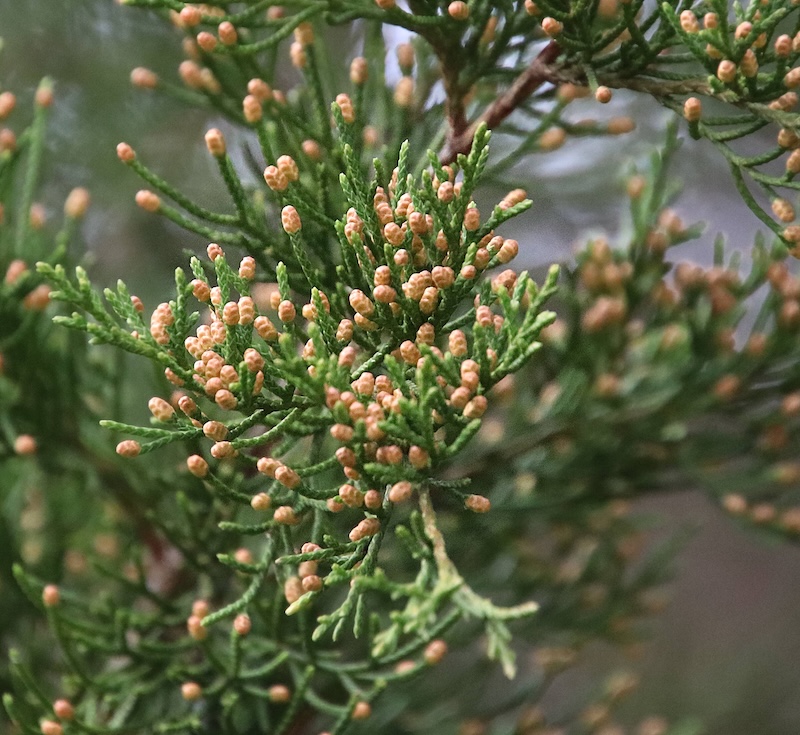


Happy Mystery Monday! Can you guess who is pictured in photo #1?
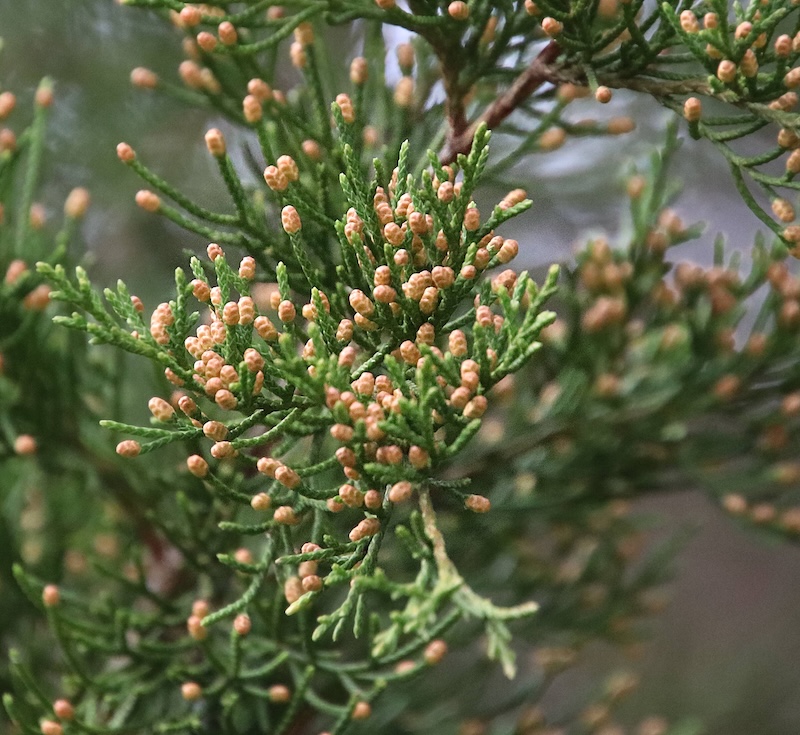
The answer to last week’s mystery is the eastern red cedar, Juniperus virginiana, pictured in photo #2.

The eastern red cedar, Juniperus virginiana, is a familiar evergreen conifer native to eastern North America, easily recognized by its year-round foliage and blue, berry-like cones. Despite its common name, it is not a true cedar but a juniper, and it plays an important ecological role across a wide range of habitats.
Eastern red cedar is dioecious, meaning individual trees produce either male or female reproductive structures. Male trees bear small, yellow-brown pollen cones clustered at the tips of branches. These cones begin forming in late Summer and mature through Winter, releasing clouds of windborne pollen when they split open.
Female trees produce small, waxy, blue seed cones that resemble berries. These cones receive pollen carried on the wind and, once fertilized, close and continue to enlarge through Fall and Winter, ripening in early Autumn. The persistent cones are an important winter food source for birds and wildlife, making eastern red cedar both a resilient evergreen and a cornerstone species in many landscapes.
Mystery Monday is sponsored by the Spy Newspapers and Adkins Arboretum.
#adkinsarboretum #mysterymonday #carolinecountymd
Write a Letter to the Editor on this Article
We encourage readers to offer their point of view on this article by submitting the following form. Editing is sometimes necessary and is done at the discretion of the editorial staff.