MENU

Sections

  • Home
  • Education
  • Donate to the Centreville Spy
  • Free Subscription
  • Spy Community Media
    • Chestertown Spy
    • Talbot Spy
    • Cambridge Spy

More

  • Support the Spy
  • About Spy Community Media
  • Advertising with the Spy
  • Subscribe
December 7, 2025

Centreville Spy

Nonpartisan and Education-based News for Centreville

  • Home
  • Education
  • Donate to the Centreville Spy
  • Free Subscription
  • Spy Community Media
    • Chestertown Spy
    • Talbot Spy
    • Cambridge Spy
Food and Garden

Adkins Arboretum Mystery Monday: Guess the Photo!

September 15, 2025 by Adkins Arboretum Leave a Comment

Happy Mystery Monday! Can you guess what is pictured in photo #1?
The answer to last week’s mystery is gold-marked thread-waisted wasp, Eremnophila aureonotata, pictured in photo #2.

The gold-marked thread-waisted wasp, Eremnophila aureonotata, is native to North America, ranging from southern Canada into Mexico. Despite their fierce appearance, these wasps are not aggressive and rarely sting humans.

They’re easy to recognize by their extremely thin, stalk-like abdomen, which helps the female maneuver when laying eggs or fending off predators. Solitary by nature, they sometimes appear in pairs during mating, with the male clinging to the female’s back as they fly from flower to flower. They are frequent visitors to goldenrods, spotted horsemint, boneset, and other Summer-blooming asters, playing an important role as pollinators.

Females dig nests in sandy soil, then paralyze large moth caterpillars and drag them back as food for their young. Once the nest is stocked with live food, she seals the entrance and covers it with bits of twigs, leaves, and small stones to better conceal it. The developing wasp larva inside will feed on the provided caterpillar until emerging as adults the following year.

Mystery Monday is sponsored by the Spy Newspapers and Adkins Arboretum.

The Spy Newspapers may periodically employ the assistance of artificial intelligence (AI) to enhance the clarity and accuracy of our content.

Filed Under: Food and Garden

Adkins Arboretum Mystery Monday: Guess the Photo!

September 8, 2025 by Adkins Arboretum Leave a Comment

Happy Mystery Monday! Can you guess what is pictured in photo #1?


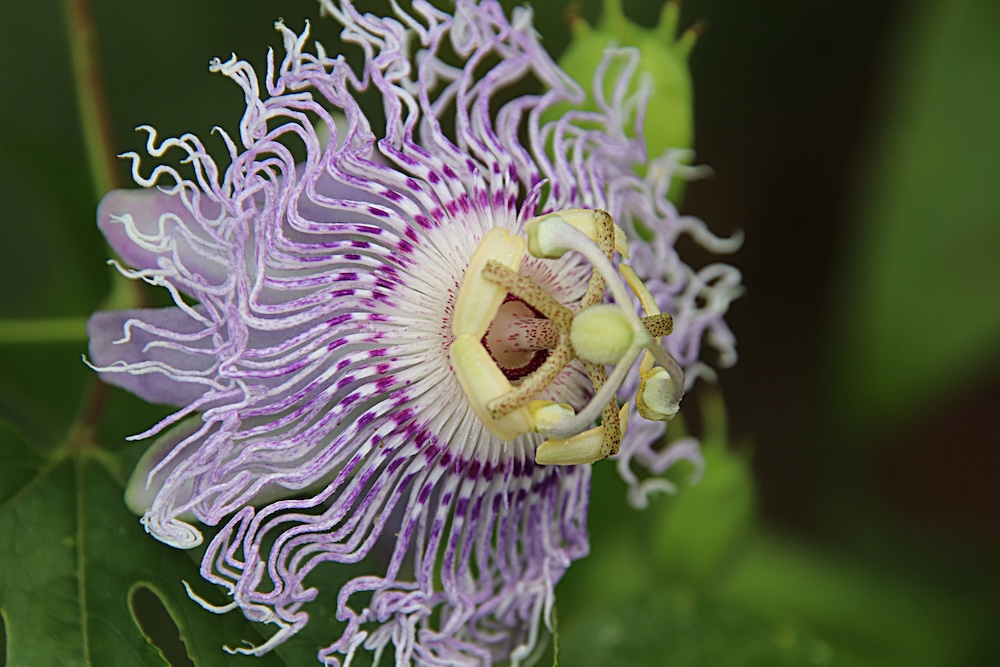
The answer to last week’s mystery is the passion flower, Passiflora incarnata, pictured in photo #2.

The passion flower, Passiflora incarnata, also known as maypop or purple passionflower, is a perennial vine native to the southeastern United States.

Its striking blooms feature five stamens, a pistil of three styles and stigmas, and a dramatic corona of filaments. These flowers are irresistible to butterflies, bees, and hummingbirds. Large bees such as the eastern carpenter bee are especially effective pollinators – the anthers are perfectly positioned to brush pollen onto a bee’s back as it rummages for nectar. The flower’s intricate structure once inspired symbolic links to the Christian crucifixion story, giving it the name “Passion.”

Despite its tropical appearance, this hardy plant can withstand temperatures as low as 0°F. Maypop vines can grow more than 20′ long and spread readily by root suckers in sandy or clayey soils where there is abundant sunlight. Their edible fruits – large, orange-yellow berries that “pop” when crushed – can be eaten fresh or used for juice and jelly. Passion flowers are also vital larval hosts for butterflies, including the Gulf fritillary, zebra longwing, Red-banded hairstreak, and Julia butterfly.

Mystery Monday is sponsored by the Spy Newspapers and Adkins Arboretum.

The Spy Newspapers may periodically employ the assistance of artificial intelligence (AI) to enhance the clarity and accuracy of our content.

Filed Under: Food and Garden

Actinic Traces: Photographic Works by Laurie Beck Peterson on View Through October 31 at Adkins Arboretum 

September 8, 2025 by Adkins Arboretum Leave a Comment

Evergreen Cyano-phtogram, Diptych 2024

Adkins Arboretum is pleased to present Actinic Traces, an exhibition of chlorophyll prints and phytograms by artist Laurie Beck Peterson, on view in the Arboretum’s Visitor’s Center Art Gallery from September 2 through October 31. A public reception will be held on Saturday, September 13, from 2 to 4 pm. 

Laurie Beck Peterson works in close collaboration with plants, sunlight, and time to create images that seem to levitate off their surfaces. Using the natural chemistry of leaves and the UV rays of the sun, her chlorophyll prints and phytograms capture fragile impressions of the plant 

world. Chlorophyll printing is a sustainable photographic process that replaces traditional darkroom chemicals with living leaves and sunlight. Phytograms are made by pressing plants onto light-sensitive paper or film, where their oils and moisture leave behind delicate, abstract patterns. 

The making of these works is often invisible to the eye. Exposures take place over long periods, shaped by weather and light. Development depends on the plant’s own cellular structure, and in the case of chlorophyll prints, the images continue to shift even after they are first revealed. Each work becomes a record of time and change, holding onto the subtle traces of natural processes. 

“I create images that resist permanence and precision, favoring instead ephemerality, decay, and organic authorship,” Peterson explains. “These works are not static artifacts; they are temporal surfaces, slowly fading, reminding us of our shared fragility and deep entwinement with the ecologies we often overlook.” 

For this exhibition, Peterson also explores new ways of presenting her work. Some phytograms are mounted inside clear acrylic boxes, while the chlorophyll leaf prints are displayed atop pedestals that evoke both scientific specimens and fragile jewelry. Other prints are illuminated from behind, their glowing exteriors recalling the experience of looking through a microscope into the hidden cross-sections of plants. These varied presentations highlight the dual identity of the images as both specimen and artwork, encouraging viewers to reflect on the interconnections between humans and the natural world. 

Actinic Traces highlights Peterson’s ongoing interest in impermanence, ecological awareness, and the role of natural systems in shaping images. Her work asks viewers to slow down, notice subtle changes, and see photography not as control over materials but as a partnership with the forces that sustain life. 

Laurie Beck Peterson (b. 1962) is recognized for her innovative use of 19th-century photographic processes in contemporary contexts. Her work explores themes of impermanence, ephemerality, and the natural cycles of growth and decay. Currently a faculty member at the Tyler School of Art and Architecture in Philadelphia, she has exhibited nationally and internationally, with recent highlights including her selection for the Royal Photographic Society’s International Photography Exhibition 164 at the Fox Talbot Museum, Lacock Abbey, UK. She is represented by UpStart Modern Gallery in Sausalito, California.

This exhibition is part of Adkins Arboretum’s ongoing series highlighting regional artists whose work engages with natural themes. The Arboretum is located at 12610 Eveland Road in Ridgely, Maryland. 

For gallery hours or more information, contact Adkins Arboretum at 410-634-2847, or visit adkinsarboretum.org. 

A 400-acre native garden and preserve, Adkins Arboretum provides exceptional experiences in nature to promote environmental stewardship. 

The Spy Newspapers may periodically employ the assistance of artificial intelligence (AI) to enhance the clarity and accuracy of our content.

Filed Under: 5 News Notes

Adkins Arboretum Mystery Monday: Guess the Photo!

September 1, 2025 by Adkins Arboretum Leave a Comment

Happy Mystery Monday! Can you guess what is pictured in photo #1?


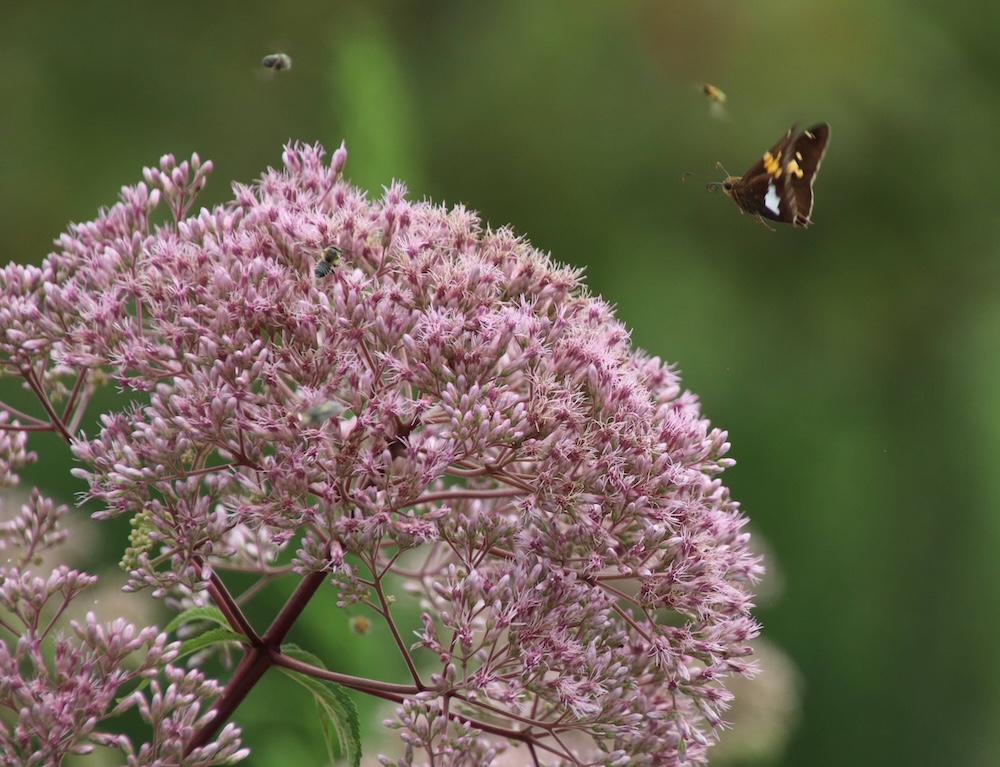
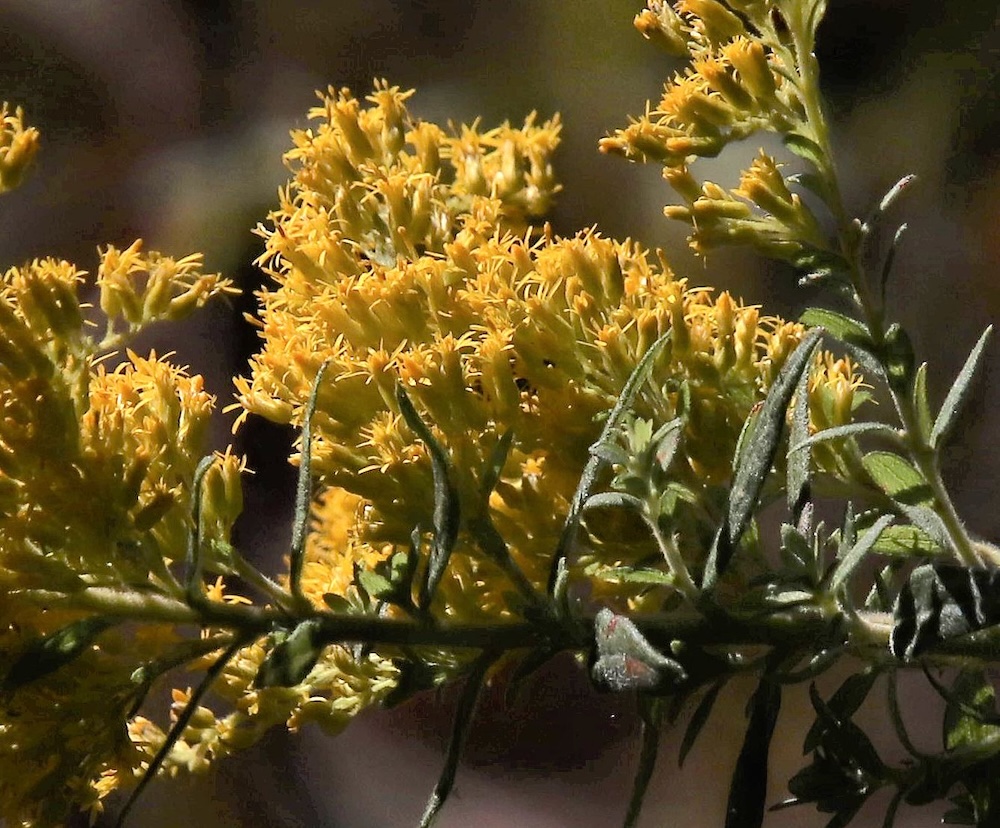
The answer to last week’s mystery is goldenrod, Solidago, pictured in photo #2.

Goldenrods are herbaceous perennials belonging to the Asteraceae, or aster, family. There are 75 species of goldenrod native to the United States. They range in hight from under a foot to more than 6′.

Goldenrods are easily recognized by their clusters of tiny, golden flowers that appear in mid to late-August and last into October. These flowers are heavy with pollen that sticks to insects, rather than disperses in the wind. Therefore, goldenrod pollen will not make you sneeze.

All goldenrods are pollinator powerhouses. They bloom in succession, supporting more butterflies and moths than any other perennial. The rapidly disappearing monarch butterfly relies on goldenrod nectar to fuel their long Fall migration to Mexico. Goldenrods are one of the most important late-season sources of pollen and nectar for bees who are provisioning their nests for Winter.=

Goldenrods naturalize quickly in the garden and are easy to grow in full sun and dry-medium, well-drained soil. They have a deep, fibrous root system, and can help prevent soil erosion and improve soil structure.

Mystery Monday is sponsored by the Spy Newspapers and Adkins Arboretum.

The Spy Newspapers may periodically employ the assistance of artificial intelligence (AI) to enhance the clarity and accuracy of our content.

Filed Under: Food and Garden

Adkins Arboretum Mystery Monday: Guess the Photo!

August 25, 2025 by Adkins Arboretum Leave a Comment

Happy Mystery Monday! Can you guess what is pictured in photo #1?
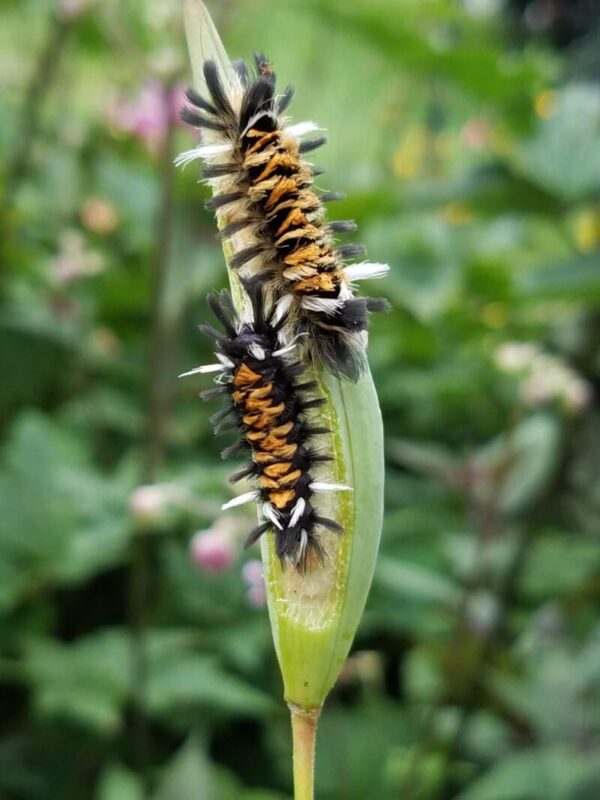
The answer to last week’s mystery is larvae of the milkweed tussock moth, Euchaetes egle, pictured in photo #2.
Milkweed tussock moth larvae is the OTHER caterpillar commonly found on milkweed. The species most commonly associated with milkweed are monarch caterpillars. Both tussock moths and monarch butterflies are entirely dependent on milkweed. They both lay their eggs on milkweed for their larvae to feed and develop.
While this native caterpillar is brightly colored and covered in tufts of black, orange and white, the adult moth is plain brown. This striking coloration, along with their hairy bodies, serves as a warning
signal to potential predators that the caterpillars are toxic and not a good meal. Handle this caterpillar with care! Touching their hairs can result in an uncomfortable rash.
Mystery Monday is sponsored by the Spy Newspapers and Adkins Arboretum.
The Spy Newspapers may periodically employ the assistance of artificial intelligence (AI) to enhance the clarity and accuracy of our content.

Filed Under: Food and Garden

Adkins Arboretum Mystery Monday: Guess the Photo!

August 18, 2025 by Adkins Arboretum Leave a Comment

Happy Mystery Monday!  Can you guess what is pictured in photo #1?


The answer to last week’s mystery is cypress twig gall midge, Taxodiomyia cupressiananassa, pictured in photo #2.


Nope, they’re not pinecones! The spongy, powdery balls encasing the cypress twigs pictured are caused by the larvae of a tiny fly, the cypress twig gall midge. Female twig gall midges lay a cluster of eggs on young cypress leaves. The growing maggots induce the midrib of the leaf to swell into a gall. A single gall can contain a dozen or more larvae.
The galls are most noticeable in late Spring and Summer, appearing as white or greenish-white.
Insecticide is not recommended because the galls do not harm the tree and there is no good, practical treatment for controlling them. Gall midge outbreaks are somewhat sporadic and a tree that was heavily infested with galls one year may have only a few galls in subsequent years.
Mystery Monday is sponsored by the Spy Newspapers and Adkins Arboretum.


The Spy Newspapers may periodically employ the assistance of artificial intelligence (AI) to enhance the clarity and accuracy of our content.

Filed Under: Food and Garden

Free Speaker Series Returns to Inspire Healthier Landscapes Across the Eastern Shore

August 13, 2025 by Adkins Arboretum Leave a Comment

Ecological horticulturist, Rebecca McMackin speaks at the Avalon Theatre on Sunday, Nov 9th, 2024

Adkins Arboretum is proud to announce the 2025 Naturally Better Landscaping Speaker Series, a free four-part series designed to help homeowners, HOA boards, land managers, and community members explore practical and inspiring ways to care for the land using native plants and ecology-based practices.

This series is part of the larger Naturally Better Landscaping, a multi-year education and outreach initiative developed initially in partnership with ShoreRivers, and now in an extended collaboration with Eastern Shore Land Conservancy, Pickering Creek Audubon Center, and Phillips Wharf Environmental Center. The project is generously funded by the Chesapeake Bay Trust and Queen Anne’s County. This year’s speaker series expands on the success of earlier events, offering timely guidance from nationally recognized experts in the fields of horticulture, ecology, and design. Attendees will gain insight into how everyday landscaping choices impact pollinators, water quality, and climate resilience, and how to create landscapes that benefit both people and wildlife.

2025 Speaker Schedule:

Specialist Bees with Heather Holm Saturday, August 9, 1–3 p.m. Cadby Theatre, Chesapeake College, Wye Mills, MD. Register here. Discover the vital relationships between native plants and specialist bees, and how to support them on your property.

What Do You Mean I’m Not a Perennial?! Native Shrubs and Small Trees for Perennial Companionship with Bill Cullina Sunday, August 31, 2–3:30 p.m. Oxford Community Center, Oxford, MD. Register here. Learn how to enhance the beauty and structure of your garden using native woody plants that work in harmony with perennials.

Cultivating Change: A Native Landscaping Success Story Saturday, October 25, 2–3:30 p.m. Adkins Arboretum, Ridgely, MD. Register here. A panel of Cove Creek Club residents shares how their HOA shifted to native plantings, what worked, what didn’t, and what’s next.

Reimagining Our Landscapes: A Talk by Rebecca McMackin Sunday, November 9, 2–4 p.m. Avalon Theatre, Easton, MD. Register here. Ecological horticulturist Rebecca McMackin will explore how we can transform gardens and green spaces into thriving, resilient ecosystems that support biodiversity and respond to a changing climate.

All events are free and open to the public. To ensure adequate seating and materials, pre-registration is encouraged. For more information, visit adkinsarboretum.org or call 410-634-2847. A 400-acre native garden and preserve, Adkins Arboretum provides exceptional experiences in nature to promote environmental stewardship.

The Spy Newspapers may periodically employ the assistance of artificial intelligence (AI) to enhance the clarity and accuracy of our content.

Filed Under: Eco Notes

Adkins Arboretum Mystery Monday: Guess the Photo!

August 11, 2025 by Adkins Arboretum Leave a Comment

Happy Mystery Monday!  Can you guess what is pictured in photo #1?
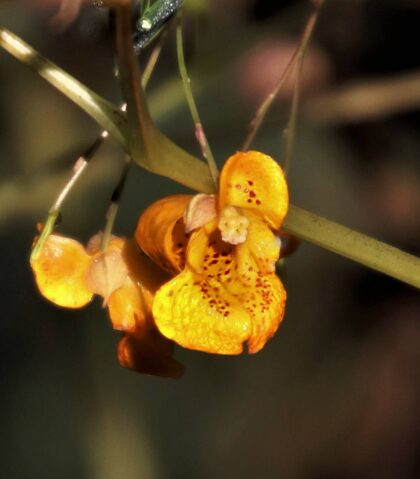
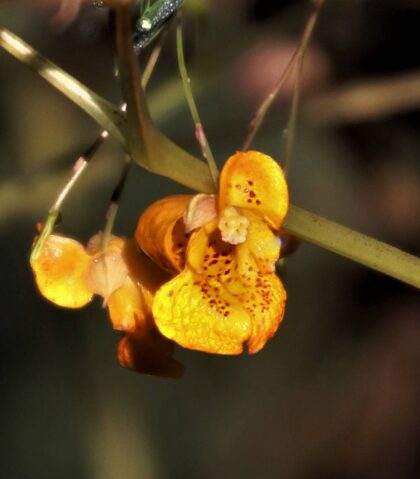
The answer to last week’s mystery is jewelweed, Impatiens capensis, pictured in photo #2.
Jewelweed is native to a large part of the United States, mainly occurring along stream banks on marshy ground, growing with other herbaceous plants in shaded sites. It will often form large colonies in the wild.
Jewelweed is an annual herb that grows 3–5′ tall and blooms from late–Spring to early–Fall. The flowers are orange to orange-yellow with red spotting. When rain or dew appears on the flower, it sparkles like jewels. The flower is three-lobed and has a hooked conical spur at the back. Jewelweed is an important nectar source for hummingbirds, but is also frequented by bees, and butterflies.
Jewelweed self-seeds very easily. When ripe, the seed pods burst open and disperse tiny seeds in all directions at the slightest touch.
Jewelweed is rich in anti-inflammatory compounds, which can calm inflamed skin.
Mystery Monday is sponsored by the Spy Newspapers and Adkins Arboretum.
The Spy Newspapers may periodically employ the assistance of artificial intelligence (AI) to enhance the clarity and accuracy of our content.

Filed Under: Food and Garden

Adkins Arboretum Mystery Monday: Guess the Photo!

August 4, 2025 by Adkins Arboretum Leave a Comment

Happy Mystery Monday! Can you guess what is pictured in photo #1?
The answer to last week’s mystery is swamp rose mallow, Hibiscus moscheutos, pictured in photo #2.
Swamp rose mallow is an obligate hydrophyte, meaning it is wetland-dependent. It thrives in moist to wet soils and can be found in southern and eastern North America.
Swamp rose mallow’s five-petaled flowers range from white to pink. The center of the flower is red or burgundy, where a tubular column of yellow stamens extends. Mallow’s large, heart-shaped leaves are grayish-green on top and white below.
All parts of the swamp rose mallow is edible. The leaf buds and flowers can be cooked or eaten raw. The young leaves have a mild taste with a gelatinous consistency that can be added to salads. The root of the plant can also be eaten, but are quite tough.
Yes, marshmallows were originally derived from the roots of the marsh mallow or swamp mallow! They were mashed, boiled in water until thick, and then eaten. However, our current confection tastes nothing like marshmallow.
The rose mallow bee is considered a specialist bee, as it pollinates this species and only a few others. It’s a robust bee that resembles a bumblebee.
Mystery Monday is sponsored by the Spy Newspapers and Adkins Arboretum.
The Spy Newspapers may periodically employ the assistance of artificial intelligence (AI) to enhance the clarity and accuracy of our content.

Filed Under: Food and Garden

Adkins Arboretum Mystery Monday: Guess the Photo!

July 28, 2025 by Adkins Arboretum Leave a Comment

Happy Mystery Monday!

Can you guess what is pictured in photo #1?

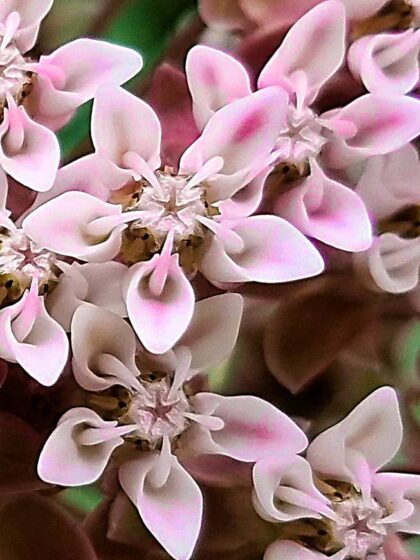
The answer to last week’s mystery is milkweed, Asclepias, pictured in photo #2.

Unlike most flowers, milkweed does not produce loose pollen, but waxy, sticky balls of pollen called pollinia. Each milkweed blossom has a small slit leading down a chamber to the pollinia. When insects land on the droopy milkweed flowers, clinging to the petals as they feed on nectar, a foot can slip into the slit and come in contact with pollinia. When an insect pulls its foot out of the slit, it brings the pollinium with it. Should that same foot slip into another milkweed flower’s slit, the pollen can be transferred, facilitating fertilization.

Milkweed plants typically produce a lot of nectar. The nectar replenishes overnight, gratifying nocturnal moths. The remaining nectar is ready for the first diurnal visitors in the morning.

To access nectar, floral visitors prop themselves on one of the five flower hoods, sliding their tongues down the side of the hood where the nectar is held. They must be careful not to slip their leg down into the flower between the slits. Sometimes insects get stuck in a slit and are never able to free themselves. Some insects are not robust enough to remove their legs from the anther slits with the attached pollinia and are trapped to die there if they don’t lose their appendage first. Other times, they must tear off their own limbs to escape. Even if an insect does manage to pry its leg out of the trap door, some insects are unable to remove the pollinia.

One or two pollinia will slow an insect down, but too many can make it difficult to move. Despite the potential harm of visiting a milkweed flower, for many insects, this is a reliable source of nectar that is worth the risk.

Mystery Monday is sponsored by the Spy Newspapers and Adkins Arboretum.

The Spy Newspapers may periodically employ the assistance of artificial intelligence (AI) to enhance the clarity and accuracy of our content.

Filed Under: Food and Garden

  • « Previous Page
  • 1
  • 2
  • 3
  • 4
  • …
  • 16
  • Next Page »

Copyright © 2025

Affiliated News

  • Chestertown Spy
  • Talbot Spy
  • Cambridge Spy

Sections

  • Sample Page

Spy Community Media

  • Sample Page
  • Subscribe
  • Sample Page

Copyright © 2025 · Spy Community Media Child Theme on Genesis Framework · WordPress · Log in