MENU

Sections

  • Home
  • Education
  • Donate to the Centreville Spy
  • Free Subscription
  • Spy Community Media
    • Chestertown Spy
    • Talbot Spy
    • Cambridge Spy

More

  • Support the Spy
  • About Spy Community Media
  • Advertising with the Spy
  • Subscribe
February 6, 2026

Centreville Spy

Nonpartisan and Education-based News for Centreville

  • Home
  • Education
  • Donate to the Centreville Spy
  • Free Subscription
  • Spy Community Media
    • Chestertown Spy
    • Talbot Spy
    • Cambridge Spy
Archives Food and Garden Notes

Adkins Arboretum Mystery Tuesday: Guess the photo:

January 21, 2025 by Adkins Arboretum Leave a Comment

Happy Mystery Tuesday!  Can you guess what is pictured below?

The answer to last week’s mystery is ground pine or tree clubmoss, Dendrolycopodium obscurum, pictured in photo #2.

Ground pine, or tree clubmoss, is neither a pine nor a moss. but is more closely related to ferns. This flowerless ground cover is rarely more than six inches tall and is a very slow grower.

Found in moist sites in woods, thickets, and clearings in nearly every county in Virginia and northern forests in North America and Asia, ground pines prefer acid soil and cool temperatures. The plant tolerates slow nutrients and can withstand a wide range of light conditions. If temperatures become warmer and the forest becomes drier, this species would be expected to decrease.

Lycopods reproduce asexually by spores. The dried spores of ground pine have been used for flash powder for early photography, and in entertainment, like in magic shows. Historically harvested from the wild for Christmas greens, excessive harvesting has threatened ground pines. States like Indiana and New York protect ground pine by state law.

Mystery Monday is sponsored by the Spy Newspapers and Adkins Arboretum.

The Spy Newspapers may periodically employ the assistance of artificial intelligence (AI) to enhance the clarity and accuracy of our content.

Filed Under: Archives, Food and Garden Notes

Within Our Reach: Mixed Media Works by Bridget Z. Sullivan on view through Feb. 28 at Adkins Arboretum

January 14, 2025 by Adkins Arboretum Leave a Comment

Bridget Z. Sullivan’s exhibition Within Our Reach at Adkins Arboretum’s Visitor’s Center offers an evocative exploration of the natural world and its interconnectedness with human perception. On display through Feb. 28, the exhibit invites visitors to experience the quiet power of nature in new and profound ways. A reception to meet the artist will be held on Sat., Jan. 18, from 2 to 4 p.m.
Inspired by John Berger’s Ways of Seeing, Sullivan invites viewers to consider seeing not as a passive act but as an active, relational process. Sullivan’s work reflects her fascination with the relationships between what we observe and how we interpret it. Her use of archival pigment prints layered with acrylic, ink, oil pastel, and graphite creates rich, multi-dimensional surfaces. Her compositions’ dynamic textures and intricate details suggest the movement of plants as if they were shifting gently in the breeze, blurring the line between stillness and life.
In Within Our Reach, Sullivan’s distinctive style combines digital photography with traditional drawing techniques, blending the precision of the camera with the expressive qualities of hand-drawn marks. The layered media and textural contrasts create a sense of depth and vitality. This approach underscores the reciprocal relationship between nature and its observer, a theme that runs throughout her body of work.
Through her art, Sullivan highlights the profound connections between humans and the natural world, resonating with Adkins Arboretum’s mission to promote environmental stewardship and appreciation for the native landscape. Her work serves as both a reflection and celebration of the Arboretum’s commitment to fostering an understanding of the interconnectedness of all life.
Sullivan’s career spans solo and group exhibitions at venues such as Maryland Art Place, School 33 Art Center, and the University of Maryland Global Campus Art Gallery. A two-time National Park Service Artist-in-Residence and a recipient of multiple Maryland State Arts Council Individual Artist’s Grants, her work has been featured in AfterImage: Inklight and URHere Journal of Creative Geography. Since 2012, Sullivan has volunteered as president and curatorial director of the Hamilton Arts Collective | Hamilton Gallery in NE Baltimore.
This show is part of Adkins Arboretum’s ongoing exhibition series highlighting regional artists whose work engages with natural themes. The Arboretum, located at 12610 Eveland Road near Tuckahoe State Park in Ridgely, is a 400-acre native garden and preserve offering exceptional experiences in nature.
For gallery hours or more information, contact Adkins Arboretum at 410-634-2847, ext. 100, or visit adkinsarboretum.org.

The Spy Newspapers may periodically employ the assistance of artificial intelligence (AI) to enhance the clarity and accuracy of our content.

Filed Under: 6 Arts Notes

Adkins Arboretum Mystery Monday: Can you guess the photo?

January 13, 2025 by Adkins Arboretum Leave a Comment

Happy Mystery Monday!  Can you guess what is pictured in the photo below?
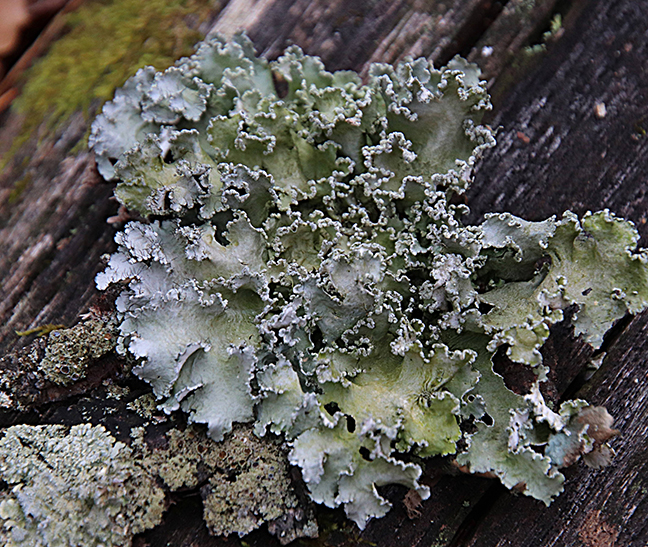
The answer to last week’s mystery is foliose lichen, pictured in the photo below:.
Foliose lichen is one of the three most common growth forms of lichens. Foliose means leafy, as they tend to look like leafy growths that are attached to a base with one or more stem-like structures called rhizomes.
Foliose lichens provide food and shelter to wildlife. Some species of birds and squirrels use them for nests, while some amphibians use lichens as camouflage. Lichens are low in protein but high in carbohydrates. They are one of the few foods available in areas where winters are very cold. Many species of deer, mountain goat, antelope, and caribou depend on them for part of their diet. Small mammals like flying squirrels, rabbits, and voles also consume lichens.
Lichens can be found almost everywhere on earth. They are a pioneer species. This means they are the first to come into an area that has been recently disturbed by events including lava flows, glaciers, and other natural disasters. Pioneer species help the area recover and create a more stable ecosystem. Carpets of lichens can prevent soil erosion where infrequent but heavy rains appear. In these environments, they also prevent wind erosion.
Lichens are a composite organism, meaning two organisms living together as one. In the case of lichens, it is a combination of a fungus and algae. The fungi never exist outside of the lichen and the algae can occasionally be found outside the lichen. The fungus provides the habitat and protection for the algae while the algae provides the food.
Lichens can have a very long lifespan ranging from 30 to over 4,500 years.
Mystery Monday is sponsored by the Spy Newspapers and Adkins Arboretum.
The Spy Newspapers may periodically employ the assistance of artificial intelligence (AI) to enhance the clarity and accuracy of our content.

Filed Under: Food and Garden Notes

Adkins Arboretum Mystery Monday: Guess the photo!

January 6, 2025 by Adkins Arboretum Leave a Comment

Happy Mystery Monday! Can you guess what is pictured in photo below?
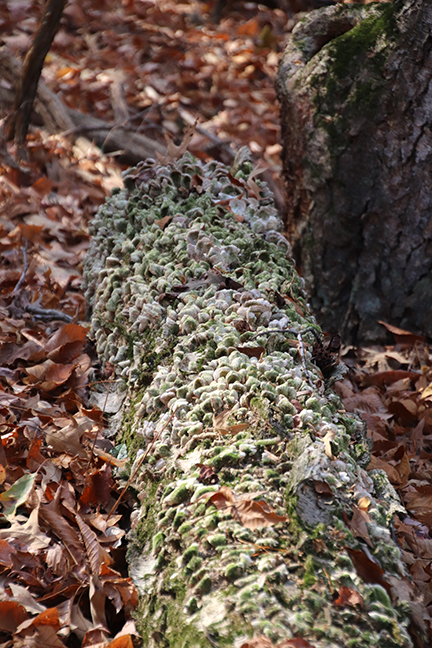
The answer to last week’s mystery is a nurse log, pictured in photo below:
A nurse log is a fallen tree that rests on the forest floor. It absorbs rain like a sponge, and provides water and nutrients for new growth. Decaying wood makes an excellent substrate.
When a tree dies, it contains protein, fats, resins, and waxes, as well as minerals. Woody plants contain huge amounts of energy, mostly in the form of cellulose. During composition, all of these become available to other organisms.
Ants, beetles, and other invertebrates tunnel through moist, decaying wood and feed upon it. They create
valleys and openings where a tiny seed, drifting down from where it was released tens or hundreds of feet up in the air, can settle in. The forest floor is partly covered by ferns, mosses, fallen leaves and needles. As a result, chances are not high that a seed will land on exposed soil needed for germination. Seeds that land on decaying wood have a better chance at germinating.
It often takes several decades for a nurse log to decay completely, at which time the seedlings’ roots have become strong enough to support themselves. A tree constantly contributes to the forest until nothing remains of the tree.
Mystery Monday is sponsored by the Spy Newspapers and Adkins Arboretum.

The Spy Newspapers may periodically employ the assistance of artificial intelligence (AI) to enhance the clarity and accuracy of our content.

Filed Under: Food and Garden Notes

Within Our Reach: Mixed Media Works by Bridget Z. Sullivan on view through Feb. 28 at Adkins Arboretum

January 5, 2025 by Adkins Arboretum Leave a Comment

Bridget Z. Sullivan’s exhibition Within Our Reach at Adkins Arboretum’s Visitor’s Center offers an evocative exploration of the natural world and its interconnectedness with human perception. On display through Feb. 28, the exhibit invites visitors to experience the quiet power of nature in new and profound ways. A reception to meet the artist will be held on Sat., Jan. 11, from 2 to 4 p.m.
Inspired by John Berger’s Ways of Seeing, Sullivan invites viewers to consider seeing not as a passive act but as an active, relational process. Sullivan’s work reflects her fascination with the relationships between what we observe and how we interpret it. Her use of archival pigment prints layered with acrylic, ink, oil pastel, and graphite creates rich, multi-dimensional surfaces. Her compositions’ dynamic textures and intricate details suggest the movement of plants as if they were shifting gently in the breeze, blurring the line between stillness and life.
In Within Our Reach, Sullivan’s distinctive style combines digital photography with traditional drawing techniques, blending the precision of the camera with the expressive qualities of hand-drawn marks. The layered media and textural contrasts create a sense of depth and vitality. This approach underscores the reciprocal relationship between nature and its observer, a theme that runs throughout her body of work.
Through her art, Sullivan highlights the profound connections between humans and the natural world, resonating with Adkins Arboretum’s mission to promote environmental stewardship and appreciation for the native landscape. Her work serves as both a reflection and celebration of the Arboretum’s commitment to fostering an understanding of the interconnectedness of all life.
Sullivan’s career spans solo and group exhibitions at venues such as Maryland Art Place, School 33 Art Center, and the University of Maryland Global Campus Art Gallery. A two-time National Park Service Artist-in-Residence and a recipient of multiple Maryland State Arts Council Individual Artist’s Grants, her work has been featured in AfterImage: Inklight and URHere Journal of Creative Geography. Since 2012, Sullivan has volunteered as president and curatorial director of the Hamilton Arts Collective | Hamilton Gallery in NE Baltimore.
This show is part of Adkins Arboretum’s ongoing exhibition series highlighting regional artists whose work engages with natural themes. The Arboretum, located at 12610 Eveland Road near Tuckahoe State Park in Ridgely, is a 400-acre native garden and preserve offering exceptional experiences in nature.
For gallery hours or more information, contact Adkins Arboretum at 410-634-2847, ext. 100, or visit adkinsarboretum.org.

The Spy Newspapers may periodically employ the assistance of artificial intelligence (AI) to enhance the clarity and accuracy of our content.

Filed Under: 6 Arts Notes

Adkins Arboretum Mystery Monday: Guess the Photo

December 30, 2024 by Adkins Arboretum Leave a Comment

Happy Mystery Monday!  Can you guess what is pictured in photo below:
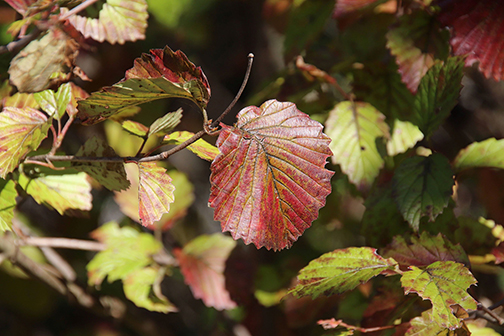
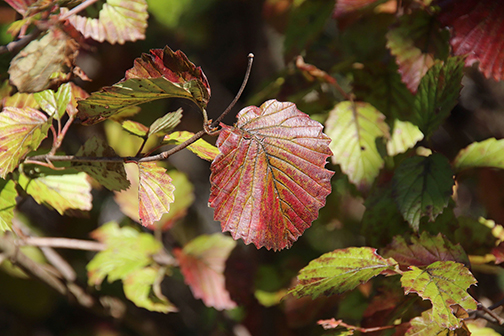
The answer to last week’s mystery is arrowwood viburnum, Viburnum dentatum, pictured below:
Viburnum is a genus of about 150-175 species of shrubs with simple leaves that are coarsely toothed or “dentate.” Viburnums tend to be multi-season plants with ornamental value throughout a large part of the season. Variable Fall color ranges from drab yellow to attractive shades of orange and red.
Arrowwood viburnum flowers in late-May to early-June. The more sun the shrub receives, the showier the flowers it will produce. Its flowers are arranged in flat-topped clusters and are not scented.
Arrowwood has gorgeous, dark blue–purple berries that, while not toxic, are not edible to humans. Birds, however, love the fruit.
This shrub tolerates being planted in shade or full sun, as well as both flooding and occasional drought. Arrowwood can be found along wood margins, open woods, stream banks, in moist floodplain forests, wet flatwoods, seepage swamps and even tidal and alluvial swamps.
The common name, arrowwood, is said to originate from the fact that Indigenous Peoples used the stems of the plant to make arrows. The Neolithic Iceman, Otzi, found frozen in the Alps in 1991, was carrying arrow shafts made from viburnum wood
Native viburnums are the host plants for many creatures, including the Spring azure butterfly. Arrowwood has no serious pests and is even tolerant of salt. Deer, disease, or insects usually do not bother them.
Mystery Monday is sponsored by the Spy Newspapers and Adkins Arboretum.
The Spy Newspapers may periodically employ the assistance of artificial intelligence (AI) to enhance the clarity and accuracy of our content.

Filed Under: Archives, Food and Garden Notes

Call for Artists: Adkins Arboretum to Sponsor 2025 Juried Art Show

December 24, 2024 by Adkins Arboretum Leave a Comment

Pantelis Of Water, Too are Grasses

Adkins Arboretum in Ridgely, Md., is seeking submissions for its annual Juried Art Show, to exhibit in March and April 2025. The theme of the show—Discovering the Native Landscapes of Maryland’s Eastern Shore—celebrates the Arboretum’s mission of conservation. The Leon Andrus Awards, named in honor of the Arboretum’s first benefactor, will be given for first and second places.

The show is open to original two- and three-dimensional fine arts in all mediums, including outdoor sculpture and installations. This year’s juror is Jason Patterson. His work on African American history focuses on the Black history of Maryland’s Eastern Shore. His work consists of portraiture, the recreation of historic texts and documents and the designing and building of ornate, period-appropriate wood frames for his portraits and documents.

The deadline for submissions is Jan. 17, 2025. Digital images of up to three pieces of art by each artist should be sent to [email protected]. Submissions should include title, medium, dimensions (maximum of 6 feet in any direction, excluding outdoor sculpture) and artist’s name, address and phone number. Works should reflect or interpret broadly the show’s theme of the wild nature and landscapes of the mid-Atlantic coastal plain region.

Artists whose work is selected will be contacted by Feb. 13 to submit the original work ready to hang by Feb. 27–March 1. The exhibit will run from March 4 to April 25, 2025, with a reception on Sat., March 29 from 2 to 4 p.m. There is no entry fee, but artists are responsible for all shipping expenses. Selected artists may be considered for future exhibits at the Arboretum.

The 2025 Juried Art Show is part of Adkins Arboretum’s ongoing exhibition series of work on natural themes by regional artists.


Adkins Arboretum is a 400-acre native garden and preserve at the headwaters of the Tuckahoe Creek in Caroline County. For more information, visit adkinsarboretum.org or call 410-634-2847, ext. 0.

The Spy Newspapers may periodically employ the assistance of artificial intelligence (AI) to enhance the clarity and accuracy of our content.

Filed Under: 6 Arts Notes

Adkins arboretum Mystery Monday: Guess the photo

December 23, 2024 by Adkins Arboretum Leave a Comment

Happy Mystery Monday!  Can you guess what is pictured in photo below?
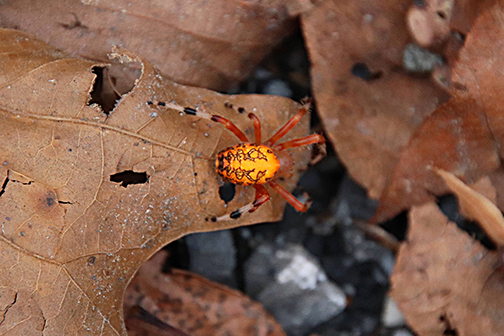
The answer to last week’s mystery is white marbled orbweaver, Araneus marmoreus, pictured in photo below.
Marbled orb weavers get their name from the mottling and spotting patterns found on their bodies. They can be found in residential landscapes, fields, and forests from Spring–late Fall in Maryland. They mostly eat smaller insects, which they capture in their vertically oriented webs. A “signal thread” running through the middle of their webs alerts the spider when prey is caught. Marbled orbweavers spin their web in the morning, and typically spend the day resting in a retreat off to the side of the web.
Mating for the marbled orbweaver takes place in mid–late Summer. Females mate once in their lives, while males may mate several times. Egg sacs, which contain several hundred eggs, are generally deposited in October. The female becomes shriveled late Fall because of lost body mass from laying her eggs.
Marbled orbweavers do not survive the Winter, so adults are not present to provide any sort of care when the spiderlings emerge the following Spring. Their average lifespan is six months.
There are no known adverse effects of marbled orbweavers on humans.
Mystery Monday is sponsored by the Spy Newspapers and Adkins Arboretum.
The Spy Newspapers may periodically employ the assistance of artificial intelligence (AI) to enhance the clarity and accuracy of our content.

Filed Under: Archives, Food and Garden

Adkins Arboretum Mystery Wednesday: Guess the photo

December 18, 2024 by Adkins Arboretum Leave a Comment

Happy Mystery Monday!  Can you guess what is pictured in photo below?

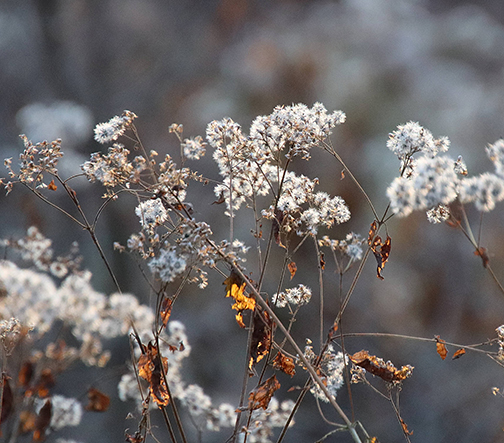
The answer to last week’s mystery is white snakeroot, Ageratina altissima, pictured in photo below:

White snakeroot is a perennial herb that is native to eastern and central North America. All parts of the plant are poisonous to most warm-blooded animals, including humans. When the plant is consumed by cattle, the meat and milk become contaminated with toxins, which, if consumed, can be passed on to humans. The poisoning is called milk sickness and can cause nausea, weakness, abdominal discomfort, and more.
The flowerheads of the wine snakeroot are arranged in loose, terminal, flat-topped clusters in white. Blooms appear from July to October. After blooming, small seeds with fluffy white tails are released in the wind.
White snakeroot is one of the last wild natives to flower, providing nectar late in the season to hungry insects, like bees, butterflies, wasps, moths, and flies.
This plant adapts well to different growing conditions. It is found in woods, brush thickets, and also in
shady areas with open bare ground. It can also be weedy in shady landscapes and hedgerows.
Mystery Monday is sponsored by the Spy Newspapers and Adkins Arboretum.
The Spy Newspapers may periodically employ the assistance of artificial intelligence (AI) to enhance the clarity and accuracy of our content.

Filed Under: Archives, Food and Garden Notes

Adkins Arboretum Mysery Monday: Guess the photo!

December 9, 2024 by Adkins Arboretum Leave a Comment

Happy Mystery Monday!  Can you guess what is pictured in photo below:
The answer to last week’s mystery is pokeweed, Phytolacca americana, pictured in photo #2.
Pokeweed is a native herbaceous perennial in the Phytolaccaceae family that grows 3-8′ high. It is found in riparian areas, oak woodlands, forest edges, fence rows, forest openings, pastures, under power lines, disturbed areas, cultivated fields, parks, and ornamental landscapes.
Common Pokeweed is a long-lived perennial and can survive for years. Their seeds can remain viable in the soil for up to 50 years! The plant has a thick fleshy taproot up to 12′ long and 4′ thick, making adult pokeweed difficult to remove.
The pokeweed’s white, clustered blooms first mature in early Summer and continue into early Fall. The flowers are born in a raceme that usually starts out erect and begins drooping as the fruit develops.
Pokeweed berries are green at first, turning glossy, dark purple. They leave a deep purple-red stain when crushed. The berries are poisonous to humans, containing chemicals that can damage red blood cells. The berries are, however, a favored food for migrating songbirds and a source of food for some mammals. These animals help to distribute the seeds far and wide.
Pokeweed is one of many hosts of the Giant Leopard Moth.
Pokeweed has an extensive history of being used as a food, medicine, herb, dye for clothing, ink for writing, colorant for wines, and much more.
Mystery Monday is sponsored by the Spy Newspapers and Adkins Arboretum.

The Spy Newspapers may periodically employ the assistance of artificial intelligence (AI) to enhance the clarity and accuracy of our content.

Filed Under: Food and Garden, Food and Garden Notes

  • « Previous Page
  • 1
  • …
  • 5
  • 6
  • 7
  • 8
  • 9
  • …
  • 17
  • Next Page »

Copyright © 2026

Affiliated News

  • Chestertown Spy
  • Talbot Spy
  • Cambridge Spy

Sections

  • Sample Page

Spy Community Media

  • Sample Page
  • Subscribe
  • Sample Page

Copyright © 2026 · Spy Community Media Child Theme on Genesis Framework · WordPress · Log in