MENU

Sections

  • Home
  • Education
  • Donate to the Centreville Spy
  • Free Subscription
  • Spy Community Media
    • Chestertown Spy
    • Talbot Spy
    • Cambridge Spy

More

  • Support the Spy
  • About Spy Community Media
  • Advertising with the Spy
  • Subscribe
March 10, 2026

Centreville Spy

Nonpartisan and Education-based News for Centreville

  • Home
  • Education
  • Donate to the Centreville Spy
  • Free Subscription
  • Spy Community Media
    • Chestertown Spy
    • Talbot Spy
    • Cambridge Spy
1A Arts Lead Arts Arts Portal Lead Arts Looking at the Masters

Looking at the Masters: Asters and Ravens

September 21, 2023 by Beverly Hall Smith Leave a Comment

“Bouquet of Asters” (1859)

If you were born in the month of September, your birth flower is the aster. Its name is derived from the Greek word for star because the bloom is star-shaped. The virgin goddess Astraea believed there were not enough stars in the sky. She wept, and asters sprouted where her tears fell. Asters are symbolic of love, justice, innocence, wisdom, and faith, and they were used, to decorate altars to the gods. References to Astraea can be found in the works of Shakespeare, Dryden, Milton, and Browning, and the American author Ralph Waldo Emerson. Ovid (8 CE) tells the story that Astraea abandoned Earth during the Iron Age because of the wickedness of the people, and she ascended into heaven as the constellation Virgo. Thus, asters are an illustrious flower.  

“Bouquet of Asters” (1859) (18.5”x24”) was painted by the French artist Gustave Courbet (1819-1877), who is credited with starting the Realist movement. In 1851, Courbet exhibited two very large paintings. One “The Burial at Ornans” (10’4’’x 21’8’’) depicted the funeral of a common person on a dark and dreary day. Its subject and size scandalized the art viewing public. This lower-class subject was his initial foray into Realism. His interest in painting flowers was caused by a brief visit to his friend’s estate where he encountered extensive gardens and a greenhouse. Enchanted by the flowers, he painted several works during his visit. In this casual bouquet, Courbet has included asters of all colors: pink, red, white, lilac, and mauve. Although he was not thinking about the meaning of the different colors, as did the Victorians, he included several white and pink asters to center the composition. White and pink represent innocence, purity, and love. The red asters represent passion and love. The purple asters represent admiration and dignity, and the lilac asters represent faithfulness. 

Courbet included several other flowers, knowing that they did not all bloom at the same time but added variety of shape and color. The realist in his nature did not permit him to place the flowers in a fancy setting. A common clay jug and simple dish that could be found in homes of the common people are arrangement on a well-worn wooden table. One of Courbet’s unique painting techniques was to use a palette knife to apply the paint, adding a rough texture to the work. He used the palette knife to create some of the petals of the yellow and orange flowers, the clay jug, and the table.

“Asters” (1880)

“Asters” (1880) by Claude Monet illustrates the contrast in style between Courbet’s Realism and Monet’s Impressionism. Monet’s brushwork is obvious in each of the petals. The star shape is apparent, but the specific colors of the asters dissolve into a riotous profusion of dashes of yellow, purple, orange, blue, red, and green. The Impressionists preferred the colors of the rainbow. Monet has also included white and black in the bouquet. In Impressionistic fashion, he also created the wall behind the flowers with the same colors rather than the black background of Courbet’s work. Monet’s vase, also created using the same color palette, appears to be porcelain, and the wooden table has been given a very polished surface and decorative rounded edge.

“Elijah Fed by Ravens” (early 20th Century)

If you were born between September 22 and October 22, your Native American animal totem is the raven, a symbol of intelligence, foresight, a bearer of magic, and a messenger.  Throughout history ravens have held a special place in religion and myth. In the Old Testament there are eleven mentions of the raven, the first in Genesis 8:7 when Moses sent a raven to see if the flood waters had receded. The raven went out and came back several times until it did not return because it found land. “Elijah Fed by Ravens” (early 20th Century) (26’’x16’’) (SAAM) depicts the story in Kings 17:2-6:  God sent ravens to feed Elijah while he was hiding in the desert from the evil king. In this carved wood panel, two black ravens supply Elijah with bread and meat. This work falls into the vague category of folk or primitive art created by an untrained artist. The work has simple shapes, a unique interpretation of trees, and like all folk or primitive art, touches that intangible experience that speaks to viewers. 

Ravens hold a major place in Norse mythology. “Odin Enthroned and Flanked by His Ravens Huginn and Muninn” (1882) is an illustration for the 13th Century Poetic Edda, the first written version of the Norse saga. Carl Emil Doepler (1824-1905), a German illustrator, painter, and costume designer, illustrated episodes for the Prose Edda in 1882. The entire title is Odin enthroned holding his spear Gungnir, and wolves Geri and Freki flanked by his ravens Huginn and Muginn. Odin is the one-eyed All-Father of Norse legend who sacrificed one eye in order to be able to see everything that occurs in the world. Odin made the ravens Huginn (old Norse for thought), and Muginn (old Norse for memory) his messengers. He gave them the ability to fly over the world quickly, to understand any language they heard, and to return to him as messengers. The ravens were considered intelligent, and they gave excellent advice and represented a source of power. In battle, ravens feeding on dead warriors was considered a sacrifice to Odin and a means to enter Valhalla. Odin also was known as “the raven god.”

Carl Emil Doepler created the costumes for the premier presentation of Wagner’s Der Ring des Nibelungen at the Bayreuth Festival in 1876. The festival was Wagner’s idea; he wanted it to be in a small town where the viewers could concentrate more on the opera than anything else.  The keystone was laid on May 22, 1872, Wagner’s 59th birthday. The opening performances of The Ring took place from August 13 to 17, 1876.

“The Raven and the First Men” (1980)

In the Native American Haida culture, the story of Raven starts with the beginning of humankind. Raven was alone, but one day on Rose Spit beach, on Haida Gwaii, Ravan found an extraordinarily large clamshell with noise coming from inside it. Several small creatures were trying to emerge from the shell. Raven encouraged them to come out and to see the world. After a bit of time, overcome by curiosity, they came out of the partly opened clamshell and became the Haida men. After that, Raven helped the Haida to find fresh water, salmon, and to build fish traps. He also found small chiton shells (a marine mollusk), which he opened to find small women inside. After he introduced them to the men, they followed the normal path of life. Raven was never lonely again.

“The Raven and the First Men” (1980) was carved by Canadian Bill Reid (1920-1998).  His mother was descended from the Tanuu, Haida Gwai, and his father was American. Reid’s Haida name was Yaahl Sqwansung, The Only Raven. Reid was a multitalented artist, writer, and broadcaster, who fully turned to creating art in1952, adapting Haida designs. In 1973, Vancouver industrialist Walter Koerner commissioned Reid to make a large version of his “The Raven and the First Men.” The sculpture is carved from a laminated yellow cedar block (6’2’’x6’4”) that took over a year to properly combine and dry for carving. Reid and his assistants began to carve the block in the fall of 1978. It was unveiled and dedicated on April 1, 1980, by Prince Charles. The Bank of Canada issued a $20 bank note depicting “The Raven and the First Men” (September, 2004) as part of the Canadian Journey series to recognize and celebrate Canada’s history, culture, and achievements. Reid is considered to be one of the most significant Canadian artists of the 20th Century.

Ravens are thought to be intelligent and resourceful by all cultures. They are also considered tricksters who can be harmless, heroic, cruel, or selfish. Charles Dickens had many household pets, three of which were ravens, all named Grip. The ravens pecked at his children and pets and stole their food. A raven named Grip is a main character in Dickens’s Barnaby Rudge.  Ravens lived in the Tower of London in England, one of them named Grip. The legend says that if the ravens ever leave the Tower of London, the kingdom and the Tower will fall. One of Grimm’s fairytales is titled The Seven Ravens.  Lewis Carroll’s Mad Hatter poses the question at the tea party, “Why is a raven like a writing-desk?” Paul Gauguin titled a painting “Nevermore” (1897) that depicted a dreaming woman watched over by a raven.

“Once upon a midnight dreary”

Finally, a Maryland contribution: Edgar Allen Poe’s “The Raven” (1845) has been illustrated many times. French artist Gustave Dore created between 20 and 30 drawings for the publication of The Raven just before his death in January 1883. The drawings were turned over to Harper and Brothers in New York City, and 14 master engravers translated the drawings onto steel plates. The 10,000 copies with 26 engravings each were advertised as a Harper and Collins Christmas gift book costing $10. Dore’s work received high praise and Poe’s poem sold exceedingly well.

After a competition to name a football team and after more than 100 names were entered, a football team was named the Ravens in 1996 after the famous Baltimore poet’s poem.

Note: Looking at the Masters writer will be on vacation next week.

Beverly Hall Smith was a professor of art history for 40 years.  Since retiring with her husband Kurt to Chestertown in 2014, she has taught art history classes at WC-ALL. She is also an artist whose work is sometimes in exhibitions at Chestertown RiverArts and she paints sets for the Garfield Center for the Arts.

The Spy Newspapers may periodically employ the assistance of artificial intelligence (AI) to enhance the clarity and accuracy of our content.

Filed Under: 1A Arts Lead, Arts Portal Lead, Looking at the Masters

Looking at the Masters: Charles Ephraim Burchfield

September 13, 2023 by Beverly Hall Smith Leave a Comment

Charles Ephraim Burchfield (1893-1967) brought American art to a new level. His work did not fit into any existing category but was a style of modern art not seen before. He was born in Ashtabula, Ohio, but after his father died in 1898, his mother and he moved to Salem, Ohio. While a junior in high school, he was determined to make a record of all the flowering plants in the area. Constantly sketching and painting, he kept a journal of his thoughts and ideas. He said he was “gathering the material for a lifetime.” He was valedictorian at his high school class graduation in 1911. His interest in art was well established by that time. After graduating from the Cleveland Institute of Art in1916, he was awarded a scholarship to attend the National Academy of Design in New York City. He left the Academy one day after attending a life drawing class, and he returned to Ohio.

“Song of the Katydid on an August Morning” (1917)

Burchfield drew upon recollections of life in eastern Ohio: “There gradually evolved the idea of recreating impressions of that period, the appearance of houses, the feelings of woods and fields, memories of seasonal impressions….” “Song of the Katydid on an August Morning” (1917) (18’’x22’’) (watercolor, gouache, colored chalk, pastels) is one of the 400 watercolors and drawings Burchfield would complete over the next few years.  He later called this period his “Golden Years.” An accomplished artist, Burchfield was equally at ease with traditional landscape, still-life, and portrait subjects, but landscape was his principal choice. His sensitivity to the sounds of nature, the poetry he heard and felt, the colors that sprung to life in his mind, and the emotions he felt, shaped his uniquely personal style. 

Writing in his journals and on the backs of his paintings, he offers the viewer insight into his work. “Song of the Katydid on an August Morning” depicts, in his words, “a stagnant August morning during the drought season, as the pitiless sun mounts into the mid-morning sky, and the insect chorus commences, the katydids and locusts predominating. Their monotonous, mechanical, brassy rhythms soon pervade the whole air, combining with the heat waves of the sun, and saturating trees and houses, and sky.” 


“Cricket Chorus in the Arbor” (1917)

“Cricket Chorus in the Arbor” (1917) (22’’x17.5’’) (watercolor, brush and ink, wax crayon) is typical of Burchfield’s work. He was primarily a watercolorist, but he added other media for effect.  He described his choice of watercolor in his journals: “I like to be able to advance and retreat just like a man writing a book. I doubt that very few of them ever sit down and leave a paragraph as it first comes into their head. They work over it, delete things and add things. Well, I feel that I like to do that just as they do. Or as a composer does. I mean you start a picture and I don’t know how it is going to turn out. I think I know what I want to do but, when I put it down it’s not right and it’s got to be changed. I have to find out where the idea wants to go.” 

Burchfield knew and recognized the sounds of various insects and developed a type of artistic shorthand to define those sounds: “I noticed the brilliant yellow sunlight at noon–following a clear morning–a solitary katydid, at times, while at noon the cicadas charm me. Crickets are notorious for chirping nonstop in the evenings.” 

“The Insect Chorus” (1917) (20’’x16’’)

Burchfield painted the same subject over and over, each time changing the image to create another interpretation of that same subject. He described “The Insect Chorus” (1917) (20’’x16’’) (opaque and transparent watercolor, graphite, and crayon): “It is late Sunday afternoon in August. A child stands alone in the garden listening to the metallic sounds of insects. They are all his world, so, to his mind, all things become saturated with their presence–crickets lurk in the depths of the grass, the shadows of the trees conceal fantastic creatures, and the boy looks with fear at the black interior of the arbor, not knowing what terrible thing might be there.” Burchfield said ‘‘terrible things that might be there’’ perhaps because of the recent discovery that mosquitoes transmitted yellow fever and malaria. 

The trees and ferns are drooping as a result of the sweltering heat; their colors are dull green and beige, and their black trunks and branches are distorted. The rounded arbor is a sickly yellow-green, and the entrance to the arbor is a black hole. The V-shapes are the jumping crickets. Burchfield wrote that the crickets’ chirping is a ”high shrill pin-point cricket chorus.” 

Burchfield served in the US Army’s camouflage unit, using his painting skills to hide tanks and artificial hills. He was honorably discharged in 1919. He designed wall paper at M.H. Birge & Sons from 1921 until 1928.  He married in 1922, had five children, and lived in West Seneca, New York until his death in 1967. Life Magazine named him one of America’s 10 greatest painters in 1926. Beginning in 1929, he was represented by the Frank Rehn Gallery in New York City.  Commissions, sales, and teaching positions in several universities supported his family from 1928 onward.  Election in 1954 to the National Academy of Design in New York was among the many acknowledgements he received during his career.

“Wild Geese and Poplars” (1956)  


He wrote about “Wild Geese and Poplars” (1956) (39’’x26.5’’) (watercolor) in his journal on October 18,1956: “About mid-morning a flight of wild-geese going straight south–As they passed by the poplar trees an extra hard puff of wind scattered leaves over the sky–The sight and sound of wild geese affects me in a way that is hard to understand–My heart begins to pound, and breathing is difficult–It is an elemental event.” Popular trees lined one side of his garden. He worked on the sky for most of the day, but he recognized that the “wild geese cannot be put in without disturbing the sky–which is more important?” He made at least two versions of the subject. The subject would seem to be a simple one, but with only a few strokes of his brush, Burchfield captured the essence of this moment in time.

The Charles E. Burchfield Center at Buffalo State College was opened in his honor in1966.  His paintings can be found in over 109 museums in the United States and Europe. Burchfield’s watercolors are his distinctive response to nature through all seasons of the year: “Often I say to myself, ‘This is the best time of the year.’ I say it every day the year thru. And it is true. Every season is the best. I cannot conceive of a true lover of nature despising winter but liking summer or vice versa.”

Beverly Hall Smith was a professor of art history for 40 years.  Since retiring with her husband Kurt to Chestertown in 2014, she has taught art history classes at WC-ALL. She is also an artist whose work is sometimes in exhibitions at Chestertown RiverArts and she paints sets for the Garfield Center for the Arts.

The Spy Newspapers may periodically employ the assistance of artificial intelligence (AI) to enhance the clarity and accuracy of our content.

Filed Under: 1A Arts Lead, Looking at the Masters

Looking at the Masters: Jean Francois Millet

September 7, 2023 by Beverly Hall Smith Leave a Comment

Born into a prosperous peasant family, Jean Francois Millet (1814-1870) had a good education, and because of his artistic talent he was admitted to the Ecole des Beaux-Arts in Paris. He began his career as a portrait painter. His early paintings were accepted by the Paris Salon, but his work was rejected in 1843. He moved with his wife to Le Havre, a harbor town at the mouth of the Seine. They had nine children. He became friends with the painters Theodore Rousseau, Constant Troyon, and Honore Daumier, among others. By 1849, the group had moved to the village of Barbizon in the Fontainebleau Forest.

France was experiencing two revolutions: the Industrial Revolution and a political revolution. Inventions included sewing machines, mechanized looms, and mechanical reapers. Production of wool and cotton cloth for clothing was a major source of income for the rural peasant beyond the production of food. The faster production of cloth caused numerous factories to be built on the outskirts of Paris, resulting in a mass migration from the farm to the city. The 1848 political revolution created chaos and fighting in the streets killed tens of thousands.

“The Sower” (1850)

Smoke from trains and factories began to fill the Paris air. Barbizon was an undisturbed rural village where artists could paint unpolluted nature. “The Sower” (1850) (40’’x33’’) (Museum of Fine Arts, Boston) is one of Millet’s first paintings made in Barbizon. His farm upbringing, discussions with Daumier and others about the poor conditions of laborers in France, and his earnest concern for his hardworking Barbizon neighbors influenced his choice of subject matter. While other Barbizon painters concentrated on the unspoiled landscape, Millet focused on the people: “The human side of art is what touches me most.” Millet’s Sower is monumental in scale. He walks vigorously under the twilight sky sowing winter wheat. His legs are wrapped in straw for warmth, his hat is pulled down across his face, hiding his face. He clutches the sack of seeds in his left hand, and he uses his right hand to fling the wheat seeds onto the plowed earth. In the distance a farmer driving two oxen that pull the harrow to cover the sown seeds.

“The Sower” was immediately a source of criticism at the 1850 Salon. To the majority of Parisiens, the painting was ugly and crass, and it depicted the part of society to which they felt superior, the rural poor who offended and disgusted them. Art critic Theophile Gautier said the paint looked like “trowel scrapping.” Few recognized “The Sower” as a work that depicted the dignity of hard work. Millet wanted to show the heroism of the common man. He presented the Academy, the government, and the upper and middle classes of France with a radical social realism that had not been seen before.


#2 “Woman Baking Bread” (1854)

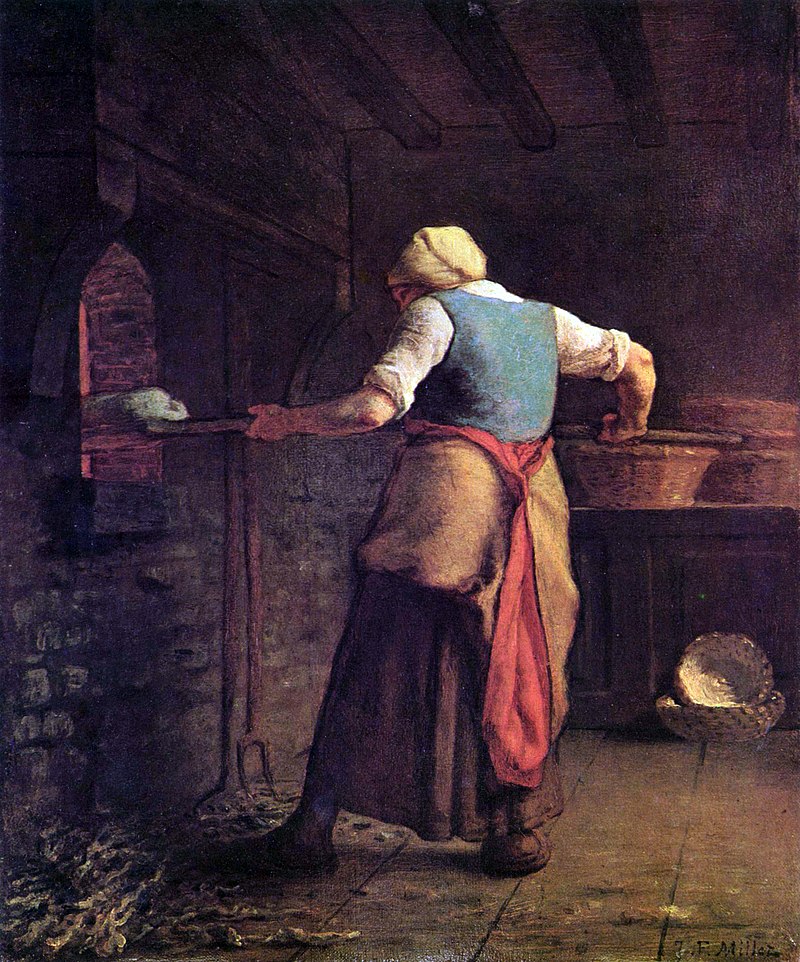
Millet continued to paint male and female laborers: shepherds tending their flocks and peasants pushing wheelbarrows, cutting timber, haymaking, carding wool, digging potatoes, knitting, mending, and occasionally resting from their labor. “Woman Baking Bread” (1854) (22”x18’’) depicts a sturdy peasant woman putting a loaf of bread into the oven. The house is made of stone with wide wood plank floors. Dark timber beams support the ceiling. Several handwoven baskets are stacked along the wall. Earlier genre paintings, scenes of ordinary life, depicted clean and tidy houses with simple but comfortable furniture and clean people engaged in less strenuous activity. In “Woman Baking Bread,” the woman is hard at work, her clothes are rough, the house is dark, the floor is messy, stacks of empty baskets are scattered about, and next to the oven are a rake and pitchfork used for work in the field.

“The Gleaners” (1857)

Fortunately, Alfred Sensier, a government bureaucrat admired Millet’s peasant paintings, and he offered in 1850 to provide Millet with materials and money in return for some of his drawings and paintings. Sensier’s support allowed Millet to continue his chosen theme. He also could sell work to other buyers. “The Gleaners” (1857) (33”x44”) was exhibited in the Salon of 1857. Gleaners were the poorest of peasants, and by law they were allowed to glean the leftovers after crops had been harvested. Critics at the time considered this painting to be subversive, an affront to the middle and upper classes, and the cause of extremely discomfort to the general public. French art critic Paul de Saint Victor wrote, “His three gleaners have gigantic pretensions; they pose as the Three Fates of Poverty…their ugliness and vulgarity have no relief.” The public agreed with Adam Smith’s laissez-faire economics; these people were responsible for their own misery.

The subject of “The Gleaners” are three poor women of undetermined age, doing grueling work in order to feed themselves and their families. Central to the composition, the farthest figure reaches down as she spots some grain, the middle gathers a handful of grain from the ground, and the closest is about to bend over, a motion repeated again and again. In the distance, several tall stacks of newly harvested wheat provide contrast to the poor pickings left for the gleaners. The rider on a brown horse likely is the overseer for the estate owner. He watches the gleaners to make sure they obey the rules and take only what is allotted to them.

Millet was accused of preaching radical political ideas and of exaggerating the social and economic hardships of the peasants. At the time, the socialist movement was taking hold. Engels’s and Marx’s The Communist Manifesto was published in 1848. In a review, Charles Baudelaire, French poet, and literary and art critic wrote, “His peasants are pedants who think too highly of themselves. Instead of simply extracting the natural poetry from his subject, M. Millet is desperate to add something to it.”‍


“Shepherdess with her Flock” (1864)

The 1860’s saw a change in Millet’s popularity. He was commissioned to paint 25 works and given a monthly stipend for the next three years. Emile Gavet, an art dealer and collector, commissioned Millet to make pastel drawings in 1865. They eventually numbered 90 works. Gavet also introduced Millet’s paintings to American buyers. “Shepherdess with her Flock” (1864) (32”x40”) had been an idea Millet had for a painting since 1862. His patron and friend Sensier recalled that the idea “had taken hold of him.” When it was shown in the Salon of 1864, it was called “an exquisite painting” and “a masterpiece.” The painting was awarded a Salon medal, and the government wanted to purchase it. However, it already was promised to a collector.

“Shepherdess with her Flock” depicts a young shepherdess quietly praying in a peaceful evening landscape. She is not a giant figure, nor is she dressed in rags. Her dress in thick and heavy enough for the weather. Her shawl with a fur collar has a decorative pattern, and her red woolen scarf fits snugly over her hair and wraps around her neck. She appears to be saying the rosary. Her flock of sheep is large, gathered together peacefully eating grass. Her loyal dog watches from the right. The sun is beginning to set across the panoramic landscape, and its rays cast a golden glow through the opening in the clouds. Millet’s strong Christian faith is evident. Quietly grazing sheep have long been a reference to the Good Shepherd watching over His flock. The general public preferred this pastoral painting over those of Millet’s rough, grubby peasants. Millet thought of this painting as true to life, depicting the dignity of the hard-working peasant class.

French sentiment was changing. Millet was given a major showing of his paintings in the 1867 Exposition Universelle. In 1869, he was named a Chevalier de Legion d’ Honneur, and in 1870, he was elected to be a member of the Salon jury. A posthumous retrospective at the Ecole des Beaux-Arts honored Millet. His work was considered part of the French national heritage. All past criticism of his radical work was done. His influence on future artists was significant. Van Gogh considered him an “essential modern painter who opened the horizons to many.” In 1890, in a letter to his sister, Van Gogh wrote; “Millet! Millet! How that fellow painted humanity and the ‘something on high,’ familiar and yet solemn. To think that that fellow wept as he started painting.”

“I was born as a peasant and shall die as a peasant.” (J.F. Millet)

Beverly Hall Smith was a professor of art history for 40 years.  Since retiring with her husband Kurt to Chestertown in 2014, she has taught art history classes at WC-ALL. She is also an artist whose work is sometimes in exhibitions at Chestertown RiverArts and she paints sets for the Garfield Center for the Arts.

The Spy Newspapers may periodically employ the assistance of artificial intelligence (AI) to enhance the clarity and accuracy of our content.

Filed Under: 1A Arts Lead, Arts Portal Lead

Looking at the Masters: Gladiolas and Bears

August 31, 2023 by Beverly Hall Smith Leave a Comment

Bouquet of Gladiolas, Lilies, and Daises” (1878)

If you were born in the month of August, your flower is the gladiola. It symbolizes strength of character, victory, and pride. It was named after the gladius, the sword used by Roman legions and gladiators, because of the flower’s tall stalk and the pointed petals. The gladius had a sharp pointed blade, 30 to 33 inches long, double-sided and two inches wide, and two pounds in weight. It was excellent for the close hand-to-hand combat. 

“Bouquet of Gladiolas, Lilies, and Daisies” (1878) (32.5’’ x 24.5’’) is by Claude Monet. He moved with his wife and son to Vetheuil, a small village 37 miles from Paris because he could not afford to live in Paris. His flower paintings appealed to a wider audience. From 1878 until 1881, his reputation grew and his commercial success increased with the backing of Parisian art dealer George Petit, who brought Monet’s work to the attention of the Parisian art market. 

The red and white gladiolas are placed with an unruly bunch of daisies to create a casual bouquet. Two white lilies center the composition. The white oriental vase and the colorful patched cloth on the table add to the rich color palette of the canvas. Monet’s choice of soft blue for the wall behind the vase and bouquet has a calming effect. Complementing the colors and shapes of the flowers and greenery, the round vase has two handles and two visible feet, and it is decorated simply with the colors in the painting.

“Vase with Red Gladiolas’’ (1886)

“Vase with Red Gladiolas’’ (1886) (26’’x16’’) is by Vincent Van Gogh. Van Gogh had the opportunity in 1886 to see the fifth Exposition Internationale of works by the Impressionists. His first impression was the works were “careless, ugly, badly painted,” but by the autumn of 1886, he wrote, “I have much admired certain Impressionist pictures–Degas, nude figures–Claude Monet, landscapes.” Although the two never met, Monet’s landscape “Tulip Fields” (1886), in the Exposition, is considered to have been a strong influence on Van Gogh’s work. The intense color of the tulips, painted with a thick impasto, were very different from Van Gogh’s then current style that followed Dutch painting, with its realism and earth tones. 

The colors, including those of the red gladiolas, are potent, and the brush work is vigorous. Van Gogh’s red gladiolas, symbols of the intense passion and strength of the gladiator, are powerful. In the rich green background, the two complementary colors red and green, have been used to best advantage. The green and white pattern of the vase, the pop of white flowers, the brick wall, and the rich wood tones of the table, would become the style that made Van Gogh famous.


Zuni Bear Totem


If you were born between August 22 and September 21, your Native American Totem Animal is the bear. The bear is the guardian of the West. Bears are symbols of strength, vitality, courage, and health, to name a few. Bears are considered the ultimate protectors, and many tribes always carry the bear symbol to keep the powerful spirit of the bear with them. One example is the Zuni Bear Totem (3.35’’x 1.5’’), a fetish carved by Bernard Homer, Jr., grandson of a famous Zuni fetish carver and follower of a long tradition of carvers. 

The bear carries a medicine bundle with turquoise, coral, a mussel shell arrow head. The bear has inlaid coral eyes. Turquoise, a popular stone with Native Americans and with ancient cultures around the world, brings good luck. Its bright blue color is the color of a clear sky. Coral has a long history as a symbol of the ocean. To native Americans it represents the lifeblood of Earth Mother. Coral and turquoise represent the unity of the earth and water. A valued food source, mussels live in both fresh and salt water. Mussels were a part of the sacred water world. The arrowhead represents courage and determination, important human characteristics for a successful hunt.

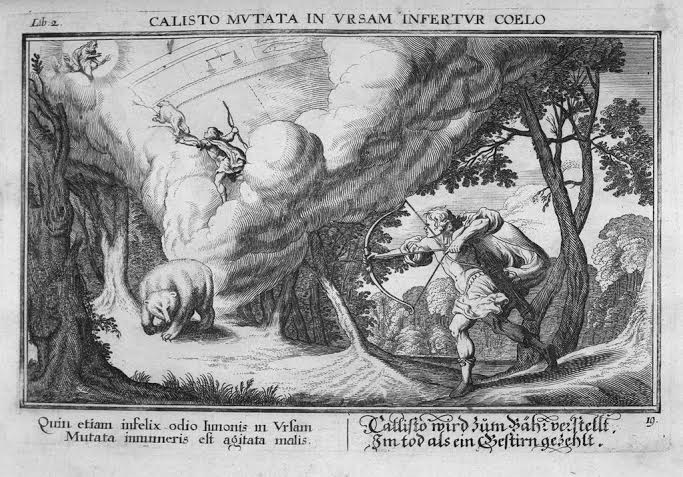
The bear has been a symbol in ancient cultures such as China, India, and Greece. The constellations Ursa Major and Ursa Minor, also known as the Big Dipper and the Little Dipper or the Big Bear and the Little Bear, combined are the largest constellation in the northern sky. In the Greek myth of Callisto,

Zeus, married to Hera, had a roving eye and seduced many beautiful women. When Hera discovered his relationship with the nymph Callisto, she changed Callisto into a bear made to roamed the earth and hunted for 15 years.  Johann Wilhelm Baur’s etching “Callisto Hunted by Arcas” (1639) (Metamorphosis,1639) depicts the conclusion of the myth. By chance, Callisto’s son Arcas came upon her in the forest, and not recognizing her, drew his sword to kill the bear. Zeus, seeing this from above, swept down as a whirlwind and set them in the sky as the constellations Ursa Major and Minor. Callisto could watch over her son forever.

One of a bear’s most important strengths was its nurturing and protective nature. The Chippewa, Creek, Algonquian, Huron, Hopi, Cheyenne, and others tell several versions of the bear’s nurturing and supernatural healing powers. The tales tell of the bear’s mysterious power to heal itself and to teach others how to heal. Bears are considered spirit guides, and they are closely related to tribal shamans and figure in long-practiced rituals. 


The cartoon by political cartoonist Clifford Berryman was first seen in the Washington Post on November 16, 1902. He was inspired by newspaper stories about President Theodore Roosevelt, a well-known big game hunter. While on a bear hunt, he could not find a bear to shoot. Some of the men with him found a young black bear and tied it up for the kill. Roosevelt refused to shoot it, to do so was unsportsmanlike. Berryman’s cartoon caught the attention of Morris Michtom, a toymaker. With the President’s approval, he started selling “Teddy Bears.” Roosevelt created the United States Forest Service, five National Parks, and conserved over 230 million acres of land.

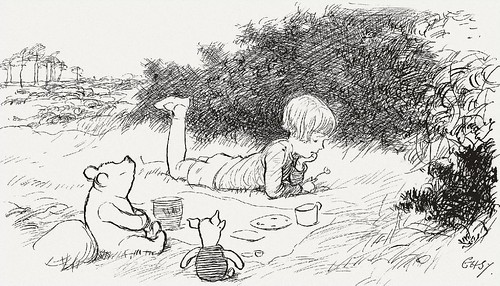
“Christopher Robin, Winnie the Pooh, and Piglet” (1926)

The story of bears continued in the London Evening News in 1925, as a children’s Christmas story with writer A.A. Milne and illustrator E.H. Shepherd. Milne bought a teddy bear for his son Christopher Robin Milne for Christmas from Herod’s Department Store in London. Christopher named his bear Winnie after a Canadian black bear he saw at the London Zoo. The Canadian black bear was a gift from Canadian Lieutenant Harry Colebourn, who purchased the cub while in Canada on his way to England during the First World War. He named the bear ‘Winnie” after his adopted hometown of Winnipeg. Winnie, a female bear, was a popular attraction. Pooh was the name of Christoper’s friend’s swan. Winnie the Pooh was drawn by Ernest Howard Shepherd, an illustrator at Punch Magazine. His drawing was inspired by his son’s teddy bear named Growler. The book Winnie-the-Pooh was first published in 1926.

“Paddington Bear” (1958)

The book A Bear Called Paddington first appeared on October 13, 1958. The book was written by British author Michael Bond and illustrated by Peggy Fortnum. Bond was inspired by a solitary teddy bear on a shelf in a bookstore near Paddington Station on Christmas Eve1956. He bought it for his wife. The inspiration for the story came during his observation of Jewish refugee children and London children who were sent to the country for safety during World War II. The children wore signs saying “Please look after this child.” Bond wrote the first story in ten days. Peggy Fortnum was commissioned to make black and white drawings for the book.

Peggy Fortnum, born in north London in1919, always wanted to be an artist, and she enrolled in art school in 1939. However, she could not stay out of the War after witnessing the bombing of London in 1940. She was a member of ATS, the women’s branch of the British Army. After a long recovery from a war injury, she returned to art school and went on to became an art teacher, painter, textile designer, and book illustrator. To be as accurate as possible, she went to the London Zoo and sketched and photographed Malayan black bears. “At the beginning, I wasn’t sure of the anatomy,” she wrote. “I wasn’t sure what to do with his paws…It takes an age to get it right.” Bond said of Fortnum, “She thought very highly of Paddington, as I did of her. It was a happy combination.”

Smokey Bear’s first appearance on a Forest Fire Prevention campaign poster, in 1944.

In 1942, a Japanese submarine attacked a southern California oil field next to the Los Padres National Forest. The War Advertising Council created a campaign to warn of the dangers of forest fires. On August 9, 1944, Smokey the Bear became the mascot of the U.S. Forest Service. He was drawn by the then popular animal illustrator Albert Staehle, and named after Smokey Joe Ryan, a famous New York City Fire Chief. After a discussion about Smokey’s image needing to be family and child friendly, officials selected the image of gentle bear holding a can of water and putting out a fire. Staehle designed the next two Smokey posters. During his career he drew 25 Saturday Evening Post covers, illustrated for the American Weekly, and created popular animal logos for products. Billboards using his popular animal images could be seen all over America.

Just one more bear story. In the spring of 1950, a fire in the Capitan Mountains of New Mexico left a badly burned bear cub clinging to a tree. Firefighters found him and named him Smokey. Smokey was given a home at the National Zoo in Washington, DC, and he became a popular resident and a national symbol of conservation and fire safety. When he died in 1976, his remains were taken back to Capitan, New Mexico, and buried in the State Historical Park.  

Beverly Hall Smith was a professor of art history for 40 years.  Since retiring with her husband Kurt to Chestertown in 2014, she has taught art history classes at WC-ALL. She is also an artist whose work is sometimes in exhibitions at Chestertown RiverArts and she paints sets for the Garfield Center for the Arts.


The Spy Newspapers may periodically employ the assistance of artificial intelligence (AI) to enhance the clarity and accuracy of our content.

Filed Under: 1A Arts Lead, Looking at the Masters

Looking at the Masters: Ravenna

August 24, 2023 by Beverly Hall Smith Leave a Comment

By the 3rd Century CE, the Roman Empire was in decline largely as a result of civil wars and barbarian invasions. However, Christianity was taking hold despite Roman persecution.

Romans cremated the remains of their citizens, but Christians did not. In order that members’ bodies could be buried together in consecrated ground, the Christians asked for and were granted land outside the city for cemeteries. As more people converted to Christianity, more space for burial was required, and it became necessary to dig deeper into the earth for tombs. Painting on plastered walls of catacombs began in the 3rd Century as the Christian community drew in more, and wealthier, members. Images were drawn from classical Greek art. For example, the strong man figure of Hercules was depicted holding a sheep, a reference to a good shepherd. Scenes were drawn mostly from Old Testament salvation stories: Jonah saved from the whale or Shadrack, Meshack, and Abednego alive and well in the fiery furnace. Human figures in early Christian catacombs were painted crudely and in earth tones.

Mausoleum of Galla Placidia, Ravenna (425-450 CE)

Constantine the Great, who reigned from 306 until 337 CE, declared Rome to be Christian in 312 CE. He took the title Holy Roman Emperor and moved the capital from Rome to the Greek city of Byzantium, renaming it Constantinople in 330 CE. During the reign of Emperor Honorarius (395-420 CE), the official capital in the west was Ravenna, not Rome. Galla Placida, daughter of Honorarius, was made regent of Ravenna until her six-year-old son Valentinian reached age eighteen. She built the Mausoleum of Galla Placida to hold her sarcophagus and those of her father, husband, and son. The Mausoleum, made of unadorned brick outside, is in the shape of a cross created by two barrel vaults that meet in the center to form a dome.

“St Lawrence”

The mosaic decorations inside the Mausoleum represent a new phase in Christian art. Richly colored mosaics decorated the interiors of the new buildings in Ravenna, inspired by the mosaics of Byzantine Greece. The walls and floors were covered with multicolored marble slabs and cut marble inlays. The ceiling vaults were covered with deep blue mosaics to resemble the starry heavens. The Mausoleum was dedicated to St Lawrence, and the mosaics depict him clothed in white, carrying a large open Gospel book and a large gold cross. For the first time he wears a large gold halo. Introduced into Christian art, the halo identified members of the Holy Family and the saints. Lawrence, a Christian deacon in the 2nd Century CE, was responsible for giving alms to Rome’s poor, widows, and orphans. When Pope Sixtus II was executed in Rome, Lawrence sold church treasures and gave the money to the poor. For this offense against the Church, a large grill was made, and Lawrence was put on it and burned to death. The figure of St Lawrence is always seen with a grill. The chest with the open doors holds the four gospels labeled Matthew, Mark, Luke, and John. Lawrence is the patron saint of the poor and of cooks.

“Christ the Good Shepherd”

At another end of the cross-shaped building is the mosaic “Christ the Good Shepherd.” The figure of the good shepherd was popular, but its identity as the figure of Christ was just beginning to be accepted. In Ravenna, for the first time, the Christ figure is dressed in a golden robe with deep blue decorations, a royal purple stole, gold halo, and holds a gold cross. The face is of a young beardless man. He sits on a rock in a green field, surrounded by six white sheep among rocks and plants under a blue sky. The arch above Christ is a Greek Christian artist’s innovative and lavish depiction of the starry heavens.

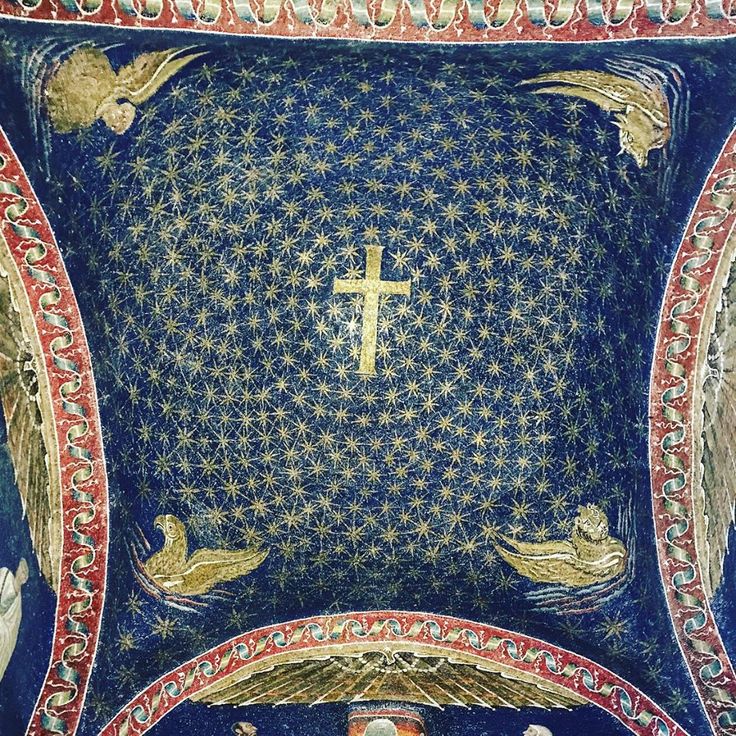
Dome of Mausoleum of Galla Placida

On the dome is the depiction of another version of the starry heavens, filled with swirling gold stars. A large decorated gold cross is placed at the center. At the four corners are the symbols of the four Gospels. At the lower left, the eagle represents John the Evangelist, who was taken up to Heaven where God dictated to him the Book of Revelations. At the lower right is the Lion of St Mark. When Mark first heard John the Baptist’s voice “crying out in the wilderness” (Mark 1:3), he said that it sounded like the roar of a lion. At the upper right is the Ox of St Luke. His gospel emphasizes sacrifice, service, and strength. At the upper left Matthew appears as an angel. The Gospel of Matthew opens with the angel appearing to Joseph to tell him to wed Mary.

Apse mosaic, Basilica of San Vitale, Ravenna (526-547 CE)

Justinian the Great reigned from 527 until 565 CE. He was able to reclaim most of the Roman territory previously lost to Barbarian tribes. He codified Roman law, condemned the Monophysite heresy that Christ was a single being, and embraced the Trinitarian belief that Christ represented three persons in one. Justinian also was an important patron of architecture and art. The Basilica of San Vitale in Ravenna was built under the direction of Bishop Eccelsius of Ravenna and financed by the local banker and architect Julius Agentarius. St Vitale is the patron saint of Ravenna, and the church was built on the site of his martyrdom. An officer in the Roman army who was discovered to be a Christian, Vitali was stretched on a rack, thrown into a pit, and covered with rocks and dirt.

“Christ Offers the Crown of Martyrdom to St Vitali”

In “Christ Offers the Crown of Martyrdom to St Vitali,” the young beardless Christ is placed at the center of the mosaic. Dressed in royal purple robes, He sits on the globe of heaven. A halo representing the Trinity encircles His head. Angels robed in white stand on both sides. He extends the martyr’s crown to San Vitale. The figure of Eclesius, representing the congregation of the church, holds a model of the San Vitali for presentation to Christ. The four figures stand on green earth with white flowers. Christ is suspended above earth in the blue globe of heaven, the golden world of eternal paradise.

“Justinian”

Two mosaics, “Justinian” and “Theodora,” are elevated above the altar on the walls just below the mosaic of the crown of martyrdom. The levels are significant. The church floor is the space for the congregation. The altar, elevated a few steps above the floor, is the space for the priests. The Emperor and Empress are placed above the priests, and just below Christ.

In “Justinian” (8’8’’ x 12’), the Emperor is depicted wearing a royal purple and gold stole over a white robe. He is the only figure with a crown and a halo. At the far right of the scene, the clergy in white vestments carry a censer, a gospel book, and a Bishop holds a gold cross. Justinian holds a gold bowl containing the Eucharistic bread. At the left are imperial administrators wearing white and purple robes. The figures at the far left are soldiers: one holds a large shield with the Christian symbol Chi Rho, the first letters of the Greek word Christ. This symbol was introduced by Constantine the Great.

“Theodora” (547 CE)

Theodora, the wife of Justinian, had been his mistress, and was 20 years younger than the Emperor when he married her. She was a showgirl/actress, but she was very intelligent and a significant figure in Justinian’s government. In the mosaic ‘’Theodora’’ (8’8’’ x 12’) is dressed in royal purple robes and lavish jewelry. At the right are her court ladies and eunuchs. Among the mosaic tiles of her jewelry are mother of pearl discs. She wears a crown and halo and holds the vessel of Eucharistic wine. The three Magi are shown bearing their gifts in the gold border at the hem of her robe. Justinian and Theodora are the formal officiants in the ceremony. Green earth surrounds Theodora and the figures, while a striped canopy covers her court ladies, and an elegant cupola covers Theodora. At the far left, a fountain with an eagle on top provides clear, fresh water. A mysterious space is revealed beyond the open curtain.

“Lamb of God”

The mosaic “Lamb of God” on the surface of the dome contains an exquisite pattern of flower and animal figures. Each flower and animal is a symbol. The figure of the Lamb of God with a halo, stands at the center of the starry heaven. The dome is divided into four sections. Four Orans, praying figures with raised arms, stand on sky globes and praise the Lamb. Orans were among the most common and earliest figures found in Early Christian art. The crisscrossing mosaic includes flowers and fruit and the image of a peacock at each corner. The Greeks believed that the flesh of the peacock did not decay after death. The peacock became a symbol of immortality for Christians.

The Mausoleum of Galla Placida and the Basilica of San Vitale are two of the eight Byzantine Christian monuments designated UNESCO World Heritage structures in Ravenna: “The early Christian religious monuments in Ravenna are of outstanding significance by virtue of the supreme artistry of the mosaic art that they contain, and also because of the crucial evidence that they provide of artistic and religious relationships and contacts at an important period of European cultural history.” (UNESCO, December 1996)

Beverly Hall Smith was a professor of art history for 40 years.  Since retiring with her husband Kurt to Chestertown in 2014, she has taught art history classes at WC-ALL. She is also an artist whose work is sometimes in exhibitions at Chestertown RiverArts and she paints sets for the Garfield Center for the Arts.
The Spy Newspapers may periodically employ the assistance of artificial intelligence (AI) to enhance the clarity and accuracy of our content.

Filed Under: 1A Arts Lead, Arts Portal Lead, Looking at the Masters

Looking at the Masters: Ostia Antica 

August 17, 2023 by Beverly Hall Smith Leave a Comment

Ostia Antica

One of the great experiences when visiting the city of Rome is to take the Metro to the Piramide station and catch the train from Porta San Paolo to Ostia Antica, a 25-minute ride.  Rome’s original port city is well-preserved with a forum, several temples, cemetery, imperial palace, streets lined with houses, apartments with three floors, shops, and 26 baths. The semicircle structure of the active theater is a seen. A seaport, Ostia Antica has many warehouses and a section dedicated to the import and export guilds. The city was a booming commercial center with a population at its height of 100,000. More than 100 ships could dock there.

Via dei Corporations

Unique to Ostia Antica are the black and white mosaics found everywhere in the town.  Colorful mosaics are predominant elsewhere in the Roman Empire; however, Ostia Antica was a working man’s town, and the mosaic tiles were all black and white. The individual tessara (tiles) were cut from marble, flint, local rocks, and stone mostly of calcium carbonate. The individual tiles are generally as small as a penny. The individual mosaics along the streets identify the 61 shops/offices of the ship-owners, importers, grain traders, wild animal traders, and others. 

Ships, Lighthouse of Portus, and Dolphin


The mosaic of Ships, Lighthouse of Portus, and Dolphin depicts one of the many types of ships. The lighthouse of Portus signaled the entrance to the harbor.

Grain from Cagliari or Sardinia

The guilds were divided into six divisions. Upper most were grain shippers, the main food suppliers for Rome. On either side of the ship are large grain measures. 

In the center of the four walkways of the Via dei Corporations is the piazza with a temple dedicated to Ceres, the goddess of agriculture, grain, harvest, and abundance. Among the guilds were shipbuilders, rope-makers, and leather tanners. Traders brought olive oil from Greece and Tunesia, elephants and ivory from Africa, wine from Greece, exotic animals for colosseums, and slaves. 

Thermopolium, Via di Diana

Ostia Antica is divided into quarters. One of the busiest was the area of meat and fish markets, including fast food shops, bakeries, and bars. The Thermopolium (fast food joint) on Via Diana is typical of this type of establishment.  At the far left is a take-away counter lined with deep recesses for storing food.  A large wine jug sits on top. Customers who eat or drink inside can see a painted menu on the wall. The food delights of ancient Rome could include eggs and olives, spicy turnips, lentils, meat, fish, and garum, a rotten fish sauce that was extremely popular and used much like ketchup. Fish, poultry, rabbit, vegetables, and slices of cooked pig head were also available. The thermopolium might also offer flamingo tongue, grilled dormouse, or boar stuffed with mocking birds that would fly out when the boar was cut open. An open courtyard at the back offered additional seating.

Neptune, Bath of Neptune

Ostia Antica has 26 baths. The Bath of Neptune was built in 139 CE during the reign of Emperor Hadrian. It is 220 feet square with more than14 major rooms, including an open-air palestra (gymnasium) decorated with mosaics of boxers and wrestlers. Baths were an important part of Roman life. Some Romans bathed several times a week; therefore, the decoration of the rooms was of great importance. Mosaics of Neptune, his wife Amphitrite, and a wide variety of mythological sea creatures fill several rooms. Neptune, Roman god of the sea, water, earthquakes, and horses is shown riding on the fish tails of four hippocampi, part horse and part fish. Neptune carries a trident, a three-pronged spear, that gave him godlike powers which he used when he struck a rock and brought forth salt water. He also struck the earth and created the first war horse.  Other images are swimmers, dolphins, cupid on a dolphin, fish, mermen, mermaids, and various other sea creatures.

Patrons entered the bath through the apodyterium, a large dressing room with pegs on the walls for clothing. The tepidarium is a warm room in which bodies were anointed with oil. The caldarium is a hot room (sauna or stream bath), and the frigidarium is a cold room with a plunge pool. Romans considered good health important and believed bathing, massage, exercise, and eating well were a necessity. It was not unusual for patrons to hold dinner parties, to discuss politics, and to conduct business at the bath. Baths also had libraries that were well-used.


Bath of the Coachmen


The Bath of Cisiarii (Coachmen) is located close to the port. It is called the Bath of the Coachman because of the mosaic of the coach (cisia) below the four-posted structure. The two-wheeled cart, an ancient cab, is pulled by two mules. Around the structure and in the sea are male and female swimmers and dolphins. Below the cab Triton, son of Neptune and Amphitrite, is the fish-tailed figure holding a staff and a conch shell that he blows to calm the waves. The name Triton refers to a single god, as well as to a group of Tritons who aid humans and fight with the gods.

Latrines

Communal latrines were common.  Revolving door and walls were present in this structure. The marble bench has several seats with holes over a drainage channel where fresh water flushed away waste. A sponge on a stick served to wipe oneself. Toilet paper was not invented until the 15th Century CE. The latrine at Ostia Antica is one of the best preserved in the Roman Empire.

The port of Ostia Antica was silted in by 350 CE, and now is two miles from the sea.  Ostia Antica also has a Mithraeum, Synagogue, and Early Christian sites. It is now a major archeological site as important as Pompeii and Herculaneum. 

Note: The Lido di Ostia, the new town founded in 1884 on the Tyrrhenian Sea, is a short train ride from Ostia Antica. The Lido di Ostia is a resort town offering beaches and restaurants.   

Beverly Hall Smith was a professor of art history for 40 years.  Since retiring with her husband Kurt to Chestertown in 2014, she has taught art history classes at WC-ALL. She is also an artist whose work is sometimes in exhibitions at Chestertown RiverArts and she paints sets for the Garfield Center for the Arts.


The Spy Newspapers may periodically employ the assistance of artificial intelligence (AI) to enhance the clarity and accuracy of our content.

Filed Under: 3 Top Story, Looking at the Masters

Looking at the Masters: Quill Hyde

August 10, 2023 by Beverly Hall Smith Leave a Comment

Quill Hyde grew up in rural Washington, along the Canadian Border. As a child on a farm, he spent a lot of time in nature and with animals. He says he had a fantastic childhood, full of adventures. He received a BA in Physics from Reed College in Oregon and a BS in Mechanical Engineering from Columbia University in New York City, both in 1995. He spent 15 years in New York City automating Broadway shows such as Mamma Mia, Blue Man Group, and productions of the American Ballet Theater. Hyde returned to his roots in the town of Tonasket, Washington. He set up a metal shop where he gathered a crew “committed to making beautiful, unique, and durable creations. We design, build, and collaborate to make dreams come true,” he said.

The Council of Animals” (Burning Man Festival, 2021)

Hyde first visited the Burning Man Festival in the desert at Black Rock City, Nevada in 2006. Started in1986, the Festival has been held annually the week before Labor Day. It features a large number of artists’ presentations designed and built around an annual theme. Hyde first participated in 2007. 

The theme of the 2021 Festival, the first after COVID, was The Great Unknown.  Over 80,00 artists and visitors participated. “The Council of Animals (What to Do About the Monkeys)” was Hyde’s contribution. He describes his point of view: “It was a surprise, as a young person, when I realized that none of my classmates thought of themselves as animals, that they thought of themselves as somehow separate, superior, like we were dropped in from another reality. I grew up close to the dirt, with animals as friends and foes alike, as equals. So, it was a shock, in that fifth-grade classroom–wait, what? I’ve been thinking about it ever since.” 

“The Council of Animals” consists of three large metal sculptures: a1200 pound elephant, a 7-foot-tall polar bear, and a 6-foot-tall rhino. Standing upright and holding a burning earth talking stick topped by a globe, Coyote delivers a message. He is the animals’ lawyer and delivers their message to the Festival participants seated on benches of reclaimed wood.

“The Council of Animals” (night at Burning Man)

At night the “Council” circle is lit dramatically. Coyote’s earth globe lights up with flames. The benches for “the monkeys,” are placed to encourage watchers to engage in a meaningful dialogue about the relationship of animals and humans. Hyde says that we are judged by the animals. ‘’We’re all in it together and better figure it out soon.” 

Polar Bear, Elephant, Rhino, and Chicken (National Mall, Washington DC, 2023)

On July 11, 2023, “The Council of Animals (What to Do About the Humans)” opened on the National Mall in Washington, DC, and it will close on September 3, 2023. The exhibition is presented by PETA (People for the Ethical Treatment of Animals). Ingrid Newkirk, President of PETA, commented at the opening ceremony, “Humans aren’t the only animals who communicate, and if we could speak the languages of other species, we would understand their appeals for freedom and a just world.”


Coyote

Coyote delivers the animals’ message: “Dear friends, we are gathered here today to discuss the problem of humanity. Look around you. There’s the elephant, with her profound emotional intelligence; the rhino, with his majestic horn; the polar bear, with his unmatched resilience; the chicken, with her superb mothering instincts; and me—the clever coyote. But our talents, interests, and autonomy are often overlooked because some humans believe other animals exist just for them.” Coyote’s message is delivered through the globe speaker broadcasting the recorded voice of actor Edward James Olmos.

Chicken

The animals sit and look on calmly, except for the chicken perched on the rhino’s back. The chicken was not included in “The Council of Animals” at Burning Man. With wide spread wings and ruffled feathers, she regards the human viewers with watchful eyes. 

“The Council of Animals” (2023)


Quill Hyde describes his intentions with respect to the creation of this sculptural group: “All of the living beings on this planet are part of one family and we’re all special and have a right to exist. I hope this piece, “The Council of Animals,” will help people realize that we are not the only ones that matter, that the idea of being judged by our animal peers will inspire us humans to make kinder choices, for everyone’s sake.”

Beverly Hall Smith was a professor of art history for 40 years.  Since retiring with her husband Kurt to Chestertown in 2014, she has taught art history classes at WC-ALL. She is also an artist whose work is sometimes in exhibitions at Chestertown RiverArts and she paints sets for the Garfield Center for the Arts.

The Spy Newspapers may periodically employ the assistance of artificial intelligence (AI) to enhance the clarity and accuracy of our content.

Filed Under: 1A Arts Lead, Arts Portal Lead

Looking at the Masters: Lascaux 

August 3, 2023 by Beverly Hall Smith Leave a Comment

Starting at the beginning of the story, the caves at Lascaux in the Valley of Vezere on the Dordogne River in France were discovered by accident on September 12, 1940. Four boys and their dog Robot stumbled onto the entrance of the cave.  Since that time, historians, archeologists, and others wondered about and explored some of the earliest created images during the Paleolithic period (530,000-10,000 BCE). The cave contains images of over 6000 figures of animals, humans, and abstract designs dating from c.17,000-15,000 BCE. 


Hall of Bulls

A tunnel, forty-nine feet long, connects the entrance of the cave to the large open space called the Hall of Bulls. Historians and archeologists believe the cave was not lived in. The entrance is too long and too narrow. Hunter-gathers of the period needed to live in a cave with an opening closer to the outside for easier access to water, food, and fresh air. Lascaux was a sacred, hidden space. The images serve as a record rather than art. With no identifiable language, these images recorded what was most important to life: food, clothing, and shelter. 

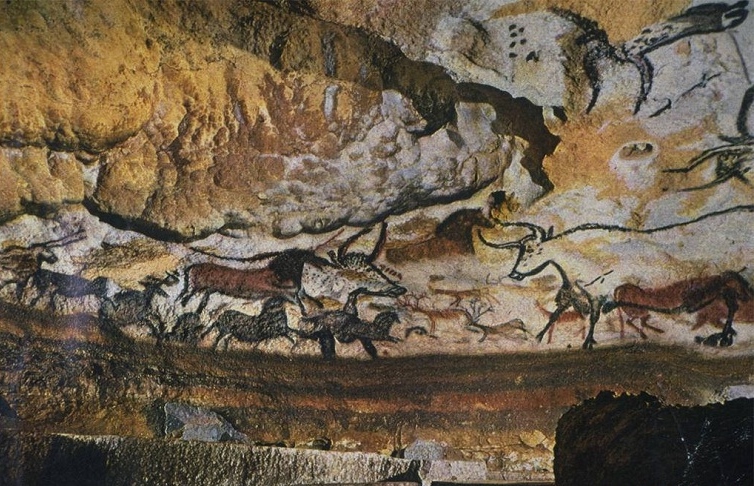
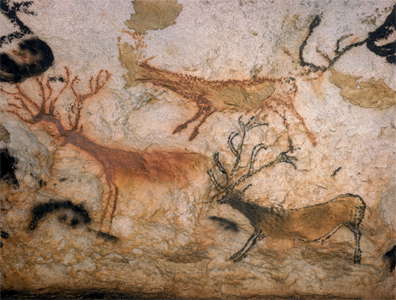
The Hall of Bulls, also called the Rotunda, is 62 feet long and 25 feet wide. The ceiling is covered with images of herds of animals. The two large so-named bulls are aurochs, an extinct cattle species, several brown horses and ponies, a group of deer, and a so-named unicorn, the last animal on the left. Images of animals were added over many years, thus the overlapping of drawings, paintings, and engravings. The Hall of Bulls is sometimes referred to as the Paleolithic Sistine Chapel. 

Hall of Bulls, center detail

To the surprise of the discoverers, the animals are not simple stick figures, but relatively well developed and detailed images. Nine hundred animals are identifiable. Drawn in profile except for the horns, the animals are not stationary, but they appear to be walking, running, or swimming. They have a vital force. The aurochs have identifiable noses, mouths, and eyes, along with well-shaped bodies, four walking legs, and hooves. The auroch at the right side of the wall is 15 feet long.

The animals were drawn using natural pigments found in the cave or nearby. The red, yellow, and black colors were made from charcoal, hematite, geothite, manganese, and a variety of iron oxides and animal fat. In order to get the ground pigments to adhere to the wall, warm animal fat was applied first, and the color then was rubbed or blown onto the fat. Many hollow bones, wood, or reeds stained inside with color were found. The ground pigment was placed inside the hollow tube and blown onto the wall. Evidence of this technique can be observed in the horse head at the top of the wall. Also found were sockets in the wall where scaffolding would have been built to reach the ceiling. 

Among the animal images are abstract symbols: the small black arch with two dots under it at the foot of the deer, the three ochre lines next to the head of the auroch on the left, and the black lines of a spear that pierces the chest of the auroch at the right.  Many of these symbols represent hunting, but others cannot be explained. The abstract designs are straight lines, parallel lines, branching lines, nested convergent lines, quadrangular shapes, claviform signs, v-shaped lines, and dots. 


Hall of Bulls, detail of deer

The paintings and drawings of deer provide an interesting comparison. The top red deer is missing its head. The next red deer has an elaborate but rather crooked set of antlers. Two black dots appear between the antlers. The depiction of the deer at the lower right is most unique. The elaborate set of black antlers spring from the well-shaped head. The front legs and hooves are placed in a forward position, although the deer does not appear to be running. The deer’s black head and neck flow into the modulated browns and oranges of the body. The deer is a remarkable image. She is also pregnant, as are many other animals in the cave.

Black Bull in Axial Gallery

Deeper in the cave, beyond the Hall of Bulls, is a narrow passage which leads into the Axial Gallery. It is not as wide as the Hall of Bulls, but is 72 feet long with a dead end. The herds of horses, aurochs, bulls, bison, and ibexes cross the ceiling. Most notable is the Black Bull, the largest animal in the cave at 17 feet long. The features of its face are well developed, as is the entire body. It is a massive animal for a hunter to encounter. The three-pronged shape in front of the Black Bull may represent a weapon aimed to disable it.

#5 Chinese Horse in Axial Gallery

Among the horses in the Axial Gallery, the 56 inch long Chinese Horse stands out. The horse’s mane clearly exhibits pigment blown through a tube, even to the puff marks at the edges. The black outline is masterful. The placement of ochre, which runs from a reddish-brown to yellow, effectively defines her chest, back, and rounded rump. Her stomach bulges and hangs low in pregnancy.  Two arrow shapes are depicted in front of her and at her side. An abstract design, perhaps a trap or cage, appears to be ready to drop down on her. The unexpected skill of the Paleolithic artist is clearly in evidence here.


Well Scene in Shaft


At the middle of the Hall of Bulls, a long narrow passage with animal images on the ceiling accompany the viewer to chambers called the Apse and the Nave. A hole in the floor of the Apse opens to the farthest and darkest part of the cave, accessible only by a ladder. Here is one of the most confusing images in the cave. A bison has been speared in the stomach by a hunter, and its entrails are hanging out. In front of the bison is the prone stick figure of a male hunter, with mouth open and bird-like head. This is the only human depicted in the cave, and it has none of the detail or sophistication of the animal images. A line symbol is placed on the ground next the feet of the dead human. 

The two remaining images offer no understanding of the scene. A long pole with the simple image of a bird is painted next on the wall. Beyond, the partial image of the body of a rhinoceros, with a horn, walks away from the scene. 

Two Bison in Nave

Returning to the Nave (59’ X 20’), two back-to-back bison can be recognized. The male bison’s thick hairy coat is best depicted in the bison on the left. 

Swimming Deer in Nave

The Nave’s ceiling varies in height from 8.5 feet to 27 feet. The irregular wall, or a patch of natural color on the wall, often has been taken into consideration in the placement of an animal’s body. The rippling texture of this section of the wall represents the flowing water of a river. The drawing of the four black deer, heads up and noses in the air, suggest they are swimming across the water. 

One explanation for the images in the cave is “sympathetic magic.” The hunters recognized that animals stay together in herds, and images of groups of the same animals appear throughout the cave. Although the law of mutual attraction, “like attracts like,” was not defined until 1906, it seems applicable here.  The drawings were intended to attract animals to the cave, making hunting easier. Spears and arrows account for the hunter’s success. The cave also may have been used to prepare young hunters for their first hunts. 

The study of primitive societies in the present day has reveals that reverence for the animals that were hunted is an important part of their culture. The careful depiction of the animals and abstract symbols in the caves also may be intended as praise for the animals and to show gratitude that they gave themselves up to be killed. The presence of images of pregnant females also reflects the importance of reproduction to the supply. 

Lascaux opened to the public on July 14, 1948. By 1955, the cave had attracted1200 visitors every day and was discovered to be deteriorating. Carbon dioxide, heat, humidity, and the like were causing fungus, black mold, lichens, and other forms of deterioration. The cave was closed to tourism in 1963. Lascaux was designated a UNESCO World Heritage Site in 1979. In order to allow the public to see the remarkable work in the cave, the creation of an exact replicas the cave was begun in 1983. In December 2016, the largest and most exact copy was opened to the public.  

Beverly Hall Smith was a professor of art history for 40 years.  Since retiring with her husband Kurt to Chestertown in 2014, she has taught art history classes at WC-ALL. She is also an artist whose work is sometimes in exhibitions at Chestertown RiverArts and she paints sets for the Garfield Center for the Arts.


The Spy Newspapers may periodically employ the assistance of artificial intelligence (AI) to enhance the clarity and accuracy of our content.

Filed Under: 1A Arts Lead, Arts Portal Lead

Looking at the Masters: Larkspur and Salmon

July 27, 2023 by Beverly Hall Smith Leave a Comment

‘’Larkspur’’ (18881) by Henri Fantin-Latour

If you were born in the month of July, your flower is the larkspur. It is the symbol of positivity, dedication, a beautiful spirit, loving bonds, delight, and joy. The painting “Larkspur” (1888) by Henri Fantin-Latour is unusual in that it is a depiction of a vase entirely of larkspur. Fantin-Latour, a French flower painter, was extremely popular with English Victorian art lovers, who gave a symbolic meaning for every flower. The larkspur was introduced to England from Italy in the mid-1500’s, and it became immediately popular.  The flowers bloom on a stalk that is one to three feet tall. Most often the larkspur is used in mixed bouquets to add height. The airy blue-gray foliage is fern-like.

Fantin-Latour has painted the larkspur in three of its four colors. White larkspur represents a happy nature and purity. Purple represents first love, but pink represents a contrary and fickle disposition. As beautifully painted as it was, Fantin-Latour’s bouquet seems to send a conflicting message to a young lady.

The English sprinkled larkspur in the bath as a protection against ghosts, magic, lightning, and to ward off other evils. It was planted around stables in Transylvania to keep witches away. The larkspur’s protective qualities are drawn from various stories and myths. In Greece, after the death of Achilles, the great hero of the Trojan War, his armor was awarded to Ulysses, another hero. Ajax, a third significant hero, was so distressed at not receiving the armor, he committed suicide by throwing himself on his sword. The larkspur flower bloomed where Ajax’s blood dropped onto the ground. In medieval Italy, the larkspur flower first bloomed when three knights slew a fierce dragon, and the flowers sprung up where the knights wiped their bloody swords on the grass. The English name larkspur developed in medieval England. The pointed petals and the pointed center were likened to the claws of the meadowlark, and the spurs of medieval knights. A knight had to “win one’s spurs.” Larkspur, when eaten, is poisonous to humans and animals.


#2 “White Rose and Larkspur No.1” (1927) by Georgia O’Keeffe

Whatever meaning the larkspur or rose may have had in Victorian times, Georgia O’Keeffe was not concerned about its meaning in her paintings. She began a series of large flower paintings in 1927. “White Rose and Larkspur No. 1” (1927) was from a series of five with white roses; two of them with Larkspur.

O’Keeffe’s interest was two-fold: to examine the flower closely and to create different compositions with the same objects. “White Rose and Larkspur No. 1” contrasts dark versus light. The five petals of the flower are pointed and its center can be seen. Using the limited palette of blues and whites, O’Keeffe created a striking image.: “So, I said to myself…I’ll paint what I see—what the flower is to me but I’ll paint it big and they will be surprised into taking time to look at it.  I will make even busy New Yorkers take time to see what I see of flowers.” At one time she said she hated flowers, but they were great models as they did not move. Nevertheless, she is well-known for her large and gorgeous paintings of flowers. O’Keeffe said, “When you take a flower in your hand and really look at it, it’s your world for the moment, I want to give that world to someone else.”

Black Hollyhock, Blue Larkspur” (1930) by Georgia O’Keeffe

“Black Hollyhock, Blue Larkspur” (1930) was painted while O’Keeffe was in Taos, New Mexico, a visit she made every summer from 1929 until her husband Alfred Stieglitz died in 1949.  She moved to New Mexico permanently in 1949. O’Keeffe said: “When I was at Mabel’s [Dodge Luhan] at Taos…there was an alfalfa field like a large green saucer. On one side of the field was a path lined with flowers…One day walking down the path I picked a large blackish red hollyhock and some bright dark blue larkspur that immediately went into a painting, and then another painting.” 

The blue larkspur is a symbol of dignity and grace. Raised as a Catholic, O’Keeffe may well have known that blue flowers were symbols of the Virgin Mary.  In art, Mary always is dressed in blue. O’Keeffe carefully details the five petals of each flower and the pistil in the center. The Bible tells of Christ having received five wounds on the cross. In Christian iconography, the larkspur is a reference to Mary’s tears. An American Pawnee tribe story tells of “Dream Woman,” who cut a hole in the sky so she could look down. Pieces of the blue sky fell to the earth and became larkspur.


“Salmon Fishing on the Cascapedia River” by Albert Bierstadt

If you were born between July 22 and August 21, your Native American totem animal is the salmon. It is the symbol of determination, strength, perseverance, wisdom, prosperity, and renewal.  Salmon have been a major food source for Native Americans for thousands of years. The fish is revered and celebrated in rituals. Its symbolic characteristics are related to its observable life cycle. Returning each year to spawn in the same location involves swimming a long distance upstream to return home.

Albert Bierstadt (1830-1902) is most famous for his panoramic landscape paintings of the American west. “Salmon Fishing on the Cascapedia River” depicts two buckskinned fishermen steadying a dugout canoe while a third fisherman casts his line far into the lake. He has caught a salmon; its silvery body arches out of the river as it tries to escape the fisherman’s hook. Bierstadt’s landscape includes the peaceful river, autumn leafed birch trees, a forest beyond the lake, and tall mountains in the distance. The clear air and quiet peace of untouched nature is relaxing and reassuring. The Cascapedia River was and is still known as the home of some of the largest Atlantic Salmon on the Gaspe Bay coast of Quebec, Canada.

“Realm of the Supernatural” by April White

April White (b.1972) a Haida artist of the Raven Clan was born in Haida Gwaii, an archipelago off the coast of British Columbia in Canada. Her Haida name is SGaana Jaad (Killer Whale Woman). She earned a BSc in geology from the University of British Columbia and became a field geologist in the North American West. While making maps, she began to paint landscape scenes in watercolor. She is self-taught but has a natural talent. “Realm of the Supernatural” displays her skill with watercolor. The top half of the panoramic waterscape depicts a small forested island set in the calm lake. As the lake flows forward, the water becomes supernatural and a fish, decorated in the “formline” style of Haida art, appears.

In the mid-1980’s, White made painting her vocation. She continued to paint realistic landscapes, but she also created paintings that were “formline” to honor her heritage. Formline is two dimensional, compact, and highly organized art. It consists of flowing lines and striking color. The three standard Haida colors are black, red, and green. The fish shape is well defined with attention to facial features, fins, and flippers. Within the fish or other animal, a face with large eyes is often a prominent part of the design. In this piece, the fish includes the image of a woman’s face, her long black hair swirling upward in simple arches. White said, “Haida women are very prominent in Haida stories and myths—understandable given our matrilineal society. So, it was very important for me to develop a representation of the water realm that reflects not only myself being a woman, but as a Haida.”

White’s “Salmon Tale” (2015) (acrylic) was the winner of the 2015 competition sponsored by the Pacific Salmon Foundation to design the Recreational Fisheries Conservation Stamp. The stamp competition began in 1989, and sportfishermen are required to buy it to support salmon fishing in British Columbia as well as other conservation efforts. Since 1989, $7.75 million have been raised to support more than 2,000 community conservation projects. 

White relates the Haida story depicted in “Salmon Tale.”  A young daughter of a powerful chief woke up crying from her dream. She saw a shining, leaping fish unlike any known fish. The village Shaman said, “We have many fish in our Inlet, but none like that. Raven, who lives among the Cedars might know.” Raven traveled far, and when he saw a leaping salmon, he caught it. The salmon was the son of the Salmon Chief. Many salmon tried to catch Raven and Salmon, but Raven returned home with Salmon and placed it before the young girl. The Shaman told the people, “Many salmon will try to rescue this young Salmon. You must weave a huge net to catch all the fish.” When the run of salmon arrived, the people caught enough to feed the village, but spared many. The salmon searched the forest streams and decided to spawn in the shallow beneath a Ts’uu-Cedar Tree. The salmon came back year after year and spawned and the humans honored them. The humans developed a ritual for preparing them to eat, and they placed the fish skeletons back into the water, believing that the Spirit of Salmon would rise again each year and regenerate. 

The salmon in “Salmon Tale” is depicted in the traditional Haida manner: a profile view, mouth open, a large eye, fin and flippers. Inside the salmon, the Raven’s profile head, open mouth, large eye, and feather patterns of both wings depicts the connection and refers to the tale of how Raven brought Salmon to Humans.

In 2016, the Royal Canadian Mint chose White to design a collection of coins for a collector’s series titled Mythical Realm of the Haida, composed of supernatural figures from the realms of water, earth, and sky. The first is a Haida image of Whale with a female head inside. White’s Haida name SGaana Jaad, Killer Whale Woman, was the inspiration. The second coin features Eagle, with a male dancer cloaked in feathers inside, and the third, Black Bear with a child on its lap.  White has also written and illustrated several books. 

“From inspiration through to artistic expression…it’s as if I am experiencing innate memories that connect me deeply to my cultural past. It’s as if my brain is really doing the seeing, not my eyes. The feeling of this cerebral vision is supernatural…magical.” (April White)

Beverly Hall Smith was a professor of art history for 40 years.  Since retiring with her husband Kurt to Chestertown in 2014, she has taught art history classes at WC-ALL. She is also an artist whose work is sometimes in exhibitions at Chestertown RiverArts and she paints sets for the Garfield Center for the Arts.

The Spy Newspapers may periodically employ the assistance of artificial intelligence (AI) to enhance the clarity and accuracy of our content.

Filed Under: 1A Arts Lead, Looking at the Masters

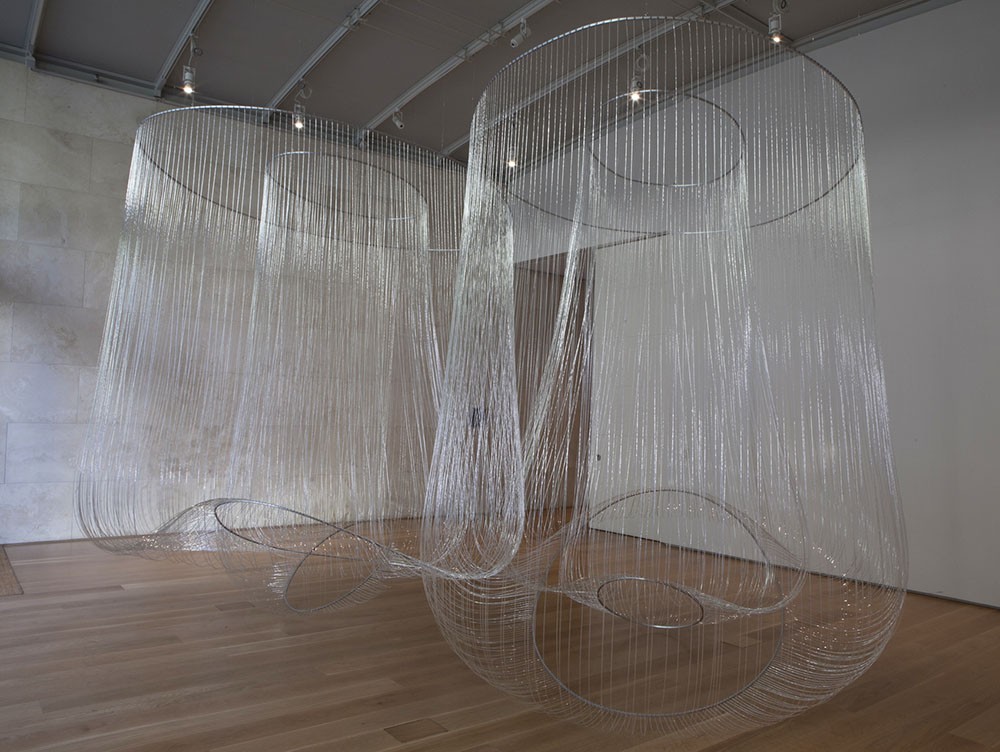
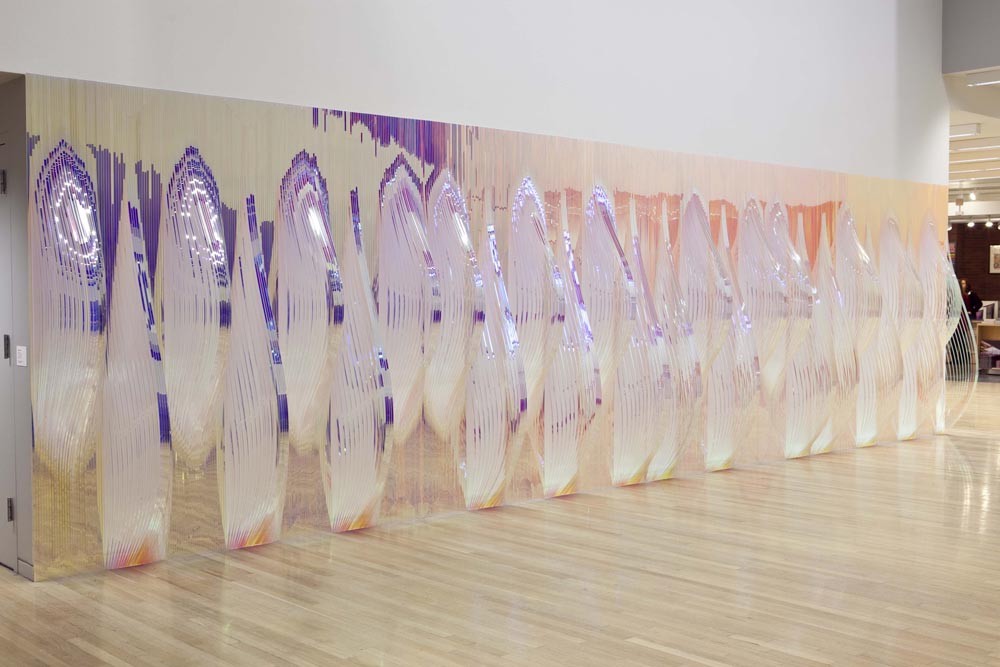
Looking at the Masters: Alyson Shotz 

July 13, 2023 by Beverly Hall Smith Leave a Comment

Born in 1964 in Glendale, Arizona, Alyson Shotz is the daughter of a United States Air Force pilot and a teacher. Shotz studied geology and physics, but turned to art, earning a BFA in 1987 from the Rhode Island School of Design and an MFA in 1991 from the University of Washington in Seattle. She moved to New York to begin her career in art. Her work has been influenced by science. She began using photography as her medium, capturing the motion of an object with a series of photographs and putting them together in prints and videos. From 1996, her work has included three-dimensional pieces made of materials such as mirrors, optical lenses, and piano wire. She explores natural phenomena such as space, light, gravity, and patterns found in nature that are invisible to the human eye, and she makes them visible. By 1999, her works received wide notice and approval.

“Mirror Fence” (2002-2014) (138’ x 36”x 4”) (Storm King Art Center, New Windsor, NY) was made of Starphire glass mirror and aluminum. Starphire glass transmits 5% more visual light than ordinary glass, and it eliminates distortion and altered colors. Sections of the picket fence appear and disappear as visitors walk by, the color changing from day to night and season to season. 

“Mirror Fence” was in the company of such well-known sculptures by David Smith, Henry Moore, Louise Nevelson, Alexander Calder, and Maya Lin. Storm King is an outdoor museum opened in 1960 that contains works by some of the most acclaimed artists of the 20th and 21st Centuries.

Wave Equation” (2010)

In “Wave Equation” (2010) (120”x144”x117”) (stainless steel wire, silvered glass beads, aluminum) (Nasher Sculpture Center, Indianapolis, IN) Shotz draws on her knowledge of physics: “There are things that I see happen when I’m working with a material that tells me something about gravity, space, force. I’m interested in showing that idea through the artwork.”

Shotz’s sculptures are fascinating; they are large and continually changing. Visitors respond to their beauty and energy, and that is enough. However, appreciation of the ideas that influenced their creation requires some explanation. A wave “is a disturbance that travels through space and matter transferring energy from one place to another. When studying waves, it’s important to remember that they transfer energy, not matter.” (Physics for Kids, duckster.com) “Wave Equation” is constructed of two sets of four aluminum ellipses, connected by shiny piano wire. Cylindrical, mirrored glass beads are attached intermittently to the piano wire. The movement that is generated depicts the rise and fall of gravitational forces. Writer Rebecca Cater describes her observation of “Wave Equation”: “In my 360-degree tour of the sculpture, it is as if the wires are in fact broken, held together by a space of emptiness. Take one more step, and the illusion vanishes.”  (DMagazine, November 23, 2010)

“Wave Equation” (detail of bottom)

“Standing Wave” (2010)

“Standing Wave” (2010) (25’ long) is composed of thousands of acrylic dichroic strips that are fastened with tape side-by-side at stepped intervals to the gallery wall. The dichroic acrylic is clear; the surface reacts, reflects, and transmits rays of color depending on the conditions of the gallery and the passage of viewers. The result is an undulating wave of colors.

Dichroic acrylic is made by vaporizing quartz crystals and metallic oxides with an electron beam in a vacuum chamber. The resultant particles condense on the surface of the acrylic sheet, forming a crystal structure. Dichroic comes from Greek meaning “two-colored.”  The earliest known example comes from 4th Century Rome in the “Lycurgus Cup” which appears red under normal light, but when a flash photo is taken, the cup is green. In the 1990’s NASA developed dichroic glass for use as mirrors and re-entry tiles on space shuttles. Since then, the ever-changing color of dichroic glass and acrylic have played a major part in jewelry making. 

“Entanglement” (2022)  

Shotz continues to explore natural phenomena in “Entanglement” (2022) (206”x207”x206”) (165 feet in length) (stainless steel and paint). The sculpture was commissioned by the Billi Tisch Center for the Integrated Sciences at Skidmore College in New York. The 750-pound sculpture is suspended from the ceiling of the atrium of the building. What are entanglements? Shotz explains that “entangled structures are fundamental to DNA proteins, turbulent plasmas, fluid dynamics, and the quantum-mechanical foundations of nature itself. When two particles become entangled, they remain connected even when separated by vast distances. I like to imagine this sculpture as the pathway between two connected particles in space.” 

According to Shotz, “Entanglement” explores the idea that a shape can be defined by space rather than mass. There is more space in this sculpture than steel. It also asks, ‘How does perception define the experience of space?’ If you look at the sculpture from only one point of view, it might be difficult to understand, you have to move around it to experience it fully. As your point of view changes and the light changes, the shape itself changes. These concerns flow through all of my work.” In motion, the color will change from gold to green to blue.

The stainless-steel structure was made by MX3D, a process invented by a company in Amsterdam, Netherlands. A robot printed the work in two-to three-foot-long sections by dropping a single drop of molten steel at a time. Paint was applied after the steel frame was completed. The sections were then welded together and installed in the atrium of the Tisch center.

“The Robes of Justitia” (2022)

“The Robes of Justitia” (2022) was commissioned for the ceiling of the Fred D. Thompson Federal Courthouse in Nashville, Tennessee. Justitia was the Roman goddess of justice introduced to the pantheon by emperor Augustus, who reigned from 27 BCE to 14 CE. She was one of the four virtues, often depicted blindfolded and holding scales and a sword. She is the prototype for America’s Lady Justice. Shotz chose to represent her with folds of a classical Roman tunic. The ceiling installation is composed of eight panels containing very small glass mosaic tiles. Each panel is 25 feet wide and 13.5 feet tall. The domed ceiling is 50 feet in diameter.  Shotz describes the effect she wanted to create: “In this mosaic the folds of her robe sweep around the central oculus like the wind and space that surrounds us–a metaphor of the protection of justice and the work of the law as it is supposed to be enacted in this country.” 

Shotz’s “The Robes of Justitia” was one of the winners of the Honor Award, presented in 2022 by the U.S. General Services Administration for highest achievement in art. The award is presented annually to recognize excellent design in a federal building.

“Density of Air” (2023)


In May 2023, the Academy Art Museum in Easton added “Density of Air” (2023) (144”x59.5”) to the permanent collection. The sculpture consists of thousands of small stainless-steel discs. The work references the mixture of gases and air that expand and compress, but are invisible to the human eye. Stotz stated, “There are things that I see happen when I’m working with a material that tells me something about gravity, space, and force. I’m interested in showing that idea through the artwork.”

“Density of Air” (detail)

Shotz’s work can be found in museums and collections world-wide. Closer to home, her work is in the collection of the Baltimore Museum of Art, the Hirshhorn Museum and Sculpture Garden, and the Phillips Collection. She continues to explore multiple mediums and new technological break-throughs to advance her knowledge and the viewer’s experience of the unseen but very present phenomena of nature that surround us.

Beverly Hall Smith was a professor of art history for 40 years.  Since retiring with her husband Kurt to Chestertown in 2014, she has taught art history classes at WC-ALL. She is also an artist whose work is sometimes in exhibitions at Chestertown RiverArts and she paints sets for the Garfield Center for the Arts.
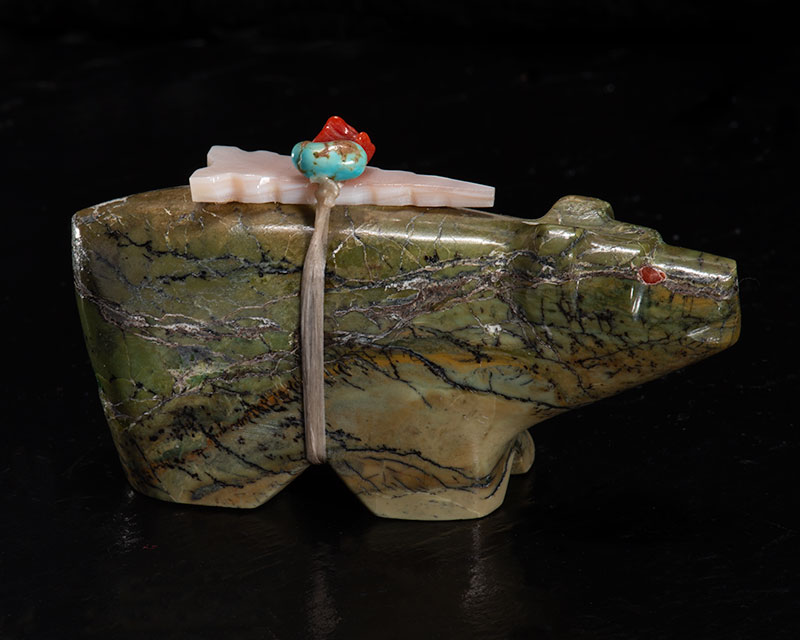
The Spy Newspapers may periodically employ the assistance of artificial intelligence (AI) to enhance the clarity and accuracy of our content.

Filed Under: 1A Arts Lead, Arts Portal Lead

  • « Previous Page
  • 1
  • …
  • 9
  • 10
  • 11
  • 12
  • Next Page »

Copyright © 2026

Affiliated News

  • Chestertown Spy
  • Talbot Spy
  • Cambridge Spy

Sections

  • Sample Page

Spy Community Media

  • Sample Page
  • Subscribe
  • Sample Page

Copyright © 2026 · Spy Community Media Child Theme on Genesis Framework · WordPress · Log in