MENU

Sections

  • Home
  • Education
  • Donate to the Centreville Spy
  • Free Subscription
  • Spy Community Media
    • Chestertown Spy
    • Talbot Spy
    • Cambridge Spy

More

  • Support the Spy
  • About Spy Community Media
  • Advertising with the Spy
  • Subscribe
March 14, 2026

Centreville Spy

Nonpartisan and Education-based News for Centreville

  • Home
  • Education
  • Donate to the Centreville Spy
  • Free Subscription
  • Spy Community Media
    • Chestertown Spy
    • Talbot Spy
    • Cambridge Spy
1A Arts Lead Arts Looking at the Masters

Looking at the Masters: Cai Guo-Qiang  

July 6, 2023 by Beverly Hall Smith Leave a Comment

Cai Guo-Qiang was born in 1957 in Quanzhou, China. His father ran a book store. Cai was able to read widely, including books that would be forbidden under Mao’s Cultural Revolution (1966-1967). Then Cai had to help his father burn books. He received a BFA (1985) in set design from the Shanghai Drama Institute. He began making gunpowder drawings in1984. Why gunpowder? Quanzhou was located across the straits that separated mainland China from Taiwan. Cai recalled, “I grew up with gunpowder. They (Chinese Nationalist) were always bombing us and we them. It was a part of my life.” Fireworks also were and are a part of every Chinese festival. 

Primeval Fireball (1991)


Primeval Fireball (1991) (exhibition in Tokyo) includes several gunpowder drawings from The Projects for Projects series exhibit. Each piece is titled and falls into Cai’s category of Projects for Extraterrestrials. Cai perfected the technique of spreading paper on the floor, sprinkling gunpowder as desired, placing a second sheet of paper on top to control the fire, and igniting it. Over time, he developed great control over the process and added colored gunpowder that was used in fireworks. 

“Project to Extend the Great Wall of China by 10,000 Meter” (1993)

“Project to Extend the Great Wall of China by 10,000 Meters” (1993) is No. 10, and it is the first large work from Cai’s Project for Extraterrestrials. Charges were placed across 6.2 miles of the Gobi Desert at the western end of the Great Wall. Small charges were placed 1.86 miles apart, and larger charges .62 miles apart. At dusk on February 27, 1993, the first charge was ignited and the remaining fired in sequence over a period of fifteen minutes. Forty thousand residents and tourists witnessed the performance.

“Transient Rainbow” (2002)

“Transient Rainbow” (2002), a performance on the East River on June 29, 2002, in New York City was sponsored by the Museum of Modern Art. One thousand, three-inch, multi-colored peony fireworks were fitted with computer chips. They were set off at 9:30 PM. The “Transient Rainbow” lasted 15 seconds.

“Footprints of History” (2008)

“Footprints of History” (2008) was Cai’s spectacular firework display over the Bird Cage Stadium at the Beijing Olympics. Twenty-nine footsteps were set off in sequence. They extended 9 ½ miles from Tiananmen Square to the Olympic Stadium and lasted 63 seconds.

“Fallen Blossoms” (2009)

In 2009 the Philadelphia Museum of Art exhibited of Cai’s gunpowder drawings to honor Anne d’Harnoncourt, the director of the museum who died unexpectedly in June 2008. The exhibition opened on December 11, 2009, with “Fallen Blossoms” (2009) (60’ x 85’), an explosion in front of the façade of the Museum. It was intended as a gift to the City and was witnessed by a large audience. The blossom was made of fuses placed on a metal net attached to a scaffold. The title was taken from a Chinese proverb that references the great loss experienced when a life is cut short. Anne d’Harnonocourt was sixty-four years old when she died.

“Fallen Blossoms” (second image)

Cai has received many awards and honors, among them the Praemium Imperiale (2012) that recognizes lifetime achievement in the arts, a category not covered by the Nobel Prize. He also received the first United States Department of State Medal of Arts for commitment to international cultural exchange. Although Cai lives in New York City, his works are commissioned internationally. His works deal with such human issues as climate change, the pandemic, increased national conflicts, and materialism. 

“Remembrance” (2014)

“Remembrance” (2014) is the fireworks component of a larger Cai exhibition titled The Ninth Wave, held at the Power Station of Art in Shanghai. It is China’s first contemporary art museum, opened in 2012. The $64 million cost of the Museum, was paid for the by Shanghai government. The Power Station is located on the Huangpu River, and “Remembrance” was performed from a long barge.

“Black Wave” (2023)

“Black Wave” (2023) is the first phase of When the Sky Blossoms with Sakura (Cherry Blossoms) (2023). It was performed on Yotsukura Beach in Iwaki City, Japan, to recognize and remember the destruction caused by the earthquake and tsunami that took place there in 2011. The first sequence titled “Black Wave” was to recall and remember the pain of the past.

Memorial Monument” (2023)

“Memorial Monument” (2023), the second phase, recognizes the loss suffered during the earthquake and tsunami, the COVID pandemic, and wars. 

“When the Sky Blossoms with Sakura” (2023) was the third phase of the performance that filled the sky with beautiful pink blossoms. The cherry blossom is the unofficial flower of Japan, and the Cherry Blossom Festival is an annual event in Japan. Cherry blossoms are symbols of spring and renewal of life; the festival it is a time for family and friends, for joy, and for renewed vitality. Cherry blossoms last only two weeks. Their arrival is time for great joy and reflection.

The entire performance lasted thirty minutes. Forty thousand choreographed fireworks were launched from the water. The display was 1312 feet wide and 427 feet high. On the day of the event, June 26, 2023, Cai commented on the significance of the work: “Thank you to the beautiful sea and sky of Yotsukura, and the rare cooperation and companionship of the sound of the wind and waves in this worrisome June…Mankind today is facing various challenges such as coexisting with the pandemic, economic decline, deglobalization, and increased national and cultural conflicts. Through the sakura in the sky, I was expressing the story of the friendship between the people of Iwaki and me, which transcends politics and history, and I hope that the artwork will inspire the world with faith and hope.”

Cherry Trees, Iwaki Manbon Sakura Project (2015)

Cai lived in Iwaki, Japan from 1986 to 1994, and he had many friends. His first major performance in Japan in 1994 was in this Iwaki location. The Sakura blooming in the sky echoes the initiative in 2015 by Cai and his friends, who called themselves “10,000” (the many or infinite), to create the Project to Plant Ten Thousand Cherry Blossom Trees.  

“From gunpowder, from its very essence, you can see so much of the power of the universe—how we came to be. You can express these grand ideas about the cosmos. But at the same time, we live in the world where explosions Kill people, and then you have this other immediate context for the work.”

Beverly Hall Smith was a professor of art history for 40 years.  Since retiring with her husband Kurt to Chestertown in 2014, she has taught art history classes at WC-ALL. She is also an artist whose work is sometimes in exhibitions at Chestertown RiverArts and she paints sets for the Garfield Center for the Arts.


The Spy Newspapers may periodically employ the assistance of artificial intelligence (AI) to enhance the clarity and accuracy of our content.

Filed Under: 1A Arts Lead, Looking at the Masters

Looking at the Masters: Giuseppe De Nittis 

June 29, 2023 by Beverly Hall Smith Leave a Comment

America’s Kentucky Derby on May 6, Preakness on May 25, and Belmont Stakes on June10 have been run for the year 2023. England’s Royal Ascot was run from June 20 through June 24. One other world class European horse race in 2023, the Prix de l’Arc de Triomphe, will run during the first week of October at Longchamps race course in Paris. Longchamps, Paris’s most prestigious course, was built in 1857 on top of the ruins of an abbey that was destroyed during the French Revolution. Emperor Napoleon III and his wife Eugenie attended the first race at Longchamps on Sunday, April 27, 1857. 

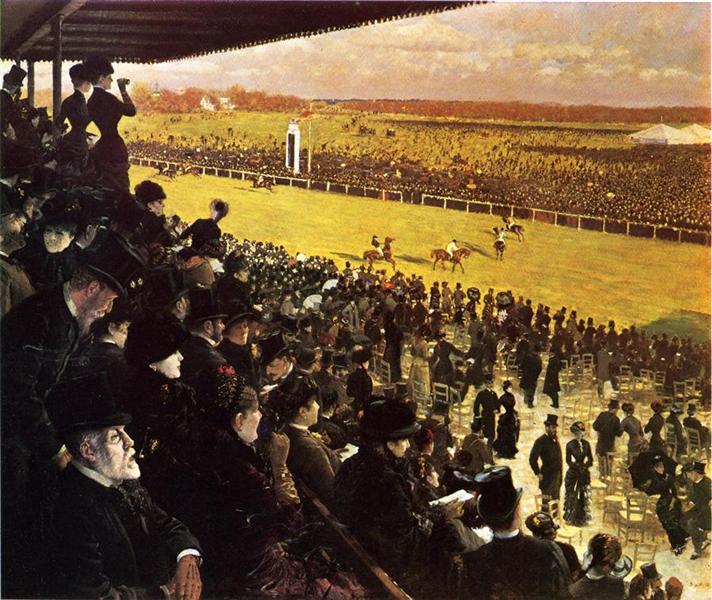
The Races at Longchamps from the Grandstand” (1883)

Both artists Manet and Degas painted the races at Longchamps, concentrating on the horses and the track. The Italian artist Giuseppe De Nittis (1846-1884) was more interested in the crowds of people who attended races. In “The Races at Longchamps from the Grandstand” (1883) (39”x48’’) De Nittis devoted two-thirds of the canvas to a view of the race from the top of the grandstand down to the track. He created several diagonals in the composition: people seated in the grandstand, people standing on the ground by the rails, a stretch of dirt track with horses working out, and the crowd behind the rail on the opposite side of the track. The diagonals are enclosed by the dark roof over the grandstand. 

Gentlemen in top hats and dark suits escort women wearing black dresses and a variety of black hats. Here and there he injects a dash of orange and red, picking up the color of the horses, and the orange fall foliage in the distance. De Nittis uses a light-yellow color to shine light on the manicured ground where some yellow chairs have been provided for the crowd. The track and the crowd standing beyond the rail are composed of a combination of yellows and orange-browns. Pops of white appear in shirt collars, pale skin, jockey silks, two tents, a white tower, and a few houses in the distance. White clouds complete the color palette. 

De Nittis was born in Barletta, a port city on the Adriatic on the west coast of Italy. He began art lessons at an early age in Naples, where he was admitted to the Realis Institution de Bella Art. He was expelled in1863 because he had opinions and spoke his mind. He said, “I became my own sole master.” He moved to Paris in 1868 where he became friends with Manet and Degas. 

“In the Shade of the Trees on the Racecourse” (1874)

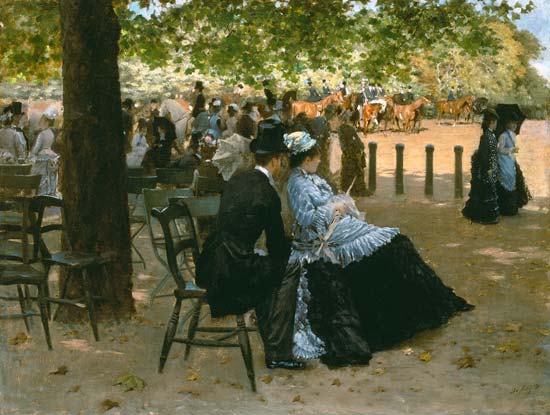
Degas invited De Nittis to show his work with the Impressionists in their first exhibition in 1874. He was the only Italian artist invited. De Nittis is frequently listed with the Impressionists. However, he employed only some of the Impressionists’ style while maintaining a strong traditional realist style. De Nittis’s “In the Shade of the Trees on the Racecourse” (1874) illustrates these two styles. Like the Impressionists he was a plein-air painter. While Impressionists decided to use only the colors of the rainbow, De Nittis continued to employ black, and he did not use the colors of the rainbow to create shadows. The elegant top hat and suit are highlighted with grays, as is the shadow on the white collar. The lady’s lovely blue and white striped dress does not contain any orange or yellow to create highlights; the traditional white and gray are used. However, the dapples of sunlight visible through the trees and the leaves, are mere splotches of paint.

 Like the Impressionists, De Nittis painted outdoors and used a shorter brush stroke to paint objects in the distance. Most like the Impressionists, De Nittis was interested in painting scenes of modern life: racetracks, strollers on boulevards or boating on rivers, and the bourgeois middle-class enjoying life’s pleasures. This painting is also called “The Flirtation,” a delightful scene of people enjoying a sunny day, prancing horses, and fashionably dressed ladies strolling under parasols. De Nittis’s paintings were in great demand. His work sold well, causing some criticism by both French and Italian artists who called his work commercial and superficial.  


“Return from the Races” (1875)

“Return from the Races” (1875) (23’’x45’’) (Philadelphia Museum of Art) depicts the bourgeoise sitting at outdoor tables and chairs, under the shade of leafy trees on a sunny afternoon. Horse-drawn carriages pass by on the way home from the race. Continuing to employ many black and white images, De Nittis included a wider palette of yellow, pink, tan, bright green, and light greens. The bark and fall foliage of the trees, more loosely and colorfully painted, stand out against a light blue sky with puffy white clouds. The shadows at the bottom of the clouds are an Impressionistic light purple. The more distant group of people is suggested by dabs and dots of paint. This work is part realism and part Impressionism.

“Lady Walking her Dog” (1878)

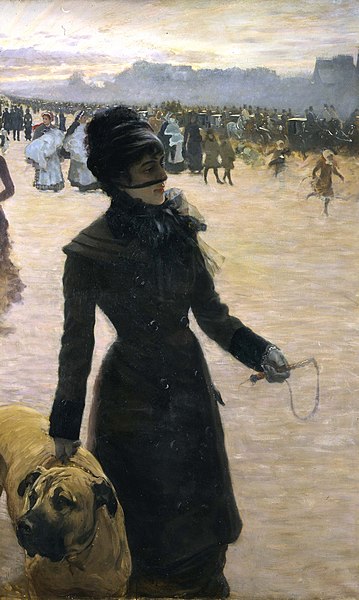
“Lady Walking her Dog” (1878), also titled “The Return from the Races,” singles out one of the fashionably dressed ladies De Nittis often depicted. She is beautiful and self-assured. Her outfit consists of a black hat that smartly but suggestively veils her face. The collar of her coat flares out in in three tiers, and her sheer black scarf is tied in a bow. Five pairs of shiny black buttons close her belted coat. Light gray leather gloves complete her outfit. This is a fashion statement. Also making a statement is the large golden-brown mastiff that she holds by the collar with her right hand, and the small whip she holds in her left hand. The people and the city in the background to the left and right of her head, serve only to highlight her face, not calling attention to themselves. This De Nittis painting was exhibited at the 1878 World Expo in Paris.

De Nittis was immensely popular and sociable in his time. Among the several exhibitions he participated in was the 1876 Universal Exposition, where he exhibited 20 paintings and won a gold medal. That year he also was made a member of the French Legion of Honor. He frequently traveled between Paris and London where he continued to chronicle the middle-class in front of the two cities’ signature sights. He and his wife Leontine held one of Paris’s most lively salons at their home. The walls were covered with paintings by Corot, Degas, Manet, Monet, and Japanese woodcuts. Guests included such famous writers as Alexander Dumas, Guy de Maupassant, Oscar Wilde, Emil Zola, Edmond Goncourt, who wrote the Dictionary of Art History, and luminaries such as Princess Matilda Bonaparte. Meals were cooked by De Nittis, who was proud both of his art and his cooking. 

De Nittis postage stamp (1984)        

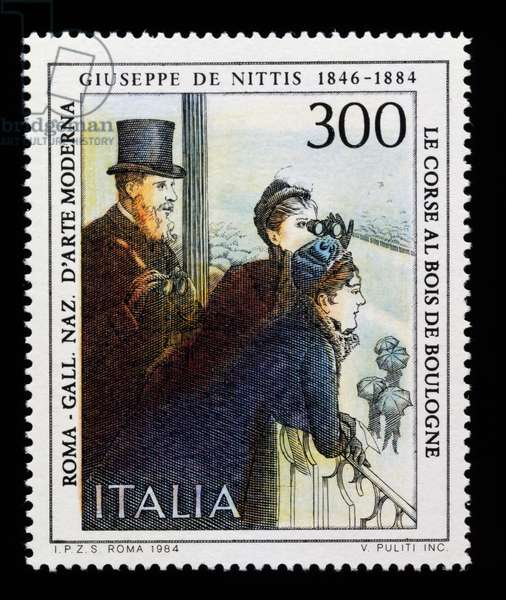
De Nittis died in Paris at age 38 from a stroke. A major retrospective of his work was held at The Galerie Bernheim Jeune in Paris in 1886. His work was featured at the Venice Biennale in 1901, 1914, and 1928. The Italian government issued the De Nittis postage stamp (1984) featuring the third section of his triptych “Le Course al Bois De Boulogne” (Longchamps) as a part of the Italian art series. The Impressionist artists such as Monet, Renoir, and Degas remain well-known, but De Nittis’s name has fallen by the wayside. The exhibition Small wonder: the forgotten art of Giuseppe de Nittis in New York in 1995 brought attention to his work.

The exhibition titled An Italian Impressionist in Paris: Giuseppe de Nittis, from November to February 2023, at The Phillips collection in Washington, D.C., continues to bring him well-deserved recognition.

Beverly Hall Smith was a professor of art history for 40 years.  Since retiring with her husband Kurt to Chestertown in 2014, she has taught art history classes at WC-ALL. She is also an artist whose work is sometimes in exhibitions at Chestertown RiverArts and she paints sets for the Garfield Center for the Arts.

The Spy Newspapers may periodically employ the assistance of artificial intelligence (AI) to enhance the clarity and accuracy of our content.

Filed Under: 1A Arts Lead, Looking at the Masters

Looking at the Masters: Honeysuckle and Woodpeckers

June 22, 2023 by Beverly Hall Smith Leave a Comment

Honeysuckle is the birth flower for the month of June. In Native American cultures the woodpecker is the spirit animal for the period of June 21 through July 21. As Europe began to explore the world beyond its borders, interest developed in the plants and animals in far off lands. The Renaissance saw the development of zoos and botanical gardens along with the sciences of zoology and biology. Artists, both women and men, were called upon to draw detailed images for publication in catalogs. Many of these artists are not well known, but their images are remarkable. 

Honeysuckle (1935)

“Honeysuckle” (6”x7’’) (1935) is a colored woodcut by the English artist Mabel Allington Royds (1874-1941). It is the flower for people born in the month of June, and it represents sweetness, happiness, affection, and love. Like many women artists, Royds was popular in her time, but she did not make it into the art history lexicon. Her talents were recognized early, and she was awarded at the age of fifteen a scholarship to the Royal Academy in London. She instead chose to enroll in the equally prestigious Slade School of Art in London. Later she traveled to Paris to train with noted printmaker and painter Walter Sickert. She taught art at Havergal College in Toronto, then she relocated to Scotland in1911 to teach at the Edinburgh College of Art. At that time, she began to make color woodcuts in the style of Japanese Ukiyo-e prints. Royds married in1913, and she traveled extensively with her husband in India. Her first popular woodcuts were of people and places in India.

Royds and her husband returned to Edinburgh, and they continued to teach at the College of Art. From 1933 until 1938, she changed her subject matter to flowers. She developed her own technique, using powdered color in a readymade medium, rather than rice flour paste to support the color, as used by the Japanese. “Honeysuckle” illustrates the intense color achieved by this method. Two fully-opened honeysuckle blossoms show the unique features of the blossom. For hundreds of years, children and adults have pulled one of the yellow trumpet-shaped flowers from the center and sucked a drop of the sugary sweet nectar.  The flowers have a sweet aroma that is attractive to people, bees, hummingbirds, and butterflies. The bright green leaves are paired, creating the symbol of affection and love. Honeysuckle was often found in wedding bouquets to represent happiness. 

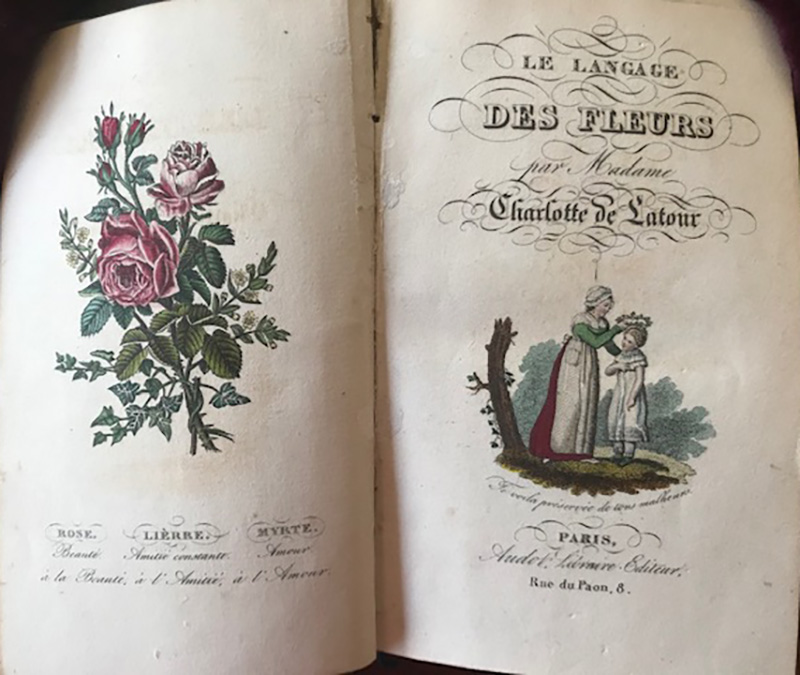
Madame Charlotte de la Tour’s The Language of Flowers (1819) was the first popular book to collect information about the symbolism of flowers from different time periods and cultures. There are two flowers for each month; June’s other flower is the rose. Numerous well-known artists have painted roses, a topic for future discussion. The Language of Flowers tells the history of honeysuckle going back to China where it was valued for its sweet nectar and beautiful flower as well as for its medicinal uses for a wide variety of ailments. It is an edible flower, and its sweet nectar is used in perfumes. In 4th Century Ireland, Druids carved a series of parallel lines on upright stones and tree trunks as a symbol of honeysuckle. The symbol was to commemorate a person, and meant one should follow one’s own path. It was intended to attract the sweetness of life. In Victorian England, planting honeysuckle by the entrance door brought good luck and stopped evil from entering. 

“Honeysuckle” (1883)

‘Honeysuckle” (1883) (wallpaper) was one of the first designs by May Morris during her early years working for her father William Morris in his still famous Morris & Co. in England. “Honeysuckle” was one of her most successful, long-lasting, and well-selling patterns. Like the plant that grows well on trellises, the brown branches intertwine across the surface of the pattern. Light and dark green leaves appear in pairs. Morris designed the wallpaper using the most common honeysuckle vine. Each blossom lives about three days, and turns from white to yellow. The twining of the branches and flowers as they climb and cling to posts and walls symbolizes nurturing, protection, loyalty, and formation of strong bonds.

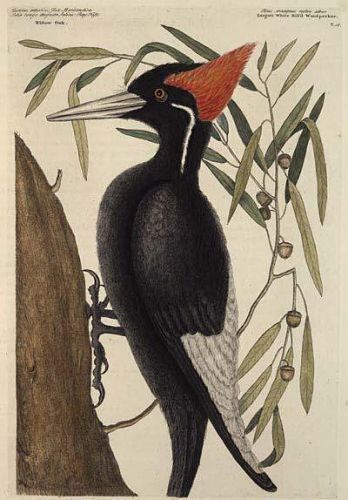
“Ivory-billed Woodpecker” (1731)

John James Audubon is the name that one thinks of when illustrations of American birds are discussed. However, “Ivory-billed Woodpecker” (1731) (etching) by Mark Catesby (1683-1749) of London is one of 220 etchings of the birds, mammals, plants, and others from his trips to America and the Bahamas in 1712 and 1722. Catesby’s etching clearly depicts the distinct characteristics of the ivory-billed woodpecker: black feathers, a notable long ivory beak, yellow eyes, a crest of red feathers on the male, a pattern of white feathers on its head, white feathers trailing down its back into the tail, and remarkable large talons made for climbing trees. Catesby has included acorns; nuts and berries are food for woodpeckers. However, his accuracy fails here, as frequently happened, when he randomly picked foliage from his many drawings of birds, plants, and other animals. 

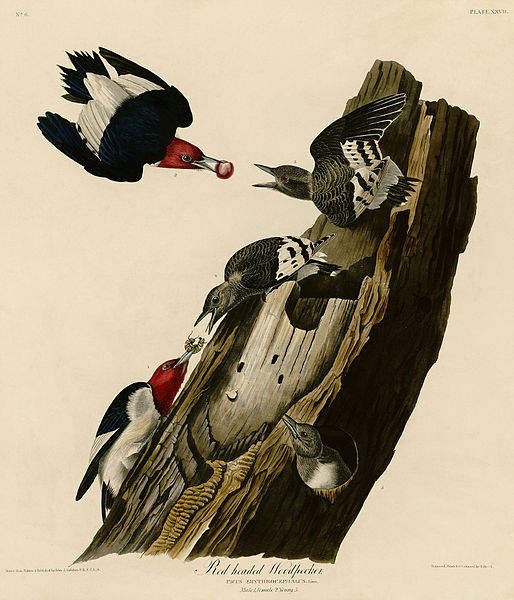
“Red-headed Woodpecker” (1840-44)

John James Audubon (1785-1851) depicts in “Red-headed Woodpecker” (1840-44) (10”x6.5’’) (lithograph) some of the characteristics of woodpeckers that are significant to their symbolism. They are committed, kind, and nurturing. Woodpeckers mate for life, and both the male and female create the nest, taking turns to peck a hole in the tree. They are considered creative because of the way they create their nest. They do not go back to the nest once it is used, leaving it for other birds to use. Other characteristics are their tenacity in making the nest, their intuition in finding insects for food hidden in trees, and their ability to balance on the bark or trees.  

Their pecking, like drumming, is thought to be communication between humans and the spirit world. The brilliant red feathers of the male crest are used by shaman in their rituals. Their pecking indicates their ability to be good communicators and thus good listeners. To hear pecking is considered an awakening, an opportunity is knocking, a call to find a new path, to keep moving forward, or to seize the moment. In ancient Rome the woodpecker was sacred to Mars, the god of war, and was associated with augury. Native Americans and other cultures, such as the Chinese, consider seeing a woodpecker very good luck.   

Beverly Hall Smith was a professor of art history for 40 years.  Since retiring with her husband Kurt to Chestertown in 2014, she has taught art history classes at WC-ALL. She is also an artist whose work is sometimes in exhibitions at Chestertown RiverArts and she paints sets for the Garfield Center for the Arts.


The Spy Newspapers may periodically employ the assistance of artificial intelligence (AI) to enhance the clarity and accuracy of our content.

Filed Under: 1A Arts Lead, Arts Portal Lead, Looking at the Masters

Looking at the Masters: Keith Haring 

June 15, 2023 by Beverly Hall Smith Leave a Comment

Keith Allen Haring (1958-1990) was born in Reading and raised in Kutztown, Pennsylvania. He was the son of an engineer and amateur cartoonist. Growing up with Disney cartoons and Dr. Seuss, Haring loved cartoons and began drawing them at an early age. After graduating from high school, he began to study commercial art, but he decided it was not for him. He moved to the Lower East Side of New York City in 1978 to attend the School of Visual Arts. The New York art scene was flourishing. He joined this thriving art community and became friends with artists such as Andy Warhol and Jean-Michel Basquiat. 

Keith Haring in a New York subway station (1980-1985)

His first drawings were on the matte black spaces between advertisements in the New York City subway stations. He said they were “a perfect place to draw.” From 1980 to 1985, using white chalk, he made over 5000 drawings. He developed several personal iconic images. A significant icon was “Radiant Baby.” Four babies crawl across the bottom of the drawing, and in the center of the heart-shaped head of an androgenous dancing figure is a “radiant baby.” The baby radiates lines of positive energy. For Haring, the baby was “the purest and most positive experience of human existence.” 

The radiant heart and dancing figure were influenced by the booming New York club scene, particularly Danceteria (1979-1986), where performers such as Madonna, Billy Idol, and Cyndi Lauper got their start. Positive energy lines radiate from everything and represent freedom, spontaneity, and joy. Haring stated, “I am becoming much more aware of movement. The importance of movement is intensified when a painting becomes a performance. The performance (the act of painting) becomes as important as the resulting painting.” His subway art was a performance of sorts because people often stopped and asked him questions: “I was always totally amazed that the people I would meet while I was doing them were really, really concerned with what they meant. The first thing anyone asked me, no matter how old, no matter who they were, was what does it mean?” Haring almost never titled his work.

“Keith Haring Drawings, Tony Shafrazi Gallery” (1982)

By 1982, Haring’s hundreds of subway drawings were a major attraction, and he began to make a series of posters to support various messages. For Haring, “Art is nothing if you don’t reach every segment of the people.” Tony Shafrazi, a major art gallery owner in Soho, gave Haring a solo exhibition in 1982.  “Keith Haring Drawings, Tony Shafrazi Gallery” was the cover design for the exhibition in Soho. Four crawling babies occupy the center of the poster and are accompanied by a cross in a circle, referencing the various Jesus movements of the 1970’s and 80’s, like the Campus Crusade for Christ and American cult leader Jim Jones whose followers committed mass suicide in Guyana in 1978.

In the lower section of the drawing, barking dogs, are another of Haring’s iconic images. Dogs are generally thought of as “man’s best friend” and are trusted companions. In Haring’s world, discrimination, racism, drugs, AIDS (1981), and Three-Mile Island (1979) became causes for his social activism. Barking dogs were meant to act as warnings to viewers to stop and think of abuses of power present in society. At the top of the drawing, two robust figures lift a radiating third figure into the air. Caution and hope are depicted in the same work. 

In 1982, Haring became the first of twelve artists to show his work on the computer-animated billboard in Times Square, New York. 

“International Youth Year” (1985)

The United Nations commissioned Haring to design an image to commemorate International Youth Year. His poster of the same name (1985) (11”x 8.5” lithograph) (edition of 1000) contains a brilliant blue figure radiating energy and holding up a globe, another Haring iconic image to represent world peace and unity. This frequently employed image represented his belief in the need for collaboration and positivity in a world faced with numerous global issues. 

“Free South Africa” (1985)

“Free South Africa” (1985) (32”x40” lithograph) addresses one of the many critical issues Haring supported with his art. He distributed more than 20,000 posters in New York City in1986 to awaken consciousness about apartheid. In his journal he wrote, “Control is evil. All stories of white men’s ‘expansion’ and ‘colonization’ and ‘domination’ are filled with horrific details of the abuse of power and the misuse of people.” 

“Crack is Wack” (1986)

“Crack is Wack” (1986) was Haring’s first major outdoor mural. After trying to help his friend Benny get off crack cocaine, and Benny’s subsequent death, Haring painted this large mural on the wall of an abandoned handball court in Harlem. The large mural features the skull, ribcage, and arms and legs of a skeleton holding on to a burning zero-dollar bill. The crack pipe and the raging and dying figures deliver a strong anti-drug message.

Haring was arrested and faced jail and a fine when The Washington Post, The New York Post, and local people wrote to support the anti-crack image. As a result, Haring was allowed to plead guilty to a lesser charge of disorderly conduct and paid a $100 fine. The mural was vandalized and had to be painted over. However, the New York City Department of Parks and Recreation offered Haring eight sights for repainting the mural. He chose the original location. 

Haring voluntarily created from 1982 until 1989 over 50 public works of art many for hospitals, day care centers, and schools. He opened in Soho in1986 Pop Shop, a boutique to sell posters, prints, t-shirts, buttons, magnets, and more. Pop Shop made his art accessible to everyone. Haring said, “I could earn more money if I just painted a few things and jacked up the price. My shop is an extension of what I was doing in the subway stations, breaking down the barriers between high and low art.” 

“Ignorance=Fear, Silence=Death” (1989)

As a gay man, he tackled the AIDS epidemic that started in 1981. “Ignorance=Fear, Silence=Death” (1989) is one of many images Haring developed to awaken America to the AIDS crisis. The figures stamp their feet and cover their eyes, ears, and mouth, representing the three monkeys See No Evil, Hear No Evil, and Speak No Evil. The images first appeared in a carving on a Japanese temple during the Muromachi period (1336-1573), and it has been in common use world-wide. Haring’s other AIDS related images depict loving couples and promote safe sex.

Haring formed the Keith Haring Foundation in 1989 to perpetuate his “artistic and philanthropic legacy through the preservation and circulation of his artwork and archives by providing grants to children in need and those affected by HIV/AIDS.” (Keith Haring Foundation web-site)

“The Last Rainforest” (1989) (detail)

“The Last Rainforest” (1989) (detail) was one of Haring’s last three paintings. Haring traveled to Brazil frequently with Kenny Scharf and his Brazilian wife. His interest in saving the rainforest was intense. He planned an exhibition of 100 paintings to help create awareness of this environmental disaster. “The Last Rainforest” (72”x 96”) is a dense painting containing multiple colliding figures. Haring iconic images are included with burning, impaled, or roasting figures. Monsters, serpents, smoking guns, and stabbing knives, are woven together with branches of trees. 

“The Last Rainforest” (detail) illustrates the density and intensity of the entire painting. In the chaos, there is one peaceful detail: Radiant Baby. This time, the baby sits in the lotus position of the meditating Buddha. Radiant Baby evolved in Haring’s work, coming to represent a warning about nuclear proliferation and the meltdown of nuclear reactors such as those of Three-Mile Island (1979) and Chernobyl (1986). Haring’s warnings were significant in all his work. In this instance Radiant Baby can be interpreted as Haring, knowing he has only a little time left, and has found peace in the chaos of the world. He painted only three of the 100 canvases, working on them as he was dying.

“Tuttomondo” (1989)


“Tuttomondo” (1989) (translation “All the World”) (591 square feet) was painted on the wall of the Church of Sant’ Antonio Abate in Pisa, Italy. In New York, Haring met graduate student Piergiorgio Castellani, who asked Haring to come to Pisa to paint the mural. The mural was painted in one week in mid-June 1989. Its theme is peace and harmony. The mural contains 30 Haring iconic figures, including red and yellow flying angels and dancing and loving people. In the center are a blue figure with a television for a head, another of Haring’s iconic figures, a red mother with a blue baby, and a red barking dog. At the top, a blue dolphin, another iconic figure, rides on the back of a purple figure. The popular image links humans with nature. Blue scissors cut in half the red serpent of evil. Haring stands at the base of the wall.

Haring describes the week-long experience:  “Every day there would be more and more people.” Haring later recalled, “When I put my last stroke on the wall, it all seems incredibly Felliniesque. It all seems utterly unreal–beyond anything I had ever experienced before.” This was Haring’s last wall mural. 

Keith Haring died from complications of AIDS on February 16, 1990. His memorial service at the Cathedral of St. John the Divine was attended by over 1000 people.  

Beverly Hall Smith was a professor of art history for 40 years.  Since retiring with her husband Kurt to Chestertown in 2014, she has taught art history classes at WC-ALL. She is also an artist whose work is sometimes in exhibitions at Chestertown RiverArts and she paints sets for the Garfield Center for the Arts.
“I don’t think art is propaganda; it should be something that liberates the soul, provokes the imagination and encourages people to go further.  It celebrates humanity instead of manipulating it.” (Keith Haring)


The Spy Newspapers may periodically employ the assistance of artificial intelligence (AI) to enhance the clarity and accuracy of our content.

Filed Under: 1A Arts Lead, Looking at the Masters

Looking at the Masters: Henri Fantin-Latour      

June 8, 2023 by Beverly Hall Smith Leave a Comment

Ignace Henri Jean Theodore Fantin-Latour was born in 1836 in Grenoble, France. His father, an artist, was his first teacher. When the family moved to Paris in 1850, Fantin-Latour spent three months on probation at the Ecole des Beaux-Arts, but he was not admitted.  Undaunted, he began to copy the old masters at the Louvre. In particular, he studied the still life paintings of Louise Moillon (1610-1696) and Jean Chardin (1699-1779). Fantin-Latour said, “The Louvre, there is only the Louvre.”

Fantin-Latour and the Impressionists Manet, Morisot, Degas, Renoir, and Monet were great friends, but he chose to go his own way: “To make a painting representing things as they are found in nature…[I] put a great deal of thought into the arrangement, but with the idea of making it look like a natural arrangement of random objects.”  He was an accomplished portrait          painter, but his true calling was to paint flowers. He wrote, “Never have I had more ideas about Art in my head, and yet I am forced to do flowers.”

“Chrysanthemums” (1862)

“Chrysanthemums” (1862) (18’’x22’’) (Philadelphia Museum of Art) was the painting that started Fantin-Latour’s long-time popularity with England’s Victorian society. His friend James Abbott McNeill Whistler promoted the flower paintings in England, and the British fell in love with them. There are over 800 extant still life paintings by Fantin-Latour, mostly of flowers. The small scale of his flower paintings made them fit well into heavily decorated Victorian houses. The chrysanthemum signified to the Victorians friendship, happiness, and well-being.

Influenced by17th Century Dutch still life paintings, Fantin-Latour placed his flowers against a neutral background. Although the painting is titled “Chrysanthemums,” he included several other popular flowers found in English gardens. The Victorians fervently studied Floriography, the language of flowers, and several floral dictionaries were available to the upper and the new middle classes. Flora Symbolica (1819) by John Ingram identified 100 flowers and their symbolic meanings and discussed the proper etiquette for sending flowers. 

“Summer Flowers” (1866)

“Summer Flowers” (1866) (29”x23’’) (Toledo Museum of Art, Ohio) likely was painted in June because the variety of flowers in the glass vase, hydrangeas, ranunculus, and roses bloomed in June. They are accompanied by strawberries, oranges, and a white, lidded pot. For the Victorians white hydrangeas were symbolic of gratitude, happiness, and enlightenment. Several multicolored ranunculi in pink, yellow, and white, represented attraction, charm, and “I have a crush on you.” Two white rosebuds are tucked into the bouquet. Colors of flowers had different meanings. The color white was the symbol of purity, innocence, silence, and secrecy.

Strawberries have a long history as symbols of purity and sensuality, as well as fertility and abundance. The double meaning was derived from the sweetness and the beauty of the berry. The strawberry was a symbol of the Virgin Mary; the plant produces white flowers and red fruit at the same time, symbolic of Mary’s motherhood and continued virginity. A succulent fruit, and at the time as exotic one, the orange was frequently depicted in paintings of the Garden of Eden. Orange sections represented fertility.  Orange trees were planted in luxurious gardens of kings, such as the Orangerie at Versailles. 

Fantin-Latour credited his study of still-life paintings in the Louvre as his teacher and inspiration. Dutch still-life painters frequently showed off their painting skills by depicting the textures of slices of oranges and lemons. Fantin-Latour’s paintings contain a variety of brush strokes, thick and thin paint, and other techniques he employed to render the variety of textures and surfaces of petals and leaves, of glass, and of cloth and wood. 

“Pansies” (1874)

“Pansies” (1874) (18”x22’’) (Metropolitan Museum of Art) depicts two pots and a basket of multicolored pansies. Named after the French word pensée (thought), pansies were regarded as cheerful because of their bright colors and sweet faces. Their faces also could cause someone to become nostalgic, because reminding a viewer of a beloved person who no longer is present.  Pansies were called heartsease by the ancient Greeks, who believed the ancestors of pansies, violas, could be used as a love potient, as did the Celts. Pansies are edible and have been used medicinally since the 16th Century.  The first pansies were white and blue. English gardeners in the 1830’s fell in love with pansies and cross-bred over 400 varieties. The face first emerged in 1839.

“Pansies” allows the viewer to appreciate Fantin-Latour’s artistic skill. The rough texture of the pots is played off against the polished shine on the old wood table top, and the velvet softness of the pansy petals. The light and shadow dancing on the leaves create a pleasing effect. 

The yellow pansy in the basket stands out. The bright yellow signifies happiness, joy, and positivity. The other yellow pansies in the painting draw the viewer’s eye around the composition to include a bunch of yellow apples at the lower right. The blue and purple pansies are symbols of devotion, honesty, and loyalty. Blue is the color of the sky and of the Virgin Mary’s garment. The dark purple pansy adds another message–broken love. It is a reminder of something beautiful that was lost.

“Hollyhocks” (1889)

“Hollyhocks” (1889) (29’’x24’’) represent the circle of life, ambition, fertility, and abundance. Hollyhocks bloom from the middle of summer until the first frost of fall. The plant had many medicinal uses, one of them hollyhock tea. The petals were used in jam, jelly, confections, and in salads. In England these tall, large, and sweet-smelling flowers were planted by the front door to welcome visitors, and invite in prosperity.  Legend says the Crusaders brought hollyhocks back from the Holy Lands, thus the name holly. The crusaders made a salve from the plant to treat their horses’ hind legs, called hocks.  In Egypt, wreaths of hollyhock were placed in tombs to help the dead on the journey to the afterlife. 

Fantin-Latour’s arrangement appears to be a casual bouquet, but as in all his paintings, the composition is well planned, interesting, and unique. 

The flowers placed on a well-worn wooden table stand out against a carefully chosen beige background.  The center stems of pink hollyhocks relay a message of sensitivity and thoughtfulness. The yellow blossoms at the sides mean friendship and trust. The darker purple blossoms at the back and laid casually on the table are symbols of charm and grace. Purple is always considered the royal color, and it signifies tradition. Fertility and abundance are represented by the large number of buds at the end of the stems.

One additional use for hollyhocks in England was to shield the outhouse from view. However, their stalks stood tall enough to call attention to the structure so ladies would not have to ask where it was. The pleasing fragrance of hollyhocks also was useful. In Maryland, hollyhocks also were planted around the outhouse.

“Peonies” (1902)

The peony appeared in China about1000 BCE, and then spread to Japan. In both countries peonies are called the “king of flowers.” In Greece, Paeon was the physician to the Gods. He healed several of them with a milky substance made from peony roots. Thus, the name of the flower. The flower has several meanings: love, honor, happiness, wealth, romance, beauty, good will, best wishes, and joy.  

Fantin-Latour’s “Peonies” (1902) (16.5”x14.5”) shows five pink peony flowers in three different stages of life. Two peonies are buds, not yet fully opened, two are in full bloom, and the last has spread its petals out, and they are about to drop off one by one. The stems of the peonies are visible in the glass vase. Fantin-Latour’s careful study of the blossoms illustrate his masterful handling of light and shadow. Some petals catch the sun, coming from the right, that bleaches their pink color almost to white. A range of pinks lead to the deeper pink center of the flower. A touch of sunlight glistens on the glass vase. 

Fantin-Latour married Victoria Dubourg, a fellow flower painter, in 1875. They lived in Paris and spent summers at Victoria’s family country estate in Normandy, France. He was a quiet man. He died in 1904. French novelist, playwright, and art critic Emile Zola was known for his support of Impressionist artists, also appreciated the work of Fantin-Latour: “The canvases of M. Fantin-Latour do not assault your eyes, do not leap at you from the walls. They must be looked at for a length of time in order to penetrate them, and their conscientiousness, their simple truth–you take these in entirely and you return.” 

Beverly Hall Smith was a professor of art history for 40 years.  Since retiring with her husband Kurt to Chestertown in 2014, she has taught art history classes at WC-ALL. She is also an artist whose work is sometimes in exhibitions at Chestertown RiverArts and she paints sets for the Garfield Center for the Arts.

The Spy Newspapers may periodically employ the assistance of artificial intelligence (AI) to enhance the clarity and accuracy of our content.

Filed Under: 6 Arts Notes, Arts Portal Lead, Looking at the Masters

Looking the the Masters: Calder Circus by Beverly Hall Smith

June 1, 2023 by Beverly Hall Smith Leave a Comment

Alexander Calder (1898-1976) was born in Philadelphia, Pennsylvania into a family of artists.. His grandfather and father were known for their public sculpture commissions, and his mother was a portrait artist. Alexander, better known as Sandy, started making small sculptures of mixed materials by1902.  The first one was an elephant. By age ten, Sandy had a small workshop. However, his parents having experienced the artist life, wanted Sandy to choose another line of work. Sandy graduated from the Stevens Institute of Technology in New Jersey with a degree in mechanical engineering. The following inscription was written in his yearbook: “Sandy is evidently always happy, or perhaps up to some joke, for his face is always wrapped up in that same mischievous, juvenile grin. This is certainly the index to the man’s character in this case, for he is one of the best natured fellows there is.” 

“Calder Circus” (1926-1931)

Calder held several jobs as a hydraulic engineer, draughtsman, mechanic, and timekeeper at a logging camp. From the camp he wrote home to request paint and brushes to paint the mountain scenery. He started his art studies in 1923 at the Art Students League in New York City. He frequently visited Coney Island, the circus, and the Bronx and Central Park zoos. He began the creation of the “Calder Circus” (1926-1931). Over the next several years the “circus” grew to over 70 miniatures of performers, almost 100 accessories, 30 musical instruments, records, and noisemakers. Eventually the work filled five suitcases. The figures were made of wire, wood, metal, cloth, yarn, cardboard, leather, cloth, string, rubber tubing, corks, buttons, rhinestones, pipe cleaners, bottle caps, and other found objects.

Calder moved back and forth from Paris to New York from 1926 until 1933. He performed the show over 70 times. In Paris his audience included critics, collectors, and artists from the theatre, and literature, including the Parisienne avant-garde, Miro, Duchamp, Cocteau, and Leger. Paris audience members sat on bleachers made from champagne crates, and they ate peanuts. They were given noisemakers to sound when Calder gave the signal. In New York his audience included members of high society. Calder announced the acts in French or English, choreographed all the movement, gave voice to the performers and animals, played music, and created sound effects. The shows were so well received they often lasted for two hours. 

At the lower right-side corner of the display is the “Little Clown Trumpeter.” In a performance, Calder would place a balloon in the clowns mouth and then blow through the hose until the balloon burst and knocked over the bearded lady that was placed in front of him. The figures in the middle are a cowboy wearing wooly chaps, a bull made of wire and corks, a cowboy on horseback wearing a red bandana and holding his black hat, and a woman waving an American flag. A street lamp, and a dachshund fill in the left front corner. At the rear, three trapeze artists hold onto the high wire that Calder would vibrate to animate them. In case one should fall, a net was suspended beneath.

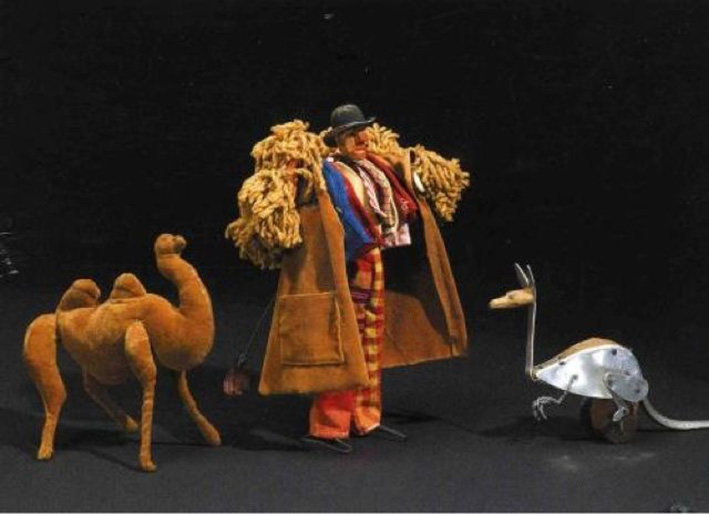
“Clown, Camel, Kangaroo”

The clown (10.5’’x7’75’’x5’75’’) is dressed in a long brown coat with arms made of Yarn. Calder would strip off the clown’s clothes in layers until he was dressed in coveralls, and revealed to be a thin wire figure. The camel is a cloth sculpture sewn together and wired for stability (6.5’’x5’75’’x4’25’’). The kangaroo is made from shaped pieces of metal nailed to a wooden base on a wheel. When the kangaroo is pulled by an attached cord its legs appear to move, similar to a child’s pull toy. As a result of the success of his inventions, Calder went to Oshkosh, Wisconsin, in 1927, to meet with a children’s toy manufacturer. They signed a contract for his Action Toys: a hopping kangaroo, a skating bear, and a goldfish that appeared to swim, opening and closing its gills when pulled.  

“Monsieur Loyal and Lion Cage”


Standing in the center ring, ringmaster Monsieur Loyal in top hat and tails points to the lion in cage. Out of the cage for a performance, the lion completed a few tricks and then sat on a pedestal. The lion then dropped a few chestnuts as if popping, which were quickly removed. Calder planned to add scent to the performance, but he found musk perfume too expensive and abandoned the idea.

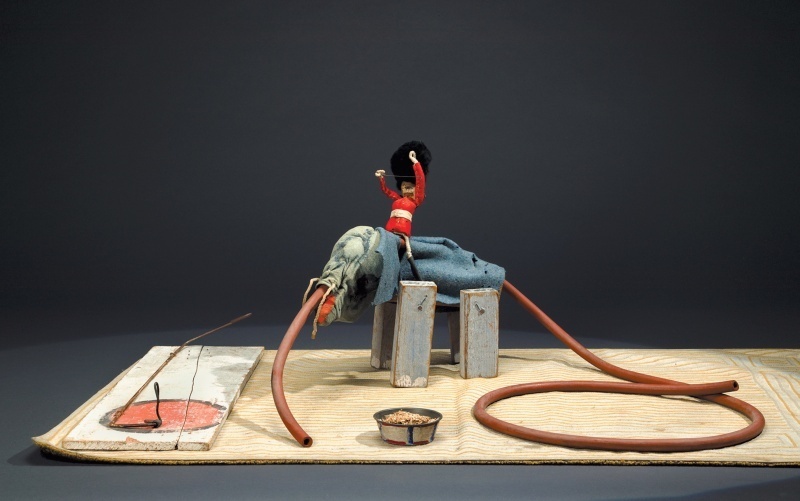
“Elephant and Rider”


Other attractions at the Calder Circus included a sword swallower, Sultan of Senegambia, who threw spears and axes, a belly dancer who gyrated, a horse and chariot, cows, seals, a tightrope act, dogs, and other acts from the circus and the side show. The rider on the elephant appears to an English Kings Guard wearing a bearskin hat and bright red tunic. The elephant has a tube running through its body. In a performance the tube/trunk hung down as if the elephant were drinking water, but when Calder blew into the tube the trunk raised up and spewed out small pieces of paper to  give the effect of  spaying water. 

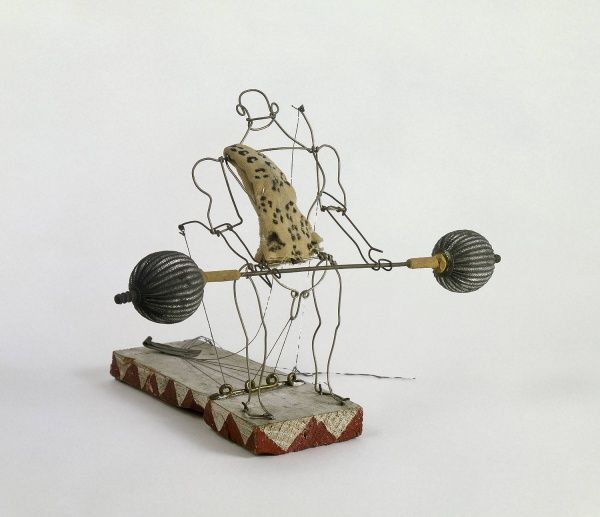
“Rigoulot, the Strong”


 Calder included well-known circus performers in his show. May Wirth, a famous bareback rider from the Barnum and Bailey circus, performed in the center ring. “Rigoulot the Strong” was a popular performer. When Calder loosened the cord, Rigoulot bent forward and picked up the barbell with his wire-hook hands. When the cord was tightened, the figure returned to the upright position and groaned. The figure then proceeded to lift the barbell backward and over his head.

During the run of the “Calder Circus” from1926 to 1931, Calder added a new dimension to the show with a series of figures constructed of wire only (1929). After meeting Piet Mondrian in 1930 and after being introduced to totally abstract art, he wrote a letter to Mondrian stating it was “the shock that converted me. It was like the baby being slapped to make its lungs start working.” It was then that Calder began to work as he said, “Just as one can compose colors, or forms, so one can compose motions.” He began creating his “Mobiles” in 1931.

Calder gave the last performance of the Calder Circus in 1961, for the filming of Le Cirque de Calder by Carlos Vilardebo. The Whitney Museum in New York City raise $1.25 million in 1932 to the purchase the Circus. The work continues on display at the Whitney.

Beverly Hall Smith was a professor of art history for 40 years.  Since retiring with her husband Kurt to Chestertown in 2014, she has taught art history classes at WC-ALL. She is also an artist whose work is sometimes in exhibitions at Chestertown RiverArts and she paints sets for the Garfield Center for the Arts.
 

The Spy Newspapers may periodically employ the assistance of artificial intelligence (AI) to enhance the clarity and accuracy of our content.

Filed Under: 1A Arts Lead, Arts Portal Lead

Looking at the Masters: Hung Liu – Part 4

May 25, 2023 by Beverly Hall Smith Leave a Comment

Hung Liu had many talents. She was a painter, photographer, video maker, and a printer. Since 2006, several of her paintings have been chosen to be woven into tapestries. In 2004 she attended the Tamarind Workshop at the University of New Mexico in Albuquerque, established in 1960 to advance the art of printmaking in America. There she developed a unique style of printmaking that involved layers, also in her paintings. Hung Liu won in 2011 the SGC International Award for Lifetime Achievement in Printmaking. 


“Dandelion with Mallard” (2016) (32’’x31’’) (monoprint with hand leafing and hand coloring) is from a series titled Drifters. On a road trip with her husband in the summer of 2014, Hung Liu began to photograph dandelions.  Large paintings from the series are titled by location: “Deadwood,” “Little Big Horn,” and “Mt. Rushmore.” Hung Liu appreciated the fact that dandelion seeds are migratory, they cross all earth and water barriers, and then multiply in new lands. The painting and prints depict dandelions past their prime, their blossoms going to seed. Their life is ending but is regenerated by the seeds.

The familiar Hung Liu circles and drips continue in this print. She also adds a brightly colored Mallard duck, in Chinese tradition a symbol of prosperity, abundance, and good luck.

“Migrant Mother” (2015)

Hung Liu visited the Oakland County Library in California in 2015 to study the archives of Dorothea Lange and the other photographers of the WPA (1939-43) who documented the Great Depression in America.  “Migrant Mother” (2015) (66”x66”) (oil) was one of the first of many paintings and prints in Hung Liu’s exhibition American Exodus. She commented,“This landscape of struggle is familiar terrain, reminding me of the epic revolution and displacement in Mao’s China. Only, now I am painting American peasants looking for the promised land.” 

Although the Dorothea Lange image is familiar to most viewers, Hung Liu said she finds “true inspiration…to discover, to excavate, to peel off the layers and try to find out what was there that got lost, for there is always something missing.” In “Migrant Mother” the face is the same as Lange’s photograph, but the poses of both mother and child are slightly altered, and a background is added. The figures are placed in a room, its dreary grey-brown color resembling a tent, not a house. A kerosine lamp and a bowl are placed on the table,

To offer hope in an atmosphere of despair, Hung Liu has painted a pink square on the wall, and the image of man’s hand holding a bouquet of freshly picked daisies. Daisies are an international symbol of purity and innocence. They represent new beginnings, and they bring joy. She said, “We can adopt each other’s children, so why can’t we adopt each other’s ancestors.”

“Tobacco Sharecropper” (2017)

“Tobacco Sharecropper” (2017) (monoprint with silver leaf) (33”x33”) depicts a barefoot and bare legged little girl helping her father pick tobacco. Hung Liu’s introduction of metal onto the surface of the print achieves a unique multicolored, mirror-like surface that reflects light. Her art education in China included painting of Russian Icons where precious metals, particularly gold leaf, were layered onto the image to increase its spirituality. Hung Liu’s inclusion of silver and gold leaf serve the same purpose. The images of the past are not lost, but brought back from history and preserved for the future.  

Hung Liu states: “With this new body of paintings, I would like to summon the ghosts from Dorothea Lange’s brilliant [black and white] photographs…I personally identify with Ms. Lange’s photographs since I am myself an immigrant from China and was caught up in wars and famines…forcing my family to migrate elsewhere. As an American citizen, I am very passionate about how painting American subjects remind me so much of those of my homeland.”

An exhibition of Hung Liu’s work was scheduled to open on December 6, 2019, at the Center for Contemporary Art in Beijing. The exhibition was abruptly cancelled in November.  Hung Liu had agreed to remove a few of her paintings that were considered too controversial, but the reason for the cancellation was suspect, permits to bring her work into China were denied. In an interview with Art News (2019) Liu stated, “The message is anti-war so I thought it was OK. When I talked with my Chinese artist friends about it, they just said one word: Hong Kong.” Hung Liu held a cancellation party on the day the show was supposed to open.

“Sanctuary” (2019) (72”x72”) (oil with gold leaf) depicts a Mexican mother and her baby boy. Hung Liu’s concern for immigrants included those Mexican, Guatemalan, and Central American migrants arriving in large numbers at the American border. She visited the Texas border and talked with and photographed many migrants. The expression on the face of this mother displays a mixture of emotions: joy, thankfulness, relief, and many more. Previously, Hung Liu painted Madonna-like figures in different forms, both Chinese and African American. In “Sanctuary,” Hung Liu placed a solid gold leaf circle behind the woman’s’ head. It is a reference to the Virgin Mary, to the Mexican Virgin of Guadalupe, to the halo always around the head of the Buddha, and it represents the sun and hope.  

Hung Liu retired from Mills College in 2014, but she never stopped working. She died on August 7, 2021 as the result of pancreatic cancer. She was 73 years old. She was an internationally respected and beloved artist, and her work was exhibited in over fifty solo exhibitions.  Memorial exhibitions continue to be scheduled world-wide. Her paintings remind us that everyone, no matter the race, religion, or place in the world, should be respected and honored. Having come from an authoritarian country, she loved American democracy. She remarked: “The story of America as a destination for the homeless and hungry of the world is not only a myth. It is a story of desperation, of sadness, of uncertainty, of leaving your home. It is also a story of determination, and—more than anything—of hope.” (Hung Liu, 2017)

Beverly Hall Smith was a professor of art history for 40 years.  Since retiring with her husband Kurt to Chestertown in 2014, she has taught art history classes at WC-ALL. She is also an artist whose work is sometimes in exhibitions at Chestertown RiverArts and she paints sets for the Garfield Center for the Arts.


The Spy Newspapers may periodically employ the assistance of artificial intelligence (AI) to enhance the clarity and accuracy of our content.

Filed Under: 1A Arts Lead, Arts Portal Lead

Looking at the Masters: Hung Liu – Part 3

May 19, 2023 by Beverly Hall Smith Leave a Comment

“When I got the United States, I had already lived half my lifetime in China. I did not really think about this; I just got on with my studies and trying to make a success of my painting career…. But I always felt I should be doing more, because of the Cultural Revolution and so on.”  Since her arrival in San Francisco in 1984, Hung Liu’s paintings have dealt with the cultural history she uncovered in old photographs. “I use historical photographs, they’re already grainy and really blurry–so it’s like memory, like our sense of perception, out of focus over time.”

‘Refugees – Woman and Children” (1999)

Another of her frequently represented themes is the struggle of so many Chinese people who were displaced as a result of disruptions caused by famine and war. “Refugees: Woman and Children” (1999) (80’’x120’’) is from a series titled Refugees. Everyone, from the very young to the very old, is affected. The old woman has become responsible for two babies placed in large woven baskets.  Sadly, Hung Liu also recognized the photograph might have depicted a mother desperate to sell her infants, not uncommon in China at the time. Her ability to communicate to the viewer sensitive facial expression is remarkable. 

To counteract desperation of the mother, she includes images of hope for the future. In China the crane and sparrows are powerful symbols of happiness. Lotus blossoms grow from the mud and muck at the bottom of ponds, but the flower rises above to bring great beauty and happiness into the world. It is a symbol of resurrection. The images of the Buddha bring a message of hope and a blessing to guide the family to a better life. Hung Liu’s emotional connection to the people, and her painting of the events, is sensitive and strong.  Viewers can easily connect to the people and their circumstances.

“Arise Ye Wretched on the Earth” (2007)

“Arise Ye Wretched of the Earth” (2007) (80”x80”) was the cover painting for the exhibition catalog Daughters of China. Hung Liu titled the exhibition after a Chinese propaganda film she had seen in 1948. “Arise Ye Wretched of the Earth” is a photograph of eight paramilitary women who threw themselves into the river rather than be taken prisoner during the Japanese invasion of Manchuria in 1931.

“Tis the Final Conflict” (2007)


Among the paintings in Daughters of China, several were titled “Tis the Final Conflict” (2007) (66”x66”). The paintings feature the incredibly expressive faces of individual Chinese warrior women, in groups, alone, and some with their fallen comrades. They are a compelling reminder of the terrors of war.

Hung Liu witnessed the Wenchuan earthquake in 1976 that killed 240,000 people. She painted “Richter Scale” (2009) (80”x160’’) in response to the 8.0 earthquake on May 12, 2008 in Sichuan. The quake killed 90,000 people, including the children attending an elementary school, largely as a result of the soddy construction of the building. She was in China in May 2008 for two solo exhibitions of her work in Beijing and to paint landscapes when the earthquake occurred. 

Building materials and bits and pieces of destroyed items are piled high in this thirteen-foot-long painting. A young girl and her little sister sit amidst the devastation. White birds, like angels, fly over the debris but can do nothing. At the upper right an animal’s eye, orange and black, looks out from the pile of wood. 

“Apsaras – White” (2009)

Hung Liu’s exhibition titled Apsaras (2009) was installed in 2009 at the Nancy Hoffman Gallery in New York City. “Richter Scale” and other paintings of victims of the earthquake were included. Many of the portraits were simply titled Apsaras and a color. Many are of children with bandaged faces. “Apsaras – White” (2009) presents a poignant image of an old woman’s response to what she has seen. The Apsaras, the swirling female figure in blue, tries to bring what comfort she can to the grieving woman. The Apsaras is a beautiful heavenly maiden found in both Buddhism and Hinduism. The Apsaras sings and dances, a much-needed presence bringing calm and hope.

“Grandfather’s Rock” (2013)

Hung Liu and her husband Jeff Kelley visited Qianshan in the summer of 2006. The province encompasses almost one thousand mountain peaks and forests where Buddhist and Taoist monasteries continue to function. Liu Weihua, Hung Liu’s beloved grandfather, was the foremost Chinese authority on the temples, stone steles engraved with carvings, caves, and carved stairways that populate the area. He photographed them for years; his book Qianshan was published posthumously in 2002. Hung Liu’s exhibition Quinshan: Grandfather’s Mountain (2013) included 14 paintings based on his photographs. “Grandfather’s Rock” (2013) (48’’x60’’) is one of her paintings. Grandfather Liu, a large stone stele from which water flows into a stone basin, and a cluster of yellow chrysanthemums, and the trees in the foreground, all carefully painted, occupy the center of the composition. The distant trees with cloudlike foliage dissolve into the sky. Hung Liu uses two styles of painting, realistic and abstract, to focus viewers’ attention on the transition from earth to sky.  

The cluster of yellow chrysanthemums, a symbolic element in the painting, represents longevity, wealth, and tranquility. The flower is native to China and important for 3000 years. The plant grows in the early spring, but does not bloom until fall. It is a popular flower in Chinese gardens, and in paintings, pottery, and poetry. It is treasured for its medical qualities.

“The Botanist” (2013)

“The Botanist” (2013) (96’’x54’’) is a portrait of Hung Liu’s grandfather. He was a major influence on her life. Liu Weihua focused his life-long study of Qianshan ecology as well as the religious shrines. Hung Liu commented, “I remember a lot of things: his face, his demeanor, his body language. He had hands that were very soft and big. So those kinds of things were very important for me as part of these paintings.”

“Silver River” (2013)

“Silver River” (2013) is a mural Hung Liu painted on a long wall in the San Jose Museum of Art for her exhibit Questions for the Sky. The brochure accompanying the exhibition states that it is “A meditation on the fleeting nature of life and death, the work itself is ephemeral by design: it will disappear forever when the exhibition ends on September 29, 2013.” Climbing ladders and scaffolds, Hung Liu painted the mural in just one week. 

 Hung Liu painted “Sliver River” (2013) (detail) using traditional black paint in the style of historical Chinese scrolls. Her personal symbols, circles, lotus flowers, and an Asparas, are painted in color.  A video of the work in progress was accompanied by three other Hung Liu videos titled Black Rain, Candle, and Between Earth and Sky.  The videos contained photographs taken by Hung Liu each day with her iPhone the year after her mother died. 

The series of articles on Hung Liu will conclude in the next issue of the Spy.

In my work, my experience as a Chinese immigrant to the United States is quite important, and I also discovered some very important historical photographs, both in the U.S. and in China. We were never allowed to see such photographs when I was in China.

Beverly Hall Smith was a professor of art history for 40 years.  Since retiring with her husband Kurt to Chestertown in 2014, she has taught art history classes at WC-ALL. She is also an artist whose work is sometimes in exhibitions at Chestertown RiverArts and she paints sets for the Garfield Center for the Arts.


The Spy Newspapers may periodically employ the assistance of artificial intelligence (AI) to enhance the clarity and accuracy of our content.

Filed Under: 1A Arts Lead, Arts Portal Lead

Looking at the Masters: Hung Liu (Part 2)

May 11, 2023 by Beverly Hall Smith Leave a Comment

Hung Liu received her second National Endowment of the Art fellowship in 1991. She and her son became American citizens in 1991. Also in 1991, she made her first visit back to China on a faculty grant from Mills College. Hung Liu asked her mother, who had returned to China, to look for any old photographs for her research project: “Most families burned their photographs, especially ones of Western-style weddings or anything that indicated you were not a proletariat or had some money. I went to libraries and found some magazines. I came out with all the dust all over my face. Nobody had touched these things forever.” 

Hung Liu discovered books of photographs of high-class prostitutes from the late 19th Century until 1911 in an old Beijing film studio: “The women were doing the most hilarious things, like holding a book in hand, even though women were not allowed to learn to read and write, or driving a car, an old Ford model. The purpose was to sell themselves, pretend they were upper class. [The photos] were shocking and exotic but also familiar.” The books were a catalog used by high-ranking and wealthy men.

Hung Liu drew from her collection of prostitute photographs to create “Chinese Profile II” (1998) (80”x80’’). Profile portraits were used historically in ethnographic or anthropological studies of facial and racial prototypes. In the 21st Century women’s movements, these profiles were recognized as an attempt to avoid the “male gaze.”  Her collection of black and white photographs was an opportunity to present these figures with the dignity they deserve. “Chinese Profile II” is large in scale and rich in color. She describes the process: “Between dissolving and preserving is the rich middle ground where the meaning of an image is found.  I release information from the photo.” 

“September 2001” (2001)

“September 2001” (2001) (66’’x66’’) was completed after the attack on the World Trade Center and the Pentagon by al Qaeda. The image of a Chinese Bride in full dress is fused with the image of a 10th Century Song dynasty ink painting of a duck. The young bride wears a traditional, richly embroidered red dress and a phoenix coronet. Phoenix coronets are made from kingfisher feathers, a traditional sign of status and wealth. They are made of silver and contain precious stones and pearls. Hung Liu interpreted the expression on the young bride’s face as reflecting “a moment of uncertainly, a feeling of being on the brink” which she saw as the collective emotional response to 9/11.

Fused with the bride’s face and coronet are the wings and head of a wild duck that flies through her face like the planes flew through the Trade Center and Pentagon. The effect is an explosion.  Mandarin duck is served at wedding ceremonies because the birds are considered extremely faithful, a symbol of love, devotion, affection, and fidelity.  For this reason, images of ducks are carved, made in porcelain, and cast in bronze for houses and temples. The duck heads look up, but Hung Liu deliberately positions the duck head bowed because “the bride symbolizes people involuntarily wed to an unexpected relationship, a new era in our political consciousness.”  

“Strange Fruit” (2002)

The title, “Strange Fruit” (2002) (80’’x160’’) was inspired by the Billie Holiday song Strange Fruit (1939) that called attention to the numerous lynchings in the American South. The painting also is known as “Comfort Women,” because they were Korean prisoners of war who were forced to serve Japanese soldiers during World War II. Hung Liu used the red paint in the background to obscure the Japanese soldiers that were visible in the original photograph. She incorporates the images of two butterflies, symbol of love. White butterflies carry souls to heaven, while black butterflies represent transformation and hope after dark times. Although neither of the butterflies is entirely white or black, any butterfly is considered good luck in China as both words butterfly and good luck sound similar when spoken.

Hung Liu began to incorporate circles in paintings at this time. In Chinese writing, a circle is used rather than a period to end a sentence. In Zen Buddhism, circles represent both wholeness and emptiness, and the cycle of life. Hung Liu completes each circle in a single brush stroke. She refers to them as “a kind of Buddhist abstraction.”

Untitled” (Seven Poses) (2005)

Hung Liu’s Seven Poses (2005) is a series of “Untitled” paintings (60”x60”) of 19th Century courtesans who provided entertainment in the form of music, poetry, and song to entertain dignitaries. Each of the paintings depicts one or two courtesans with pieces of ancient pottery, and each contains symbolic animals such as grasshoppers, sparrows, swans, and cows. All the women are posed seated since they have undergone foot-binding. In “Untitled” Hung Liu has created a painting that employs the color orange. In China, orange is associated with the harvest and represents happiness and wealth. It is a popular color used in celebrations. Oranges and tangerines are a primary food for Chinese New Year. The cow is symbolic of agriculture and nurturing; it is a gentle animal. The friendly cow licks the leg of one of the women. 

Hung Liu’s signature drips and circles are present, as are Chinese characters and chop marks. In each of the seven poses, an ancient Chinese artifact is prominent in order to reinforce the historical nature of the image. Flowers are also placed in many of Hung Liu’s paintings since they too have significant symbolic meaning for Chinese people. The white flowers in this painting are magnolias, one of the most expensive flowers in China. They were considered so precious that only the emperor could own and grow them. They also were valued for their many medicinal properties. Hung Liu states, “I communicate with the characters in my paintings, prostitutes—these completely subjugated people—with reverence, sympathy, and awe.”

“Going Away, Coming Home” (2006) (10’ tall by 160’ long) can be found on the glass window of Terminal 2 at the International Airport in Oakland, California. Hung Liu painted eighty red-crowned cranes, the second rarest crane species, on the huge glass wall with enamel paint. Red brings good luck, is the color of joy, and protects against evil. The silk scroll “Auspicious Cranes” (12th Century), painted by Emperor Huizong, was hung over the roof of his palace to bring peace and prosperity to his home. From that time, cranes have been a symbol of peace, purity, wisdom, fidelity, prosperity, and longevity.         

Hung Liu has placed twenty cranes on each of the four windows of the terminal, bringing the number to 80 cranes to give blessings to travelers. A second layer of glass contains images of satellite photograph close-ups of the Bay Area and the Northern California coast toward the Asian Pacific region. Departing passengers walk past an expanding image and returning passengers see the view being reduced back to the Bay Area. Hung Liu’s circles represent the endless and wholeness of the universe.

Next week, part 3 of the article on Hung Liu will continue her journey to bring understanding and information to the public through other themes in her impressive and expansive body of work.

Beverly Hall Smith was a professor of art history for 40 years.  Since retiring with her husband Kurt to Chestertown in 2014, she has taught art history classes at WC-ALL. She is also an artist whose work is sometimes in exhibitions at Chestertown RiverArts and she paints sets for the Garfield Center for the Arts.
The Spy Newspapers may periodically employ the assistance of artificial intelligence (AI) to enhance the clarity and accuracy of our content.

Filed Under: 1A Arts Lead, Arts Portal Lead, Looking at the Masters

  • « Previous Page
  • 1
  • …
  • 10
  • 11
  • 12

Copyright © 2026

Affiliated News

  • Chestertown Spy
  • Talbot Spy
  • Cambridge Spy

Sections

  • Sample Page

Spy Community Media

  • Sample Page
  • Subscribe
  • Sample Page

Copyright © 2026 · Spy Community Media Child Theme on Genesis Framework · WordPress · Log in