MENU

Sections

  • Home
  • Education
  • Donate to the Centreville Spy
  • Free Subscription
  • Spy Community Media
    • Chestertown Spy
    • Talbot Spy
    • Cambridge Spy

More

  • Support the Spy
  • About Spy Community Media
  • Advertising with the Spy
  • Subscribe
March 7, 2026

Centreville Spy

Nonpartisan and Education-based News for Centreville

  • Home
  • Education
  • Donate to the Centreville Spy
  • Free Subscription
  • Spy Community Media
    • Chestertown Spy
    • Talbot Spy
    • Cambridge Spy
1A Arts Lead Arts Arts Portal Lead

Dar Williams & Friend Together in Song at the Avalon by Steve Parks

May 6, 2024 by Steve Parks Leave a Comment

“I won’t forget when Peter Pan came to my house, took my hand
I said I was a boy
I’m glad he didn’t check
I learned to fly, I learned to fight
I lived a whole life in one night.”
–“When I Was a Boy,” Dar Williams
She was born Dorothy Snowden Williams. One of her big sisters, Julie or Meredith, first mispronounced her name. Dar instead of Dorothy. And it stuck. For life. It’s just as well. Her parents had thought about naming her Darcy, after the character in Jane Austen’s “Pride and Prejudice.” But he was Mr. Darcy. When asked in a phone interview if that’s why she identified as a boy in the song she wrote and recorded on her album, “The Honesty Room” in 1993, Williams replied with a sly smile in her voice: “Maybe.”

Dar Williams

But how did she learn “all the tricks that boys know,” as she wrote in “When I Was a Boy”? She didn’t have brothers to mimic. But the Mount Kisco, New York, neighborhood she grew up in “was filled with boys,” she said, adding that she was more interested in their games – such as football. More than playing with Barbie, we suppose. She was also into garbage and where it went. A teacher told Dar that she might grow up to be a “garbage-olist.” She sort of has. More on that later. For now, just know that she’s playing the Avalon Theater Saturday night, May 11,

Her first love in the arts was theater. Maybe because she grew up acting and dressing like a boy “with short hair and all. I was very theatrical,” she says, as if she might’ve auditioned for the tomboy role of Anybodys in “West Side Story.” Moving to Massachusetts in 1990 to explore a career in theater, she worked as stage manager for the Opera Company of Boston, but soon turned to music, writing her own songs. “When I Was a Boy” led off her self-produced “Honesty Room” album. Williams had enough talent and good luck to attract the attention of Joan Baez, for whom she opened in the early ’90s. Baez was impressed enough to record some of Williams’ songs herself.
So then, Dar Williams had a career. “Joan went out of her way to be a mentor,” Williams says. In the realm of folk music, who could possibly have a better mentor? “She was sisterly,” Williams recalls with love and gratitude. “She modeled for me how to be on the road and enjoy it all and find a home away from home wherever you are.”
Williams seems to be paying it forward during this “Spring Colors Return” tour with Heather Maloney, who in her 30s is 20 years or so younger than Dar. Easton is their ninth stop in 10 days and nights on this road odyssey, which ends in Hawaii after a six-week break. They shared the driving throughout the South before winding up at the Avalon. “We share ideas for audiobooks to listen to, and Heather jumps out of the car to remove a cone that’s placed for our parking spot or calls ahead if we don’t know where the venue’s parking lot is.”
On stage Saturday night, Williams will sing some of her songs and Maloney some of those she’s written “and we’ll sing a few together,” Dar says.
Aside from writing music, Dar Williams is also an author of a few non-fiction books, including “What I Found in a Thousand Towns: A Traveling Musicians’ Guide to Rebuilding America’s Communities – One Coffee Shop, Dog Run & Open-Mike Night at a Time.” Her theme is the recovery of downtowns across the U.S. that were drained by the crush of malls and big-box stores. Easton is on her list of favorite small-town downtowns, possibly because there was never a mall here. And now there probably never will be.
<
When the tour ends in late June, the singer-songwriter and budding “garbage-ologist” moves on to her next gig – the annual River Roads Festival in Easthampton with a full day of music Sept. 7 headlined by Dar Williams, along with Cheryl Wheeler, Haley Heynderickx, Gail Ann Dorsey, Paula Cole, the High Tea duo and more artists. But the garbage mission comes into play the next day, as concert-goers and performers turn out to clean up the shoreline of the Connecticut River with the help of Connecticut River Conservancy, for which the festival concert raises money.
“Playing music is very abstract,” says Williams. “Getting my feet wet wading into the river is really grounded.”
When asked if she has a list of songs she considers must-play numbers on her tour, Williams says she has about 10 songs that would qualify, of which she may play two or three. She likes to mix it up, especially with a talented fellow singer-songwriter on the bill with her. But if Dar reads this story, she may consider “When I Was a Boy” my request. Among other songs that might be on her top-10 list are “Beauty of the Rain,” “Fishing in the Morning,” “The Great Unknown,” “It Happens Every Day,” “Mercy of the Fallen,” “The One Who Knows,” “So Close to My Heart,” “You Rise and Meet the Day” and “February.” Williams’ most recent album is “I’ll Meet You Here,” 2021; Maloney’s most recent is “Soil in the Sky,” 2019.
If you miss Saturday’s Avalon concert and can’t make it up to Massachusetts for River Roads, you can book a cruise next fall, October 2025. “Rhine, Women & Song” features Dar Williams, Susan Werner and Heather Maloney. Apparently, Dar loves rivers and the road.
Dar Williams in Concert With Heather Maloney
8 p.m. Saturday, May 11, Avalon Theatre main stage, 40 E. Dover St., Easton.
avalonfoundation.org; River Roads Festival, Easthampton, Mass., Sept. 7. riverroadsfestival.com; “Rhine, Women & Song” Rhine River cruise, Oct. 7-14, 2025. fanclubcruises.com/event/rhine-women-and-song

The Spy Newspapers may periodically employ the assistance of artificial intelligence (AI) to enhance the clarity and accuracy of our content.

Filed Under: 1A Arts Lead, Arts Portal Lead

Spy Art Reviews: From Heirlooms to Master Antiquity Prints by Steve Parks

April 24, 2024 by Steve Parks Leave a Comment

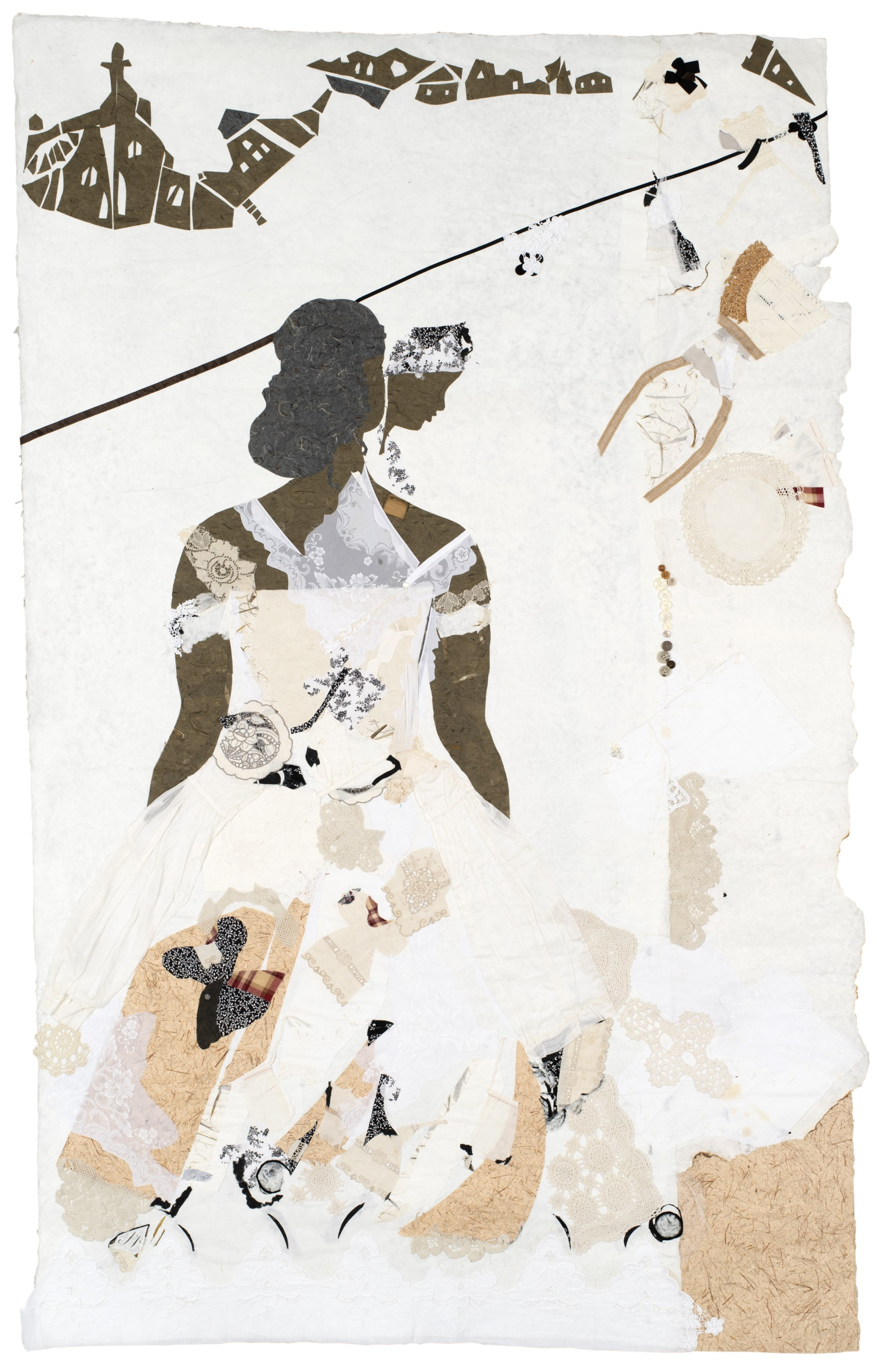
“Remembering the Name of Slaves” Darlene R. Taylor

Heirlooms are defined in dictionaries as “valuable objects that belonged to a family for generations.” The word “valuable” in that description is highly subjective. Such objects likely have value to family members or descendants. But they may or may not have monetary as opposed to sentimental value. “Darlene R. Taylor: Heirlooms,” at the Academy Art Museum, is an oddly resonant reflection of 18th- to early 19th-century free black families of the Hill neighborhood of Easton – all of them women – depicted with their backs to the viewer, ensuring their anonymity, which defined the lives of most African-American women, free or enslaved, in pre-Civil War America.

Taylor, a black woman born in 1960, has created a series of mixed-media collages, some of which are near life-size, incorporating vintage cotton, linens, laces and even buttons handed down mother to daughter mostly, but also cousin to cousin or friend to friend. Artifacts from excavations commissioned by the museum of the long-ago home of Henny and James Freeman, who headed one of the earliest free land-owning black families in Talbot County from 1787 to 1828 are part of Taylor’s motifs that almost invite touching, which of course is not allowed. The fabric-on-paper derivations are so homey they seem drawn directly from unfinished work from a sewing basket. For me, the most tempting piece to reach out and feel its domestic textile hand-me-downs is “The Children of Slaves Remember,” 2023.

Taylor says her archival works reflect untold stories of “the love, labor and thriving of black life and family.” The Freeman home and adjoining properties on Talbot Lane just behind the museum are being repurposed for much-needed administrative space.

Full disclosure regarding a possible personal connection: I grew up on a farm next to what is now Chesapeake Easton Club East on Dutchmans Lane, where I now live in retirement. From age 5 in 1952 to when I attended and graduated from the University of Maryland College Park, that farm remained my home-away-from-college. My mother taught a young man named James Freeman to read. He worked on our farm until my parents sold it in the mid-’70s. Freeman was a common name for children or grandchildren of former slaves. But I wonder now if the gentle farmworker I knew as James Freeman back in the 1950s to ’70s was a descendant of the free land-owning black family next door to what is now the Academy Art Museum.

Sometimes, it seems like an awfully small world when you move back to your childhood hometown.

***

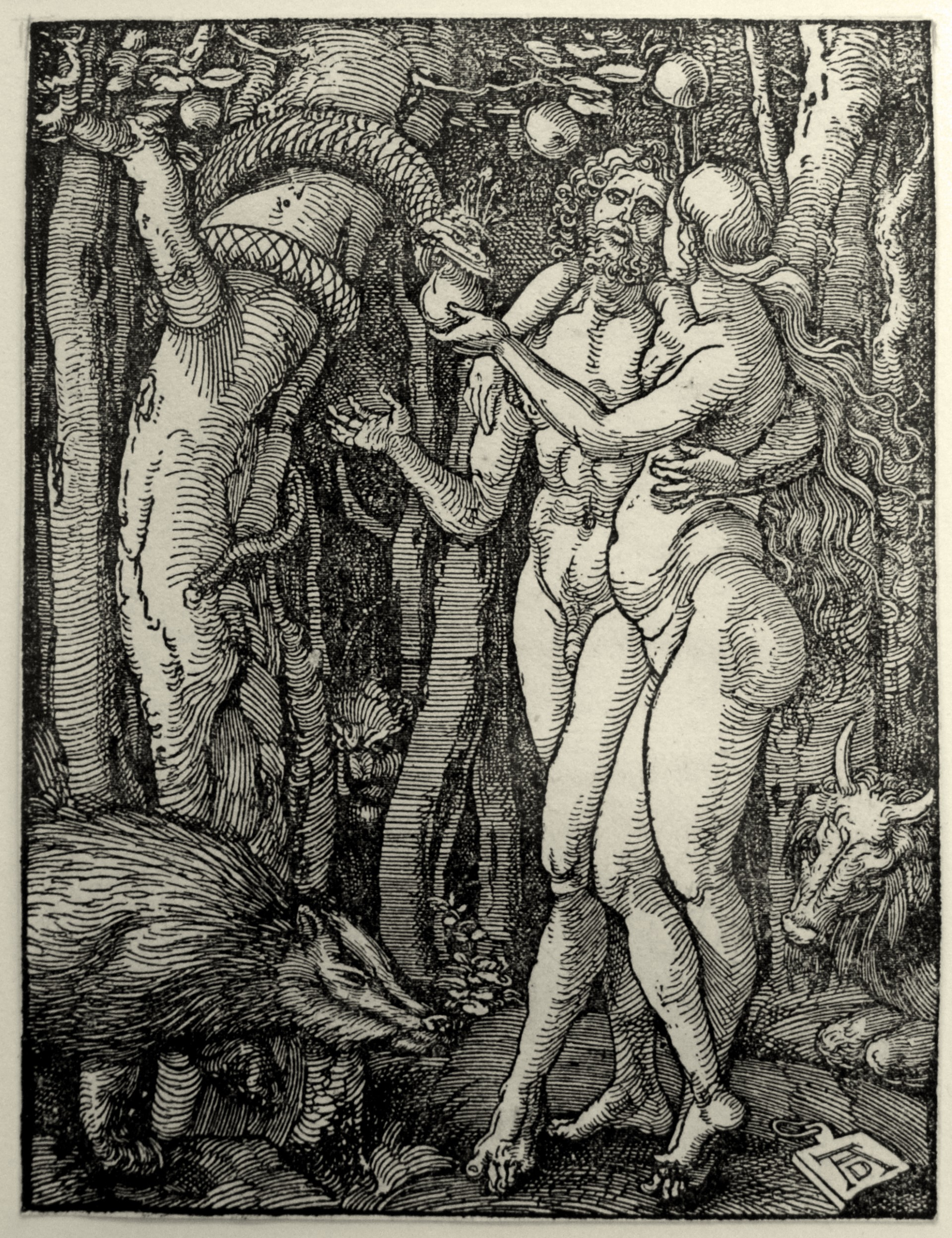
“Fall of Man,” Albrecht Durer

An important collection on loan from the Reading Public Museum in Pennsylvania of works by Albrecht Durer, the Renaissance artist who revolutionized European printmaking in the late 15th and early 16th centuries, fills the two small first-floor AAM galleries.

You’ll see a copy of a color print of young Durer with an introductory wall label summarizing his career that made him one of the most notable artists of his time. Hanging next to the portrait are magnifying glasses that you should use in the next room. There, on the far wall, you’ll see 16 remarkable prints from Durer’s “Engraved Passion” series depicting the final days in the life of Christ. All the New Testament scenes described in the gospels of Matthew, Mark, Luke, and John are there – among them the kiss of death by Judas, Pontius Pilate washing his hands as Jesus is found guilty, the crown of thorns affixed on Jesus’ head on his way to the cross, his Crucifixion and of Christ resurrected with a halo of illumination above his head. The magnifying glass makes a great difference in viewing these engravings not much larger, if at all, than baseball cards. The magnification brings their incredibly detailed imagery into stark focus. The technique reveals the delicate intricacies that distinguish Durer’s engravings from the earlier woodcuts that are also masterpieces – including his “Fall of Man: Adam and Eve Expelled from Paradise.”

Returning to the first gallery, don’t miss the posthumous portrait of Durer by Erhard Schon, dated 1538. Durer died in 1528 at age 56.

                                          ***

“The Voyage of Memory,” Philip Koch

Philip Koch, like many American artists born in the mid-20th century (1948), was very much influenced by abstract painters who were all the rage at the time. But then he met realist artist Edward Hopper, born in the previous century (1884), who died in 1967 at age 84. There was still time, however, for Koch to be taken under Hopper’s wing and, posthumously, earned him an unprecedented series of residencies – 17 of them – at the elder’s Cape Cod studio and access to the Edward Hopper Art Center in his Nyack, N.Y. birthplace. That changed the arc of Koch’s career from abstract to stark realism in landscapes and architectural detail. You’ll notice his fondness for Mansard rooflines in the current Koch exhibit at AAM. Switching in style from his previous landscapes, represented in this show with a few paintings from the early ’80s, Koch began producing colorful picture-postcard scenes as opposed to flora abstractions of his imagination.

Whether or not you see this as an improvement in his artistry may depend on your taste in paintings. Hopper’s influence on Koch’s later works is unmistakable, though it strikes me as somewhat more imitative than creative. But then, there’s nothing wrong with pretty pictures.

                                     ***
With four shows going on at once, not counting Marty Two Bulls Jr.’s “Dominion” installation that went up in AAM’s entry hallway months ago – there’s a lot to take in. But don’t skip the charming little exhibit upstairs, “Remnants of Childhood,” curated by teen interns who selected art from the museum’s permanent collection. My runaway favorite is Austrian artist Ossi B. Czinner’s “Man, Moon, Umbrella” interpretation of Jack jumping over the candlestick. Or, for local flavor, you might want to check out Claudia DeMonte’s “Shrine to Maryland” mixed-media diorama adorned with blue crabs that turn red when you boil them, reminding us that it pays to be head of the food chain.

Four New Exhibits at AAM

“Darlene R. Taylor: Heirlooms,” “Albrecht Durer: Master Prints” and “Light: Paintings by Philip Koch,” all through July 14. Also, “Teen-Curated Exhibition: Remnants of Childhood” through June 9, all at Academy Art Museum, 106 South St., Easton. academyartmuseum.org

Steve Parks is a retired New York arts critic and editor now living in Easton.

The Spy Newspapers may periodically employ the assistance of artificial intelligence (AI) to enhance the clarity and accuracy of our content.

Filed Under: 1A Arts Lead

Spy Review: They’re All Winners in this Contest by Steve Parks

April 18, 2024 by Steve Parks Leave a Comment

The Amara Trio

A trio who got together barely nine months ago – late in the summer of 2023 – came away with the top prize of $10,000 in the 11th biennial Chesapeake International Chamber Music Competition Saturday at Easton’s exquisite Ebenezer Theater.

The Amara Trio, who met at Manhattan’s prestigious and hugely competitive Juilliard School, performed a challenging and musically diverse program of chamber compositions by Rebecca Clarke, better known as a viola virtuoso who cracked the British orchestral barrier to female musicians, and two wildly haunting movements from Shostakovich’s Piano Concerto No. 2, which was somehow topped by their rendering of Mendelssohn’s sumptuous, if repetitive, first piano concerto.

The next biggest winner of the competition was the all-saxophone quartet Pulse from Michigan State University, three of whom are graduating – leaving their junior member to fend for himself. Pulse captured both the audience-choice prize of $5,000, and a judges’ tie vote for the runner-up prize with the Hesper String Quartet, representing the “usual suspects” among chamber music competitors.

That said, it doesn’t mean in any way that Hesper did not rise to the occasion. They were the only chamber group that concentrated their skilled efforts on just two compositions, playing them more or less to completion under the 45-minute performance time limit. The Schubert String Quartet No.  14, subtitled “Death of the Maiden,” opens solemnly as you might expect from the title, turning urgent and then melodic to a climactic finish.  The discordant Bartok Quartet No. 3 showed off the range of these Stony Brook University musicians based in Long Island and New York. The moderato refrains built toward crisis tension with quivering violin strings and assertive cello strokes and thumps leading to a reflective surprise finish.

To my eyes and ears, what seemed to win for the Amara Trio was their connection to each other – especially in the complexities of the Shostakovich No. 2 from which they dropped the first movement because of time constraints. (Folks who heard them in the Sunday matinee performance at Holy Trinity in Easton got the full treatment of that piece.)

In the Saturday competition, it was impossible for the audience, and perhaps the fellow musicians, not to notice the emotional expression of their pianist to whatever phrase presented a potential coda response that turned out to be a mere tease. If their idea was not to have too much drama, it worked. There were several such moments, and I was fooled each time. Best to wait for the great climax. These guys – a guy and two girls, actually – were terrific that way,

The same might be said of Pulse, the winner of the audience-favorite award, who also tied for the runners-up judges’ prize with the Hesper four. Pulse blew me away with no less than six pieces in a 45-minute tour de force on brass: A suite by Grieg, Marquez’s Cuban romanticism to O’Halloran’s “Night Music” jazz romp and a melodically soothing Puccini, followed by Itoh’s “Doublethink,” a deeply wrinkled take on Orwellian political mythology, anchored by the improvisational “Converging Spectrum” by young African-American jazz pianist Kevin Day – all of it displaying Pulse’s incredible range. I was particularly impressed with their wind-blown technique that produced the sound of ocean waves without vibrant brass notes.

The Amara Trio winners, I suspect, earned their prize with an on-stage presence that may have separated them from the evident skill of each of their competitors. It was impossible not to notice their connection – remarkable in that they just got together – to my well-aged mind – basically the day before yesterday. May the Amara Trio achieve the success they deserve. They’re really good.

That said, all the other chamber groups who came away without a specific prize deserve the standing ovations they received on Saturday. Each finalist also earned a $1,000 cash prize.

Among them are the Trio Menil, who performed a challenging program of Haydn, Ives and an emotional rendition of Mendelssohn’s Trio No. 2. Plus the opening act, the Kodak Quartet’s ambitious five-piece medley starting with the Ligeti nocturne memorialized by the Holocaust, known as “Metamorphoses.”

To pick winners or losers among these five competitors was to me, all but impossible. But that’s what a competition is about. Congratulations to all these young up-and-comers.

Remember these names for future classical music reference:

Amara Trio: Pianist Kevin Jansson, cellist Nagyeom, Jang, violinist Christina Nam.

Pulse: Zachary Costello, soprano saxophone; Michael Ethier, baritone sax;

Owen Robinson, tenor sax; Spencer Cox, alto sax.

Hesper Quartet: Violinists SeJeong Kim and Ye Jin Yoon, violist SoHui Yun, and cellist Connor Kim.

Kodak Quartet:  Violinists Edgar Donati and Martin Noh, violist Daniel Spink, and cellist Blake Kitayama.

Trio Manil:  Pianist Jonathan Muk, cellist David Dietz, and violinist Jeongwon An (also known as Claire).

Congratulations to all five finalists. You’re all winners.

Chesapeake International Chamber Music Competition
Saturday, April 13, Ebenezer Theater, Easton; chesapeakemusic.org

Steve Parks is a retired New York arts critic now living in his hometown of Easton.

The Spy Newspapers may periodically employ the assistance of artificial intelligence (AI) to enhance the clarity and accuracy of our content.

Filed Under: 1A Arts Lead

Spy Music Review: Concerto to Die For by Steve Parks

April 5, 2024 by Steve Parks Leave a Comment

Cellist Amit Peled

A remarkable evening of music and reflection opened appropriately with what amounts to a prayer.

The lyrics to the hymn inspired by Sibelius’ tone poem “Finlandia,” performed by the Mid-Atlantic Symphony Orchestra Thursday night in Easton, came instantly to mind with the first notes of the beloved middle movement of this piece about peace.

“My country’s skies are bluer than the ocean
And sunlight beams on cloverleaf and pine
But other lands have sunlight, too, and clover
And skies are everywhere as blue as mine
O hear my song, thou God of all the nations
A song of peace for their land and for mine.”

In a concert anchored by the performative genius of an Israeli-American cellist, peace inevitably came to mind there as well. But it was principally the music that spoke to appreciative listeners in Saints Peter and Paul High School’s auditorium. “Finlandia” is a 19th-century musical commentary on the Russian Empire’s oppression, continued under the Soviet Union, of neighboring Finland – now a member of NATO in defensive response to war-criminal misdeeds by Vladimir the Terrible.

The eight-minute “Finlandia” was but an appetizer for much more to savor and to mull over on the drive home from this rewarding concert.

Next up was an until-recently undiscovered masterwork by Florence Price, the first African-American woman composer to have her symphony (No. 1 in E Minor) performed by a major U.S. orchestra. Her three-movement “Ethiopia’s Shadow in America” breaks the era of slavery into “The Journey” from homeland captivity to being chained and shipped into a life as two-legged chattel, followed by “Struggle and Resistance,” which captures the loss of liberty and far worse before morphing into a resolve to overcome. Then, finally, it moves to a hopeful “Celebration of Heritage,’ in an emancipation nation clinging to racist hangovers.

Price’s “Ethiopia’s Shadow” was recorded on the New York Youth Symphony album that won the musicians and Michael Repper, now music director of the MSO, 2023’s Grammy for Best Orchestral Performance. The three movements – capture, slavery and emancipation – are marked by what-will-come-next trepidation in the first instance. The second connotes both resignation to hardships – somber notes of lost humanity and a resilience that comes from somewhere within as the higher strings and woodwinds strike a tone of getting ahead rather than getting even. Finally, a lilting passage introduced in a clarinet solo by Wendy Hatton suggests a brighter future in which dancing is one of freedom’s rewards.

Post-intermission, Repper ceded his usual role of introducing the final piece on the program to the soloist who plays most of the notes in Dvorak’s Cello Concerto widely acclaimed as the best ever written. Turns out that Amit Peled, a cello professor at Baltimore’s Peabody Conservatory, whose professorship hardly begins to encapsulate his accomplishments as an artist, loves to tell stories about the pieces he plays. The dramatic effect was so profound that I could not possibly take in the concerto without references Peled made spinning in my head as the wordless magic of his playing or Dvorak’s genius in composing it – probably both – influenced my perception of the music and musicianship.

According to Peled, Dvorak was hopelessly in love with a lass named Josephine who, like himself, was a Czech native. He offered his hand to her. But Josephine’s father insisted that he marry his older daughter instead. Meanwhile, Dvorak had accepted the challenge of writing a cello concerto, which he previously thought all but impossible. After writing a promising first movement, he decided to sail to Europe and his homeland to visit Josephine, who he heard was sick. En route, he wrote a second movement, inspired by the prospect of seeing her again, and then wrote a third upon his visit. But on his return voyage, he learned that Josephine had died. He tore up the third movement and the astonishing one we hear today of which Peled tipped us all with a musical spoiler by playing the note he cues just before a dying response from Josephine – in this case delivered by concertmaster/first violin Kim McCollum.

Aside from his storytelling, Peled’s utter mastery of this complex and athletically challenging concerto was spellbinding. An introspective opening quickly eclipsed by a bold orchestral statement featuring horns and woodwinds establish a grand entrance for the soloist, who shows who’s in charge with higher-register notes than you’d expect from a cello, played with violin dexterity mixed with cello/bass authority. While full orchestral outbursts periodically gave Peled a chance to catch his breath and rest his bow arm, he showed a knack for coming in just on the heels of a supporting instrumental phrase, such as by Dana Newcomb on oboe. You’d think the cello and oboe were one.

In the final movement, Josephine’s death note follows Peled’s lead, punctuated by a gentle pluck of a single string. Sprightly folk melodies of their shared Czech roots ease any maudlin preoccupations with death to instill a celebration instead of life.

The performance is indeed a celebration of life as interpreted through music.

Mid-Atlantic Symphony Orchestra

Spring concert series: Thursday, April 4, Saints Peter and Paul High School, Easton. Also, 3 p.m. Saturday, April 6, Epworth United Methodist Church, Rehoboth Beach, and 3 p.m. Sunday, April 7, Community Church, Ocean Pines.

midantlanticsymphony.org

Steve Parks is a retired New York arts critic now living in Easton.

The Spy Newspapers may periodically employ the assistance of artificial intelligence (AI) to enhance the clarity and accuracy of our content.

Filed Under: 1A Arts Lead, Arts Portal Lead

Spy Arts Diary: A Stands for Art in April by Steve Parks

March 29, 2024 by Steve Parks Leave a Comment


Sara Jesse has moved on to New York from her three years as director of Easton’s Academy Art Museum. But before taking the helm as director of the Memorial Art Gallery of the University of Rochester, Jesse filled the spring-to-summer calendar at AAM with such headliner exhibits as “Albrecht Durer: Master Prints,” opening April 6 and running through July 14, along with “Light: Paintings by Philip Koch,” colorful landscape paintings inspired by the American realist works of Edward Hopper, April 11-July 14.

Starting in 1983, Koch was granted the first of an unprecedented 17 residencies at Hopper’s studio on Cape Cod, which resulted in his 2015 solo exhibit at the Edward Hopper Home Art Center in Nyack, New York.

From Durer’s “Great Passion” series

The Durer exhibit features such celebrated pieces as his “Small Woodcut Passion” (1508-10), “Life of the Virgin” (1503-10), and the complete set of 16 prints from his engraved “Passion” series (1507-12). Originally trained as a goldsmith, Durer turned his avocation into a lifelong career as a painter, etcher, and draftsman noted for the complexity of his naturalistic compositions, making him one of the most influential artists of his time.

Also opening in April is “Heirlooms,” an archival product of research by Darlene R. Taylor into her own ancestry as well as that of black women in Talbot County. Scouring family photo albums, Taylor created mixed-media collages incorporating handed-down mother-to-daughter linens, laces, cotton, and buttons, some of it procured from the museum’s excavation of the former home of Henny and James Freeman, among the earliest documented free black landowning families of the Hill neighborhood in Easton, circa 1787-1828. The home on nearby Talbot Lane was acquired by the Academy Art Museum last year.

The fourth exhibit opening in April is self-explanatory – “Remnants of Childhood: Selections From the Permanent Collection AAM’s Teen Interns,” April 9-June 9.

Meanwhile, Jennifer Chrzanowski is AAM’s interim director.

academyartmuseum.org

***
“Talbot People II,”  the second half of photographer Steve Lingeman’s exhibition at the Talbot Historical Society, encapsulated in his “Talbot People: Stories and Photographs” catalog, remains on display through April 30. And in case you missed part I of his show, it’s now on view at the Talbot County Free Library in Easton through the end of April, with a gallery talk by Lingeman on the 18th.

The Ex family, refugees from Ukraine

As in the first installment, these portraits, the vast majority of which are black and white, though some have singular color highlights achieved by the trick of shooting all the photos in color but printing them B&W. Among the most compelling stories accompanying the Part II portraits of “Talbot People” is that of the refugee family of Jeff and Julia Ex and their children Vlad, Veronic and Rostic fleeing a Russian invasion.

It has now been more than two years since Vladimir Putin ordered the invasion of Ukraine. As Jeff tells their story: “On March 2 [2022] we would be safer trying to take the train west to Lyiv or further to Poland. . . . Early on the morning of the 3rd we grabbed our bags and took a bus to the train station . . . the start of our journey to Easton, Maryland, a place I had never heard of.”

Jon and Amy Ostroff are pictured next to the Ex family photo, fittingly so because their legal and diplomatic connections were deployed to rescue Jeff Ex, an American citizen who was engaged to Julia but not yet married to her. In order to obtain U.S. visas for Julia, a Ukrainian, and her children, a marriage license was arranged without the usual six-month wait and they were married in Denmark with Julia borrowing a wedding gown. They are now among the “Talbot People” with a great story to tell.

talbothistory.org/exhibits-events/exhibitions

***

A retrospective of paintings by the late Bernard Kindt put together by his friend and fellow artist David Stevens takes over the gallery spaces of the Unitarian Universalist Fellowship at Easton with an open house show-and-sale reception from 1-5 p.m. Saturday, April 6.

Bernard Kindt’s “Choptank River Near Greensboro” painting

Principally a landscape artist, Kindt was a Maryland Institute College of Art graduate who lived in Greensboro for 19 years and fell in love with the marsh and waterfront scenes so abundant on the Eastern Shore. He moved to Florida to take advantage of the greater art festival opportunities of that tourist-friendly state, painting placid vistas not far from his North Port home between Tampa and Sarasota, where he resided until his death in September. The retrospective remains on display at UUFE through May. After the open house, the exhibit can be seen by appointment by calling 443-239-0143.

uufe.org

***

If you can’t get enough of beautiful views, Chestertown’s Massoni Art gallery on High Street features paintings by New York-based Grace Mitchell and a little bit of everything – from oils and collage to photography and woodworks by popular Kent County artist Joe Karlik, while other artists at Massoni’s Cross Street location contribute to the collective visual commentary on “Spring 2024” All these works are meant to suggest, as Mitchell writes in her interpretation, that “homo sapiens are hard-wired in our DNA because of the experience of our earliest ancestors who thrived in certain environments and had a greater chance of survival to reproduce, evolve and eventually produce us.” But with an uncertain climate-change future, how long can such serenity last?

Joe Karlik “Blue Vase”

“Spring 2024 opens on First Friday, 5-7 p.m. April 5 and runs through May 5.

Massoni

***

But let us not forget the performing arts: Following up on its grand concerto competition finale on March 24, the Mid-Atlantic Symphony Orchestra makes a quick turn-around with three early April concerts, starting at Easton’s Saints Peter and Paul High School at 7 p.m. Thursday, April 4, with a program of Sibelius’ “Finlandia,” “Ethiopia’s Shadow in America” by Florence Price and Dvorak’s Cello Concerto featuring solo cellist Amit Peled. Encore performances will be performed Saturday, April 6 at Epworth United Methodist Church, Rehoboth Beach, and Sunday, April 7, at Community Church, Ocean Pines – both at 3 p.m. – Michael Repper conducting.

midatlanticsymphony.org

***

Meanwhile, the Annapolis Symphony Orchestra competes for your attention the following weekend with its “Masterworks V: Roman Festivals” concert boasting a world premiere co-commissioned by the ASO through an “Embracing 21st Century Voices” partnership with the Gabriela Lena Frank Creative Academy of Music. The commissioned work is composed by Nicky Sohn, a Juilliard and Mannes School of Music grad now pursuing her doctorate at Rice University’s Shepherd School of Music. Also on the program is Beethoven’s Piano Concerto in G Major, Opus 58 with soloist Awadagin Pratt, and Respighi’s “Feste Romane” P. 157, a four-movement tone poem. Concerts are Friday and Saturday, April 12 and 13 at Maryland Hall, Annapolis, and Sunday, April 14 at Strathmore Music Center, North Bethesda.

annapolissymphony.org

Steve Parks is a retired New York arts writer and editor now living in Easton.

The Spy Newspapers may periodically employ the assistance of artificial intelligence (AI) to enhance the clarity and accuracy of our content.

Filed Under: 1A Arts Lead, Archives

Spy Concert Review: The Final 3 in MSO Concerto Playoff by Steve Parks

March 26, 2024 by Steve Parks Leave a Comment

The Mid-Atlantic Symphony Orchestra’s Elizabeth Loker Concerto Competition rose to virtuosic playoff levels of excellence fitting for a “March Madness” Sunday matinee concert.

Concerto competition winner Rebekah Hou

Don’t dismiss the athletic comparison: The touch and dexterity in performing arts skills of this trio of finalists were as evident onstage at Chesapeake College’s Todd Performing Arts Center as a winning slam dunk on an NCAA championship basketball court. If not more so. All three competitors nailed it. But the deciding factor may well have been “degree of difficulty,” as is often the case in Olympic competitions, coming up again this summer in Paris.

The concerto that harpist Rebekah Hou of Cleveland performed may have won favor by the panel of three that judged her the top prize-winner of $5,000 in part because there are so few other solo concertos for that instrument in all of the repertoire of famous classical composers.

Written by the late Alberto Ginastera of Argentina in 1956, the piece – known for decades simply as the Harp Concerto – gained somewhat wider attention on the 2016 centennial of his birth. Other modern composers of harp solo concertos have emerged since. But they remain a rarity in the vast canon of classical music, making it a challenge to study or learn from other recordings.

Hou’s performance was impeccably precise though perhaps unfamiliar in timbre to even sophisticated classical music listeners who have rarely if ever heard the harp played as the leading concerto solo instrument.

The judges’ runner-up prize of $2,500 went to Alejandro Gomez Pareja of Madrid, Spain, who also won the audience popular vote prize for his emotive and explosive rendition of Shostakovich’s Cello Concerto No. 1 in E-flat Major, which led off Sunday’s concert program. Sophia Geng of Andover, Massachusetts, was awarded the $1,000 prize for third place by the judges for her mastery of one of the most challenging for any string instrument – Tchaikovsky’s Violin Concerto in D Major – which wrapped up this daunting program.

Going in order of appearance, Gomez Pereja dived into the complicated first movement that borrows on themes from Josef Stalin’s favorite folk tunes said to be distorted by Shostakovich as a jab at Soviet iron-fist fury. Attacking at first with the bow as a lance, Gomez Pereja’s weapon gave way to reflections on loss and remorse. A stirring third movement solo carried the melody all on its own before orchestral exchanges based on the opening theme – amplified by woodwind and horn clarion calls – signaled a climactic cello finish to a rousing ovation.

Hou’s concerto was announced silently before her on-stage appearance by the front and right-of-center positioning of her handsomely crafted harp. From the first notes, you know this is not your grandmother’s harp, nor Harpo Marx’s. While the usual angelic glissandos flourish from time to time in the concerto, many more sharply plucked notes are both singularly melodic in tone and percussive on impact, especially as she slapped wood panels of the harp architecture. The highest notes on the shortest upper harp strings could be mistaken for tinkling piano keys as other, more sonorous notes may strike you as that of a xylophone. Still others are as tender as lightly stroked acoustic-guitar notes. Who knew a harp could be so versatile? Rebekah Hou did.

Violinist Sophia Geng followed these two virtuoso performances with, by any measure, an exhausting performance of Tchaikovsky’s notoriously difficult – even in terms of mere stamina – of the Russian master’s Violin Concerto in D Major. If she felt intimidated, Geng didn’t show it. She was studiously serious in her approach to the challenges of the piece. Never faltering, she answered the opening orchestral crescendo with a solemn solo response that melts into a melody reinvented as a dance theme later on. In a lovely opening to a long final movement, Geng’s violin “gently weeps,” as the late George Harrison might have said – its introspective passages just that relatable.

Never mind the results: There were no losers among this grand finale trio. Judging in such a high-quality competition, as any of the judges would admit, is highly subjective. No matter who finished first or third or in between, they’re all winners as accomplished young musicians.

The trio of judges deciding the top prizes were Edward Polochick, music director of Lincoln’s Symphony Orchestra in Nebraska; James Kelly, executive director of the National Philharmonic Orchestra, based in suburban Maryland of Washington, D.C., and Sachi Marasugi, concertmaster of the Salisbury Symphony Orchestra and member of the violin faculty of Salisbury University.

The Elizabeth Loker Concerto Competition is named for the former Washington Post executive who helped bring that national newspaper into the digital age. In retirement, she moved to Royal Oak and became an MSO board member and supporter before her death of cancer in 2015 at age 67. This is just the third Loker competition as it was not held for two years of the COVID pandemic.

ELIZABETH LOKER CONCERTO COMPETITION

Three solo finalists accompanied by the Mid-Atlantic Symphony Orchestra, conducted by Michael Repper at Chesapeake College’s Todd Performing Arts Center, Wye Mills, on Sunday, March 24.

Steve Parks is a retired performing arts critic now living in Easton.

The Spy Newspapers may periodically employ the assistance of artificial intelligence (AI) to enhance the clarity and accuracy of our content.

Filed Under: 1A Arts Lead

Spy Art Review: Something(s) New in Downtown Easton by Steve Parks

March 15, 2024 by Steve Parks Leave a Comment

Downtown Easton’s arts district just got bigger – and broader in terms of diversity in what qualifies as art and by whom.

Easton’s trio of galleries along Harrison Street within walking distance of the Academy Art Museum and curling up a half-block on Goldsborough has increased twofold. While the Zebra and Spiralis Galleries (note the plural) occupy one address site – 5 N. Harrison St., more or less half-way between the Troika and Trippe galleries and directly opposite the Tidewater Inn and across Dover Street from the Avalon Theatre – they are separate galleries whose independent owners say they plan to collaborate on certain parallel exhibitions while diverting here and there on their own. 

“They Call Me Mr. T,” diamondback terrapin fabric art by Susan Fay Schauer

The current joint show, “At the Buzzer!” running through March 31, reflects on a compelling story of a basketball resurrection following the death of a young man on a court then in disrepair. According to Shelton Hawkins, the artist who has since painted resurfaced basketball courts across the country, starting with the one at Easton’s Idlewild Park, the death was not due to an injury. Hawkins’ cousin, James Thompson, 22, died of an enlarged heart rather than the impact of falling on a basketball court. The fatal incident, however, led to the resurfacing and repainting in bright geometric colors with the financial help of mentor Richard Marks and Easton Councilwoman Megan Cook, now the mayor. 

Since then, Hawkins has created 40 more basketball canvases in concrete in three countries – several on display in colorful patterns on framed images lining one wall as you enter this dual gallery space. Other images include black-and-white photos of, among others, superstar Lebron James, who recently became the first player to surpass 4,000 points in his NBA career. 

But you don’t have to appreciate the difference between dribble and scribble to get what else is happening in these cohabiting galleries. Gail Patterson, owner of the Spiralis Gallery, says their exhibits of shared space with the Zebra Gallery, owned by Susan Fay Schauer, is “complementary,” adding, “We each do our own thing, and sometimes we’ll do a joint show.” Like now, with “At the Buzzer!”

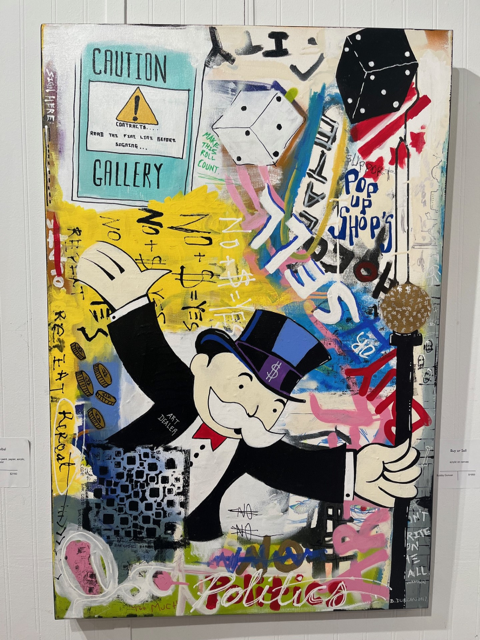
Bulsby Duncan’s “Buy or Sell”

Schauer calls the works in her gallery “evolutionary art,” mostly of flora or fauna in various media, both in abstract and realistic depictions. The current works on display are eclectic, to say the least, with mostly Afro-Caribbean art curated by Spiralis and a mix of narrative works and nature by Zebra artists. 

Among the pieces that most caught my eye are “Buy or Sell,” an acrylic takeoff on the game of Monopoly by Bulsby Duncan, which is among the Spiralis pieces in one of the galleries, plus two Zebra fiber works, “Steppin’ Out,” a Cindy Winnick sculpture of a girl kicking up her dancin’ shoes, and – particularly appealing to me as a University of Maryland alum – “They Call Me Mr. T,” a Diamondback terrapin by Schauer. Hard to miss is a piece that should never be overlooked in any case: “I’m Late I’m Late,” a sculpture in stained glass and mosaic tile by Richard Fritz, obviously inspired by “Alice in Wonderland.” It stands as if on guard in an alcove between galleries. 

While one corner of the current dual exhibit struck me as pedestrian – an array of hand-painted basketballs amounted to junior-varsity graffiti – the breadth of the art throughout and their disparate sources makes Zebra and Spiralis significant additions to Easton’s gallery scene, taking nothing away from the regional focuses of the Troika and Trippe galleries, just south and north on Harrison. The new galleries can only help expand the palette of art on view along Gallery Row, previously broadened by Studio B’s Asian influence. 

As I’ve suspected, since I moved back here in 2017, Easton has become the art capital of the Eastern Shore. Now, if only we had an Equity theater company. But that discussion is for another time. For now, I’m happy to see how much we’ve grown already as an arts-friendly community.

Both the new galleries are open Thursdays-Sundays at 5 N. Harrison St., Easton.

ZEBRA AND SPIRALIS GALLERIES
At the Buzzer!” is a joint exhibit by Shelton Hawkins through March 31, along with other artworks from each gallery.

thezebragallery.com  and spiralisgallery.com


The Spy Newspapers may periodically employ the assistance of artificial intelligence (AI) to enhance the clarity and accuracy of our content.

Filed Under: 1A Arts Lead

Spy Concert Review: A Classical Interlude with Ensemble 132 by Steve Parks

March 13, 2024 by Steve Parks Leave a Comment


Sunday’s matinee Interlude concert, billed as “Chamber Music Reimagined,” featured two alumni players from Chesapeake Music’s annual International Chamber Competition for Young Professionals. Ensemble 132, a collective of 11 musicians, of whom five performed before a packed house at the Ebenezer Theatre in Easton, featured two members of Trio St. Bernard – cellist Zachary Mowitz and pianist Sahun Sam Hong – who won the competition in 2018. 

“We’ve been returning every year since,” Mowitz said, addressing the audience between the opening Piano Trio in A Major by Haydn and Hong’s arrangement for piano quartet of Robert Schumann’s “Carnaval,” plus the concert finale, Stravinsky’s challenging “Petrouchka” ballet.

Haydn was the most prolific composer of the 18th- to 19th-century classical period, with a prodigious 106 symphonies that won him the unofficial title of “Father of the Symphony.” But he also earned the nickname “Father of the String Quartet” and that of piano trios (he wrote 45 of the latter.) As a mentor to Mozart, Haydn composed fewer quartets and trios after his genius student surpassed him in that art form. His Trio in A Major, performed by Hong and Mowitz with violinist Stephanie Zyzak, opens with a cheerful allegro moderato that flows irresistibly in what seems so easy for this threesome. The middle movement andante is more subdued as the strings weep as if haunted by regrets. But the allegro finale recovers from this brief despair with chirping syncopations that lead to a happy ending.

Schumann’s “Carnaval,” subtitled “21 Little Scenes on Four Notes,” was composed in the 1830s for solo piano, which Hong deftly arranged instead for Ensemble 132’s piano quartet. I lost count of the 21 sections of the piece, as many are not marked by a discernible pause. An assertive opening inspired by variations on a Schubert theme yields to refrains from the strings – now including violist Luther Warren – responding to the pianist’s insistent calls to attention ranging from near whispers of notes to a playful romp before surrendering to a romantic finish with happy/sad solo diversions for each instrument.

After intermission, the program moves into the 20th century with African-American composer Coleridge-Taylor Perkinson’s String Quartet No. 1 (“Calvary”), now including violinist Abi Fayette in the first chair for the concert’s Act II. Named for Samuel Coleridge-Taylor, the black Romantic-era composer from Britain, Perkinson’s wide-ranging career is reflected in his interests in jazz, working as a pianist, as well as film scores and pop arrangements for Marvin Gaye and Harry Belafonte. His classical works are marked by a contemporary sound that anticipated modern trends with blues, spirituals, and jazz influences fused with Baroque inspirations.

His musically abstract sensibility and emotional complexity are most often led assertively in each change in mood by violinist Fayette on pianist Hong’s cue. The second movement adagio, opens with plucking notes to Warren’s brief viola solo just before violins and cello amplify melancholic passages to a pizzicato heartbeat. The third movement rondo, opens with bold dual violin statements joined in by lower strings, providing a train-like undercurrent culminating in a decisive unison conclusion.

While pianist Hong also arranged the solo piano piece (Schumann’s) for a quartet, scaling up from a full-orchestra ballet presents far more obstacles – no brass or woodwinds, not to mention dancers. It helps listeners of this rearrangement to know a little about the plot of “Petrouchka.”

The first of the four Tableaux of Stravinsky’s ballet set in Russia opens with the piano and first violin together preceding the other three string players who make their separate entrances into what we must leave to our imagination – the Shrovetide Fairgrounds of St. Petersburg. Jaunty dance numbers based on Russian folk tunes are introduced by a single piano note or two. The chamber quintet’s performance palette paints a celebratory picture that unfolds the story of three puppets brought to life by a magician. (We get the jaunty dance numbers played robustly by the ensemble). As for living, breathing puppets, my only experience is “Pinocchio.” But that’s another story.

The next two tableaux take place, first in the room of Petrouchka, who has fallen in love with the lovely former puppet, Ballerina. You can hear Petrouchka’s heart pounding to a pizzicato beat. But the music turns downbeat as the scene shifts to The Moor’s room, where Ballerina has fled Petrouchka’s entreaties in favor of his rival’s.

In the final tableau, nightfall descends on the Shrovetide Fair, where Petrouchka’s jealous rage leads – spoiler alert! – to his murder. The cacophony of his demise is captured in folk minuets that break up with mad atonal intensity into mind games of deranged humiliation that costs puppet Petrouchka his life mere hours after he first drew breath – about a half hour in concert time. (And to think: Pinocchio only sprouted a really long nose.)

Even without a plot outline to guide us, Ensemble 132’s performance of this impossibly complex reduction of full orchestra instrumentation to that of five feverishly skilled musicians is a remarkable achievement both for the players and their fellow pianist/arranger. Maybe they should try it in the future with a silent video backdrop of vintage scenes from the ballet. 

CHESAPEAKE MUSIC INTERLUDE CONCERT

Ensemble 132 performed at Ebenezer Theatre, Easton, on Sunday, March 10. The next Chesapeake Music event is its annual International Chamber Music Competition, April 13-14, at the Ebenezer. chesapeakemusic.org

Steve Parks is a retired New York arts critic now living in Easton.

The Spy Newspapers may periodically employ the assistance of artificial intelligence (AI) to enhance the clarity and accuracy of our content.

Filed Under: 1A Arts Lead

Harmonies of Excellence: The 3rd Loker Concerto Competition with Michael Repper

March 6, 2024 by Steve Parks Leave a Comment

Michael Repper, now in his second year as music director of the Mid-Atlantic Symphony Orchestra, Delmarva Peninsula’s only fully professional classical orchestra, is excited – and for good reason – about the third annual Elizabeth Loker International Concerto Competition, which brings to the concert stage for the first time three finalists competing for top prize with performances of concertos each has chosen with the full orchestra accompanying them as soloists.

While this is not unique among all classical music competitive events, for the most part, only those known worldwide, such as the Van Cliburn competition named for the American who famously won the 1958 Tchaikovsky International Competition in the USSR back then, conclude with a play-off finale among three finalists – though in the case of the Van Cliburn, they’re all pianists.

Previously, this third annual MSO competition had three finalists playing their concertos with piano accompaniment. Only the winner of that trio got to perform with the full orchestra as part of the prize.

One-hundred-fifty-five applicants from 22 states and 12 countries entered this year’s competition. Through judging by a team of MSO musicians of blind recordings by each of the young soloists, ages 12 to 25, the field was narrowed to 20 semifinalists, of which Repper himself selected the final three. A panel of regional judges will decide who among the finalists will receive cash prizes of $5,000, $2,500 and $1,000 for first-, second- and third place, respectively. There’s also a $500 audience-choice prize.

They will present a diverse program. Cellist Alejandro Gomez Pareha of Madrid, Spain, performs Shostakovich’s challenging Cello Concerto No. 1; violinist Sophia Geng of Andover, Massachusetts, plays Tchaikovsky’s popular Violin Concerto in D Major, and harpist Rebekah Hou of Cleveland performs a harp concerto, a rarity for that instrument, by Alberto Ginastera.

Aside from his considerable skills as a conductor, Repper brings a wealth of experience working with young musicians. Among the accolades he’s earned is that of the 2023 Grammy for Best Orchestral Performance shared with the New York Youth Orchestra, winning the prize over the Berlin Philharmoniker, plus renowned Oscar-winning composer John Williams and Gustavo Dudamel of the Los Angeles Philharmonic, soon to be music director of the New York Philharmonic. Repper’s  student-musicians chose the pieces on their recorded album – all by African-American women composers. (COVID prevented a live performance.)

The Elizabeth Loker competition is named for the former Washington Post executive who helped bring the newspaper into the digital age. In retirement, she moved to Royal Oak and became an MSO board member and supporter before her death of cancer at 67 in 2015.

The winner and runners-up will be announced on stage at the concert, March 24 at Chesapeake College’s Todd Performing Arts Center in Wye Mills.

This video is approximately seven minutes in length. For more infomraiton about the Mid-Atlantic Symphony Orchestra please go here.

The Spy Newspapers may periodically employ the assistance of artificial intelligence (AI) to enhance the clarity and accuracy of our content.

Filed Under: 1A Arts Lead

Spy Arts Diary: From Classical Leap Year to O.C. Movie Mecca by Steve Parks

February 29, 2024 by Steve Parks Leave a Comment

Michael Repper conducts the Mid-Atlantic Symphony Orchestra

Not that I ever put much forecasting faith in a groundhog who may or may not see his shadow on Feb. 2. But this time, maybe blinded by the TV klieg lights, Punxsutawney Phil couldn’t see a thing. Nevertheless, his early spring prediction has long passed us by. Yet winter now seems to be ebbing and spring may yet arrive for good sometime between two momentous events on the music and sports calendars.

First up – delayed one day because of the Leap Year Feb. 29 –  is the Elizabeth Loker International Concerto Competition, which has gained worldwide attention in this edition of the Mid-Atlantic Symphony Orchestra annual event pitting young musicians, ages 12 to 25, for a cash prize and a chance to play with a full professional regional orchestra – the MSO. This year, however, in just the second season of maestro Michael Repper’s time as music director of the Easton-based orchestra, the competition has been expanded to a whole night of orchestral concerto competition with three finalists performing solo portions of their repertoire with the MSO under Repper’s baton.

This live competition among a trio of accomplished young musicians who have survived two previous rounds, which included a blind judging of tapes by a record 155 competitors to narrow the global field to 20 semifinalists among whom Repper selected the three finalists performing on March 24 at Chesapeake College’s Todd Performing Arts Center at Wye Mills. 

The finalists are Sophia Geng of Andover, Massachusetts, performing Tchaikovsky’s Violin Concerto in D major; harpist Rebekah Hou of Cleveland, who will play Ginastera’s Harp Concerto, followed by cellist Alejandro Gomez Pareja on Shostakovich’s Cello Concerto No. 1. The three finalists compete for recognition as the top-prize winner for what has become a prestigious international competition, but also a cash prize of $5,000 with awards of $2,500 and $1,500 going to second and third finishers.

A three-person panel of jurists will decide the final awards: They are Edward Polochick, music director of Lincoln’s Symphony Orchestra of Nebraska, James Kelly, executive director of the D.C.-area National Philharmonic Orchestra that performs at the Strathmore Music Center in North Bethesda, and Sachi Marasugi, concertmaster of the Salisbury Symphony Orchestra of Maryland’s Salisbury University.

Awards will be announced shortly after the 3 p.m. concert at Chesapeake College.

midatlanticsymphony.org

As for the second momentous event marking, hopefully, the end of winter, the Eastern Division Champion Baltimore Orioles open at home for the first time in years against the Los Angeles Angels at Oriole Park at Camden Yards, 3 p.m. March 28. The O’s seek to improve their 101-win season by advancing far enough in the post-season to win the World Series for the first time in 41 years. The 2024 season also marks the 70th season of the Orioles’ return to major league baseball in 1954. The team lost 101 games that year but finished next to the last in the American League. We trust that whatever celebrity the new Oriole front-office brass chooses to sing the National Anthem will be forewarned of the roar of “O!” from the fans on the vocal beat of “Oh, say can you see!” It’s one of the hippest traditions in local MLB traditions ever. Baltimore owns the anthem. Check it out at Fort McHenry.

mlb.com/orioles

***

Just as winter loosens its grip – it’s not even spring on the calendar yet – Chesapeake Music launches its spring-summer season, the first ever with recently retired Don Buxton not in charge. An Interlude Concert brings Ensemble/132, a rotating collection of 11 American soloists and chamber musicians, to the resplendent Ebenezer Theatre stage at 2 p.m. March 10 with a quintet. Pianist Sahun Sam Hong, violist Luther Warren, cellist Zachary Mowitz, and violinists Abi Fayette and Stephanie Zayzak present a program of Haydn Piano Trio in A Major, Robert Shumann’s “Carnaval” arranged by Hong for piano quartet, followed after intermission by Coleridge-Taylor Perkinson’s String Quartet No. 1 “Calvary” and Stravinsky’s “Petrouchka,” also arranged by Hong for piano quintet.

This Interlude Concert previews the astounding musicianship you can expect from Chesapeake Music’s upcoming marathon Chesapeake Music International Chamber Competition on Saturday, April 13, and the annual Chesapeake Chamber Music Festival, June 7-15, for whom the promotional phrase “experience the extraordinary” is well deserved.

Judges have already selected finalists for the chamber competition in April. Vying for the top juried prize and an audience choice award are five young professional chamber ensembles, including two violin, cello, and piano trios, a pair of quartets featuring two violins along with a cello and viola. Another quartet is all saxophones – soprano, alto, tenor and baritone. 

The day-long competition opens at 11 a.m. and continues through 6 p.m. with a break for late lunch/early dinner. Each chamber group in the competition plays a complete set of music. Judging begins after the final performance, and results are announced later that evening.

The nine-day, 39th annual Chesapeake Music Chamber Festival program has yet to be announced. The festival is led by co-artistic directors cellist Marcy Rosen and violinist-violist Catherine Cho, with several festival regulars returning year after year along with some notable guest performers.
chesapeakemusic.org

                                                                                       ***

For the second year in a row, the Ocean City Film Festival welcomes John Waters, widely known as the “Pope of Trash” and lately as the self-described “Filth Elder” of American movie-making – this time for its eighth annual edition of this cinematic celebration at the beach. Native Baltimorean and lifelong resident of Charm City, Waters appears live for a screening of his movie “Hairspray,” which also launched his hit Broadway musical. The film will be accompanied by Waters’ live commentary at 8 p.m. Saturday, March 9, at the Ocean City Performing Arts Center. 

Expect him to recall the under-the-boardwalk inspiration for “Hairspray,” which challenges both racism and “sizeism” as the teen heroine Tracy Turnblad (Ricki Lake) and her mom, played by drag queen Divine, aim to promote acceptance and diversity. In his teens, Waters attended live performances of the after-school T.V. dance and top-40 program, “The Buddy Deane Show” in Baltimore. An all-white cast of teen regulars populated the Buddy Deane cast, which, once a month, declared “Negro Day” so black kids could show off their dance moves. But Deane’s producers refused calls to integrate, and the host called it quits. At a “Buddy Deane Show” reunion in the 1980s, Waters was inspired to create his most mainstream hit in his filmography of culturally edgy, to say the least, movies.

But there’s so much more to the star director promising “Hair-Raising Fun!” Among the eclectic lineup of feature films is “Ali vs. Ali,” from Iran, about a fan who embarks on a globe-trotting quest to meet Muhammad Ali, and “American Meltdown,” the “best picture” winner of the 2023 Chattanooga Film Festival, a “coming-of-age” movie about a young woman who, struggling to pay the rent after losing her job, befriends a pickpocket named Mari. Dozens of shorts range from “Heritage Award: Waterfowl Festival,” about the 2022 accolade bestowed on the Easton-based festival held each November since 1971, to “Salted Earth,” spotlighting the invisible threat of saline inundation poisoning water and land alike in the looming co-disaster of rising sea-levels in the Mid-Atlantic region. 

Check it out – more than 100 films, including shorts.

ocmdfilmfestival.com

Steve Parks is a retired New York arts writer and editor now living in Easton.


The Spy Newspapers may periodically employ the assistance of artificial intelligence (AI) to enhance the clarity and accuracy of our content.

Filed Under: 1A Arts Lead, Arts Portal Lead

  • « Previous Page
  • 1
  • …
  • 3
  • 4
  • 5
  • 6
  • 7
  • 8
  • Next Page »

Copyright © 2026

Affiliated News

  • Chestertown Spy
  • Talbot Spy
  • Cambridge Spy

Sections

  • Sample Page

Spy Community Media

  • Sample Page
  • Subscribe
  • Sample Page

Copyright © 2026 · Spy Community Media Child Theme on Genesis Framework · WordPress · Log in