MENU

Sections

  • Home
  • Education
  • Donate to the Centreville Spy
  • Free Subscription
  • Spy Community Media
    • Chestertown Spy
    • Talbot Spy
    • Cambridge Spy

More

  • Support the Spy
  • About Spy Community Media
  • Advertising with the Spy
  • Subscribe
March 4, 2026

Centreville Spy

Nonpartisan and Education-based News for Centreville

  • Home
  • Education
  • Donate to the Centreville Spy
  • Free Subscription
  • Spy Community Media
    • Chestertown Spy
    • Talbot Spy
    • Cambridge Spy
Archives Ecosystem Eco Lead Ecosystem Eco Portal Lead

The Eagle’s Owl Nest: After Years of Teasing, This Great Horned Owl Couple Finally Delivers

February 28, 2024 by Val Cavalheri Leave a Comment

In 2020, the Spy published a story about Blackwater National Wildlife Refuge (NWR) that began like this: This was supposed to be a story about eagles. We were going to cover the installation of a camera above an eagle’s nest at the Blackwater National Wildlife Refuge (NWR) in Cambridge, one that would follow the progress of an eagle couple returning to their nest.

Well, this story is now about owls. Maybe.

————-

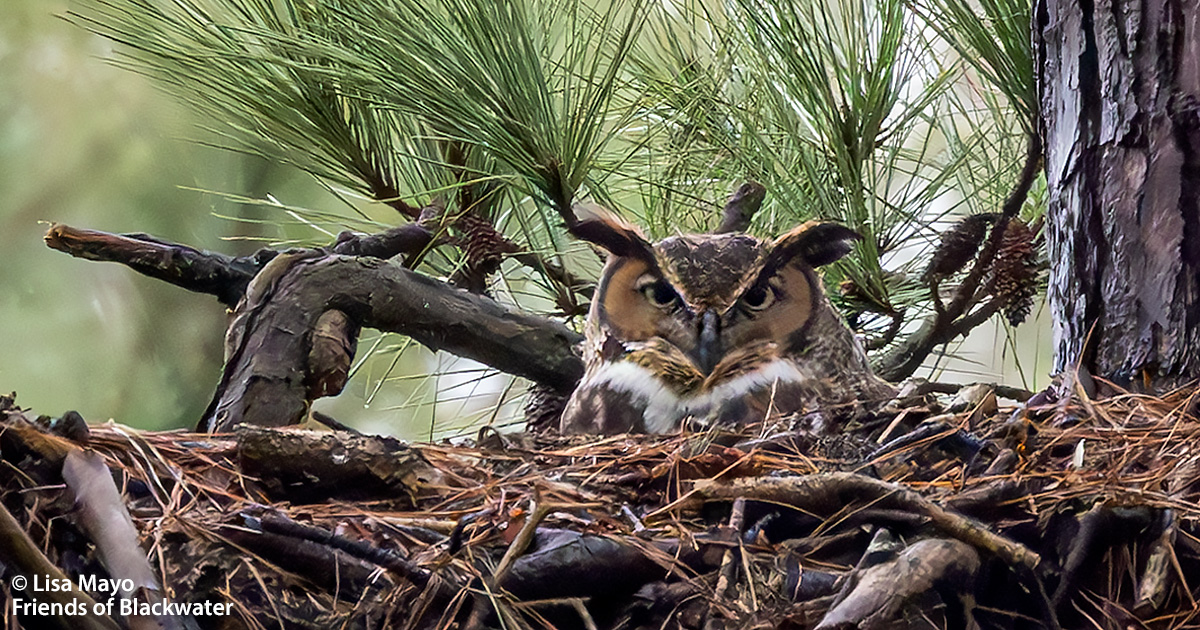
Fast forward to 2024, and we can update that story, which is now definitely about owls, particularly a nesting Great Horned Owl (GHO) couple expecting the hatching of their two eggs!

To catch up: The Friends of Blackwater (FBW) put up a streaming cam in 2020 to follow the goings-on of a busy eagle’s nest. Unfortunately, the eagles abandoned it at that point (except for an occasional visit now and then). The owls, too, have come and gone, but the rental remained vacant.

Until this year!

“We have a female owl that has been teasing us every year, coming and sitting on the nest and never laying any eggs,” said Lisa Mayo, webmaster for FBW. “She would mimic all the behaviors of an incubating female sitting on eggs. She would look down under herself as if tending eggs, rock back and forth with her brood patch against the nest, but there was nothing there.”

The behavior was repeated winter after winter, to the point that everyone gave up on any ‘egg action.’

This year, the teasing stopped, and two viable eggs appeared!

“One of our cam watchers alerted us, and Lisa went back and grabbed the video from it. When she gets up at night, you can see the two eggs pretty clearly,” said Bob Quinn, who manages the IT equipment for the cams.

Quinn, who retired as the IT Infrastructure Manager for the Consumer Financial Protection Bureau and is now a volunteer at NWR, describes the technology behind the live cam. “We use a PTZ Cam, (pan/tilt/zoom). I can move it vertically, around 360 degrees, to capture various angles,” Quinn explains.

Unlike ospreys, who take turns sitting on the eggs, the female GHO does all the incubating. “We’ve never seen the male change places with her,” Quinn said.” “We have seen her leave for a few minutes and come back. Maybe because the male hasn’t delivered enough food, and she went out for a snack.”

Given their nocturnal nature, cam viewers don’t often see the type of food the male brings to his mate, but it is probably consistent with their diet of mainly small mammals – mice, voles, muskrats, and snakes. Whatever it is, chances are these owls had no problem in their hunt. According to Quinn, great horned owls are apex predators, meaning they are at the top of the food chain. “They’ll take out an eagle. They’re silent fliers and come in from behind. So they’ll fly in and dig their claws into everything, including a larger bird. They’re extremely efficient hunters.”

The big question now is whether these eggs are viable after years of no production from this site. Mayo says it’s hard to know if this is the same couple that’s been teasing them annually. “We can just assume, based on their behavior, it’s likely the same couple. But we can’t guarantee it because we don’t tag these birds.”

The experts are uncertain about the owl’s behavior, theorizing that she is either a new parent or an older owl reaching the end of her reproductive time. “We’re not sure – there are many gaps in the story because you can’t interview them down at the nest!” Mayo said.

A GHO egg incubates for approximately 30-37 days, and the second egg was first seen on February 2nd. Expectations are that the first hatch will happen around the end of this week – beginning of next week (February 28th).  “We’ll definitely be watching even more closely then,” said Mayo. “Just to be able to keep folks updated.”

Volunteer cam watchers always notify Mayo if they see anything interesting happening at the nest. Quinn also monitors the cams even when at home. “I have two screens on my computer in my bedroom. And I keep it up on one of the screens. So that if something happens, like it goes out of focus, I can go in and refocus it. Or if I see an event, I’ll notify Lisa so she can grab the video.”

Motion detectors are also set up as an alert system. Maintaining live cams for a wildlife refuge has its challenges, especially when relying on solar power and rural internet connectivity. Quinn related instances of lost video feeds, sound issues, and inclement weather causing disruptions. “We’ve had some problems where we’ve lost the sound. And it turned out that a piece of equipment got fried, and we had to go out and replace it,” he said.

Obviously, major issues have required some hands-on triage. “We’ve had to go into the woods and reboot.” However, should anything happen while there are nesting birds, they would not be disturbed until after the fledglings have left.

There are currently five live streaming cameras: Two on the Eagle’s Owl’s Nest, an Osprey Cam, a River Osprey cam, and a Waterfowl Cam in the middle of the field, which spins around showing various views of migratory birds during different times of the year. The costs of the live streams are covered by FBW rather than the federal government or wildlife refuge.

Looking ahead, the chances of the owls returning next year seem slim. GHOs don’t build their own nests but take over other birds’ old nests. “Sometimes they’ll make a nest cut out on a rock formation – anywhere that’s convenient,” said Quinn. Unlike eagles, who invest in maintaining sturdy nests and return to them annually, owls trash their seasonal sites. “It’s common that the nest never gets used again,” Quinn added.

In fact, the borrowed eagle nest that currently houses the GHO pair is deteriorating from lack of maintenance over successive winters. Mayo is cautiously optimistic, hoping that if the chicks hatch successfully this year, the nest will hold up long enough for them to fledge successfully.

“Hopefully not this season, but I envision that the nest will eventually form a hole, or part of it will sink, or it may fall out of the tree,” she said. “It’s hard to know what will happen, but something will happen because these owls are not making any effort to strengthen it. It’s not in their behavior.”

For now, all eyes are on Mama GHO as the baby watch begins. But being part of this wildlife reality comes with a disclaimer:  “Our cameras display raw, unfiltered nature that might include wildlife interactions and weather calamities that we cannot control. We have a no-intervention policy, as we are just observers.“

Still, how can we resist a front-row seat to nature’s real-life reality show?

The Spy Newspapers may periodically employ the assistance of artificial intelligence (AI) to enhance the clarity and accuracy of our content.

Filed Under: Archives, Eco Lead, Eco Portal Lead

Md. Offshore Wind Project Loses Energy: Developer Announces ‘Repositioning’ Of Project

January 26, 2024 by Maryland Matters Leave a Comment

Maryland’s nascent offshore wind energy industry suffered a major blow late Thursday when one of the two companies planning to install wind turbines off the coast of Ocean City announced that it was “repositioning” its plans, pulling out of its agreement with the state and seeking alternative financial arrangements to keep the project going.

Ørsted, the world’s largest developer of offshore wind, emphasized that it was still committed to building its project in federal waters, but said it was opting out of the agreement it had reached with the Maryland Public Service Commission for financial clean energy credits intended to help fund the development. The company said that while it would still seek permits for the proposed wind farm from the federal government, and would continue to develop construction and operations plans for Maryland, the current financial realties of the offshore wind industry made it impossible to continue under the present arrangement.

Through two separate but adjacent leases known as Skipjack 1 and Skipjack 2 that had won state approval, Ørsted is ticketed to provide 966 megawatts of wind energy beginning later this decade. A company executive said Ørsted was determined to work with state officials, potential investors and other stakeholders in an effort to find a better way to finance and save the project.

“Today’s announcement affirms our commitment to developing value creating projects and represents an opportunity to reposition Skipjack Wind, located in a strategically valuable federal lease area and with a state that is highly supportive of offshore wind, for future offtake opportunities,” said David Hardy, group executive vice president and CEO Americas at Ørsted. “As we explore the best path forward for Skipjack Wind, we anticipate several opportunities and will evaluate each as it becomes available. We will continue to advance Skipjack Wind’s development milestones, including its Construction and Operations Plan.”

By saying the Danish company was exploring “future offtake opportunities,” Hardy was signaling that Ørsted will be looking for new funding streams, new investors, new government programs that could potentially generate additional capital, a new rate scheme for electricity consumers — or some combination.

But it isn’t quite clear where the discussions in Maryland will go from here.

By Josh Kurtz

The Spy Newspapers may periodically employ the assistance of artificial intelligence (AI) to enhance the clarity and accuracy of our content.

Filed Under: Eco Lead, Eco Portal Lead

A Conservation Journey From Cordova to Palaka and Back to Delmarva by Norman Greenhawk

January 1, 2024 by Spy Daybook Leave a Comment

Editor’s Note: As part of the Spy’s welcoming of the new year, we thought our readers would particularly enjoy this inspiring story by Mid-Shore native Norman Greenhawk and his conservation journey from Cordova to the Philippines to create the Harris Conservation Initiative and his plans for the Eastern Shore.

Twenty years ago, if you told me that I’d be writing this from the Philippines, I wouldn’t have believed you. It’s a far cry from Cordova, Maryland, where I was born and raised. Like most people in town, my family is working class; anyone familiar with Easton Farmers’ Market likely knows my mother’s business, CD Produce, a mainstay at the Saturday market for over 20 years. My grandfather spent his life as a construction worker at James Julian Construction in Delaware. My grandmother worked as a cafeteria manager at the Moton and Dobson buildings at Easton Elementary School in Easton, Maryland. My mother supported our family with her market produce business, and even after retirement, my grandparents helped us on the farm and at our family’s produce stand. 

Harry and Stella Harris of Cordova

My grandparents, Harry and Stella Harris, lived just a mile from my house, and so every weekend I’d stay over from Friday afternoon until Sunday evening. We had a tradition; every week, we’d tune into Wild America and National Geographic documentaries that were aired on Maryland Public Television. These nature programs showed me a world that seemed like fantasy, with brightly colored treefrogs peeking out of bromeliads, giant birds swooping to catch prey, and forests that seemed older than time. My grandfather would take me fishing for bluegill and smallmouth bass at the “gravel pits” owned by his employer. My grandmother would buy every book that caught my eye; the topics usually centered on dinosaurs, tropical forests, frogs, lizards, and botany. My grandfather shared with me his passion of raising aquarium fish and tropical birds. When I wanted my first pet frog, he helped convert an old fish tank into a setup appropriate for housing amphibians. 

They supported my love of nature and the outdoors, but more so, they encouraged my education. I’m the first member of my family to graduate from college, earning my undergraduate degree in Environmental Studies from Washington College in 2003. My career took me away from the Eastern Shore of Maryland. I’ve lived 11 years in Puerto Rico and five years in the Philippines. I’ve also worked and trained in Belize, Honduras, and Panama. My passions are conservation, herpetology (the study of reptiles and amphibians), forest ecology, and habitat preservation.

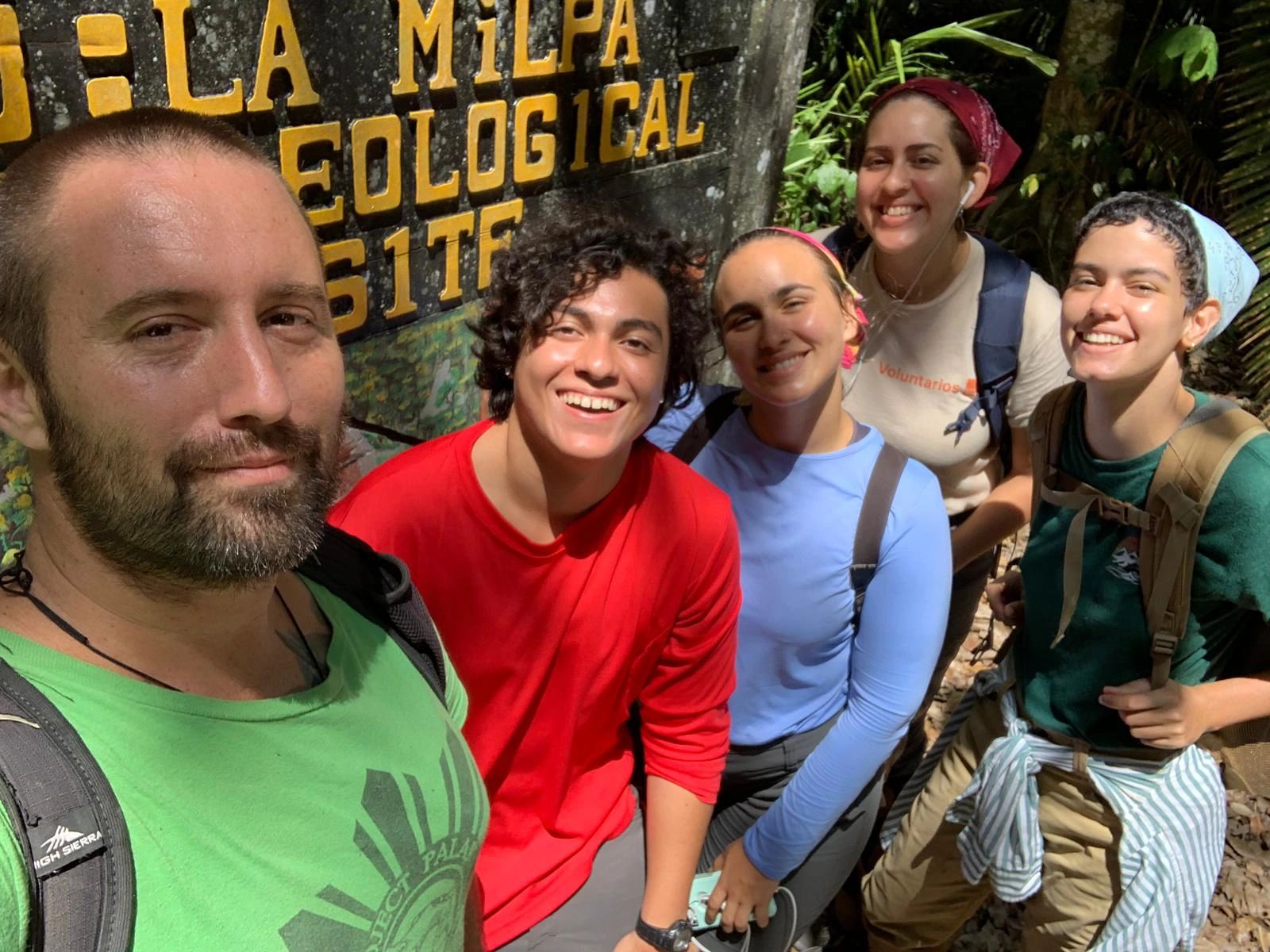
Norman Greenhawk (green shirt, on the left) on a trip to Belize with students from the Universidad de Puerto Rico, Rio Piedras

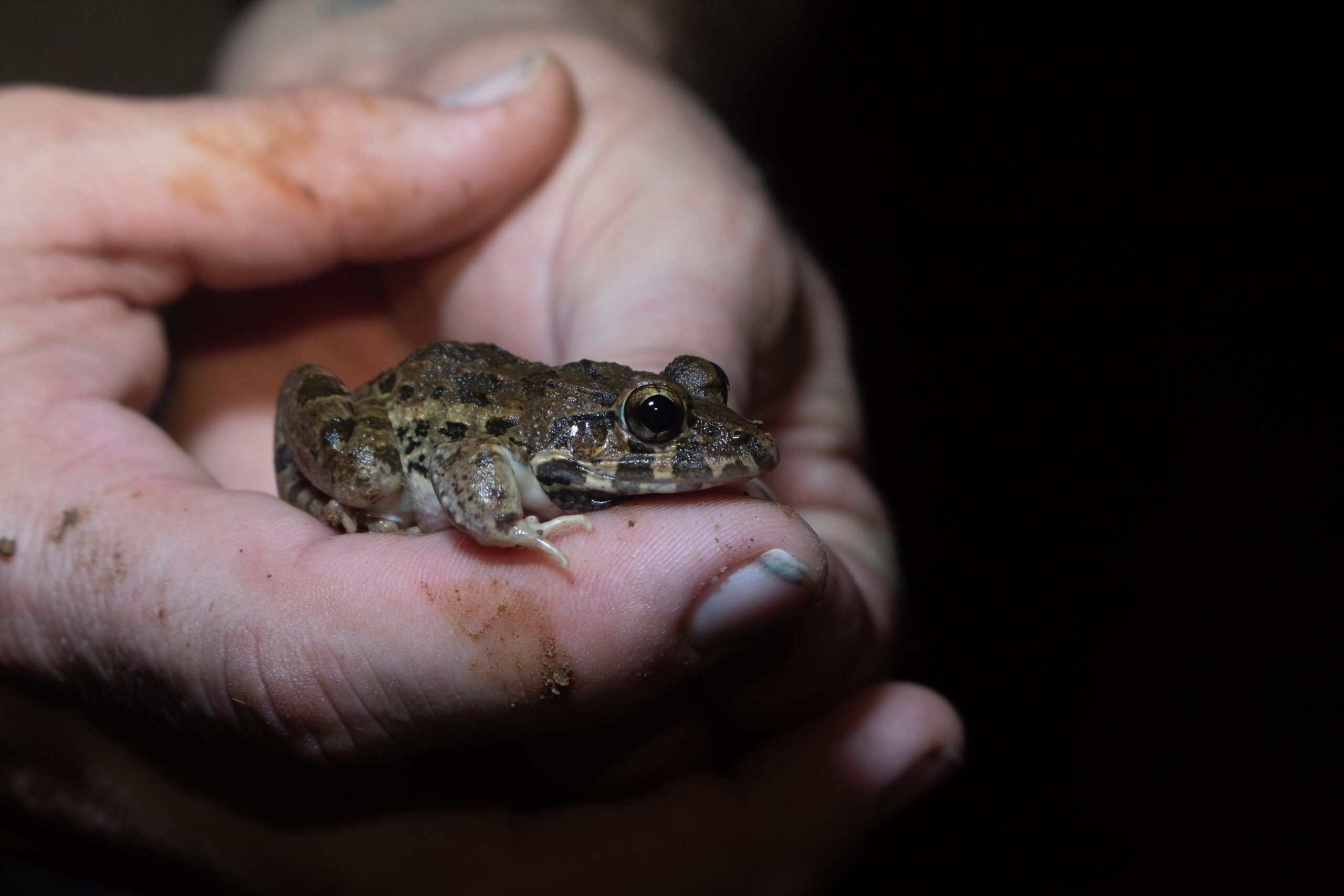
My specialty is ex-situ conservation, specifically, taking endangered animals from the wild, breeding them in captivity, and then returning the captive-bred offspring to the wild to boost populations. In 2015, my Fulbright award took me to the Philippines, where I established Project Palaka, the first organization in the country that focused on “ex-situ” (captive breeding) of endangered Philippine amphibians. We’re currently working to conserve and protect the Gigantes Limestone Frog, Platymantis insulatus, the most threatened frog species in the Philippines. Our team conducts population monitoring and threat assessment, in the remote Gigantes Islands, located in the Visayan Sea in the Philippines. We also have an assurance colony of the frog set up in Subic Bay, Zambales. Since October 2022, Project Palaka has been breeding the Gigantes Limestone frog in captivity, with plans to start reintroduction in late 2024.

Over the past two years, I’ve considered how to bring my experiences home to the Delmarva Peninsula. While my grandparents always worried about me, they supported my travels and work around the world. They have since passed on, and I miss them daily.  As a way of honoring their memory, I created The Harris Conservation Initiative (“HCI”). Formed in 2021, HCI is a 509 (a)(2) charity. Through this organization, I seek to enact real, measurable conservation actions that focus on overlooked, understudied, and ignored species of herpetofauna and freshwater fish. I have established partnerships in the Philippines, Puerto Rico, and Belize. Now, I’m developing projects in two additional areas- Japan, and back home on the Delmarva Peninsula. 

Platymantis insulatus, the Gigantes Limestone frog, Philippines. Photo by Jayson Madlao.

The Delmarva Peninsula, although small, contains six ecoregions and five types of wetlands. The Peninsula’s diverse habitats, from the forests of the Piedmont Uplands near Pennsylvania to the coastal wetlands, are home to 70 species of reptiles and amphibians and more than 40 species of freshwater fish. Conservation organizations around the world rightly focus on protecting the biodiversity of developing nations, where threats to the environment are often intensified. But that doesn’t mean that developed nations have solved all of their ecological concerns.

On a local level, I’m aiming to set up a network of study sites to monitor target species across various ecosystems on the Delmarva Peninsula, to establish updated baseline populations of threatened species, as well to enact data-driven conservation measures to protect Delmarva’s herpetofauna. I am also highly open to collaborating with local, established NGOs and conservation groups.

Just as importantly, I also began the Harris Conservation Initiative to provide the same opportunities that I have had to others. A major goal of the organization is to facilitate a research and collaboration exchange program between each project. From my time my graduate program at the Universidad de Puerto Rico, I know that every year, Puerto Rican students travel to Maryland’s Western Shore to engage in ecological research. I’d like to open that opportunity to the Eastern Shore and Delmarva, so that students from abroad can experience not only the peninsula’s unique natural landscape, but culture as well. I also want to see talented college students from Delmarva travel to and gain experience in herpetological surveys in Belize, or tropical forestry in Puerto Rico. 

I believe that by providing these opportunities, young, aspiring conservationists will be able to gain experience working in ecosystems that they otherwise might not. 

Norman Greenhawk is the director of the Harris Conservation Initiative. He is a graduate of Washington College and is holds a Master Herpetologist certification from  The Amphibian Foundation. He is also a recipient of the National Geographic Explorer award and a U.S. Department of State Fulbright Specialist. He currently lives in Philippines.

The Spy Newspapers may periodically employ the assistance of artificial intelligence (AI) to enhance the clarity and accuracy of our content.

Filed Under: Eco Lead, Eco Portal Lead

Environmental Reclamation and Sustainability for the Bay: The Poplar Island Project

December 16, 2023 by Matt LaMotte Leave a Comment

Dr. Michael Erwin

Recently retired career field biologist and college professor Michael Erwin, Ph.D., penned a scientific memoir, Birds, Beaches, and Biologists (2023, Austin Macauley Publishers, NY), chronicling a lifetime of teaching and field research in such exotic locations as Guyana, Trinidad and Suriname. But the book’s final chapters focus on Erwin’s decade-long dedication to the ongoing Poplar Island reclamation project here on the Chesapeake Bay.

Officially titled the Paul S. Sarbanes Ecosystem Restoration Project at Poplar Island, the reclamation effort has evolved into a model “Beneficial Use Project.” It is now the largest of its kind globally. It also reflects successful cooperation and coordination between Federal, State, and local organizations.

The interagency team includes the U.S. Army Corps of Engineers (USACE), the U.S. Fish & Wildlife Service (USFWS), the U.S. Geological Service (USGS), the Maryland Department of Natural Resources (DNR), and the Maryland Department of Transportation/Maryland Port Administration (MDOT/MPA). The University of Maryland (UMD) and University of Virginia (UVA), where Dr. Erwin ended his over 40-year research career, also played important roles.

The history of Poplar Island goes back to well before colonial times. By the mid-1800s, surveys showed that the island was around 1,200 acres; by 1900, there were nearly 100 residents. Besides several farms, the island had a post office, a church, and a school. Erosion was already taking its toll, and by the 1930s, it had been reduced to about four acres of “drowned wetlands.” By the 1990s, Poplar Island seemed doomed to extinction.

In 1996, the Maryland General Assembly passed a declaration stating that “all material dredged (from Baltimore Harbor) must be placed within a confined area or be beneficially reused.” A Poplar Island Research Group – a consortium of federal, state, local agencies, and non-government organizations — produced an Environmental Impact Statement that recommended using dredge material from the Baltimore Harbor to reconstruct Poplar Island as it was first surveyed in 1847. By 2000, environmental scientists like Dr. Erwin began researching the impact of the added dredge material on wildlife on and around Poplar Island.

What remained of Poplar Island was a little more semi-submerged marshland (aka, drowned wetlands) and mudflats that came and went with the tides. Using sand, rock, and stone, engineers built over 35,000 feet of dikes that created containment cells. At present, there are 20 cells. Water was discharged from these cells and dredged material was pumped in. After settling for several years, the remaining soil was graded to create a habitat that would be conducive to wildlife nesting and migratory resting areas. This is where the observations of Dr. Erwin and other scientists became so vital.

Beginning in the late 1990s, Dr. Erwin began working on Poplar Island by serving on a committee focused on project planning and design. In 2003, Dr. Erwin received funding from the USACE to serve as the USGS scientist to assist with designing upland and wetland wildlife habitats as well as monitoring wildlife populations – particularly rare species of waterbirds. For example, the arrival of the American Oystercatcher at Poplar Island has been a notable recent visitor to the Chesapeake Bay.

In the years since, waterbird species of concern, such as Least Terns, Snowy Egrets, Glossy Ibis, Black-necked Stilts, and Tricolored Herons, have begun nesting at Poplar Island. Ospreys have nested in good numbers along with Herring Gulls. In winter, rare Short-eared Owls have been seen. Since the Poplar Island Project began, researchers have identified over 250 species of birds, including close to 40 nesting species. 

Dr. Erwin’s years of field monitoring observations greatly influenced construction decisions for the island. Ultimately, construction decisions were made in no small measure based on Dr. Erwin’s years of field monitoring. It was here that he met and became associated with St. Michael’s own Jan Reese. During both field monitoring and habitat planning meetings, Dr. Erwin remarked that “Reese’s vast knowledge of the Bay’s natural history” proved extremely helpful to him and other researchers at Poplar Island. 

For Dr. Erwin, the Poplar Island Project was the longest as well as one of the most challenging projects of his career. “I had a reputation as an expert in the design and monitoring of key species using coastal habitats. It was challenging coordinating and working with the variety of engineers, administrators, and research scientists on the numerous upland and wetland decisions that were ultimately made.” In particular, the numbers and variety of colonizing, nesting, and hatching success of coastal waterbirds – many declining species – was an important highlight for Dr. Erwin. 

“As far as the future of Poplar Island, there is an ongoing need for natural resource monitoring and management,” stated Dr. Erwin. “Continuing public tours and education to make sure the island remains a wildlife and fisheries magnet – not to mention a dredged material depository – will be an important component of the ultimate success of the Project.”

Dr. Erwin retired in 2012, including from the Poplar Island Project, but he stays in touch with others he’s worked with and mentored even today. Construction and restoration, as well as monitoring and wildlife management at Poplar Island, is scheduled to continue until 2040. It should be noted that a similar project at James Island is just getting underway based on the Poplar Island model that he was instrumental in establishing.

“In the near future, we need to continue to assess and limit the degree of predation there – especially focusing on nesting birds,” said Erwin. “We should continue limited public tours, scientific research, and education visits to keep everyone aware of the invaluable wildlife and fisheries magnet that Poplar Island has become.” 

Dr. Erwin has dedicated more than 40 years to wildlife research, management, and conservation. As reflected in his memoir Birds, Beaches, and Biologists, Erwin’s career should inspire us to restore and sustain our delicate ecosystem. Poplar Island is a model example of how mankind can turn the tide and, particularly in the Chesapeake region, help reverse the ongoing loss of unique island habitats.

Matt LaMotte, a native of the Eastern Shore, has a diverse background. He grew up in Baltimore but spent much time in Easton and Chestertown. After college, he returned to the Mid Shore and worked in insurance and finance while raising his two sons. He then pursued a teaching and coaching career in independent schools across different states. In 2018, he chaired the History Department at Sts. Peter and Paul High School in Easton before retiring in 2021. Matt is now focused on conservation, outdoor education, and staying engaged with local and global affairs.

The Spy Newspapers may periodically employ the assistance of artificial intelligence (AI) to enhance the clarity and accuracy of our content.

Filed Under: Eco Lead, Eco Portal Lead

Washington College’s Natural Lands Project Creating More Wildlife Habitat

December 14, 2023 by Dennis Forney Leave a Comment

Dan Small, coordinator of Washington College’s Natural Lands Project, uses prescribed burning as one of the tools available to help maintain early successional grasslands on Maryland’s Eastern Shore

“The long-term efforts managing early successional habitat at our model farm, the River and Field Campus, have shown us that when you make a dedicated effort to set aside marginal cropland and install early successional habitat, birds will thrive.” – From Washington College’s Natural Lands Project website

Proof of that opening statement? Over the course of the last couple of years, at least 32 distinct coveys of Bobwhite Quail have been identified on and around Washington College’s River and Field Campus on the Queen Anne’s County side of the upper Chester River.

Summer surveys have recorded as many as 35 males singing their distinctive bobwhite calls. That’s according to Dan Small, coordinator of the college’s Natural Lands Project, under the umbrella of the Environment and Society department. Go big or go home!

Last week I wrote wistfully about a bygone era when evening summer rides through the Eastern Shore countryside would often be accompanied by the distinctive songs of Bobwhite Quail males. That soundtrack, due to lots of factors, eventually faded away.

This week though I write, more optimistically, about the success of the college’s efforts to return those sounds to the Eastern Shore landscape.

Since 2011, Small has been researching grassland birds such as quail. That research evolved into habitat management and conservation which led in part to creation of the Natural Lands Project in 2015.

The Chestertown college’s River and Field Campus of approximately 5,000 acres is known locally as Chino Farms. Dr. Henry Sears gathered several farms to create Chino in the latter half of the 20th century. Now known as the River and Field Campus, the diverse complex is owned jointly by Sears and the college. The total property includes 2,600 acres of farmland, 1,800 acres of forested woodlots, along with other wetlands and meadows.

“Dr. Sears,” said Small, “set aside 200 acres of that land in 1999 for experimental grasslands where he hosted classes and labs.  The specific goal was to create a successful habitat of early successional grasslands attractive to quail.  Now a thriving population occupies that area along with several other species that have been in decline including lots of different birds. On a summer’s day, it’s not unusual to hear 15 male quail calling in that area.”

Partnering with Maryland’s parks, and other state open space programs, as well as conservation-minded private landowners, the Natural Lands Project aims to replicate that success up and down Maryland’s Eastern Shore. “We advise and provide funds to assist landowners in the process,” said Small.

He noted that in cooperation and assistance with the program, public and private owners have converted more than 1,200 acres of mostly marginal farmland into early successional habitat.  Those are habitats that emerge after clearing events such as cultivation, burning or mowing take place.

If those areas were left undisturbed and unmanaged for several decades, they would eventually evolve into forests.  But management such as prescribed burnings hold them in that early successional grassland phase so preferred by quail and other species, including a number of sparrows.

”A lot of people are interested in helping,” said Small. “On eight of the properties we have converted in recent years, quail have shown up. For two years in a row we have seen successful breeding. We would like to create a corridor of habitat spanning several connecting farms. With proper management, we can have quail in the modern agricultural landscape.”

Small said the Natural Lands Project also contributes to efforts to improve water quality in the Chesapeake watershed by creating natural buffers that keep sediments and fertilizer run-off from entering waterways.

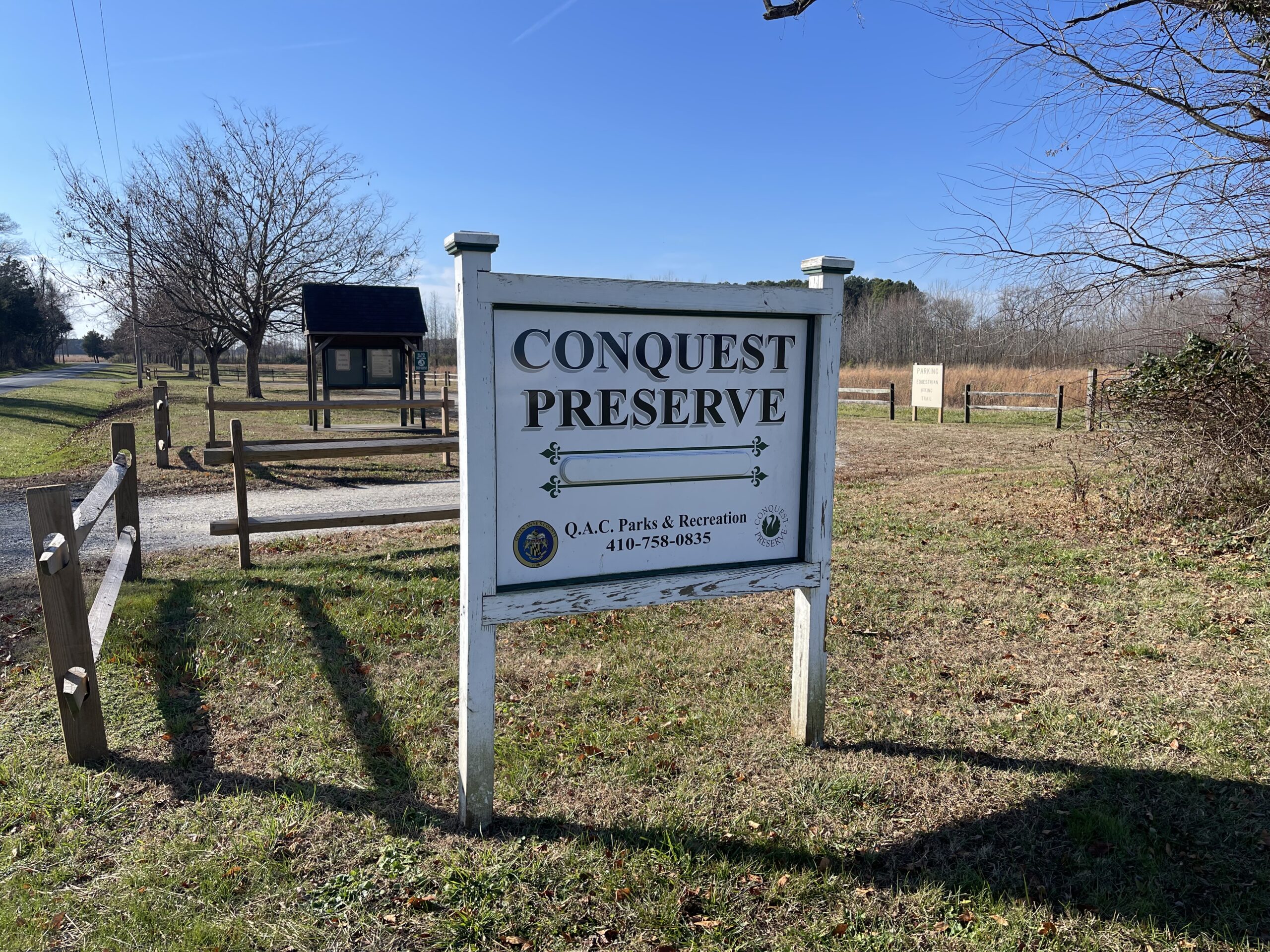
Partnering with Queen Anne’s County, the Natural Lands Project has helped convert 200 acres of farmland into grasslands between the Chester and Corsica Rivers. A parking area at the Conquest Preserve near Centreville invites visitors to walk trails winding through meadows and forests along the Chester. The meadows and five different managed wetlands attract birds, reptiles and mammals, and groups of people who like to watch nature in action. Members of the Talbot bird club, for instance, flocked there recently to add LeConte’s sparrows to their lifetime lists.

Conquest Preserve also includes an edible food forest with a variety of trees and shrubs designed to provide wild fruits for critters up and down the food chain.

“Momentum is growing,” said Small. “Farming operations are passing down to a new generation that is more conservation minded.  They realize the benefits of not farming marginal land and saving on the cost of inputs, as well as the importance of providing habitat for birds and animals.”

Dennis Forney has been a publisher, journalist and columnist on the Delmarva Peninsula since 1972.  He writes from his home on Grace Creek in Bozman.


The Spy Newspapers may periodically employ the assistance of artificial intelligence (AI) to enhance the clarity and accuracy of our content.

Filed Under: Eco Lead, Eco Portal Lead

Spy Minute: Is the Millstream Trail One of the Best on the Mid-Shore?

November 13, 2023 by The Spy Leave a Comment

A few weeks ago, one of our many spies was having coffee in Chestertown and overheard a conversation between two dog owners. The one pet owner confessed that they drove to Centreville to walk on the Millstream Trail with her dogs  because she considered it one of the best walking paths on the entire Mid-Shore.

Needless to say, curiosity took over, and we asked one of our special agents to check out the walking trail in person. They filed this special report.

This video is approximately two minutes in length. For more information about the Millstream Trail please go here.

The Spy Newspapers may periodically employ the assistance of artificial intelligence (AI) to enhance the clarity and accuracy of our content.

Filed Under: Eco Lead, Centreville Best

Discover the Mysterious Creatures of the Deep Sea at the St. Michaels Library with Horn Point’s Andrew Thaler

October 25, 2023 by Val Cavalheri Leave a Comment

Perfectly timed for the season is an otherworldly exhibition found in of all places at the St. Michaels Library. Dr. Andrew Thaler, a deep-sea ecologist and adjunct faculty at the University of Maryland Horn Point Lab, has assembled a miniature museum of bizarre sea creatures from the deep sea’s dark abyss. 

On Monday, November 6th, at noon, Dr. Thaler will present a special Lunch & Learn lecture at the library, discussing these lifeforms. Having spent over 20 years researching deep-sea ecosystems, Thaler has countless fascinating stories to share. Attendees will learn how technological innovations are rapidly expanding our access to one of the planet’s last unexplored frontiers, and they’ll discover just how much wonder and mystery still lurk in the unseen majority of our world.

Currently, Thaler runs a small environmental consulting firm in St. Michaels focused on deep-sea policy and conservation technology. But his passion for the abyss began decades earlier as a child, the first in his family to express interest in marine biology. “I’ve always been interested in studying deep-sea hydrothermal vents,” he says. “They’re unlike anything else on Earth – these oases of life dependent not on sunlight but on chemical energy gushing from undersea hot springs.”

When pursuing his Ph.D. at Duke University, Thaler specialized in researching the environmental impacts of deep-sea mining, a burgeoning industry poised to tap into valuable seabed resources. For his graduate work, he traveled to a series of hydrothermal vents off Papua New Guinea, racing to catalog species and gather ecological data before miners could disrupt the pristine sites. “The good news is, the company ended up going bankrupt,” Thaler said. “So the vents I studied were never actually mined. But it was an amazing opportunity to explore this incredible environment before any harm was done.”

Now, as a researcher and advocate, Thaler continues working to develop frameworks that allow us to study and harness the deep sea’s potential resources while safeguarding its fragile ecosystems.

The specimens currently on display at the St. Michaels library come from the archives of Thaler’s mentor, legendary deep-sea ecologist Dr. Cindy Van Dover, the first woman to pilot the DSV (deep submergence vehicle) Alvin. Van Dover retired in 2019, and Thaler inherited her samples to continue the research she had begun. “Once you’ve collected something from the deep sea,” he said, “we have a moral duty to get as much knowledge as possible out of it. So that the impact of taking it from the deep sea isn’t lost, and we get the opportunity to learn something.” 

Thaler curated the best of the samples into an educational mini museum – including the current star attraction, a giant deep-sea isopod.

Resembling a massive roly-poly or pillbug, this alien arthropod found deep in the Gulf of Mexico grows as big as a housecat, obviously dwarfing its terrestrial cousins. Thaler says the oddity appears to have become a destination for local curious kids, though some squeamish adults find it disturbingly huge and eerie. If that’s not mind-bending enough, there are also monstrous giant tubeworms, blind albino shrimp, scale worms that survive in near-boiling water, glass sponges, squat lobsters, and a menagerie of other creatures from the Gulf of Mexico, Atlantic Margin, and Western Pacific. As Thaler will explain, each organism hints at the outrageous forms evolution can take given the right conditions.

Dr. Andrew Thaler

“There are some truly astounding animals down there,” says Thaler. “Some of the weirdest creatures you’ve ever laid eyes on.” Yet, as he explained, only a handful of researchers, let alone ordinary citizens, have ever glimpsed such organisms in their natural habitat. Historically, undersea exploration has lagged behind space investigation. “I used to joke that we have more robots on Mars than we have vehicles capable of exploring the deepest parts of the ocean,” he said.

But that has changed dramatically. Now, dozens of robotic and autonomous vehicles are capable of going into the bottom of the Mariana Trench. Besides the manned submersibles, live-streamed remotely operated vehicles (ROVs) allow shore-bound scientists virtual access to the seabed. 

Still, most of us earthlings will never voyage to the abyss themselves. That’s what makes the St. Michaels exhibit so unique. “I don’t know of any other place where you can see specimens like this, from the deep ocean, somewhere so accessible as a public library,” says Thaler. “It’s a real testament to the library that they want to showcase something unusual yet evocative.”

Thaler hopes the creatures spark curiosity and wonder in visitors, especially children. He aims to share his own passion for the planet’s least explored realm. “We all share this amazing world, with incredible places most of us will never see firsthand,” said Thaler. “Yet they can still inspire us in meaningful ways.”

As part of his current research, Thaler is investigating how microplastics accumulate in the bodies of deep-sea organisms – a threat to vulnerable ecosystems we’ve scarcely begun to understand. But while environmental realities must be faced, a sense of awe persists.”The deep ocean is incredibly biodiverse,” says Thaler. “There are some of the most astounding animals down there. It’s an opportunity to discover something new and incredible, unlike anywhere else.”

Don’t miss this rare chance to glimpse the mysteries of the deep at your local library. Dr. Andrew Thaler’s upcoming lecture will illuminate how researchers are unveiling the wonders of the seabed while the ongoing exhibition lets you come face-to-face with denizens of the abyss. There is much left to explore.

Dr. Andrew Thaler will be the guest speaker for the November Lunch & Learn series at the St. Michaels Branch on Monday, November 6th, at noon. The deep-sea mini museum is currently on display until November 30th.

The Spy Newspapers may periodically employ the assistance of artificial intelligence (AI) to enhance the clarity and accuracy of our content.

Filed Under: Eco Lead, Eco Portal Lead

Adkins Mystery Monday: Whose in the Garden?

October 23, 2023 by Adkins Arboretum Leave a Comment

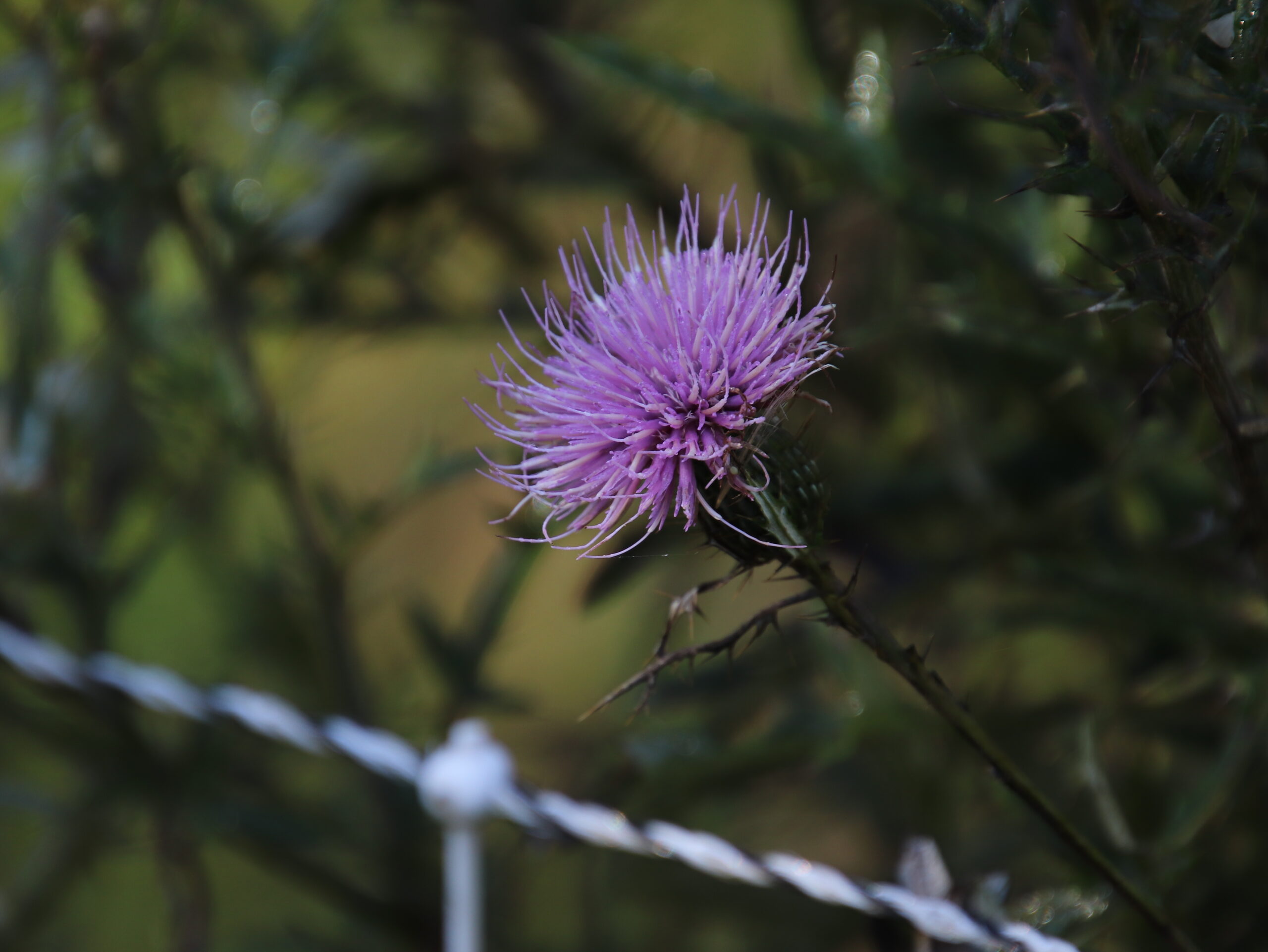
Happy Mystery Monday!  Can you guess what is pictured in photo #1?
The answer to last week’s mystery is the flower head of bull thistle, Cirsium vulgare, pictured in photo #2.
Bull thistle belongs to the artichoke sub-family, and was used by early humans as a warm medicinal tea. The roots helped with poor digestion and the treatment of stomach cramps, while the leaves were used to treat neuralgia.
In addition to medicinal uses, thistle seed fluff can serve as tinder, and the inner bark can be used in paper-making.

Goldfinches are particularly attracted to thistle. Not only do they pull the seeds out to eat, goldfinches use the thistle down, the pappus, to line their nest.

Adkins Mystery Monday is sponsored by the Spy and Adkins Arboretum. For more information go here.

The Spy Newspapers may periodically employ the assistance of artificial intelligence (AI) to enhance the clarity and accuracy of our content.

Filed Under: Eco Lead, Eco Portal Lead

A View of the Chesapeake Bay’s Health from its Headwaters

September 5, 2023 by Maryland Matters Leave a Comment

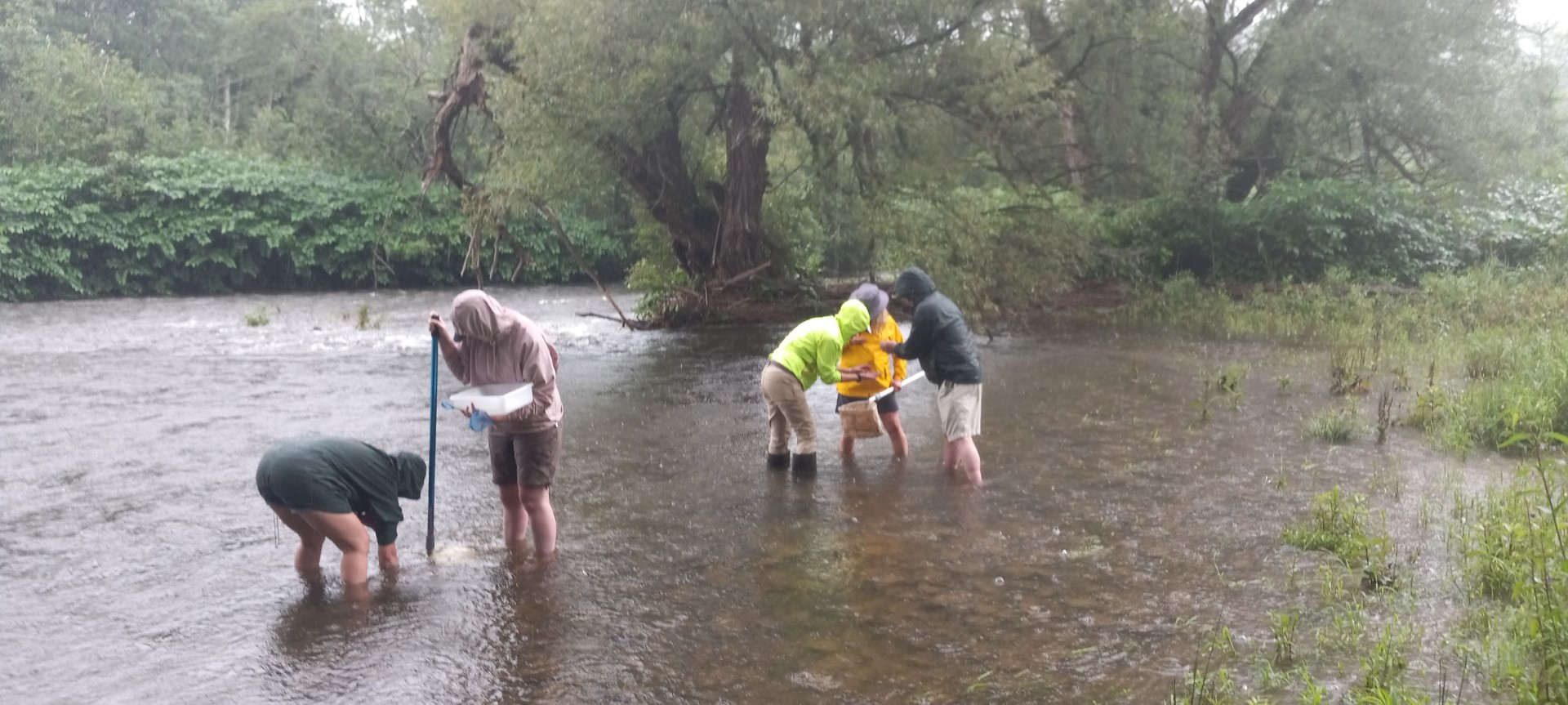
On a recent rainy afternoon, a dozen educators and environmentalists from Central New York were standing ankle deep in Charlotte Creek here, collecting water samples in test tubes, petri dishes and ice trays. As the rain pelted the group at a sideways angle, with the creek running faster than usual, Heather Grant, one of the leaders, felt compelled to offer a gentle warning.

“The teacher in me wants to say that the water is still high, so don’t go too far out by yourself,” she said. “Please don’t get washed away.”

It would not have been apparent to anyone watching, but this simple scientific inquiry, 282 driving miles from Perryville in Cecil County, the first town in Maryland to touch the Chesapeake Bay, had profound implications for the health of the Bay — and for the imperative of preparing the next generation to work to combat climate change. The creek runs into the Susquehanna River near Oneonta, about five miles east of West Davenport, and the Susquehanna, the longest river on the East Coast, is the biggest and northernmost source of the Chesapeake Bay, one of more than 150 waterways that feed into the venerated estuary.

Not that very many people know it. The Susquehanna begins at Lake Otsego in Cooperstown, N.Y., a quaint village named for James Fenimore Cooper, author of “The Last of the Mohicans” and other 19th century yarns. It’s also home to the Baseball Hall of Fame, which draws a steady stream of tourists. Brewery Ommegang, a giant and popular watering hole, restaurant and event space, is just outside of town in a corn field, its wild success surely a beacon of hope for craft brewers downriver in Maryland.

The only indication that this is the source of the Chesapeake Bay comes from a historical sign in a shady copse in Council Rock Park, which overlooks the lake, three blocks from the Baseball Hall of Fame (or the “B-HOF,” as some locals call it). “This marker signifies the point where the beautiful Susquehanna River begins its 444 mile journey to meet the Chesapeake Bay,” the sign says.

But a number of environmentalists and teachers in this part of the world are taking their responsibility as stewards of the Chesapeake Bay increasingly more seriously. And they are thinking more often about how they can incorporate Bay health into the scholastic curriculum. It can seem at times like a lonely crusade.

“Sometimes up here it’s tough to get students — or anyone — interested in the Bay, which is 400 miles away,” said Jeff O’Grady, program director at the Otsego County Conservation Association (OCCA), a leading environmental group in the area.

For the past three years, OCCA has organized a summertime training for local teachers to learn more about the Chesapeake Bay watershed and to devise strategies for teaching their students about it. Run initially by a group of volunteers, the environmental group, which has been around since the late 1960s, was launched to protect forests in the area. But its size and mission have grown exponentially over the years. Today, nine full-time staffers tackle everything from water pollution to clean energy advocacy to climate resiliency. Three years ago, the group won a grant from the National Oceanic and Atmospheric Administration to organize the teacher trainings on the Bay.

“Education is part of everything we do,” O’Grady said.

Maryland policymakers and environmentalists have long been obsessed about upstream pollution that comes into the Chesapeake Bay. But most of their ire and frustration focuses on Pennsylvania, which by all accounts and a series of lawsuits, has been lax, until recently, about its responsibilities to curb agricultural runoff and other pollution that flows to the Susquehanna and its tributaries.

New York is often missing from the conversation. In fact, environmentalists from the area joke about being left off official maps of the Bay watershed and recall a recent document from the Chesapeake Bay Foundation referring to the city of “Binghampton” — a serious misspelling to the locals. That may help explain why it’s so hard for local educators to teach their students and communities about the Bay.

“That’s how little people think about New York and the Chesapeake Bay,” said Liz Brown, OCCA’s clean energy community coordinator, who was co-leader of this summer’s teacher training. “Our portion up here is really critical to the Bay watershed, but it’s obvious why people don’t think of it, because it’s so small in proportion to all the other states.”

Grant, the other co-leader, who is a middle and high school teacher in the Morris Central School District, northwest of Oneonta, recalled fruitlessly exhorting a student to be more curious about the Chesapeake Bay.

“I don’t like oysters,” he replied.

‘We want this to be a place to not let that fleeting idea go to waste’

In Maryland, Bay education is a common and essential thing — and the state has broad benchmarks for environmental instruction that school districts are required to hit. In New York, educators were never expected to think about the Chesapeake Bay until the Empire State signed on to a multi-state agreement to reduce pollution in the Bay more than a decade ago. But there are still no standards or requirements for teaching about it.

For three days teachers participating in the Otsego County Conservation Association training program met in a historic schoolhouse at the Pine Lake Environmental Campus of Hartwick College. Hartwick, a small liberal arts school in Oneonta, just down a steep hill from the bigger campus of the State University of New York at Oneonta, offers housing in small cabins at the environmental campus for students who wish to avoid the hurly-burly of typical dorm living. During the summer, the  environmental campus is used for youth summer camps — and, for the past two years, for the teacher training on the Bay watershed (it was held virtually the first year, due to the pandemic).

The nine teachers participating in the training were at different career stages and came for a variety of reasons. All were clearly committed environmentalists. On the first day, Grant wore a T-shirt that said “Teach climate science” on the front, and on the back said, “Teach climate science for…human health, food security, ecosystems, water resources, wildlife, the economy, our future.”

One member of the group, Amy Favinger, a 4th grade teacher in the Gilbertsville-Mount Upton Central School District, grew up in Baltimore County, taught in county schools, and moved with her family to Central New York during the pandemic after teaching for several years in Northern Virginia. Favinger said the training appealed to her partially out of a kind of nostalgia — she still has family in Baltimore — and partially to network with other educators, because she’s still relatively new to the area.

“Having that connection, living and growing up and teaching in that area, I wanted to figure out how I could use my previous experience to make connections for my students,” she said.

Throughout the three days, Grant and Brown were energetic and enthusiastic guides, mixing wonky science with knowing sympathy about demands and limitations teachers face in their daily lives, coupled with political realities of preaching climate action to reluctant or indifferent communities.

Teachers and environmentalists collect water samples in Charlotte Creek in West Davenport, N.Y., part of their training on how to teach about the Chesapeake Bay watershed. Photo by Josh Kurtz.

“We’ve got a lot of resources for you guys,” Grant told the teachers, later urging them to think creatively. “We want this to be a place to not let that fleeting idea go to waste.”

One of many messages group leaders attempted to drive home was that any scientific or environmental lesson or conversation, no matter how local, could be tied to broader discussions about the health of the Chesapeake Bay watershed. At one point, Brown and Grant asked each of the teachers to think about environmental challenges near their schools that could warrant academic inquiry — and could impact Bay health.

One teacher mentioned a “sketchy” visible gas pipe on the school property, leaking effluent of unknown origin. Another talked about her school being close to an old dump notorious for its methane emissions. Another talked about wanting to study microplastics in local waterways. And another wondered about the ecological impacts of the highly popular vineyards in the nearby Finger Lakes region.

They also talked about opportunities for civic action, at the school level and in their communities — everything from Earth Day cleanups to planting pollinator gardens to pulling tires out of rivers to advocating for meatless Mondays in the school cafeteria. One teacher, Chad DeVoe, a career counselor from the Onondaga-Cortland-Madison counties BOCES (a vocational educational program), said that when a school field trip was canceled in the late spring due to unhealthy air caused by Canadian wildfires, he urged his students to call the local congressman, Rep. Marc Molinaro (R), to ask his office what he was doing to fight climate change. They never got a particularly satisfactory answer, DeVoe told his colleagues, but it was still a valuable exercise. 

“We do letter-writing [to political leaders on climate change] earlier in the year,” DeVoe he said. “But this is far more effective. The kids loved it.”

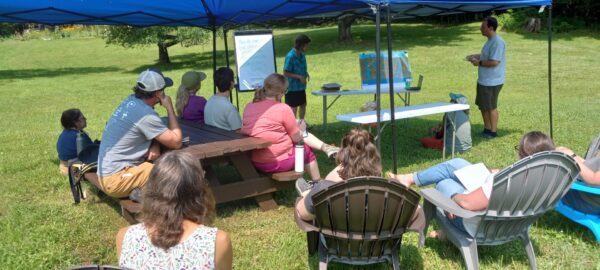
Over the three days, the group of teachers took several short field trips on the wooded grounds of the environmental center’s campus, and also received visits from a range of experts and advocates: a scholar on local leaves and an authority on archaeology, as well as the director of an agricultural extension office affiliated with Cornell University, the leader of a regional environmental group that specializes in tree planting, and the district manager of the Otsego County Soil and Water Conservation District.

The quick hike to Charlotte Creek, through a piney forest, was part of an exercise to gauge water quality and monitor macroinvertebrates living near the shore. The teachers and environmentalists examined small critters in the test tubes, petri dishes and ice trays they brought with them, and discussed what they collected: mayflies, stoneflies, and two types of crayfish, among others.

The very same experiments, Brown told the teachers, can be done with their students if there is a stream nearby. “Macros are a good way, especially if you do it year after year, to assess water quality,” she said.

‘We need the next generation to participate’

Any educational endeavor, almost by necessity in modern America, comes with its own jargon and series of acronyms. The three-day teacher training was no exception.

The grant from NOAA that the Otsego County Conservation Association received came from a program the federal agency has established called B-WET, which stands for Bay Watershed Education and Training. B-WET teacher trainings have been taking place throughout the Bay watershed for several years, but the OCCA offering is the first in New York state.

More broadly, the B-WETs borrow from a teaching concept known as MWEEs — Meaningful Watershed Education Experiences, pronounced mee-wees. MWEEs can be any number of things and have existed for decades — many teachers in Maryland know a thing or two about them. The four elements they require, educators say, are issue investigation, outdoor field experience, synthesis and conclusions, and stewardship and civic action. Every conversation during the OCCA session was geared to shedding light on those goals.

New York teachers learning from a local leaf expert at a training session on the Chesapeake Bay watershed earlier this summer. Photo by Josh Kurtz.

On the second day of the three-day training, Elise Trelegan, the B-WET program coordinator for NOAA’s Chesapeake Bay Office in Annapolis, joined the meeting on Zoom from her home on the Eastern Shore. Trelegan told the teachers that the work they are doing in New York is part of a bigger effort; there are 637 school districts in the Chesapeake Bay watershed over six states and the District of Columbia, she said, and the B-WET office has an annual budget of $2.7 million — a pittance in the federal budget — to try to reach them all.

“We recognize that if we’re going to do anything on conservation and stewardship, we need the next generation to participate,” Trelegan said. “We haven’t done a lot of work in New York, so we’re really excited to have you all here. This funding catalyzes this kind of environmental literacy, environmental education, in all these school districts.”

Trelegan also explained that NOAA, like other federal agencies, is increasingly trying to emphasize equity and environmental justice as it funds climate and education programs.

“We’re looking for a long-term commitment from school districts to change the culture on environmental education,” she said. “We see this grant as the beginning of more things happening in New York.”

One teacher asked Trelegan why it took New York so long to “jump on the bandwagon” of providing education about the Bay watershed.

“I think it’s a sort of perception,” Trelegan suggested. “If people don’t see there’s a connection to the Bay, they don’t see how the upstream decisions affect things downstream.”

A teacher told a story that illustrated that very phenomenon. “It’s interesting,” she said. “I ask my students, ‘where do you think our water winds up?’ And they may say, ‘Oh, the Susquehanna,’ or ‘Binghamton.’ They don’t really know it goes to the Chesapeake. They don’t know we’re in the headwaters of the Chesapeake.”

Trelegan signed off of the Zoom, from Maryland, and expressed gratitude to the assembled teachers. “Thanks for doing these jobs and being the role models that you are,” she said.

Throughout the three-day session, there were more reminders of Maryland. At one point, the group watched a half hour video about ongoing MWEEs in three Bay watershed school districts, organized through the B-WET program. One was a high school in Lancaster County, Pa., one was a middle school in Virginia’s Shenandoah Valley, and the third was Lewisdale Elementary School, in Prince George’s County. The teachers in the room watched with great interest as a Lewisdale teacher led her students to Sligo Creek to take water samples and examine the macroinvertebrates they collected.

“Some of you are saying you have a lobster,” the teacher says in the video. “I don’t think that’s right.” Her students laugh.

Speaking to the camera, the teacher says her students’ families regularly use the park by the creek for picnics and other recreational activities and that the program makes them more attuned to their own responsibility for keeping the park and the water clean. And she praises the B-WET grant for helping to frame her lessons.

“The MWEE does not add on to all the standards that I have to teach,” she says. “To me, it frames [the lessons] in a much different way.”

When the video was over, the New York teachers remarked on the diversity of the student populations in the video they saw, especially the kids from Lewisdale, who were primarily Latino. The teachers, whose districts are small, rural and largely white, also wondered aloud about the resources which school districts in the video may have to enable them to run well-organized and successful MWEE programs.

When the three days had ended, several teachers said they learned a lot and planned to apply what they heard to their classroom instruction in the coming school year.

“It’s pretty great,” said Bryan Hill, a science teacher at Penn Yan Academy, a high school in Penn Yan, N.Y. “I think the coolest thing, apart from the litany of resources, is using hands-on activities that show kids environmental stewardship in real-world ways.”

Hill, who dropped out of medical school to teach at Penn Yan Academy, his alma mater, said he was “shocked, given that we have so many bodies of water around here,” that so little attention has been paid to the impact upriver activities have on the Chesapeake Bay. “It’s so easy to be complacent, to say, ‘I don’t know where the water goes.’”

Favinger, the 4th grade teacher who grew up in Baltimore County, was also impressed — and grateful.

“The resources are there,” she said. “You just have to know where to look and what you need to take in. It’s empowering when you get to make the decisions and set up the programs. There’s a way to do this and meet the standards of what you have to teach.”

Several teachers said the MWEEs appear to allow for a level of creativity and flexibility that many academic programs and mandates don’t have.

“This is not marked in stone,” Grant told the teachers. “We’re not going to show up in your schools in October and check back on these.”

All politics, all environmental action and all educational activities may, at a certain level, be local, but the leaders of the Otsego County Conservation Association were quick to remind the teachers about their small but vital place in a vast watershed.

“It’s important to stay focused on your waterway, but also taking a bigger look,” Brown advised. “Not just where you are, not just the Chesapeake Bay, but globally.”

By Josh Kurtz

The Spy Newspapers may periodically employ the assistance of artificial intelligence (AI) to enhance the clarity and accuracy of our content.

Filed Under: Eco Lead, Eco Portal Lead

PSC Chair Wants To ‘Lower The Temperature’ on Disputes over Renewable Energy Projects

August 30, 2023 by Maryland Matters Leave a Comment

The new leader of the Maryland Public Service Commission said Tuesday that he plans to convene meetings with interested parties over the next few months to discuss the increasingly controversial issue of where to place renewable energy installations in the state.

Testifying before a virtual hearing of the state Senate Committee on Education, Energy and the Environment, Fred Hoover, who took over as PSC chair in July, said he wanted to “get all the parties together to lower the temperature in some of these siting topics.”

The PSC is Maryland’s chief energy and utility regulatory agency, but it also has a historical role in approving proposals to build energy-generating facilities in the state. Where once that job meant considering and approving large power plants, as the industry evolves the commission now is tasked with becoming involved in decisions about where to place renewable energy installations. Those fights, especially over whether to allow solar projects on land zoned for agricultural uses or forests — and the PSC’s role in them — have become increasingly contentious.

Four years ago, the state’s highest court, then known as the Maryland Court of Appeals, ruled that the PSC can supersede local zoning laws when it came to applications to build large renewable energy installations.

Sen. Brian J. Feldman (D-Montgomery), chair of the Education, Energy and Environment panel, said in his view the court ruling suggested “the PSC is top dog” in these disputes. But he acknowledged that other entities, including the powerful Maryland Association of Counties, may have a different interpretation of the court decision.

“This issue has been very controversial over the interplay between the Public Service Commission and local governments,” Feldman said. “…This is still a muddied water kind of topic.”

Hoover pointed out that any entity applying to build a large renewable energy installation, such as a solar array on agricultural land, still must obtain relevant permits from local governments before they can proceed.

Earlier this month, Feldman, along with House Economic Matters Chair C.T. Wilson (D-Charles) and House Environment and Transportation Chair Marc Korman (D-Montgomery) wrote a letter to Gov. Wes Moore (D) seeking guidance on how the state should approach controversies over renewable energy installations given the necessity of increasing the state’s renewable energy generation to meet aggressive climate goals, among other things. Under legislation required last year, the state is required to hit a 50% renewable energy goal by 2030 and to use 100% clean energy by 2035.

“To achieve these targets, Maryland must dramatically and equitably increase its deployment of solar installations across the State and identify appropriate locations for energy storage,” the committee chairs wrote. They asked Moore to direct several state agencies to coordinate these efforts, “as well as identifying innovative policies being pursued in other states.”

Hoover told senators that his decision to convene meetings on siting was, in part, a response to the lawmakers’ query.

The Task Force to Study Solar Incentives, which was set up by state legislation this year, is also expected to examine this topic in months ahead.

So far, local governments have taken a piecemeal approach to renewable energy siting policies. In 2021 Montgomery County passed legislation effectively limiting the number of solar arrays that can be installed in the county’s vast Agricultural Reserve. Just last month, the Carroll County Board of Commissioners voted unanimously to ban large solar projects from being built on land zoned for agricultural use. Next week, the Anne Arundel County Council is tentatively scheduled to vote on amended legislation that could limit the amount of solar arrays permissible on undeveloped land.

Several stakeholders — including leaders of renewable energy companies, environmental groups, agricultural concerns, business organizations and local governments — have begun wondering openly if the state needs uniform standards on where and how to build renewable energy installations. A bill passed in this year’s General Assembly session makes it easier to install solar arrays on industrial lands, public and private rooftops, parking lots and other public facilities. Baltimore County officials, including County Executive Johnny Olszewski Jr. (D), are participating in a ribbon-cutting Wednesday for a rooftop solar project in Rosedale that will eventually provide power to 6,000 area homes.

But it’s widely acknowledged that some agricultural land will have to be set aside for renewable energy installations if the state is to hit the clean energy goals laid out in the 2022 Climate Solutions Now Act.

Hoover acknowledged the possible need for statewide legislation to quell the siting controversy when he told the senators Wednesday that he may approach them for “a legislative fix.”

The discussion about renewable energy siting came at the end of a two-hour hearing by the Senate committee that enabled lawmakers to learn more about the Public Service Commission and its myriad responsibilities. The Senate panel was renamed and given a new portfolio at the beginning of the year, so many members of the panel are still learning about energy issues. Additionally, three of the five PSC commissioners have taken office in the past few months, as Moore attempts to make the agency an aggressive partner in the administration’s desire to combat climate change.

PSC officials led the Senate committee through discussions ranging from how the commission considers utilities’ requests to raise rates, to how to read an electric bill, to whether utilities are being given too much license to beef up natural gas infrastructure, to some of the particulars on electric supply competition.

“To me it seemed like the right level of high-level and basic,” said Sen. Cheryl C. Kagan (D-Montgomery), the committee vice chair.

By Josh Kurtz

The Spy Newspapers may periodically employ the assistance of artificial intelligence (AI) to enhance the clarity and accuracy of our content.

Filed Under: Eco Lead, Eco Portal Lead

  • « Previous Page
  • 1
  • 2
  • 3
  • 4
  • Next Page »

Copyright © 2026

Affiliated News

  • Chestertown Spy
  • Talbot Spy
  • Cambridge Spy

Sections

  • Sample Page

Spy Community Media

  • Sample Page
  • Subscribe
  • Sample Page

Copyright © 2026 · Spy Community Media Child Theme on Genesis Framework · WordPress · Log in