MENU

Sections

  • Home
  • Education
  • Donate to the Centreville Spy
  • Free Subscription
  • Spy Community Media
    • Chestertown Spy
    • Talbot Spy
    • Cambridge Spy

More

  • Support the Spy
  • About Spy Community Media
  • Advertising with the Spy
  • Subscribe
February 22, 2026

Centreville Spy

Nonpartisan and Education-based News for Centreville

  • Home
  • Education
  • Donate to the Centreville Spy
  • Free Subscription
  • Spy Community Media
    • Chestertown Spy
    • Talbot Spy
    • Cambridge Spy
Archives Food and Garden Food and Garden Notes Food and Garden Food-Garden Homepage Food and Garden Homepage Notes

Fall Planting: The Glory Days By Nancy Taylor Robson

September 16, 2025 by Nancy Robson Leave a Comment

Autumn mums

In spring, gardeners act like kids in a candy store, greedily stuffing everything we can get our hands on into the ground. Then the annual drought kicks in. For the rest of the summer, we pay for our botanical gluttony with back pain and water bills, hauling around hoses (or buckets from the rain barrels) in an effort to keep the cache alive. All this when the truth is: fall is often a better time to plant here in Maryland for a variety of reasons.

“It’s better for gardeners,” says Robin Hanway, UMD Extension Program Assistant for Kent County. Reprieved from summer’s Sarahan heat, we emerge from the AC into balmy autumn, ready for a little garden restoration, a horticultural mini makeover that benefits both the soul and the neighborhood. “Weed growth slows and there are fewer pests,” Hanway adds. So, the improvements you make now tend to last a little longer visually and require less tending.

“Cooler temperatures are [also] less stressful for plants,” Hanway notes. The hot, desiccating winds of summer have usually given way to something more temperate, so plants are able to retain more moisture. “And soil temperatures are still warm, which benefits root growth.”

The cool soil temperatures in spring, when most of us want to jump start the season (and are often too quick off the mark) can stunt growth.  Low soil temperatures affect the ability of plants to uptake nutrients.

“When soil temperatures are below 45F, overall root growth is reduced, so fewer roots grow and reach nutrients,” says Jon Traunfeld, Director of the Home and

Fall sale shade plants

Garden Information Center at University of Maryland Extension. Whereas the warm ground in autumn encourages subterranean growth. “Trees, shrubs, and herbaceous perennials planted in September and early October typically have enough time to establish root systems and survive the winter,” he says.

Also in fall, plants aren’t trying to produce leaves and blooms, so they can devote all their energy to building those sturdy root systems.

“The plants are dropping all their leaves if they’re deciduous so they’re not supporting all the energy that goes into their leaves,” explains Michael Jensen, licensed tree expert in the State of Maryland and owner of Unity Nursery in Church Hill. In conjunction with the mention of leaf fall (which is where we get the old Anglo-Saxon term for autumn), Jensen encourages people to ‘Leave the Leaves.’ “It’s not related to fall planting” he admits, “but everyone blows the leaves away.” While clearing them off is perceived as tidy, he notes that it squanders nutrients that the tree has assiduously banked. “The tree has been taking up nutrients all season long. Then all that energy falls on the ground and releases all those nutrients back on the ground. So, if you’re blowing the leaves away, you’re removing all the [free] nutrients, and then going and buying fertilizer.”

In addition to being economical (and training the community to view the leaf blanket as beneficial rather than messy), the fallen leaves are also critical habitat for some pollinators, who are also bird food. So, leaving leaves means less cost and labor for the gardener, more butterflies, lightning bugs, and birds for the community.

Another benefit that planting in fall offers is free water.

“There’s typically more rain, so there’s moisture,” says Jensen. “In fall planting, the water requirement is significantly reduced.” Generally, new plants need about an inch of water a week to get established, an amount that can taper in winter, but does not diminish completely. “During winter you need to water sometimes if it has been very dry.”

Planting in fall also offers plants – tree, shrub, perennial – some less obvious but no less valuable opportunities to adapt.

“Going into winter, which is a nice rest period with a low stress level, you’re moving plants to a new place,” says Jensen. “They’re getting settled in so they’re adjusting to the soils, their new light conditions, and all while they’re not trying to produce leaves and blooms.”

Jensen says that, depending on the weather and winter, especially now that the effects of climate change have become so apparent, he plants until the ground freezes.

Of course, some things will perform well only if they’re planted in fall. For example, early flowering perennials like Hellebore and Peony and the cool-weather bulbs, corms, and rhizomes – Daffodils, Tulips, Bearded Iris, Allium, Crocus – which won’t bloom reliably unless planted in fall.

“They need about 12 weeks of 40 degrees [F] or so to develop root systems [before they bloom],” says Jay Hutchins, general Manager of Brent and Becky’s Bulbs in Gloucester, VA. “They also take in much more food in fall than in spring.”

In addition to being easier on the gardener and many of the plants, fall planting is easier on the wallet since most garden centers discount summer-blooming perennials, shrubs, and trees at the end of the season.

“There are sale plants at the nursery to clear the way for spring inventory later and reduce maintenance requirements in winter,” Hanway notes.

Lightning bugs on Echinacea

Lightning bugs on Echinacea

Fall planting offers more bang for our horticultural buck and smarter-not-harder work for gardeners. When the plants we’ve put in during September, October, and sometimes November are called on to produce their spring flush of leaf and bloom several months hence, they’ve had the opportunity to build up reserves on which to draw instead of having to hit the ground running, so the speak. The visible result: plants tend to be larger, lusher, and less susceptible to drought. Win-win.

On Friday, Sept 26, noon-2pm, The Kent County Master Gardeners are holding a plant and bake sale in Chestertown’s Memorial Park. Mums, natives, indoor plants, human food(!). Stop by, pick up a snack or two and something for you or for a friend’s garden. All proceeds benefit the program, which benefits Kent County in so many ways.

Longtime journalist, essayist, and garden writer Nancy Taylor Robson is also the author of four books: Woman in The Wheelhouse; award-winning Course of the Waterman; A Love Like No Other: Abigail and John Adams, a Modern Love Story; and OK Now What? A Caregiver’s Guide to What Matters, which she wrote with Sue Collins, RN.


The Spy Newspapers may periodically employ the assistance of artificial intelligence (AI) to enhance the clarity and accuracy of our content.

Filed Under: Archives, Food and Garden, Food and Garden Notes, Food-Garden Homepage, Homepage Notes

Adkins Arboretum’s Mystery Monday: Guess the Photo!

June 2, 2025 by Adkins Arboretum Leave a Comment

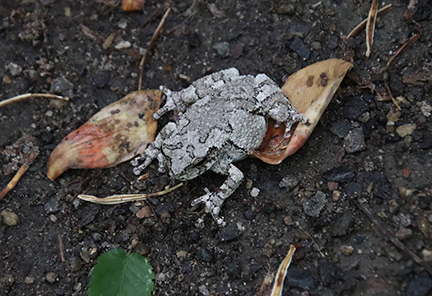
Happy Mystery Monday!  Can you guess what is pictured in photo below?
The answer to last week’s mystery is Copes gray treefrog, Hyla chrysoscelis, pictured below.
Cope’s gray tree frogs are native to North America, and are especially abundant in the southeast. They are adapted to woodland habitats but will sometimes travel into more open areas to reach a breeding pond. These frogs inhabit all elevations of wooded areas near temporary and permanent waters, such as swamps, ponds, lakes, old fields, thickly wooded suburban neighborhoods, farm woodlots, and mixed or deciduous forests.
Variable in color from mottled gray to gray green, the skin of Cope’s gray tree frogs resembles bark. They typically measure 3.2–5.1 cm long. As a member of the genus Hyla, they possess advanced toe pads, allowing them to adhere more strongly to vertical surfaces, like glass, metal, and primarily tree bark.
Cope’s grays rest in damp, rotten logs, or hollow trees, emerging to feed. Tree frogs tend to be “sit-and-wait” predators, consuming caterpillars, beetles, flies that wander by. Tree frogs produce mucus secretions that are foul tasting and cause burning sensation and inflammation. While these secretions are thought to be anti-predator functions, it is possible that they also function as antimicrobial agents.
In Winter, Cope’s gray tree frogs hibernate on land, and may be found under woody debris logs, roots and leaf litter. When gray tree frogs hibernate, they appear rigid. They have a high freezing tolerance due to glycerol in the blood. During hibernation, 80% of the body freezes and the eye becomes opaque as breathing and heartbeat are temporarily suspended. Their high tolerance for freezing temperatures has enabled gray tree frogs to expand their territory northward towards higher elevations. Cope’s gray tree frog can survive temperatures as low as 18°F.
Mystery Monday is sponsored by the Spy Newspapers and Adkins Arboretum.

The Spy Newspapers may periodically employ the assistance of artificial intelligence (AI) to enhance the clarity and accuracy of our content.

Filed Under: Archives, Food and Garden, Food and Garden, Food and Garden Notes

Bay-Wise – It’s All Connected By Nancy Taylor Robson

May 12, 2025 by Spy Desk Leave a Comment

Nancy Robson, Joan Berwick, Dona Rodrick, Secethia Davis, Gale Jayne, Joy Mayfield

There was a silver lining to the Charlie Foxtrot that was Covid. People discovered gardening. Even those who had never tried to grow herbs (never mind what kind) in college, flocked to garden centers and bought a plant or 20. ‘Victory gardens!’ the people said. ‘Let us eat vegetables!’

But it was more than a culinary impulse. Gardening – cultivating a plant that silently absorbs our angst and returns beauty, fragrance, butterflies, and maybe even salad – is psychologically nourishing.

It can also positively impact water quality.

“Homeowners are paying a little more attention to how they can adapt practices to help the Bay,” says Rachel Rhodes, Extension Coordinator for Queen Anne’s County, MD.

What we do – or don’t do – on land profoundly affects the health of the Bay, so acting on that knowledge is, as Oprah would say, HUGE.

Bay-Wise, the University of Maryland Extension stewardship program, designed by Senior Agent and Educator Wanda MacLachlan (now retired), offers a straightforward plan.

“I wanted to create a holistic approach to individual land management,” MacLachlan explains.

Key to the program is the Bay-Wise Yardstick, which has 61 possible steps broken into eight categories. Plus, steps taken in one category often spill benefits into others. For example, the native shrubs, trees, ground covers, and grasses you’ve planted to Control Stormwater Runoff and prevent erosion also act as shelter, habitat, and food source, so they Encourage Wildlife. While the Plant Wisely category urges using wind-breaking evergreens on the north and deciduous trees on the south to cut down on energy use, they also provide habitat and draw pollinators and birds (natural Integrated Pest Management) that benefit your victory garden.

Encouraging wildlife also offers enormous entertainment. Seeing a troop of ten cedar waxwings pass a Winterberry fruit (Ilex verticillata) from one bird to the next on a branch or watching a fat baby robin test his barely-fledged wings while his nest-bound siblings shout, “Go on! I dare ya!” at him, is like a homegrown Discovery channel.

Joan Berwick with her Bay-Wise landscape sign

Controlling stormwater runoff by keeping water on your property simultaneously prevents water pollution and saves on your utility bills since you use less water for the landscape and less electricity for the well water pump. Adopted broadly, the cost benefits are multiplied.

Twenty-seven years ago, Portland OR was threatened with a lawsuit for polluting the Willamette River. When they realized that there was a limit to upsizing the infrastructure, they adopted a greener approach, including green roofs, green streets, rain gardens, bioswales, and asking residents to disconnect their downspouts from the storm drain system. The measures significantly diminished runoff and resulted in approximately $65 million in municipal savings.

In Charles County, proof of Bay-Wise certification reduces the county watershed fee by 50% on the property tax bill, acknowledgment of the environmental and cost savings.

Bay-Wise certification – once a property reaches 36 inches’ (points) worth of steps on the Yardstick – bestows a nifty little sign to encourage the neighbors.

“I had my yard in Harford County certified in 2018,” says Master Gardener Joy Mayfield, who became a Bay-Wise certifier when she moved to Kent County. “I had such pride in putting that sign out!”

“It’s an amazing program,” says Rose Markham, Chair for the Charles County committee. “Once people get into it, they really love it!”

Master Gardener Eileen Clements hopes to become a Bay-Wise certifier when the next round of classes starts. Her reasons are both pragmatic and communal.

“Because we live so close to the Bay, and it’s such a resource, it’s better for everybody,” she says. “It’s the livelihood for fishing, for tourism, recreation, and whatever we can do to keep it healthy is important to do. I am a big believer in ‘fix your little world and help someone else to fix theirs.’ It’s a domino effect.”

Properties are certified as Bay-Wise via a (free) consulting visit by several trained volunteers. They walk around a property, listening to the owner’s hopes, goals, and concerns, while examining the lay of the land, the exposure, soil type, plants, wildlife.

“It was the most exhilarating day in my garden and yard,” says Joan Berwick, who lives outside of Crumpton. Berwick has left part of her woodsy property wild and has lushly planted another portion with natives. “I had always wanted a yard that had paths through the woods, that was natural, that was near a stream, and I wanted my landscaping to blend into the environment. Native plants were the way to keep things simple and easy and gave me great results with less effort.”

Part of Joan’s garden (you can’t hear the birdsong, but it’s there).

Prior to the consultation, Berwick had downloaded the Bay-Wise Yardstick from the UMD Extension website to figure out how close she was to certification. (You get 5 inches for simply NOT fertilizing the lawn!). Berwick’s property had a total score of 67 inches.

“It was fun, and I learned some things,” she says. But confirmation of her vision was what she enjoyed most. “What I was doing was valued by other people, and that’s not always the case when you do more natural plantings.”

Mayfield’s Harford County certification experience has guided her own approach to Bay-Wise visits on this side of the Bay.

“It was their tact,” she says. “They were so diplomatic in saying what needed to go, and I didn’t know what I needed to put in place.”

Their guidance helped. Here in Kent County, Mayfield has done several Bay-Wise visits, which are also fun for the certifiers since it’s also an opportunity to get to know the property owner a bit. Plus, the certifiers themselves often share different pieces of knowledge, which enhances the experience for everyone.

“I learned so much that last time,” Mayfield says about a visit to a property behind the Chestertown library. “I love the collaborative aspect of the visits.”

https://extension.umd.edu/programs/environment-natural-resources/program-areas/home-and-garden-information-center/master-gardener-program/about-program/bay-wise-program/

https://extension.umd.edu/sites/extension.umd.edu/files/2021-02/Bay-Wise%20Maryland%20Yardstick%20Landscape%20Gardens.pdf

https://extension.umd.edu/programs/environment-natural-resources/program-areas/bay-wise-program/

Native Plants for Wildlife and Conservation Landscaping

https://dnr.maryland.gov/criticalarea/Documents/chesapeakenatives.pdf


The Spy Newspapers may periodically employ the assistance of artificial intelligence (AI) to enhance the clarity and accuracy of our content.

Filed Under: Archives, Food Notes

How to be Vegan on the Eastern Shore: A Survivor’s Guide by Jason Elias

April 12, 2025 by Jason Elias Leave a Comment

It’s very hard to be a vegan on the Eastern Shore. In fact I have no doubt that it’s one of the hardest things to be. The Eastern Shore is built on food, the experience of food, the sharing and the preparation. There’s also a monetary footprint that is throughout the region. For example, according to 2020 USDA statistics, the poultry industry earned Maryland 6.7 billion dollars. That’s a lot of money.

For some “food is love” and nothing says love like crabs from the Chesapeake Bay or visiting the best restaurants looking for the best steak.

But what can you do when you’re vegan in a place like the Eastern Shore?

What exactly is “vegan?” According to the stringent definition, a vegan cannot have meat or seafood, basically food from animals. It sounds unfathomable and it sounded unfathomable to me too, until I became a vegan.

My entry in the “vegan business” came about during one bad day of eating and overeating. I was at Harris Teeter one afternoon, waiting for a sandwich that included pretty much everything on the menu. The young woman fixing the sandwich put six extra pieces of bacon on it and smiled like it was my lucky day. Yeah, really lucky. Besides this nadir, I had begun to get headaches from eating too much tuna, and a big fat belly from eating 4 and a half full meals a day. I had to do better.

I credit my girlfriend for helping me go vegan. It’s easier for her, however, she lives in New York. In comparison, Maryland isn’t as vegan friendly as it could be and the Eastern Shore is less so.

That said I’m here one of the statistics and really I should have been a group member decades before I did. Even as early as 11, I had intermittent trepidation with foods like sausage, eggs and scrapple let alone the junk they had for school lunches.

By my teen years I was even worse. I’d spend a portion of the year (for five consecutive years) sick to death, in excruciating pain, always brought on by a bad sandwich, a sub, as I couldn’t even keep down water. But for a while, I’d have a bland diet, and then I get back on the horse and live at McDonald’s again. Only if I knew about the choices out there.

During my “salad days” Maryland didn’t offer many alternative diets but times of changed. According to a 2021 study, there are 480 vegans for every 1 million people in Maryland. I’m sure the number isn’t just concentrated on the Eastern Shore alone. And given that places like the Amish Market routinely have pigs roasting on a spit for all to see, this area doesn’t have many vegan opportunities.

In many respects I had to cultivate a plan, read books and hunt and peck for my food because it’s rarely available on the drive thru but there are some places here where it is.

Thankfully area restaurants have started to offer some unique things on the menu. A lot of times you can omit one or two things from the menu and still have the taste and the ambience of fine dining as well as a guiltless conscience.

Local restaurants like Out Of The Fire, Eat Sprout, Pho Van and Roma Alla Pizza have vegan alternatives. Eat Sprout has a few locations in the area, other restaurants in the area include Sunflower and Greens and The Ivy. I’ve got to mention 4 Sisters and Kabob and Curry also have a lot of vegan dishes.

There aren’t many vegan choices in the fast food realm but the Impossible Burger at Burger King is very good. Taco Bell also has a few things to offer — -when the building is actually there and not on fire.

If I had a measurement to quantify the specifics of my vegan diet, it’s probably 80% vegan, 20% not. I often hope for better but for a person who had scrapple with his scrapple, it’s not too bad.

Since I’ve been vegan, my cholesterol and blood pressure have all gone down. I’m gratified that I can show my newfound love for pigs, cows, and sheep by not filling my plate full of them.

Jason Elias is a pop culture historian and a music journalist


The Spy Newspapers may periodically employ the assistance of artificial intelligence (AI) to enhance the clarity and accuracy of our content.

Filed Under: Food and Garden, Food Notes

Adkins Arboretum Mystery Monday: Guess the photo

March 31, 2025 by James Dissette Leave a Comment

Happy Mystery Monday!  Can you guess what is pictured below?
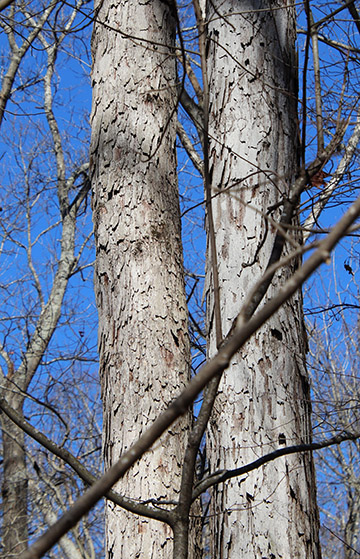
The answer to last week’s mystery is white oak, Quercus alba, pictured below:
White oak trees are native to the eastern United States and are usually found in forested areas of dry slopes, valleys, and ravines. It is a large, slow growing, deciduous hardwood tree. White oak does not tolerate wet conditions and is best planted in well-drained sites with rich, moist, acidic loam in full sun.
White oaks are in the beech family, and can reach heights of 135′ with an 80′ spread. These massive and stately shade trees grow in an artistic, wide-spreading habit. The bark of the white oak is light gray, with shallow grooves and flat, loose ridges.
White oak is one of the hardest woods on the planet with beautiful grain. It is very resistant to decay and is one of the best woods for steam bending. A unique feature of the white oak is a honeycomb-shaped film in its cells called “tyloses.” Tyloses swell to fill the vessels of the wood so that they can no longer conduct water, which is why white oak is used to make containers for liquids, like whiskey and wine barrels.
Mystery Monday is sponsored by the Spy Newspapers and Adkins Arboretum.

The Spy Newspapers may periodically employ the assistance of artificial intelligence (AI) to enhance the clarity and accuracy of our content.

Filed Under: Food and Garden, Food and Garden Notes

Adkins Arboretum Mystery Monday: Guess the photo

March 17, 2025 by Adkins Arboretum Leave a Comment

Happy Mystery Monday!  Can you guess what is pictured below?
The answer to last week’s mystery is the northern red oak, Quercus rubra, pictured in photo below:
The northern red oak is a deciduous tree native to the eastern and central United States and southeast and south-central Canada.
It is versatile and hardy in urban settings, and tolerates pollution and compacted soil, making it an ideal neighborhood or street tree.
The northern red oak grows moderately quickly, sometimes maintaining a rate of 2′ per year, especially when it’s young. It commonly attains heights of 70-80′.
This oak displays beauty in all seasons, as many of its leaves stay after they have fallen from other trees. The leaves emerge pinkish-red in the Spring, turning lustrous dark green in Summer, and changing to red, orange-red, and deep reddish-brown in Autumn.
The northern red oak produces acorns that serve as a vital food source for wildlife, including squirrels, deer, and birds.
Mystery Monday is sponsored by the Spy Newspapers and Adkins Arboretum.

The Spy Newspapers may periodically employ the assistance of artificial intelligence (AI) to enhance the clarity and accuracy of our content.

Filed Under: Food and Garden

Vietnam Veteran’s Commemoration March 29

February 26, 2025 by Spy Desk Leave a Comment

In Centreville, a group of veterans gathers weekly for coffee, donuts, and a social hour focused on camaraderie and shared experiences from their time in service. Known as The Veterans Café, the group provides a welcoming space for connection and conversation. Fred McNeil—a U.S. Army veteran, retired teacher and coach, and longtime advocate for the Centreville community—serves as the group’s moderator. He often encourages potential new members to join by inviting them to “come have a cup of joe with G.I. Joe.”

Screenshot

The group first began meeting at Dunkin’ Donuts and gradually grew, prompting a move to the YMCA and eventually to the American Legion in Centreville. They now gather every Monday morning to enjoy coffee and donuts, share personal stories, and participate in a book club that explores everything from classic war literature to contemporary accounts of post-war struggles. The group also hosts guest speakers who discuss various events and opportunities. Last week, they welcomed Dr. Clifford Coppersmith from Chesapeake College, a former commissioned officer in the U.S. Army Reserve and Army National Guard with 45 years of experience in scouting with the Boy Scouts of America. After attending a Veteran’s Café meeting, Hayley Greenwood, Compass Marketing specialist, stated, “It was heartwarming to see Dr. Coppersmith connect with the veterans, who were very engaged and asked insightful questions about opportunities within the college.”

On Saturday, March 29, members of the Veteran’s Café will host the National Vietnam Veterans Day Commemoration at Queen Anne’s County High School, honoring those who served during the Vietnam Era. The event will feature guest speaker John J. Farley III, a retired judge from the United States Court of Appeals for Veterans Claims. “The main purpose of this commemoration is to pay attention and educate people about the Vietnam Era and honor those who served,” Bob Nilsson, a Vietman-era Marine, says. “It’s to recognize those who served during the Vietnam Era or lost loved ones during the time – to recognize families.” During the commemoration, attendees receive a commemorative pin, with members of the Sea Scouts and Boy Scouts leading the presentation and honors. “The Sea Scouts and Boy Scouts will perform the honors and readings of the Missing Man Table,” explains Joe Sikes, a retired Navy captain. The Missing Man Table Formation, also known as the Fallen Comrade Table, is a solemn military tradition that honors fallen, missing, or imprisoned service members. It is commonly displayed at military dining events, veterans’ gatherings, and memorial ceremonies to remind attendees of those who cannot be present. “I think it’s amazing how these veterans are involving the youth in such an emotional and powerful event,” says Hayley Greenwood. Joe Sikes continues, explaining how challenging it was for him to talk about his service. He hopes this commemoration honors those who served and helps others who may have lost loved ones during this time. “I got back from serving and couldn’t talk about it. For 15 years, I couldn’t talk about it,” he shares. “We wanted to recognize Vietnam vets because it’s not widely acknowledged. So, we thought, let’s organize one for ourselves. It’s interesting because it’s on my birthday!”

Join Compass and members of the Veterans Café on Saturday, March 29 from 2:00-4:00pm at Queen Anne’s County High School to honor those who served on active duty anytime during the Vietnam Era. For more information, contact Dave Peterson at [email protected]. Join the nation, thank a Vietnam Veteran!

For more about compass, go here.

The Spy Newspapers may periodically employ the assistance of artificial intelligence (AI) to enhance the clarity and accuracy of our content.

Filed Under: 5 News Notes, Food-Garden Homepage

Adkins arboretum Mystery Monday: Guess the photo

December 23, 2024 by Adkins Arboretum Leave a Comment

Happy Mystery Monday!  Can you guess what is pictured in photo below?
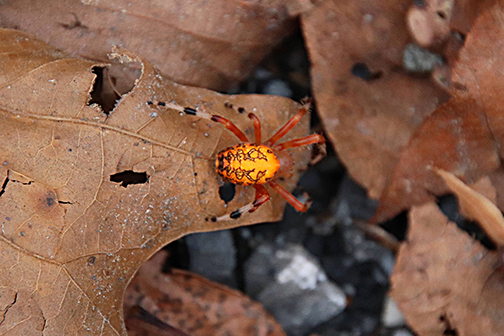
The answer to last week’s mystery is white marbled orbweaver, Araneus marmoreus, pictured in photo below.
Marbled orb weavers get their name from the mottling and spotting patterns found on their bodies. They can be found in residential landscapes, fields, and forests from Spring–late Fall in Maryland. They mostly eat smaller insects, which they capture in their vertically oriented webs. A “signal thread” running through the middle of their webs alerts the spider when prey is caught. Marbled orbweavers spin their web in the morning, and typically spend the day resting in a retreat off to the side of the web.
Mating for the marbled orbweaver takes place in mid–late Summer. Females mate once in their lives, while males may mate several times. Egg sacs, which contain several hundred eggs, are generally deposited in October. The female becomes shriveled late Fall because of lost body mass from laying her eggs.
Marbled orbweavers do not survive the Winter, so adults are not present to provide any sort of care when the spiderlings emerge the following Spring. Their average lifespan is six months.
There are no known adverse effects of marbled orbweavers on humans.
Mystery Monday is sponsored by the Spy Newspapers and Adkins Arboretum.

The Spy Newspapers may periodically employ the assistance of artificial intelligence (AI) to enhance the clarity and accuracy of our content.

Filed Under: Archives, Food and Garden

Adkins Arboretum Mysery Monday: Guess the photo!

December 9, 2024 by Adkins Arboretum Leave a Comment

Happy Mystery Monday!  Can you guess what is pictured in photo below:
The answer to last week’s mystery is pokeweed, Phytolacca americana, pictured in photo #2.
Pokeweed is a native herbaceous perennial in the Phytolaccaceae family that grows 3-8′ high. It is found in riparian areas, oak woodlands, forest edges, fence rows, forest openings, pastures, under power lines, disturbed areas, cultivated fields, parks, and ornamental landscapes.
Common Pokeweed is a long-lived perennial and can survive for years. Their seeds can remain viable in the soil for up to 50 years! The plant has a thick fleshy taproot up to 12′ long and 4′ thick, making adult pokeweed difficult to remove.
The pokeweed’s white, clustered blooms first mature in early Summer and continue into early Fall. The flowers are born in a raceme that usually starts out erect and begins drooping as the fruit develops.
Pokeweed berries are green at first, turning glossy, dark purple. They leave a deep purple-red stain when crushed. The berries are poisonous to humans, containing chemicals that can damage red blood cells. The berries are, however, a favored food for migrating songbirds and a source of food for some mammals. These animals help to distribute the seeds far and wide.
Pokeweed is one of many hosts of the Giant Leopard Moth.
Pokeweed has an extensive history of being used as a food, medicine, herb, dye for clothing, ink for writing, colorant for wines, and much more.
Mystery Monday is sponsored by the Spy Newspapers and Adkins Arboretum.

The Spy Newspapers may periodically employ the assistance of artificial intelligence (AI) to enhance the clarity and accuracy of our content.

Filed Under: Food and Garden, Food and Garden Notes

Adkins Arboretum Mystery Monday: Guess the photo!

December 2, 2024 by Adkins Arboretum Leave a Comment

Happy Mystery Monday!  Can you guess what is pictured in photo below?
The answer to last week’s mystery is water oak, Quercus nigra, pictured in photo below:
Water oak is native to North America, commonly found in the coastal plains and Piedmont areas in bottomland forests. In Maryland, these trees can typically be found in the lower Eastern Shore. Adkins is at the Northern edge of its range.
Water oak is a member of the red oak group. They have oblong, spatula-shaped leaves with rounded lobes. When young, its leaves are nearly evergreen. They offer yellow color in Autumn which can persist into Winter. The water oak fruit is a 1/2″-1″ nearly black acorn.
This tree is of exceptional value to woodworkers, and is used widely in cabinet and furniture making. Water oak is the host plant for the larvae of the imperial moth (Eacles imperialis), as well as numerous
butterflies.
Water oak is a very sensitive tree that is vulnerable to illness and pests. Their numbers are in decline due to negative human interactions, such as row-cropping or extensive clearing.  Water oak does not compete well with other species for nutrients required to grow. It is also easily injured by fire and susceptible to butt rot.
Mystery Monday is sponsored by the Spy Newspapers and Adkins Arboretum.

The Spy Newspapers may periodically employ the assistance of artificial intelligence (AI) to enhance the clarity and accuracy of our content.

Filed Under: Food and Garden

  • 1
  • 2
  • Next Page »

Copyright © 2026

Affiliated News

  • Chestertown Spy
  • Talbot Spy
  • Cambridge Spy

Sections

  • Sample Page

Spy Community Media

  • Sample Page
  • Subscribe
  • Sample Page

Copyright © 2026 · Spy Community Media Child Theme on Genesis Framework · WordPress · Log in