MENU

Sections

  • Home
  • Education
  • Donate to the Centreville Spy
  • Free Subscription
  • Spy Community Media
    • Chestertown Spy
    • Talbot Spy
    • Cambridge Spy

More

  • Support the Spy
  • About Spy Community Media
  • Advertising with the Spy
  • Subscribe
February 2, 2026

Centreville Spy

Nonpartisan and Education-based News for Centreville

  • Home
  • Education
  • Donate to the Centreville Spy
  • Free Subscription
  • Spy Community Media
    • Chestertown Spy
    • Talbot Spy
    • Cambridge Spy
Food and Garden

Adkins Arboretum Mystery Monday: Guess the Photo!

July 28, 2025 by Adkins Arboretum Leave a Comment

Happy Mystery Monday!

Can you guess what is pictured in photo #1?

The answer to last week’s mystery is milkweed, Asclepias, pictured in photo #2.
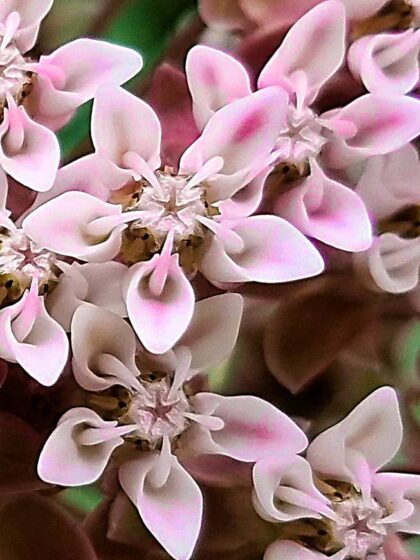
Unlike most flowers, milkweed does not produce loose pollen, but waxy, sticky balls of pollen called pollinia. Each milkweed blossom has a small slit leading down a chamber to the pollinia. When insects land on the droopy milkweed flowers, clinging to the petals as they feed on nectar, a foot can slip into the slit and come in contact with pollinia. When an insect pulls its foot out of the slit, it brings the pollinium with it. Should that same foot slip into another milkweed flower’s slit, the pollen can be transferred, facilitating fertilization.

Milkweed plants typically produce a lot of nectar. The nectar replenishes overnight, gratifying nocturnal moths. The remaining nectar is ready for the first diurnal visitors in the morning.

To access nectar, floral visitors prop themselves on one of the five flower hoods, sliding their tongues down the side of the hood where the nectar is held. They must be careful not to slip their leg down into the flower between the slits. Sometimes insects get stuck in a slit and are never able to free themselves. Some insects are not robust enough to remove their legs from the anther slits with the attached pollinia and are trapped to die there if they don’t lose their appendage first. Other times, they must tear off their own limbs to escape. Even if an insect does manage to pry its leg out of the trap door, some insects are unable to remove the pollinia.

One or two pollinia will slow an insect down, but too many can make it difficult to move. Despite the potential harm of visiting a milkweed flower, for many insects, this is a reliable source of nectar that is worth the risk.

Mystery Monday is sponsored by the Spy Newspapers and Adkins Arboretum.

The Spy Newspapers may periodically employ the assistance of artificial intelligence (AI) to enhance the clarity and accuracy of our content.

Filed Under: Food and Garden

Adkins Arboretum Mystery Monday: Guess the Photo!

July 21, 2025 by Adkins Arboretum Leave a Comment

Happy Mystery Monday!  Can you guess what is pictured in photo #1?
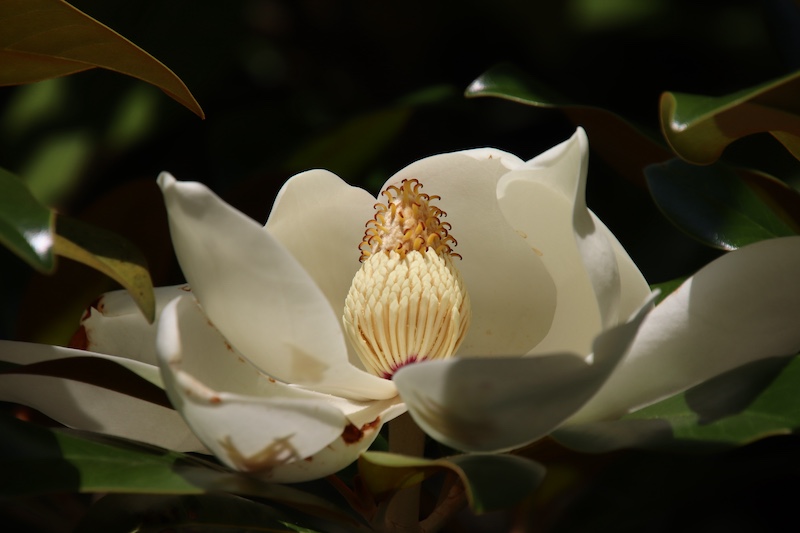
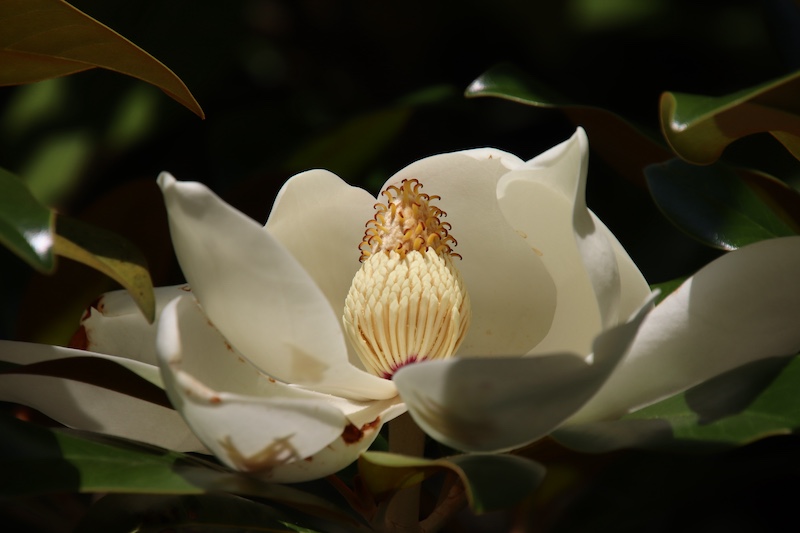
The answer to last week’s mystery is magnolia, Magnoliaceae, pictured in photo #2.

Magnolia is a large genus of 210–340 species of the family Magnolioideae. They’re a native evergreen tree or shrub with a straight trunk, conical crown, and very fragrant, large, white flowers. Their flowers are waxy and their oblong leaves are shiny and green with silvery undersides.

In cool locations, the sweet bay magnolia is usually a deciduous shrubby plant with multiple stems, while in warmer zones it tends to be an upright tree that remains evergreen.
Magnolias, especially Southern magnolia, produce seeds that are rich in fats and energy, making them a valuable food source for many animals, including wild turkeys, mockingbirds, and robins, as well as small mammals, like squirrels and opossums. The dense foliage of some magnolia species provides year-round shelter for small mammals and nesting sites for birds, offering protection from predators and harsh weather conditions.
Magnolia flowers produce a sugar-like substance that attracts pollinators. The flowers of many magnolias are considered edible.
Magnolias are an excellent plant for boggy locations or clay soils.
Mystery Monday is sponsored by the Spy Newspapers and Adkins Arboretum.
The Spy Newspapers may periodically employ the assistance of artificial intelligence (AI) to enhance the clarity and accuracy of our content.

Filed Under: Food and Garden

Second Wind Planting by Nancy Taylor Robson

July 21, 2025 by The Spy Desk Leave a Comment

Yes, it’s July, and it’s hot (it’s summer after all), but we’ve actually had rain (she half-whispers lest the mention jinx it). So, the ground is friable and a young gardener’s fancy turns to MORE BEANS! And other stuff. You know, the mid-summer renewal for fall harvest.

“A lot of people think about ‘getting their garden in’ once in May and that’s it,” says Jon Traunfeld, Director of the Home and Garden Information Center at University of Maryland here. But there’s a second planting time that can be just as rewarding as the first if we take advantage of it. “There’s still plenty of time to plant warm season crops,” he says. “Bush beans, green beans, cucumbers, squash. Also in late July, there are the fall crops. People can sow seeds for things like beets and kale and mustards, radishes, directly in the ground.”

For those of us who are less than perfect gardeners (sigh, we know who we are) that second shot can be a big help. The extended harvest offers maximum return on investment of money (plants and seeds) and time (all that weeding and worrying), and maybe we’ll also have something to ‘put by.’ Yet even if there’s not enough to freeze or can, fall harvest can be a very satisfying time. But it takes planning – and planting – now.

“I just seeded some more green beans and wax beans this week,” says Theresa Mycek, Production Manager at Unity Nursery nursery in Church Hill. “We also just put some zucchini and yellow summer squash seeds in the high tunnel.”

Even without the protection of a high tunnel, Traunfeld notes that the changing climate has altered our gardening parameters. 

“There’s so much opportunity,” he says. “That’s one of the upsides of warming weather. You can plant things through mid-to-late August. And we may be able to overwinter things like arugula, spinach, and kale, and sometimes collards. With a single row cover [to protect them from frost] they come back gangbusters in early spring.”

“When I worked at Colchester,” agrees Mycek, who for 13 years was the grower and manager of a five-acre Community Sustained Agriculture (CSA) project in Georgetown, MD, “starting in August we’d direct-seed radish and fall brassicas. So, if you want to do Pak choi, turnips, radish, watermelon radish, broccoli rabe are all good seeds to put straight into the ground now.”

Even things that we think of as early spring crops can keep producing, especially if protected. “A lot of these crops – kale, lettuces, spinach, the Asian greens – will take a heavy frost and will overwinter,” says Traunfeld. 

While the luscious but delicate butterheads of spring can’t take much heat or cold, there is now a tougher i.e. more resilient lettuce variety, Batavian summer crisp, which has slightly thicker, more water-retentive leaves that do well at this time, and also does well in summer.

 “I saw some in a community garden yesterday [July 16th],” Traunfeld says. “They’re big and ruffly, and they will grow in warm weather and can really take the heat.”

You can also start transplants of some of the brassicas now for harvest next spring. Traunfeld says that a former colleague used to start broccoli seedlings in early August each year.

“She put ‘em out in the garden in September,” he remembers. “She just wanted them to get well established but not put on a head. And they came to life in spring and had beautiful heads.”

Starting transplants in mid-late summer means paying attention to soil temp. Instead of it being too cool as it can be in spring, now soil can be too warm for some of those seeds to germinate. Seed packets usually specify a variety’s optimum germination temp.

“The leafy greens, lettuces, you can’t germinate them easily in heat,” Traunfeld says. “You may want to germinate it inside or outside under something [like row cover or in shade or indirect sunlight].” The difference between soil temperature in direct sun and shade can be as much as 10 degrees Fahrenheit.

When you plant out your seedlings, mulch them to mitigate soil temps and retain moisture for roots. Row cover can do double duty to help prevent moisture loss in their leaves and to hide new seedlings from pests. Then remember to keep them moist but not sodden.

 “[The starts] can tolerate the heat if they’re young,” Mycek says. “But you have to be on top of watering.” 

When planning late-summer seeding of any kind, bear in mind the waning light. Most things require specific amounts of daylight to reach maturity. 

“If they are planning to sow beets, for example, which have a 55-day maturity date, and you’re thinking: when should you plant before frost? you’d count back from frost,” Traunfeld says. “But we’re going into a period when sun is diminishing, so you’d plant two weeks earlier than you’d think – middle-to-end of July.”

It’s all work, but it’s rewarding. In addition to the satisfaction of fall harvest, the second planting is something of a reminder about the fact that food does not grow in the grocery store or on autopilot. It takes attention and care.

“When you grow your own food, you think wasting food is a sin,” says Kent County Master Gardener, Barbra Flook, who grows greens for the table nearly year-round. “And there’s something [empowering] about knowing what it takes to produce it in a relatively safe manner.”

And it’s satisfying. There’s nothing quite like going out to the garden on a cool misty November day to cut kale for the soup pot or pick the last of the haricots verts (slim little French beans) for dinner. Lovely.

True Leaf Batavian Lettuce

Heat tolerant lettuce mix

Johnny’s Summer Crisp Lettuce

University of Maryland Home and Garden Center


Longtime journalist and essayist Nancy Taylor Robson is also the author of four books: Woman in The Wheelhouse; award-winning Course of the Waterman; A Love Like No Other: Abigail and John Adams, a Modern Love Story; and OK Now What? A Caregiver’s Guide to What Matters, which she wrote with Sue Collins, RN. 

The Spy Newspapers may periodically employ the assistance of artificial intelligence (AI) to enhance the clarity and accuracy of our content.

Filed Under: Food and Garden

Adkins Arboretum Mystery Monday: Guess the Photo!

July 14, 2025 by Adkins Arboretum Leave a Comment

Happy Mystery Monday! Can you guess what is pictured in photo #1?

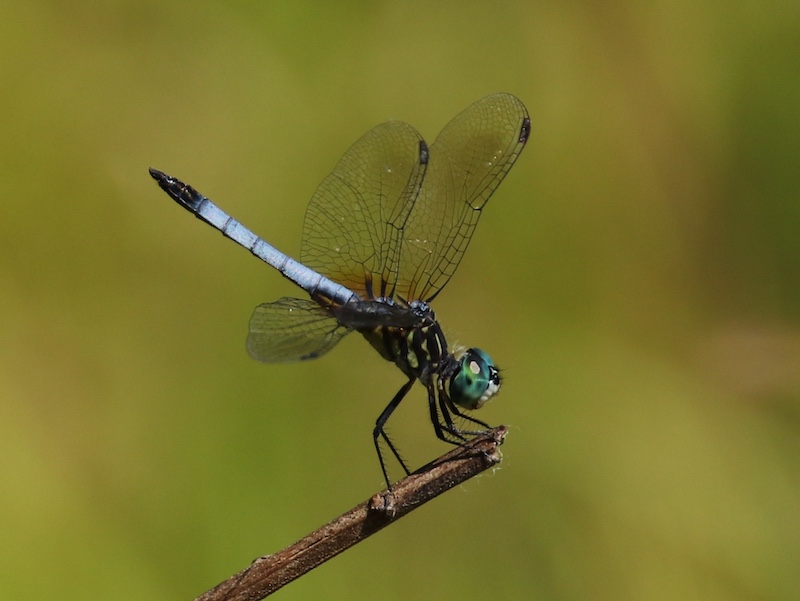
The answer to last week’s mystery is blue dasher dragonfly, Pachydiplax longipennis, pictured in photo #2.


The blue dasher dragonfly is one of the most common dragonflies in North America and can be found at most still, calm water habitats within its wide range.

Blue dashers are small skimmers. Mature male blue dashers, as pictured here, are chalky blue with a dark abdomen tip, white face, and turquoise eyes. There is a wedge of rust color on each side of the abdomen, behind the wings. Female blue dashers are a little less colorful and have red eyes, as opposed to blue.

Some dragonflies perch with their abdomens pointed upward as a means of thermoregulation. The position is typically used for cooling, lowering the amount of body surface exposed to the sun.

Mystery Monday is sponsored by the Spy Newspapers and Adkins Arboretum.
 

The Spy Newspapers may periodically employ the assistance of artificial intelligence (AI) to enhance the clarity and accuracy of our content.

Filed Under: Food and Garden

Adkins Arboretum Mystery Monday: Guess the Photo!

June 30, 2025 by Adkins Arboretum Leave a Comment

Happy Mystery Monday!  Can you guess what is pictured in the photo below:
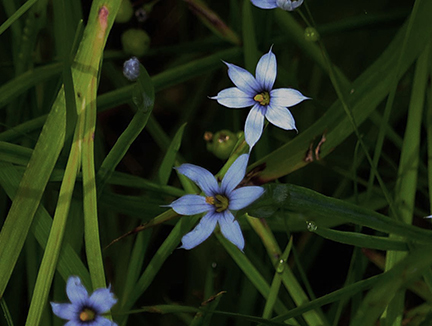
The answer to last week’s mystery is blue-eyed grass, Sisyrinchium angustifolium, pictured in the photo below.
Blue-eyed grass is a tiny, but mighty flower that is native to 60% of the United States and the eastern half of Canada. It thrives from Maine to Texas. Blue-eyed grass grows in woodlands, forests, meadows, sand hills, and swales.
Despite its name, blue-eyed grass is not a grass, it’s a member of the iris family. Its stiff, narrow, blade-like leaves form a fan shape, similar to other plants in the iris family.
Noted for its violet-blue flowers with yellow centers, the long-lasting blooms measure 1″ in diameter. In late-Spring, the flowers develop into seed heads shaped like round balls that hold several tiny seeds. The black seeds can be carried short distances by wind. When conditions are just right, blue-eyed grass will happily self-seed, but it also spreads via underground rhizomes.
Mystery Monday is sponsored by the Spy Newspapers and Adkins Arboretum.
The Spy Newspapers may periodically employ the assistance of artificial intelligence (AI) to enhance the clarity and accuracy of our content.

Filed Under: Archives, Food and Garden

Adkins Arboretum Mystery Monday: Guess the Photo!

June 23, 2025 by Adkins Arboretum Leave a Comment

Happy Mystery Monday!  Can you guess what is pictured in the photo below?
The answer to last week’s mystery is poison ivy, Toxicodendron radicans, pictured in photo below:
Poison ivy is native to every State except California, Alaska, and Hawaii. It can grow as a small plant, a shrub, or a climbing vine and it is resilient! It thrives in soils of all textures, including clays, silts, loams, sand, and more.
All parts of the poison ivy plant, including the stem and roots, contain and secrete a nonvolatile, colorless oil, urushiol, that affects the skin. According to the American Academy of Dermatology, about 50 million people get a poison ivy rash each year, making it one of the most common allergies in the United States.
If a rash doesn’t occur with first contact, it likely will with second contact. In addition, the body doesn’t build immunity to urushiol. The more times the skin is exposed to it, the worse the break out.
Urushiol oil is very durable, lingering for five or more years after the poison ivy plant has died. Inhaling urushiol oil from the smoke of burning poison ivy likely means a trip to the ER.
Poison ivy flowers are rather inconspicuous and usually not noticed by gardeners, but they also carry urushiol oil. The subsequent fruits are smooth, greenish-white berries that form in clusters about the size of currants. Birds and other wildlife eat the berries and spread the seed in their droppings, spreading poison ivy just about anywhere.
Poison ivy has compound leaves with three leaflets, giving rise to the old saying, “Leaves of three, let it be,” although the leaves are more accurately described as leaflets.
In vine form, poison ivy sprouts thousands of brown hairs that grasp the bark of its host tree. As the vine climbs toward the canopy and matures, the stem gets woodier and increases in diameter.
Mystery Monday is sponsored by the Spy Newspapers and Adkins Arboretum.
The Spy Newspapers may periodically employ the assistance of artificial intelligence (AI) to enhance the clarity and accuracy of our content.

Filed Under: Archives, Food and Garden

Adkins Arboretum’s Mystery Monday: Guess the Photo!

June 16, 2025 by Adkins Arboretum Leave a Comment

Happy Mystery Monday!  Can you guess what is pictured in photo below:
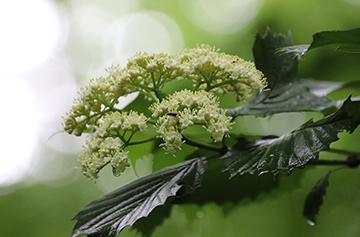
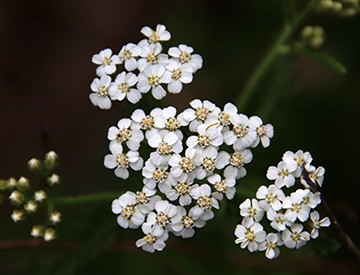
The answer to last week’s mystery is arrowwood viburnum, Viburnum dentatum, pictured in the photo below:
Arrowwood viburnum is a native deciduous shrub that can be found from Maine to Florida, and westward toward Iowa and east Texas. It thrives in open woods and streambanks and most commonly occurs in partial shade but can tolerate full sun.
Arrowwood flowers from May–June and fruits from August–November. The shrub’s non-fragrant white flowers form flat-topped corymbs. The showy flower clusters give way to blue-black, berry-like drupes which are attractive to birds and other wildlife.
Thanks to vigorous and sturdy growth, arrowwood can be used as a hedge, screen, specimen, or in mass plantings. While the shrub’s growth habit is an upright oval, the older branches arch with age. Suckers also develop with age and are easy to transplant. Next season’s blossoms appear on old growth
Native Americans reportedly used the straight stems of this species for arrow shafts, hence the common name.
Arrowwood viburnum is the host plant for various species of moths and butterflies, including two specialist moth species: the brown scoopwing moth and the marveled wave moth. It’s also a host plant for Spring azure butterflies. Arrowwood provides nectar for pollinators, including native bees, and food and shelter for birds. Arrowwood is deer resistant.
Mystery Monday is sponsored by the Spy Newspapers and Adkins Arboretum.
The Spy Newspapers may periodically employ the assistance of artificial intelligence (AI) to enhance the clarity and accuracy of our content.

Filed Under: Food and Garden

Adkins Arboretum Mystery Tuesday: Guess the Photo!

June 10, 2025 by Adkins Arboretum Leave a Comment

Happy Mystery Monday!  Can you guess what is pictured in the photo below?
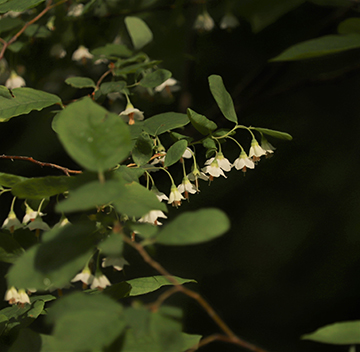
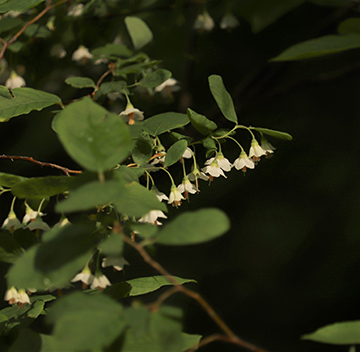
The answer to last week’s mystery is deerberry, Vaccinium stamineum, pictured in the photo below:
Deerberry is a very common, native deciduous shrub that grows in sandy, well-drained soil and xeric communities such as dry oak woods, pine barrens, savannas, dry pine ridges, sparsely wooded bluffs, sand hills, thickets, and clearings. It often grows in conjunction with rhododendrons and azaleas, which share similar acidic soil requirements.
Deerberry’s nodding, bell-shaped flowers produce from April–June. They’re greenish-white and pink tinged. The stamens are prominent, as indicated by the Latin name stamineum. The fruit of deerberry dangles in loose clusters. The berries are sour and largely inedible for humans, unless they’re sweetened. The berries ripen from late–Summer to early–Fall and are enjoyed by birds and mammals.
Deerberry and blueberry are both members of the same plant family, ericaceae, and share similar characteristics, but also have key differences. For instance, deerberry fruit is typically larger and has a more tart flavor than blueberries.
Deerberry’s foliage turns a variety of colors through the seasons.
Mystery Monday is sponsored by the Spy Newspapers and Adkins Arboretum.

The Spy Newspapers may periodically employ the assistance of artificial intelligence (AI) to enhance the clarity and accuracy of our content.

Filed Under: Archives, Food and Garden, Food and Garden Notes

Adkins Arboretum’s Mystery Monday: Guess the Photo!

June 2, 2025 by Adkins Arboretum Leave a Comment

Happy Mystery Monday!  Can you guess what is pictured in photo below?
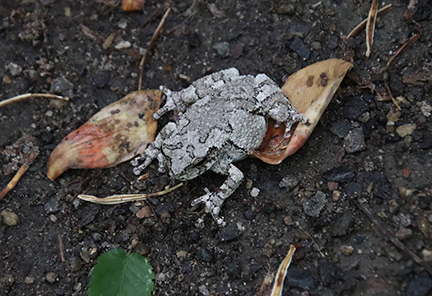
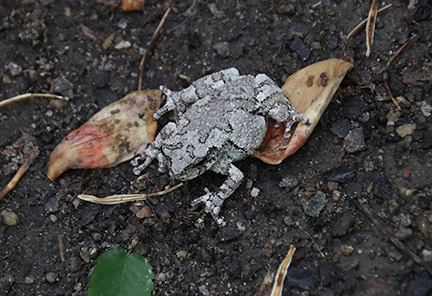
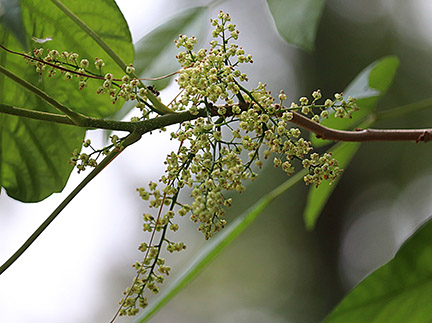
The answer to last week’s mystery is Copes gray treefrog, Hyla chrysoscelis, pictured below.
Cope’s gray tree frogs are native to North America, and are especially abundant in the southeast. They are adapted to woodland habitats but will sometimes travel into more open areas to reach a breeding pond. These frogs inhabit all elevations of wooded areas near temporary and permanent waters, such as swamps, ponds, lakes, old fields, thickly wooded suburban neighborhoods, farm woodlots, and mixed or deciduous forests.
Variable in color from mottled gray to gray green, the skin of Cope’s gray tree frogs resembles bark. They typically measure 3.2–5.1 cm long. As a member of the genus Hyla, they possess advanced toe pads, allowing them to adhere more strongly to vertical surfaces, like glass, metal, and primarily tree bark.
Cope’s grays rest in damp, rotten logs, or hollow trees, emerging to feed. Tree frogs tend to be “sit-and-wait” predators, consuming caterpillars, beetles, flies that wander by. Tree frogs produce mucus secretions that are foul tasting and cause burning sensation and inflammation. While these secretions are thought to be anti-predator functions, it is possible that they also function as antimicrobial agents.
In Winter, Cope’s gray tree frogs hibernate on land, and may be found under woody debris logs, roots and leaf litter. When gray tree frogs hibernate, they appear rigid. They have a high freezing tolerance due to glycerol in the blood. During hibernation, 80% of the body freezes and the eye becomes opaque as breathing and heartbeat are temporarily suspended. Their high tolerance for freezing temperatures has enabled gray tree frogs to expand their territory northward towards higher elevations. Cope’s gray tree frog can survive temperatures as low as 18°F.
Mystery Monday is sponsored by the Spy Newspapers and Adkins Arboretum.
The Spy Newspapers may periodically employ the assistance of artificial intelligence (AI) to enhance the clarity and accuracy of our content.

Filed Under: Archives, Food and Garden, Food and Garden, Food and Garden Notes

Adkins Arboretum Mystery Monday: Guess the photo!

May 26, 2025 by Adkins Arboretum Leave a Comment

Happy Mystery Monday!  Can you guess what is pictured in the photo below?
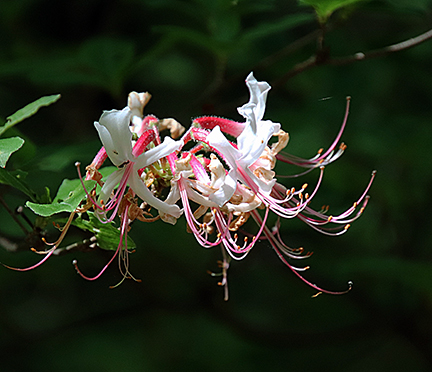
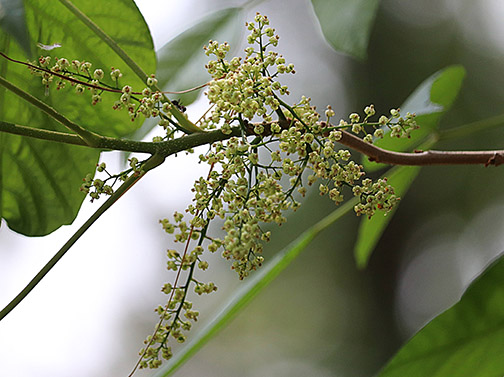
The answer to last week’s mystery is pinxter flower azalea, Rhododendron periclymenoides, pictured below:
Pinxter flower azalea is native to the Eastern United States, from Massachusetts to Alabama. It is one of several azaleas native to Maryland. An understory shrub, pinxter azalea is dense and bushy, typically growing 2–6′ tall. Pinxter azalea grows naturally in mixed deciduous forests, along streams, swamp edges and ravines, where they can form dense thickets.
Pinxter flowers open in mid to late Spring, and are often mistaken for honeysuckle blooms. The flower colors vary among species populations from white to dark pink. The open petals curve back to show off the long extended stamens and styles. Pinxter flowers begin to open before leaf expansion, drawing many pollinators, including hummingbirds, bees, and butterflies. The flowers are fragrant, and have a light spicy scent.
Maryland’s native azaleas host at least 50 species of native caterpillars, including hairstreaks and brown elfins.
The common name “pinxter” means Pentecost (the seventh Sunday after Easter) in Dutch, in reference to the bloom time for this shrub.
Warning: Rhododendrons contain poisonous substances and should not be ingested by humans or animals. All parts of the plant are highly toxic, even honey made from the flowers may be dangerous.
Mystery Monday is sponsored by the Spy Newspapers and Adkins Arboretum.
The Spy Newspapers may periodically employ the assistance of artificial intelligence (AI) to enhance the clarity and accuracy of our content.

Filed Under: Food and Garden

  • « Previous Page
  • 1
  • 2
  • 3
  • Next Page »

Copyright © 2026

Affiliated News

  • Chestertown Spy
  • Talbot Spy
  • Cambridge Spy

Sections

  • Sample Page

Spy Community Media

  • Sample Page
  • Subscribe
  • Sample Page

Copyright © 2026 · Spy Community Media Child Theme on Genesis Framework · WordPress · Log in