
MENU

Sections

  • Home
  • Education
  • Donate to the Centreville Spy
  • Free Subscription
  • Spy Community Media
    • Chestertown Spy
    • Talbot Spy
    • Cambridge Spy

More

  • Support the Spy
  • About Spy Community Media
  • Advertising with the Spy
  • Subscribe
February 6, 2026

Centreville Spy

Nonpartisan and Education-based News for Centreville

  • Home
  • Education
  • Donate to the Centreville Spy
  • Free Subscription
  • Spy Community Media
    • Chestertown Spy
    • Talbot Spy
    • Cambridge Spy
00 Post to Chestertown Spy News Maryland News

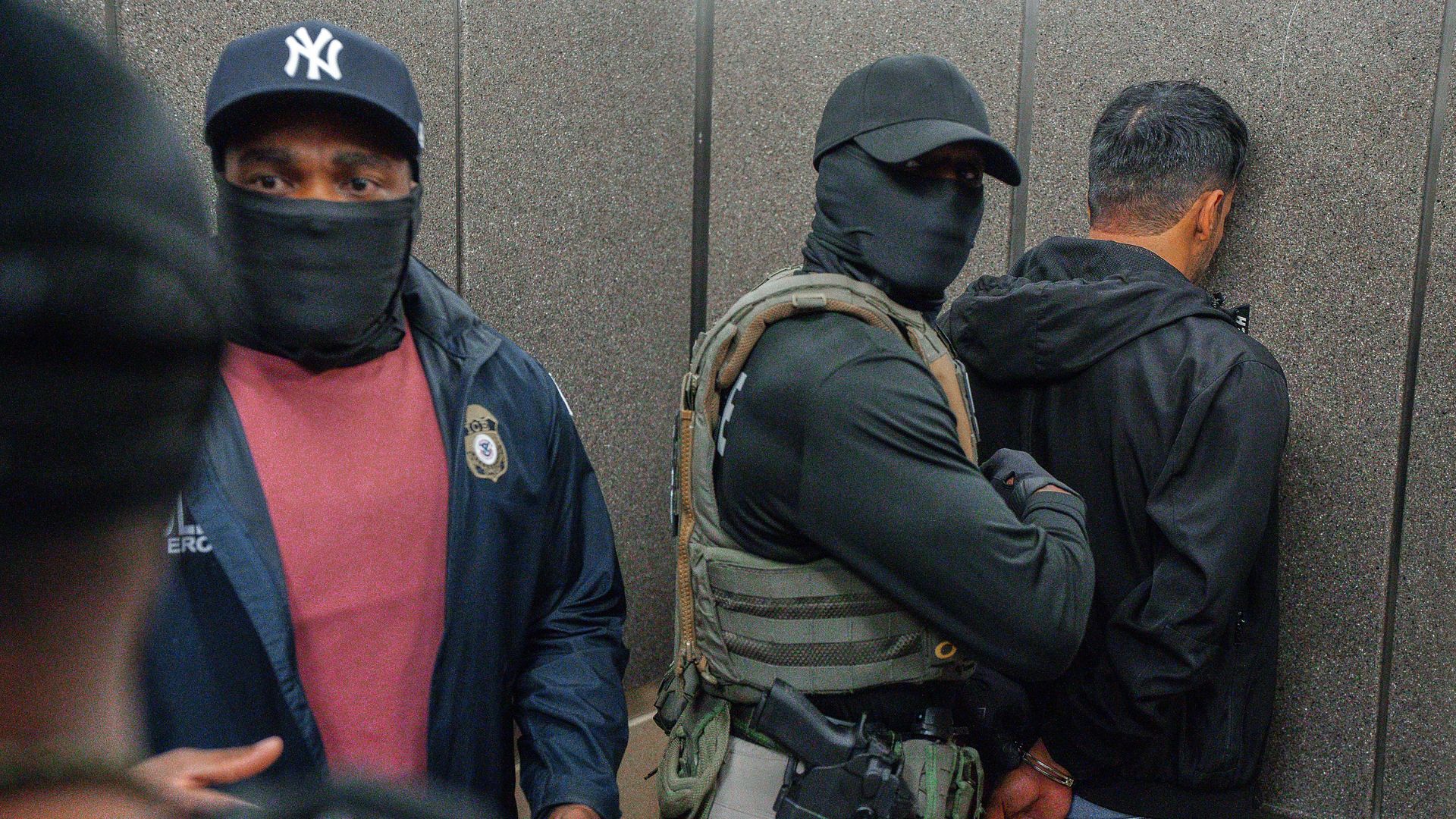
MD Senate gives Preliminary OK for Prohibiting mask Use by Law Enforcement

January 30, 2026 by Maryland Matters Leave a Comment

The Maryland Senate gave preliminary approval Thursday to two bills aimed at reining in immigration enforcement, by prohibiting cooperation agreements between local police and federal immigration agencies and by banning face coverings on officers while they are on duty.

Democrats managed to beat back a number of Republican amendments to both bills on largely party-line votes over about three hours of debate. The only amendment approved Thursday was a Democratic proposal to make the bill prohibiting local-federal agreements an emergency measure that would take effect as soon as it was signed into law.

That amendment would make the Senate bill on so-called 287(g) agreements identical to a House version of the legislation sponsored by Del. Nicole Williams (D–Prince George’s), which is expected to come up for debate in the House on Friday.

The bills are speeding through the two chambers at a time of heightened scrutiny of the Trump administration’s aggressive immigration enforcement policy, that led to fatal shootings by federal agents in Minneapolis this month of two U.S. citizens — Renee Good and Alex Pretti, both 37.

“I know there’s lots of disagreement on this,” said Senate President Bill Ferguson (D–Baltimore City), explaining his vote for the emergency legislation amendment. “I deeply appreciate the debate here and the thoughtful consideration, but we are in a really important moment. So, I appreciate this truly being an emergency that we figure out how to move forward.”

He said both measures could come up for a final vote Tuesday. The emergency designation amendment passed 33–13, with all 13 GOP senators voting against it.

Republicans said the 287(g) agreements in Maryland bear little resemblance to the video of violent confrontations in Minnesota. Maryland agreements are strictly jail-based programs, they said, that allow county jails to hold an individual in their custody for another 48 hours for pickup by U.S. Immigration and Customs Enforcement if it is determined the person is in the country illegally.

Republicans also said Senate Bill 245 infringes on local governments. Senate Minority Leader Stephen S. Hershey Jr. (R–Upper Shore) offered an amendment that would let county leaders decide whether to enter into or terminate a 287(g) agreement.

“I think this is important because we’ve seen the counties have already found a way to handle this issue,” Hershey said. “What’s important is that the counties should be able to decide. They are the ones that are in charge of our public safety. They made those decisions. They are elected bodies.”

But Sen. William C. Smith Jr. (D–Montgomery) said 287(g) agreements make communities “less safe” and that Hershey’s amendment “fundamentally undermines the bill.”

The amendment was rejected 32–14, with Sen. Mary-Dulany James (D–Harford) joining the 13 Republicans in opposition.

Senators also rejected an amendment from Minority Whip Justin Ready (R–Frederick and Carroll) that would have mandated the state adopt E-Verify, a federal database that lets employers determine whether workers are legally able to work in the country. What Ready called a “pro-labor” amendment was rejected 31–13 on a straight party-line vote.

‘They’re petrified’

The debate on 287(g) agreements followed nearly two hours of debate on Senate Bill 1 — sponsored by Sen. Malcolm Augustine (D–Prince George’s) — that would prohibit face coverings on law enforcement officials in the state, including ICE agents who are typically masked. Williams is also sponsor of the House version of the mask bill, which is scheduled for a hearing before the Judiciary Committee on Feb. 24.

The bill would impose a civil penalty on officers who wear balaclavas, ski masks, neck gaiters, or other face coverings while on duty. Exceptions would be made for officers in an undercover operation, wearing a motorcycle helmet, or wearing a covering for religious or health-related reasons.

The majority Democratic chamber rejected all six Republican amendments, including one from Sen. Chris West (R–Baltimore and Carroll) that would have lowered the civil penalty from $1,500 to $100.

West said there could be conflicts between state officers enforcing the law and federal officers carrying out their duties.

“ICE agents are working Americans, just like our police officers, and $1,500 for a working-class person is a lot of money,” he said.

Smith acknowledged the bill could face litigation.

“I’d say that’s a safe assumption,” he said.

Senate Majority Leader Nancy King (D–Montgomery) said the masking of ICE agents represents fear for immigrants in her district.

“They’re petrified to even go to the grocery store,” King said. “My community is petrified, and when they see somebody coming up to them with a mask on, it makes it even worse.”

By William J. Ford
The Spy Newspapers may periodically employ the assistance of artificial intelligence (AI) to enhance the clarity and accuracy of our content.

Filed Under: 00 Post to Chestertown Spy, Maryland News

Moore’s Budget Fixes Current Deficit, but Analysts Pessimistic about Future

January 29, 2026 by Maryland Matters Leave a Comment

Gov. Wes Moore’s (D) $70.8 billion spending plan unveiled last week closes a more than $1.5 billion deficit for fiscal 2027 but does little to ease projected future budget pain, lawmakers were told Monday.

In the first analysis of Moore’s budget, Department of Legislative Services budget analyst David Romans told members of the Senate Budget and Taxation and House Appropriations committees Monday afternoon that the proposal “makes some progress” but still leaves billions in structural gaps over the next four years.

“I think this budget is a lot less complex than last year, likely less controversial than last year, but it does accomplish the spending affordability committee goals that were set,” Romans said. “So, it does make some progress.”

The budget, the fourth of Moore’s current term, increases funding for education, housing, and police initiatives. It also closes a $1.5 billion gap without new taxes or fees. But the plan leaves multibillion-dollar shortfalls looming in out years.

“It improves the structural outlook, certainly for fiscal ’27 and ’28 as well,” Romans said. “However, it does not make substantial progress for fiscal ’28 and beyond. So, we still face very substantial and challenging shortfalls in the out years that will likely be left to the next term to try to resolve.”

In December, the Joint Spending Affordability Committee recommended limiting the structural deficit to $600 million. Moore’s proposed budget exceeded that request.

Even so, the outlook over the next four years is “pessimistic.”

In the next term, the General Assembly and governor will have to deal with a $2.3 billion shortfall. That gap widens again, this time to about $3 billion in fiscal 2029. By fiscal 2031, the gap is projected to be $4.1 billion.

In addition to the costs that will be imposed on future budgets by the Blueprint for Maryland’s Future, the state’s sweeping, decade-long education reform plan, the growing deficit will be driven in coming years by rising employee salaries and benefits, teacher retirement, and human services spending.

Not included in that outlook are potential lawsuit settlements related to the Child Victims Act, a 2023 law that lifted the 20-year statute of limitations for public and private entities accused of sexual abuse, essentially allowing victims to file suit at any time. If all the current suits that have been filed against the state under the law were settled for the maximum amount, the state could face a bill of almost $10.7 billion.

“It’s probably not something you’re going to have to deal with this session, but the Child Victims Act remains out there,” Romans said.

There are roughly 12,000 claims filed against the state, each with a potential maximum liability of $890,000. The potential liability equals almost 40% of the fiscal 2027 general fund budget.

The budget increases state aid to local governments by $370.5 million, or 3.2% over the current year. Of that, $359 million is earmarked for public education.

But not all the news is good for local governments.

Local health grants are flat-funded at $115 million.

And Moore proposed making local governments pick up 50% of the increased retirement costs for K-12 education, community colleges and libraries, an estimated $39 million tab for local governments to pick up.

Funding for local governments will be cut by about $27.2 million, driven mostly by reductions in the disparity grant. That money is sent to counties with lower-than-average per capita income tax revenues.

Prince George’s County will see a reduction of nearly $18 million. Allegany County will take a $6.3 million hit.

That cut comes as Allegany County continues to rebuild after a historic flood last spring that hit the communities of Midland, Lonaconing and Westernport particularly hard. The Federal Emergency Management Agency denied the state’s request for more than $33 million in relief aid.

Moore’s budget proposes $12 million for county infrastructure repairs related to the storm.


by Bryan P. Sears, Maryland Matters
January 27, 2026

Maryland Matters is part of States Newsroom, a nonprofit news network supported by grants and a coalition of donors as a 501c(3) public charity. Maryland Matters maintains editorial independence. Contact Editor Steve Crane for questions: [email protected].

The Spy Newspapers may periodically employ the assistance of artificial intelligence (AI) to enhance the clarity and accuracy of our content.

Filed Under: 00 Post to Chestertown Spy, Maryland News

Eastern Shore Delegation Presses Harris on Local Concerns

January 27, 2026 by Zack Taylor Leave a Comment

In a lengthy Zoom meeting between the Eastern Shore delegation to Annapolis, chaired by Del. Christopher Adams, local legislators pressed U.S. Rep. Andy Harris on issues that affect everyday life on the Shore: the cost of electricity, the future of farming and the poultry industry, local waterways and fisheries, and how state and federal budget decisions land on rural communities.

The Jan. 23 discussion ranged from seafood markets to solar farms, from dredging projects to redistricting, with Harris and Shore lawmakers repeatedly framing their concerns around affordability, local control, and the region’s economic drivers.

Markets, not oysters, are the problem

Del. Jay Jacobs told colleagues that Maryland just experienced one of the “worst oyster markets” he has ever seen, even though oyster populations themselves are strong. The numbers, he said, reflect poor prices and oversupply from other states, not a collapse of Maryland’s oyster resource.

Jacobs said aquaculture growth from New England through the Gulf of [Mexico] has flooded the market, eroding Maryland’s historic dominance. He warned that environmental groups could misinterpret the numbers as a biological decline.

Jacobs and Sen. Mary Beth Carozza are sponsoring legislation to reopen four long-closed oyster sanctuary sites for rotational harvest. Closed 16 years ago as part of what was originally a five-year study, the areas have since silted over and lost productivity. The goal, Jacobs said, is to allow watermen to restore and work a productive bottom rather than leave it idle.

Harris said he is pushing federally funded oyster restoration to focus less on unproductive sanctuaries and more on public fisheries, calling the current balance “out of whack.”

On blue catfish, Harris highlighted federal funding to expand processing capacity, saying it remains the most realistic way to control the invasive species as long as U.S. Department of Agriculture inspection requirements remain unchanged. He added that USDA has agreed to include wild-caught catfish in federal food programs, helping create a stable end market.

Dredging: keeping waterways open for work and safety

Lawmakers thanked Harris for securing funding for dredging projects on the Northeast River, the Wicomico River, Slaughter Creek, and the Ocean City Inlet, as well as for Ocean City beach replenishment. Harris said dredging is critical to commerce, flood protection, and navigation in a low-lying coastal district.

One of the most tangible announcements: $40 million in federal funding for a new dredge vessel for the Army Corps of Engineers. Harris said aging equipment has slowed emergency and maintenance dredging along the Atlantic coast.

“That’s going to make a significant impact along the entire Atlantic coast, including Maryland,” he said.

Energy bills and solar farms: cost and land use concerns

Several delegates criticized Maryland’s energy policies for driving up rates. Harris echoed those concerns, arguing that offshore wind and other utility-scale renewables are significantly more expensive than natural gas once construction and transmission costs are included, recalling a small business owner who recently told him his monthly electric bill rose from $900 to $2,700 in three years.

Energy funds collected from ratepayers also drew sharp criticism. Harris warned that using those funds to plug budget gaps rather than reduce bills undermines public trust, saying such practices would trigger serious consequences in the private sector.

Delegation members repeatedly raised concerns about large solar farms on productive agricultural land. Harris said the federal government’s “only lever” is USDA’s agreement to withhold certain loans and subsidies for solar projects on prime farmland.

Lawmakers also warned that some solar installations strip topsoil and render farmland permanently unsuitable for production, leaving families with unusable land at the end of 20-year contracts. Harris agreed that once solar panels are installed on farmland, it is “gone forever,” and urged stronger state and local safeguards.

Poultry: permits, regulation, and a cornerstone industry

Sen. Carozza said a lapse in Maryland environmental permitting for animal feeding operations last year contributed to an estimated $30 million in lost business affecting poultry growers, builders, and related industries. She asked Harris how federal agencies could help accelerate the state’s resolution.

Harris said one of his top priorities is defending the poultry “tournament system,” which he credits with keeping the industry competitive. He also said federal agencies can apply pressure when state regulators act as federal partners but fail to keep systems functioning, saying the “greatest hazard” to the industry sits in Annapolis, not Washington, DC.

Local governments: budgets, mandates, and property taxes

Representatives from the Maryland Municipal League and Maryland Association of Counties warned Shore legislators that state budget decisions are increasingly shifting costs downward to counties and towns. They described rising pressure from unfunded mandates, flat or reduced aid, and a growing reliance on property taxes to pay for basic services such as roads, police, water systems, and emergency response.

Both groups urged Shore lawmakers to help protect highway user revenues, oppose raids on dedicated funds, such as emergency response funds, and resist policies that limit local authority over land-use and housing decisions. Housing policy also loomed large, with county leaders warning that state mandates designed for urban areas could overwhelm rural infrastructure and sewer capacity on the Shore.

Redistricting and rural representation

The meeting closed with concerns over congressional redistricting and the future of rural representation.

Adams said proposals that would split or dilute the Eastern Shore’s congressional district ignore the region’s shared economic and cultural identity. Harris agreed, arguing that rural communities are often treated as interchangeable despite having distinct needs.

The Shore, Adams said, depends on having a representative whose district is anchored in agriculture, fisheries, and rural economies, which will protect livelihoods and affordability, and ensure that decisions made in Annapolis and Washington reflect the realities of Eastern Shore life.  

The Spy Newspapers may periodically employ the assistance of artificial intelligence (AI) to enhance the clarity and accuracy of our content.

Filed Under: Maryland News

Moore’s Redistricting Commission Recommends ‘Congressional Map Concept’

January 22, 2026 by Maryland Reporter Leave a Comment

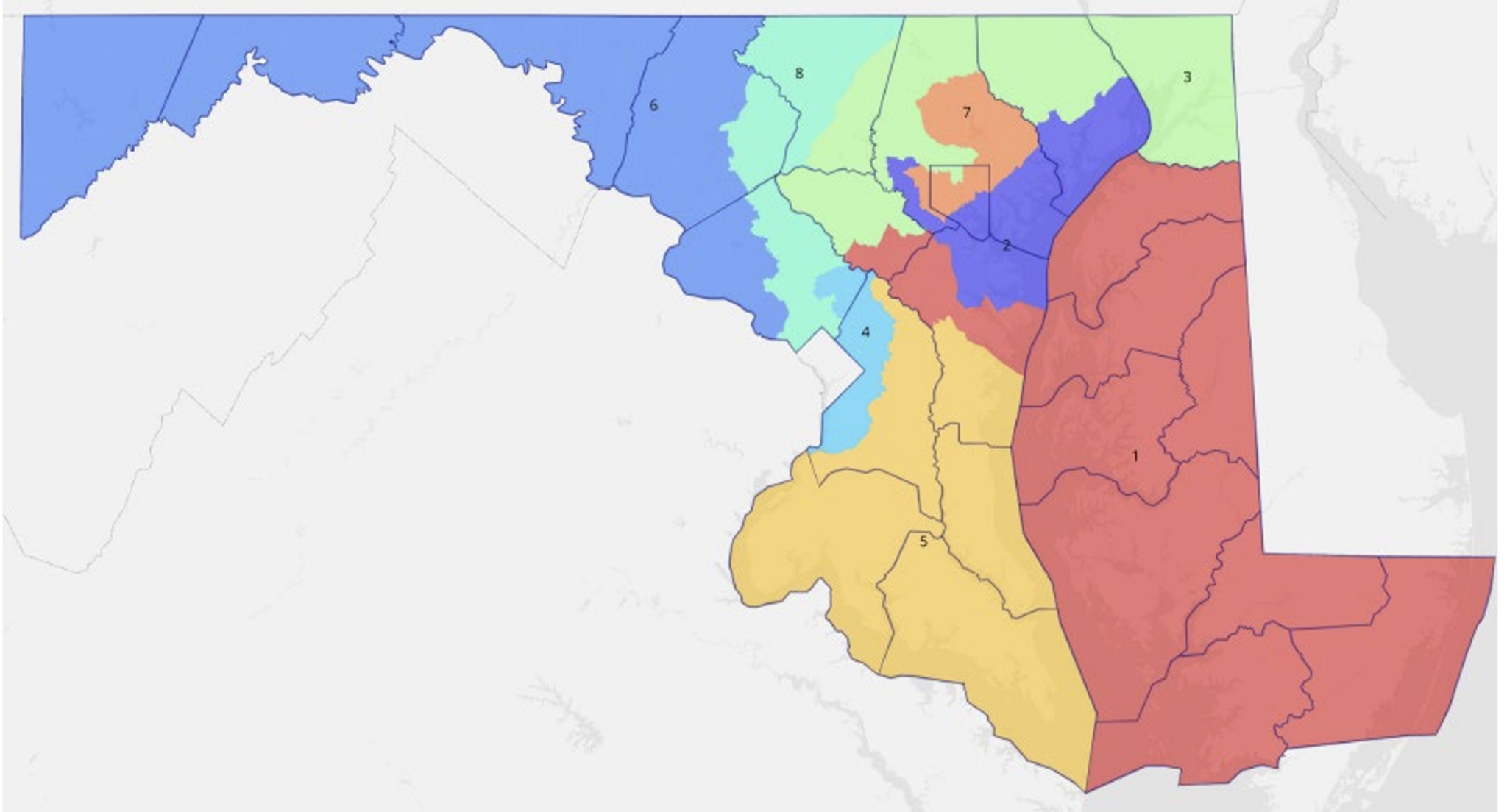
The redistricting plan approved “in concept” Tuesday by the Governor’s Redistricting Advisory Commission. The map would shift Democratic voters into the 1st District, currently held by GOP Rep. Andy Harris, and will require changes to equalize population in the districts. (Map courtesy Governor’s Redistricting Advisory Commission)

A five-member panel voted behind closed doors Tuesday to advance a “congressional map concept” that will be used as a guide for legislation that will attempt to redraw the state’s eight congressional districts.

The Governor’s Redistricting Advisory Commission voted 3-2 to recommend the map to Gov. Wes Moore (D) and the Maryland General Assembly. U.S. Senate Angela Alsobrooks (D), who chaired the panel, said the vote followed a “transparent redistricting process.”

“From the start, our commitment has been simple: Put Marylanders in the driver’s seat,” Alsobrooks said in a statement following a roughly one-hour meeting that the public could not observe.

“This process has been conducted in the open, with opportunities for the public to participate, weigh in, and submit their own map proposals for consideration,” her statement said. “All Marylanders — regardless of party, background, or ZIP code — can engage with this process, see the options, and make their voice heard.”

The concept map overhauls the 1st District — the state’s lone Republican district, held by GOP Rep. Andy Harris. While the district currently includes the Eastern Shore, Cecil, and part of eastern Baltimore County, the conceptual map would have it stretching from the Eastern Shore over the Bay Bridge through Anne Arundel County and into part of Columbia in Howard County. The shift moves more liberal Democrats into the district held by Harris, the chairman of the conservative House Freedom Caucus.

Changes to districts held by Democrats do not appear to threaten control of those seats.

The vote was blasted by state Republicans, with House Minority Leader Jason Buckel (R-Allegany) saying it “confirmed what we have been saying all along: that this Commission had nothing to do with fairness, nothing to do with the wants and needs of our citizens, and, quite frankly, nothing to do with Maryland.”

“Instead, this Commission has everything to do with D.C. partisan politics and the desires of the Democratic National Committee,” Buckel said. “This Commission was merely a drawn-out political sham with a predetermined outcome: To rid Maryland of any Republican representation in Congress and disenfranchise voters in Western Maryland and the Eastern Shore. Nothing drives this home more than their absurd end product.”

National Democratic leaders, who have been pressing Maryland to respond to redistricting schemes in GOP states, hailed the vote.

“Partisan Republican hacks were counting on Democrats to roll over while they gerrymander congressional maps in Texas, Missouri, North Carolina and Florida,” House Minority Leader Hakeem Jeffries (D-N.Y.) said in a statement. “They were wrong. Arrogant and corrupt Republicans started this battle. Democrats will end it. We will ensure that there is a free and fair midterm election in November.”

But redistricting still faces a difficult future in Maryland, where Senate President Bill Ferguson (D-Baltimore City), a member of the commission, is opposed to midcycle redistricting. A redistricting bill, should it reach the Senate, is not expected to receive a vote from the full chamber.

Ferguson and fellow commission member, Cumberland Mayor Ray Morriss, a Republican, voted against the proposed map Tuesday.

Ferguson said in a statement that the map “fails the Governor’s own test. It breaks apart more neighborhoods and communities than our existing map, and it fails the constitutional requirement of one person, one vote. We heard from no Boards of Elections. We heard nothing from the Office of the Attorney General of Maryland, which would have to defend this process and outcome. We heard no testimony to the impact on our election cycle. Ultimately, a flawed process has delivered a flawed product.”

Morris, who said he was asked to serve on the commission to ensure fair congressional districts, said that, “After a while, it became obvious that definition of fair that was being put out there was what was fair for the Democratic Party.”

The governor’s office said it will send the proposed map to the House speaker’s office, and from there “it will be in the hands of the Maryland General Assembly,” Moore said recently, noting that it “is not an administration bill.”

Moore has defended the commission he empaneled as transparent. But there was little public notice for Tuesday’s closed-door meeting, the second time the panel met and made decisions in private.

Four of the five members reached by Maryland Matters said they believed the meeting should have been held in public, and that the public would have benefited from witnessing the deliberations. But former Attorney General Brian Frosh, a commission member, said that while the closed-door meeting bothered him “it’s the governor’s commission, and he can run in any way he wants…. If he says, you’re going to do this in private. I think we end up doing it in private.”

The work of the panel at times seemed slapped together. There was initial confusion about how districts needed to be drawn or if changes would affect local election boards. Alsobrooks, in the panel’s first meeting, promised in-person meetings, but those never materialized.

“I’ve had concerns about the way this process has moved forward from the get-go,” Ferguson told reporters during a meeting before the commission met.

The legislation will start in the House.

House Majority Leader Del. David Moon (D-Montgomery) said a bill could be introduced quickly — possibly as early as the end of next week.

“If you’re the Speaker’s office, you can get it done pretty quickly, but there’s still logistical process, right?” Moon said, adding that there are some “logistical” hurdles that will need to be overcome.

“It’s going to be a multiday process, but I do think we are talking a matter of days, not weeks,” Moon said. “And again, if there’s a will to act, I do believe you’ll see the House wanting to act as soon as possible. I would hope this could be a conversation handled in the first month of session.”

The map approved by the commission will not likely be the one that goes to lawmakers, said Del. C.T. Wilson (D-Charles), a member of the commission who expects to lead the bill on the floor and may also be its sponsor.

“That map will not be the map submitted with the bill,” Wilson said. “It will be zeroed out. That was a concept of the map … because time is an issue. When citizens put maps in, they’re not going to be exact. If they were, well, that’d be a whole other question, wouldn’t it?”

The concept map increases the number of majority-minority districts from two to three. Two have populations that are at least 50% Black voters. But the map also included population deviations some members said would not meet strict “one person, one vote” population standards used by the courts.

Ferguson’s statement called the map “objectively unconstitutional.” He said the new map will likely result in the current map facing a court challenge. Democrats, he warned, risk losing seats the party currently holds.

Former Attorney General Brian Frosh, a member of the commission, said Ferguson’s characterization was inaccurate.

“We voted on a map in concept,” Frosh said, “The map needs to be tweaked. I don’t think it requires major changes. But it’s not perfectly aligned in terms of the numbers. You have to be within a few votes one way or another, a few people one way or another. It probably is out of line in a way that can be fixed.”

Frosh said the tweak should take “half an hour or 45 minutes by the folks at the Department of Legislative Services.”

The adjustments may not matter. Ferguson is a staunch opponent of mid-cycle redistricting, and any bill passed by the House is likely to be sent to the Senate Rules Committee to die without a committee hearing or full Senate vote.

The commission recommended the concept map following a series of 10 meetings — two of which were closed to the public.

More than three dozen maps were submitted by the public. The maps ranged from the basic, with no supporting documentation, to sophisticated iterations that included party registration and demographic data. But in two meetings one map, which was later tweaked, clearly garnered most of the attention.

“To me, when 28 out of 30 people all talk about the same map, it seems just, I don’t know, it just seemed a little odd to me,” Morriss said. “Everybody seemed to know which map they were going to talk about.”

When asked if he felt an outcome had been predetermined, Morriss said it “definitely gave the perception, to me, that something could be a little odd about it. Statistically, it just didn’t add up. So, yes.”

Morriss questioned the vote by the panel, noting that most of the public testimony did not support mid-cycle redistricting.

“I look back at the beginning, when over 70% of the people didn’t want to move forward,” Morriss said. “I think that said a lot. I think what the public got from this was what the Democratic party wanted for the state of Maryland, and for their national agenda. I don’t think the public really got a real — let’s use the word fair — a real, fair analysis of the congressional districts in the state.”

Wilson rejected that argument, saying testimony of roughly 30 people in each meeting was not the only consideration for the commission.

“This was a hearing,” Wilson said. “Not a poll.”

Moore appointed the panel in November, saying he he wanted to ensure the maps drawn in 2022 were “fair.” He has never provided a definition of the term.

But his efforts came as Republican states began hyper-partisan mid-cycle redistricting. The effort, kicked off in Texas, was seen as a way to improve chances of keeping a GOP majority in Congress in this fall’s elections.

In an interview a week ago, Moore said Maryland was reacting to Republican states who recast their maps to eliminate Democrats in Congress.

“The point is this is that if the rest of the country is going to go through a process of determining whether or not they have fair mass in a mid-decade process, then so will the state of Maryland,” Moore said during The Daily Record’s Eye on Annapolis opening day event.

In Maryland, the Democratic Party holds a 2-1 registration advantage over Republican voters, with Democrats accounting for about 50% of registered voters and the GOP and unaffiliated voters accounting for about 25% each.

Even so, Democrats hold seven of eight congressional seats in Maryland; 25 years ago, Republicans held four of the eight seats.

“It was not necessarily, in my mind, what was fair to all of the voters of the state of Maryland,” Morriss said of the commission’s work. “Especially in this case, the Republicans and the unaffiliated voters.”

Frosh said the commission and its recommendation was a response to Trump and MAGA Republicans policies on immigration, voting rights and the push for Republican states to redraw their own districts.

“I think that we can’t be holier than thou in this situation. If the Supreme Court says all you need to do is have an equal number of votes and not openly discriminate, then that’s what we should do,” Frosh said. “Why should we? Why should we cede that advantage to the Republican states? And I just think we’ve got to fight back, and as the old saying goes, you don’t bring a knife to a gunfight.”

Wilson agreed and said complaints about fairness from Maryland Republicans are not persuasive when racial equity is under attack by the Republicans at the federal level.

“The one thing I will clearly say is that my children are a protected class, and we can’t pretend that African Americans are the same thing as being Republican,” Wilson said. “And I don’t hear them saying that … about Texas, about Florida, about Missouri. I don’t see them fighting for a protected class of people in a country with a history of racism and violence.

“And to be clear, they still have a voice. They can still vote,” said Wilson. “My people couldn’t vote for the longest time. They can still vote.”

By Bryan P. Sears
Maryland Matters reporter Dianne J. Brown contributed to this report

The Spy Newspapers may periodically employ the assistance of artificial intelligence (AI) to enhance the clarity and accuracy of our content.

Filed Under: 00 Post to Chestertown Spy, Maryland News

Moore, other PJM Governors Push for Changes at the Nation’s Biggest Electric Grid

January 18, 2026 by Maryland Matters Leave a Comment

Maryland Gov. Wes Moore (D) found himself in a rare position Friday: Joining forces with President Donald Trump’s (R) administration on energy policy.

Moore was one of 13 governors who signed an agreement with the Trump administration, pushing for PJM Interconnection, the operator of the nation’s largest electric grid, to bring $15 billion worth of new power online — with data center companies paying the tab.

Moore has been a critic of PJM, arguing that its policies delayed new clean energy projects, which got stuck in a backlogged queue waiting for approval, and then electricity demand skyrocketed because of power-hungry data centers.

“I have been crystal clear: We cannot build a 21st-century economy on an energy market that blocks new supply,” Moore said in a statement Friday. “This moment calls for urgency. Maryland families and businesses must be served by a reliable grid without shouldering the cost of sky-high energy bills.”

But PJM’s Board of Directors released its own data center plan later Friday.

That plan also initiated a “backstop procurement” for new energy. But PJM merely directed its staff to study assigning the costs of new energy to the jurisdictions, who could then pass those costs to the data center companies, such as Amazon and Google.

PJM’s plan also encourages — but doesn’t mandate — “bring your own generation,” wherein data centers could choose to bring new power onto the system on an expedited basis, to defray the possibility of being asked to reduce their power demand when the grid is strained.

Jason Stanek, executive director for governmental services at PJM Interconnection, speaks during a panel convened Friday by the Maryland Freedom Caucus about energy affordability issues. (Photo by Christine Condon/Maryland Matters)

“This decision is about how PJM integrates large new loads in a way that preserves reliability for customers while creating a predictable, transparent path for growth,” said David Mills, PJM Board Chair and Interim President and CEO, in a statement.

“This is not a yes/no to data centers,” Mills’ statement said. “This is, ‘How can we do this while keeping the lights on and recognizing the impact on consumers at the same time?’ We look forward to implementing, along with our stakeholders, these proposals to manage the phenomenal demand growth we are experiencing.”

PJM’s plan also includes changes to the way that the grid operator forecasts energy demand. Concerns had been raised that PJM’s projections were inflated, because companies looking to build data centers could be shopping the same data center proposal in more than one jurisdiction.

According to a news release from PJM, some of the items will require approval from the Federal Energy Regulatory Commission, while others can take place immediately.

Environmental groups argued Friday that PJM’s data center plan favors fossil fuels.

The Natural Resources Defense Council said in a statement that PJM’s decision protects “everyday families from blackouts” caused by data centers, but it falls short when it comes to new power generation.

PJM has created a “fast-track process that effectively excludes clean energy projects and gives special treatment to fossil fuel power plants built for data centers, allowing them to cut ahead of low-cost clean resources that have been waiting years to connect to the grid,” wrote Claire Lang-Ree, advocate for the Sustainable FERC Project at NRDC.

Maryland Del. Lorig Charkoudian (D- Montgomery) also chimed in, adding that PJM’s decision doesn’t provide sufficient protections for ratepayers.

“The primary fast-tracking of energy PJM is doing is biased towards fossil gas,” wrote Charkoudian, vice chair of the House Economic Matters Committee. “Given that solar and batteries are the fastest, cheapest way to provide new generation, this is another example of PJM serving for-profit energy companies and not families who can’t afford their energy bill.”

Del. Lorig Charkoudian (D-Montgomery) speaks during a rally for the Affordable Solar Act, which she is sponsoring, on Jan. 14, 2026, the first day of the Maryland General Assembly session. (Photo by Christine Condon/Maryland Matters)

A Trump spokesperson called the administration’s plan with the governors an “unprecedented bi-partisan effort urging PJM to fix the energy subtraction failures of the past, prevent price increases, and reduce the risk of blackouts.”

“Ensuring the American people have reliable and affordable electricity is one of President Trump’s top priorities, and this would deliver much-needed, long-term relief to the Mid-Atlantic region,” wrote White House spokesperson Taylor Rogers in a statement.

The governors’ proposal would also have extended a cap on PJM’s energy capacity auction, which has lowered the price charged to ratepayers from the last several auctions, during which PJM procures energy supply to feed the grid in the future.

But PJM decided to request additional feedback about the cap before making a final decision.

Meanwhile, PJM executive director Jason Stanek was in Annapolis on Friday, speaking to a panel of legislators from Maryland, Pennsylvania and New Jersey, convened by Maryland’s conservative Freedom Caucus.

Stanek, a former Maryland utility regulator, argued that PJM has pursued multiple reforms to approve new energy projects more quickly.

“Despite what you may have heard, our interconnection queue is open, and PJM has been processing the connection of new, and mostly renewable, resources to connect to the grid at record pace,” Stanek said. “We soon hope to turn around requests in a period of one to two years, or possibly sooner.”

During his remarks, Stanek said that states own part of the blame for energy supply worries — and high electric bills, citing state-level energy policies and permitting procedures. He urged the legislators in the room to look inward as they aim to reduce prices.

“We would implore all of our states in the PJM region not to retire any more [power] resources until you have a sufficient amount of resources to backfill those retirements,” Stanek said.

Del. Mark Fisher (R-Calvert) speaks following a panel on energy affordability, convened by the Maryland Freedom Caucus with Republicans from other states in the PJM network. (Photo by Christine Condon/Maryland Matters)

“We would also ask that you look at your state permitting laws on the books to determine whether or not we can actually build energy infrastructure in your states in a timely manner.”

The Republicans in attendance were insistent that Maryland has contributed to its own power woes, by passing legislation to push the state away from fossil fuels — and toward a grid fueled by solar, wind and nuclear power. By law, Maryland has until 2031 to cut its carbon emissions 60% from 2006 levels.

“Why would politicians push to force the economy onto electricity while simultaneously shutting down the very power plants needed to generate it? It’s simple. Virtue signaling, green dreams over common sense,” said Del. Mark Fisher (R-Calvert).

Senate Minority Leader Steve Hershey (R-Upper Shore) said Friday that he was initially encouraged by the PJM governors’ announcement, because he agrees that data centers should pay for new power. But he remains concerned that Moore will focus on renewable sources, such as wind and solar, to supply that new power to the grid.

“Gov. Moore needs to embrace natural gas,” Hershey said. “He hasn’t done it yet. He’s trying to talk about nuclear, because it’s clean, but nuclear is 12 or 15 years out. As we heard today in this hearing, the quickest way to get reliable energy back on grid is to open up these retired fossil fuel generation facilities.”


by Christine Condon, Maryland Matters
January 17, 2026

Maryland Matters is part of States Newsroom, a nonprofit news network supported by grants and a coalition of donors as a 501c(3) public charity. Maryland Matters maintains editorial independence. Contact Editor Steve Crane for questions: [email protected].

The Spy Newspapers may periodically employ the assistance of artificial intelligence (AI) to enhance the clarity and accuracy of our content.

Filed Under: 00 Post to Chestertown Spy, Maryland News

Poll: Moore Approval Numbers Continue Downward Trend Even as Most Voters Would OK Second Term

January 14, 2026 by Maryland Matters Leave a Comment

Roughly half of Maryland voters said they would vote to reelect Gov. Wes Moore to a second term, even as the first-term Democrat’s job approval numbers continue a downward trend.

The poll released Tuesday by Annapolis-based Gonzales Research & Media represents a mixed bag for the governor.

“If the election were today, Moore would be reelected, but the election isn’t today,” said Patrick Gonzales, a veteran state pollster. “It’s 10 months away. We have a session that is going to be rather problematic, I suspect, for the governor. Where we are six months from now, where we are on Labor Day, that’s going to matter. That’s how I see it.”

The poll of 808 registered Maryland voters who said they were likely to vote in 2026 was conducted between Dec. 21 and Jan. 6. The margin of error is plus or minus 3.5%.

Gonzales also asked who voters would support if the 2026 election were held today.

Moore, with 49.9%, tops a generic Republican and third-party candidate. The number is driven by nearly 76% of Democrats who said they would give Moore a second term.

Democrats hold a 2-1 registration advantage over Republicans in Maryland, making up slightly more than 50% of all registered voters in the state.

Predictably, 81% of Republicans said they would back a Republican candidate. Unaffiliated voters are more evenly split, with 35% saying they would vote for Moore and 32% favoring the unnamed Republican.

Gonzales noted that polling data suggests voter discontent over pocketbook issues: affordability, the economy and taxes. Nearly six in 10 voters who responded said they believe they are paying too much in taxes.

“They’re paying too much for their electricity,” he said. “They’re paying too much in taxes and people are [angry].”

All of which is a harbinger for a potential pocketbook election, he said.

Gov. Wes Moore has seen a narrowing of the separation between voters who approve of his job performance and those who disapprove since entering office. (Gonzales Research & Media Services

Gonzales noted that of those who said they pay too much in taxes, “a hypothetical Republican candidate bests Moore by 13 points, 47% to 34%.”

Another 41% said they believe they pay “the right amount” in taxes. Just 1% said they believe they should pay more.

Last year, Moore and the General Assembly increased taxes by a projected $1.6 billion,  part of a plan to close a projected $3.3 billion structural budget deficit.

The expectation was that the tax increase, coupled with one-time fund shifts and some cuts, would fill the spending gap and leave $300 million for the fiscal 2028 budget year.

Those expectations fizzled. The state faces a $1.5 billion projected structural deficit for the coming budget year. Officials point the finger at federal actions including the loss of 25,000 federal jobs since President Donald Trump took office.

Republican candidates in recent history enjoyed late election year surges tied to one or more so-called pocketbook issues. In 1994, Ellen Sauerbrey lost to Parris Glendening by just 6,000 voters. In 2002, Robert Ehrlich became the first Republican elected governor in nearly four decades. In 2014, Larry Hogan won the first of two consecutive elections. He was the first Republican to do so since Theodore McKeldin.

Downward job approval trend continues

Moore entered office in 2023 enjoying approval of roughly six in 10 Marylanders. He peaked in Gonzales’ September 2024 poll, when 64% of those surveyed approved of his efforts. The gap between those who approved and those who disapproved in that poll was 35 points.

Since then, there has been a downward trend. Last March, there was a 19-point separation. In Tuesday’s poll, 52% said they approve of the job Moore is doing compared to 41% who disapprove, three points lower than a Gonzales survey in March 2025. The governor has performed similarly in other surveys, including the Institute for Politics at the University of Maryland, Baltimore County.

Beneath those top-line numbers in the Gonzales poll, the survey shows a continuing trend of voters who are changing their minds about Moore’s efforts.

The current poll shows an 11-point separation between those who approve and those who disapprove. And for the first time since Gonzales asked about Moore’s job performance, the number of those who said they strongly disapprove is larger than those who strongly approve.

Roughly one voter in three said they strongly disapproved of Moore’s job performance heading into the final session of the current term — a 7-point change from March.

Moore lost ground with Democrats, Republicans and unaffiliated voters. While 73% of Democrats approved of Moore’s performance, that was down from 83% in March 2025. At the same time, those who disapproved increased five points, to 18%.

In March, one-fifth of unaffiliated voters declined to offer an opinion on Moore’s job performance. Now, just 10% declined to answer: 41% of independent voters approve of the governor’s performance — a 7-point increase from March — but 49% said they disapproved, also an increase of seven points.

Democratic optimism

Moore’s job approval numbers come even as the Gonzales poll shows an uptick in overall sentiment about the direction of the state.

Of those surveyed, 47% said the state is moving in the right direction compared to 44% who said the state is on the wrong track.

The results are an improvement from last March when 50% said the state was on the wrong track and 41% said things were moving in the right direction.

The results don’t track directly with Moore’s job approval numbers.

“It’s not solely tied to whether people think taxes are too high,” Gonzales said. “There are other factors that play into what seems like a contradiction in the poll. I wouldn’t get all bollixed up on that.”

Instead, Gonzales said national politics and the impending midterm elections — a referendum on Trump — may be in play. Democrats nationally are eying the potential to retake a majority in the U.S. House in November.

“When we did the poll in March, Trump had just taken office and Democrats were a bit demoralized,” Gonzales said. “Now they’ve got that eye of the tiger, Rocky and Apollo Creed running on the beach mentality back and 70% of Democrats see things moving in the right direction for them.”


by Bryan P. Sears, Maryland Matters
January 13, 2026

Maryland Matters is part of States Newsroom, a nonprofit news network supported by grants and a coalition of donors as a 501c(3) public charity. Maryland Matters maintains editorial independence. Contact Editor Steve Crane for questions: [email protected].

The Spy Newspapers may periodically employ the assistance of artificial intelligence (AI) to enhance the clarity and accuracy of our content.

Filed Under: 00 Post to Chestertown Spy, Maryland News

More than 3,300 Marylanders Detained by ICE in 2025, Twice the Number of Preceding Years

January 12, 2026 by Maryland Matters Leave a Comment

 U.S. Immigration and Customs Enforcement make an arrest in Chicago on Jan. 26, 2025. Since President Donald Trump took office on Jan. 20, ICE arrests have soared in Maryland and across the country. (Photo by Immigration and Customs Enforcement)

The GoFundMe page Julia Leverone created in February for legal fees and bond payments to get Minoska Maldonado-Deras out of Immigration and Customs Enforcement custody was successful, helping to get her out of custody and back with her family in Carroll County.

That’s until Maldonado-Deras, a cousin of Leverone’s husband, was hauled back into  custody during an appointment with ICE in October. She’s now in an ICE detention facility in Lousiana, and the GoFundMe page is back in business.

Maldonado-Deras was “doing everything she was supposed to do” following her first detainment, said her husband, Patrick Sortino, including probation meetings with ICE.

Sortino, a U.S. citizen, says he doesn’t have “any straight answers,” about what will happen to his wife, whether she will be granted bail or deported to Honduras — her native country that she has not been to in nearly 20 years.

“This was her new life, you know — here,” Sortino said. “We were hoping to spend the holidays together.”

Maldonado-Deras is one of the more 3,200 people in Maryland who were arrested by ICE from Jan. 21, 2025, the day after President Donald Trump returned to office, through Oct. 15, 2025. The data comes from the Deportation Data Project.

All told, ICE had arrested 3,308 people in Maryland from Jan. 1 to Oct.15, 2025, the last date for which the Deportation Data Project provided numbers. That compares to 1,353 for all of 2024 and 387 for the last four months of 2023, according to the data.

ICE did not respond to Maryland Matters’ request for data.

Only one-third (1,073) of those arrested in Maryland had criminal convictions, and 50.9% (1,652) had no criminal charges whatsoever. The remaining 519 have or had criminal charges pending at the time of their detention.

“The administration comes out promising to deport millions and millions of illegal criminals, and what they’ve done instead is started picking up moms and grandfathers … who have no criminal convictions,” said Ben Messer, a senior immigration attorney at Wilkes Legal.

Nearly all of those detained originally went to holding rooms or field offices in Maryland, most often in Baltimore, with many then transferred to out-of-state locations — some being thousands of miles away.

Messer says there are more people asking for help since the Trump administration took over in January, but the ways that attorneys are able to help are dwindling because of the administration “closing off areas of relief.”

“Some people who would have had a case before are going to be unable to succeed under drastic changes in interpretation of law,” Messer said. “The cases that do remain are just quite a bit more difficult for the same reason.”

There has been a “bloodbath” of immigration court judges due to actions by the Board of Immigration Appeals and U.S. Attorney General Pam Bondi, Messer said. Judges who have previously represented immigrants or worked at pro-immigrant organizations have been fired, he said, with some of them being replaced by military lawyers.

“We have a few of these temporary immigration judges now in our area — the DMV [D.C., Maryland, Virginia] — and they’ve supposedly gotten a crash course in immigration law, but none of them have any experience in it,” Messer said.

Messer noted that the Board of Immigration Appeals and Bondi’s decision to overturn “decades of practice and precedent” by determining that anyone who came to the U.S. without a visa does not have bond eligibility — a decision which many federal courts have rejected — as one of the new challenges.

The Justice Department, in a statement, disagreed with Messer’s assessment, saying the new interpretations of the law are common sense.

“The Executive Office for Immigration Review is restoring integrity to the immigration adjudication system, and Board of Immigration Appeals decisions reflect straightforward interpretations of clear statutory language,” a Justice Department spokesperson said in a statement.

“President Trump and the Department of Justice will continue to enforce the law as it is written to defend and protect the safety and security of the American people,” the statement said.


By Nicole Pilsbury, Maryland Matters January 11, 2026

Maryland Matters is part of States Newsroom, a nonprofit news network supported by grants and a coalition of donors as a 501c(3) public charity. Maryland Matters maintains editorial independence. Contact Editor Steve Crane for questions: [email protected].

The Spy Newspapers may periodically employ the assistance of artificial intelligence (AI) to enhance the clarity and accuracy of our content.

Filed Under: 00 Post to Chestertown Spy, Maryland News

Transportation Officials Approve Rough Plans on Chesapeake Bay Bridge Replacement

December 23, 2025 by Maryland Matters Leave a Comment

The Maryland Transportation Authority Board gave preliminary approval Thursday to a long-range plan that would replace the current Chesapeake Bay Bridge spans with two parallel spans that would add four driving lanes as well as a shoulder lane in each direction.

The “alternative C” plan would also raise the bridge height to allow for larger cargo ships to pass under and would cost between $16.1 billion and $17.6 billion if the final design includes “shared-use paths” for bicycles and pedestrians. Dropping that option would save about $1.3 billion from the final cost, according to state estimates.

Choosing the alignment and size of the replacement bridge is just another step in a years-long planning process, that kicks off several more years of hearings and planning on the project that would not begin construction until 2032 at the earliest. ButMdTA Executive Director Bruce Gartner was happy with the progress of the Bay Bridge replacement project that has been decades in the making.

“It’s been an incredibly successful development to get to this point” Gartner said. “This is just another step in the process … But this is a kick-off of really needing to get citizen input on that project.”

Melissa Williams, MdTA’s director of planning and program development, said a new bridge is needed due to the “aging infrastructure” of the current William Lane Preston Jr. Memorial Bridge. Besides the current lanes — two eastbound and three westbound — not being enough to meet current traffic demands, the lack of shoulders does not allow for emergency vehicles to access the bridge easily.

The new design would build a four-lane eastbound span parallel to the current eastbound bridge, which would then be torn down, and the process would be repeated for the westbound bridges. The bridge would also be raised to a 230-foot vertical clearance to allow larger ships through, matching the height of the proposed replacement for the Francis Scott Key Bridge in Baltimore.

Alternative C was the least costly of the seven alternative designs that were under study. Those costs, from $14.8 billion to $17.6 billion, “are planning-level costs estimated in 2025 dollars. These are very preliminary dollars,” Williams reminded the board.

The design plan under consideration also had the least environmental impact compared to other design plans presented to transportation officials. The new bridge could yield between $17 billion and $23 billion into the local economy, and bring in over 61,000 jobs during construction.

MDTA voted unanimously to focus on Alternative C. The next step will be a report on the design’s potential environmental impact, which would be released in January 2026. There will be public hearings in February where Marylanders and other stakeholders can respond to the report.

MDTA Chair Samantha Biddle and board member William Cox consider a plan to replace the Chesapeake Bay bridge. (Photo by Danielle J. Brown/Maryland Matters)

A final decision on design construction is projected to occur in Spring 2028, with construction beginning around Summer 2032. Williams said it was too early in the project to estimate when completion of the new bridge would occur.

“We are still in the planning phase,” she said. “Once we get our designers on board and our construction team on board, the details of exactly how we move forward, and what the timing would be and the construction sequencing would be, will be ironed out.”

Consideration for the Chesapeake Bay bridge replacement comes at a time when state officials are also working to replace the fallen Francis Scott Key Bridge.

“It’s rather daunting to think about taking on construction of two very large bridges in short periods of time,” said Board Member Cynthia D. Penny-Ardinger. “One due to disaster, and one that’s been in the works for a very long time.”

But she and the other board members were ready to take on the challenge.

“We have a great team, and we can do hard things,” said Chair Samantha J. Biddle. “We can walk and chew gum at the same time.”


by Danielle J. Brown, Maryland Matters
December 18, 2025

Maryland Matters is part of States Newsroom, a nonprofit news network supported by grants and a coalition of donors as a 501c(3) public charity. Maryland Matters maintains editorial independence. Contact Editor Steve Crane for questions: [email protected].

The Spy Newspapers may periodically employ the assistance of artificial intelligence (AI) to enhance the clarity and accuracy of our content.

Filed Under: 00 Post to Chestertown Spy, Maryland News

Let the Great Redrawing Begin: Redistricting Commission Votes to Move Forward on New MD Congressional Map

December 19, 2025 by Maryland Matters Leave a Comment

A panel appointed by Gov. Wes Moore (D) to make recommendations on midcycle congressional redistricting voted behind closed doors Thursday to move forward with its work and solicit proposals from the public on how the state’s eight districts could be redrawn.

The 3-2 vote happened in a virtual meeting that was not listed on the Governor’s Redistricting Advisory Commission website and was not open to the public. There was no agenda posted. It was a meeting, and a vote, that Senate President Bill Ferguson (D-Baltimore City) criticized in a blistering statement that called the outcome “pre-ordained” and lacking in public transparency.

The commission, led by Sen. Angela Alsobrooks (D-Md.), met at 5 p.m. Just after 6, within minutes of the meeting’s close, Moore’s office released a statement in which Alsobrooks announced the commission would solicit maps from the public and hold two more meetings.

“Today, the Governor’s Redistricting Advisory Committee [sic] met to discuss our path forward and decided to continue our work to recommend a congressional map to the Governor and the General Assembly,” Alsobrooks said in the statement.

“After Christmas, we will make the submitted maps available publicly and hold two additional public meetings to gather feedback on the options before us. This process will remain open, transparent, and focused on ensuring Maryland’s districts reflect our communities and comply with the law,” she said.

Joanne Antoine, executive director of Common Cause Maryland, said the commission suffered from a “glaring lack of transparency,” highlighted by Thursday’s decision to move forward with redistricting after failing to release any proposed maps to the public.

Critics: ‘The entire process is a mess’

Thursday’s unannounced and unbroadcast meeting of the Governor’s Redistricting Advisory Commission raised concerns for open-government advocates about transparency and violations of the state’s Open Meetings Act.

“The commission has convened five times already without publishing a proposed map for public comment or review – a pattern that raises serious concerns about the commission’s commitment to public engagement and transparency,” said Common Cause Maryland Executive Director Joanne Antoine. “Tonight’s meeting may have also violated Open Meetings Laws for failing to provide adequate public notice.”

Previous meetings of the panel were all held in public, and virtually. None featured maps that the public or commission members could look at. Meetings were often added along the way without a clear idea whether the panel would hold in-person meetings, produce maps for comment or even if there was an expected end date to proceedings.

Nikki Tyree, executive director of the League of Women Voters of Maryland, said the commission “failed to meet the spirit or intent” of state open meetings laws. The panel “demonstrated that it is more loyal to a single party’s desire to redistrict than to the people of Maryland,” she said.

“There was no notice of today’s meeting; it was not streamed for public viewing,” Tyree said in a statement. “The Commission has not shared future meeting dates or even an outline of a process or tools for people to contribute to the development of meaningful and fair maps. While it seems like small details, it sends a clear message that says the majority party can jam through what it wants while ignoring the citizens.”

The invitation from Sen. Angela Alsobrooks (D-Md.), the redistricting commission chair, to submit redistricting plans included no details on a format or other requirements for such plans. Those interested were simply directed to “submit their map ideas for our consideration over the next two weeks by emailing [email protected].”

Antoine said she is concerned about the timing for map submissions that leave “only a few days to submit map proposals with no date for the next two meetings. The entire process is a mess.”

A spokesperson for the governor’s office did not respond to a request for comment about the private session.

“It’s unfair to ask voters to comment on what they can’t see,” Antoine said in a statement. “Ultimately, this is about transparency; it’s about whether redistricting happens in the light of day or behind closed doors. The commission should immediately release any maps under consideration so the public can provide meaningful input, instead of putting the burden on members of the public to draw their own maps during the holidays.”

The League of Women Voters of Maryland also said in a statement that it was “disturbed” to learn of the commission’s meeting and subsequent action Thursday.

Making sure maps are ‘fair’

Moore created the five-member panel in early November. He charged it with ensuring the congressional district maps approved by the state in 2022 were “fair” — a term he has repeatedly declined to define.

While Democrats in Maryland hold a 2-1 advantage over Republicans in voter registration, they hold a 7-1 advantage in the state’s congressional districts: Rep. Andy Harris (R-1st) is the sole Republican in the congressional delegation, from the 1st District, which covers the Eastern Shore and stretches into eastern Baltimore County.

Alsobrooks, in her statement, said Maryland has a “responsibility” to redistrict.

“At a moment when other states are moving aggressively to redraw maps — and with some already signaling they want the Supreme Court to weaken or effectively nullify key protections in the Voting Rights Act — Maryland cannot afford to sit on the sidelines,” her statement said. “We have a responsibility to move forward so the next Congress reflects the will of the people and can serve as a real check on this President. That’s what tonight’s announcement is about: doing the work, inviting the public in, and getting this right.”

Democratic Congressional Campaign Committee Executive Director Julie Merz said the Maryland commission “took a critical step in ensuring the voice of Marylanders are heard in the face of national efforts by Donald Trump and MAGA Republicans to rig the midterm elections in their favor through unprecedented mid-decade redistricting. We applaud the Commission for their continued work to create a firewall against extremists seeking to silence the voice of Marylanders.”

But the commission’s decision drew swift rebukes from Republican leaders in the House and Senate, with House Minority Leader Jason C. Buckel (R-Allegany) calling it  “the most corrupt process possible in an inherently corrupt endeavor.”

Ferguson flames commission before meeting

Minutes before the start of the closed-door meeting, Ferguson released a statement charging that “the outcome is already known. Clearly, the Commission’s work was pre-determined from the moment the GRAC was announced.”

Ferguson, one of the five commission members, is an outspoken opponent of hyper-partisan midcycle redistricting. He pointed to recent polling that he said showed state residents have bigger issues on their minds than redistricting.

“Our state’s residents have been clear, in front of this commission and through polling,” his statement said. “The overwhelming majority do not want a new congressional map. They want their government focused on fostering growth, affordability, and real protections against this lawless federal Administration. The Senate of Maryland remains focused on this important agenda as we continue to try to tackle a $1.4 billion budget shortfall in Maryland’s state budget.”

Commission members who attended the meeting told Maryland Matters that the bulk of the discussion centered on whether to send a recommendation to the governor to move forward with a redistricting proposal.

Cumberland Mayor Ray Morriss, in an interview early Thursday afternoon, said he expected the meeting to be “administrative” in nature, largely because of the previous lack of maps “or anything like that. So, more than anything, I think that’s what today’s meeting will be … pretty much administrative and sort of figuring out the roadmap going forward.”

Speaking again after the meeting, Morriss said the commission discussed maps but none were shown to members.

“There were discussions about about them, about maps, how they would be drawn, who would be drawing them, and whether or not we would have more hearings open public hearings about it,” said Morriss, who joined Ferguson to vote against moving forward. “I would say that there was a consensus that we would have the public draw maps, and we would have open hearings to just allow to allow the public to voice their opinions about the different maps that they’ve seen.”

But Morriss noted that part of the discussion included an option to send the issue to Moore and the legislature for public hearings.

“That was the discussion, whether we wanted to have the hearings or go directly to the to the General Assembly,” he said. “We decided that it would probably be best, since we were a commission who would ask for the public’s input, to then give them the opportunity to have input on the maps that we were considering.”

Others who attended the meeting called it “a check-in.”

“I didn’t see it as any big deal,” said Del. C.T. Wilson (D-Charles), a member of the commission who voted with the majority Thursday night. “I saw it s a check-in, like,  ‘Guys, are we going to keep doing this or what?’ There was no policy discussed.’”

Wilson said he was not privy to how the decision was made to hold the meeting in private. Morriss said after the meeting that he saw no reason why the public could not attend.

“There wasn’t anything being discussed that the public couldn’t have been a part of,” Morriss said by phone. “To be honest, initially, I thought that it was was open, and there would be people … listening. But then found out that today that it was just us.”

“I’m not a lawyer but to me, there wasn’t anything we were discussing that couldn’t have been discussed publicly,” he said.

A ‘predetermined’ outcome

Ferguson, in his statement said he agreed to sit on the commission “because we were tasked with hearing from Marylanders as to whether to move forward with mid-cycle redistricting. The cumulative oral and written testimony received to date demonstrates by a large margin that Marylanders oppose mid-cycle redistricting. Moreover, we did not engage in a thoughtful, informed conversation that would have included, at the very least, testimony from the Office of the Attorney General, or our State and local boards of elections.”

“Pushing forward a pre-ordained recommendation outside the public eye is irresponsible and lacks transparency,” his statement said

Morriss agreed that the combination of written and in-person testimony led him to believe that Marylanders were not overwhelmingly in favor of redrawing the congressional maps. He said he’s tried to keep an open mind about how the commission might act but said the makeup of the members leans one way.

“I wouldn’t say that anything is predetermined, but I think when you look at the makeup of the commission, it gives you a general idea of … what their perspective is,” he said. “I think that perspective could be obviously seen going forward from the very beginning. I haven’t seen anything to indicate that there was anybody that really changed their … perspective from from what I would have considered it to be .”

Morriss said the makeup of the commission, and the timing of the statement from Moore’s office Thursday so close to the end of the commission meeting, suggests “the commission to a great extent was selected for a specific purpose.”

Senate Minority Leader Stephen S. Hershey Jr. (R-Upper Shore) applauded Ferguson for issuing a statement in advance of the meeting “to speak candidly about what many Marylanders plainly saw from the beginning.”

“Citizens across Maryland recognized this effort for what it was: a thinly veiled attempt to advance a political outcome that had already been decided behind closed doors,” Hershey said. “Public hearings and commissions should be vehicles for transparency and trust, not performative exercises designed to legitimize predetermined decisions.”

Hershey said the commission should seek real input and not just to “rubber-stamp a political strategy already in motion.”

“I share President Ferguson’s belief that Marylanders deserve better,” Hershey said, adding: “When leaders from different parties arrive at the same conclusion, it should serve as a clear signal that this approach missed the mark and that Marylanders were right to be skeptical from the start.”

By Bryan P. Sears

The Spy Newspapers may periodically employ the assistance of artificial intelligence (AI) to enhance the clarity and accuracy of our content.

Filed Under: 00 Post to Chestertown Spy, Maryland News

The New House Speaker: Forged By Poverty, Fueled By Empathy

December 18, 2025 by Maryland Matters Leave a Comment

 House Speaker Joseline Peña-Melnyk (D-Prince George’s and Anne Arundel) addresses the chamber after being elected the first Afro-Latina presiding officer in the history of the Maryland General Assembly — a far cry from her childhood in poverty in the Dominican Republic. (Photo Bryan P. Sears/Maryland Matters)

When she was a small child growing up in her native Dominican Republic, Joseline Peña-Melnyk would frequently return home from school at midday to find a house packed with relatives, but not a morsel of food.

The Peña family’s home was “tiny,” she recalls, a one-bedroom wooden structure with holes in the roof and a latrine in the yard. She frequently lived with as many as 17 aunts, uncles, cousins and grandparents. They were too embarrassed to ask the proprietor of the local bodega for food on credit.

Young Joseline had no such qualms.

“I would go to the bodega,” the just-elected speaker of the House of Delegates said in a recent interview. “And I would tell the lady, ‘Muneca, my grandmother said if you can let us fiao’ — it’s a slang term, meaning to buy on credit — ‘can you give us 2 pounds of rice, a pound of beans, and some tomato paste and some cilantro and some salt? My mom, when she sends money, will pay you.’”

The shopkeeper said yes. “And then I would come home and we would eat!”

The story, which Peña-Melnyk tells now with relish, reflects the confidence that has fueled her improbable rise in politics, from election to the College Park City Council at age 37 to her unanimous choice Tuesday as House speaker.

“From early on, I was just fearless,” she told Maryland Matters. “Not ashamed. Not ashamed at all that someone would see me go [to the bodega] after other families had already eaten. So I would do that.”

The future legislator also watched her mother, the oldest of 14 children, labor to provide for her children, siblings and parents. Being around folks who worked hard but struggled to meet even their most basic needs instilled in her a strong sense of compassion.

“I learned to have empathy and to care about the things that really matter,” she said.

Peña-Melnyk first came to New York at age 7 with her mother and sister, before returning to the Dominican Republic at age 11 with her sister, while her mother stayed behind, working jobs in the garment district and sending money home. When she was 14, she returned to the U.S. for good.

Money was always tight. In the DR, her family used corn husks and newspaper for toilet paper. Uncles would pawn small appliances for cash. In New York, they relied on food stamps and other public assistance to supplement her mother’s wages. “We were very, very, very poor, and went through a lot of struggles — but we had a lot of love,” she recalled.

Peña-Melnyk began to learn English in school and from watching “Sesame Street” and “Mister Rogers’ Neighborhood.” When her mother needed help navigating the welfare system, her oldest daughter would help translate, soon translating for other Spanish-speaking mothers.

“[My mother] would volunteer me to translate for everybody that was waiting” in the welfare office, Peña-Melnyk said. “I had no business knowing people’s grown-up business. But what I did learn was that I did not want to be treated like these women — it was mostly women, women of color — were treated. [Clerks] would ask them questions that were really offensive.”

Peña-Melnyk’s mother began to refer to her daughter as “’abogadita,’ which means the little lawyer. I wouldn’t stay quiet…. At that age I knew that I wanted to do something with my life.”

In high school, Peña-Melnyk told her guidance counselor she wanted to go to college, despite having no idea what that meant. She attended Buffalo State College (a school she chose site unseen) and the State University of New York at Buffalo Law School. After a stint as a public defender in Philadelphia, she became a prosecutor in the U.S. Attorney’s office in Washington, D.C.

Law school was “transformational,” said Peña-Melnyk. Working with accused persons who struggled with disadvantaged upbringings became a particular passion. “I was like, ‘Wow, look at this law here. I can apply it. I can try to fight for fairness and justice. And I used the law to back me up — and my mouth. And my grit. [I learned] to leave it all out there.”

Del. Joseline Peña-Melnyk (D-Prince George’s and Anne Arundel). (Photo by Bryan P. Sears/Maryland Matters)

Elected to the House in 2006, she landed on the Health and Government Operations Committee, where she became steeped in issues ranging from abortion to long-term care, same-sex marriage to insurance to the pharmaceuticals industry. She grew close to Del. Shane Pendergrass (D-Howard), the long-serving committee chair whom she succeeded when Pendergrass retired in 2023.

In an interview last week, Pendergrass lavished praise on her former colleague, whom she considers a sister.

“She is the kindest, most generous, smartest and hardest-working person I have ever dealt with,” Pendergrass said. “She was my equal partner when I chaired HGO. I invited her into everything because I needed her help.

“It’s a very big job to be a chair of a committee,” Pendergrass said. “Nothing compared to being the speaker of the House, but still a big job. And I wanted her to be as educated about every issue that she could be so that she could help me make decisions. And she did.”

Peña-Melnyk was always “over-prepared” when it was her turn to defend a committee bill on the floor, Pendergrass recalled. She expects her to approach her role as speaker in the same manner.

The new speaker isn’t afraid to engage in the rough and tumble of politics. She ran against a slate of Democratic incumbents in District 21 in 2006. After publicly criticizing former Prince George’s County Executive Angela Alsobrooks (D) for not having any Hispanics in her Cabinet, Peña-Melnyk endorsed her rival, David Trone, in the 2024 U.S. Senate primary.

Pendergrass said that when a state senator was killing House bills in large number out of apparent pique, Peña-Melnyk pressed for killing his bills in retribution. Pendergrass resisted at first, but then relented. The unnamed senator got the message, she said.

“She gets politics much more than I did,” Pendergrass said last week.

When Peña-Melnyk became chair of HGO, some Republicans on the panel considered a transfer to a new committee, perhaps concerned that the new boss  would be too liberal or not as fair. Pendergrass said that one member — Del. Nik Kipke (R-Anne Arundel) — later stopped her in the hallway.

“We’re really glad we stayed,” Kipke told her. “We really like her. She’s [even] better than you are.”

She’s a liberal, I’m a conservative, but I do believe she is a good person who cares deeply about people — and she has a tremendous work ethic. She’s a workaholic. She’s just trying to get good things done for people.” – Del. Nik Kipke (R-Anne Arundel), on working with Speaker Joseline Peña-Melnyk (D-Prince George’s and Anne Arundel)

Kipke said he and Peña-Melnyk both arrived in Annapolis in 2007, and have served on the same committee the entire time. He estimates they’ve spent thousands of hours together.

“She’s a liberal, I’m a conservative, but I do believe she is a good person who cares deeply about people — and she has a tremendous work ethic. She’s a workaholic,” Kipke said. “She’s just trying to get good things done for people.”

He and Pendergrass both said they could recall numerous times when they overheard Peña-Melnyk on the phone, trying to arrange help for a constituent in need, often someone who didn’t live in her legislative district. “Not all politicians spend their time on those types of issues,” Kipke said.

Kipke said Peña-Melnyk has been particularly helpful expanding access to health care in Republican parts of Maryland.

“We’ve all talked about her being in this role, and the thing I’ve heard over and over again is you feel really welcome to disagree, to share your opinion,” he said. “She’s been very respectful to the Republicans on our committee.”

Pendergrass expects the new speaker to remember “people who have the least and need the most help…. She helps people. That’s who she is.”

Peña-Melnyk said she spent a lot of time in the lead-up to Tuesday’s vote reflecting on the many mentors she’s had over her 59 years — her mother and other relatives, that high school guidance counselor and numerous Annapolis figures, including Pendergrass, former Speaker Adrienne Jones and former lawmakers Shirley Nathan-Pulliam (the first African-Caribbean woman elected to the General Assembly), Peter Hammen, Delores Kelley and Gwendolyn Britt among them.

As one of the first Afro-Latina legislators in the nation to become a presiding officer, at a time when the federal government is targeting immigrants, Peña-Melnyk could become a go-to for national journalists. But she said her focus will remain on Maryland — and conducting herself as she always has, by doing her homework, listening with compassion and searching for consensus.

“I am famous for sitting everyone around a table, and just going around and listening. And I don’t speak,” she said. “After I have listened to everyone attentively, the answer comes to me.

“And I think that I am ready to do a good job — and to learn.”


by Bruce DePuyt, Maryland Matters
December 17, 2025

Maryland Matters is part of States Newsroom, a nonprofit news network supported by grants and a coalition of donors as a 501c(3) public charity. Maryland Matters maintains editorial independence. Contact Editor Steve Crane for questions: [email protected].

The Spy Newspapers may periodically employ the assistance of artificial intelligence (AI) to enhance the clarity and accuracy of our content.

Filed Under: 00 Post to Chestertown Spy, Maryland News

  • 1
  • 2
  • 3
  • …
  • 23
  • Next Page »

Copyright © 2026

Affiliated News

  • Chestertown Spy
  • Talbot Spy
  • Cambridge Spy

Sections

  • Sample Page

Spy Community Media

  • Sample Page
  • Subscribe
  • Sample Page

Copyright © 2026 · Spy Community Media Child Theme on Genesis Framework · WordPress · Log in