

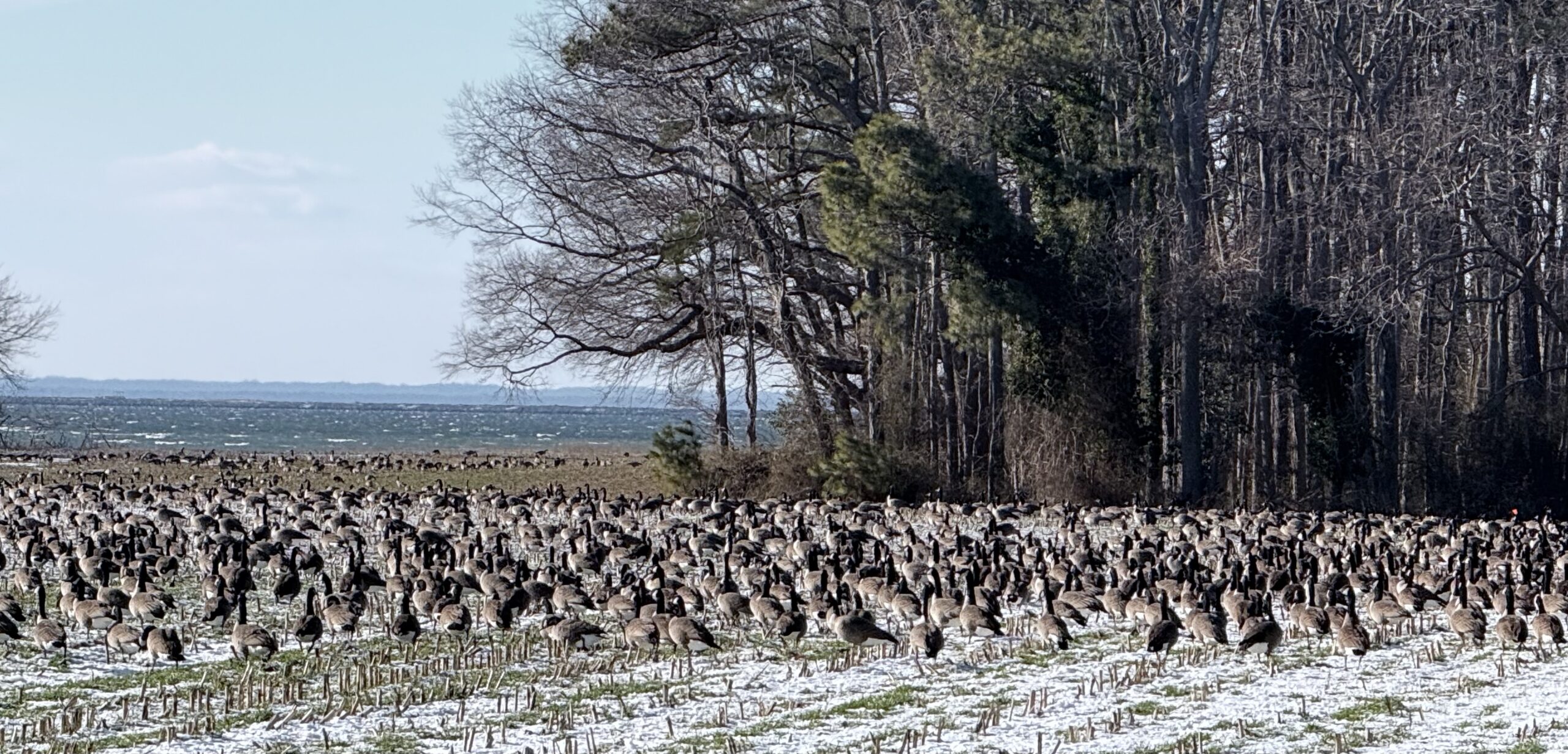
 Dense flocks of Canada geese, like these in a Chesapeake Bay-front field near Tilghman Island, have been typical on the Eastern Shore during this cold January.
A survey of the 2024 nesting season on Quebec’s Ungava Peninsula for our Atlantic Flyway Canada geese recorded one of the lowest reproduction rates on record. Given that, why are we seeing so many more Canadas in our fields and waterways this year than we’ve seen in previous years?
The answer is obvious, but before we get to its nuances let’s step back a ways.
I’ve been traveling the roads of the Delmarva Peninsula’s mid-shore area for 60 years or so. It’s usually a triangular area including Chestertown on the north, Lewes and Rehoboth Beach on the coastal east, and the St. Michaels/Tilghman Island area–locally called the Bay Hundred–on the western edge.
My old man used to drive us kids out to Remington Farms, near Rock Hall, to see great flocks of ducks and geese filling winter fields. Seeing them scratched some primordial itch in his soul. There were years of tremendous numbers. Other years, not so much. But the annual migration was always worth noticing.
On the coastal side of the triangle, winter typically brings far greater numbers of snow geese than Canadas.
The tradition he established has continued, but on the larger scale mentioned above. This year is remarkable. Field after field of thousands of geese. Happy hunters blasting away during a significantly limited season further confirm the large numbers.
The reason, says Josh Homyack of Maryland’s Department of Natural Resources, is all around us. He’s a waterfowl biologist and leader of the state’s wildlife and heritage section.
“We have a real winter this year,” he said this week. “Prolonged cold weather to the north is leading to lots of movement of geese and other birds. We have our usual migrant flocks in addition to flocks of other migrating birds coming down which in past years have stopped in the states north of us. Even resident geese in Pennsylvania and New York become migrants in this kind of weather and are heading our way to further swell local numbers.”
An interesting side note: Resident geese tend to be larger, he said, a subspecies brought by humans to this region in the early and mid 1900s when it was still legal to use live decoys. But back to the numbers.
“The midwinter count for Maryland is just finishing. It should show more geese than in the past several years. The geese getting stacked up here now represent several different migrant groups,” said Homyack.
It’s all a matter of food. For centuries, Delmarva Peninsula has provided optimal winter feeding grounds for migrating Canadas and snows. That behavior, and its annual repetition by adults and each year’s newborn birds, imprints deeply.
With that comes the equally imprinted culture associated with geese as an important and reliable winter food source for humans, dating back to Native American groups who made their homes here. Associated hunting, artwork, cooking and honking of geese and swans flying over night and day in the winter add to the culture and soundtrack of our lives.
They all contribute to the mystique of this region, known all the way back to 1600s’ English explorer John Smith, as a land of pleasant living.
But with so many geese here this winter, why does Maryland have a more limited goose hunting season than last year?
The answer, as mentioned above, lies on Quebec’s Ungava Peninsula, 1,500 miles north of Delmara. There, between the shores of Hudson Bay and Ungava Bay and Canada’s maritime provinces, geese making their long spring return flight will settle on ancestral nesting grounds to raise the next generation of our Atlantic Flyway Canada goose population.
“It’s subarctic,” said Homyack. “Tundra and rocks, a few widely spaced Innuit villages, not much else. The geese have to be nesting by late May or early June, and hatched by the end of June, if the new young will be strong enough to make that 1,500-mile return flight to the upper shore starting in September. Late springs like the last 10 to 12 years can really impact nesting success.
“Not wonderful,” is how Homyack characterizes the 2024 nesting season. “Scientists up there count breeding pairs of geese and overall populations during the nesting season. “Through early-August banding up there, when molting geese, who can’t fly, can also be checked for age and sex, we check the ratio of young to adult to assess how things went during the nesting season. The past year showed us one of the lowest years on record for reproduction.”
That’s why waterfowl managers at the state and federal levels remained conservative and cautious for this year’s hunting regulations.
Numbers show 88,890 breeding pairs counted in 2024 compared to 115,328 in 2023. The estimated population of Atlantic Flyway Canada geese, from those same surveys, showed 606,672 individual birds in 2024 compared to 611,590 in 2023. The total population count of 1,316,000 in the 2022 survey demonstrates the wide variations possible from one nesting season to the next.
The smallest total population estimates came in the earliest years of the Ungava Peninsula surveys. The 1995 survey found 33,995 breeding pairs; the 1993 total population count came in at an alarming 210,000 Canadas in the Atlantic flyway.
Based on those populations over the decades, hunting seasons and limits have also varied radically. There have been years when there were two- and more seasons with four-birds-a-day limits. That compares to this year’s 30-day season in Maryland with a two bird limit.
Homyack said Maryland’s midwinter counts tend to be unreliable in terms of the total flyway population and are heavily weather-dependent as to where birds will be concentrated.
For those reasons, it’s the breeding ground surveys that are used to guide hunting dates and limits, not the midwinter counts.
“But for now and from a hunting standpoint there are lots of geese around,” said Homyack. “That makes this a very goosey year for Delmarva.”
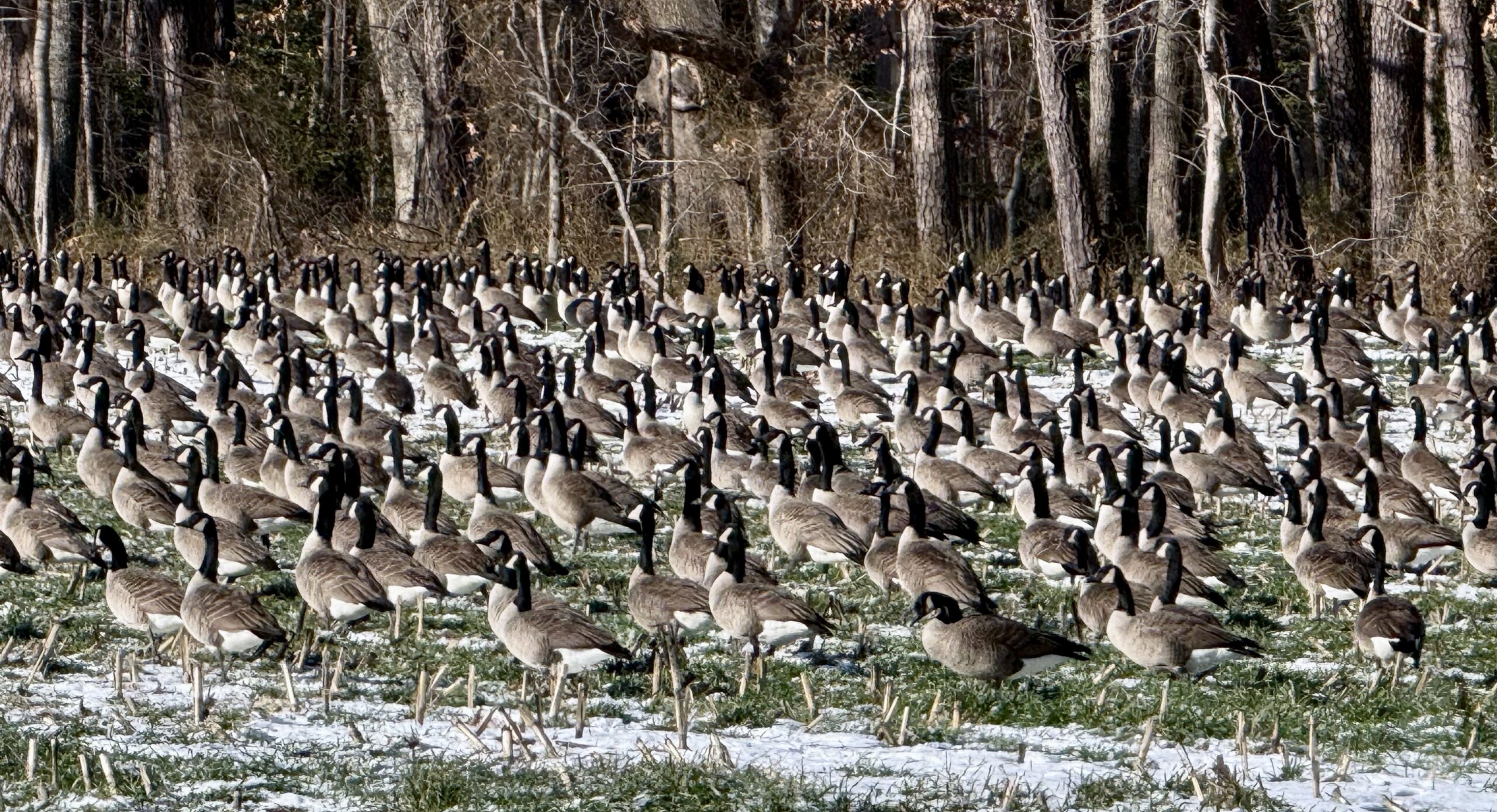 Several flocks of resident geese from surrounding northern states have also been swelling Delmarva’s winter population. Resident geese can become migrants during these weather conditions. They are thought to be a larger subspecies brought here by humans in the early to mid 1900s when using live decoys for hunting was still legal. DENNIS FORNEY PHOTOS


