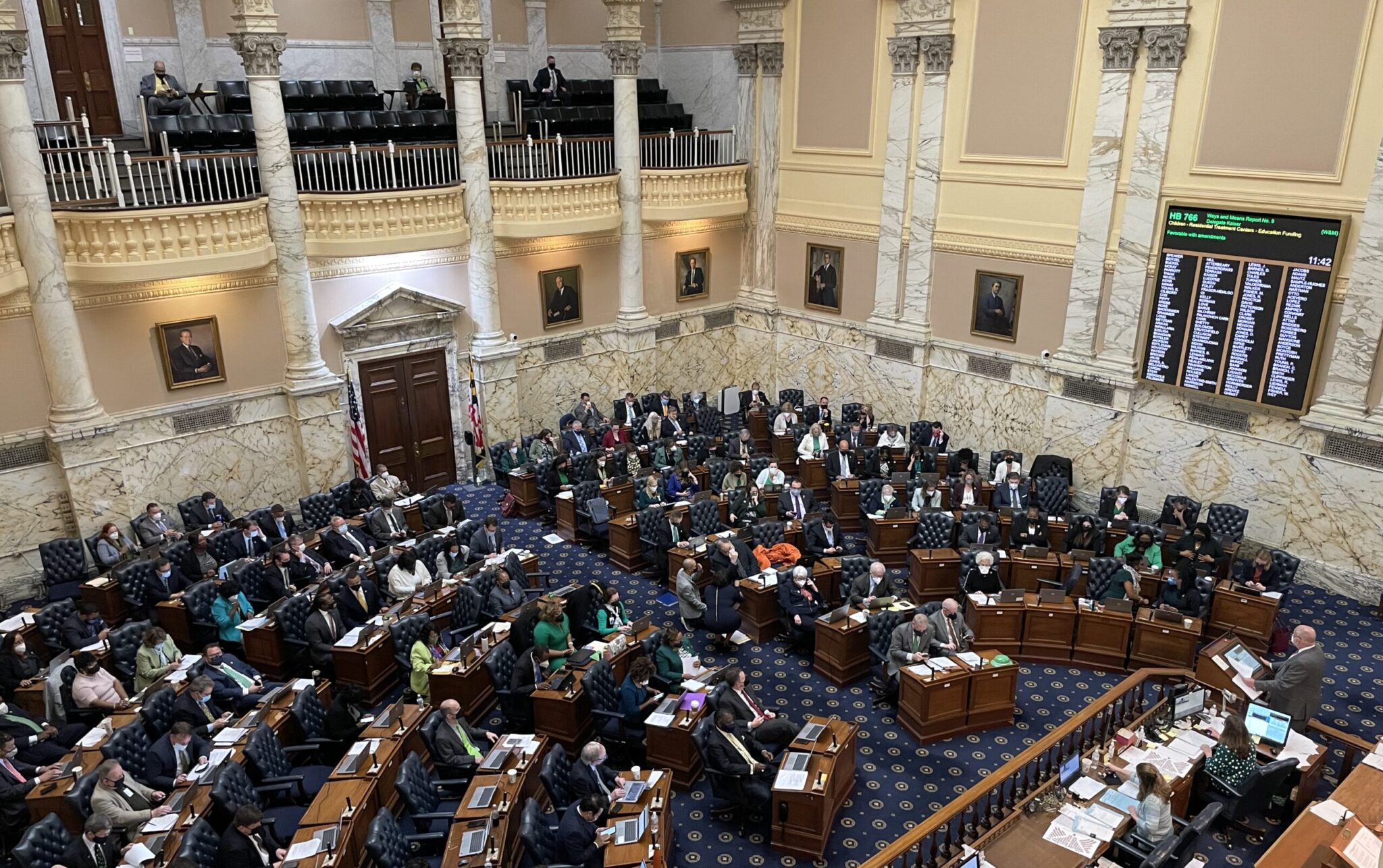


House leaders are fast-tracking legislation to redraw the state’s eight congressional districts, drawing sharp criticism from Republicans who stand to lose the only seat the party holds in Maryland in the process.
The House on Friday introduced House Bill 488, a 40-page bill redrawing the state’s congressional districts for 2026 and then asking voters to approve a constitutional amendment that would keep the new districts for the 2028 and 2030 elections.
The bill is scheduled to be heard Monday afternoon by the House Rules Committee and could be back before the full House by the middle of the week.
The introduction of the bill comes just three days after a five-member gubernatorial advisory committee voted 3-2 to recommend a congressional redistricting plan that would heavily redraw the Eastern Shore–based 1st District.
Republicans were quick to challenge the process and express concerns that the public was not being given enough time to participate. They also raised concerns about how Monday’s hearing would be affected by an impending snowstorm.
“It is disappointing, and frankly unfair, that the House will be shoving this legislation on an accelerated timeline that provides no real opportunity for public input,” said House Minority Leader Jason Buckel (R-Allegany). He added that the storm could make it impossible to get to Annapolis to testify or knock out power, making virtual participation impossible.
“Moving this bill through so quickly in the middle of a giant weather event is a clear message that the Democratic majority has no interest in what the people think,” Buckel said.
HB 488 is sponsored by Del. C.T. Wilson (D-Charles), who served on the governor’s redistricting advisory commission, and is based on a “concept map” approved by that panel.
House Rules and Executive Nominations Chair Anne Healey (D-Prince George’s) said the committee would meet virtually in light of the winter storm that led Gov. Wes Moore (D) to declare a state of emergency.
The conservative, seven-member House Freedom Caucus called the governor’s redistricting commission “a sham” in a statement Friday.
“No Kings? Gov. Wes Moore is ramming through an unconstitutional congressional map to eliminate all Republican representation in D.C.,” said Del. Kathy Szeliga (R-Baltimore County), the caucus’ vice chair. “This is a rigged process.”
It’s possible the bill could clear the House by midweek and reach the Senate by next Friday. But it faces a tougher path there, where opponents — including Senate President Bill Ferguson (D-Baltimore City) — have said it should not come up for a vote.
Ferguson, who also served on the governor’s redistricting panel, opposes mid-cycle redistricting, saying it could reopen litigation that resulted in the current map. He also warned the move could ultimately risk additional seats for Republicans.
Despite pressure from national Democrats who want Maryland to pursue a fully Democratic map, Ferguson has emphasized other priorities.
When asked to respond Friday, Ferguson said, “I appreciate their thoughts and advice,” but added that voters are more concerned about other issues.
“The world is uncertain, the world is crazy, and we have a limited amount of time and energy and focus, and we have to put it where it matters most,” Ferguson said.
“We’ve got to close a $1.4 billion budget shortfall. We’ve got to focus on affordability. We’ve got to find a way to grow our economy, and we’ve got to pass policies that truly and actually protect Marylanders against the Trump administration,” he said.
Ferguson appears to have the support of his caucus, which holds a supermajority in the Senate. He has said previously that the chamber does not take up bills lacking caucus support.
Ferguson and Cumberland Mayor Ray Morriss, a Republican, were the two advisory commission members who voted against advancing the redistricting plan.
The concept map approved by the commission makes changes to all eight congressional districts, but the most dramatic changes affect the 1st District, currently held by Republican Rep. Andy Harris.
The district now includes the entire Eastern Shore before extending into Cecil and Harford counties and part of eastern Baltimore County. Under the new proposal, the district would lose part of the upper Shore and instead cross the Chesapeake Bay into Anne Arundel County, then extend north and west into Howard County to include part of Columbia.
Those changes would significantly increase the number of Democratic voters in the district, making it more difficult for a conservative Republican like Harris to retain the seat.
The original concept map had legal issues. None of the eight districts met the constitutional requirement that districts have nearly equal population, with differences exceeding 1,000 people between the largest and smallest districts.
Wilson said the bill introduced Friday corrects that problem by adjusting boundaries to “zero out” population discrepancies and bring the map into compliance with court rulings. An official analysis of the bill was not immediately available.
Szeliga raised concerns about the timing of the Department of Legislative Services’ fiscal analysis.
“This is for the public record, because should this proceed, there certainly will be a lawsuit,” Szeliga said on the House floor. “We need to know when the fiscal note will be available so people can read the bill along with it.”
Szeliga was the plaintiff in a lawsuit challenging the 2022 map. An Anne Arundel County judge struck down that map, leading to a quickly negotiated compromise that is currently in effect.
House Speaker Joseline Peña-Melnyk (D-Prince George’s and Anne Arundel) said the analysis would be available before the hearing.
By Bryan P. Sears
Write a Letter to the Editor on this Article
We encourage readers to offer their point of view on this article by submitting the following form. Editing is sometimes necessary and is done at the discretion of the editorial staff.