

From about age seven, I began my lifelong love affair with what I affectionately call my “grandma hobbies.” In our family, handwork wasn’t a quaint pastime, it was the quiet pulse of our daily life, the language spoken by the women who raised me. I come from a lineage of artists, and musicians, women whose hands seemed to know instinctively how to coax beauty out of the ordinary. I was channeling Laura Ingalls Wilder in Little House on the Prairie and the March sisters in Little Women, two of my favorite books.
My grandmother, Ruthie, stood at the head of that line. She was an accomplished seamstress, taught by Catholic nuns in Louisiana. She didn’t need patterns as much as she needed a moment of stillness to imagine what fabric could become. In my parents’ first house, every curtain, fully lined, perfectly pleated, heavy enough to fall just right, was made by her hands. For my sister and me, she created dresses with matching coats, and then, because she believed dolls should never feel left out, duplicate outfits in miniature. One of my last visits with Ruthie was spent shopping for the perfect linen for slipcovers for my living room chairs. Ruthie wore a a brightly colored Pucci dress, apropos for a San Diego afternoon, her days of sewing her own clothes were long past.
My mother inherited Ruthie’s skill but made it more playful. She sewed many of my school clothes; corduroy jumpers with appliqués, pinafores trimmed in rickrack, dresses with smocking and pockets big enough to hide treasures. She stitched doll outfits, holiday centerpieces, embroidered hostess skirts, and decorations for every season. Our sewing room often looked like a stage set preparing for its next scene, drawers and cupboards filled with bolts of fabric, pins, yarn, and half-finished crafts spread out across the sewing table. It never felt messy to me, just full of possibility. On a whim, I could spend a few minutes sewing a comforter or dress for a doll in my dollhouse.
One of my favorite rituals was our Saturday trip to the local yarn and craft shop. Stepping inside felt like crossing a threshold into a world where ordinary materials shimmered with promise. The chairs in the corner filled with women happily chatting while knitting, shelves with skeins of colorful yarn, and racks with seasonal projects in plastic bags, still lingers in my memory. Walls of embroidery floss gleamed like rainbows; shelves overflowed with felt, ribbon, and beads. My mother and I would walk the aisles slowly, choosing kits and materials for the projects that would carry us through autumn and into Christmas. Every purchase felt like tucking away a little packet of joy for later.
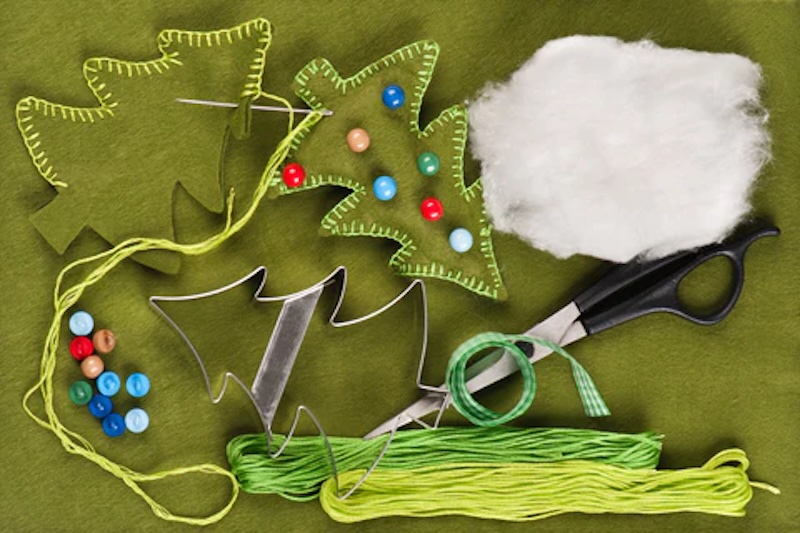
Christmas time was our season of true magic. That was when she taught me how to sew sequins and beads onto felt ornaments. The process required patience, knotting the thread just right, sliding on each bead, anchoring it with tiny stitches, repeating the pattern until the piece sparkled like something alive. I loved the feel of it: the softness of the felt, the cold smooth beads, the rhythm of the needle dipping in and out. Sitting beside my mother at the table or in the den in front of the tv, both of us bathed in the golden glow of a nearby lamp, we finished a Twelve Days of Christmas tree skirt. My memories of those evenings still feel cozy and sacred. It wasn’t just crafting, it was communion.
I still have most of those ornaments. Some have lost a bead or two, and a few show the uneven stitches of a child who was more eager than skilled. But when I open the ornament boxes each December, I feel a sharp, sweet tug of recognition. These little creations are time capsules; holding the warmth of the kitchen, the murmur of my mother’s voice, the patient guidance of hands that shaped mine. Hanging them on my Christmas tree today is like stitching the past onto the present.
As I grew older, those “grandma hobbies” became a refuge; something steady and warm that existed outside the noise of adolescent uncertainty. I learned embroidery stitches, cross-stitch patterns, and the thrill of choosing fabric for my own small projects. During my freshman year in college, I turned to crocheting, finding comfort in the rhythm of repetition. Afghans were given to family and friends in their favorite color. Handwork grounded me, gave my hands something meaningful to do, something that tethered me to generations of women I loved. One Christmas, while still in college, I spent weeks sewing a colorful wreath of 3D felt fruit for my Mom, she hung that wreath on her front door every year until she died. I remember the absolute joy on her face when I gave her that wreath, it still fills me with happiness and pride. My mother coined our handwork: “loving hands,” which to us was a double entendre, lovingly made but maybe just a tiny bit rustic, imperfect.
Later, as a teacher, I watched small children’s faces soften as they touched yarn or traced stitching with curious little fingers. I realized then that I wasn’t just recreating a hobby, I was reweaving a tradition. When I threaded a needle for a student or showed them how to tie a simple knot, I could feel my grandmother’s steady patience and my mother’s gentle encouragement moving through me, as if their hands were resting lightly on mine.
Handwork has always been more than the things I’ve made. It is how I have marked seasons, soothed worries, expressed love, and stayed connected to the women who shaped me. My husband and family are the recipients of my knitting, mostly hats and mittens now. Every stitch is a memory. Every piece, a story. And even now, when I sit down with a new project, there is a familiar quiet that settles around me, a sense of returning home, a meditation.
The older I get, the more I understand that the true beauty of those early lessons had nothing to do with mastering a craft. It was a legacy. It was about learning patience, presence, and tenderness. It was about realizing that handmade things, imperfect though they may be, carry a warmth that store-bought items never can. And it was about discovering, even at seven years old, that some of the most meaningful parts of life are created slowly, stitch by stitch, alongside the people we love.
Kate Emery General is a retired chef/restaurant owner who was born and raised in Casper, Wyoming. Kate loves her grandchildren, knitting, and watercolor painting. Kate and her husband, Matt are longtime residents of Cambridge’s West End where they enjoy swimming and bicycling.
Write a Letter to the Editor on this Article
We encourage readers to offer their point of view on this article by submitting the following form. Editing is sometimes necessary and is done at the discretion of the editorial staff.