
MENU

Sections

  • Home
  • Education
  • Donate to the Centreville Spy
  • Free Subscription
  • Spy Community Media
    • Chestertown Spy
    • Talbot Spy
    • Cambridge Spy

More

  • Support the Spy
  • About Spy Community Media
  • Advertising with the Spy
  • Subscribe
February 28, 2026

Centreville Spy

Nonpartisan and Education-based News for Centreville

  • Home
  • Education
  • Donate to the Centreville Spy
  • Free Subscription
  • Spy Community Media
    • Chestertown Spy
    • Talbot Spy
    • Cambridge Spy
00 Post to Chestertown Spy 1 Homepage Slider Point of View Laura

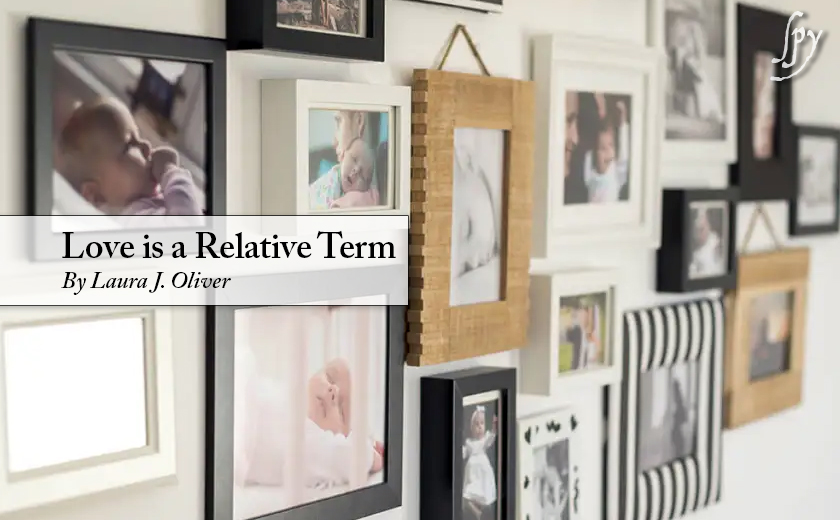
Love is a Relative Term By Laura J. Oliver

November 23, 2025 by Laura J. Oliver Leave a Comment

As you read this, Grandme is a memory, relationships have come and gone, children have left home. 

As you read this, only the feeling that existed in this time and place lives on, but it is proof that what people most remember about us is not what we did or said, but how we made them feel.  

Walnut leaves fall like golden rain this long-ago autumn as we make the 7 ½ hour drive to the southern mill town of Asheboro, North Carolina, to visit the children’s great-grandmother. We go to escape our daily schedules, to be spoiled with attention and shown off to neighbors, for in this world we are still children, though we have children of our own. We have been coming since we were in college, before we had made a family. Now, we make this trip on borrowed time. Grandme will be 88 in the spring. 

When we turn down the long, hilly road leading to Grandme’s brick house, it beckons from the top of the rise like a lantern in the twilight. Autumn is as gentle here as the retired millworkers and Sunday School teachers who reside in this tight-knit community. Even in the balmy November dusk, we can see blue morning glories, tightly closed, clinging to the lamppost as we pull the car into the drive and emerge stiff with travel. Pale yellow roses placed about the house in honor of our arrival greet us in the parlor. A single perfect bud bows from a slender vase on the linoleum kitchen table, where we gather to recount tales of the trip south while the children scamper about in search of “Boy.”

Boy is Grandme’s 17-year-old, black-as-carbon, cat. His formal name is Booger-Boy… a fact we conceal from the children because they would love it too much. No one knows why Boy is peculiar, but his intense paranoia is generally accepted as the infirmity of any aging relative. He jumps at the slightest sound, won’t be held, and spends an inordinate amount of time hiding in the basement, coming and going unobtrusively by a cat door.

A squeal, a thud, and running feet tell us there has been a sighting, and we relax, knowing the children will be occupied for a while.

Grandme stands at the kitchen counter pulling out Tupperware containers full of homemade baked goods of every kind. She stands very erect, and her grey hair is swept upward, adding several inches to her stature. Behind her, the paned window has been polished crystal clear, and on the pristine, white-painted sill, African violets bloom in pink profusion.

Grandme is the first to begin the ritual storytelling as we sample coconut cake, then a cherry pie. The entire town knows when Grandme’s “kids” are coming, and in southern tradition, they all pitch in to help with the food. Grandme lets us assume she has made all these delicacies, and we don’t ask for recipes. 

The week before our arrival, she begins, she came home from shopping, fed Boy, and began to sense another presence in the house. She called her next-door neighbor Lucy.

“Lucy?” she whispered. “Hey, honey, it’s me. Listen, I think there’s somebody in my house.”

The two women, neighbors for 60 years, who routinely scare each other with arrest accounts from the Courier-Tribune, armed themselves with kitchen utensils and began their search. 

Boy, slinking around with them, appeared under beds, in closets, and on clothes chests, his green eyes wild and gleaming when confronted by the flashlight. 

At last, the intruder was identified. An opossum, sound asleep under an upstairs sofa, had found the cat door convenient access to a good night’s rest. Boy, eyes bulging at the discovery, dissolved into the night like spilled ink. 

We laugh at the story and refill our coffee cups; thick, rounded porcelain mugs you’d find in a small-town diner. 

The children, exhausted, climb the stairs to bed and we adults settle down to gossip late into the night about all the aunts, sisters, brothers, and cousins not present. We can do this, of course, because we are family, and it is assumed we love each other unconditionally, if imperfectly. So, we gasp over Marcia’s affair, shake our heads woefully at Uncle Joe’s beer consumption, and discuss with genuine interest distant relations we will never meet. 

Although these are not my blood relatives, they are my children’s, and by association, I can gasp and gossip with the rest of them. After all, we are a clan, kinfolk, a tribe. With that thought, I glance around at the photographs on the TV, the scrawled cards from the great-grandchildren on the refrigerator, and know that we each make this trip for a different reason, take home a different experience.

The children are compiling memories of a great-grandmother they will not always have. Their father is fondly reliving summer memories of his youth, and I am being healed. 

My own family had little of this comfortable unity. My mother retained custody of my two older sisters and me, but we were no longer a family of five. We were Virginia and the girls. Divorce took more than a parent; it took our familyness, 

When love has gone haywire in the past, it becomes even more important to create families of our own–a place where we can satisfy our innate need to belong to someone. That acceptance, wherever we can find it, is the healing and magnification of the human heart. It is through this experience in my own life that I have come to recognize a larger and larger group as family. 

Even now, when a writer whose manuscript I’m working on complains about the state of publishing today, I nod with split attention, remembering that tonight, my family is going to enjoy homemade vegetable soup with crusty herb bread and Irish butter by the fire. Joy that is pure and simple gratitude wells up and spills over. I am spirit-rich. I am generous. I feel a connection to people I have not met, and I know it is real, though it is beyond my understanding. My family becomes the family of man, including this writer and his anxieties. 

It is late when we rise to wash our coffee cups at the porcelain sink. The darkness outside has turned the kitchen window into a mirror, and our reflections break and mingle in the small panes.

We call the cat inside softly and prepare for bed. By midnight, the house is finally silent, and we whisper our goodnights to Grandme from the quilted four-poster bed in the guestroom. 

But I am not a guest. Nor are you. We are simply family that has yet to meet.

Happy Thanksgiving, beloveds. Happy Thanksgiving. 


Laura J. Oliver is an award-winning developmental book editor and writing coach, who has taught writing at the University of Maryland and St. John’s College. She is the author of The Story Within (Penguin Random House). Co-creator of The Writing Intensive at St. John’s College, she is the recipient of a Maryland State Arts Council Individual Artist Award in Fiction, an Anne Arundel County Arts Council Literary Arts Award winner, a two-time Glimmer Train Short Fiction finalist, and her work has been nominated for a Pushcart Prize. Her website can be found here.

The Spy Newspapers may periodically employ the assistance of artificial intelligence (AI) to enhance the clarity and accuracy of our content.

Filed Under: 00 Post to Chestertown Spy, 1 Homepage Slider, Laura

The Hard Problem of Consciousness By Laura J. Oliver

November 16, 2025 by Laura J. Oliver Leave a Comment

I’m walking across my college campus, mahogany leaves crunching beneath my feet, just as they did the year I arrived as an Eventual-English major.  

I climb the steep steps of William Smith Hall to sit in the same classroom where I studied American Lit in order to learn about “The Hard Problem of Consciousness” from Jeff, a fellow alumnus. Spoiler Alert: no one knows how to distinguish mind from brain or how life first became self-aware. No one knows how it was that millions and millions of years ago, some microbial cell in the primordial soup woke up and announced, “Eureka! 

“I see me!”

What if, I wonder as I glance out the centuries-old, massive windows of my classroom, one of us, one day, makes a similar leap in consciousness and announces, “Eureka! I’m love made manifest.” Because of course, we are.

I see you. 

Chairs scrape on hardwood floors as I wave goodbye to Jeff but rising to leave, I see the freshman co-ed I was rushing down the worn varnished steps of Smith Hall to my work-study job on High Street. 

I had been hired as a companion to an elderly widow named Mrs. Molloy. She employed a housekeeper but wanted a nice young girl from the college to accompany her on afternoon walks along the tree-lined streets of Chestertown. That nice young girl was me. 

She might have done better. 

Mrs. Molloy wore her silver hair up in a twist, and her home was only a block from the shallow banks of the sparkling Chester River. I thought of her as wealthy because she had traveled all over the world, though I had no means of comparison. She dictated letters for me to write, and then we bundled up and negotiated her steep front steps for our daily walk, she leaning heavily on my arm, and me trying to support the weight of fragile cargo three times my age but about my size. As we inched past art galleries and bakeries, I realized pretty quickly that my actual role was that of a storyteller.

So, I told her about the boy from Chapel Hill I had fallen in love with while working on Cape Cod for the summer, and about a Midshipman from the Naval Academy I’d gone out with a few times, before heading to the Cape. I told her about the letters my very Southern boyfriend wrote from his frat house at UNC, and how I was looking forward to him coming up to Maryland for Thanksgiving.

Weirdly, Mrs. Molloy followed each Chapel Hill update with a complete non sequitur: “And what about that Midshipman?” Maybe she was wise enough to know my long-distance relationship was going to be a challenge, but her strange loyalty, her advocacy for this other boy I barely knew, made me wonder if she was a fan of the Armed Forces or knew something I didn’t know. So, on the day I shared that without warning, Chapel Hill had broken my heart, her response was predictable and practical: “And what about that Midshipman?”

 For the first time, I took her advice and invited the Midshipman to Thanksgiving instead of the Confederate, and the rest of that story is three children. 

One spring afternoon, Mrs. Molloy and I were in her study—rust-and-blue oriental carpet, hardcover books to the ceiling, organdy curtains softly obscuring a bay window—she sitting on the overstuffed sofa, me in her desk chair–and she lit up a cigarette. She usually smoked in the garden, but on this day, as I watched, she tried to light the wrong end, then ignited it somewhere in the middle, stuck it between her lips, and continued our conversation with the smoldering cigarette bobbing about. This was odd, but I didn’t say anything. I didn’t know how. It was her house, she was my employer, and above all, I didn’t want to embarrass her. 

But as I watched, she started listing to the side, slowly, like she was kind of melting. Like she was a tree, felled by the last blow of the ax. Yet she kept talking and smoking as if everything was normal. 

As a child, I had learned to normalize everything—if there was an elephant in the room, I’d explain how that might not be so odd: circus in town, exotic pet on the loose! So, as she listed, I leaned, and just kept talking, covering for her, until, still acting as if everything was routine, she lay completely horizontal on the couch.

The word ‘stroke’ never crossed my mind. It was simply beyond my range of experience, and she seemed fine in every other way. I must have gotten the housekeeper for help, though I don’t remember. I may have just propped her back up like a Webble. 

I usually worked on Thursday afternoons, but that Monday in Seventeenth Century Literature, Professor James, who also lived in town, pulled me aside to tell me Mrs. Molloy was dead. I didn’t cry. I normalized the news. 

I think I had a Cinderella fantasy: that this woman with no children had cared for me, and that, knowing I was only in college by the grace of multiple scholarships, she might possibly leave me some financial help to further my education. That’s what I mean by she could have done better than a girl whose affection was corrupted by hope. She did leave the college $10,000.

She left me a begonia. 

Why am I telling you this, and why am I telling you now? Because I’m back on campus in the same room where I was so naive, I didn’t know how to say, Wait, what??? And I’m learning about consciousness even as I have to acknowledge that I have gone through my life pretty unconscious. Blundering along. And for that, I just can’t stop being sorry. 

Sorry.

I set my begonia on the sunny window ledge of my room in Minta Martin Hall and loved it in Mrs. Molloy’s honor for several years. And I’m still trying to separate out whether I can be sorry enough for the mistakes that I’ve made to absolve them, or whether that’s what the fuss is all about. 

Absolution is not required.

You did the best you could. “A” for effort, beloved classmates. And maybe the best that you could do was always the goal on your cosmic syllabus. You didn’t fail; you fulfilled.  

I read this prayer years ago, and perhaps it’s how consciousness came into the world –that moment when life became aware of itself for the first time, a blank slate of pure potential. 

Maybe that first cell woke up and said: “I’m alive!” And then with all the hope of you and me in its nascent awareness added–

“God, help me accept the truth about myself.

 “No matter how beautiful it is.” 


Laura J. Oliver is an award-winning developmental book editor and writing coach, who has taught writing at the University of Maryland and St. John’s College. She is the author of The Story Within (Penguin Random House). Co-creator of The Writing Intensive at St. John’s College, she is the recipient of a Maryland State Arts Council Individual Artist Award in Fiction, an Anne Arundel County Arts Council Literary Arts Award winner, a two-time Glimmer Train Short Fiction finalist, and her work has been nominated for a Pushcart Prize. Her website can be found here.

The Spy Newspapers may periodically employ the assistance of artificial intelligence (AI) to enhance the clarity and accuracy of our content.

Filed Under: 00 Post to Chestertown Spy, 1 Homepage Slider, Laura

Attachment Theory By Laura J. Oliver

November 9, 2025 by Laura J. Oliver Leave a Comment

It was supposed to last a hundred years. The trust set up to protect Eagle Hill was to keep the woodland along the Magothy River safe from developers, but the last of the family who owned the property has died. Its future is unknown. 

The developers who would subdivide this legacy have very different aspirations from those my midwestern parents brought to Maryland more than half a century ago. All they wanted was an old house along a river in which to raise their three daughters. What they could afford was Barnstead, an abandoned stable overlooking the river, which they began remodeling into our family home the year I turned three. 

Time was told by season at Barnstead. In winter, migrating swans crowded the icy cove with their snowy grace, stark December’s only vain accessory. In summer, thunderstorms billowed across the open water like undulating curtains. Each raindrop, if you watched from the pier, displaced a small crown of water as it met the river, but there was no royalty here. Education had allowed my parents to exceed the usual limitations of their rural childhoods, but my father was still a carpenter’s son, and my mother, a farmer’s daughter.  

Together they built a home where my mother would write books and my father would boat, but the sparkling surface of the Magothy obscured unanticipated depths, and the sandy bottom could disappear without warning beneath small bare feet. My sisters and I would learn that sometimes we are parented by a place as much as by those responsible for us, and that dreams, though a less obvious inheritance than the color of our eyes, are also part of our parents’ legacy; both yours, I suspect, and mine.

On my last trip back to Eagle Hill, a 30-minute drive from the town where I live now, I think it is ironic that my kids, who grew up in a world of private schools and yacht clubs, would approach with caution the people who inhabited Eagle Hill.

Mr. Prince and his numerous preschool children rented an old house near the Barn. We seldom saw the Princes, but every so often, Mr. Prince would arrive on our doorstep for a visit. Smoking a pipe, he’d sit on the early American loveseat Mom had slipcovered, while several small muslin bags, tied through his belt loops, twitched and roiled.  

Mother served iced tea, and I kept a vigilant eye on those bags, knowing each contained one, if not several, snakes. I thought Mr. Prince was unbearably weird, but my father, if he were alive today, would laugh and assure me he was harmless. Dad was naturally generous and slow to pass judgment. I can’t imagine what they talked about, the snake collector and the hospital administrator, but a kind of midwestern hospitality was at work: no one is turned away from the door, even a man wearing snakes. 

A gregarious ladies’ man, my father had a story for every occasion, but I had learned not to always trust his claims. I doubt, for instance, that the pirate Blackbeard once slipped up the Chesapeake as far as the Magothy, but Dad said angry settlers had ambushed the pirate where he had moored in Black Hole Creek. During the most intense part of the battle, Blackbeard and his first mate managed to row ashore with a treasure chest. They walked for 15 minutes, then buried it, returned to the ship, and set sail. So somewhere near Barnstead lay a pirate’s chest of gold, Dad said. But in which direction did they walk? And how fast can two grown men walk carrying a heavy burden between them? As my father began taking longer and longer overnight business trips, I spent an increasing amount of time searching for treasure I thought would save us.

In my father’s absence and my mother’s increasing distraction, I found comfort in practicing self-sufficiency. I rearranged the furniture in my bedroom to resemble a living room. A small table in the center displayed a candy dish for visitors. I liked the idea that I could live on the apples in the orchard, walnuts and mulberries, even the bitter persimmons, and wild plums. I could crab and fish. Barnstead allowed me to believe I could take care of myself. It would never be necessary, of course, but there was a sense of security in the exercise. 

For all the tension around me as my parents’ distance grew, I never feared I’d be abandoned, as children often do. Instead, I worried that we would somehow lose Barnstead. I’d overhear my parents talking about developers and zoning laws, and I feared the woods would be lost to tract housing. I even began to worry that a tidal wave could appear at the mouth of the Magothy to sweep away my world. 

I prepared for a natural disaster because I didn’t know there were other kinds. My anxiety was well-founded. I had simply attached it to the wrong loss. 

As my parents’ dream of a river house full of children neared completion, so did their marriage. After a decade of sheltering my family, an ad was run, and Banstead was sold to the first person who walked in the door. 

My affection for Barnstead remains the intense attachment of a child, though I am a woman now. It was the only home in which I had two parents–a family. As I pass the entrance to our lane this afternoon, the house has been swallowed from view by the trees, but I heard it was torn down decades ago, replaced by a McMansion I do not want to see. 

I am a trespasser here. 

Whatever there was of value, I have taken with me–an appreciation for beauty, for labors of the heart, an unwillingness to pass judgment on their outcome. Now I am the mother who raised three children in the company of a river. Now, I write the books. 

Where do you carry the past? That’s not rhetorical, I’m really asking. What part of you is you because of where you’ve been?

My youngest, who lives in DC, is coming home for the weekend. I remember the night, years ago, when I went upstairs to check on her after the babysitter left. She was sound asleep in the twin Jenny Lind bed that had been mine as a child, the book she’d been reading, fallen to the floor. Kneeling to retrieve it, I lifted the white eyelet dust ruffle and noticed that the slats supporting the mattress were unusually narrow. 

Raising the fabric further, I realized for the first time that the slats were the rough, white battens that vertically sided the Barn when we found it, eventually replaced by cedar shingles, but saved and put to good use. 

Dropping the dust ruffle, I rose and walked out, leaving the legacy of Barnstead beneath new and tender dreams.


Laura J. Oliver is an award-winning developmental book editor and writing coach, who has taught writing at the University of Maryland and St. John’s College. She is the author of The Story Within (Penguin Random House). Co-creator of The Writing Intensive at St. John’s College, she is the recipient of a Maryland State Arts Council Individual Artist Award in Fiction, an Anne Arundel County Arts Council Literary Arts Award winner, a two-time Glimmer Train Short Fiction finalist, and her work has been nominated for a Pushcart Prize. Her website can be found here.

The Spy Newspapers may periodically employ the assistance of artificial intelligence (AI) to enhance the clarity and accuracy of our content.

Filed Under: 00 Post to Chestertown Spy, 1 Homepage Slider, Laura

Here’s to You By Laura J. Oliver

November 2, 2025 by Laura J. Oliver Leave a Comment

I was in my doctor’s office the other day thinking about some lies I was told as a kid…

  1. This is going to hurt me more than it’s going to hurt you.
  2. No one is going to laugh.
  3. You probably won’t need a shot.

I was going to receive a couple of injections, pleased that one of the advantages of being a grownup is that what used to be truly terrifying is no longer scary, like going to the dentist (drills) and going to the doctor (shots). 

 (Of course, the number one fear most people suffer, I still suffer as well: A fear greater than death, which is #4, or mutilation, which is #3, or divorce, #2. The most common fear greater than death? Public speaking.)

I did wonder, however, if it’s not that I’ve matured but that shots have gotten better, because I’m pretty sure when I was a kid, the needle was the size of a turkey baster, and the injection was not in my arm…  

So, I was taken back to a cubicle before I could even be seated in the waiting room, which is a bait-and-switch kind of move. You think you’re being seen right on time, but you’re really being removed from the interesting but jeopardizing melee of feverish coughers to cool your heels alone in an exam room. 

I got up on the table with the crinkly paper and eyed the same pictures on the wall that I’ve seen on previous visits—the blue-footed booby, the tortoise, and the gull…the chart on the back of the door where I could compute my body mass index. Time clicked on.  

I got out my phone and started emailing, having looked through all the drawers last time. Half an hour went by. I’m pretty punctual, so I admit I was getting a bit annoyed, but my doctor is retiring, and I didn’t want to be mad at her the last time we were going to see each other in this life. This was challenging, however, because I had seen her sitting in the room next door, eating a Caesar salad and yukking it up with a coworker when I was led to my cubicle, and I could still hear her socializing through the wall. Sometimes when this happens, I get up and open the door, so they can see me still sitting in there, a perky, punctual cuckoo in a clock. 

After a while, an apologetic nurse came in and said, “Let’s just go ahead and give you your flu shot and your COVID booster.”

“Sure,” I said, rolling up my sleeves with grown-up bravado. Have at it, sister! She pointedly closed the door upon leaving. 

When the door finally reopened, my doctor looked at me a little guiltily, but I did not complain. I am exceptional at not crying over spilled milk. I smiled hello, she sat down, and we chatted about our lives, though in reality, I barely know her.

She was installing a new birdfeeder, and I told her I used to wake to a cacophony of birdsong, but dawn comes silently now. Curious as to why, I looked it up. Turns out it was not my imagination. There is a virus sweeping through Maryland bird populations, and the State has asked that we stop using feeders (birds are polite but don’t need them). I noted I also haven’t seen the annual migration of yellow finches this fall, and that’s when we started talking about what will happen to us when we die. 

Sorry. She started it. 

I don’t have any health issues, so I don’t know why she suddenly said, “I think, when your time is up, it’s up.”

 (Oh my gosh…maybe she was talking about retirement!)

“Why do you think that?” I asked, intrigued and assuming otherwise. 

“I started thinking that when the Twin Towers fell,” she explained. “Too many people were on those planes who should not have been— unexpected changes to plans– and too many people were not on those flights who should have been—overslept, traffic jams.” 

I used to think that way as well for much the same reason, I told her. People survive the impossible and die from the improbable. But I don’t know anymore. I can make a case both ways. And as Stephan Hawking said, “I have noticed that even people who say they believe everything is predestined, look both ways before crossing the road.”  We laughed at that.

Suddenly she said, “I’m having a party. You should come.” And as we chatted, she wrote down an address and stuck the paper in my purse.

It’s at a church nearby, and although I won’t know a soul in attendance, I’m going. Alone, of course. It will be a little uncomfortable, and being alone makes it more so, but I’ve noticed that magic happens when you embrace the thing that most scares you. 

As long as it’s not a toast. That’s a fear worse than death. But I’ll think of you when I raise my glass and say, Cheers! I’m so glad I could come.

Because your best stories have not even begun. 


Laura J. Oliver is an award-winning developmental book editor and writing coach, who has taught writing at the University of Maryland and St. John’s College. She is the author of The Story Within (Penguin Random House). Co-creator of The Writing Intensive at St. John’s College, she is the recipient of a Maryland State Arts Council Individual Artist Award in Fiction, an Anne Arundel County Arts Council Literary Arts Award winner, a two-time Glimmer Train Short Fiction finalist, and her work has been nominated for a Pushcart Prize. Her website can be found here.

The Spy Newspapers may periodically employ the assistance of artificial intelligence (AI) to enhance the clarity and accuracy of our content.

Filed Under: 00 Post to Chestertown Spy, 1 Homepage Slider, Laura

No Easy Love By Laura J. Oliver

October 26, 2025 by Laura J. Oliver Leave a Comment

At my training session at JT’s gym, I swing open the glass door and call out, “Oh, thank God she’s here!” to make him laugh. He’s killing time waiting for me between clients, running on the treadmill to keep himself in shape. He laughs, pretends to check his mileage monitor as the treadmill slows. “Gee, only 17, eight-minute miles,” he sighs as he turns it off. I laugh at the lie, then I plop down in the chair next to his desk.

“What’s up?” he says, pulling out his chair as well and yawns while he waits for the latest installment of my past week’s activities. 

“You’ve been doing that a lot lately,” I say. 

He nods, yawns again. “I wake up every night at 3:30. But the good thing is, it doesn’t affect me at all.” 

“Yeah, I can see that,” I say. “Are you anxious about anything?” The dreaded cable pulls are behind me, waiting as I settle in. “We should talk about this.” 

“Nice try. Get up,” he says, ending the best of my delaying tactics. “Let’s see whatcha got.”

JT has learned the art of revealing nothing while having a conversation, which makes sense since he has to talk to someone new for an hour at least 8-10 times a day. At the computer all day, I am a boundary-challenged bean spiller. Do not confide in me—the brain hates to keep a secret—it’s spelled s-t-r-e-s-s. The alternative spelling is s-t-o-r-y, and we live for it.  

After demonstrating the way I am to lift some weights while simultaneously lunging, JT stands aside, and I take the stance, trying not to tip over. Yesterday, I spun around with my eyes closed in the shower and thought, Uh-oh, this could have gone badly. So, I tell him that maybe we should work on balance and not strength today. He is already on it, dragging over the heinous half-ball thing on which you must balance, much like trying to stand on one foot in a bouncy house while some kid jumps up and down right next to you.

JT and I feel the same way about virtually everything except politics, so we never talk about that, but our attitudes are often apparent in our responses to other things. 

“They’ve just discovered another rogue planet not connected to any solar system,” I report, excited about this discovery. He eyes me as if scientists are tricksters out to get us—their ulterior motive–to fool humanity about everything from planets to platelets. “How do they know that?” he asks.

“And tomorrow is the shortest day in history,” I add. “Thanks to the Earth spinning slightly faster, it’ll be 1.34 milliseconds less than the standard 24 hours.”

“How do they know?” he asks again. “Says who?”

This is often the response to facts I share, and it’s one that I can’t answer because I can’t reproduce the corresponding research proving this fact off the top of my head. I read it, but I just can’t retain it. I guess I only have the mental bandwidth to remember the fascinating end product of research, so that’s what I share. 

For instance, the Appalachians are far older and were once taller than the Rockies. I remember they are lower in altitude because they have eroded centuries longer, but I don’t remember how scientists know that. 

Being able to explain how seemingly impossible things could be true is something I’ve surrendered spiritually as well. I’ve experienced enough miracles not to need the “how.” Likewise, when I pray, I ask for what would be impossible for me to accomplish on my own, trusting that it is effortless for a power greater than myself. I see it as done– this healing, this reconciliation, this grace. Strategizing means I still think the universe needs my input. 

Hard pass, says the universe.

JT takes me off the half-ball and tells me to walk the length of the gym, heel-to-toe, lifting a 10-pound weight extended over my head. I do this easily, my confidence returning. “Want me to go faster?” I ask.

“No. I want you to close your eyes and do it backwards,” he says.

Our relationship is one of balance. We are so far apart politically we can only 

acknowledge that fact with a laugh or a joke once in a while. 

But I often ask what JT did on the weekend and it’s what I did, as well. And he has two daughters he adores, and I have two daughters I adore. And I listen to him put their welfare ahead of his own desires, week after week, and I know I’d walk backward and blindfolded across the Bay Bridge for mine, so there’s that. 

He loves a dog who is a real pain, and I love one of those, as well. He has a roof that needs replacing, and I have one, too.

I was recently told that my soul’s purpose in this life is to experience all forms of love—parental, romantic, for humanity at large. In this life, I needed to love as a sibling, a spouse, and a friend —surely, we all do. But that’s easy love. I don’t think it counts toward being a good person. Love like that makes you a regular person. It’s the least you can do.

I saw a greeting card the other day that said, “One of us is right, the other one is you.”

How do we find common ground when it feels as if our very morals conflict?

I don’t know. It’s like finding my way backward and blindfolded to those with whom I don’t agree. But I can place my attention on judgment and strategy, or I can ask that love magnifies all that we share.

Rumi wrote, “Out beyond our ideas of right-doing and wrongdoing, there is a field.

 “I’ll meet you there.” 


Laura J. Oliver is an award-winning developmental book editor and writing coach, who has taught writing at the University of Maryland and St. John’s College. She is the author of The Story Within (Penguin Random House). Co-creator of The Writing Intensive at St. John’s College, she is the recipient of a Maryland State Arts Council Individual Artist Award in Fiction, an Anne Arundel County Arts Council Literary Arts Award winner, a two-time Glimmer Train Short Fiction finalist, and her work has been nominated for a Pushcart Prize. Her website can be found here.

The Spy Newspapers may periodically employ the assistance of artificial intelligence (AI) to enhance the clarity and accuracy of our content.

Filed Under: 1 Homepage Slider, Laura

The Story of Us By Laura J. Oliver

October 19, 2025 by Laura J. Oliver Leave a Comment

Anthropologist Jane Goodall, whom I greatly admire, died recently.  Until Jane, we believed we were the only species on the planet to make and use tools. Of course, Jane was a single, blond, 26-year-old female when she proved otherwise through her patient observations of a wild chimp she had named David Greybeard, so her discovery was discounted by the established (read primarily male) scientific community for years. Eventually, we (they) had to admit, Holy cow, that little gal was right. We aren’t quite so unique after all. 

She also proved that we are not the only species to kiss and to beg. Interesting juxtaposition.  

We are falling from the pedestal of our self-proclaimed uniqueness. We had to learn that the Earth is not the center of the solar system, that the Milky Way is not the center of the universe. We may not be the only planet upon which life has arisen, and we are not the only species to reason, feel affection, and gratitude. Perhaps we are not even unique in this last bastion of distinction. After watching chimps discover a waterfall, then stop to gaze at it as if mesmerized, Goodall speculated we may not be the only species to feel awe. 

We are, however, the only species for which nearsightedness has become a global epidemic. In the U.S., there is a national surge of over 36%, and globally, 224 million people are highly nearsighted, meaning they can’t see things clearly that are far away.

Another word for nearsighted is shortsighted. Ahem.

We are in the middle of the 6th mass extinction event; did you know that? We are losing biodiversity at a rate 1,000 to 10,000 percent higher than would occur naturally if humans were not affecting the environment. Humanity itself may be dying out. There is currently an unprecedented decrease in birth rates worldwide, with fertility rates falling below replacement levels in most countries. Statisticians report that the effect of these trends will be felt on a global scale in about 60 years. 

There are cultural reasons for this trend, and many reasons we could still reverse. “How is it possible,” Jane Goodall asked, “that the most intellectual animal to have ever walked on planet Earth is destroying its home?” Talk about shortsighted.

In 1977, NASA launched twin Voyager probes into space, weeks apart, carrying identical golden records imprinted with a message from humankind to any intelligent life form in the cosmos who might find them. 

The records carry both audio and visual messages that represent Earth’s diversity of life and diversity of human life, with greetings in 59 human languages and 115 images. Sounds include footsteps and whale songs, laughter, and thunder, a rain forest teeming with life, and the heartbeat of a woman in love. Voyager 1, carrying that greeting, is now more than 15.6 billion miles from home, sailing in silence through the constellation Ophiuchus, still seeking someone to tell: we are here, we are here, we are here.

This is who we are.

Goodall’s last published work is “The Book of Hope: A Survival Guide for Trying Times,” but she warns that the window of opportunity in which to reverse our path is closing. How accurate will Voyager 1’s message be if it is ever found? What if 59 languages have become four, and back on Earth, no one recognizes the sound of a rainforest? Or the heartbeat of a human in love?

If we are losing our ability to see clearly what is approaching from a distance, we should at least see clearly what is right here: the precious, rare beauty of this Earth and the interconnectedness, the holy interdependence of all who inhabit it. 

Interestingly, for all our lack of uniqueness, there is one thing that it seems only we do: bury our dead. Not for fear the body might attract predators to the campfire, but with ritualistic reverence because those who died were loved and their loss mourned. This practice dates back at least 150,000 years, to the time of the Neanderthals. How do we know?

Because Neanderthals didn’t just bury their dead, they filled their graves with flowers. 

If the Golden Record is ever found and decoded, I hope the message it carries remains true. 

We are a blue planet orbiting a yellow star, 26,000 light-years from the center of a galaxy called the Milky Way. We teem with whale song and laughter, babies’ cries and thunder, and evidence that we have loved each other for a long, long time.  


Laura J. Oliver is an award-winning developmental book editor and writing coach, who has taught writing at the University of Maryland and St. John’s College. She is the author of The Story Within (Penguin Random House). Co-creator of The Writing Intensive at St. John’s College, she is the recipient of a Maryland State Arts Council Individual Artist Award in Fiction, an Anne Arundel County Arts Council Literary Arts Award winner, a two-time Glimmer Train Short Fiction finalist, and her work has been nominated for a Pushcart Prize. Her website can be found here.

The Spy Newspapers may periodically employ the assistance of artificial intelligence (AI) to enhance the clarity and accuracy of our content.

Filed Under: 1 Homepage Slider, Laura

Near-Miss Miracles By Laura J. Oliver

October 12, 2025 by Laura J. Oliver Leave a Comment

It is October, the month in which both my daughters were born. I guess back in March of the year in which each was conceived, I thought that to have an autumn birthday in Maryland would be to celebrate the rest of your life in the prettiest month of the year, and somehow that worked out not once, but twice.  

We lived in a neighborhood that had long been a working-class fishing community but as waterfront property became coveted by Washington professionals willing to commute, the peninsula was becoming slowly gentrified. At the time we brought our firstborn home, however, it still possessed an eclectic diversity we were drawn to as young adults, but worried about now that we were parents. There were sirens at night, and once, gunfire right down the street. 

We pulled up in front of our white stucco Victorian with the picket fence I’d painted in the last days of my pregnancy, and I lifted my two-day-old daughter from her car seat for the first time. This was to be a private homecoming, with my mother arriving after we got settled to make us her Hawaiian chicken for dinner. Unfortunately, I hadn’t anticipated Mrs. Rosman next door. She was old and eccentric, unkempt in an unpleasant way, and her silent, staring husband was very strange. I was young and superficially friendly but kept my distance.  

What I didn’t know was that she had been waiting for this moment since seeing me lowered gingerly into the passenger seat of the car and an overnight bag stowed in the back. She emerged from her house with the sagging sofa on the porch, and hobbled out onto the sidewalk, her thin hair lifting in the breeze. 

“Let me see the baby,” she demanded. She stared critically at the little face. “Well, what is it?”

“It’s a girl,” I said, leaving the blanket partially covering the baby’s mouth like a miniature surgeon’s mask. I smiled and tried to turn away, to get to the safety of my own front door, when Mrs. Hosfeld’s claw-like hand grabbed my arm and twisted the baby towards her. She lowered her face and planted a big, wet, germ-laden kiss right on my new baby’s face. Hormones surging, ready to cry at everything, and completely irrational, I was horrified. “Oh my God,” I thought, with all the sense of the sleep-deprived, “She just ruined my baby!” 

Once in the house, I needed to take a shower. Should I bring the baby into the bathroom with me? The idea of not being in the same room seemed intolerable, like breaking the law. I think I thought I had to carry her around in her carrier like a purse.

Over the next few weeks, I realized protecting my daughter was more immediate, more irrational, and more primal than love. The need to keep her safe, encountered for the first time there on the sidewalk, was the first fierce attachment I had felt as an adult. It was in the following days of feeding, rocking, diapering, and bathing that protection took on its true identity, which was, of course, profound and abiding love. I have thought about this often since then, having learned that love can be inspired by service, not the other way around. But there was another lesson here. 

Sometimes we are the recipients of miracles and too distracted or oblivious to notice. It is only years afterward that it dawns on us that, but for an alert stranger on the beach, we might have drowned, or two seconds later into that intersection, we might have crashed. 

So, it was years later that I realized I had not thanked God for the biggest miracle in my life. 

The night this child was born, I’d been in prodromal labor for the preceding 24 hours, where you suffer contractions hour after hour that do not move the baby down. Eventually hospitalized, with some intervention, labor finally became productive, but she was a very large baby and had been unceasingly active in the womb most of those nine months.

 By 3 am, I’d been pushing for two hours, and my doctor wanted to leave for a hunting trip on the Eastern Shore in the morning. The decision was made to use forceps for the last couple of pushes to get this show (and him) on the road. It worked. But until that moment, no one realized that the umbilical cord had been wrapped tightly around the baby’s neck throughout the entire ordeal. Not wrapped around once. Not twice. But cinched around her tiny neck three times like a belt, strangling her through all those crushing contractions and hours of pushing. 

“Jesus!” the nurse exclaimed as the doctor uncoiled loop after loop after loop. 

They put her in my arms, and all I saw was a perfect baby. It didn’t occur to me then or for years how easily we could have lost her. And it makes me want to heap retroactive gratitude upon the universe for sparing me that near-miss tragedy and for giving me that joy. 

How many miracles have gone unheralded? Having missed this one, I’m assuming on principle that my life and yours have been flooded with them.

 Like having been lucky enough to live next door to an elderly lady who had waited all night and all day to welcome home the new little life next door. Who gave the only thing she had to give: a kiss. 

And just like learning that service generates love, retroactive gratitude is now a continuous wave, a spiritual practice, especially in October, when I find myself saying thank you for the gifts I recognize, like you, beloveds, and for all those I will become aware of in the fullness of time. 


Laura J. Oliver is an award-winning developmental book editor and writing coach, who has taught writing at the University of Maryland and St. John’s College. She is the author of The Story Within (Penguin Random House). Co-creator of The Writing Intensive at St. John’s College, she is the recipient of a Maryland State Arts Council Individual Artist Award in Fiction, an Anne Arundel County Arts Council Literary Arts Award winner, a two-time Glimmer Train Short Fiction finalist, and her work has been nominated for a Pushcart Prize. Her website can be found here.

The Spy Newspapers may periodically employ the assistance of artificial intelligence (AI) to enhance the clarity and accuracy of our content.

Filed Under: 1 Homepage Slider, Laura

Can I Help You Find Something? By Laura J. Oliver

October 5, 2025 by Laura J. Oliver Leave a Comment

I spent the weekend with my two older sisters and their husbands in what has become a regular sister-gathering now that our parents are dead. 

 As usual, there were some retellings of family tales, some stories that were revelations, and some that were three variations on a theme. There was no right or wrong to them; they were just each of us sharing our differing perspectives—like who was Mom’s favorite, what we inherited from Dad, and how things might have turned out differently. That kind of thing. 

And for the record, I’ll say it again, I was not Mom’s favorite. That distinction varied, the recipient being, in Mom’s words, “Whomever needs me the most.” 

A role to which no one aspired. 

This powwow was in the hills of Western Maryland, where my firstborn sister’s place overlooks a valley of golden fields bisected by a picturesque railroad track. In the morning, fall mist draped the tree line, giving the illusion of mountains and memories far bigger than the hills.

Because looking back often includes a confession of sorts, I shared this one because it involved a talent for which I have always been a bit vain, and which may demonstrate a learned response to those who need me as well. I am, after all, my mother’s (third) daughter.

Don’t judge too harshly. About the only things I was good at were kickball, running, and making eye contact with my teachers. Kickball and running have not turned out to be particularly valuable life skills, but eye contact is probably why I have three kids and own my own home today. 

We were lingering at the dinner table over my brother-in-law’s peach upside-down cake. “I was at the post office,” I said, “and the line was about 12 patrons deep waiting to get up to one of the three service windows. There was an 8-foot-long, narrow table, about 12 inches wide and chest-high, down the center of the room, where we could queue up to await our turn, simultaneously writing last-minute addresses on envelopes without losing our place in line. I set my purse down and started addressing a package while several other customers did the same.”

 As each person finished their business at the windows, our line slid along the table, I explained. A man ahead of me in line was frumping around pretty anxious about how long the whole process was taking, and I sympathized. It was like being on the beltway in a slowdown—where I always remind myself that every car in front of me has the same goal I do–to get to the next exit as quickly as possible. So, I relax about what I can’t control, knowing my anxiety contributes nothing, and that everyone working towards their goal is inadvertently working towards mine.

The man, fastidious in a button-down-collar, blue shirt, rolled up sleeves, and black jeans, was about three customers ahead of me, so we got to our windows simultaneously—he all the way down the row, me at the one nearest the end of the table. But as I turned in my parcel, I noticed he had not left the building but was frantically searching for something on the floor. Then, out of the corner of my eye, I saw he was now roaming the entire room, looking a tad panicked. Then he bolted out the door. 

I asked when I could expect my package to be delivered, thanked the clerk helping me, and turned to leave when this man burst back in frantically scanning the room again. 

“Did you lose something?” I asked, looking him right in the eye, because what can I say? It’s a gift. And because my only other gift, besides kickball and running fast, is that I am a really good finder. When the kids lost something, or Mr. Oliver could be witnessed searching his car, I’d always ask, “What are you looking for?” then calmly scan my intuition and within a minute or two produce the missing object.

My finder-sense was coming online, my helper-sensibility was on high alert. He had a need, and I was going to help him meet it. It was the role I was born for.

“My keys!” he groaned, panicked. “I can’t find my car keys, and I’ve got to get home. My wife has to get to an appointment and I’m already late.”

I felt into an image of his keys, imagined them in my mind’s eye—scanned my internal vibe-meter for where they might be lying in a corner of the room behind a table leg, or under a one-day delivery envelope left on the counter. I lifted a pile of label debris by the postal packaging display.

Then I began looking with him in earnest, and now his problem felt like my problem, which meant I was kind of in my element. I could almost feel the sense of happy satisfaction the moment I’d be able to say, ‘Are these yours?” 

He left the building again and I continued to search. Finally, I walked out into the wide shallow parking lot where cars were parked like teeth in a comb, in case he had found them and left, but he was out there peering under a Subaru. 

I needed to get home myself, and having completely failed to use my superpower for good, I called out, “I’m so sorry! Hope you find them!” 

I opened my purse for my sunglasses, and to my horror, there sat a clump of keys I had never seen before. 

He was incredulous. To be fair, so was I. “You mean you’ve had my keys all this time?” he asked, eyebrows raised, face flushed, and voice rising.

Sometimes you just can’t do anything but say you’re sorry and know that, for the moment at least, you have legitimately earned the title: Mom’s Favorite Child. 


Laura J. Oliver is an award-winning developmental book editor and writing coach, who has taught writing at the University of Maryland and St. John’s College. She is the author of The Story Within (Penguin Random House). Co-creator of The Writing Intensive at St. John’s College, she is the recipient of a Maryland State Arts Council Individual Artist Award in Fiction, an Anne Arundel County Arts Council Literary Arts Award winner, a two-time Glimmer Train Short Fiction finalist, and her work has been nominated for a Pushcart Prize. Her website can be found here.

The Spy Newspapers may periodically employ the assistance of artificial intelligence (AI) to enhance the clarity and accuracy of our content.

Filed Under: 1 Homepage Slider, Laura

When a Little is Good, More is Better By Laura J. Oliver

September 28, 2025 by Laura J. Oliver Leave a Comment

I have a philosophy which is, if a little is good, more is better. A teaspoon of Miracle-Gro once a week makes the flowers bloom? How about a tablespoon every day? Kaboom. 

Leah-dog agrees with me on this philosophy. One walk a day is good? Three is waaay better, mama. 

This does not pertain to everything, however, as you shall see. 

Someone we will just call Not-Me, over-ordered mulch for this small city yard—to the tune of six yards–which is a mound, no lie, the size of a Volkswagen Beetle. And since this house has no driveway or off-street parking, the tractor-trailer that delivered this astonishing order had to dump it on the sidewalk and street in front of the house. 

Immediately, city traffic enforcement began cruising by, very excited at this new development. Parking had been compromised. Scofflaws were afoot! That was me, now doomed to haul the mulch, one wheelbarrow load at a time, up the 3 brick steps into the front yard, behind the wrought iron fence, to free the avenue of parking obstacles. 

Professional landscaping trucks cruised by hour after hour, the employees in the cabs looking down, shaking their heads with incredulity, and probably placing bets on the impossible task. As the hours wore on, parking officials cased the situation more frequently, waiting for that one opportunity, say, during a break for water, that they could claim the mulch had been abandoned and was now a legitimate violation. 

I shoveled, heaved, and dragged for 7 hours without pause. I missed a physical therapy appointment; lunch was on the fly. But by 4 o’clock that afternoon, the car-sized mound of mulch on the street was now a car-sized mound in the front yard. 

It was a lot of a lot, as Taylor Swift would say.

What if something crawls in there over the winter I asked Not-Me, eyeing the mountain, which was as tall as my head. I had encountered this once before, you remember. In my previous neighborhood, forty snakes had come slithering out of a mulch pile in the spring, in which they had been incubating for God knows how long. All of which I had had to kill by myself for the safety of a two-year-old toddler standing on the far side of the pile.

I was assured this would not happen twice. Yeah, what are the chances that something creepy wants to live in the new mulch pile? 

Yet when I went to move more of the mulch to places that didn’t need it a week later, the rake hit two big eggs. Perfect, unbroken, and yet buried deep within Magic Mountain. Too big to be snake eggs, I told myself, yet what mother duck would burrow into a mulch pile and abandon her eggs there? Maybe they had been stolen by a raccoon! A little bandit with a black mask and little black hands! Stowed away for future use. 

I pulled the eggs out and left them next to the house foundation to admire and wonder over. Two days later, they had disappeared without a trace. 

But this weekend, I was taking the dog for a walk, and on the side of the house between the remnants of Mulch Mountain and the street, I looked down and spied a snake slithering along next to my shoe. Had he come from the mulch? Were we going there again? I snapped a quick photo and checked him out on my phone. A harmless rat snake. 

There was a time in my life, I would have run for a shovel anyway, but those days are gone. I carry flies out of the house. Run down three stories to release spiders. (Not always. If a bug doesn’t cooperate with capture, sometimes it has to go into the light…), because I’m not extreme about anything. I’d say I’m a very medium person. 

But everything seems more sacred now. Although a bit squeamish, I captured the snake in a cardboard box and carried it down to the creek, where I let it go among the kudzu vines, the violet asters, and burgundy coneflowers. The breeze blew up the bank carrying the scent of saltwater and sun. Live long and prosper, snake. 

But I feel bad that whatever was in those eggs didn’t have a chance to live. Although I don’t know how this could be true, I suspect that it is: there isn’t life that doesn’t matter and life that does. Life is diverse in its expression, yet universally holy. Indivisible. And, I’m beginning to believe, somehow conscious.

 As Kate Forster points out, spiders dream, dolphins have accents, otters hold hands, and ants bury their dead. And I’d add, elephants grieve, cephalopods hold grudges, and gray wolves mate for life.

We are islands in an ocean, and it is not the ocean that connects us but the floor of the sea.

I think “if a little is good, more is better” refers only to love and how it shows up in the world. Through you. Through me.


Laura J. Oliver is an award-winning developmental book editor and writing coach, who has taught writing at the University of Maryland and St. John’s College. She is the author of The Story Within (Penguin Random House). Co-creator of The Writing Intensive at St. John’s College, she is the recipient of a Maryland State Arts Council Individual Artist Award in Fiction, an Anne Arundel County Arts Council Literary Arts Award winner, a two-time Glimmer Train Short Fiction finalist, and her work has been nominated for a Pushcart Prize. Her website can be found here.

The Spy Newspapers may periodically employ the assistance of artificial intelligence (AI) to enhance the clarity and accuracy of our content.

Filed Under: 1 Homepage Slider, Laura

Fireball By Laura J. Oliver

September 21, 2025 by Laura J. Oliver Leave a Comment

I am on time, but my dance class is missing. I run down the deep stairwell at the City Rec Center, past the rock-climbing wall, where the bored instructor in the ballcap sits student-less as usual and yell to him, “Next time! Really going to try it soon!” which is a well-intended promise, but when push comes to shove, I always eye that towering, two-story wall with its dangling ropes, and wonder if that’s how I want to die. 

I continue down the stairs, cheers from a basketball game surging over me in waves, and sure enough, the room where we danced last week is dark, the door closed, and I’m momentarily confused and disappointed. This is our second session of Latin Dancing and I went all out in preparation, meaning, as the instructor suggested, I wore a skirt this time and I’ve got a hair tie on my wrist in case the room heats up again.

The women in this class are strangers to me, although a couple seem to know each other. There were eight of us at the first class, and for the instructor’s sake, I have been praying that everyone came back tonight, because she can’t afford to lose students. Her name is Nancy, she’s about 28 years old, wears a ponytail and glasses, and is a professional choreographer who calls out instructions in a lilting Spanish accent. 

As I hit the last step, a woman from my class runs out of a nearby room and smiles at me—“We’re in here! I came to get you.” And I smile back; the tiniest kindnesses are ridiculous in their impact. 

I feel the beginnings of a tribe stir my heart.

So, we are in a smaller and better room where the mirrors are unobstructed. And everyone returned! A couple of other students are wearing skirts as well. We practice the dance we learned last week, Fireball, and then move on to the Mambo. Then back to Fireball because we have the mental retention of bricks. 

But the more we practice the more control we have and the freer we get, the less we concentrate on the instructor and begin inhabiting our own bodies, dancing for whoever we are dancing for. You. Memory. Imagination. 

Sometimes I think we dance because of the days we didn’t, and for the days to come when dancing will no longer be on the syllabus. We have been briefly given another moment in which to defy gravity and the limitations of time. I was born in a flame, everybody gonna know my name, the music imagines. And like adolescents, who still believe there is no one they can’t be, and nothing they can’t do, for the length of the dance, we imagine that, too.

As we learn the Mambo, which is essentially another word for “shake it,” I am fixated on Nancy as she breaks down new moves. Like how to swing your hips as you rotate in a circle, swinging out slooowww, then fast- fast, slooowww, fast- fast. 

This is much harder than it sounds. Rotating your hips without moving your torso starts with your feet. Watch a hula dancer sometime. All that mesmerizing rhythm and grace are being engineered elsewhere. That’s the trick, isn’t it? To hide the mechanics of grace?

 When I compliment the woman dancing next to me, she suggests I move like I’ve got a hula hoop around my waist. Elbows up to keep our frame.

This makes me think of the first dance I ever learned. One day my father brought a hula hoop home from work, a new toy, then set it aside and taught us the Twist. It’s a new dance, he said, demonstrating. Just move like you are drying your backside with either end of a bath towel while putting out a cigarette with the toe of each shoe. 

Well. He wasn’t wrong. 

Funny the things that stay with you. 

I participate in another class at the Rec Center called Cardio Dance. Like Nancy, Leandra, who teaches it, is a pro, a joy to watch, and a challenge to emulate. But Leandra goes through the moves slowly, lets you think you’ve gotten them, then does a bait and switch, whipping them out at triple speed. Or she changes direction! 

We are all facing one way and suddenly she spins around, and we are supposed to be going in the opposite direction, leaderless—or sometimes, in any direction, it’s a spontaneous free-for-all. Decorum breaks down, and we rollick like teams in the Puppy Bowl. You can’t help but laugh, dancing with the rules tossed out, responsible for your own moves. Wait! I’ve got moves?

Wait… I have to change direction?

Sometimes Leandra just shouts for joy over the music or laughingly yells, “Uh-oh!” Like someone’s in big trouble now, like her body just got away from her, and who knows what’s going to happen. Even she doesn’t know; she’s following wherever spirit leads her. 

I always laugh because “Uh-oh!” means, “Let go,” and the words break something open inside me. A container of some kind that keeps me in here and you out there. 

But in that moment, façades fall away, and spirit takes us higher.

Time is our partner, beloveds.

Dance like the roof’s on fire. 


Laura J. Oliver is an award-winning developmental book editor and writing coach, who has taught writing at the University of Maryland and St. John’s College. She is the author of The Story Within (Penguin Random House). Co-creator of The Writing Intensive at St. John’s College, she is the recipient of a Maryland State Arts Council Individual Artist Award in Fiction, an Anne Arundel County Arts Council Literary Arts Award winner, a two-time Glimmer Train Short Fiction finalist, and her work has been nominated for a Pushcart Prize. Her website can be found here.

The Spy Newspapers may periodically employ the assistance of artificial intelligence (AI) to enhance the clarity and accuracy of our content.

Filed Under: 1 Homepage Slider, Laura

  • « Previous Page
  • 1
  • 2
  • 3
  • 4
  • …
  • 14
  • Next Page »

Copyright © 2026

Affiliated News

  • Chestertown Spy
  • Talbot Spy
  • Cambridge Spy

Sections

  • Sample Page

Spy Community Media

  • Sample Page
  • Subscribe
  • Sample Page

Copyright © 2026 · Spy Community Media Child Theme on Genesis Framework · WordPress · Log in