MENU

Sections

  • Home
  • Education
  • Donate to the Centreville Spy
  • Free Subscription
  • Spy Community Media
    • Chestertown Spy
    • Talbot Spy
    • Cambridge Spy

More

  • Support the Spy
  • About Spy Community Media
  • Advertising with the Spy
  • Subscribe
March 7, 2026

Centreville Spy

Nonpartisan and Education-based News for Centreville

  • Home
  • Education
  • Donate to the Centreville Spy
  • Free Subscription
  • Spy Community Media
    • Chestertown Spy
    • Talbot Spy
    • Cambridge Spy
3 Top Story

Spy Review: Mid-Atlantic Symphony Orchestra Season-Opener, by Steve Parks

September 27, 2024 by Steve Parks Leave a Comment

You could say that the Mid-Atlantic Symphony Orchestra trumpeted the opening of the fall arts season at the acoustically pleasing Easton Church of God Thursday night, except that it was mostly strings that heralded the “Violin Virtuoso” concert series, which continues with performances this weekend in Lewes, Delaware and Ocean Pines, Maryland.

The 27th season of the Delmarva Peninsula’s only fully professional symphony orchestra, led by Grammy-winning music director Michael Repper, got off to an exhilarating start with a program that, on the surface, might appear to be a medley of dead European composers’ greatest hits. Johannes Brahms, a heavyweight in his class of composers, wrote his only two classical overtures in 1880 – the fittingly brooding Tragic Overture and, as a bookend in temperament, the celebratory Academic Festival Overture, perhaps the most popular piece of his career as a successor to Romantic-period forebears, Beethoven and Bach.

Violin soloist Grace Park

If there was to be comedy tomorrow, reversing the order in the song from “A Funny Thing Happened on the Way to the Forum,” it was, indeed, tragedy tonight. Still, the overture’s opening allegro suggests robust assertiveness rather than gloomy foreboding The middle Moderato movement settles unexpectedly into a peaceful, march-like interlude. In the concluding third movement, Brahms intertwines rapidly evolving counterpoints between tumult and moody reflection, of which each fully engaged section of the orchestra keeps up with the furious race to the finish.

The next long-dead European composer on the program, was essentially making her concert debut. Alice Mary Smith was the first British woman to compose symphonies – two to her credit – in the latter half of the 19th century. Back then it would have been as likely that a woman composer could get a symphony published, much less performed, than it might be today for a woman to play tight end for the Kansas City Chiefs, regardless of Taylor Swift’s enamor for that position on the field.
Smith had two things going for her: A family of some means that helped get her into London’s Royal Academy to study music and a talent that put her in the same league with male contemporaries. Though she was not very widely recognized in her lifetime, she is by no means a fluke. Modern recordings of her two symphonies, including No. 2 in A Minor, accessible now on YouTube, prove that she should have been taken seriously and only recently – 140 years after her  death in 1884 – has been appreciated.

Repper is one who noticed her work. And as a champion of underperformed composers, mostly women and/or African-Americans, he conducts performances of these long-lost or disregarded symphonies and concertos.

Smith’s Symphony No. 2 opens with a bold Allegro as if to stand her symphonic ground against her almost exclusively male fellow composers. The second movement Andante introduces lyrical contrasts to tensions of the first, providing a tenderly reflective mood that sets the stage for the third movement’s rhythmic syncopation while adding a danceable theme to Smith’s symphonic palette. The Allegro finale reintroduces themes from each of the previous movements, building to a climactic and confident close.

Following intermission, soloist Grace Park, winner of the prestigious Naumburg International Violin Competition, set the pace for the orchestra as assuredly as music director Repper. It was not so much her virtuosity as the inventive piece itself, created by Felix Mendelssohn, still another long dead composer. He succumbed at age 47 to overwork and the heartbreak of his beloved sister Fanny’s passing. Mendelssohn’s groundbreaking Violin Concerto changed how such concertos were composed and presented for the next century and a half.

Orchestras customarily set the tone of the opening theme of a concerto while the soloist bided his or her time. But from the start of his “Violin Concerto” the attention is riveted on the soloist, thanks to Mendelssohn’s innovations. Another change he introduced was that the three movements of his concerto are played almost as one – with little or no pause in between.

The effect is to make the soloist the star attraction almost throughout the piece. It works best, of course, if the violinist can garner that attention in a spell-binding way. Grace Park did so with near breathless aplomb, fulfilling her solo role with dexterity and authority. The orchestra also fulfilled its supporting role. The bassoon marks the transition between the first movement with a sustained B note, led by Terry Ewell, followed by a rise to C in moving on to the tenderly melodic second movement. Meanwhile, the string section, featuring concertmaster Kimberly McCollum and her associate William Wang, gives the soloist a bit of a break. Finally, there’s the briefest pause while Park plays the last whisper of a phrase before diving in with a sprinter’s burst of speed, punctuated with pizzicato gymnastics as woodwinds led by Rachael Yokers on flute and Cheryl Sanborn on clarinet join in to complete a triumphant finish.

After a couple of standing-ovation bows, Park returned to center-stage for a solo encore. “What do you play after that?” she asked. “Maybe some Bach.” As fine as Park performed the Bach encore, it was child’s play for someone of such great skill and presence.

Mid-Atlantic Symphony Orchestra’s ‘Violin Virtuoso’
Thursday night at Easton Church of God. Two more performances at 3 p.m. Saturday, Sept. 28, Cape Henlopen High School, Lewes, Delaware, and 3 p.m. Sunday, Sept. 29, Community Church, Ocean Pines. midatlanticsymphony.org

Steve Parks is a retired New York arts critic now living in Easton.
A footnote: The MSO ratified a new three-year collective bargaining agreement with the musicians represented by the Musicians’ Association of Metropolitan Baltimore late last month. So Delmarva’s only professional symphony orchestra is good to go for at least another three years.

The Spy Newspapers may periodically employ the assistance of artificial intelligence (AI) to enhance the clarity and accuracy of our content.

Filed Under: 3 Top Story

17th Annual Chesapeake Film Festival and the Man Behind It All by Steve Parks

September 8, 2024 by Steve Parks Leave a Comment

For the 17th annual Chesapeake Film Festival – opening Sept. 27 in Easton, preceded by a one-day mini-fest Sept. 12 in Chestertown – more than 200 films from five countries and 15 states were submitted of which 32 made the grade.

Among those that were accepted by the festival team is the opening day documentary at the Ebenezer Theater, “Call Me a Dancer,” highly recommended by the festival’s executive director Cid Collins Walker and by Martin Zell in his fourth and final year as CFF president. Co-directed by Pip Gilmour and producer Leslie Shampaigne, who will there in person for an audience Q&A after the noon showing of the film, it’s the story of Mannish, a young street dancer from Mumbai, who struggles with dreams of becoming a ballet star and his parents’ insistence that he follow the tradition in India that requires a son to support them in later life. Upon meeting an Israeli ballet master, Mannish is more determined than ever to follow his dream. But can it be realized against the odds?

Martin Zell

Zell, who himself was a documentary filmmaker and a producer of major national and international special events, will introduce the environmental documentary “Diary of an Elephant Orphan.” Baby Khanyisa, a three-month old albino calf caught in a wire snare and rescued with the hope of integrating her into a herd of mostly former orphans. “You will see elephants like you’ve never seen them before,” says Zell, who has explored many parts of Africa and Asia in his myriad travels to those continents. “Very inspiring,” he adds.

The world premiere of a film short of local and regional interest precedes the pachyderm documentary. “Chesapeake Rhythms,” written by Tom Horton and directed by Dave Harp celebrates the migration of native trumpet swans to Eastern Shore marshes.

A one-day mini Environmental Festival features six films on conservation efforts regarding the Chesapeake Bay and its thousands of miles of estuaries. It will be presented at the Garfield Center in Chestertown in two sessions, matinee and evening, on Sept. 12.

Aside from environmental and social issues that have long been a CFF focus, the arts get their due as well. “Jamie Wyeth and the Unflinching Eye” headlines the “Saturday Night & the Arts” program on Sept. 28. Directed by Glenn Holsten who will also stick around for a Q&A, Jamie is part of a three-generation dynasty of painters beginning with N.C. Wyeth and his son Andrew, who  is Jamie’s dad. (“Wyeth,” a festival preview film also directed by Holsten, was shown in August at the Academy Art Museum.) Jamie is best known for his painting subjects, ranging from JFK to Rudolph Nureyev along with Arnold Schwarzenegger and Andy Warhol. But aside from these and other famous faces, he also directs his eye toward animals on his farm and the rocky islands of Maine.

Among the “Spotlight on Maryland” films on the last evening of the festival is a glimpse into civil rights history as seen through the eyes of 50 people from Chestertown. “Get on the Bus” takes you along for the ride, with stops in Atlanta, Birmingham and Selma, Alabama, and a tour of the Legacy Museum in Montgomery, paying homage to the African-American experience.
Meanwhile, if you want to learn how such films are made or get free advice from filmmakers, head to the Talbot County Free Library just a couple of blocks from the Ebenezer. “The Art of Storytelling” panel and workshop begins at 10:30 a.m. on the final day of the festival, Sept. 29, which closes with a student awards showcase.
                              
***

When I asked Martin Zell in a Zoom interview if he and his wife Linda moved from D.C. to the Eastern Shore “after you retired,”  he replied, “I don’t use the R word. We moved to the Eastern Shore” – more specifically to Sherwood – “the day after I stopped working.” Well, not to quarrel with such an accomplished man as Marty Zell, but it seems to me he hasn’t stopped working.

He found a niche when he first attended the Chesapeake Film Festival shortly after he moved. Soon he was volunteering. A few years later, he joined the board of directors and will “retire” – excuse me: “stop working” – as president of CFF in November after a four-year term. But in the interim it has become apparent that he is uniquely qualified for the role. Not that his successor will not be qualified in his or her own way. But Zell has seen and done it all when it comes to film and event production.

Right after college, graduating from Drake University in Iowa with a minor in film, he took a year off to travel. Now, just in the decade since he “stopped working,” he and Linda have traveled three months a year to an estimated 15 to 17 countries – mostly to remote villages and rural parts of two continents – Africa and Asia. “I have an affinity for other cultures,” he says.

Returning after that first year abroad, Zell took a job as cameraman for Iowa Public TV in Des Moines, which led to filming and later producing documentaries, several of which won awards and national attention on PBS stations across the country. Chief among them were “Don’t Forget the Khmer,” a documentary that arose from an Iowa fund-raiser to help refugees in Cambodia. It raised $300,000. Zell was assigned to find out how that money was spent. A significant portion went to sending nurses to refugee camps for desperate people who had probably never had proper health care. “They were so grateful,” Zell says, adding, “It fed my soul as well.”

“I would label him a humanist with great understanding for people,” says John White, then program director for IPTV. “This quality is evident in many of his nationally broadcast PBS documentaries.”

In 1987, Zell moved on to form his own company, Zell Productions International based in Washington, where he produced CINE Golden Eagles award-winning documentaries for the U.S. Department of Agriculture and Forest Service. But in 2000, as funding for such projects was drying up, he “transitioned to another field” to become production manager for Hargrove Inc., which he calls “the big gorilla” in major special events. In 2008, he brought his talent and experience in producing films to such mega events as the 2008 Inauguration of President Barack Obama, staging and designing the decor and presentation of 55 to 60 events a day over the inaugural’s five days. Four years later, he was executing production plans for the DNC National Convention in Charlotte, N.C., and also in 2012, for the NATO Conference in Chicago.

“You do what you’ve done as a film producer,” Zell recalls, “applying the same sensibilities that it takes on making a documentary. You make all the contacts and create a budget, present your ideas to the director you’ve hired and go from there.”

So, yes, he was pretty much up to the job of producing the Chesapeake Film Festival. And after that’s over, he’ll take off for another three months to see the world as he and his wife prefer to see it – up close and personal with people who may or may not get noticed that much.

One thing he’s observed in his travels, Zell says, is that “most people love us. Forget the radicals or the dictators. In Morocco, Muslim people were reminding us that their country was the first to recognize the United States as a nation, back in 1787, when we were barely a country yet.”

Zell takes pictures by iPhone of these regular folks and their villages and environs on his travels. You can see them by the hundreds on his site: instagram.com/martin_zman): “The adventures of a curious shutterbug who lives on the Eastern Shore . . .”

Zell even teaches a Chesapeake Forum, Academy for Lifelong Learning class in “iPhone Photo Magic.” Check it out at chesapeakeforum.org

CHESAPEAKE FILM FESTIVAL
Sept. 12 mini festival, Garfield Center, Chestertown
Sept. 27-29, Ebenezer Theater, Easton
Sept. 29, “The Art of Storytelling,” free admission, Talbot County Free Library, Easton
Tickets and times at chesapeakefilmfestival.com; garfieldcenter.org for mini fest
Steve Parks is a retired New York arts writer and editor now living in Easton. 

The Spy Newspapers may periodically employ the assistance of artificial intelligence (AI) to enhance the clarity and accuracy of our content.

Filed Under: 1A Arts Lead

Mid-Shore Arts: A Unique Singer-Songwriter Showcase in Rock Hall

August 14, 2024 by Steve Parks Leave a Comment

You could say it’s a “rock hall,” except that The Mainstay in Rock Hall, the historic burg by the Bay, presents far more than one genre of live music. On Sunday afternoon, Mainstay hosts a Singer-Songwriter Showcase outdoors on the venue’s Backyard stage – weather permitting. Matt Mielnick, director of The Mainstay, says the showcase is the “brainchild” of its Delmarva Singer-Songwriter Association (DSSA), which formed in 2022 and meets monthly to encourage local and regional musicians to write and perform their own songs.

“Our group got together as an offshoot of The Mainstay’s very successful open mic night on the second Wednesday of each month, now going into its third year,” says Mark Einstein, a well-known Kent County musician whose day job is captaining charter boats. He plays in another open mic night at the Garfield Center for the Arts in Chestertown on the fourth Wednesday of the month.

“Mark deserves the lion’s share of the credit for organizing our singer-songwriter association and these showcases that have grown out of it,” Mielnick says.

“Since we’ve encountered so many musicians who enjoy writing their original songs, we thought it would be a good idea to provide a way for them to share their ideas and music with other like-minded folks,” says Einstein. “We try to meet once a month at The Mainstay with a goal of providing two showcases a year.  Our first one was a free live event at The Mainstay, which was very successful. Our second showcase was video-recorded and edited for YouTube.

“The third free showcase on Sunday [4 p.m., Aug. 18], like the others, uses a Nashville-style writers-in-the-round format. The idea,” Einstein says, “is to place three or four people on the stage at a time, sometimes more, with each performing an original song of theirs – usually with guitar accompaniment. Sometimes violin. Everybody has a turn, and the concert moves along at a quick pace,” he added.
The musicians are mostly local, with a few regional exceptions, including Tom Chirip, a seasoned songwriter and recording artist who lives in southern New Jersey. (He can’t make it to Rock Hall this Sunday.) The showcase usually features 12 to 14 musicians, including a few award-winners and up-and-coming local artists.
Here’s the lineup for Sunday:

* Host Einstein has many original songs to his credit, which he posts weekly on YouTube and Facebook.

* Stephanie Aston Jones plays and sings folk ballads she has written.

* Don Clark, member of the Mid-Shore Songwriters Circle in Easton, writes and sings with acoustic guitar accompaniment.

* Einstein met Jerry Diangelo at an open mic night in Middletown, Delaware, where he discovered him to be “a great player and songwriter.”

* With an extensive background in guitar and vocals, Dave Fife has numerous original songs in his repertoire, many of which he has recorded.

* A singer-songwriter from Worton, Earl French recently won an award for his song, “The Wind.”

* Richard Geller, a regular leading volunteer at The Mainstay, is an accomplished songwriter as well.

* Del Hayes, known as one of Chestertown’s finest pickers, has performed his original songs at The Mainstay’s open mic nights.

* Frank Hogans, also from Chestertown, is known locally as a polished songwriter and guitarist.

* A vocalist and guitar player, David Simmons has written and performed many uplifting spiritual compositions.

* Bob and Laura Taylor perform as a duo and have been regular participants in Mainstay events and share their knowledge and talent with the Delmarva Singer-Songwriters Association.

As you’ll gather from the accompanying video, Mark Einstein plays frequently – in this case with an ensemble of fellow DSSA musicians. This performance is from the second Mainstay Singer-Songwriter Showcase.

Steve Parks is a retired New York arts writer and editor now living in Easton.
Singer-Songwriter Showcase
4 p.m. Sunday, Aug. 18, Backyard stage of The Mainstay, 5753 N. Main St., Rock Hall. Open mic nights are at 7 p.m. on the second Wednesday of the month (Aug. 14, this month) and at 7:30 p.m. on the fourth Wednesday of the month (Aug. 28, this month) at the Garfield Center for the Arts, 210 High St. Chestertown. mainstayrockhall.org; garfieldcenter.org

The Spy Newspapers may periodically employ the assistance of artificial intelligence (AI) to enhance the clarity and accuracy of our content.

Filed Under: 1 Homepage Slider, Spy Highlights

Spy Art Review: American Modernist Blanche Lazzell by Steve Parks

August 1, 2024 by Steve Parks Leave a Comment

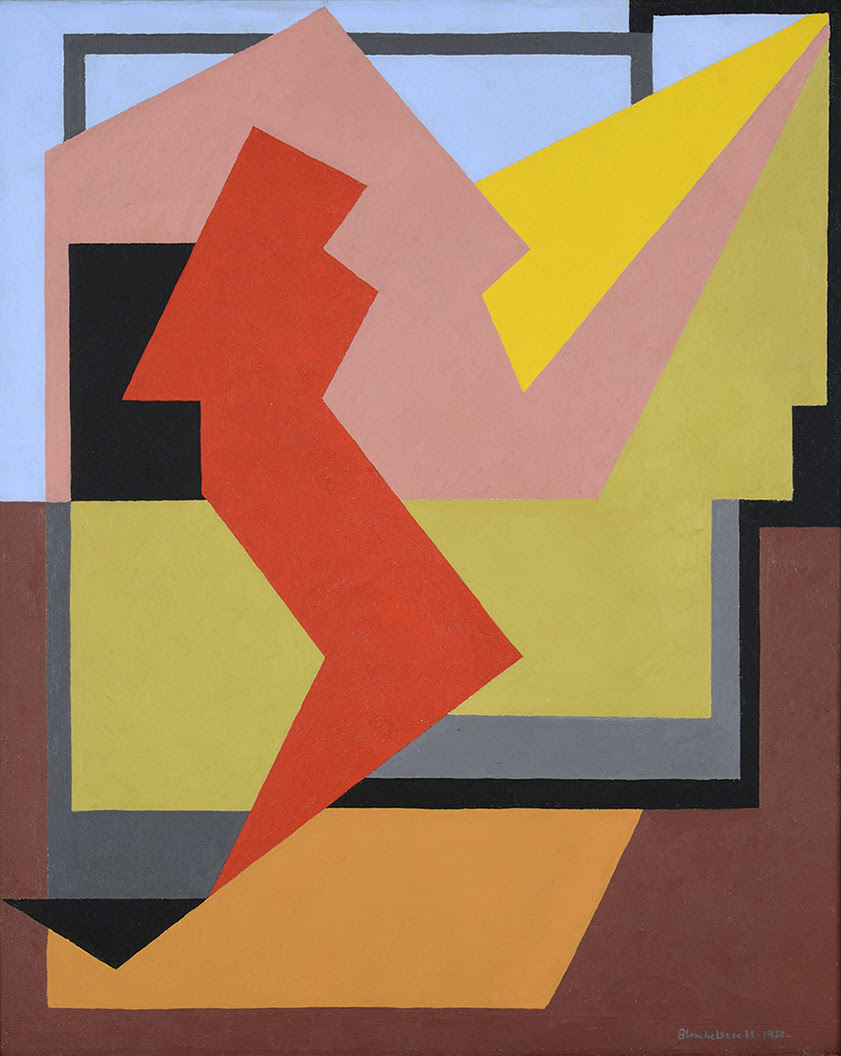
Blanche Lazzell never achieved great fame – or fortune for that matter. But she was widely admired by fellow artists, several of whom she studied with or were tutored in her signature technique, which is captured in several of her woodblock prints in the Academy Art Museum exhibit of her wide-ranging works in “Becoming an American Modernist.”

An untitled 1950 oil on canvas by Blanche Lazzell

Of course, however accomplished women artists born in the 19th century and who continued to create and exhibit their works into the mid-20th, they were rarely recognized with the popular and critical attention that male artists enjoyed.

Lazzell, the ninth of 10 children born in 1878 near the West Virginia farming community of Maidsville – went on to graduate West Virginia University with a degree in fine arts. Determined to make a career of it, Lazzell enrolled in the Art Students League of New York where she studied with William Merritt Chase and Georgia O’Keeffe, who unlike most contemporary artists of her gender would gain international acclaim.

In an early turning point in her career, Lazzell sailed to Europe where she found her niche at the Academie Moderne in Paris, studying with post-impressionist painter Charles Guerin, and on her second stay in France studying Cubism alongside Fernand Leger. Between trips abroad, she spent the first of 40 summers in Provincetown on Cape Cod, thriving in the company of the blooming art colony there and was influenced by German abstract expressionist Hans Hofmann.

All these threads of her remarkable career are evident in the the Academy Art’s subtitles that organize this comprehensive exhibition beginning in the Lederer Gallery with “Petunias, Provincetown and Process,” which bears witness to the introductory wall-label statement from the artist herself: “Often I can’t get a thing out of my system with just one print.” So, moving on from the lovely 1932 white-line block print “The White Petunia,” we encounter the solo “White Petunia’ of her 1943 monotype, “Petunias” of various colors in the 1934 monotype, followed by the 1940 “One Petunia” on paper, and, in the final statement on the subject, a ruddy red untitled petunia captured in her 1943 watercolor. Finally, images switch from flowers to Provincetown where she maintained a home studio adorned by potted flowers she lovingly tended. The new repeating subject here is “The Provincetown Church Tower,” starting with a 1921 graphite on paper and continuing with five more images of the same tower through 1922.

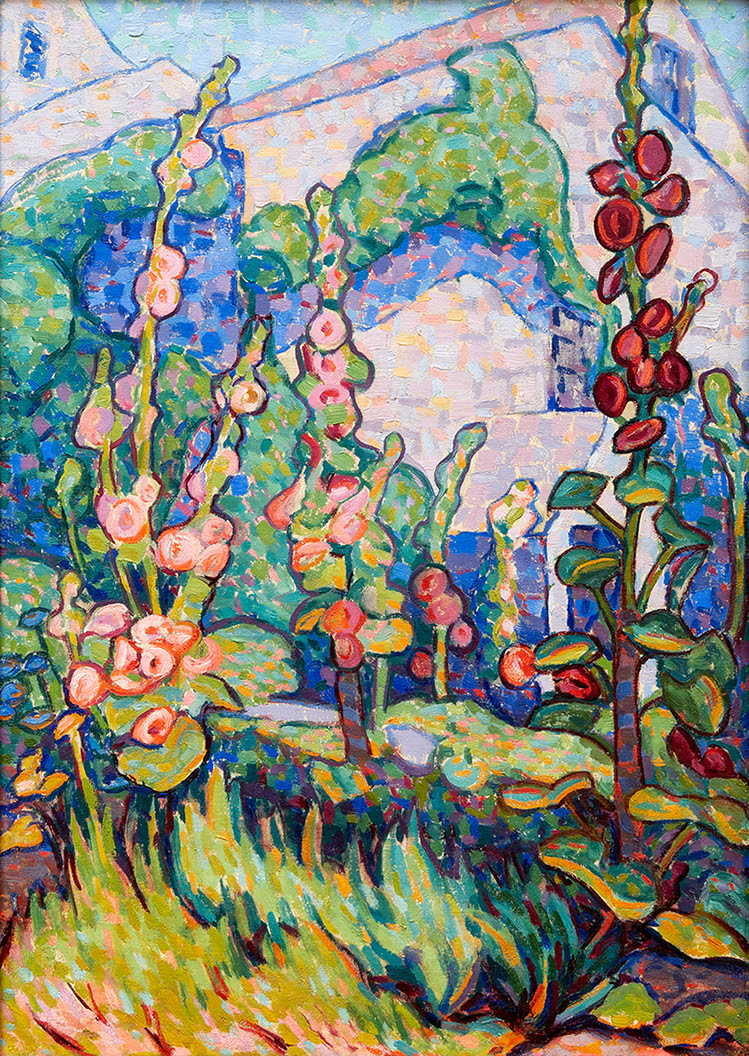
Blanche Lazzell’s Hollyhock, a 1917 oil on canvas


The first image under the heading of “Coming Home to Abstraction” with the large 1952 block print masterpiece “Planes II,” which caught our eye from across the gallery as we first entered. This woodcut print of colliding geometric shapes and complementary colors, all narrowly separated by distinct white lines – one of the finest of her career – was executed late in her life. She died in 1956. A series of purely abstract paintings-on-board squigglies from the 1940s follows, punctuated by a pair of geomatics from the early ’50s, anticipating “Planes II,” as if they were oil-on-canvas studies.
“Abstractions of the 1920s,” Lazzell’s breakthrough decade, brings this gallery full circle with “Painting VIII” and subsequent works of varied Roman numerals. Some bring to my mind a few famous abstract suggestions of musical instruments, though unlike Picasso, Lazzell never hinted at what these objects might be. The only exception in this section is the final “Abstract Windmill” study for a tempera painting not part of this exhibit. You won’t have to guess that the image represents a windmill.

Moving across the hall to the Healy Gallery, we encounter diverse examples of “Understanding Abstractions” as Lazzell explores various means of expression during early years, beginning with “Roofs,” a 1918 woodblock print that looks more like a painting with sharply angled rooftops reaching toward a towering treetop. An untitled 1915 oil on canvas of a Provincetown manse upstaged by sprawling trees and a foreground boat is more impressionistic than abstract. Falling somewhere in between is another oil, a lush “Hollyhock” that brings Van Gogh’s 1899 “Irises” and others among his floral still lifes to my mind.

Skipping over for now the next section of architectural scenes, Lazzell’s “Still Lifes” take many forms, ranging from her highly abstract 1942 oil-on-canvas “Shell,” said to be that of a conch alongside cockeyed flowers, to her standard 1927 “Still Life” painting of fruit in a bowl with a side of flowers in a vase. Others expand the subject matter far afield to “Beach Combings,” her 1931 linoleum block print to the final image in the show, a 1939 “Still Life” oil influenced by her teacher-student relationship with Hoffman. It focuses on what appears to be a skeletal portion of a large animal, likely a cow.

“The Built Environment” phase of her career offers more or less representational scenes, mostly from Provincetown and West Virginia. They range from “Provincetown Suburbs,”  a 1940 oil that seems to foresee lyrical imagery suggested by the 1962 Malvina Reynolds song “Little Boxes,” to her semi-abstract “Campus,” 1934 block print depicting a view of Lazzell’s West Virginia alma mater, and the colorful 1935 woodblock “Provincetown Waterfront,” which was not printed until 1956, three months before her death. It is possibly the last artwork Lazzell completed.

While she was appreciated by her fellow artists as a woodcut pioneer and in developing abstract art in the United States, Lazzell’s work faded into obscurity after her passing. But her art has been rediscovered in recent years. In 2012, her 1931 white-line block print “Sail Boat” sold for $106,200 at auction.
‘Blanche Lazzell: Becoming an American Modernist’
Through Oct. 20, Academy Art Museum, 106 South St., Easton.
Opening reception, 5-7 p.m. Thursday, Aug. 1
academyartmuseum.org

The Spy Newspapers may periodically employ the assistance of artificial intelligence (AI) to enhance the clarity and accuracy of our content.

Filed Under: 1A Arts Lead, Arts Portal Lead

Mid-Shore Arts Plein Air Easton and ESLC Pair Up to Promote Land Conservation

July 19, 2024 by Steve Parks Leave a Comment

Painting by Russell Jewell

Plein Air Easton introduced a new collaboration during its just-concluded 20th anniversary festival with the Eastern Shore Land Conservancy. This invitational for past and current PAE artists was intended to connect art to the cause of – guess what? – land conservation.

Eighteen artists participated in the exhibit that ran through the end of the Plein Air fest on July 20. The show and sale at ESLC headquarters on Washington Street was mounted, in part, by way of a grant by Bruce Wiltsie, who has partnered with the Avalon Foundation since the start of Plein Air Easton. He has just been inducted into the PAE Hall of Fame for, as the event program stated, “years of support for the many ways that art can underscore the vital importance of conservation of our land and the beauty that surrounds us.”

The participating artists were Jill Basham, Tim Beall, Zufar Bikbov, Hiu Lai Chong, Lisa Egeli, Martin Geiger, Stephen Griffin, Joe Gyurcsak, Charlie Hunter, Debra Huse, Russell Jewell, Mick McAndrews, Charles Newman, Daniel Robbins, Mark Shasha, John Brandon Sills, Mary Veiga and Stewart White.

Some of the paintings are along the lines of what you may have viewed (or purchased) at the festival, including Debra Huse’s lavish brushstroke-textured “Historic Beauty” of trees bending over river’s edge and pointing toward a puff-clouded sky. But several others reminded me personally of the farm I was raised on in the ’50s and ’60s on Dutchman’s Lane, virtually next door to where I live now in Easton Club East. One-hundred acres of that farm are being developed into a Four Seasons 55-and-up community. (Full disclosure: My parents sold the farm in the ’70s.)

I remember a time when much of the waterfront acreage in Talbot County was tilled as farmland harvested for corn, wheat, rye and soybeans. Most of that land is now occupied by grand waterview estates, many like the ones hosting the annual “Meet the Artists” party which opens Plein Air Easton. I have no quarrel with that as those former agricultural fields with a view – maybe even a beach – were not much more accessible to trespassers than these myriad private waterfront properties, now best seen by boat or by rare – but often generous – invitation.

The paintings that resonated most with me depicted farm scenes that are still integral to Talbot County’s rural character. John Brandon Sills’ “Sunset, Yorktown Farm” for one, arrays a planted field in the fading evening light. Another, from the same 500-acre Talbot County farm, features a large harvesting combine like the one I was not allowed to operate as a boy but occasionally perched upon when my father was done or when it was parked in a shed – just like the one in Russell Jewell’s “Deep Breath & Swallows.” Can’t figure the title to that one, priced at $1,900. Other paintings in the show fetched up to $3,000.

Proceeds from the sale go to the artists and to Plein Air Easton, care of the Avalon Foundation. ESLC plans to use the paintings or copies of them as future educational tools.

The Spy Newspapers may periodically employ the assistance of artificial intelligence (AI) to enhance the clarity and accuracy of our content.

Filed Under: Eco Lead, Eco Portal Lead

Spy Theater Review: Tennessee Williams’ ‘A Streetcar Named Desire’

July 18, 2024 by Steve Parks Leave a Comment

The Factory describes itself as a “community arts project [providing] creative space for individuals to explore their passion for the performing arts.” And although I didn’t get a chance to see this stunning company debut in the “evocative atmosphere of our open-air venue,” I can say that the performance lived up to The Factory’s promise “to deliver a fresh and captivating interpretation” of this great American classic.

A rainy Friday – which put a damper on opening night of the 20th anniversary of Plein Air Easton – forced the company to scramble for an indoor venue. Thankfully, the Avalon Theatre accommodated The Factory after raffling off prizes to deserving Plein Air Easton volunteers.

But “Streetcar” was scheduled as a double feature with The Factory’s rollicking riff on Wild West gender roles – “The Ballad of Jesse Devereaux Radio Play” as the opener. Take-down of one set and replacing it with another pushed the Williams masterpiece, which runs 2 ½ hours, into a late-show time zone. I strongly encourage those of you who missed the Friday performance or left it early to see it in the Talbot Historical Society gardens before it closes on July 21. It’s too good to miss.

The 1947 Broadway original, as well as the 1951 movie starring Marlon Brando and Vivien Leigh, is a taut and fraught love-hate story involving sisters and the husband of one and brother-in-law of the other. We encounter the first main character as she arrives at her destination on the title streetcar. Blanche DuBois is shocked to find what she considers the squalor her sister Stella lives in with her husband Stanley Kowalski. Stella returns home shortly after to greet her and suffer Blanche’s complaints about sleeping arrangements consigning her to a couch. Because it is his bowling night, Stanley shows up just in time to wolf down his supper before reporting for his overnight job.

That gives the sisters more time to talk, which proves painful as Stella learns the real reason for Blanche’s sudden arrival. The family plantation, Belle Reve, has been lost to profligate spending by previous male heirs and likely by Blanche herself, who brought a trunkful of once glamorous gowns and accessories, including a rhinestone tiara that Stanley later mistakes for diamond. “Death is expensive,” Blanche says, further explaining that funeral expenses of family elders cost her the plantation mansion and the remaining 20 acres.

Citing what he calls the “Napoleonic Code,” that which belongs to the wife (or her family) belongs to him. This motivates Stanley to ask questions about Belle Reve and Blanche’s side of the story and why she now has no place to turn to but the Kowalski second-story walk-up. If you aren’t already familiar, never mind the spoiler answers his investigation reveals.
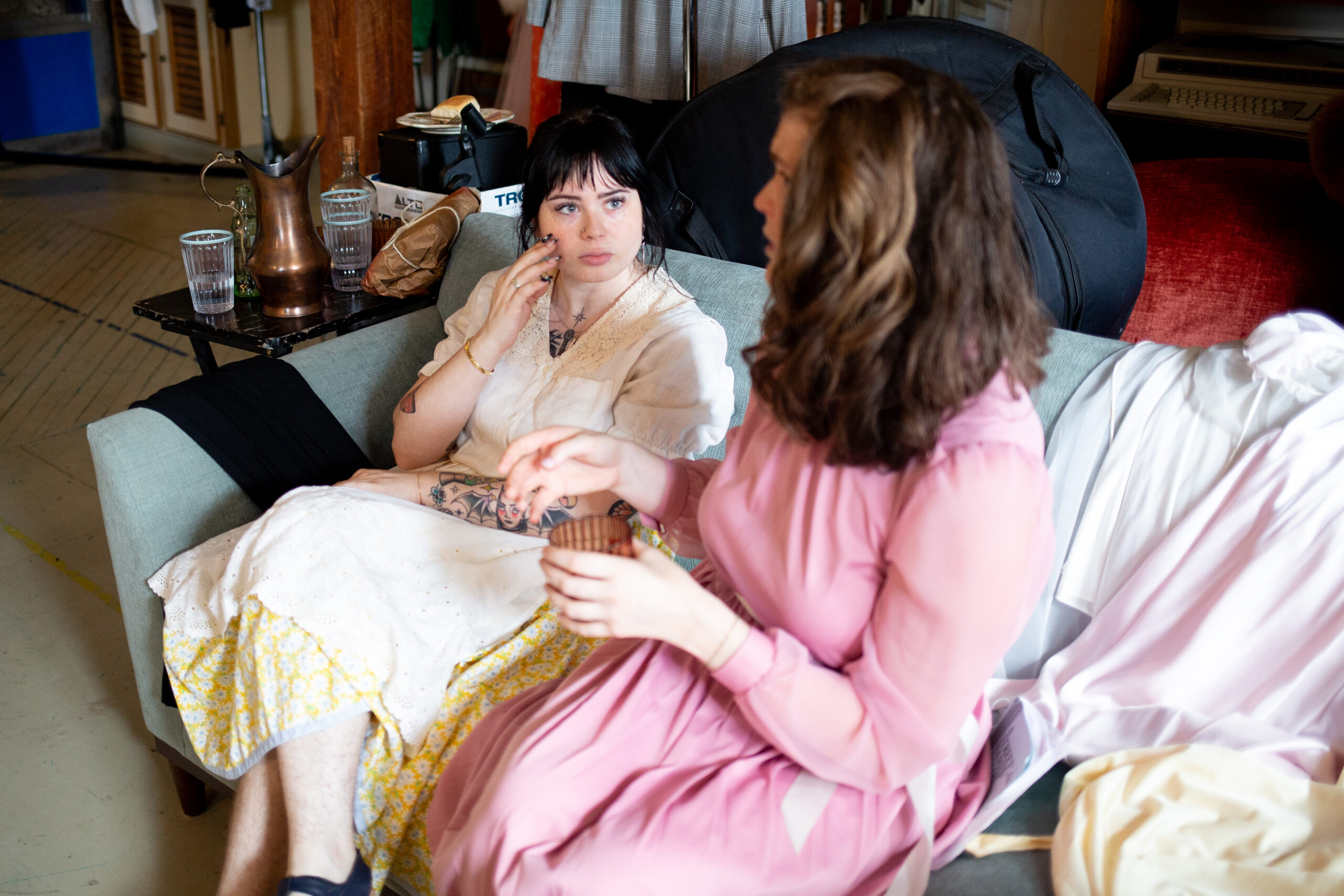
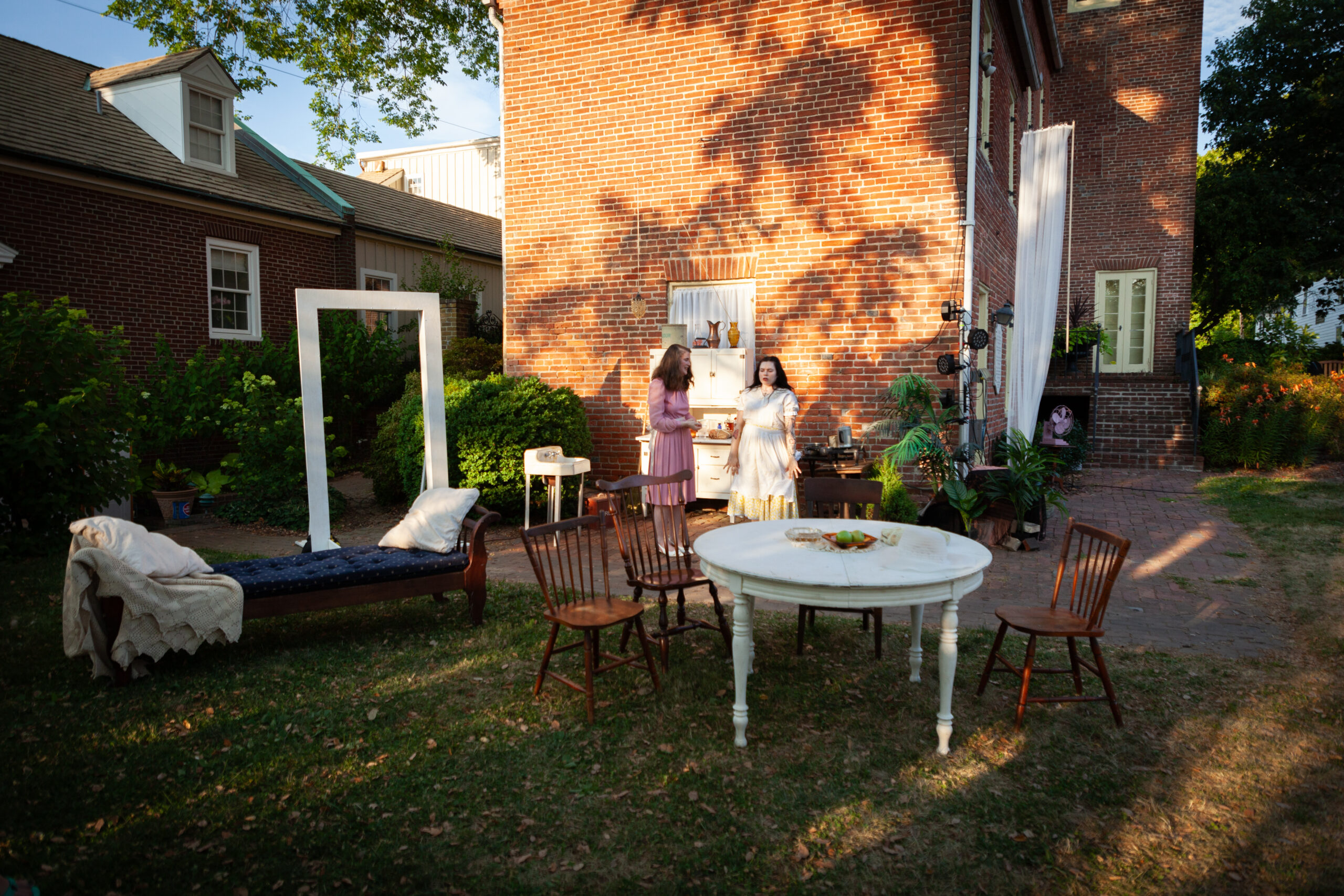
All of which transpires in the apartment, appropriately unprepossessing but hardly squalid as Stella has kept it as presentable as she can for Blanche’s arrival. The two love each other but are appalled by their sibling’s circumstances. Ben VanNest’s set design somehow captures all this along with the center of attention on poker nights – the kitchen table with seating for four. That’s where Blanche catches the eye of one of Stanley’s guest gamblers. Among the foursome, Mitch, as they call him, is the only gentleman. He’s lonely and easily taken in by Blanche’s flirty, lady-like solicitations. Anchoring the other side of the set is the Kowalski marriage bed, around which most of the sisters’ conversations take place. Whether intentional or not by the set designer, it appears to be long overdue for a new mattress.

Running virtually the length of the rear wall of the Avalon stage is a black-and-white photo of rowhouses, long-ago broken up into multiple apartments, upstaged by a commuter train. There’s a streetlight visible just outside the Kowalski bedroom window, which we imagine is about the size of a bathroom mirror.

Costumes by Jeri Alexander – mostly for the sisters – speak volumes about where one comes from and who the other has become. Flimsy dresses Blanche steps in and out of are of no professionally appropriate use for a schoolteacher. In one amusing opening night scene, the rear hem of Blanche’s dress clings to the slip, leaving it exposed where no one seems to notice except anyone in the audience. Inadvertent wardrobe malfunction.

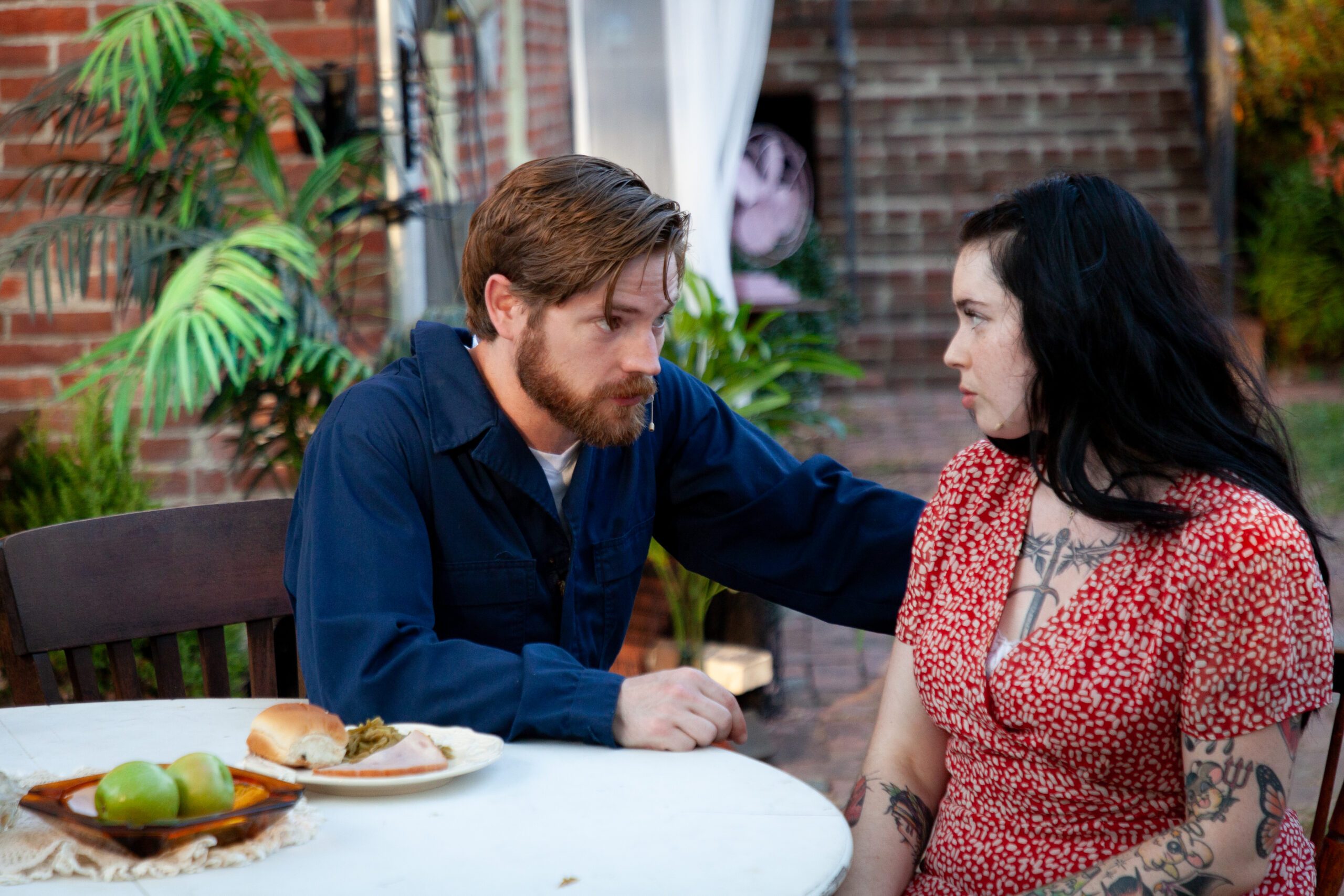
By contrast, Stella wears loose-fitting gingham or print dresses barely hiding what Stella has yet to tell Blanche: She’s pregnant. Her short sleeves and, in one dress-up case, a diving neckline, myriad tattoos on her arms, legs and along her collarbone are meant to reveal – effectively – perceived new class distinctions between the sisters.

The lighting, relatively dim as Blanche prefers, also plays a shifting role implying the drama of the moment, credited to Factory producer Cecile Storm. And uniquely, except of course for the film version, are instrumental overlays performed offstage by the “Ballad of Devereaux” combo. Movies deploy music to accent whatever is happening on-screen. Here, as directed by Willoughby Buxton, the instrumentation indicates dramatic moments – pay attention – or to provide sound effects such as a passing train whistle. My only complaint on opening night was that at times the incidental music obscured lines spoken from some parts of the stage. Perhaps it was designed for an outdoor venue where the show now moves – weather permitting.

The theatrical accessories were far more pertinent to than distraction from the storytelling, which in this case, inspired Tennessee Williams’ masterpiece. But all are nothing without actors who seem to live the lines rather than just speak them.

Here are the leading suspects in making this happen. Cavin Moore as Blanche achieves such an astonishing transformation, particularly as we had an hour or so earlier caught her as a radio-play singer and deliverer of zingers. In “Desire,” we see her struggling to relive her long-past post-graduate schoolgirlish days like those of ones she later taught. But she can’t hide behind badly told jokes to lift her spirits after an unhappy birthday cake-and-candles ritual. As Stella, Liv Litteral tries to hide desperation for her sister but also for herself in that, with a baby coming, she has no better way forward than Blanche if the bully in her husband overtakes his professed love for her.

Alex Greenlee, in the pivotal role of Stanley – loved by his wife, hated by her sister – manages all the explosiveness of a brute, seeming to slug his pregnant wife hard with impressive fight-scene precautions for Litteral’s safety and later violently clearing his plate from the table on Blanche’s birthday. Other infractions by Stanley – all well-played – would be further spoilers to reveal here. All I would add is that Greenlee still seems just a little too civilized to be a monstrous Stanley. But he does scream with convincing agony, “Stella! Stella!” – begging forgiveness without actually asking for it.

Another key player is Mitch, played by Noah Thompson with both the infatuation and disillusion of a jilted lover who was neither jilted nor a lover, though he wanted to be the latter. But the suitor side of his equation and the plaintive side come through viscerally in Thompson’s deft interpretation of his character’s conflicted emotions.

One other in a fine cast, all worthy of mention, is aforementioned costume designer Alexander, doubling as Stella’s downstairs neighbor who figures in supportive roles in both the crucial opening and closing scenes.

So there could only be kudos for director Iz Clemens. Whatever these fine actors brought to the table in this challenging psychological/sociological drama, Clemens has brought out the best in them. So far. Maybe they can be even better next time. Following the “Shakespeare in Love’ royal directive, it might as well be a comedy or musical.

In the meantime, try not to miss this “Streetcar Named Desire” before its last stop on July 21.

A production by The Factory, a community arts project in Easton. Remaining performances at 7 p.m. July 19-21 in the Talbot Historical Gardens, 30 S. Washington St., thefactoryproject.org. Photos by Henley Moore.

Steve Parks is a retired New York arts critic now living in Easton.

The Spy Newspapers may periodically employ the assistance of artificial intelligence (AI) to enhance the clarity and accuracy of our content.

Filed Under: 3 Top Story

Plein Air ‘Meet the Artists Party’ and More by Steve Parks

July 16, 2024 by Steve Parks Leave a Comment

Plein Air Artist Abby Ober

Among the 58 artists competing in the 20th anniversary Plein Air Easton festival, one who planted his easel along a water view from the sumptuous greens of Wye Heights Plantation, was John Brandon Sills of Cockeysville, making his 17th appearance in one of the leading events of its kind in the United States.
Of the three he’s missed, one was the COVID-restricted event that amounted only to a show and sale of art by local plein-air painters at what was once the News Center space in Talbottown. As grand prize winner of the 10th anniversary PAE in 2014, the award was increased for the occasion to $10,000. “So this year,” Sills said as he added brushstrokes to his water-meets-sky oil of the scene before him, “I asked if they were raising the grand prize to $20,000.”
No dice. It will be $5,000 as usual.
While water views were still well-represented among the paintings presented for sale under the Meet the Artists tent Saturday evening, there were so many other views to capture within the myriad gardens and the sloping greensward from the Wye Heights Plantation mansion where dozens of black sheep grazed oblivious to the guests and artists ambling around their space.
Nancy Tankersley, one of the co-founders of Plein Air Easton and judge of this year’s competition, made the rounds to reconnect with many of the local and far-flung painters she has known from her own tours of the plein-air circuit that inspired her to help bring one to Easton.
It has been a great and unexpectedly successful event. And one of the keys to that success, besides the beautiful land-and-seascapes that provide painterly inspiration, is one word I’ve heard repeatedly from artists who come back year after year, or others from transcontinental distances who return occasionally to a place they fondly remember. The word is hospitality.

Plein Air Artist, Fairley Lewis

Many of the painters we encountered at Meet the Artists congregated in the various gardens on the grand estate, owned by Lisa and Tim Wyman, including one that encompasses a pub rebuilt to 17th-century specifications but which provided air-conditioned relief from the sweltering midafternoon heat otherwise leavened only by shade or a breeze off the water. Fairley Lewis of Springfield, Missouri, making his Plein Air Easton debut, said he made the trip because “this is a famous event that everybody who does plein air knows about.”
We asked Christopher Leeper or Confield, Ohio, making his second trip to Plein Air Easton – his first since 2019 – if he had chosen his spot along Skipton Creek for its shade. He smiled and said, “Mostly I just liked the view.”
Abby Ober of St. Michaels, who has competed in a dozen other festivals from Florida to Pennsylvania, was making her Plein Air Easton debut. She was painting a landscape perspective of the estuary and trees on the opposite shore.
Far across the gardens and an open expanse, one painter stood alone, capturing the view where Skipton Creek and Wye River funnel into each other – with a portion of Wye Island in a corner of her canvas. Olena Babak was making her ninth pilgrimage to Plein Air Easton. What brings her back so many times from Maine? “I love the beautiful scenery here. But I also appreciate that they do the best job in treating the artists – always making you feel special.” Babak cites as evidence a time when her car broke down after the long drive from Maine and a volunteer said, “Just hand me the keys and go paint. And it got fixed” – while Olena painted.
As we settled with cool drinks into comfortable outdoor sofas for two, watching the sheep grazing their way from one side of the lawn to the other, we watched the artists, one by one bringing their paintings to the tent where they would be displayed briefly, just before a buyer takes one home with them. Among those that sold early that evening was one by Plein Air Easton first-time Lewis. It fetched his price of $1,200. That was the same price as PAE regular Jill Basham of Trappe got for her “Wye Riverview.” In just his second PAE appearance, Leeper of Ohio sold his “River View with Oak” for $1,600.
One of the true veterans of the festival out-of-towners, Sills was among the last to mount his painting under the tent. He priced his “Across the River” at $2,200. Before it was marked “sold,” we left to pick up our bright orange bag filled with gourmet entrees, sides, dessert and wine.
Besides taking care of the festival artists, the Avalon Foundation also takes care of its guests.
                                                                ***
Former winners of Plein Air Easton first, second and third place awards, along with artist choice winners and other featured alumni painters, have been invited to paint during this 20th anniversary PAE. Their works will be exhibited for sale at the Eastern Shore Land Conservatory at 114 S. Washington St., Suite 101. The show opens Wednesday, July 17, 6-8 p.m., and remains up through July 19.
Other happenings this week include the “Paint Tilghman” exhibit and sale, Monday, July 15; “Happy Hour Paint-In” featuring costumed actors from The Factory, Tuesday, July 16; “Local Color” demos by PAE artists Tim Beall and Charles Newman, Thursday, July 18; Collectors Preview Party, Friday, July 19; Quick Draw and Next Generation Painting competitions, Saturday, July 20; competition judge Nancy Tankersley’s discussion of her winning selections for Plein Air Easton 2024, pleinaireaston.com/calendar.
Steve Parks is a retired New York arts writer and editor now living in Easton.

The Spy Newspapers may periodically employ the assistance of artificial intelligence (AI) to enhance the clarity and accuracy of our content.

Filed Under: 1A Arts Lead

Easton Art Galleries Host Plein Air Shows by Steve Parks

July 3, 2024 by Steve Parks Leave a Comment

On Plein Air Easton/s opening night, July 12, Trippe Gallery celebrates with its “Variations 3.0: 1 Photograph, 15 Painters” exhibit and party. This third annual “Variation,” like its predecessors, is in part a contest involving both artists and appreciators. Fifteen painters participating in the Plein Air festival create their own interpretations of a single photo challenge presented by gallery owner and photographer Nanny Trippe. Viewers compete in matching the artist to his or her painting and then vote for a people’s choice winner.
“Mingle with the artists,” Trippe says, adding that the opening night “party starts here.”
The 15 artists who will paint their own variations on the photo include some who have been in most of the previous 19 Plein Air Easton festivals. They are, alphabetically, Olena Babak, Jill Basham, Beth Bathe, Zufar Bikbov, David Diaz, Vlad Duchev, Stephen Haynes, Charlie Hunter, Len Mizerek, Diane DuBois Mullaly, Elise Phillips, Crista Pisano, Cynthia Rosen, Nancy Tankersley and Mary Veiga. The first “Variation” came about during the 2020 COVID shutdown when the only public event was a show and sale of paintings in the Talbottown space that was formerly the News Center bookstore and gift shop.
A few doors south from Trippe on Harrison Street, Spiralis Gallery, which shares space with Zebra Gallery, opens its “Vistas and Viewpoints” show on First Friday, July 5, featuring interpretive landscapes by Larry Horowitz, Leslie Lumen, Kerream Jones, Francis Eck and James Stephen Terrell.
In adjoining rooms, Zebra has welcomed three new artists with exhibits ranging from Gabriel Lehman’s delightfully colorful paintings, which are essentially children’s-book illustrations of fairies and “real” kids in fanciful settings, to Adam Himoff’s patterned-face oil portraits “Plain Sight” and “She Looked Right Through Me,” among others. Golsa Golchini completes the threesome with mixed-media constructions, including “Knock Knock,” a document displayed within a frame on which a woodpecker is hammering away and “The Snow Shortcut” enveloping skiers riding a three-dimension avalanche downhill. Both, weirdly fascinating.

Kevin Fitzgerald “Ocean Nightfall”

Heading further south on Harrison, just past the Avalon Theater, the Troika Gallery renews its popular “Fabulous Forgeries” format with paintings by member artists creating paintings inspired by – “after” is the word – of various masters with photos of the original masterpieces posted next to their “forgeries.” That show runs before and after the Plein Air fortnight, along with Kevin Fitzgerald’s “Points of Departure II” exhibit of horizon-view land-and-seascapes.

Betty Huang “Splendor of Provence”

On Goldsborough, between Washington and Harrison streets, Studio B Art Gallery hosts its First Friday salon-style open house July 5, featuring new paintings by previous Plein Air Easton winners and participants in this year’s event, as well as paintings by Bernard Dellario and Studio B owner Betty Huang who just returned from France, where they applied their brushes in capturing Provence landscapes. On July 16, Dellario leads a live painting demonstration in floral still life for those who’d like to learn the technique or who just enjoy seeing how it’s done.

***

For this 20th anniversary Plein Air Easton, Nancy Tankersley serves as awards judge of the festival, now managed by the Avalon Foundation.

Tankersley, who founded Plein Air Easton two decades ago this month in partnership with the Academy Art Museum and Al Bond, then Easton’s economic development director who now leads the Avalon Foundation, brings her founding partners together again 20 years later.


Academy Art Museum opened its “Reflections: Nancy Tankersley” exhibit in the upstairs landing gallery, running through July 28, which bookends, calendar-wise, 2024 Plein Air Easton. Her art talk late last month revealed her reasons for choosing these particular reflections on her career – not only as an artist but as plein-air enthusiast, promoter and co-founder. Before 2004, such painting, historically associated with French art painted outdoors, was popular mostly in this part of the world along the West Coast.

Tankerley encountered the regional phenomenon first at Carmel, California, in 2004, and brought the idea to Easton and to Bond, who was seeking attractions in the summertime that might lure tourism to Easton rivaling the hugely successful Waterfowl Festival in November. It took only a few years to catch on, and Plein Air Easton is now regarded as one of the premiere events on the plein-air circuit.

Painters who come from all over the United States and other countries find that they can sell their artworks even before the paint is dry. It’s practically a Plein Air Easton trademark. From day-two’s “Meet the Artists” painting-and-purchase frenzy to the closing-night sales and festival awards, you can sniff the aroma of oil-on-canvas as prospective buyers are warned that they can look but not touch still-wet paint. It’s the closest that fine-art painting comes to matching the spontaneity of live performing arts.

Tankerseley’s “Reflections” attempts but never quite achieves that spontaneity, although a few of her most recent 2024 oils in this show gave me a still-drying whiff. Of course, you’re not allowed to touch them anyway. “Old Partners” (2024), portraying friends out for a leisurely crabbing-by-boat expedition – laughing and likely sharing old stories – practically reeked of fresh paint when I took it in. Or was it just my imagination? I don’t think so.

Several other paintings were chosen, it seems, to show the geographical extent of Tankersley’s plein-air experience, ranging from 2015’s “Curacas Ball” at Plein Air Curacao, South America, to “The End of the Island,” painted at 2019’s Plein Air Easton’s “Tilghman Island Paint-Out” at midday.

You’ll also see decades-apart Tankersley self-portraits, from her current home and studio on Aurora Street, still evoking fresh oil scents, to her first studio in Arlington, Virginia, in 1990. No such sniffs. One of my favorites comes from the mouth of what defines our region: “Bound for Baltimore” depicts in large-frame oil the view of Bay meets Ocean as you approach by automobile one of the apertures of the Chesapeake Bay Bridge-Tunnel in far southeast Virginia. I vividly recall feeling on my first crossing that we might drive directly into the ocean before the enveloping tunnel ahead became apparent. Still-life drama in oil.

For this 20th Plein Air Easton, Tankersley serves as awards judge of the festival, managed by the Avalon Foundation.
Gallery Happenings During Plein Air Easton
“Reflections: Nancy Tankersley,” through July 28, Academy Art Museum, 106 South St.
“Fabulous Forgeries” and Kevin Fitzgerald, through July 29, Troika Gallery, 9 S. Harrison St.
New artists at Zebra and Spiralis galleries, through Aug. 18, 5 N. Harrison St.
“Variations 3.0,” opening night July 12, Trippe Gallery, 23 N. Harrison St.
First Friday Salon, July 5; still-life demo, July 16, Studio B, Goldsborough St.Steve Parks is a retired New York arts critic and editor now living in Easton.

The Spy Newspapers may periodically employ the assistance of artificial intelligence (AI) to enhance the clarity and accuracy of our content.

Filed Under: 1A Arts Lead, Arts Portal Lead

Concert Review: Chestertown’s National Festival by Steve Parks

June 9, 2024 by Steve Parks Leave a Comment

The National Music Festival, now in the orchestral phase of its two-week residency at Washington College, performed one of its signature apprentice-and-mentor concerts Saturday night, anchored by Felix Mendelssohn’s Symphony No. 3, better known as “The Scottish Symphony,” conducted by festival artistic director Richard Rosenberg.

Richard Rosenberg

Most of the players in these symphonic concerts are talented young musicians who are on the cusp of professional careers. Coming from about 30 states and a dozen countries, they auditioned for a spot in the festival to be mentored by seasoned professionals and teachers who perform among them in major concerts on campus at the Decker Theatre concert hall. First up was Friday night’s program featuring Mahler’s Symphony No. 4, with soprano soloist Caitlin Redding, whose usual concert venues are in Barcelona, Berlin and other European arts capitals.

I wondered why several men in the lobby on Saturday, waiting for the pre-concert talk to begin, wore kilts. But then it dawned on me. Of course, the “Scottish Symphony” was the final piece for what turned out to be an all-Scottish program. The first of the evening – Overture in C, Opus 1, No. 2 by Thomas Erskine, the 6th Earl of Kellie – is a title linked to the 12th-century Scottish castle. Erskine was famed for his talent as a composer but also for notoriety as founder of an all-male drinking club. His music fell into obscurity in modern times. So its performance in the festival was something of a curiosity.
Written in the 1760s for a comic opera that made its way to London’s Covent Garden Royal Opera House, the overture in three movements bears some resemblance to a symphony, but not quite full blown. Its sprightly opening creates a see-saw aural effect as written for the string section, broken only by occasional brass and clarinet shoutouts.  The more solemn second movement resembles a strings-only weeping fit that settles into a soothing melody only to switch back and forth before the third movement’s rhythmically danceable motif presents a catchy, if repetitive, melody. Conductor Elisabeth Thomas and the mostly strings orchestra deliver a coherent interpretation of a flawed and outdated museum piece of an overture. An “underture,” if you will.
The difference in quality of composition takes a notable leap with Alexander Campbell Mackenzie in his Pibroch Suite for Violin and Orchestra, ably conducted by Britney Alcine. (Pibroch is associated with Scottish bagpipe music, but no bagpipers were in play Saturday night.) Though his music largely fell out of favor after Mackenzie’s death in 1935, a 1997 recording by Malcolm Stewart and the Royal Scottish National Orchestra brought new attention to the piece’s robust and physically challenging intensity. Although technically written for violin and orchestra, one of the most outstanding contributions by the latter were harpist Eric Sabatino’s dreamy embroidery as violin soloist Emma McGrath endeavored to bring us to tears,  playing her melodrama that ends the first-movement “Rhapsody” with a whispering whistle of bow-on-string.
The middle “Caprice” movement is indeed capricious – given the abrupt changes from dramatic violin pyrotechnics to a tender folk motif that enlivens the full orchestra – brass section and all –  with the opportunity to be more than a mere supporting cast. The final “Dance” movement begins with a chattering solo passage by McGrath, up and down the scale at a flawlessly furious pace with rare breaks from the lead. She looked at times as if she was about to cry herself – maybe from exhaustion at the extraordinary volume of notes to execute, leading to a thunderous finish with all strings on board, led by mentor concertmaster Dane Goode and, of course, the star soloist.
Most remarkable was that McGrath only started to learn the piece a few weeks earlier when the scheduled violin soloist had to drop out. The standing ovation she earned required an encore appearance to take one more bow.
Intermission gave a welcome break, not just for the audience, but for the final performance of the evening with such a tough act to follow. Fortunately, Richard Rosenberg was conducting a piece that more fully engaged the whole orchestra, which proved up to the challenge. Swollen to its fullest extent with upwards toward 90 musicians made for a richer sound than you can expect these days from even the finest professional orchestras whose players all must be paid.
The orchestra got to show its muscle in the somber opening Andante, followed by the sound-and-fury of the aptly named Allegro “agitato” that concludes the first movement. The relatively brief Vivace second movement, introduced with barely a pause, a Scottish folk music theme both in melody and rhythm, which grew in intensity and pace to something of a gallop. The third movement Adagio, suggesting a pastoral scene with a thunderous interlude that subsides before alternating in pace and mood again. Another very brief pause signals the final movement’s serialist Allegro starting with the “guerriero,” which sounds and signifies a combative stance. It’s followed by an Allegro “vivacissimo,” vibrantly fast-paced as if reacting to danger or strife. The Allegro “maestoso,” builds to a triumphant finish heralded by an all-brass bugle call or in this case, trumpet and horn, with patriotic fervor.
There’s another week of the festival ahead. Besides the orchestral concerts, there are intimate chamber music performances, free “Lunchtime Bites” recitals and outdoor pop-up concerts in various Chestertown locations, as well as master classes and open rehearsals. Rehearsing for concerts in a week or less gives the apprentice musicians experience they will need as professionals performing in ensembles ranging from string or brass quartets to full symphonic orchestras.
This year’s cast of mentors include Brazilian guitarist Camilo Carrara and violinist McGrath, who traveled from Australia, where she is concertmaster of the Tasmanian Symphony Orchestra. They join mentors who have been with the festival since its 2011 inception: Dana Goode (violin), Jared Hauser (oboe), Jeff Keesecker (bassoon), Tom Parchman (clarinet) and Jennifer Parker-Harley (flute).
Among the upcoming festival concerts are Friday, June 14, featuring a Rossini overture and Emilie Mayer’s Symphony No. 1, and the June 15 Saturday night finale culminating in the Ravel orchestration of Mussorgsky’s “Pictures at an Exhibition,” with Rosenberg conducting.
NATIONAL MUSIC FESTIVAL
Through June 15 in and around Gibson Center for the Arts, Washington College, and other Chestertown locations. nationalmusic.us

The Spy Newspapers may periodically employ the assistance of artificial intelligence (AI) to enhance the clarity and accuracy of our content.

Filed Under: 1A Arts Lead, Arts Portal Lead

Concert Review: Chamber Music Fest Opening Night, by Steve Parks

June 8, 2024 by Steve Parks Leave a Comment

The Chesapeake Chamber Music Festival celebrated its 39th annual opening night on Friday with a diverse medley of classics performed by its longtime lineup of globally acclaimed musicians along with scene-stealing guest artistry by a young Grammy-nominated string quartet known for its dressed-for-fun virtuosity.

The only apparent hitch in the evening had nothing to do with the music. On a relatively last-minute decision, the concert – and possibly the entire festival – was relocated from its Ebenezer Theater home base to the auditorium in nearby Academy Art Museum. More on that later.

Opening night, billed as an “Extravaganza,” mostly lived up to that superlative, beginning with Richard Strauss’ Sextet in Strings, Opus 85, featuring two paired violins, violas and cellos with co–artistic directors Marcy Rosen (cellist) and Catherine Cho (violist) joined by the aforementioned string ensemble, the Aizuri Quartet: violinists Emma Frucht and Miho Saegusa, violist Brian Hong and cellist Caleb von der Swaagh. (No strangers to Easton, they were finalists in the Chesapeake Music International Concerto Competition a decade ago at the Avalon Theater.) The lush Strauss sextet that opened “Capriccio,” the final opera he wrote, introduces  a somber motif passed among the players. Picking up the pace dramatically and without pause, the six string players turned seamlessly to searing passages with violin calls and viola responses, concluding with dual cello solos revisiting the opening theme, this time in a major key.

pianist Leva Jokubaviciute

Next up, and to me the highlight of the concert, was Clara Schumann’s Piano Trio in G minor, Opus 17. As pianist Leva Jokubaviciute observed in her opening remarks, Schumann was recognized as one the finest pianists of her 19th-century time but also – rare for that era – as an accomplished composer. She wrote remarkable piano pieces that she played as well or better than anyone of either gender of which this piano trio is regarded as her masterpiece.

After cellist Rosen took charge to rearrange the chairs and music stands to her liking, the wistfully melodic opening allegro gave way to high-drama string interchanges and tumbling piano keystrokes suggesting an intemperate demand for resolution that grows more and more impatient as if throwing serial fits. The mood turns distinctly lighter in the second movement with strings taking the lead early in an almost cheerful demeanor. The piano introduces the third movement Andante tenderly as the melody is taken up by Todd Phillips’ violin, suggesting a let-it-be acceptance. The final movement advances with renewed confidence and determination through perky strings amplified by expressive piano overlay before racing toward an assertively optimistic conclusion.
After intermission, the guest Aizuri Quartet proved their mettle in Schubert’s famously melodramatic “Death and the Maiden” String Quartet No. 14 in D minor. Severely ill at the time he wrote it, Franz Shubert was fully aware he was dying, which accounts for the ferocity of his composition as well as the attacking of strings by the Aizuri foursome. Taken from a song Schubert had written years earlier, a young girl asks Death to pass her by. Moods shift inexorably between dark and light throughout the piece, expressed alternately by angry fortissimo and placid (or resigned) pianissimo. The spirited first movement brings to mind parrying and thrusts as if fencing for notes – or for one’s life.
Throughout, moods shift from lyricism to agitation and back again, rendered by each player, with brief solo violin turns of almost screaming vocalizations of despair to the percussive heartbeat of cello pizzicato. The final movement mimics a chattering exchange among the four in musically disparate states of their duel with Death before returning to agitation at a galloping pace to the end.
So who was the winner of the evening? Everyone who attended. And the best news is there is much more to come.
Festival concerts that follow the opening-night triple play include Saturday night’s “Personal Perspectives,” with festival co-artistic director Cho performing Mozart’s Duo for Violin and Viola with her husband, violinist Phillips. Also on the program is Schubert’s counterintuitively lighthearted Piano Trio No. 1 in B-flat major composed just a year before his death. In between is a short work commissioned for the Aizuri Quartet, Reena Esmail’s Zeher (Poison) for String Quartet, combining South Asian and Western themes. The guest ensemble returns Sunday with Fanny Mendelssohn Hensel’s String Quartet in E-flat major, recognizing the unsung sibling of Felix, who – due to conventions of the time – is credited with writing six of his big sister’s songs. Next is Schubert’s Fantasia for Piano
Four-Hands in F minor, considered one of his greatest hits. Wrapping up the late matinee program is Erno Dohnanyi’s Piano Quintet No. 1 in C minor, Opus 1, written when the composer was 17. It so impressed Johannes Brahms that he performed its premiere himself.
The festival resumes on Thursday next week with Haydn’s “London” Symphony for Flute, String Quartet and Piano. It’s followed by Pietro Bottisini’s Andante and Variations for Flute, Clarinet and String Quartet, featuring perennial festival contributors Tara Helen O’Connor and J. Lawrie Bloom on the woodwind instruments. Brahms puts the final notes on the evening with his Piano Trio No. 1 in B  major, Opus 8, with Sahun Sam Hong on the ivory. Next Friday’s concert puts the spotlight on winners of Chesapeake Music’s most recent biennial International Concerto Competition, the Amara Trio – Christina  Nam (violin), Nagyeom Jang (cello) and Kevin Jansson (piano) – likely reprising their prize-winning number, Shostakovich’s challenging Piano Concerto No. 2 in E minor, Opus 67, preceded by 20th-century composer Rebecca Clarke’s Piano Trio. The opener for the evening, Luigi Bocchereni’s String Quintet in A major, composed by the virtuoso cellist, brings two other cellists to the fore – Rosen and young Sterling Elliott, who wowed Chesapeake Music audiences twice before, followed by young Oregon-born  composer Kenji Bunch’s “Vesper Flight for Flute and Piano,” a 2021 work commissioned by flutist O’Connor in memory of her parents.
The Festival Finale next Saturday night begins with “A Night Piece and Scherzo for Flute and String Quartet” by American composer Arthur Foote who favored late European Romanticism, Claude Debussy’s “Reverie” arranged for cello and piano, performed by Elliott and his “Rising Stars” partner Eliot Wuu, “Serenade for Clarinet, Cello and Piano” by Danish composer Emil Hartmann inspired by Scandinavian folk tunes and, finally, Elgar’s Piano Quintet that approaches or achieves orchestral proportions.
Something old, something new, something unexpected. That’s the mark of the latest iteration of this distinguished chamber festival.
On a practical note: Ticket holders should pay attention to their emails or text messages. It’s possible that week 2 of festival concerts may switch back to the Ebenezer. According to Bluepoint Hospitality, which owns and operates this and other downtown Easton arts-related businesses and restaurants, the Ebenezer “needed repairs on the former church built in 1856.” Stay tuned.
Chesapeake Chamber Music Festival
Through Sunday and next week through June 15, Thursday-Saturday, Academy Art Museum (or possibly in week 2, at Ebenezer Theater), both in downtown Easton. Concerts start at 7:30 p.m. except Sunday at 5:30. chesapeakemusic.org
Steve Parks is a retired New York arts critic now living in Easton.

The Spy Newspapers may periodically employ the assistance of artificial intelligence (AI) to enhance the clarity and accuracy of our content.

Filed Under: 1A Arts Lead, Arts Portal Lead

  • « Previous Page
  • 1
  • 2
  • 3
  • 4
  • 5
  • 6
  • …
  • 8
  • Next Page »

Copyright © 2026

Affiliated News

  • Chestertown Spy
  • Talbot Spy
  • Cambridge Spy

Sections

  • Sample Page

Spy Community Media

  • Sample Page
  • Subscribe
  • Sample Page

Copyright © 2026 · Spy Community Media Child Theme on Genesis Framework · WordPress · Log in