MENU

Sections

  • Home
  • Education
  • Donate to the Centreville Spy
  • Free Subscription
  • Spy Community Media
    • Chestertown Spy
    • Talbot Spy
    • Cambridge Spy

More

  • Support the Spy
  • About Spy Community Media
  • Advertising with the Spy
  • Subscribe
March 6, 2026

Centreville Spy

Nonpartisan and Education-based News for Centreville

  • Home
  • Education
  • Donate to the Centreville Spy
  • Free Subscription
  • Spy Community Media
    • Chestertown Spy
    • Talbot Spy
    • Cambridge Spy
1A Arts Lead Archives

TAP Takes on Neil Simon’s Plaza Suite: A Chat with Maureen Curtin and Brian McGunigle

February 6, 2025 by The Spy Leave a Comment

Tred Avon Players is thrilled to kick off its 2025 season with Neil Simon’s classic comedy, PLAZA SUITE, and the Spy was delighted to talk to Act III Director Maureen Curtin and actor Brian McGunigle. to get up to speed on the Neil Simon classic last week.

The talented cast includes new and returning actors to the TAP stage: Melissa Barcomb-Doyle(Karen Nash), Dean Goodwin (Sam Nash), Joseph Spain IV (Bellhop/Borden Eisler), MichelleSpain (Waiter), Leigh Marquess (Jean McCormack), Charles Ulveling (Jessie Kiplinger), Mary Ann Emerson (Muriel Tate), Susan Patterson (Norma Hubley), Brian McGunigle (Roy Hubley) and Jackie Royer (Mimsey Hubley).

PLAZA SUITE opens on Thursday, February 13, and runs for seven performances through Sunday, February 23. Thursday, Friday, and Saturday performances are at 7:30 p.m. and Sunday afternoons are at 2:00 p.m. at the Oxford Community Center, 200 Oxford Rd in Oxford. Tickets are for adults, $25 / students, $15 (fees included). Preview Night (February 13) and Sunday matinees sell out quickly!

This video is approximately three minutes in length. To purchase tickets please go here. 
The Spy Newspapers may periodically employ the assistance of artificial intelligence (AI) to enhance the clarity and accuracy of our content.

Filed Under: 1A Arts Lead, Archives

In praise of Inspectors General by J.E. Dean

January 29, 2025 by J.E. Dean Leave a Comment

Last Friday, we learned that President Trump had fired the Inspectors General (IGs) at 17 federal agencies. The firings were not conducted in accord with the Inspector General Act. Congress was not given the required 30-day advance notice or an explanation for the firings.

Congressional Democrats—and some Republicans—are now asking why Trump took this unexpected action. After all, Inspectors General are best known as watchdogs charged with finding fraud and abuse in government and making recommendations for agencies to be more efficient and effective. 

I look forward to learning more about the firings but was prompted by the news to look at the recent work of the IG at the U.S. Department of Education. I chose Education because I followed the work of that Department’s IG for more than 30 years, as counsel to a Congressional Committee, as a lawyer representing clients with contracts with the Department, and as a lobbyist. Over the years, I came to respect the work of the Department’s IG. Reading the Semiannual reports of the IG, as well as the reports on fraud investigations and financial audits of the Department itself, was like reading the owner’s manual to the Department. 

In talking to friends about why President Trump may have fired the IGs, I was struck with how little some friends knew about IGs and their value to good government. Some friends were surprised that I spoke favorably about IGs given that during my career some IG findings and recommendations were against the interests of my clients or simply recommendations with which I disagreed.

After a few discussions about the firing and the rampant speculation about why Trump decided to fire so many IGs at once without citing failures or deficiencies with any of them, I decided to write this week about IGs rather than about Trump’s decision to fire them.

Over the weekend, just before watching the Philadelphia Eagles embarrass the Washington Commanders, I read the final Semiannual Report of the ED Inspector General, issued just before President Biden left office. It is typical in terms of the focus and objectivity of most IG reports I have read over the years.

The report recites the mission of the IG office: “To identify and stop fraud, waste, and abuse; and promote accountability, efficiency, and effectiveness through our oversight of the Department’s programs and operations.”

In this report, the IG summarized the results of its operations during the six months between April 1 and September 30, 2024. The IG opened 21 investigative cases and closed 36, won 15 criminal convictions, collected $31.3 million in fines, restitution, and recoveries, submitted 18 audit-related reports, and made 69 recommendations for improving the Department’s operations.

A summary of one of the Department’s investigations reads: “The former Senior Director of Fiscal Services for the Magnolia School District in California was sentenced to prison for embezzling more than $16 million from the district over several years. The former official made unauthorized payments to themselves with district funds that were deposited into their personal bank account and spent on items such as a million-dollar home, an expensive car, luxury items, and cosmetic procedures.”

Examples of audit work conducted by the Department are harder to summarize. One example is an audit of the Department’s Performance Measures and Indicators for Returning Student Loan Borrowers to Repayment. The IG wrote: “We conducted an inspection to determine whether FSA [Office of Federal Student Aid] established performance measures and indicators for returning borrowers to repayment. We found that the FSA needed to establish effective performance measures and indicators to evaluate its performance for returning borrowers to repayment. Although the FSA and the Office of the Under Secretary established operational and strategic objectives and operational goals for returning borrowers to repayment, they were not written in specific and measurable terms. In addition, although FSA identified several data metrics as performance measures and indicators for returning borrowers to repayment, they did not include clearly defined targeted percentages, numerical values, milestones, or measurements.”

Why is this audit report notable? It objectively identifies deficiencies in FSAs operations that were not politically helpful to the political leadership of the Department—Democrats.

J.E. Dean writes on politics, government, and, too infrequently, other subjects. A former counsel on Capitol Hill and public affairs consultant, Dean also writes for Dean’s List on Medium and Dean’s Issues & Insights on Substack.

The Spy Newspapers may periodically employ the assistance of artificial intelligence (AI) to enhance the clarity and accuracy of our content.

Filed Under: 3 Top Story, Archives, J.E. Dean

Adkins Arboretum Mystery Monday: Guess the photo

January 27, 2025 by Adkins Arboretum Leave a Comment

Happy Mystery Monday!  Can you guess what is pictured below?

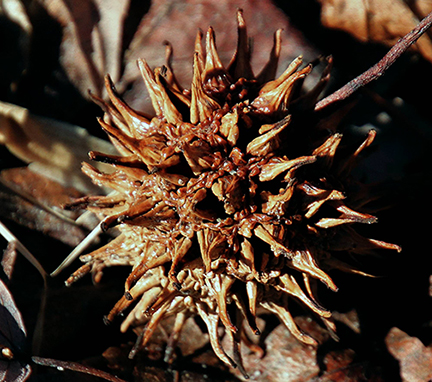
The answer to last week’s mystery is a sweetgum ball from a sweetgum tree, Liquidambar styraciflua, pictured in photo below:

Sweetgum balls are the fruit of the sweet gum tree. Each sweetgum ball is actually made up of dozens of fruits that have fused together. Upon close inspection, the gum ball’s spikes are arranged in pairs, which point toward one another.

As the gum balls dry, they turn from green to brown. During the drying process, holes appear. If you peer into a recently-opened hole, you will see two winged seeds measuring about .25 inches long. Each gum ball will produce 30-50 seeds. Fertile seeds are black with wings on either side, while infertile seeds are yellow and wingless. The seeds disperse by the wind and by animals.

To harvest the sweetgum balls, wait until they are fully brown, but before they dry out. Lay them on a sheet of paper to allow them to dry. Once they dry, they’ll open and release the seeds. These seeds are a food source for many birds and mammals, including mourning doves, finches, chickadees, towhees, chipmunks, squirrels, and rabbits.

Researchers have discovered that the unripe fruit of the sweetgum tree contains a key ingredient used in Tamiflu called shikimic acid.

Mystery Monday is sponsored by the Spy Newspapers and Adkins Arboretum.

The Spy Newspapers may periodically employ the assistance of artificial intelligence (AI) to enhance the clarity and accuracy of our content.

Filed Under: Archives, Food and Garden Notes

Catfished By Laura J. Oliver

January 26, 2025 by Laura J. Oliver Leave a Comment

This is a story of being catfished—you know, when you think you’re getting to know an attractive person online with a successful career, who may even have their family name on a wing at the hospital, only you’re actually corresponding with a troll in a third world country emptying your bank account.

And although this is also a story reminiscent of the first rule of writing: “Nothing is as it appears,” I want you to know from the outset I’m not as naïve as I look.

Okay, that’s a lie

But I do know that no matter how many Instagram requests I receive, that’s not the real Liam Neeson who wants to follow me, or the real Keanu Reeves who wants to be my friend.

Because that would be just silly.

Really silly…

(This is where you say, “It’s not them! Move on!”)

So, the ad said, “Small, sweet, gray kitten, free to good home.” I suppose it was our first foray into being pet owners –the precursor to being parents. We made an appointment with the family running the ad and drove out to Cape St. Claire to meet our new offspring. “I love you already,” I thought as we drove to their neighborhood. “Even more so if you are the runt of the litter.” I was born to champion the disadvantaged.

We sat on the plaid sofa in the living room of a middle-class split-level while the patriarch of a somewhat strange clan retrieved the animal advertised. But what came sauntering down the hall in this house full of liars was no sweet gray kitten. It was an enormous striped alley cat with a gun-slinger swagger. This cat was packing heat. Wearing shades and an attitude. Mr. Oliver and I looked at each other and then back at the ringer like we were in the twilight zone. How could what we were expecting be so different from what we found? Where was the disconnect between the ad for the sweet gray kitten and well, Cujo?

But we had come to get a cat—and we were going to leave with a cat. I did not know yet that I’m not good at shifting gears—at letting go of what I am anticipating to embrace a new reality.

So we took this thug home, optimistically naming her “Sweetcakes,” and Cakers was immediately in charge. We were afraid. Very afraid.

She insisted on sleeping at the foot of our bed, the problem being that if either of us moved one bare foot, even an inch, she dove onto the covers, grabbed whatever moved with her claws, fell on her side, legs thrumming, and sunk needle-sharp teeth through the comforter into bare skin till you screamed.

We lay as still as death, trying not to even twitch, but it was inevitable—one of us would move a leg followed by a shriek in the dark and a competitive scramble for safe space under the covers. As reality dawned that she wasn’t going to acclimate – we were slow learners –we decided to banish her by closing the door to the bedroom. But that just made her sit on striped haunches out in the hall and howl.

We lived in Navy Housing, where thin walls between units meant she was keeping others awake, but the hollow interior doors left about an inch of open space at the bottom, so newly inspired, she hunkered down on her side in the hall and stuck huge, hairy arms like salad tongs under the door clawing at the air trying to latch onto us. We’d sit up in bed transfixed, staring at the disembodied forearms like we were watching a horror movie—The Thing was in the hall! The Thing might get under the door at any moment. I have to admit it was a little exciting.

During the day, she caught mice to play with. She’d take them out into the yard and throw them so high in the air even she didn’t see where they landed. And when we got a second cat, a sweet, small, low-IQ stray we named Henry (let’s have another baby, the dopey couple said, the first one didn’t work out so well), she repeatedly sauntered over to the sofa where he lay sleeping, leaped up and sat on him as if he didn’t exist, usually settling down complacently on his dumb little head.

And then we got pregnant. Like—how bad could having a baby be, we said? At least we won’t be afraid of it.

.I’d like to say I’m quicker now to relinquish what I am hoping for when what I find is something different. But I’m not.

I expected to dance, to become an astronomer, a physicist, a healer, to write a bestseller by the age of 30.

I expected to be a better daughter than I was, to live in one house my whole adult life with a white picket fence and a rose trellis—where the family gathered for parental wisdom and homemade baked bread.

I intended to be a perfect mother.

Can you imagine that naivete, Liam Neeson?

Are you shaking your head, Keanu Reeves?

It’s just that it feels as if the possibility of doing better is still an option when so many expectations have been realized. I did have a house with a white picket fence and rose trellis for a time. I never became an astronomer, but I study the stars. I didn’t write a bestseller, but I did publish a book that I wrote from the heart. I didn’t become a physicist, but I am a student of the cosmos, the search for the beginning, and aren’t we all healers?

If time is an illusion unlived potential is, too –reality is still in play–the ending of your story hasn’t been written yet.

Laura J. Oliver is an award-winning developmental book editor and writing coach, who has taught writing at the University of Maryland and St. John’s College. She is the author of The Story Within (Penguin Random House). Co-creator of The Writing Intensive at St. John’s College, she is the recipient of a Maryland State Arts Council Individual Artist Award in Fiction, an Anne Arundel County Arts Council Literary Arts Award winner, a two-time Glimmer Train Short Fiction finalist, and her work has been nominated for a Pushcart Prize. Her website can be found here.

The Spy Newspapers may periodically employ the assistance of artificial intelligence (AI) to enhance the clarity and accuracy of our content.

Filed Under: 1 Homepage Slider, Archives, Laura

Adkins Arboretum Mystery Tuesday: Guess the photo:

January 21, 2025 by Adkins Arboretum Leave a Comment

Happy Mystery Tuesday!  Can you guess what is pictured below?

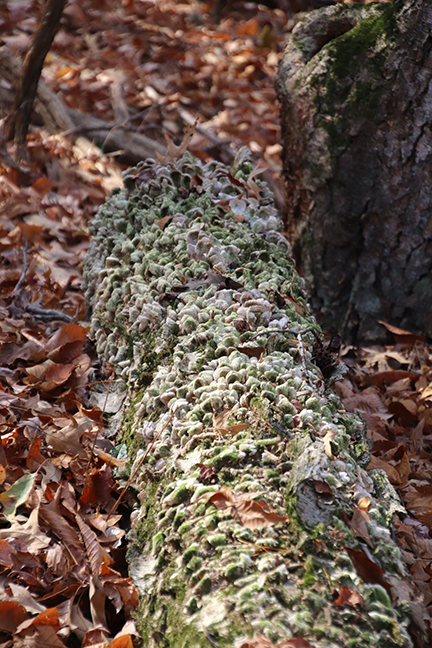
The answer to last week’s mystery is ground pine or tree clubmoss, Dendrolycopodium obscurum, pictured in photo #2.

Ground pine, or tree clubmoss, is neither a pine nor a moss. but is more closely related to ferns. This flowerless ground cover is rarely more than six inches tall and is a very slow grower.

Found in moist sites in woods, thickets, and clearings in nearly every county in Virginia and northern forests in North America and Asia, ground pines prefer acid soil and cool temperatures. The plant tolerates slow nutrients and can withstand a wide range of light conditions. If temperatures become warmer and the forest becomes drier, this species would be expected to decrease.

Lycopods reproduce asexually by spores. The dried spores of ground pine have been used for flash powder for early photography, and in entertainment, like in magic shows. Historically harvested from the wild for Christmas greens, excessive harvesting has threatened ground pines. States like Indiana and New York protect ground pine by state law.

Mystery Monday is sponsored by the Spy Newspapers and Adkins Arboretum.

The Spy Newspapers may periodically employ the assistance of artificial intelligence (AI) to enhance the clarity and accuracy of our content.

Filed Under: Archives, Food and Garden Notes

Adkins Arboretum Mystery Monday: Guess the Photo

December 30, 2024 by Adkins Arboretum Leave a Comment

Happy Mystery Monday!  Can you guess what is pictured in photo below:
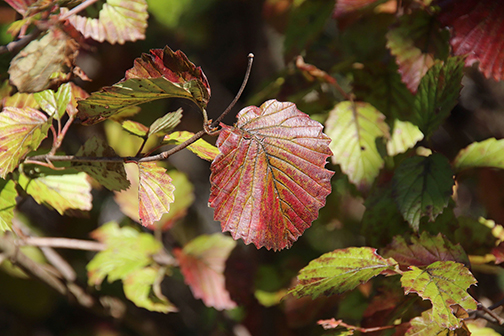
The answer to last week’s mystery is arrowwood viburnum, Viburnum dentatum, pictured below:
Viburnum is a genus of about 150-175 species of shrubs with simple leaves that are coarsely toothed or “dentate.” Viburnums tend to be multi-season plants with ornamental value throughout a large part of the season. Variable Fall color ranges from drab yellow to attractive shades of orange and red.
Arrowwood viburnum flowers in late-May to early-June. The more sun the shrub receives, the showier the flowers it will produce. Its flowers are arranged in flat-topped clusters and are not scented.
Arrowwood has gorgeous, dark blue–purple berries that, while not toxic, are not edible to humans. Birds, however, love the fruit.
This shrub tolerates being planted in shade or full sun, as well as both flooding and occasional drought. Arrowwood can be found along wood margins, open woods, stream banks, in moist floodplain forests, wet flatwoods, seepage swamps and even tidal and alluvial swamps.
The common name, arrowwood, is said to originate from the fact that Indigenous Peoples used the stems of the plant to make arrows. The Neolithic Iceman, Otzi, found frozen in the Alps in 1991, was carrying arrow shafts made from viburnum wood
Native viburnums are the host plants for many creatures, including the Spring azure butterfly. Arrowwood has no serious pests and is even tolerant of salt. Deer, disease, or insects usually do not bother them.
Mystery Monday is sponsored by the Spy Newspapers and Adkins Arboretum.

The Spy Newspapers may periodically employ the assistance of artificial intelligence (AI) to enhance the clarity and accuracy of our content.

Filed Under: Archives, Food and Garden Notes

Adkins arboretum Mystery Monday: Guess the photo

December 23, 2024 by Adkins Arboretum Leave a Comment

Happy Mystery Monday!  Can you guess what is pictured in photo below?
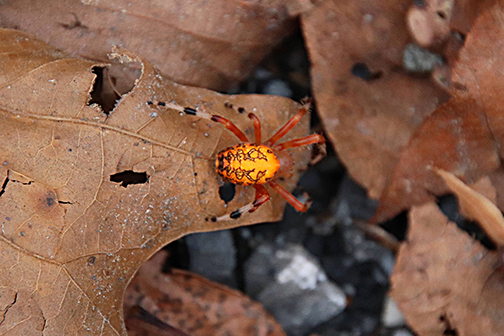
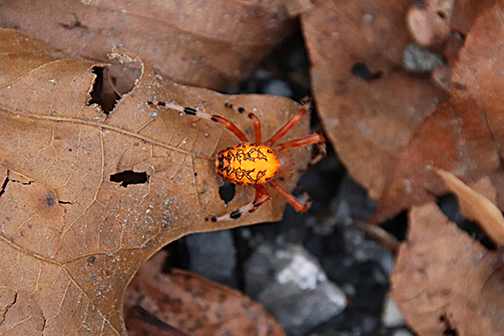
The answer to last week’s mystery is white marbled orbweaver, Araneus marmoreus, pictured in photo below.
Marbled orb weavers get their name from the mottling and spotting patterns found on their bodies. They can be found in residential landscapes, fields, and forests from Spring–late Fall in Maryland. They mostly eat smaller insects, which they capture in their vertically oriented webs. A “signal thread” running through the middle of their webs alerts the spider when prey is caught. Marbled orbweavers spin their web in the morning, and typically spend the day resting in a retreat off to the side of the web.
Mating for the marbled orbweaver takes place in mid–late Summer. Females mate once in their lives, while males may mate several times. Egg sacs, which contain several hundred eggs, are generally deposited in October. The female becomes shriveled late Fall because of lost body mass from laying her eggs.
Marbled orbweavers do not survive the Winter, so adults are not present to provide any sort of care when the spiderlings emerge the following Spring. Their average lifespan is six months.
There are no known adverse effects of marbled orbweavers on humans.
Mystery Monday is sponsored by the Spy Newspapers and Adkins Arboretum.

The Spy Newspapers may periodically employ the assistance of artificial intelligence (AI) to enhance the clarity and accuracy of our content.

Filed Under: Archives, Food and Garden

Adkins Arboretum Mystery Wednesday: Guess the photo

December 18, 2024 by Adkins Arboretum Leave a Comment

Happy Mystery Monday!  Can you guess what is pictured in photo below?

The answer to last week’s mystery is white snakeroot, Ageratina altissima, pictured in photo below:

White snakeroot is a perennial herb that is native to eastern and central North America. All parts of the plant are poisonous to most warm-blooded animals, including humans. When the plant is consumed by cattle, the meat and milk become contaminated with toxins, which, if consumed, can be passed on to humans. The poisoning is called milk sickness and can cause nausea, weakness, abdominal discomfort, and more.
The flowerheads of the wine snakeroot are arranged in loose, terminal, flat-topped clusters in white. Blooms appear from July to October. After blooming, small seeds with fluffy white tails are released in the wind.
White snakeroot is one of the last wild natives to flower, providing nectar late in the season to hungry insects, like bees, butterflies, wasps, moths, and flies.
This plant adapts well to different growing conditions. It is found in woods, brush thickets, and also in
shady areas with open bare ground. It can also be weedy in shady landscapes and hedgerows.
Mystery Monday is sponsored by the Spy Newspapers and Adkins Arboretum.

The Spy Newspapers may periodically employ the assistance of artificial intelligence (AI) to enhance the clarity and accuracy of our content.

Filed Under: Archives, Food and Garden Notes

Conceal/Carry By Laura J. Oliver

December 15, 2024 by Laura J. Oliver Leave a Comment

I was in the wine store the other day not asking for help because I already know that all the least expensive wines are displayed on the lowest shelves so that you have to crouch down near the floor to read those descriptions and prices, which means you are in the way of customers who don’t have to get on the floor to buy wine. You just hunch a shoulder toward the shelf so they can brush past you in the narrow aisle like a tumbleweed on the prairie or boulder in a stream. Balancing on the floor with my purse on one shoulder and a South Moon Under bag in the other hand, I tried not to keel over while reminding myself that the average price Americans pay for a bottle of wine is $12.75.

I was reading wine labels when I found what I was looking for– a “crisp, dry, Sauvignon Blanc with citrusy notes” for $12.99, and walked up to the counter to pay for it. I gave my name to be sure the manager logged the purchase in on my account so that at some point in the future I would qualify for something undefined but good. A whole curated box of holiday wines, perhaps. Or publication of my next book—it doesn’t matter—just the vague promise of accumulating points for a bonus is enough to register every purchase.

The manager looked like my high school friend Jerry Ward, who decided to be a small-town doctor in Vermont at the age of 17 and then, lo and behold, became one. Very cute, with dark curly hair, expressive dark eyes. I thought we were chatting quite amiably when not-Jerry suddenly raised his voice and became very stern.

“Ohhhh no! Not you again!”

I thought he was still talking to me at first. Like he’d suddenly recognized me as that slacker English major who would never earn a discernable income. Startled, I looked up from where I’d been searching for my credit card.

“Oh no, you don’t!” he repeated. “You’re not going to pull this again!”

I realized then that although he was continuing to ring up my wine on autopilot, he was actually looking over my head at someone behind me.

I turned and saw a very scruffy older character who had obviously stuck a bottle of wine down his pants. The top of the bottle protruded from under his shirt above his belt like the creature Sigourney Weaver had to vanquish in Alien.

The man muttered a denial and made no move to extract the bottle from his pants. Only four of us were in the store at the time: me, the manager, a salesclerk, and the thief. We all looked at each other. Pulling the evidence from this man’s pants was a task none of us was willing to perform.

Since he denied the bottle was in there, and we were unwilling to prove it, we were in a kind of a standoff. Encouraged, our shoplifter started edging towards the door in mincing, scuffing baby steps.

Irate, the manager abandoned me and came around the counter. “Stop right there! Sir! You’re not going to get away with this again! You pulled this stunt last week! I’ve got you on camera!” The shoplifter continued to mutter his denial and shuffle toward the door.

I’m having a robbery, I thought, a bit excited at this development in my day.

Like one entity, equally helpless but braver as a unit, the manager, salesclerk, and I all began instinctively moving in a sort of communal shuffle of our own between the thief and the door.

The salesclerk announced loudly, “I’m calling security,” and I stood there while she reported to the authorities that a robbery was in progress. I was still standing there when they didn’t come.

“Good thing no one has a weapon,” I observed quietly to her, then wondered if that was true. What are the conceal/carry laws in Maryland, I wondered? Maybe the guy’s not lying. He’s not stealing wine; he’s stuffed a gun in his pants!

“Let me get you out of here, “the salesclerk whispered to me and quickly completed my purchase as the stalemate continued.

As I walked past the manager in this bizarre standoff, I offered, “Alzheimer’s? Dementia?” The situation was so bizarre that the possibility seemed warranted.

“No way,” the manager said, then added softly, “I’m sorry for this.” His apology felt intimate. Like an intruder had interrupted our family dinner. Or as if the conflict had made us teammates for a moment. Team Right-Side of the Law! Team Right versus Wrong.

Fortunate versus Unfortunate. Us versus Them. I edged on out the door.

I was back in the store a few weeks later—okay, a week later—and reminded the manager that I’d been there during the incident. “What happened?” I asked. “I noticed Security never came.”

“Oh, they came,” he said. “After you left. It was a big deal. He resisted arrest. They got him on a bunch of counts. That guy has been pulling this stunt all over this shopping center. He’s been banned from the entire place for two years.”

“What did you do with the wine down his pants?” I asked, eyeing the bottle I was buying. The manager rolled his eyes, and we laughed about how that bottle was a goner, about all the inadequate ways one might have rehabilitated it. Ha, ha, ha, we laughed together as he slipped my purchase into a bag. I handed not-Jerry a credit card, looked at the bottle I was buying, and wondered, not about wine but about the man who needed to steal it.

About how little space there is–none actually– between us and them.

About what we conceal and what we carry.


Laura J. Oliver is an award-winning developmental book editor and writing coach, who has taught writing at the University of Maryland and St. John’s College. She is the author of The Story Within (Penguin Random House). Co-creator of The Writing Intensive at St. John’s College, she is the recipient of a Maryland State Arts Council Individual Artist Award in Fiction, an Anne Arundel County Arts Council Literary Arts Award winner, a two-time Glimmer Train Short Fiction finalist, and her work has been nominated for a Pushcart Prize. Her website can be found here.


The Spy Newspapers may periodically employ the assistance of artificial intelligence (AI) to enhance the clarity and accuracy of our content.

Filed Under: 1 Homepage Slider, Archives, Laura

Destination Dover Station: Craig Fuller talks to Sevan Topjian

December 11, 2024 by Craig Fuller Leave a Comment

A new market opened in a place known for commercial activity in Easton for a century.  Their theme, “Shop small / shop local,” is gaining attention among shoppers and makers of handcrafted products across the Eastern Shore and beyond.  And, with the holidays approaching, there couldn’t be a better time to explore the many offerings.

Recently, Craig Fuller dropped by to talk with Sevan Topjian, a local resident and developer of Dover Station LLC. Sevan explained the vision he and his wife Keri are bringing to the three large structures at 500 Dover Road in Easton.

The Market at Dover Station is in a revitalized historic building.  Many makers and artisans have already found the location provides a wonderful opportunity to display and sell what they create.  There is already a great sense of collaboration among the artists. And, as Sevan explains, the systems in place takes care of recording inventory and transactions, allowing those who make the products to keep creating while leaving the retail side to the team at the Market.

Spend a few minutes enjoying the conversation and tour the Spy took with Sevan and meeting some of the people involved in creating an innovative new environment that will eventually include a Café Bistro and a brewery.

This video is approximately seven minutes in length. For more information about the Dover Station please go here.

The Spy Newspapers may periodically employ the assistance of artificial intelligence (AI) to enhance the clarity and accuracy of our content.

Filed Under: Archives, Spy Highlights

  • « Previous Page
  • 1
  • …
  • 3
  • 4
  • 5
  • 6
  • 7
  • …
  • 21
  • Next Page »

Copyright © 2026

Affiliated News

  • Chestertown Spy
  • Talbot Spy
  • Cambridge Spy

Sections

  • Sample Page

Spy Community Media

  • Sample Page
  • Subscribe
  • Sample Page

Copyright © 2026 · Spy Community Media Child Theme on Genesis Framework · WordPress · Log in