MENU

Sections

  • Home
  • Education
  • Donate to the Centreville Spy
  • Free Subscription
  • Spy Community Media
    • Chestertown Spy
    • Talbot Spy
    • Cambridge Spy

More

  • Support the Spy
  • About Spy Community Media
  • Advertising with the Spy
  • Subscribe
March 4, 2026

Centreville Spy

Nonpartisan and Education-based News for Centreville

  • Home
  • Education
  • Donate to the Centreville Spy
  • Free Subscription
  • Spy Community Media
    • Chestertown Spy
    • Talbot Spy
    • Cambridge Spy
Archives Spy Highlights

Irma’s Got a Brand New Gig: A Chat with Eden Green’s New CEO Irma Toce

September 23, 2024 by The Spy Leave a Comment

The last time the Spy saw Irma Toce was during an exit interview at the end of her long and successful tenure as Londonderry on the Tred Avon’s CEO a few years ago. As we said goodbye to Irma, we wished her well as she and her husband began a well-deserved retirement in a new, beautiful home in Lewes, Delaware. But for those who knew Irma and her well-known Dutch work ethic, it was a bit of a betting game if she was ready for a leisure-based lifestyle.

It turns out she wasn’t, but what surprised a few was that she chose to work at the Residence at Eden Green, an assisted living and memory care facility in Denton. Unlike her leadership position at Londonderry with its very spray, fully engaged residents, Eden Green has a mission of assisted living and memory care.

But as someone who cared for a mother who suffered from dementia, Irma Toce knows firsthand what caring for those suffering from memory loss is all about. In her most recent interview with the Spy, Irma talks about her return to work, her passion for her new project, Eden Green, and her goal of making it one of the best memory care facilities in Maryland.

This video is approximately minutes in length. For more information about Eden Green, please click here


The Spy Newspapers may periodically employ the assistance of artificial intelligence (AI) to enhance the clarity and accuracy of our content.

Filed Under: Archives, Spy Highlights

I’ve Got You By Laura J. Oliver

September 22, 2024 by Laura J. Oliver Leave a Comment

I was on a United Airlines flight from Dulles to LAX the day after a major ice storm in the Northeast had closed a third of the country’s airports, and the airlines were playing catch up. My flight was delayed, all of us already onboard, waiting to leave the gate. Our pilot came on the intercom giving periodic updates as to our status.

“Folks, we’ve closed the doors and are ready to push off here, but we’ve been told we have to wait for 13 pieces of luggage. Apparently, some of you were late.” No one made eye contact with anyone except the people they’d boarded with, hiding the culprits’ identity. But over the next 15 minutes, the captain came on less and less frequently with updates, more irritated each time. Finally, he reported, “Uh, folks, we’re not waiting anymore.”

The cabin lights dimmed, and the plane rocked slightly, then began the slow push back, the careful turn, the taxi toward the runway. I was relieved because I had a connection to make in LA, but I hoped my suitcase wasn’t one of the 13 we were leaving behind.

We accelerated toward takeoff, runway edge lights whipping by, each passenger in his own way preparing for that moment in the race for ascent when you feel the rear wheels leave the earth. What is it about that moment? Do we somehow know it’s like dying? Finally free of the restraints of both our own gravitational body and the earth’s?

But we didn’t take off. Instead, the plane suddenly decelerated and powered down to a stop. After a moment, the pilot explained: “Folks, Air Traffic Control isn’t happy about us leaving without the bags. Looks like we’re going to sit in a penalty box for a while.”

So, on my trip to California this spring, I decided not to check luggage. It was so much easier not to go to baggage claim, where passengers bunch and bump at the carousels like impatient cows milling at the trough. The only difficulty was lifting my carry-on into the luggage bin over my head. I couldn’t get it up over the lip, but a kind passenger several seats away intuited the struggle wasn’t going to go my way and moved around people clogging the aisle as passive as logs to offer a hand in the nick of time. I still love him. No, seriously. I love him.

I always take a seat on the aisle so I can get up without bothering anyone. Southwest 5461 was packed, but as passengers boarded, I wanted to use the restroom, and as I was seated so close to the front, I decided to go for it. There was a lovely girl in the window seat next to me—young enough to be my youngest daughter–with long dark hair like Emily’s. She was wearing a beautiful, three-diamond engagement ring, and I’d seen her Facetiming her fiancé on her tablet. He looked so affable—a big guy with reddish hair.

Seats aren’t assigned on Southwest (although they claim they are changing this policy), so I asked my seatmate if she could be sure no one else took the seat in the few minutes I’d be away. She smiled—“of course,” she said—“no worries.”

I maneuvered my way up the aisle of boarding passengers like a salmon to discover a pristine restroom in that rare spacetime anomaly in which it had not been used since the pre-flight cleaning. I then made my way back to my seat, but when I approached, I saw it had been claimed by an enormous backpack. I paused, uncertain what to do, when the girl glanced up, “Oh, that’s mine,” she said, lifting it, “I wasn’t going to let anyone take your seat,” she said, laughing. I must have looked relieved as I sank down and searched for my seatbelt. She leaned over, “I’ve got you,” she said and went back to work on her laptop.

She’s got me, I thought, ridiculous with gratitude. When you are traveling alone, little kindnesses are big. Supersized, actually.

Eventually, my seatmate put her work aside and began scrolling through wedding dresses. We didn’t say one word to each other for the next five hours, not until we started our descent. I developed this inflight protocol after years of making the nearly 13-hour flight from LAX to New Zealand after having already flown five hours cross country. Don’t start a conversation with your seatmate until the landing gear is down. There is a swimming pool salesman on board NZ 8 whom I suspect is still talking. He probably hasn’t even noticed we’ve landed, and I’m back in America.

“When’s the wedding?” I asked my seatmate as we descended over Baltimore.

She smiled, seemingly pleased to be asked. “October,” she said.

“The dresses you were looking at are gorgeous,” I said. “You will be a beautiful bride.”

We hit the tarmac with a thump, and the wing flaps caught the air to slow us. As always, it felt as if the engines powered in reverse- as if parachutes had deployed behind us. Five hours in the clouds and earth had reclaimed us.

The flight attendant came on to thank us for flying Southwest. “If you are connecting to another Southwest flight,” she said,” be sure to check the arrivals and departures board at the top of the jetway when you enter the terminal, as gate assignments can change.

 “And if you are connecting to another flight that’s not Southwest…how can I put this?… We really don’t care what happens to you.”

I pulled my carry-on down, laughing.

“Have a lovely wedding,” I said, but I meant, Have a beautiful life. Because unlike our flight attendant, I did care about her. May whatever baggage you’ve brought into this partnership be dispatched with grace. May you never miss a flight and your delays be minimal. May you have as little turbulence as possible. May your losses be small and your love be big and resilient. Keep your seatbelt on.

In October, I will wish that lovely young woman a sunny day for her wedding and a marriage that stays aloft.

As for you, may there always be someone in your life to say, “No worries, I’ve got you.” May you never miss a flight, lose your luggage, or pick the beef entré.

And may love be waiting at the Arrivals Gate.


Laura J. Oliver is an award-winning developmental book editor and writing coach, who has taught writing at the University of Maryland and St. John’s College. She is the author of The Story Within (Penguin Random House). Co-creator of The Writing Intensive at St. John’s College, she is the recipient of a Maryland State Arts Council Individual Artist Award in Fiction, an Anne Arundel County Arts Council Literary Arts Award winner, a two-time Glimmer Train Short Fiction finalist, and her work has been nominated for a Pushcart Prize. Her website can be found here.

Laura Oliver will be reading her work at the Stoltz Listening Room at the Avalon Foundation in Easton on April 24th at 6 pm as part of our Spy Nights series. Tickets can be purchased here.


The Spy Newspapers may periodically employ the assistance of artificial intelligence (AI) to enhance the clarity and accuracy of our content.

Filed Under: 1 Homepage Slider, Archives

Chesapeake Lens: “Starlight” By Kim Cowley

September 21, 2024 by Spy Desk Leave a Comment


A night on Wildlife Drive in the Blackwater National Wildlife Refuge is a magical time to experience the beauty of the Bay and its habitats.

The Spy Newspapers may periodically employ the assistance of artificial intelligence (AI) to enhance the clarity and accuracy of our content.

Filed Under: 3 Top Story, Archives, Chesapeake Lens

Striking Out at Camden: How Three Bad Seasons Sent A Once Proud Franchise Into A Decade Long Tailspin

September 20, 2024 by Jason Elias Leave a Comment


Cal Ripken from the dugout on the night he stopped the streak on September 20, 1998. The Orioles lost to the Yankees 5-4.

The 1998–2000 Orioles were one of the more disappointing teams of modern times. From owner Peter Angelos’s ham-fisted and wrongheaded ownership to Mike Mussina’s inevitable exit, we saw how a team loses 14 straight seasons. How does it start? One season at a time…

The cynical among us say that the roots of the 1998 losing season were in 1997. After falling to the Cleveland Indians in the AL Championship Series, Orioles owner Peter Angelos fired Davey Johnson. For all of his vaunted intellect, Peter Angelos basically fired a perfectly capable manager who got his team to 1st place.

That was just a start. Star Orioles closer Randy Myers got 46 saves in 1997, didn’t want the O’s contract and went to Toronto, San Diego and then out of baseball.

The Orioles went in-house for a new manager, pitching coach Ray Miller. Although he was there for the Oriole Way/Cal Ripken fungo bat days, he wasn’t in any shape to practice “The Oriole Way,” especially on a team of rented and hurt veterans.

Really, Ray Miller was a so-so manager who hadn’t managed in 13 years, he wasn’t the  optimum choice, especially dealing with a George Steinbrenner manqué in owner Angelos. It didn’t take long for Miller and the Orioles to be tested.

On May 19th the Orioles and Yankees faced off in a bench clearing fight. Reliever Armando Benitez gave up a home run to Bernie Williams and then dinged the next batter, Tino Martinez (of course) in the shoulder and a brawl for the ages started. One of the biggest highlights was when Daryl Strawberry ended up in the Orioles’ bleachers.

Even the fight was telling. The Yankees had more fighters, even their brawls were coordinated and the Orioles were outmatched in fights and in baseball games. At the point of the fisticuffs, the Yankees were 28–9 in first, the Orioles were 20–23 in last place and 11 games back.

That said, the 1998 team wasn’t a bad one. Rafael Palmerio, Roberto Alomar and Cal Ripken were All-Stars and both Mike Mussina and Scott Erickson had gutsy seasons. Strong vets anchored the team including Eric Davis and Harold Baines. The problems? Well, they started off slowly but surely.

Only two pitchers Mike Mussina (13–10) and Scott Erickson (16–13) had wins in the double digits. The Orioles searched for a third starter in tired arms like Doug Drabek, Scott Kamienicki and Juan Guzman. Jimmy Key spent most of the season in pain and went 6–3 and retired from baseball.

To add insult to injury, the Yankees went 114–48 and won the World Series in 4 games. The Yankees winning percentage was a staggering .714. The Orioles winning percentage was .488.

Not surprisingly, the Orioles’ high level talent started to leave. General manager Pat Gillick left for the Seattle Mariners. Rafael Palmerio took a pay cut to play again for the Texas Rangers. Roberto Alomar left to play with his brother for the Cleveland Indians.

The Orioles vaunted farm system wasn’t going great guns either. After another promising start, the oft injured Jeffrey Hammonds was traded to the Reds. 

In other comings and goings, Mike Mussina longtime battery mate Chris Hoiles called it a career. And oddly enough the 1998 season was the year that the Iron Man Cal Ripken decided to stop his streak. It was as good a time as any. Promising farm system player Ryan Minor replaced Ripken in the lineup at 3rd base.

Since it wasn’t 1992, neither Joe Carter, Norm Charlton, Jimmy Key or Doug Drabek would be coming back to the Orioles. By this point, Angelos’ brusque management style had become so renowned that exiting GM Pat Gillick told 1999 GM Frank Wren not to take the job. He didn’t listen. What came so easy in 1996–97 became downright difficult in 1999.


1999 Outside Pitch Card, Mike Mussina, Cal Ripken Jr, and Brady Anderson

Of the returning players, the O’s still had Brady Anderson who was a durable presence even after his 1996 dream season. Cal Ripken was still there although age and injuries were catching up to him. Mike Mussina remained a dominant pitcher although on a diminishing team that couldn’t recruit A level talent.

Peter Angelos started to own the team in 1994. Despite early good luck, Angelos made rookie mistakes that hampered the organization for many years

Peter Angelos and the Orioles front office dysfunction wasn’t exactly an inviting place to go play baseball so the options became limited. Angelos did his tried and true acquisition of vets including Charles Johnson, Jeff Conine and Delino DeShields.

In an interview, Angelos talked about a player he wouldn’t have taken a chance on.

“Jeez, that guy! I’ve looked at medicals for 30 years as a lawyer, and that guy had the injuries of an infantryman!”

Who was that guy? It was Will Clark and Angelos signed him to a 2 year, $11 million dollar contract.

Angelos sidestepped the glaring pitching issue and signed human powder keg and Albert Belle for a five year $65 million dollar contract.

Belle’s stats were great. For all of the talk about his slugging (.564 batting percentage) he was great on the field too with a .976 fielding percentage. According to reports, Angelos acquired Belle so the Yankees couldn’t get him. How cynical was that? And costly, very costly.

The pitching was a bit better but not enough to compete. Mike Mussina just missed having his first 20 game season and Scott Erickson actually had more wins than losses at 15–12. Mike Timlin was all but the poster boy of this team’s deficit and was 3–9 and appeared in 69 games, mostly used in short relief. The once promising Rocky Coppinger started to find his path out of baseball going 0–1 with a 8.32 era.

The worst of the bunch had to be Heathcliff Slocumb who got paid $1 million dollars for 10 games and a 12.46 era. Slocumb didn’t make it past April. Really? In retrospect, the very idea of having a pitching staff that included Heathcliff Slocumb, Mike Timlin and Mike Fetters wasn’t going to compete let alone win.

The manager had to go and he did. In October 1999 Ray Miller’s option wasn’t picked up at the end of a very grim season. That season incurred more wrath and collateral damage from Angelos, and while Angelos and GM Frank Wren were looking for a new manager, Wren was relieved of is duties too.

In November 1999, the Orioles signed Mike Hargrove as the manager. Like the 1997 Orioles, the 1999 Indians they lost in the playoffs after coming in 1st in the AL Central and Hargrove was the fall guy. In effect, he brought all of that cheer to a fading, failing highly dysfunctional franchise.

If anyone thought Hargrove would light a winning spark in this group of vets, they were sadly mistaken. At this point the losing skid was in the team’s DNA regardless of whether Cal Ripken was there or not. Syd Thrift was in the GM role and reportedly helped Frank Wren out the door.

The Orioles didn’t make any moves, likely a combination of being tentative, being cash strapped and the organization having a bad reputation. Shortly after the All-Star break, the Orioles were 38–49, the accustomed “comfort zone” for the team hovering below .500

Something has to be done and Angelos did it during the season. Instead of filling his dugout full of vets, he let a bunch of them go. Charles Johnson, Will Clark, Mike Timlin, Mike Bordrick were all traded as there were more games to be played. Even a returning Harold Baines wasn’t immune and was sent for his third stint with the White Sox.

While it was good news to see some of those recent acquisitions go by the end of the season, another important one was on the horizon and it didn’t have to be so.

The farm system continued to be depleted as Calvin Pickering didn’t turn out to be a Y2K Gates Brown anymore than beloved Ryan Minor would become an heir to Cal Ripken Jr. Although this was all bad, worse was coming.

By 2000, Albert Belle had a degenerative hip condition and at a press conference, Peter Angelos stated the following:

“This is the end…Albert is no longer playing baseball for the Orioles.”

Belle didn’t go away with just a handshake, the O’s had to pay $13 million in for the final three seasons of the $65 million, 5 year contract with $3 million a year deferred.

Mike Mussina at the press conference with the Yankees.

In November 2000, the Orioles No. 1 pitcher and franchise player, free agent Mike Mussina, left and signed with the New York Yankees for 88 million dollars. The loss of Mike Mussina still stings to this day, most had expected Moose to end his career here. The reason he left was simple and Mussina said at the Yankees press conference…

“It just came down to who really seemed to want me on their team the most…”

Before it got to this point, owner Angelos never even considered Mussina leaving as he said, “He’s not going anywhere…”

Rafael Palmerio returned in 2004 only to be chased out of baseball due to failing a steroids test. David Segui was also back and the mercurial Sidney Ponson was still there and had a 5.30 era that year.

Mike Hargrove ended up managing the Orioles for 2 more seasons. He ended up with four seasons where the Orioles ended up in 4th place. Arguably, he had little to do with the losing seasons, the foundations started years before the Orioles turned losing into an art form.

The Orioles basically toiled in anonymous anonymity. Melvin Mora (acquired from the Bordick trade), Nick Markakis, Matt Wieters and later Chris Davis and Adam Jones represented the new guard.

The O’s had a flirtation with actual success in 2005 under new manager Lee Mazilli, the Orioles led in the East most of the season until they collapsed in a heap and headed towards another losing season.

Angelos’s machinations seemed to be mollified by the mid 2010s. His yen for limping veterans abated due to the fact that that kind of player began to retire early and wasn’t available.

The Orioles finally won again in 2012 with manager Buck Showalter. Not surprisingly, the winning season seemed to come as baseball changed and Angelos just stayed out of the way. The Angelos family sold the Orioles in January 2024 to a group led by private equity investor David Rubenstein. Peter Angelos died in March 2024. 

After over a decade of steady losing, the Orioles are a regular team again, going through the simple highs and lows of a contemporary baseball ball club. At this point, that is a gift in and of itself.

Jason Elias is music journalist and a pop culture historian. 

The Spy Newspapers may periodically employ the assistance of artificial intelligence (AI) to enhance the clarity and accuracy of our content.

Filed Under: Archives, Opinion

A New Chesapeake Ferry? By Brent Lewis

September 18, 2024 by Spy Desk Leave a Comment

The findings of a yearlong Chesapeake Bay Passenger Ferry Feasibility Study, spearheaded by a five county consortium consisting of Anne Arundel, Calvert, St. Marys and two counties on the Eastern Shore – Queen Anne’s and Somerset – were announced at this summer’s Maryland Association of Counties Conference in Ocean City.

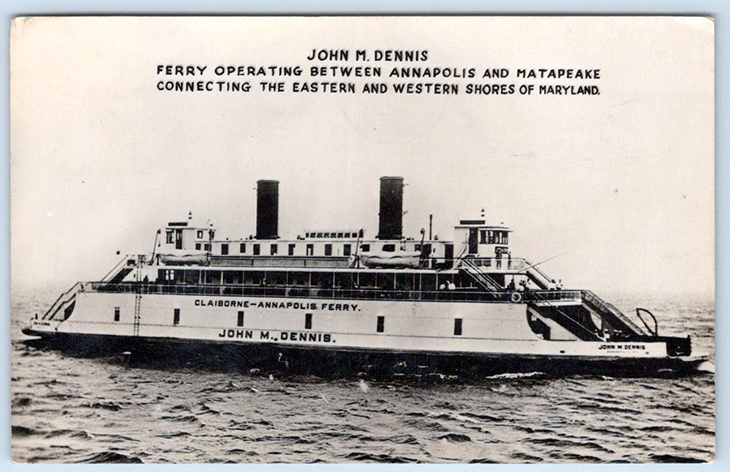
The use of ferries for the purpose of making one’s way around the Chesapeake Bay has been part of the region’s economy and social fabric since the earliest days of colonization. Travelers on foot and horseback, catching rides up and down and across the Chesapeake, led to the iconic vessels of the steamboat era and then to the early Automobile Age ferry system that crisscrossed bay waterways to meet the needs of a more mobile vehicular culture.

These ferries, built or modified for passengers as well as their cars and trucks, were an important part of bay freight and transportation networks through three decades of the early twentieth century and still hold a nostalgic value for those who remember them. Their era of service ended in 1952 after the Bay Bridge opened to traffic. Now, seventy two years later, there is a serious initiative underway to perhaps bring a regional passenger ferry system back into existence and back into people’s hearts.

In the past there have been conversations, speculation, and even other studies undertaken as to what a new ferry system might look like, but the current process began in earnest in January 2023 when the five participating counties, all Maryland counties with bay access were invited to join, began accepting bids to conduct a feasibility study. The winners of that procedure, the Massachusetts-based transportation consultants Cambridge Systematics were  assigned to explore how a new passenger ferry service could stimulate economic growth, encourage tourism, and restore vital  links between people and their surrounding communities.

The 114-page study outlines such primary details as vessel requirements and ferry station infrastructure along with such more nuanced data as potential passenger appeal and economic projections. Initially focusing on a handful of key baseline communities that are most likely to experience success as travel destinations, including Baltimore and Annapolis, plus St. Mary’s City and Crisfield, a long term favorable outcome would see more than twenty locales included in the network.

Heather Tinelli

Heather Tinelli, the Economic and Tourism Development Director for Queen Anne’s County, says that even in these early planning stages of the proposed ferry project, the five county collaboration on both sides of the Chesapeake has proven the potential of “making the bay more of a connector than a divider.” There are two prospective route connections in Queen Anne’s, one at Matapeake Fishing Pier, one of the last and most popular dockages of the old ferry lines, and one at Kent Narrows.

As society reassess both the importance of interpersonal connections between communities and expanded access to the bay as being critical to people better understanding, appreciating, and prioritizing the area’s natural resources, the establishment of a system of passenger ferries might not only be capable of introducing Marylanders and visitors alike to parts of the state they’re unfamiliar with, but could, despite significant initial investment and risk, result in meaningful financial advantages.

Clint Sterling

Clint Sterling, the Director of Recreation, Parks & Tourism for Somerset County, says that potential benefits are numerous, including investment in the community to “increase and optimize our amenities to serve visitors, revitalization and growth for our existing tourism partners, and serve as a catalyst for economic growth across many sectors.”

The study recommends that an initial plan should include the service of two 149-passenger and five 49-passenger diesel or diesel-electric hybrid catamarans which would serve 50,000 riders on six proposed routes with fourteen stops four twenty six weeks from mid-April to mid-October. It is estimated that each low-impact rider, no cars will be added to the mix, will spend an average of $200 at their destination in food, attractions, shopping, services, and lodging.

The venture will be funded by a public and private partnership, a fiscal structure that provides access to transportation funds made available through the state and federal governments while still being driven by the goal of making a profit. The operation of the vessels used in the system would be financed by ticket and advertising revenue, in conjunction with support through the communities that will benefit from their service. There would be costs to establish the system and revenue would take time to catch up to investment, but ownership shared through public-private resources provides different avenues to reach operational goals.

The next steps to seeing the proposed Chesapeake Bay ferry network come into being will all also take time. It will take time to assess the readiness of the recommended docking locations, to contact potential private transportation companies who would oversee ferry operations (auto ferries were considered but would require more investment than current data would support), and to secure development funding, tools, and opportunities.

“Most important of those next steps,” says Heather Tinelli, “include continuing to reach out to the community for input and support and getting the results of the feasibility study into the hands of individuals, as well as businesses and politicians in the region.  Any plans made moving forward will be bolstered by positive community feedback and support. Community involvement will be crucial.” Clint Sterling emphasizes that all efforts will be made to “make sure all voices are heard.”

Tinelli says the consortium and the participating counties they represent believe that the “unique economic development opportunity to boost tourism and strengthen connections within the Chesapeake Bay region are real.” She says that the study decided the basic vision the counties have is feasible but long term, future-looking planning has to be flexible. “This is not,” she says, “an overnight process. No one would want it to be. Bringing something like this to fruition takes careful consideration. There are lots of moving parts and the numbers matter.”

Sterling concurs: “Any undertaking that is worth the effort will certainly have its challenges – for our area I look at this opportunity not necessarily as a series of challenges, but more of meeting benchmarks by creating the areas that will be appealing to the visitor and meet their needs and providing support to the potential operators of the service that will make our location an enticing place to do business.

“A far more problematic scenario,” he says, would be “if this study and potential project were taking place and we were not part of the proposal and were on the outside looking in.

“We believe this ferry has the potential to revitalize our region and develop many beneficial opportunities, create jobs, enhance our tourism industry and boost the economy, and provide access to recreational amenities.

“And” he adds, “that the real work is just beginning.”

The full Chesapeake Bay Passenger Ferry Feasibility Study can be seen here.


The Spy Newspapers may periodically employ the assistance of artificial intelligence (AI) to enhance the clarity and accuracy of our content.

Filed Under: 1 Homepage Slider, Archives

Waterfowl Festival Announces Conservation Mini-Grant Awards

September 16, 2024 by Waterfowl Chesapeake Leave a Comment

Waterfowl Festival Executive Director Deena Kilmon presents check to Phillips Wharf Executive Director Kristen Lycett

The Waterfowl Festival Conservation Committee is delighted to announce the recipients of this year’s Community in Conservation Grants. As part of our ongoing commitment to preserving our rural environment and supporting wildlife conservation, we are pleased to award grants to three outstanding organizations: Ducks Unlimited Inc., Phillips Wharf Environmental Center, and ShoreRivers. Each organization created exceptional projects that will educate and have a positive impact on our community.

“For over fifty years, we have supported organizations whose mission is to acknowledge the importance of our natural environment and open spaces, and work to preserve it,” remarked Chip Heaps, Conservation Committee chairman. “We congratulate Ducks Unlimited, Phillips Wharf Environmental Center, and ShoreRivers for their exceptional contributions to this work and are excited to see the positive results of these funded projects.”

Waterfowl Conservation Committee and Waterfowl Festival VP Julie Susman presents check to Shore Rivers Suzanne Sullivan

Every year, our Community in Conservation Grant Program accepts funding requests from non-profits and community organizations across the region whose mission is to make a difference in supporting our shared mission of environmental conservation. The program supports projects that are at the intersection of waterfowl and habitat conservation and how this impacts our community, whether they are focused on education and outreach, science and research, or restoration. Ideally, projects include aspects of each focus area and benefit our waterfowl, their habitats, and the people of our community. Past awardees include University of MD- Horn Point, University of Delaware, and Talbot County Public Schools. The grant cycle will re-open in spring 2025.

Non-profit organizations that impact the environment or the education of our community in this space are welcome to exhibit this year in our Chesapeake Bay Pavilion during this year’s Waterfowl Festival November 8-10, 2024. Please contact the Waterfowl Festival for more information on how your organization can participate by emailing [email protected] or by calling our office, 410-822-4567.

The Spy Newspapers may periodically employ the assistance of artificial intelligence (AI) to enhance the clarity and accuracy of our content.

Filed Under: Archives

Only You By Laura J. Oliver

September 15, 2024 by Laura J. Oliver Leave a Comment

During summers at Barnstead—before I turned 12 and my parents sold it — we were a lanky tribe of kids at loose ends. No one had a basketball hoop, or a blacktop; no one took tennis, sailing, or swimming lessons. Instead, we played competitive games like Pompom-Pullaway, Red Rover, and Spud. We had the rope swing over Scott’s ravine and bikes. Freeze tag and swinging statues. Hide and Seek.

Honestly, we were the original characters in Lord of the Flies including a personalized and quite popular game of which I am not proud called, “Let’s run away from Georgie.” He was the youngest among us and built like a very short Michelin man. When his younger brother Billy was born, Billy should have become the object of our ostracism, but because he was a baby, running away from him was about as entertaining as running from a backpack or flowerpot. Sorry George. I understand you live in Florida now and have a beautiful daughter.

Because it was cooler, we spent most of our days making forts in the woods–a village of residences that were outlines dug in the soft dirt and pine needles, cleared of debris, then reinforced with logs or branches, of course leaving a “door” to walk through. Forts were built adjacent to each other, so we had a kind of village— Lord of the Flies became Habit for Humanity.

As kids you agree to abide by the same reality so there was no rude stepping over or walking through walls to enter someone’s fort. Enter through the front door only. That was the rule. The kid rule. There were others like, “Never ask for candy at someone else’s house.” Oh, and “If you see Georgie, run for it.”

But what made a fort a home was the acquisition of seats–planks of wood left over from construction projects and thrown out in the woodpile. Inviting someone into your fort and offering them a seat was high-rent-district protocol.

When war broke out in the woods between different factions of fort builders (boys against girls) or the settlers on one side of the pasture versus the other, finding that your seats had been stolen was worse than finding that your walls had been scuttled. But I was more than a homeowner. I had a humanitarian project.

I made shoes from giant tulip tree leaves. I poked the stem of one through the top of another and then tied them around hot bare feet. My shoes were as soft as silk though they only came in one color. They also only lasted for several steps unless one employed a kind of flat-footed zombie walk that didn’t put a lot of stress on the stem ties. I’m demonstrating this, you just can’t see me.

Like not walking through walls, in some ways we agree to the same rules of reality now. We agree that we are born into this world, age and die. We agree that green is green and yellow is yellow, although we really don’t know if what we are seeing is exactly the same. We share a tendency to go through life two by two when we can, in whatever manner we can. We agree that a birth is a miracle, that all dogs go to heaven (where like the good boys and good girls that they were, they’re waiting to greet us even now). We agree to stop at red lights and wear seatbelts.

We used to agree that the sun revolved around the earth, that the universe was static, eternal, and there was only one. Now we agree the universe is expanding and at an accelerating rate. We are asking each other whether there may not be many universes, whether in fact, we live in a multiverse. The idea is in part, that there are an infinite number of versions of you—there is the you that became who you are, and a you that dropped out of school and became a rockstar, a you that never married, a you that lives on a planet where it rains diamonds.

But I hope this is not true. I really want there to be only one universe. One beautiful, eternal, evolving, galaxy-studded universe, where kids still make forts in the woods, where forests still stand lush and alive with birdsong, where raindrops are not made of jewels but do create tiny crowns when they splash into the river—a universe in which the big bang was the first beat in the heart of God.

And there is only one you.


Laura J. Oliver is an award-winning developmental book editor and writing coach, who has taught writing at the University of Maryland and St. John’s College. She is the author of The Story Within (Penguin Random House). Co-creator of The Writing Intensive at St. John’s College, she is the recipient of a Maryland State Arts Council Individual Artist Award in Fiction, an Anne Arundel County Arts Council Literary Arts Award winner, a two-time Glimmer Train Short Fiction finalist, and her work has been nominated for a Pushcart Prize. Her website can be found here.


The Spy Newspapers may periodically employ the assistance of artificial intelligence (AI) to enhance the clarity and accuracy of our content.

Filed Under: 1 Homepage Slider, 3 Top Story, Archives, Laura

The Dreamcatcher, Chapter Two: “Haddon” By Jamie Kirkpatrick

September 10, 2024 by Jamie Kirkpatrick Leave a Comment

(Author’s Note: This is the second chapter of “The Dreamcatcher,” a serial story in this space.)

 By the time the newly-minted Dr. Solomon DeSouza accepted a position in cyber security with the National Security Agency at Fort Meade, and his wife, Mrs. Hyacinth DeSouza, reported to her new job at the Department of Education in downtown Washington, DC, the family had moved to a small rambler in Silver Spring, Maryland, an appropriately diverse enclave accessible to both parental postings.

Little Tatu had just turned eleven and was preparing to enter fifth grade. His parents decided to enroll him at Haddon, a well-respected, all-boys school in the adjacent suburb of Bethesda. Coming from the relative freedom and independence of the Montessori method, the transition to the academic discipline and social mores of Haddon was not easy for Tatu. Moreover, Haddon boys were interested in sports almost to a fault, while Tatu was anything but athletic. In the fall, he tried soccer, but his large, black-rimmed glasses came home broken—twice. In winter, he attempted to dribble a basketball but couldn’t manage more than a bounce or two before losing control to gravity. In spring, Tatu’s parents bought him a tennis racket in hopes he might make new friends on the court. But the ball never seemed to find the strings of Tatu’s racket, and by the end of the first week of spring sports, Tatu was a spectator, not a participant, sitting and studying on the sidelines.

That was when the teasing began in earnest. As his parents ascended their respective professional ladders, Tatu descended his social staircase. One of the more popular boys in his class decided Tatu was a stupid name, and that his classmate’s real name was Ragu, as in the spaghetti sauce. From that moment on, his classmates rechristened him ‘Ragu,’ which soon morphed into ‘Clam,’ which was the acronym for Ragu’s advertising jingle, “Cook Like A Mother.” Tatu at home, Clam at school.

A lesser spirit might have withered on Haddon’s thorny social vine, but all the taunts and teasing never seemed to penetrate Tatu’s sense of self.  During recess or after school, he retreated to the library and, using his Montessori skills, began to reach for the stars in what was becoming to be known in academic circles as STEM: Science, Technology, Engineering, and Math. To relax, he played Sudoku. By the end of fifth grade, he was doing algebra. In the summer between fifth and sixth grade, he conquered geometry. By the time he graduated from Middle School, Tatu was versant in multivariable calculus. The mathematical world and its STEM shoreline was his proverbial oyster.

This might seem like a pathway to scholarly success, but a single lane is hardly a highway. Tatu had very little interest in his other required subjects: his foreign language class (Spanish) bored him; American History made him somnambulant; and his Upper School English classes tortured him with their aphorisms and ambiguities. Haddon prided itself on developing men of character who could think and write as well as wrestle and play lacrosse, but Tatu adamantly stayed in his own STEM lane. That he was a social orphan never seemed to bother him, nor did he bring any apparent social malaise home from school.

As a result, Solomon and Hyacinth were oblivious to Tatu’s situation. Absorbed in their own jobs and used to Tatu’s closed bedroom door, they focused all their attention on their careers up until the day when Tatu, midway through his junior year in Haddon’s Upper School, came home and announced that his college counselor wanted to schedule a family meeting to discuss Tatu’s college aspirations. Solomon and Hyacinth immediately saw an opportunity to ascend another rung on the ladder of the American dream and threw themselves into high gear. They did their research and then, with Tatu in tow, they went off to meet with Haddon’s college counselor, a seasoned veteran of the college admissions wars. Solomon and Hyacinth expressed their desire—more, their expectation—that Tatu attend an Ivy league institution. The counselor listened patiently, then diplomatically pointed out that while Tatu did indeed excel in STEM-related subjects such as math, computer science, and robotics, his overall GPA put him somewhere in the fifth decile of his class, well below the standard of what any Ivy League institution would deem acceptable for admission. Moreover, the counselor said, Tatu did not have any meaningful extracurricular activities, nor was his college essay—his Personal Statement, the counselor called it—likely to impress an admissions officer. “Aim a bit lower,” he suggested.

As a result, for reasons neither Solomon nor Hyacinth could quite fathom, the counselor strongly recommended adding a few what he called “foundation schools” to the list of schools to which Tatu should apply. That neither Solomon nor Hyacinth had never heard of any of these schools made for a rather ticklish meeting, but in the end, they agreed that in addition to Harvard, Yale, Brown, Princeton, and Cornell, Tatu would also submit applications to Stanford, the University of Chicago, the University of Illinois at Champagne-Urbana (“Our alma mater!” Solomon proudly told the counselor), the University of Michigan, and someplace called Clark, a well-regarded private research institution located in Worcester, Massachusetts, which, the counselor assured them, had world-class STEM programs. Tatu remained silent throughout the meeting.

Now you shouldn’t be surprised to learn that midway through the following year, Tatu was rejected at Harvard, Yale, Brown, Princeton, and Cornell. He was also denied at Stanford, the University of Chicago, and the University of Michigan. Perhaps because both his parents had once attended the University of Illinois, Tatu made it to the Wait List there, but that was as far as he got. Thankfully, he was accepted at Clark. Haddon’s college counselor breathed a sign of relief. Hyacinth and Solomon were disappointed, but a generous scholarship from Clark helped to soften the blow.

I’ll be right back….

Jamie Kirkpatrick is a writer and photographer who lives in Chestertown. His work has appeared in the Washington Post, the Baltimore Sun, the Philadelphia Inquirer, the Pittsburgh Post-Gazette, the Washington College Alumni Magazine, and American Cowboy Magazine.

His new novel, “The Tales of Bismuth; Dispatches from Palestine, 1945-1948” explores the origins of the Arab-Israeli conflict. It is available on Amazon.


The Spy Newspapers may periodically employ the assistance of artificial intelligence (AI) to enhance the clarity and accuracy of our content.

Filed Under: 3 Top Story, Archives

Please Take the Spy Survey on Lifelong Learning on the Mid-Shore

September 9, 2024 by The Spy Leave a Comment

Dear Spy Reader:

Once a year, The Spy selects a nonprofit organization or school on the Mid-Shore that we admire and use our 8,000 daily subscribers to help them with their mission and strategic planning.

This year, we are helping the three local organizations that have been devoted to ensuring our region’s lifelong learning opportunities exist.  The Talbot County-based lifelong learning program, Chesapeake Forum, the Academy for Lifelong Learning (WC-All) in Chestertown, and the more recent Institute of Lifelong Leaning out of Centreville offer hundreds of lifelong learning opportunities here on the Eastern Shore each year, and the Spy has grown to be a big fan of the volunteers, course leaders, and, of course, participants who make that happen.

To help these organizations and their mission, Spy has worked with Chesapeake Forum on a Spy readership survey to help their leaders better develop and calibrate their programming to meet the region’s needs. This short survey about lifelong learning will help us better understand your interest in and involvement with lifelong learning programs. All responses are anonymous. We will share our results in a future article with you.

Thank you in advance for taking the time to help one of the Mid-Shore’s best examples of education programming and citizenship engagement.

Take the survey here


The Spy Newspapers may periodically employ the assistance of artificial intelligence (AI) to enhance the clarity and accuracy of our content.

Filed Under: Archives, Spy Highlights

Fifteen Minutes from Now By Laura J. Oliver

September 8, 2024 by Laura J. Oliver Leave a Comment

Yesterday, we drove east across the Chesapeake Bay Bridge for fun and adventure. For a change of scene and spiritual renewal.

Everybody else was going to the beach.

I have an almost visceral response to the forest-encircled fields on the eastern shore, perhaps triggered by my midwestern farming-ancestor genes. I look out at a pasture of horses and remember that when she was a little girl, my paternal grandmother rode a horse named Barney Linzo to her piano lesson each week. Gentle but nervous, Barney Linzo had been a famous racehorse in his youth. Her father had given her strict instructions never to give the horse his head—he was just too fast for a six-year-old to control at anything but a walk.

But one day, while riding along the dirt road home from her lesson, a cluster of mares in an adjacent field began to run alongside Barney. “That, he couldn’t take!” my grandmother recalled. “He instantaneously aired out, flattened his body, and took off! And oh, how he ran for more than a mile! It was like being in a rocking chair!” She was, of course, in big trouble when her father collected the sweating horse to take him to the barn. “You ran this horse,” he said grimly. But what could she have done? Barney was born to run.

On the other side of the family, my mother’s older siblings, Ralph and Lenora, were not allowed to ride the farm horses because the animals worked so hard all day in the fields. The creative solution? They rode cows. That is, they rode cows until in adolescence, they became too embarrassed to be seen out on the road with, as my uncle put it, the cows’ “big flapping bags.” He tried to cover his mount’s unsightly lady parts with his sister’s raincoat, but the cow got hold of a sleeve and ate it.

So many farm stories must reside in my DNA as I cross from the present, carrying my grandparents’ pasts to a future they could not have imagined. Each time I do this, the delivery system is the Bay Bridge.

Driving the bridge is not unlike flying——if you don’t look down, you are suspended in a steel gridwork of tunnel right through the sky—and if you do look down, there’s all that sparkling water. If you were to float under the bridge you could float all the way to England— Africa—to the Cape of Good Hope. I used to sit on the end of our pier and imagine that I could float from the cove to the river, from the river to the bay, and the bay to the ocean—I could get anywhere from there. Now, I drive over it, and the feeling is the same.

I can get anywhere from here.

And none of it would even exist if it were not for an asteroid one to three miles wide that hit the east coast of North America 35 million years ago—a glancing blow that created a shallow crater 25 miles wide that, over time, the Susquehanna River filled in, creating by chance, the nation’s largest inland estuary.

There are over 30,000 Near Earth Objects orbiting the sun, any one of which could eventually collide with this planet. We are hit every day somewhere on the globe, and usually, these collisions do no harm. Like the asteroid that formed the bay, perhaps they eventually give more than they take, but we all know the K2 asteroid that wiped out the dinosaurs after a 175-million-year reign took 60-to-90 percent of all life on Earth along with it.

Six miles across, K-2 hit the atmosphere above the Yucatan peninsula at 55,000 miles per hour and blasted a hole in the earth 20 miles deep and 120 miles wide. Even though we have found the evidence, this is almost inconceivable. A hole 20 miles down into the earth???

But! Did you know that if the asteroid had hit only 3 minutes sooner or 3 minutes later, the dinosaurs might well be here, and you would not be? Of all the places on Earth to make impact, K2 hit a shallow ocean floor with a high concentration of gypsum. Upon impact, the gypsum turned to sulfur, almost instantaneously becoming acid rain. Three minutes later, the point of impact would have been the Pacific Ocean, where the combined deeper waters and composition of the ocean floor would not have been nearly so deadly.

It is only a matter of time before the Earth is struck again by a life-annihilating asteroid.

Sometimes, when I am meditating, and my thoughts are monkeys at a barn dance, which is, I’d say, roughly 100 % of the time, I imagine this—that an asteroid is on a collision course with the Earth, and we are 15 minutes from annihilation. Like the K2, it’s sailing in from beyond Jupiter. No time to find those you love, no time to say goodbye, no last “I love you’s.” Fate is a non-negotiator. There is only enough time to accept and let go, to merge your life and soul into all that is.

What if we are always 15 minutes from nothing? Like hummingbirds, always 20 minutes from starvation? Or mayflies, with only a day to dance?

Maybe it’s not that we live 15 minutes from nothing, but 15 minutes from everything.

I have learned that when you have asked the universe for something big, sometimes something big has to happen to prepare you for it. Maybe death is a collision of cosmic proportions that gives more than it takes. It’s not a loss. It’s a portal; it’s a bridge.

I read recently that everything will be ok in the end.

If it’s not ok, it’s not the end.


Laura J. Oliver is an award-winning developmental book editor and writing coach, who has taught writing at the University of Maryland and St. John’s College. She is the author of The Story Within (Penguin Random House). Co-creator of The Writing Intensive at St. John’s College, she is the recipient of a Maryland State Arts Council Individual Artist Award in Fiction, an Anne Arundel County Arts Council Literary Arts Award winner, a two-time Glimmer Train Short Fiction finalist, and her work has been nominated for a Pushcart Prize. Her website can be found here.

The Spy Newspapers may periodically employ the assistance of artificial intelligence (AI) to enhance the clarity and accuracy of our content.

Filed Under: 1 Homepage Slider, 3 Top Story, Archives

  • « Previous Page
  • 1
  • …
  • 6
  • 7
  • 8
  • 9
  • 10
  • …
  • 21
  • Next Page »

Copyright © 2026

Affiliated News

  • Chestertown Spy
  • Talbot Spy
  • Cambridge Spy

Sections

  • Sample Page

Spy Community Media

  • Sample Page
  • Subscribe
  • Sample Page

Copyright © 2026 · Spy Community Media Child Theme on Genesis Framework · WordPress · Log in