
MENU

Sections

  • Home
  • Education
  • Donate to the Centreville Spy
  • Free Subscription
  • Spy Community Media
    • Chestertown Spy
    • Talbot Spy
    • Cambridge Spy

More

  • Support the Spy
  • About Spy Community Media
  • Advertising with the Spy
  • Subscribe
March 12, 2026

Centreville Spy

Nonpartisan and Education-based News for Centreville

  • Home
  • Education
  • Donate to the Centreville Spy
  • Free Subscription
  • Spy Community Media
    • Chestertown Spy
    • Talbot Spy
    • Cambridge Spy
00 Post to Chestertown Spy Arts Design with Jenn Martella

Design with Jenn Martella: Royal Oak Mid-Century Modern

December 18, 2025 by Jennifer Martella Leave a Comment

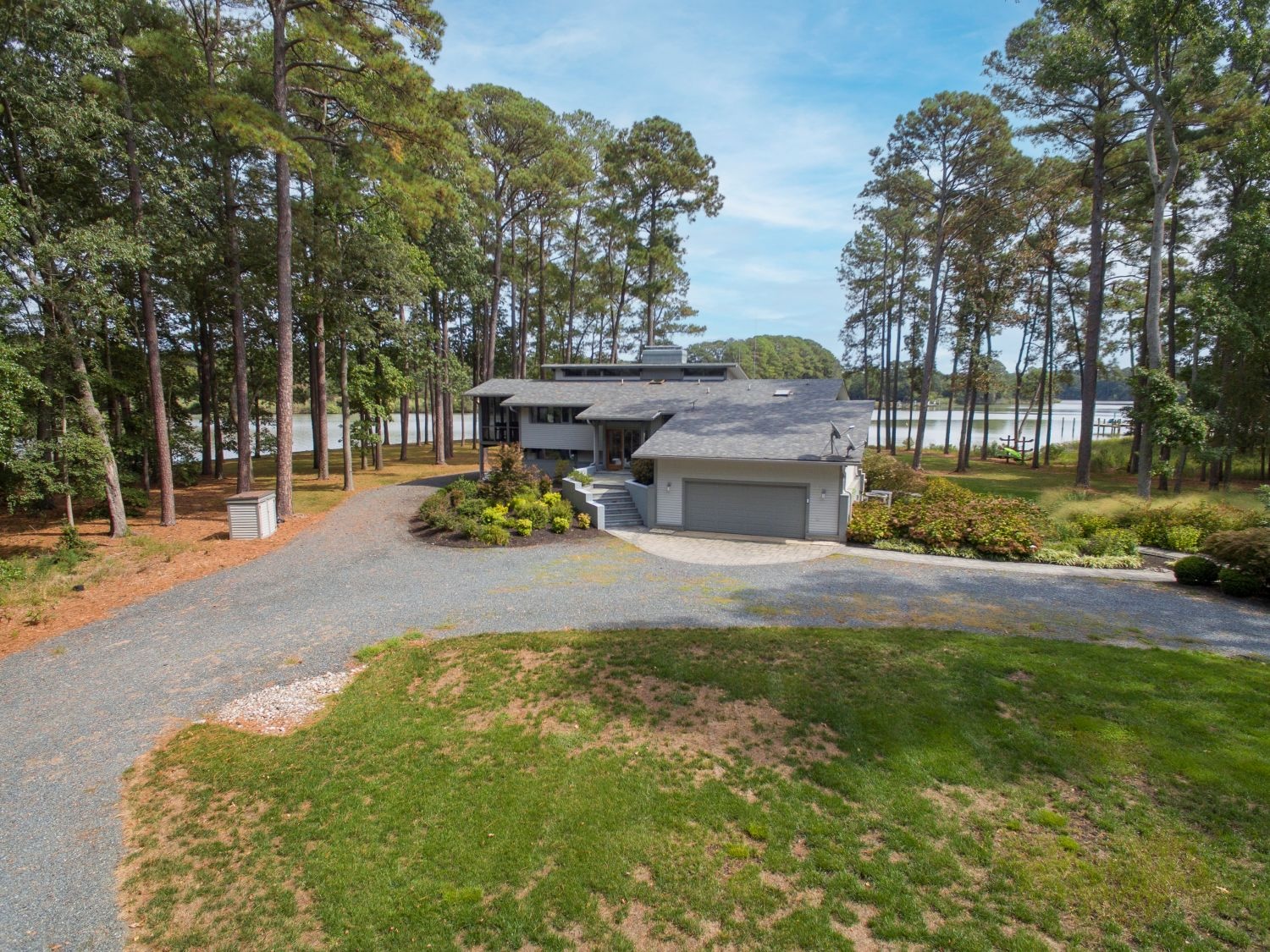
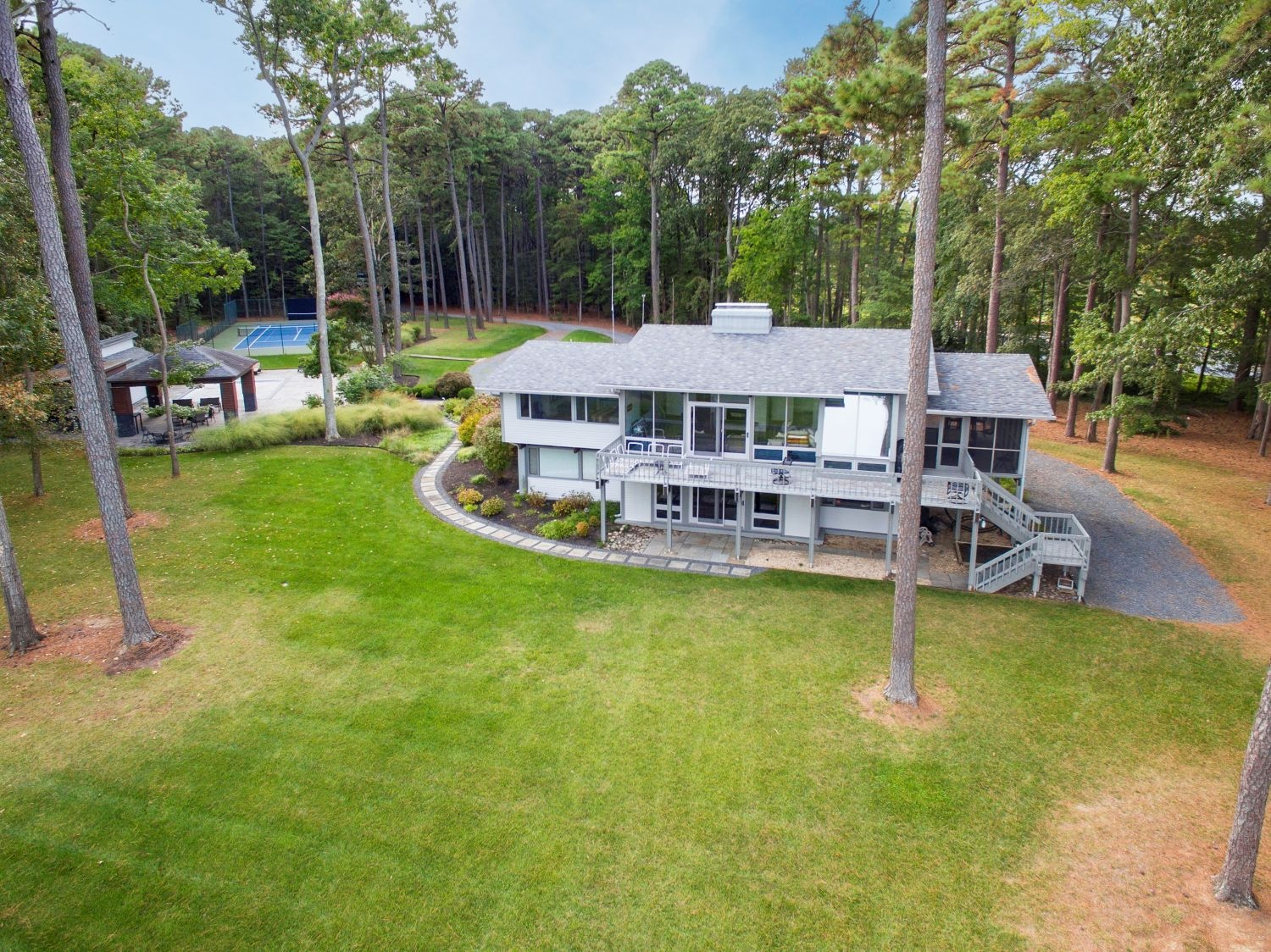
Sleek rooflines, deep eaves, and offset volumes blend this mid-century modern home beautifully into the surrounding pines.

Since last week’s feature was an exquisite historic house, I was thrilled to find this equally exquisite mid-century modern house in Royal Oak for today’s feature. The house is surrounded by tall Loblolly pines with their “feather duster” canopies that provide unobstructed views of Irish Creek. As I walked around the house, I admired how well several offsets in the floor plan create the house’s lively massing.  Deep eave overhangs obviated the need for gutters and created a sleek look. The house’s architecture, the exterior color palette of various shades of gray and the mix of brick and siding creates great curb appeal. 
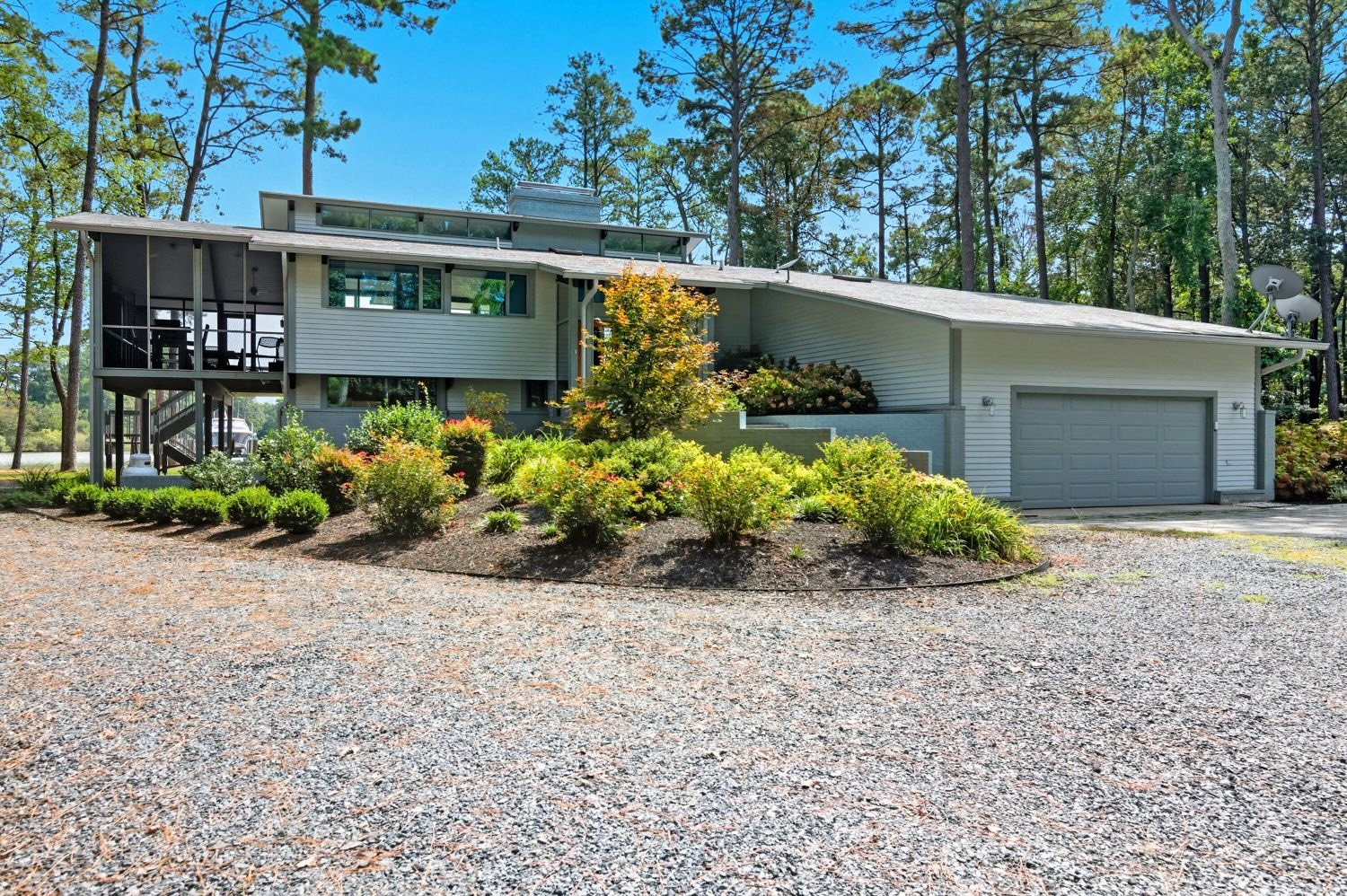
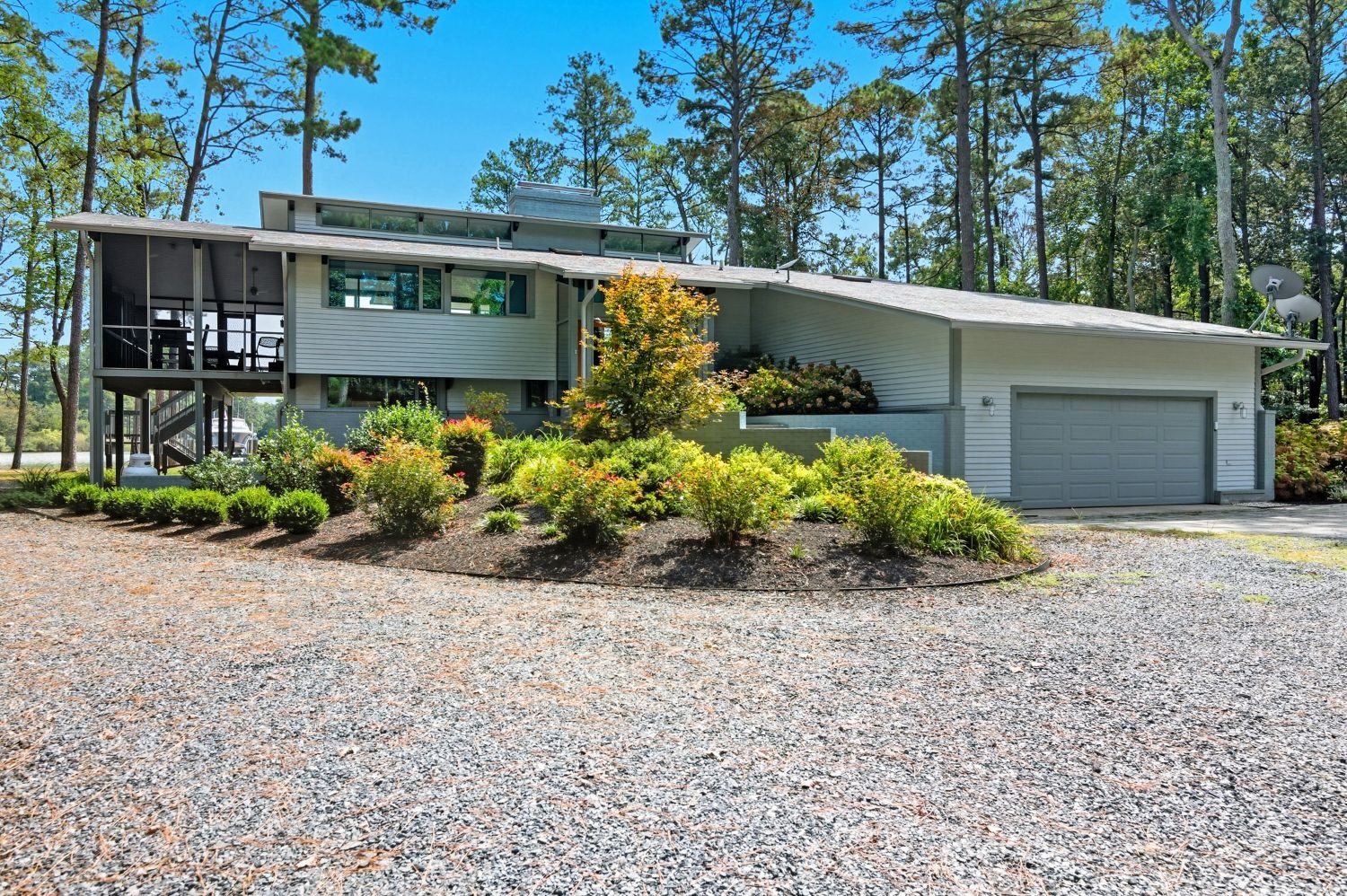
The landscaped berm softens the retaining wall while clerestory windows crown the design with light and airiness.

The house was designed with two levels reached by a split stair off the foyer. To soften the sides of the retaining wall along the stair to the front door, a landscaped berm was created. I especially admired the house’s juxtaposition of solid walls with the transparency of the windows and the screened porch that floats above the ground. The clerestory rising above the roof’s ridge is the crowning touch to this magnificent composition.
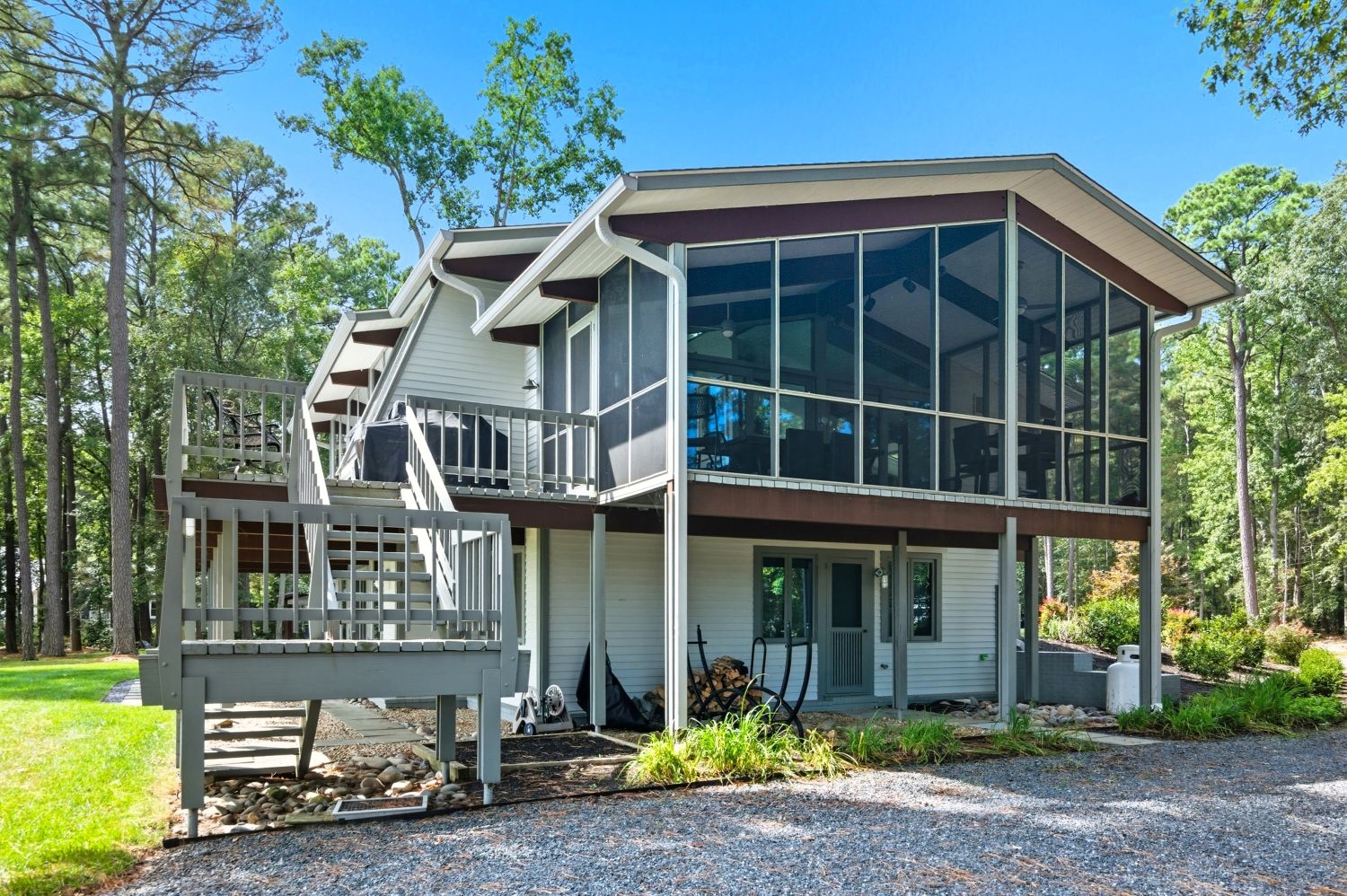
This elevation showcases layered outdoor spaces, from the elevated screened porch to the stretching deck and covered storage below.

This side elvation highlights the house’s outdoor rooms. The elevated screened porch provides maximum water views and the screened panels rise to the underside of the roof rafters to create an airy feeling. The covered area below provides storage of wood and lawn maintenance items. The deck spans across most of the upper level for bird’s eye views of Irish Creek. The deep eaves above the exposed roof rafters add character to the elevations. 
A lively roofline with a central clerestory and sloped glass conservatory enhances the transparency of the waterside elevation.

The rear waterside elevation’s clerestory in the middle part of the house above the side wings of the screened porch and the bedroom wing on the other side creates a lively massing. The upper level is almost entirely transparent, including the sloped glass roof of the conservatory. 

Offsets and soaring windows enliven this facade, leading seamlessly to the stone path toward the pool area.

All of the house’s elevations are very appealing with this elevation’s pitched roof, upper windows that rise to the underside of the roof rafters and offsets in plan that enliven the façade. The path of stone pavers around the corner of the house leads to the pool area. 

Unobstructed views and a maintenance-free pier invite serene escapes on protected Irish Creek.

Before I explored the pool area, I turned toward the water and savored the unobstructed view of the protected shoreline and the tranquil view of no other house in sight along the other shore of Irish Creek. Boating enthusiasts will enjoy the maintenance-free Azek pier with new 30K lb. boat lift.
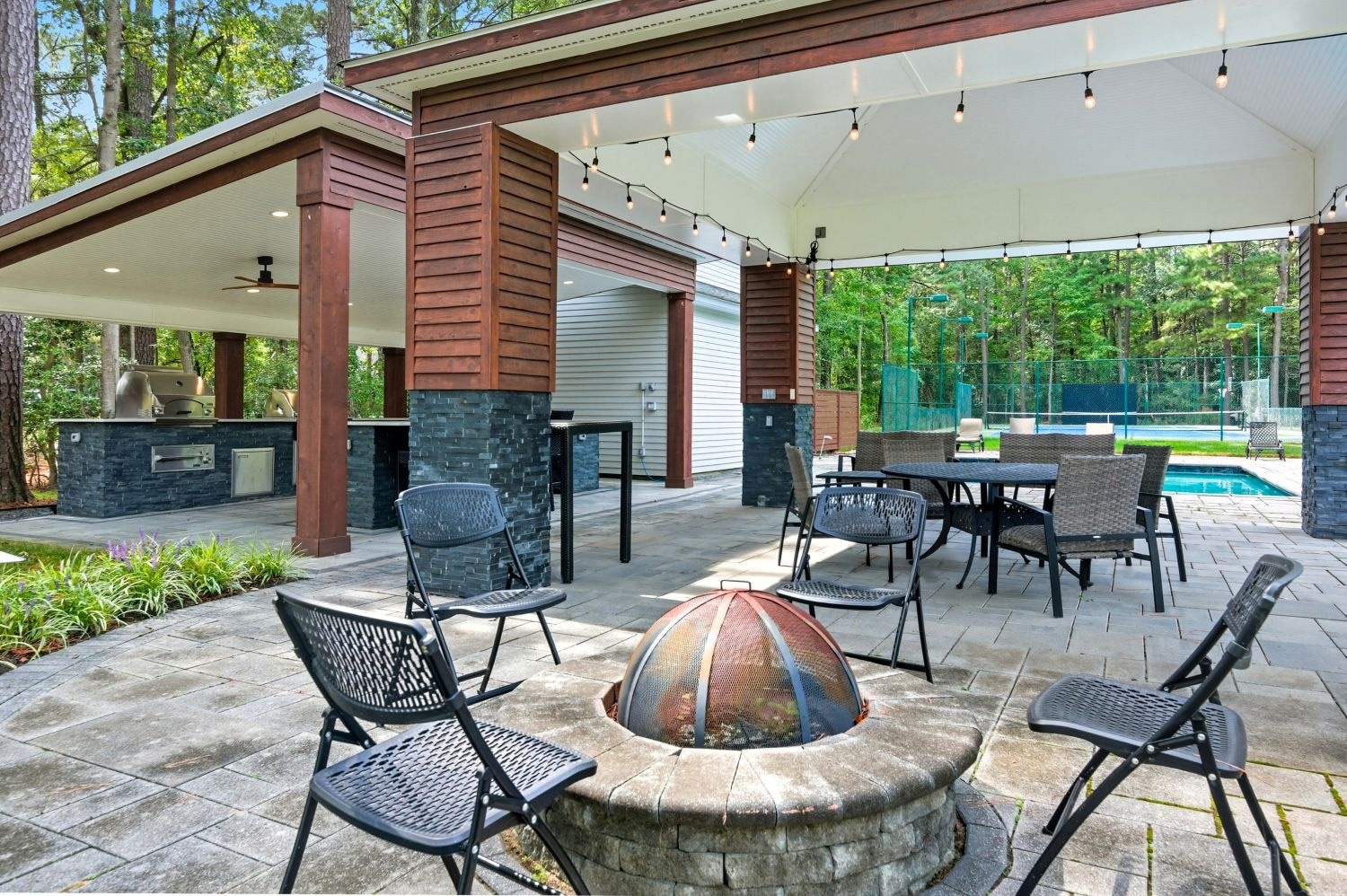
A terraced outdoor space with a firepit, dining pavilion, and luxe kitchen pavilion elevates al-fresco living.

After walking the shoreline, I rejoined the path of stone pavers that ended at a series of spacious outdoor rooms beginning with a terrace with a firepit surrounded by folding chairs. Next was an open air pavilion supported by large columns of textured tiles set horizontally below wood siding. Under the pavilion is a large area for al-fresco dining. Another open air pavilion with a sloped roof  contains an outdoor kitchen luxuriously equipped with every appliance one could need for preparing meals for one’s family or parties. The same tile that was used on the pavilion encases the appliances and unified the two spaces. Seeing the string of light bulbs that outlined the rim of the pavilion’s soffit, I could visualize how lovely their effect would be when the sun begins to set.    
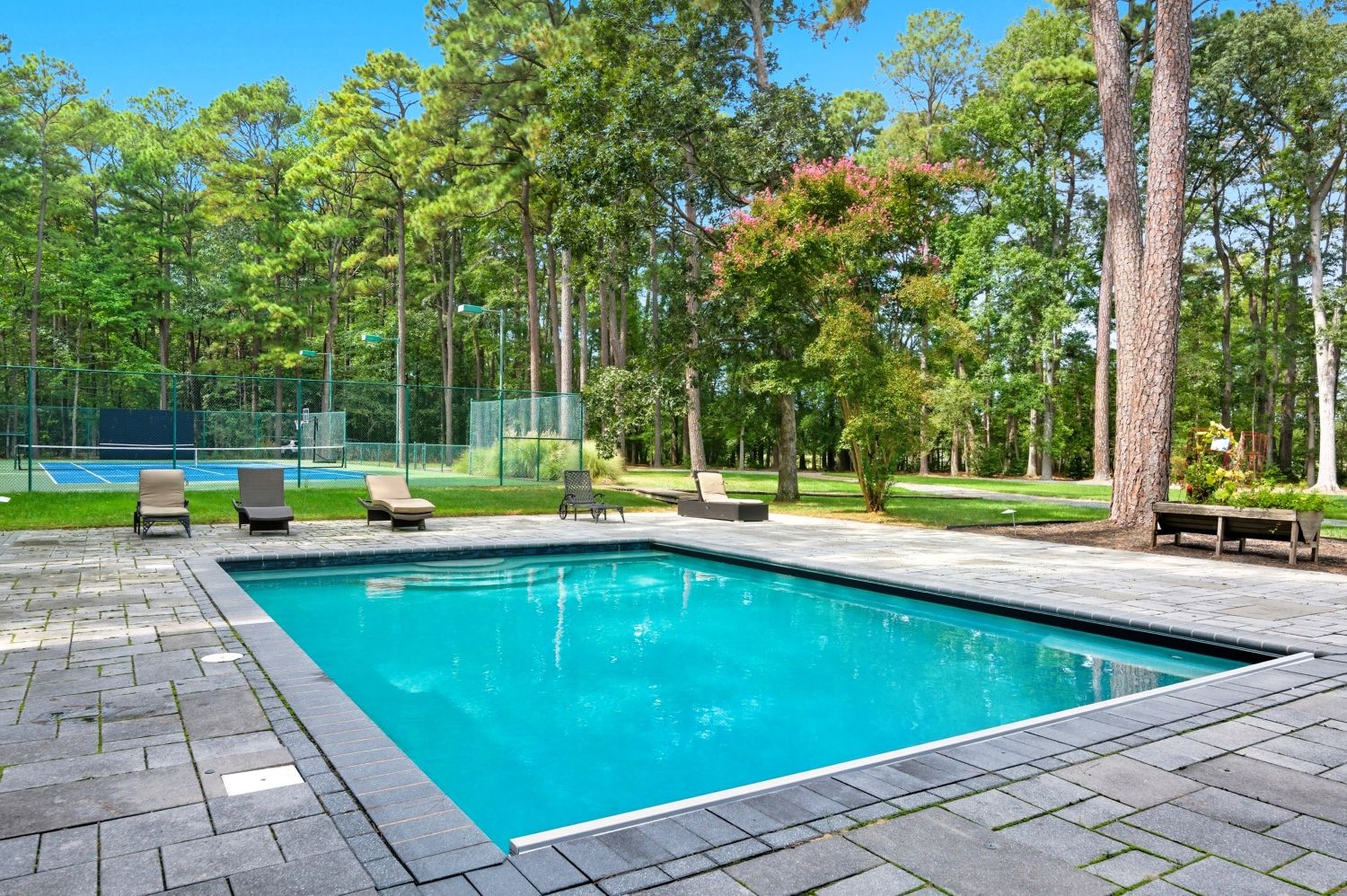
The heated pool, in-ground hot tub, and full-sized tennis court offer endless opportunities for recreation and relaxation.

Past the pavilion is a large heated pool with a surround of random sized stone pavers. There is also an in-ground hot tub and an outdoor shower.  If water sports are not for you, the full size tennis court awaits you.
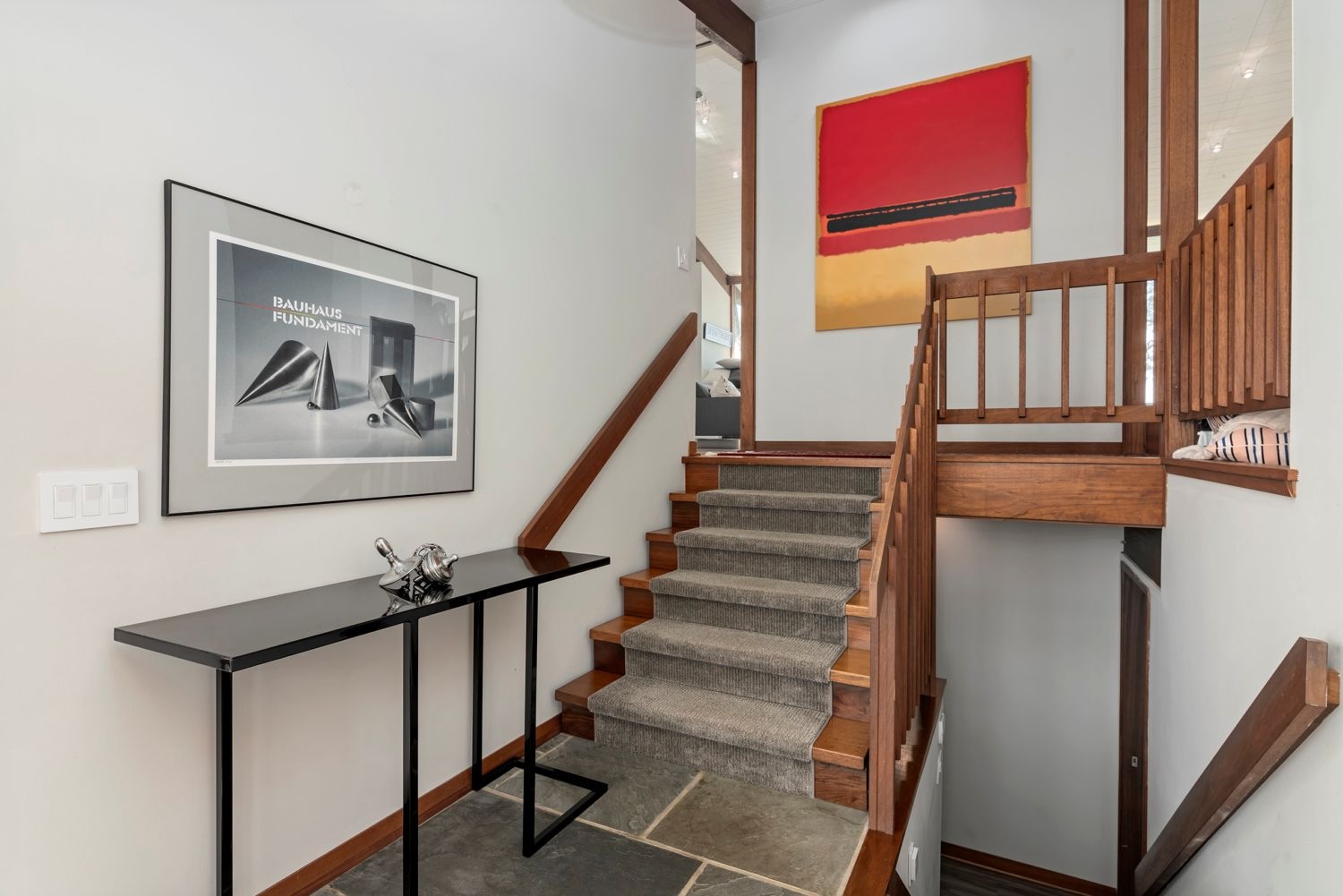
The split-level foyer, simply yet stylishly furnished, gives an immediate sense of the home’s spacious and thoughtful design.

Having explored the grounds, I was primed for a tour of the interiors. From the driveway, brick steps lead up to the front door that opens into the foyer with stairs to the lower and upper levels. I noted how the run to the lower level is longer so the lower level rooms would have high ceilings. The spatial volume,  simply furnished with the sleek table below the Bauhaus print and the colorful art clearly are clues this mid-century house is much, much more than the usual “split level”.   
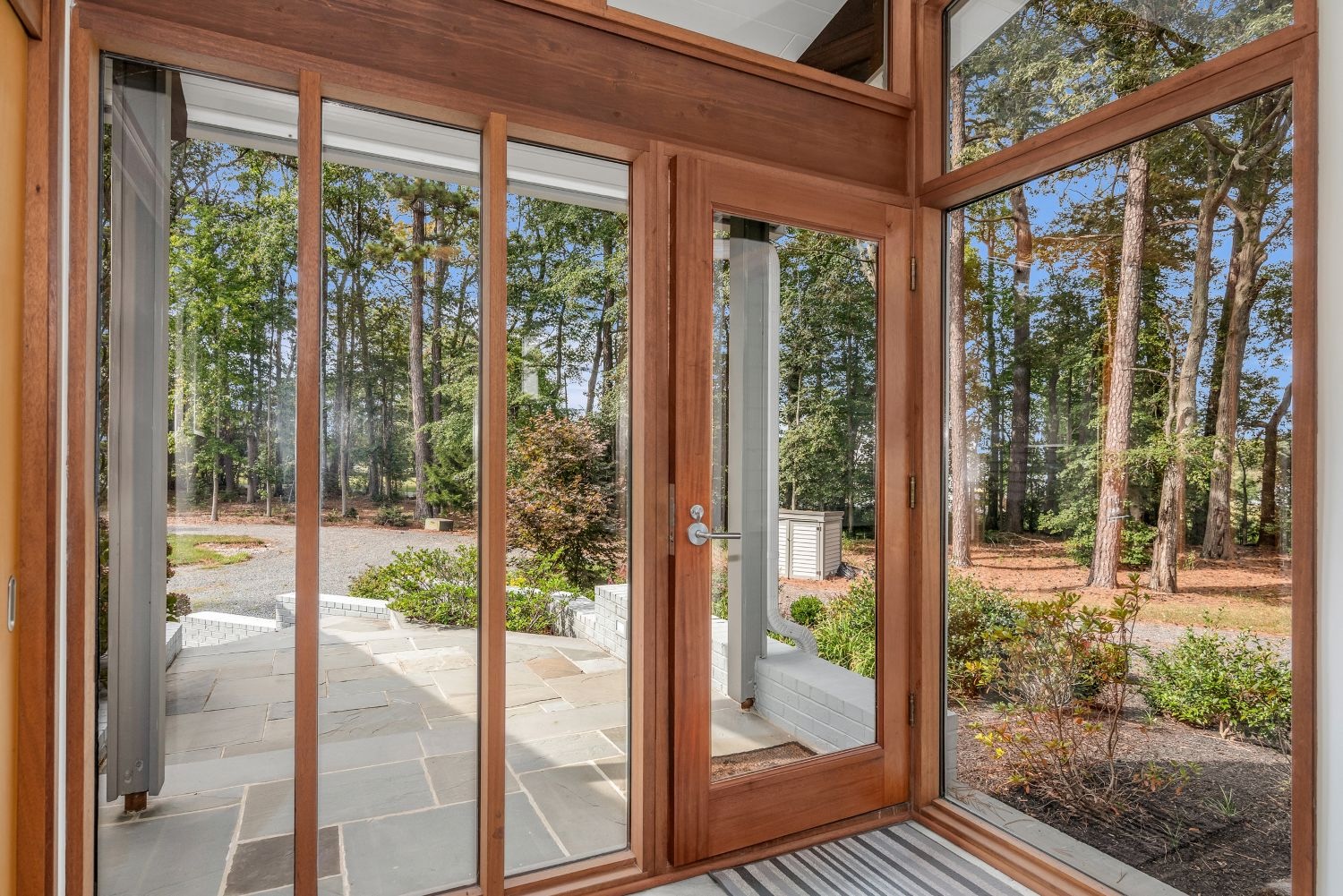
Panoramic glass infilled framing creates a seamless connection between the interiors and the surrounding landscape.

I admired the carefully thought out detailing of the foyer’s exterior wall infilled with wood framing and glass that rises to the underside of the roof framing for panoramic views of the landscape.  The foyer’s steps ends at a hall that blends into the open floor plan and connects all of the upper floor rooms.
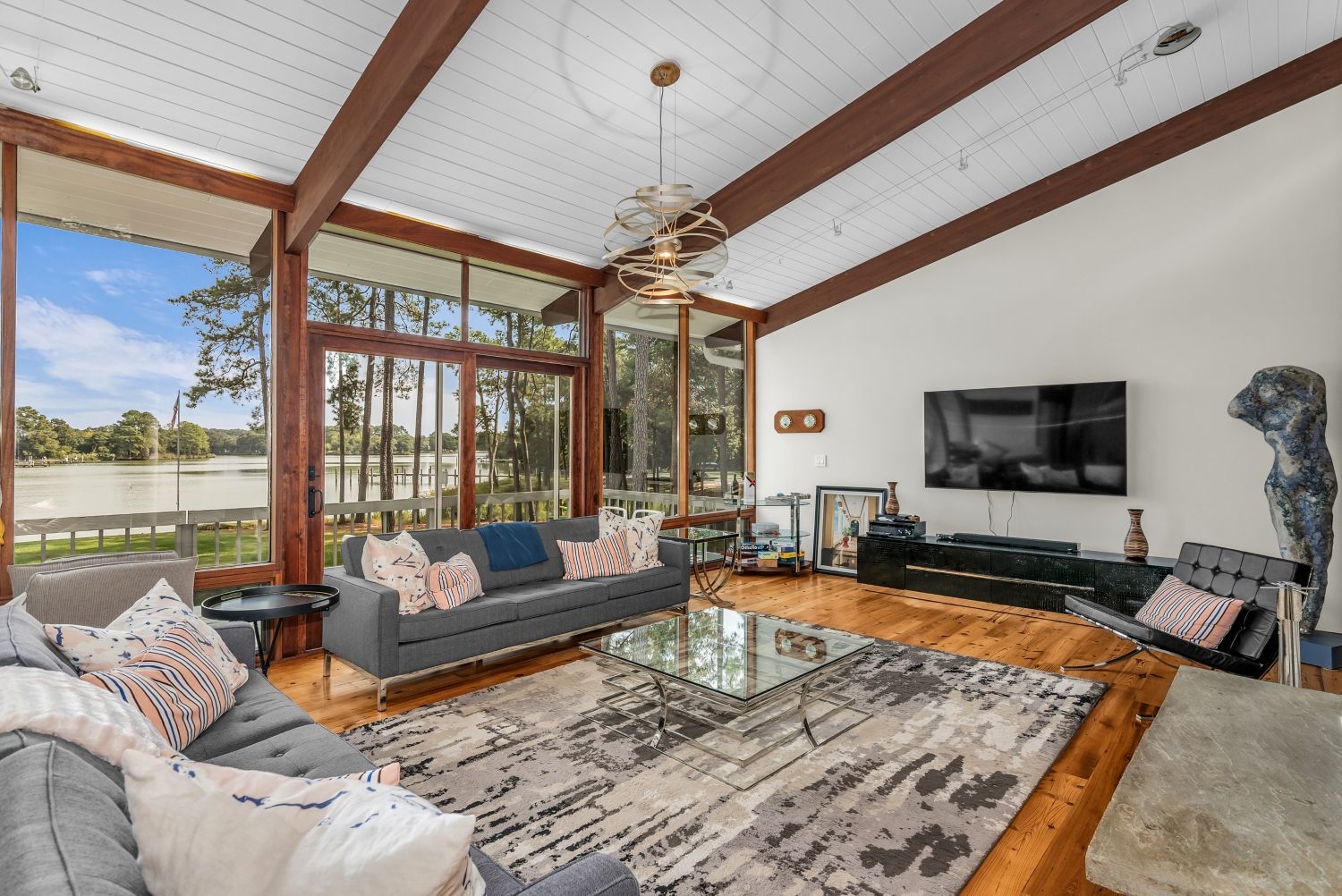
Natural wood framing, exposed roof rafters, and a cantilevered hearth define the mid-century modern character of this space.


The wall of art at the foyer is the back side of the fireplace’s chimney in the open plan living-dining room. The wide hearth floats above the floor since it is cantilevered from the chimney. I admired the proportion of the space from the roof’s slope being just right-neither too low nor too high. The living room’s rear wall grid of wood framing infilled with glass and the wood roof rafters with white decking creates a rhythm of bays that gives the space so much character. As befitting a house surrounded by pines, the beautiful pine floors add warmth to the space and the mid-century modern furnishings complement the architecture. Wide sliding doors lead to the deck that spans across the living room and wraps around the dining room to end at the screened porch.
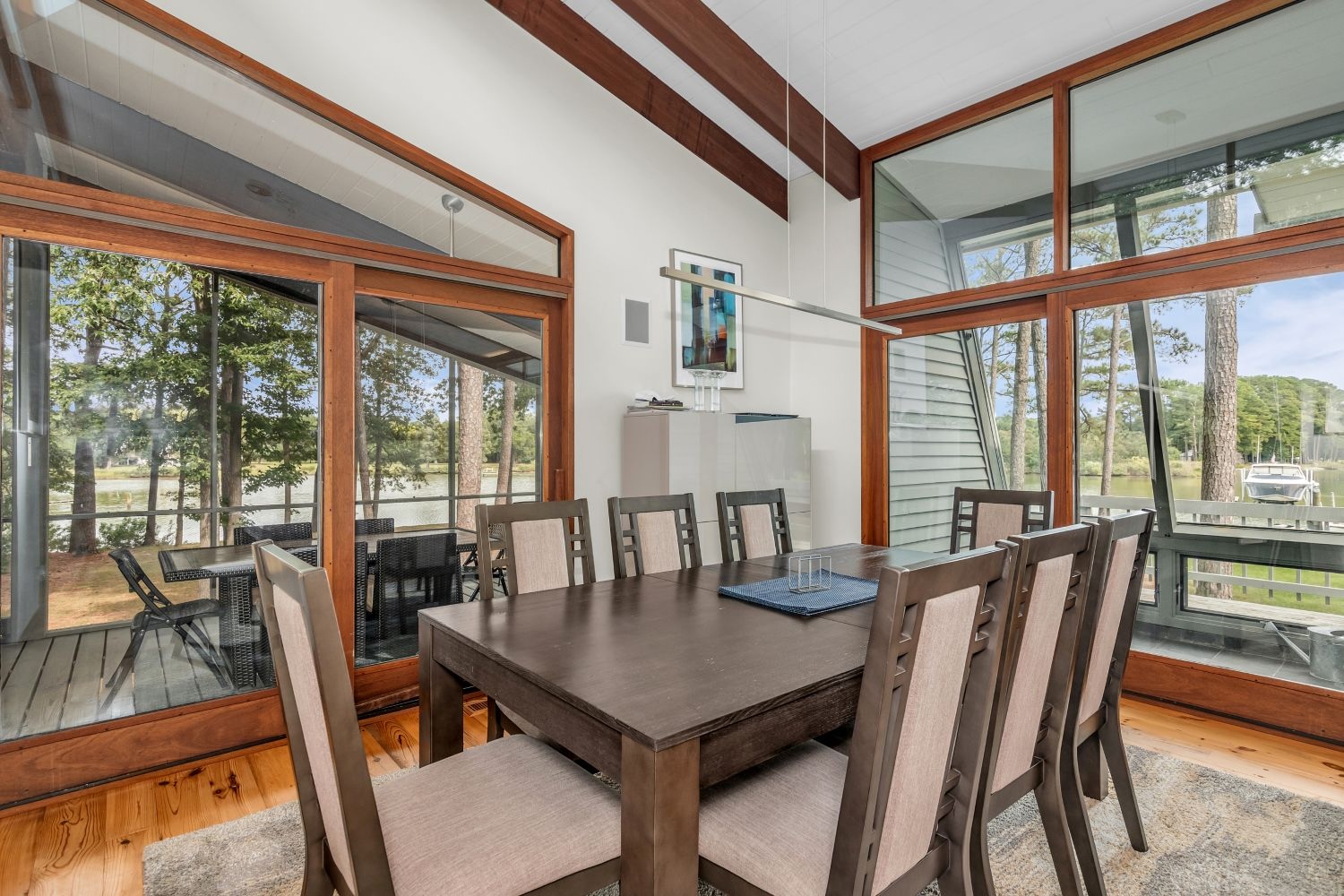
Walls of glass and the sloped conservatory roof fill the dining space with light and vistas of the lush outdoors.

The corner of the dining room faces the conservatory with its sloped glass roof beyond the rear wall of the dining room. Alas, the conservatory is in its winter dormancy but I could well imagine how colorful plants would create a delightful vista for diners. The dining area’s rear wall of glass and wood and the side wall to the screened porch with its sloped  ransoms above the wide wood sliding doors offer panoramic views of the landscape and water beyond. The thin tubular modern pendant light fixture is suspended in space above the table.
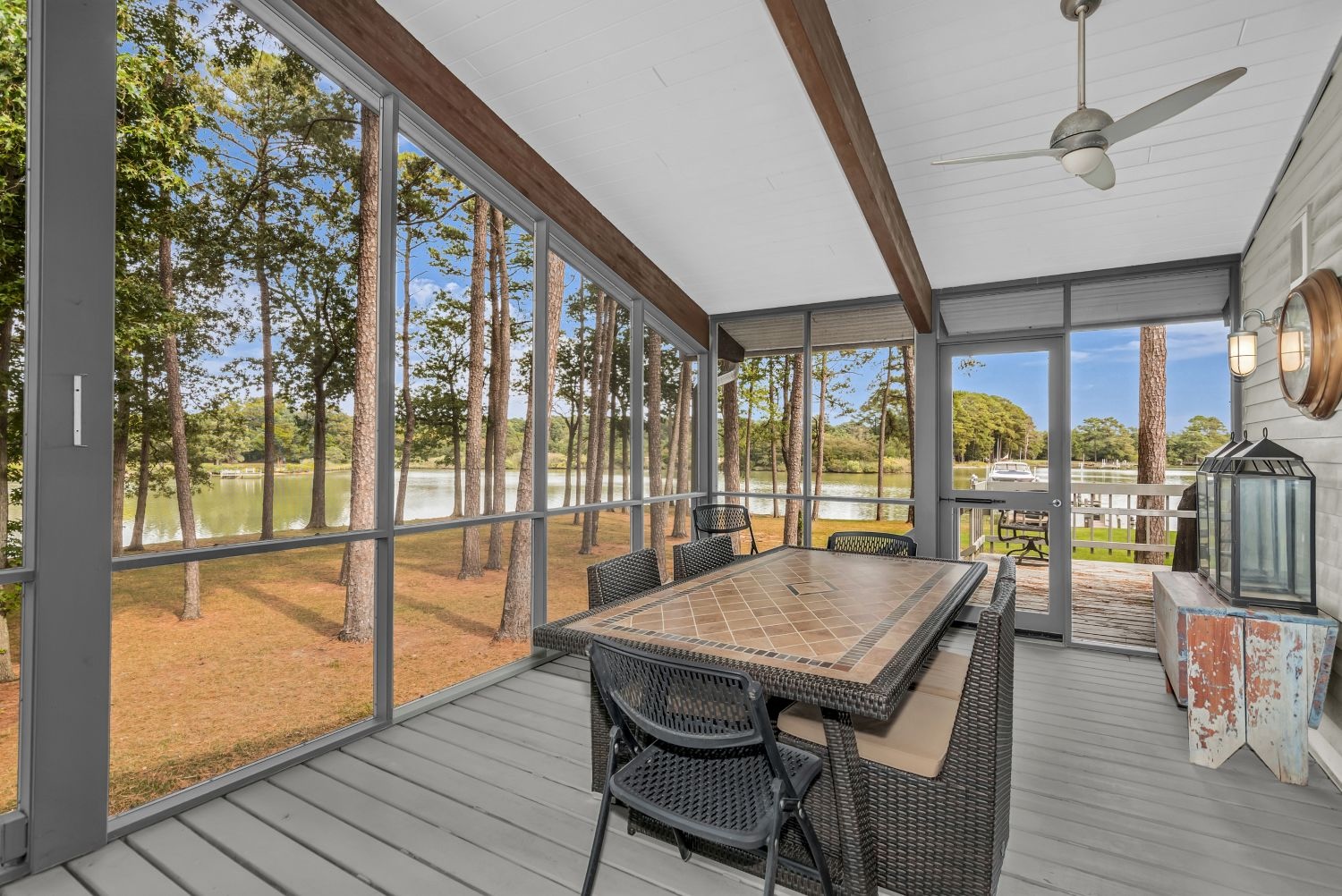
 

Perched in a corner for maximum views, this airy screened porch is the ideal retreat for dining or relaxing.

Screened porches are usually my fave rooms and this spacious outdoor room is no exception. Its corner location that offers one hundred eighty degree views and cooling summer breezes is the perfect spot for warm weather family dinners or dinner parties with friends. At the rear wall, a door leads to the waterside deck for easy indoor-outdoor flow to the open plan living-dining area.  The sloped ceiling accentuates the airy feeling of this delightful space.

Stretching along the rear elevation, the deck provides sweeping views of Irish Creek through the sheltering pines.

The long deck offers panoramic bird’s eye views of Irish Creek through the tall pine trees.  The rear wall of the open plan living-dining area is beautifully proportioned with picture planes of glass and operable units below and transoms above the wide sliding doors. 
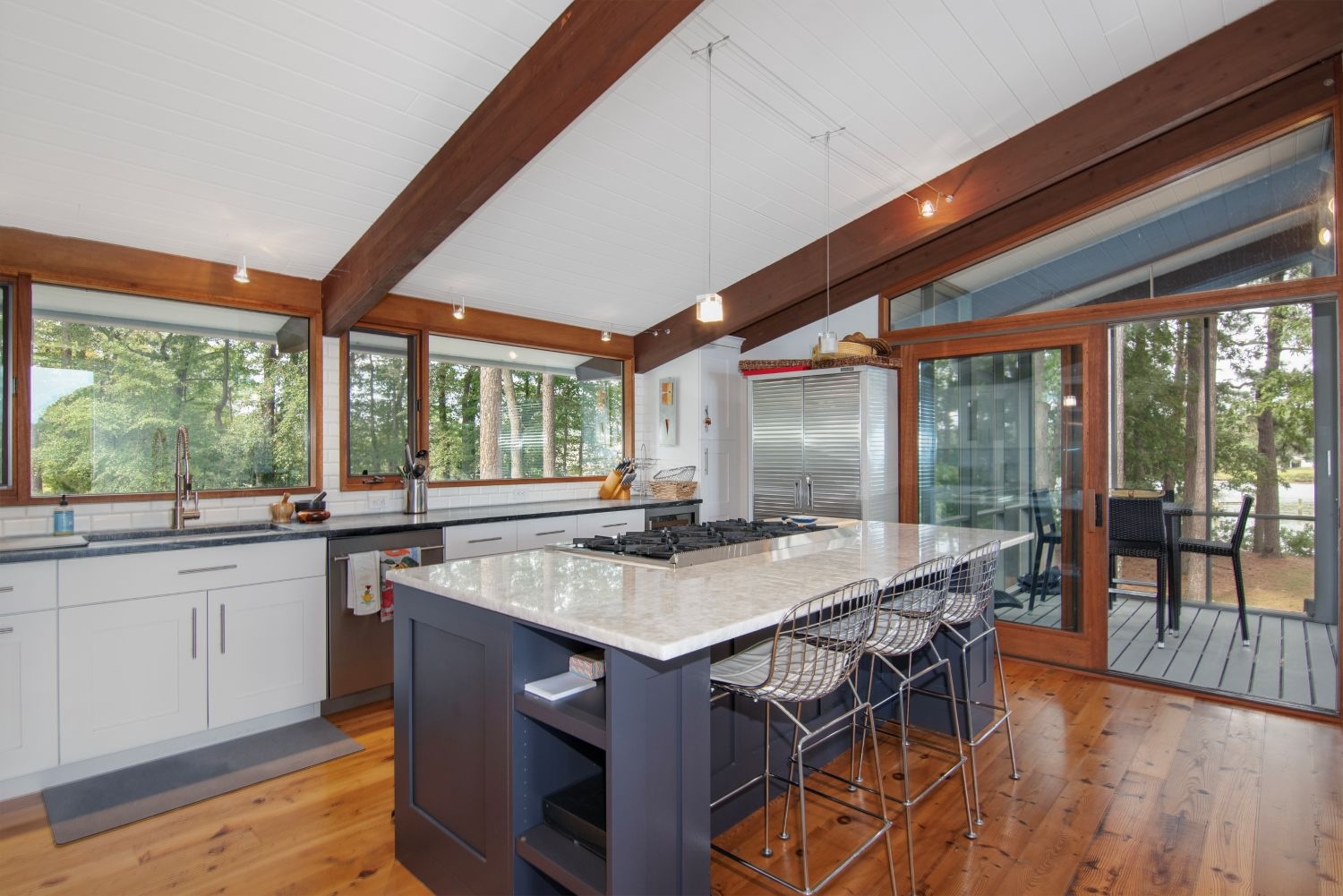
A balance of open shelving and cabinetry, paired with blue island accents, creates a kitchen both functional and visually striking.

The kitchen is connected to both the dining area and the screened porch. I loved the windows along the sink wall of base cabinets and how only the side wall of this “L” and island arrangement has upper cabinets to maintain the spatial volume. The island’s blue cabinetry and white veined countertop accents the white cabinets and the dark countertop color of the other cabinets. The subtle pendant lights are the perfect finishing touch.  
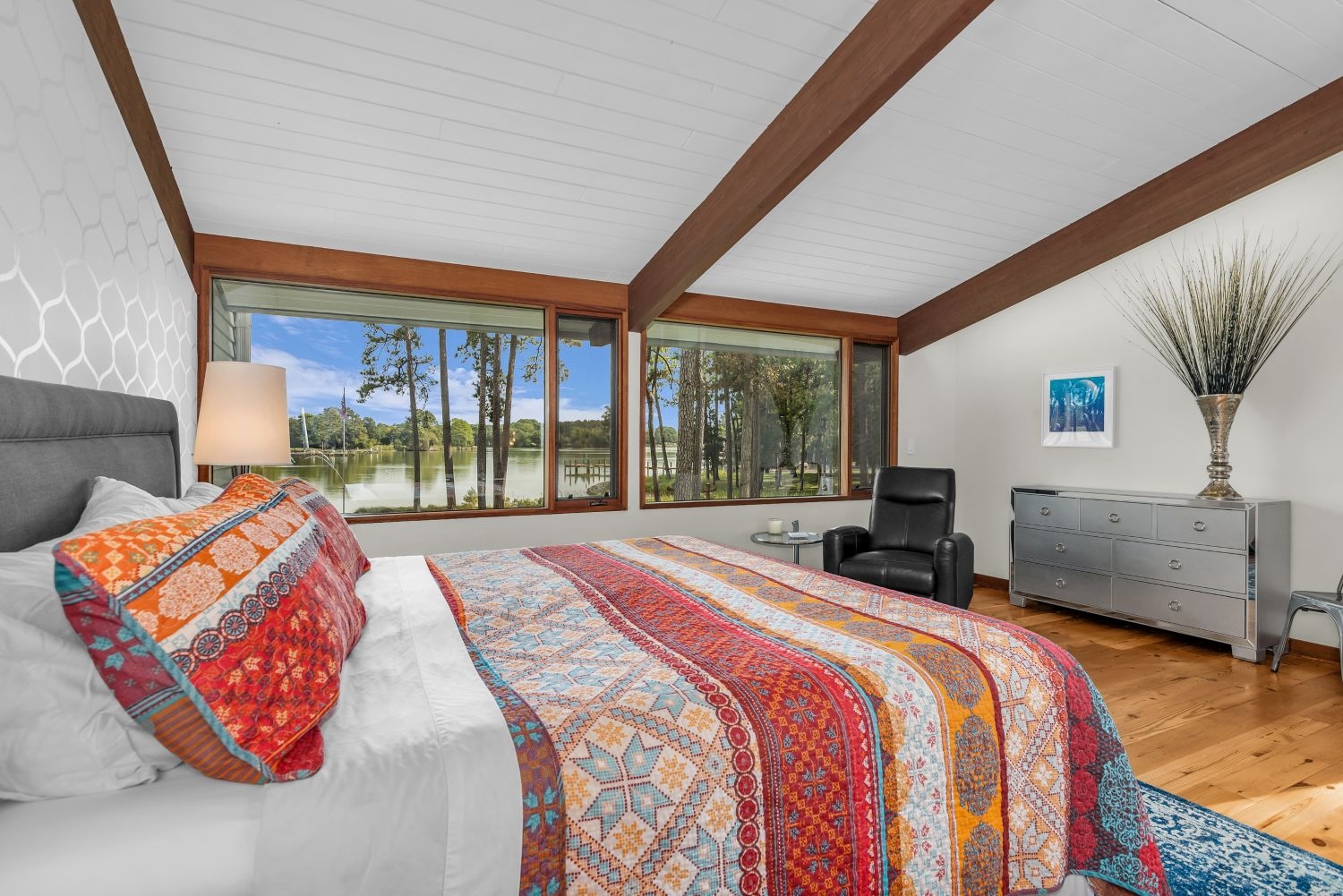
 

Floor-to-ceiling glass walls frame the tranquil waterside views, blending the indoors with the serene landscape.

The primary ensuite is located at the quiet waterside corner of the house and its wall of picture plane glass between an operable unit becomes a live mural. The spacious bedroom easily accommodates sleeping and sitting areas.
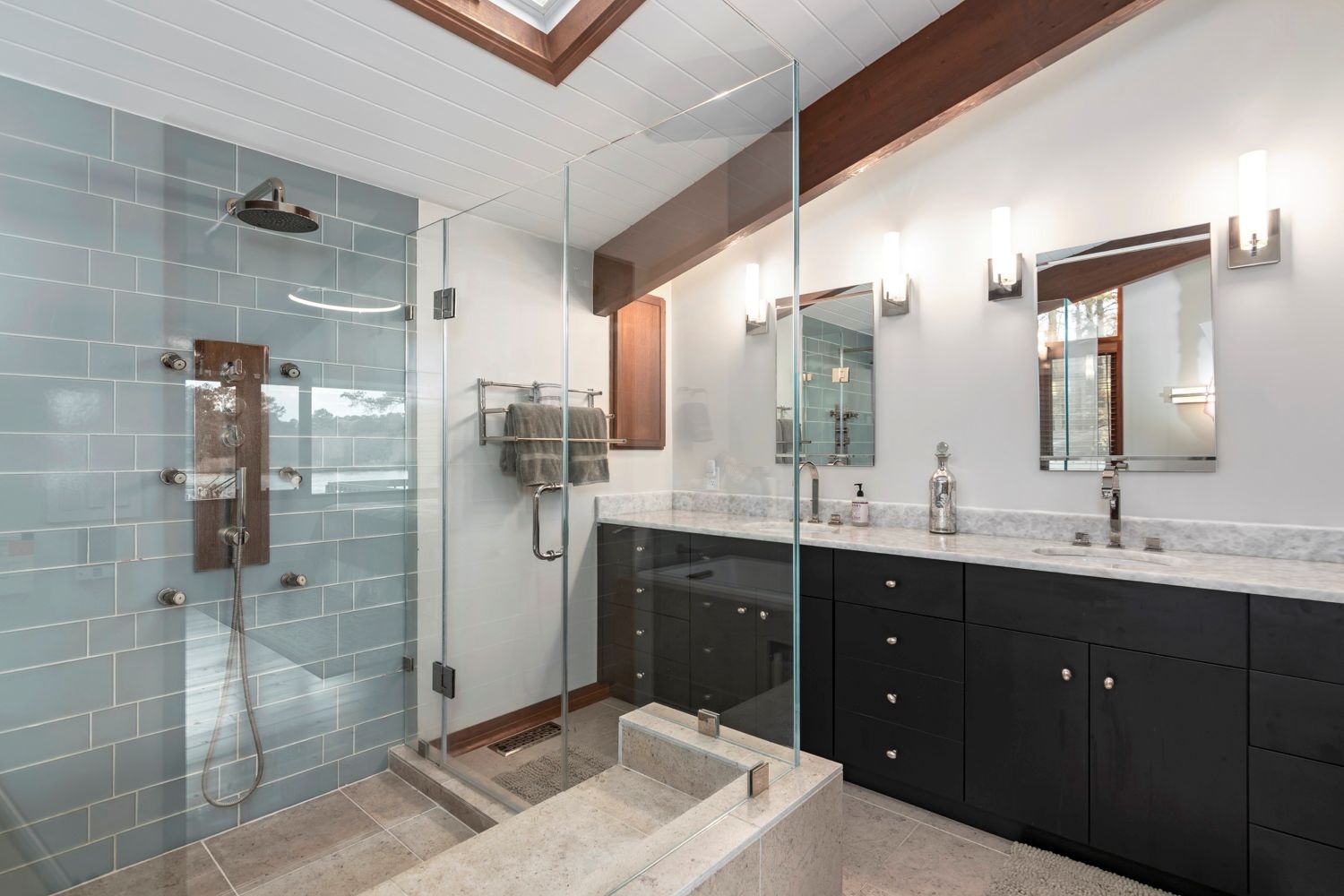
A neutral palette and light blue tile accents create a clean, serene backdrop in the primary bath’s design.

I admired the compact design of this bathroom and the neutral color palette with an accent of light blue tile is a backdrop to one’s choice of towels and accessories. The five-piece primary bath has a long dual lavatory cabinet and a free-standing glass panel separating the shower/tub area from the toilet.
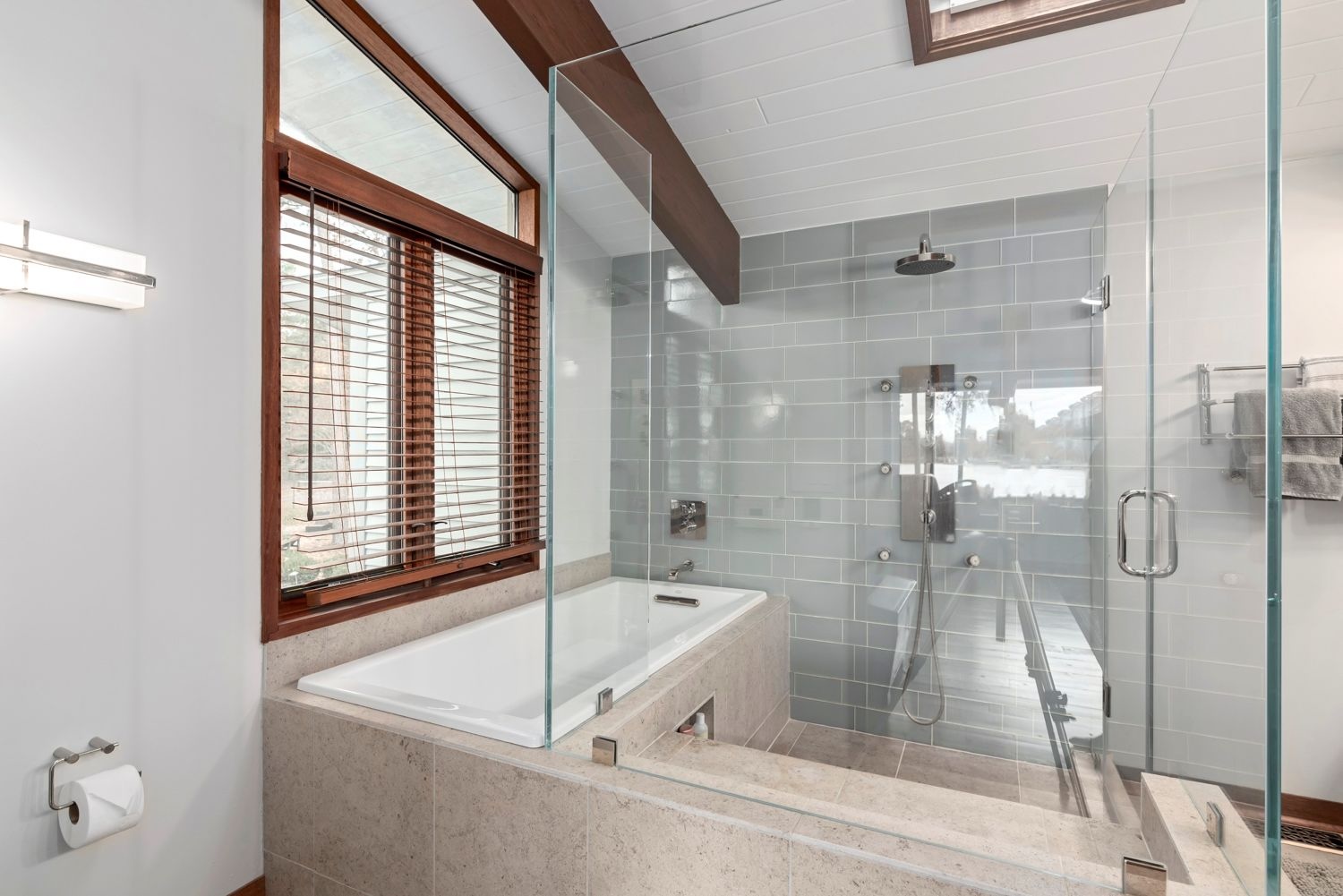
 

Daylight streams into the bath from a skylight and window, enriching the calm, spa-like atmosphere.


Both the window over the tub and a skylight provide ample daylight for the primary bath. A walk-in closet, laundry, and powder room complete the upper level floor plan.
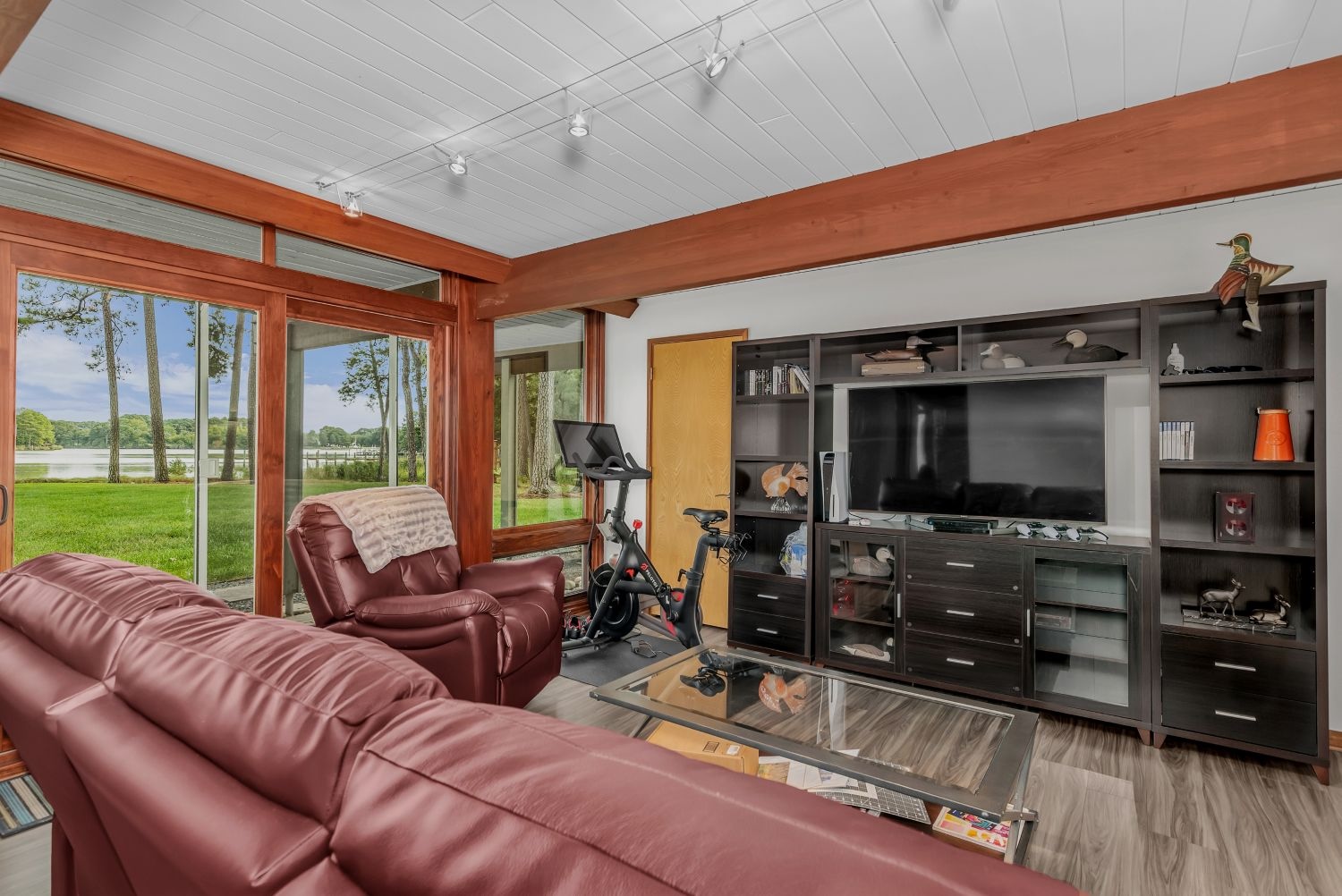
The lower-level living area creates a cozy, private retreat with a fireplace and outdoor connections.

The house was zoned very well with the upper level’s main living areas and primary ensuite and the lower level’s family room with a fireplace, three bedrooms, one office/small bedroom and two baths so visiting family members or guests have privacy.  The family room and the two bedrooms at the rear of the house have their own outdoor rooms below the upper level deck.  

The  lower level also contains a large utility room that has a door to the two-car garage.

Oversized corner windows flood the lower-level guest bedroom with light and offer serene views of the water and landscape.

Each guest bedroom is a different size and this corner bedroom has a wall of windows for water views and another window overlooking the landscape.

As I walked through the house, it was hard to believe this house was built in 1988 since it has been so meticulously maintained. The 7.9 acre property in sought after Royal Oak ensures privacy and the 500 lineal feet of protected shoreline along Irish Creek offers tranquil views. Mid-century modern architecture and interiors are one of my fave styles so I am sorry the architect of this exquisite house is unknown so he/she could be credited for their thoughtful design and appealing massing of the house.

The upper level floor plan offers great indoor-outdoor circular flow from the open plan living area to the screened porch to the deck. The perfectly proportioned spatial volumes of the upper level rooms whose ceilings are the roof’s exposed roof rafters and decking made me want to linger and enjoy the tranquil panoramic views of the landscape and Irish Creek framed by the house’s rear wall of wood and glass.  The outdoor rooms of the open air pavilion, kitchen pavilion, pool and tennis court are great bonuses. This turn-key property is fully furnished. Bravissimo!


For details about this property, contact Rob Lacaze, SVP/Realtor with TTR Sotheby’s International Realty at 410-745-2596 (o), 410-310-7835 (c), or [email protected] , “Equal Housing Opportunity”.

Photography by Eve Fishell, Chesapeake Pro Photo LLC, 443-786-8025, www.chesapeakeprophoto.com, [email protected]

Contributor Jennifer Martella has pursued dual careers in architecture and real estate since she moved to the Eastern Shore in 2004. She has reestablished her architectural practice for residential and commercial projects and is a real estate agent for Meredith Fine Properties. She especially enjoys using her architectural expertise to help buyers envision how they could modify a potential property. Her Italian heritage led her to Piazza Italian Market, where she hosts wine tastings every Friday and Saturday afternoons.

The Spy Newspapers may periodically employ the assistance of artificial intelligence (AI) to enhance the clarity and accuracy of our content.

Filed Under: 00 Post to Chestertown Spy, Design with Jenn Martella

Spy Poetry: The Journey by James Wright

December 13, 2025 by Spy Poetry Leave a Comment

Editor’s Note: I fell in love with this poem on first reading it. Its simple yet evocative language, the subtle shift in significance and meaning of the word dust, and the unforgettable image of the spider, touched by sunlight, stepping lightly through the accumulations of her wind-blown ruins, as Wright advises us to do.

The Journey

Anghiari is medieval, a sleeve sloping down
A steep hill, suddenly sweeping out
To the edge of a cliff, and dwindling.
But far up the mountain, behind the town,
We too were swept out, out by the wind,
Alone with the Tuscan grass.

Wind had been blowing across the hills
For days, and everything now was graying gold
With dust, everything we saw, even
Some small children scampering along a road,
Twittering Italian to a small caged bird.
We sat beside them to rest in some brushwood,
And I leaned down to rinse the dust from my face.

I found the spider web there, whose hinges
Reeled heavily and crazily with the dust,
Whole mounds and cemeteries of it, sagging
And scattering shadows among shells and wings.
And then she stepped into the center of air
Slender and fastidious, the golden hair
Of daylight along her shoulders, she poised there,
While ruins crumbled on every side of her.
Free of the dust, as though a moment before
She had stepped inside the earth, to bathe herself.

I gazed, close to her, till at last she stepped
Away in her own good time.

Many men
Have searched all over Tuscany and never found
What I found there, the heart of the light
Itself shelled and leaved, balancing
On filaments themselves falling. The secret
Of this journey is to let the wind
Blow its dust all over your body,
To let it go on blowing, to step lightly, lightly
All the way through your ruins, and not to lose
Any sleep over the dead, who surely
Will bury their own, don’t worry.

James Arlington Wright was born on December 13, 1927, in Martins Ferry, Ohio. His father worked for fifty years at a glass factory, and his mother left school at fourteen to work in a laundry; neither attended school beyond the eighth grade. The poverty and human suffering Wright witnessed as a child profoundly influenced his writing, and he used his poetry as a mode to discuss his political and social concerns. He modeled his work after that of Thomas Hardy and Robert Frost, whose engagement with profound human issues and emotions he admired. Wright’s books include The Green Wall (Yale University Press, 1957), winner of the Yale Series of Younger Poets Award, Saint Judas (Wesleyan University Press, 1959), and The Branch Will Not Break (Wesleyan University Press, 1963). Wright was elected a fellow of the Academy of American Poets in 1971, and, the following year, his Collected Poems (Wesleyan University Press) received the Pulitzer Prize in Poetry. “The Journey” is from Above the River: The Complete Poems and Selected Prose. Copyright © 1990 by Anne Wright.

The Spy Newspapers may periodically employ the assistance of artificial intelligence (AI) to enhance the clarity and accuracy of our content.

Filed Under: 00 Post to Chestertown Spy, Spy Poetry

Chesapeake Lens: “On the Hunt” By Vibhanshu Shekkar

December 13, 2025 by Chesapeake Lens Leave a Comment

At this time of year, short-eared owls return to grasslands of the Blackwater National Wildlife Refuge to hunt for small mammals. Bon appetite!
“On the Hunt” by Vibhanshu Shekkar

The Spy Newspapers may periodically employ the assistance of artificial intelligence (AI) to enhance the clarity and accuracy of our content.

Filed Under: 00 Post to Chestertown Spy, Chesapeake Lens

House of the Week: Treasure in Trappe

December 11, 2025 by Jennifer Martella Leave a Comment

This Queen Anne and Victorian-inspired home, with its wrap-around porch, blends historic charm and modern functionality alongside the garage and guest apartment.

Several of my friends who wanted to purchase historic houses and found Easton’s Historic District too costly have discovered Trappe. Being a history buff, I am always curious to know the origin of a town’s name. I learned Trappe was incorporated in 1827 and its name may have been inspired by either wolf traps or a Trappist Monastery. This charming house caught my eye several years ago when  I featured another House of the Week that was located across the street and I am so pleased to feature this house today. The long and deep lot is located in the heart of Trappe’s residential district and the house and landscaped grounds have been lovingly maintained by its current owner who purchased it from the original owner. As I walked up the driveway for my tour, I admired the original lap siding that has been meticulously sanded down and repainted so it looks like new. The two-bay, two room wide, four rooms deep house’s multiple gables, wrap-around porch, 2/2 windows and bay windows identify its blend of Queen Anne and Victorian styles. 

The updated gray palette with textured scalloped shakes and mulberry shutters enhances curb appeal while maintaining the home’s historic elegance.

When the current owner bought the house, the exterior color palette was tan siding with green shutters. She chose an exterior color palette of light gray, white trim and deep mulberry shutters was spot on and gives the house a much better curb appeal. The darker gray of the third floor’s scalloped shakes is a great accent  of both color and texture. The landscaping along the brick sidewalk is a prelude to the manicured landscaping of the grounds; even in the beginning of winter, there is still color in the plantings.

Generous proportions and classic fluted columns create a welcoming outdoor space with a nod to timeless architectural detail.

The deep wrap-around porch easily accommodates rocking chairs and circulation space. The light blue-gray ceiling and darker blue-gray flooring contrasts with the white fluted columns. 

The porch seamlessly connects to the family room, framed by sculptural crape myrtles for privacy and seasonal color.

The porch ends at the door to the family room for great outdoor-indoor flow. The crape myrtles are sculptural elements and await their next season of color that will provide even more privacy. 

Layered gables, screened porch transparency, and thoughtful massing elevate the architectural appeal of the home’s rear and side views.

All of the elevations of this charming house are architecturally interesting. The rear elevation’s overlapping gables and the side elevation’s gable enliven the facades. The screened porch is another delightful outdoor room that also adds transparency to the house’s very appealing massing. 

This pre-fabricated gazebo, crafted with care by the owner and her children, creates a serene space surrounded by gardens and complemented by wind chimes.

Walking through the gardens along hardscaped paths that varied from gravel to brick to stone pavers led me to this delightful gazebo next to the garage with an apartment above. I especially liked the pendant light fixture so one could dim the light after sunset and savor being surrounded by the sounds of nature to the tune of the wind chimes. 

I later learned from the owner that the gazebo was a pre-fab kit that she and her children assembled! It was tempting to linger and listen to the sounds of the wind chimes but I was eager to explore the full extent of the grounds

Formal landscaping breaks into lush greenery, leading to the brick terrace with views of the expansive grounds and discreet garage-apartment.

My walk ended at this brick terrace surrounded by boxwoods.  I paused on the bench to appreciate the full depth of this unique property and its landscaping. From the bench, the garage-apartment was visible but the house was totally obscured. 

Original oak balustrades and curved stair detailing highlight craftsmanship from the home’s early 20th-century origins.

Having explored the grounds, I was quite eager to begin my tour of the house. The front door opens into a spacious foyer with daylight from two windows above the stair. I admired the stair’s detailing with its stained winders and treads,  painted risers that accentuates beauty of the wood and tall oak newel posts whose recessed panels are lined with egg and dart molding . I especially liked how the bottom two treads have curved ends that gracefully spill into the foyer. 

The house was built in 1900 and I was so thankful that the beautiful stained oak balustrade had not been painted over the years! I also admired the trim at the stair wall that adds texture and how both the doors and windows are trimmed with fluted jambs and headers with rosette trim at the corners-details from the era of gracious living.

Corner windows frame the wrap-around porch, while the open layout welcomes natural light into this versatile space.

A stained wood French door leads from the foyer into the living room that was probably the formal parlor of the house when it was built. The windows at the corner look out onto the wrap-around porch. The spacious room easily accommodates seating for a gathering of family or friends. 

Angled bay windows and built-in cabinetry enhance this central gathering space, featuring vistas to the lush gardens beyond.

My fave room was the large dining room that was probably the family room when the house was built. Currently furnished as a dining room, it is connected to both the foyer and the living room. The subtle bay angled wall of windows, the recessed cabinet with an arched top and glass doors and the fireplace create a wonderful setting for cocktails by the fire and dinner by the windows overlooking the grounds. The light wall and historic trim green color continues throughout the house.

Stained wood accents, corner windows, and access to the wrap-around porch connect this cozy space to the home’s exterior.

Off the dining room is the family room that also has an exterior door to the wrap-around porch. I admired the stained wood of the exterior door and again was thankful that the house’s doors had not been painted over the original wood. Windows at the corner walls offer views of the gardens.

Sunlit windows and a clever mirrored backsplash reflect thoughtful design in this bright, well-planned kitchen.

A short hall off the dining room leads to a powder room, the screened porch, a secondary stair to the second floor and a doorway to the kitchen. The window overlooks the driveway so the distance from this house to the neighbor’s house allows full sunlight into the kitchen. Since the sink is located on an interior wall, the owner cleverly added a mirror detailed like a window. As I stood at the sink, I could see the reflection of the glass in the door at the rear wall of the house overlooking the gardens.

Framed panels maximize sightlines, while hedges create outdoor privacy within this delightful, enclosed retreat.

The cozy screened porch is a perfect Snug for relaxing at the end of the day or for warm weather meals. Hedges provide seated privacy and the framing of the screened panels maximizes one’s view of the landscape and the garden shed beyond. Behind the screened porch at the rear of the house is a full bath and laundry and a mud room with an exterior door to the driveway and gardens.

The landing’s angled walls and full newel post offer elegant detailing, while creating opportunity for functional desk space.

Instead of climbing the secondary stair from the kitchen, I went back to the foyer and climbed the main stair. The stair landing blends into the large hall connecting three spacious bedrooms and the hall bath. 

I especially liked how the balustrade detailing included a full newel post against the wall. I also liked how the wall opposite the stair has an angled edge which gives room for a desk on the wall opposite this window. Mounting a mirror above the desk would provide a view of the window for a respite from computer work. 

Three large windows illuminate this spacious corner room, showcasing its handsome trim and functional original radiator heating.

The largest bedroom is the primary bedroom located at the front corner of the house with three windows on the two exterior walls for abundant daylight. I noted the radiators for heating which to me is the best source of heat when combined with high velocity AC for thermal comfort.

Windows on three walls provide sun-filled views of the gardens throughout the day, creating a bright and welcoming retreat.

The middle bedroom has windows on each of its three exterior walls for sunlight throughout the day and bird’s eye views of the side and rear gardens. 

Dual access via the secondary stair and hall makes this rear corner bedroom a versatile and sunlit space.

The third bedroom is located at the rear of the house and has the secondary stair leading to the first floor hall. The bedroom has windows on all three exterior walls for sunlight throughout the day. 

Natural daylight flows in through high windows, and its central layout offers convenient access to all second-floor bedrooms.

The hall bath has doors to both the rear bedroom and to the stair hall. My architect’s imagination kicked in and I believe a second bath could be created next to this one so the new one could be dedicated to the primary bedroom.

Unfinished yet full of potential, this attic’s skylights and gable windows create a foundation for a future office or recreation space.

The house’s bonus room is the unfinished attic space, accessed by stairs off the landing at the second floor. With windows at each gable end and skylights, this space could be renovated into myriad uses; office, recreation room, studio, etc., or simply storage.

The apartment’s entry balances functionality with proximity to the gazebo, offering an inviting connection to its own outdoor room.

I reluctantly ended my tour of this exquisite house to explore the apartment above the garage. Opposite the building’s entry door is the large gazebo which is a wonderful outdoor room for the apartment.

Sloped ceilings and dual gable windows create dynamic architecture within this bright apartment, perfect for extended stays.

The apartment’s front gable wall with the two windows and the mix of flat and sloped ceilings creates delightful interior architecture. With a full bath, stack W/D and mini-kitchen, this bonus room with multiple windows would be hard to beat for extended stays. 

This historic gem in the heart of Trappe’s residential district have been meticulously maintained and offers the charm of two appealing architectural styles with modern conveniences. The compact floor plans on both floors maximizes the room sizes and multiple windows provide abundant sunlight. Details including the wood floors, trim and built-ins offer character from an era of gracious living. Garden enthusiasts would enjoy the spacious grounds and add their own finishing touches. The outdoor rooms of the front wrap-around porch, screened porch, terraces in the gardens and the gazebo keep one close to the sights and sounds of nature. The double garage and the apartment above are both a bonus as well as the full third floor attic of the main house. Wonderful property!


For more information about this property contact Judy Moore with Benson and Mangold at 410-822-0415 (o), 410-463-1730 (c) or [email protected]. For more photographs and pricing visit  www.TheMarylandShore.com, “Equal Housing Opportunity”. 

Photography by Janelle Stroop, 845-744-2758, [email protected]. ‘

Contributor Jennifer Martella has pursued dual careers in architecture and real estate since she moved to the Eastern Shore in 2004. She has reestablished her architectural practice for residential and commercial projects and is a real estate agent for Meredith Fine Properties. She especially enjoys using her architectural expertise to help buyers envision how they could modify a potential property. Her Italian heritage led her to Piazza Italian Market, where she hosts wine tastings every Friday and Saturday afternoons.

The Spy Newspapers may periodically employ the assistance of artificial intelligence (AI) to enhance the clarity and accuracy of our content.

Filed Under: 00 Post to Chestertown Spy, Design with Jenn Martella

Looking at the Masters: Our Lady of Guadelupe

December 11, 2025 by Beverly Hall Smith Leave a Comment

Our Lady of Guadalupe is the Patroness of the Americas. The celebration of her feast day on December 12 dates back to the 16th century. Her story can be found in several chronicles of the time. She is particularly important in Mexico, where her story originated. 

Cape with image of “Virgin of Guadalupe” (1531)


On Saturday morning December 9, 1531, on Tepeyac Hill, 28 miles from Mexico City, the Virgin Mary appeared to Juan Diego, a 57-year-old widower of Aztec ancestry.  She spoke in Nahuatl, his native tongue. She told Diago to ask the bishop of Mexico, Juan de Zumarraga, to build a chapel in her honor on the place where they stood. He told the bishop of his vision, and the bishop asked for a sign from the Virgin. She appeared again to Diego and told him to gather roses, even though it was winter. He gathered the roses in his cloak (tilma) and returned with them to the bishop. When the roses tumbled from his cloak, the image of the Virgin miraculously appeared on the garment. The ‘’Image of Virgin of Guadalupe” (1531) on the cloak hangs today above the high altar of the new Basilica of Guadalupe on Tepeyac Hill. The cloak was a catalyst for the conversion of many indigenous people to Catholicism. She is the patroness of the Americas and a symbol of Mexican identity. The Basilica is one of the most visited Marian sites in the world, and the most visited Catholic church except for St Peter’s in Rome.

The crown above the cloak was placed there on October 12, 1895, during the Canonical Coronation of the Virgin of Guadalupe. The Mexican flag hangs below the cloak.

“Virgin of Guadalupe” (1691)

“Virgin of Guadalupe” (1691) (72”x49’’) (Los Angeles County Museum) was painted by Manuel de Arellano (1662-1722), a well-known artist in 17th Century Mexico. The many paintings of the Virgin of Guadalupe were intentional copies of the painting on the cloak.  As a result, the image was not altered from the original, but in almost all, four scenes of Juan’s interaction with the Virgin were added to the four corners. Later artists also added elaborate borders of flowers, particularly roses, and birds. Arellano painted in the Spanish Baroque style of chiaroscuro, using a rich color palette in the border.

“Virgin of Guadalupe” (1691) (detail)

In the fourth and final part of the story, Diego holds his cloak with the roses, and kneels in the presence of the Virgin. Mexico City can be seen beneath her image, and the image of the Virgin can be seen on the edge of the cloak.

“Virgin of Guadalupe” (1698)

“Virgin of Guadalupe” (1698) (84”x37’’) was created by Miguel Gonzales. The medium is mother-of-pearl on wood, called enconchado, popular at the time. A variety of shells are placed on the painting like mosaic tiles and then covered with a glaze. Gonzales’s work repeats the traditional images, but the medium makes the work glow. 

Angels hold the four corner scenes, a dove flies above Mary’s head, a unique shield sits at the Virgin’s feet, all surrounded by an elaborate floral border that includes red and gold flowers and small scenes of a ladder, palm tree, ship, lily, and fountain from Bible references. For example, Mary was believed to be the ship of salvation, as was Noah’s ark. The white lily is a symbol of Mary’s virginity. Marion iconography was abundant in Baroque paintings.

“Virgin of Guadelupe” (1698) (detail)

At the top left corner, angels guide Diego to the Virgin. At the top right, Mary appears to Diego. At the lower left, Diego goes away with a cloak full of roses. At the lower right, Diego shows the roses and the image on his cloak to the bishop.


“Virgin of Guadalupe” (1698) (detail)

The shield beneath the figure of the Virgin had both religious and political significance. The creoles of Mexico sought a symbol that would distinguish them from old Spain. The eagle and cactus became popular.  Mexican myths told about the founding of the ancient Aztec capital city Tenochtitlan, now Mexico City. The solar god Huitzilopochtli told the people they would find the destination of their new home when they found an eagle on a cactus. The current Mexican flag design was adopted on September 16, 1968, but the central image is a version of the original 1821 design, and it also is found in Gonzales’s shell inlay work. Famous explorer and conquistador Hernando Cortez (1485-1547) carried a banner with the image of the Virgin when he brought down the Aztec empire in 1521.

“Virgin of Guadalupe” (1824)

“Virgin of Guadalupe” (1824) (23’’x15’’) was painted by Isidro Escamilla after the 1821 Act of Independence that formally ended Spanish reign in America. Always a popular image, the Virgin of Guadalupe became even more important as a figure whose divine help was a factor in freeing the people from Spanish rule. The part in Mary’s hair is a symbol of her virginity. She wears a cross, her hands are folded in prayer, and she wears a dark ribbon around her waist, over her womb. She is expecting a child. The Spanish word for pregnancy, encinta, means adorned with a ribbon. Her blue-green cloak represents Heaven; the reddish robe represents Earth. The stars on her robe are arranged in their position in the sky on December 12, 1531.

Her reddish gown is decorated with four-petaled jasmine flowers, a sign of the divine to the Aztecs and a symbol that the age of peace has come. A jasmine flower is placed over Mary’s womb. Mary is surrounded by the rays of the Sun. The crescent Moon under her feet is a Christian symbol of her perpetual virginity as well as of the Aztec god Quetzalcoatl, the feathered serpent of the Moon. An angel supports both the Moon and the Virgin. At the bottom, the two angels hold a rose and a palm branch, and at the top, one plays a violin while the other plays a guitar. Red and blue roses adorn the sides. Escamilla used gold paint to depict the rays of the sun, to cover Mary’s gown with jasmine flowers, and to accent the roses. Her crown also is gold.

The Virgin of Guadalupe who appeared to Diego was Aztec; therefore, her complexion was traditionally painted with a greyish tint. Her connection with Aztec culture and Roman Catholicism continues to be strong. Twenty-five popes have honored her, and Pope John Paul II visited her shrine four times. On his third visit in 1999, he declared December 12 the Liturgical Holy Day for the whole continent. Juan Diego was canonized by John Paul II on July 31, 2002.


Beverly Hall Smith was a professor of art history for 40 years. Since retiring to Chestertown with her husband Kurt in 2014, she has taught art history classes at WC-ALL and the Institute of Adult Learning, Centreville. An artist, she sometimes exhibits work at River Arts. She also paints sets for the Garfield Theater in Chestertown.

The Spy Newspapers may periodically employ the assistance of artificial intelligence (AI) to enhance the clarity and accuracy of our content.

Filed Under: 00 Post to Chestertown Spy, Looking at the Masters

Spy Poetry: Sheep in the Winter Night by Tom Hennen

December 6, 2025 by Spy Poetry Leave a Comment

Editor’s Note: The poet paints a cozy farmyard scene. We’re lulled into a sense of calm with amusing descriptions of the sheep. The allusion to the Christian religion makes us think of another night in a barn, long ago. What are the sheep listening for in the dark? Their wooly backs are full of light, their breath suspended. There’s a building sense of anticipation. We think, like he animals, it is for snow, but in the last two lines, we learn it’s something else.

Sheep in the Winter Night

Inside the barn the sheep were standing, pushed close to one
another. Some were dozing, some had eyes wide open listening
in the dark. Some had no doubt heard of wolves. They looked
weary with all the burdens they had to carry, like being thought
of as stupid and cowardly, disliked by cowboys for the way they
eat grass about an inch into the dirt, the silly look they have
just after shearing, of being one of the symbols of the Christian
religion. In the darkness of the barn their woolly backs were
full of light gathered on summer pastures. Above them their
white breath was suspended, while far off in the pine woods,
night was deep in silence. The owl and rabbit were wondering,
along with the trees, if the air would soon fill with snowflakes,
but the power that moves through the world and makes our
hair stand on end was keeping the answer to itself.

Born into a big Dutch-Irish family in 1942 in Morris, Minnesota, Tom Hennen grew up on farms. After abandoning college, he married and began work as a letterpress and offset printer in 1965. In 1972 he helped found the Minnesota Writers’ Publishing House, printing work with a press stashed in his garage—work that included his first chapbook, The Heron with No Business Sense. He worked for the Department of Natural Resources Wildlife Division in the 1970s and later worked as a wildlife technician at the Sand Lake National Wildlife Refuge in South Dakota. Now retired, he lives in St. Paul near his children and grandchildren. This poem, is from Darkness Sticks to Everything: Collected and New Poems. It is reprinted with permission of Copper Canyon Press.

The Spy Newspapers may periodically employ the assistance of artificial intelligence (AI) to enhance the clarity and accuracy of our content.

Filed Under: 00 Post to Chestertown Spy, Spy Poetry

Chesapeake Lens: “Tradition” by Michale Dreese

December 6, 2025 by Chesapeake Lens Leave a Comment

Burl Lewis and Jamie Fisher tend their pound nets in the pre-dawn light carrying on a time-honored fishing tradition. “Tradition” by Michale Dreese.

The Spy Newspapers may periodically employ the assistance of artificial intelligence (AI) to enhance the clarity and accuracy of our content.

Filed Under: 00 Post to Chestertown Spy, Chesapeake Lens

Design with Jenn Martella: Contemporary on the Chesapeake Bay

December 4, 2025 by Jennifer Martella Leave a Comment

Design with Jenn Martella: Contemporary on the Chesapeake Bay

4.4-acre waterfront retreat in Neavitt features decks designed to take full advantage of Chesapeake Bay views.

When I began my home search after moving to Talbot County twenty one years ago, I fell under the spell of the charming village of Neavitt. I liked both its location near St. Michaels’ amenities but also its privacy from being a peninsula surrounded by various creeks and the Chesapeake Bay. The picturesque houses, the former Post Office building that has been restored by architect Mark McInturff, the Community Park and Neavitt Landing give Neavitt its unique charm.  This contemporary house was built in 1986 and is sited on a 4.4 acre lot with both mature trees and also its long driveway for privacy. Decks at both floors of the house offer panoramic views of the Chesapeake Bay.

Compact yet striking, the layered rooflines and large windows add architectural interest while maintaining a minimal site footprint.


The house’s compact footprint minimized disturbance of the site and its simple sloped roof is enlivened by a layer of shed roofs infilled with windows at both the front and the rear of the house. At the front of the house, one shed roof provides headroom for the second floor primary suite.    

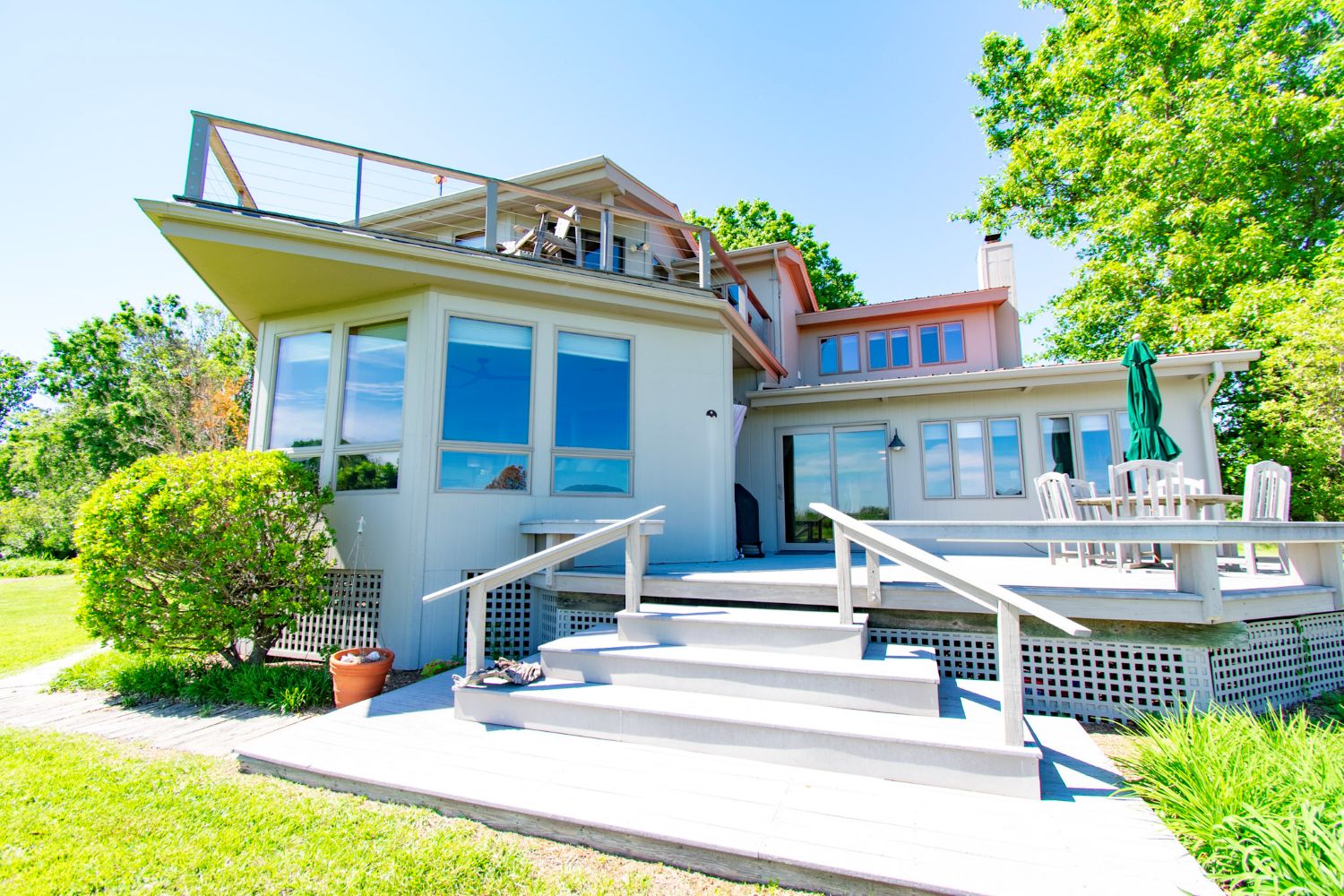
The elevated first-floor deck and expansive windows create seamless indoor-outdoor living with stunning Bay vistas.

The rear elevation opens up the house to unobstructed vistas of the Chesapeake Bay and the offsets of the second floor rooflines enliven the façade. The first floor deck is elevated to maximize the water views and is connected to the stone terrace by a paved walkway.

A prow-shaped upper deck with sleek cable railings offers uninterrupted panoramic views of the Chesapeake Bay.

The second floor deck is shaped like the prow of a ship above the bay wall projections of the living room below. The railing of horizontal cables and thin cap offers clear bird’s eye views of the Chesapeake Bay. 

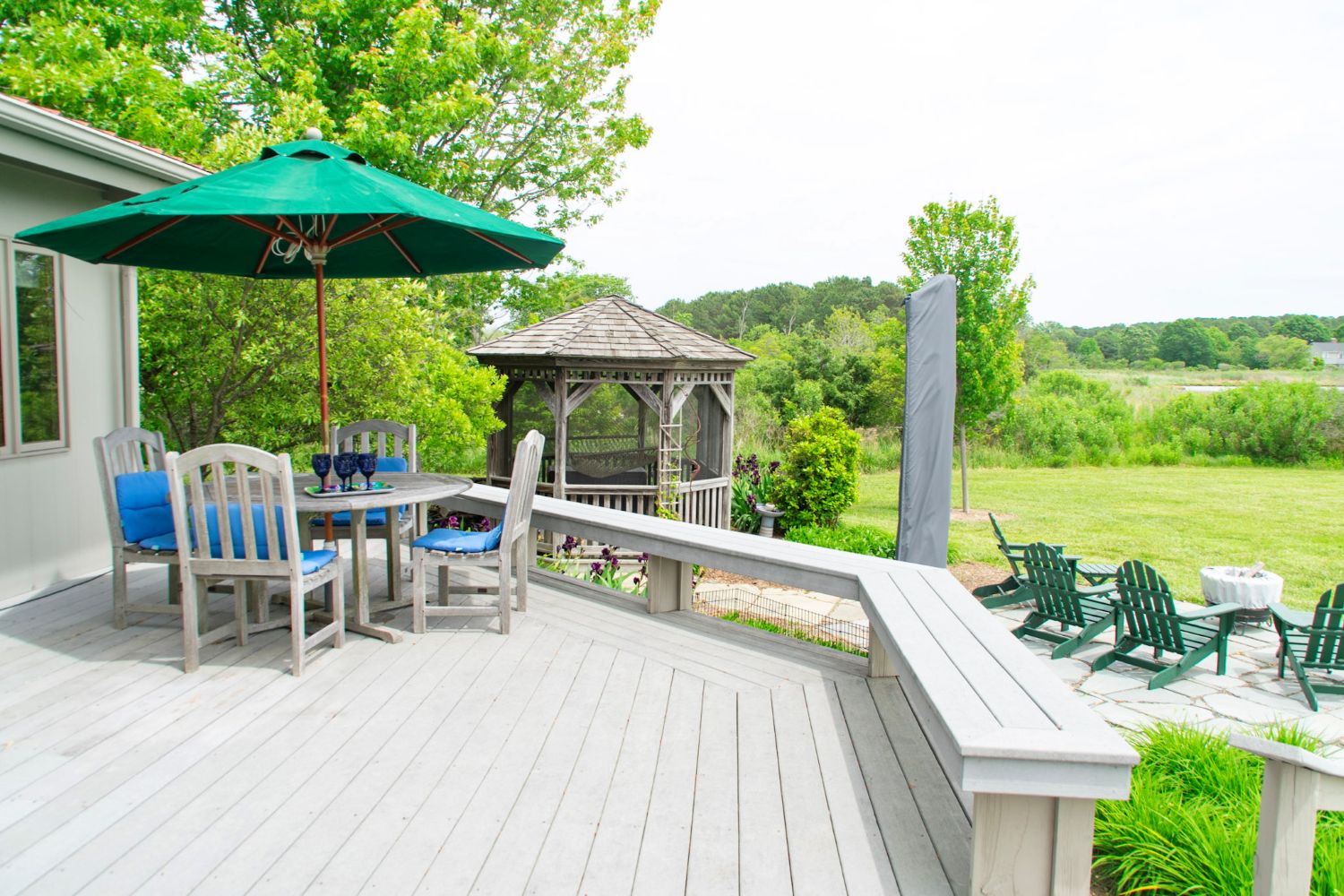
Multi-level outdoor spaces, including a deck, terrace, and screened gazebo, provide versatile areas for relaxation.

The placement of the main level outdoor spaces, from the large deck with a wide railing for extra seating to the stone terrace below and the screened gazebo offer a variety of options for relaxing outdoors. The blue cushions and the green umbrella are colorful accents to the house’s  and deck’s exterior palette of light gray.

The red roof, bold door, and accents create a vibrant entry, warmly welcoming visitors into the home.

A welcoming front entry is crucial for a house that is for sale. As I walked up the steps to the front entry deck, I admired the deep aqua pot with red flowers and the bench accented by a striped, multicolored pillow. The other red accents, that symbolize welcome, of the door and the red roof created an entry that beckoned me inside.

Natural light pours into the foyer through sidelights and a central window, complementing the wood floors and pale yellow walls.

I opened the front door into a foyer with daylight from both the sidelights on either side of the front door and a window on axis with the interior French door that creates a vestibule and airlock. Opposite the front door is a long closet for family coats and another closet under the stair to the second floor. The wood floors and trim accentuated the pale yellow walls. As I walked down the hall, I glimpsed a view of the water through both an arched opening of the adjacent office and also the living room’s exterior wall of windows. 

Sloped ceilings and tiered windows add character and light to the cozy guest spaces.

At the end of the hall a short hall leads to the guest suite at the front of the house. The bedrooms are compact but their sloped ceilings give them a pleasing spatial volume and the soothing neutral wall color is accented by the colorful striped bed linens. The side window has both a low operable window as well as a picture window above.

Thoughtful design, such as L-shaped cabinetry and glass shower walls, maximizes the functionality and openness of this shared space.

Between the two guest bedrooms is a large bath with “L” shaped  cabinetry that wraps around one corner. Placing the lavatory in the corner provides separate space for each guest’s  toiletries. The transparent glass shower maintains the spatial volume.

Visible roof beams and partial-height walls maintain an open, airy flow throughout the hall and living spaces.

The entry hall ends at the open plan kitchen-office-living room. The hall table is strategically placed for entertaining and the kitchen’s breakfast bar has a vista down the stair hall. I admired the lightly stained wood framing that frames the partial height wall between the adjacent office and dining room so the expanse of the exposed stained roof beams and decking is uninterrupted. 

The U-shaped design features granite countertops, airy shelving, and uninterrupted views.

The large “U” shaped kitchen has everything a  cook would want-plenty of counter space, an easy care floor finish, white cabinets, dark granite countertops, and stainless steel appliances.  I appreciated the lack of cabinets at the rear wall so windows could instead offer views of the landscape and water.

Stained sloped ceilings anchor this light-filled dining room surrounded by wrap-around windows and custom millwork.

The large dining room’s wrap-around windows and the sloped ceiling with stained exposed beams and decking create a stylish space for family dinners or celebrations. The bespoke millwork with glass fronted upper cabinets tucked into a recess in the room and the rattan backing of the dining room chairs maintain the transparency of the space. Windows on both exterior walls provide panoramic views of the landscape and water.

Arched shelves and open sightlines connect the office with the entry hall while framing views of the landscape.

The office ‘s interior wall’s rhythm of recessed arched openings infilled with open shelves has a full center opening that creates a “peek-a -boo” space to the entry hall. Cabinets below the arches provide ample storage for office supplies. Next to the desk at the rear corner of the space is a wall opening to the living room. Seated at the desk, one can enjoy views through the living room’s wrap-around windows. 

A bay window wall creates a focal point, framing water views while complementing the warm tones of the living room addition.

The living room addition with a rear bay-shaped wall infilled with long windows of picture planes above operable units for ventilation maximizes the vistas to the landscape and water. The room’s other angled side contains the fireplace and TV with shorter windows above more bespoke millwork.

The sloped ceilings and trio of large windows fill the serene primary suite with light and views of the landscape.

The stair to the second floor ends in a hall that contains to the primary bedroom, bath, laundry and a family room. The primary bedroom is tucked under the sloped roof with high knee walls that can easily accommodate a bed’s high headboard. A door in the knee wall painted to match the wall leads to eave storage. At the side wall, a vertical window containing a picture unit, ventilated unit and transom with a sloped top stretches from the baseboard to just below the underside of the ceiling.  

Expansive windows ensure waking up to tranquil Bay views in the light and airy main bedroom.

Opposite the bed is a trio of windows that offer views of the landscape and water. The light blue walls and white furnishings create a serene setting for sleep.

A trio of high-set windows provides ample light while maintaining privacy and adding symmetry to the bright, spacious bath.

The bath for the primary bedroom is located off the hall. The trio of windows provides ample daylight and their high sill height accommodates towel racks below and also eliminates the need for window treatments. The primary bedroom’s blue and white scheme extends into the bath.  

Wrap-around windows and deck access offer a seamless indoor-outdoor connection in the second-floor family room.

The house’s bonus room is this delightful family room, reached by additional steps from the second floor’s stair hall. The long pitched ceiling begins at the corner windows and extends past the dropped stained beam and ends at the rear wall of windows. The large closet is convenient for extended stay guests.

Built-in millwork blends seamlessly with wrap-around windows and sliding doors that frame breathtaking water views and lead to the angled deck beyond.

The notch in the family room’s side wall accommodates bespoke millwork without compromising the water view from the sitting area. This delightful room has wrap-around windows of both picture and ventilated window units for panoramic views of the landscape and water beyond. The neutral colors of the upholstered furnishings and blue accents create a great space for relaxing with family and friends. Sliding doors lead to the large deck with angled sides for panoramic water views. 

The ship-inspired angled deck and low-profile railings maximize water views, creating an outdoor oasis for relaxing.

My fave room was this deck off the family room with Adirondack chairs facing the tip of the angled deck that reminded me of the prow of a ship. The slender cap rail and horizontal cable lines disappear into the lawn beyond. With the south facing orientation, this outdoor room must be quite popular during the warm months. 

This waterfront retreat combines its close proximity to St. Michaels with its location in the  picturesque village of Neavitt. Carefully designed to maximize the expansive views of the Chesapeake Bay, the house’s compact footprint is seamlessly integrated into its natural surroundings. The contemporary architecture of sloped ceilings and wrap-around windows enliven the spaces with daylight, maximize the spatial volume and offer panoramic views of the landscape and the Chesapeake Bay. 

The compact floor plan is zoned very well with the first floor’s living-dining-kitchen spaces and guest rooms and the second floor’s primary bedroom, bath, laundry and family room. The outdoor rooms of  the terrace and gazebo, the first floor’s elevated deck and the second floor’ deck with its prow shape facing the water keeps one connected to the landscape and water. Nature enthusiasts would enjoy sightings of deer, eagles, foxes, geese, osprey and other shorebirds and water enthusiasts would enjoy the private pier to launch a boat for an afternoon on the water.  The property also has a detached shed for storage or a workspace. Great property for weekend or full time living!


For more information about this property contact Wink Cowee with Benson and Mangold at 410-745-0415 (o), 410-310-0208 (c) or [email protected]. For more photographs and pricing visit  www.buythechesapeake.com, “Equal Housing Opportunity”. 

Photography by Janelle Stroop, 845-744-2758, [email protected]
Architecture for the addition by Atelier 11,  www.atelier11architecture.com ,(410) 310-1385

Contributor Jennifer Martella has pursued dual careers in architecture and real estate since she moved to the Eastern Shore in 2004. She has reestablished her architectural practice for residential and commercial projects and is a real estate agent for Meredith Fine Properties. She especially enjoys using her architectural expertise to help buyers envision how they could modify a potential property. Her Italian heritage led her to Piazza Italian Market, where she hosts wine tastings every Friday and Saturday afternoons.

The Spy Newspapers may periodically employ the assistance of artificial intelligence (AI) to enhance the clarity and accuracy of our content.

Filed Under: 00 Post to Chestertown Spy, Design with Jenn Martella

Spy Poetry: From Our House to Your House by Jack Ridl

November 29, 2025 by Spy Poetry Leave a Comment

Editor’s Note: Many of us will remember these halcyon days of our 1950’s youth. Yes, there was the Cold War, your better-off neighbors were building bomb shelters and we practiced hiding under our desks during nuclear bomb drills. But after-school afternoons spread out ahead of us like lazy Sundays. We’d ride our bikes to buy penny candy at the local market, play baseball and dodge ball. And in the evening, after dinner, we’d run outdoors again to catch fireflies beneath the weightless, unthreatening immensity of the night sky.

From Our House to Your House

It is 1959. It is the cusp of the coming revolution.
We still like Ike. We are still afraid of Sputnik.
We read Life magazine and Sports Illustrated
where the athletes grow up shooting hoops
in the driveway, playing catch in the backyard.
We sit on our sectional sofa. My mother loves
Danish modern. Our pants have cuffs. Our hair
is short. We are smiling and we mean it. I am
a guard. My father is my coach. I am sitting
next to him on the bench. I am ready to go in.
My sister will cheer. My mother will make
the pre-game meal from The Joy of Cooking.
Buster is a good dog. We are all at an angle.
We are a family at an angle. Our clothes are
pressed. We look into the eye of the camera.
“Look ’em in the eye,” my father teaches us.
All we see ahead are wins, good grades,
Christmas. We believe in being happy. We
believe in mowing the lawn, a two-car garage,
a freezer, and what the teacher says. There is
nothing on the wall. We are facing away
from the wall. The jungle is far from home.
Hoses are for cleaning the car, watering
the gardens. My sister walks to school. My
father and I lean into the camera. My mother
and sister sit up straight. Ike has kept us
safe. In the spring, we will have a new car,
a Plymouth Fury with whitewalls and a vinyl top.

Jack Ridl, Poet Laureate of Douglas, Michigan (Population 1,100), is the author of All at Once, (CavanKerry Press, 2024), Saint Peter and the Goldfinch (Wayne State University Press, 2019), and Jack’s Practicing to Walk Like a Heron (Wayne State University Press, 2013) was awarded the National Gold Medal for poetry by ForeWord Reviews. His collection Broken Symmetry (WSUPress) was co-recipient of The Society of Midland Authors “Best Book of Poetry” award for 2006. His Losing Season (CavanKerry Press) was named the best sports book of the year for 2009 by The Institute for International Sport, and The Boston Globe named it one of the five best books about sports. In 2017 it was developed into a Readers’ Theater work. This poem is from Practicing to Walk Like a Heron.

The Spy Newspapers may periodically employ the assistance of artificial intelligence (AI) to enhance the clarity and accuracy of our content.

Filed Under: 00 Post to Chestertown Spy, Spy Poetry

Chesapeake Lens: “Morning Mist” by Richard Shanks

November 29, 2025 by Chesapeake Lens Leave a Comment

It’s a misty morning in the Blackwater National Wildlife Refuge, peaceful as can be. “Morning Mist” by Richard Shanks.

The Spy Newspapers may periodically employ the assistance of artificial intelligence (AI) to enhance the clarity and accuracy of our content.

Filed Under: 00 Post to Chestertown Spy, Chesapeake Lens

  • « Previous Page
  • 1
  • 2
  • 3
  • 4
  • 5
  • 6
  • …
  • 61
  • Next Page »

Copyright © 2026

Affiliated News

  • Chestertown Spy
  • Talbot Spy
  • Cambridge Spy

Sections

  • Sample Page

Spy Community Media

  • Sample Page
  • Subscribe
  • Sample Page

Copyright © 2026 · Spy Community Media Child Theme on Genesis Framework · WordPress · Log in