
MENU

Sections

  • Home
  • Education
  • Donate to the Centreville Spy
  • Free Subscription
  • Spy Community Media
    • Chestertown Spy
    • Talbot Spy
    • Cambridge Spy

More

  • Support the Spy
  • About Spy Community Media
  • Advertising with the Spy
  • Subscribe
March 12, 2026

Centreville Spy

Nonpartisan and Education-based News for Centreville

  • Home
  • Education
  • Donate to the Centreville Spy
  • Free Subscription
  • Spy Community Media
    • Chestertown Spy
    • Talbot Spy
    • Cambridge Spy
1A Arts Lead Arts Arts Portal Lead

Looking the the Masters: Calder Circus by Beverly Hall Smith

June 1, 2023 by Beverly Hall Smith Leave a Comment

Alexander Calder (1898-1976) was born in Philadelphia, Pennsylvania into a family of artists.. His grandfather and father were known for their public sculpture commissions, and his mother was a portrait artist. Alexander, better known as Sandy, started making small sculptures of mixed materials by1902.  The first one was an elephant. By age ten, Sandy had a small workshop. However, his parents having experienced the artist life, wanted Sandy to choose another line of work. Sandy graduated from the Stevens Institute of Technology in New Jersey with a degree in mechanical engineering. The following inscription was written in his yearbook: “Sandy is evidently always happy, or perhaps up to some joke, for his face is always wrapped up in that same mischievous, juvenile grin. This is certainly the index to the man’s character in this case, for he is one of the best natured fellows there is.” 

“Calder Circus” (1926-1931)

Calder held several jobs as a hydraulic engineer, draughtsman, mechanic, and timekeeper at a logging camp. From the camp he wrote home to request paint and brushes to paint the mountain scenery. He started his art studies in 1923 at the Art Students League in New York City. He frequently visited Coney Island, the circus, and the Bronx and Central Park zoos. He began the creation of the “Calder Circus” (1926-1931). Over the next several years the “circus” grew to over 70 miniatures of performers, almost 100 accessories, 30 musical instruments, records, and noisemakers. Eventually the work filled five suitcases. The figures were made of wire, wood, metal, cloth, yarn, cardboard, leather, cloth, string, rubber tubing, corks, buttons, rhinestones, pipe cleaners, bottle caps, and other found objects.

Calder moved back and forth from Paris to New York from 1926 until 1933. He performed the show over 70 times. In Paris his audience included critics, collectors, and artists from the theatre, and literature, including the Parisienne avant-garde, Miro, Duchamp, Cocteau, and Leger. Paris audience members sat on bleachers made from champagne crates, and they ate peanuts. They were given noisemakers to sound when Calder gave the signal. In New York his audience included members of high society. Calder announced the acts in French or English, choreographed all the movement, gave voice to the performers and animals, played music, and created sound effects. The shows were so well received they often lasted for two hours. 

At the lower right-side corner of the display is the “Little Clown Trumpeter.” In a performance, Calder would place a balloon in the clowns mouth and then blow through the hose until the balloon burst and knocked over the bearded lady that was placed in front of him. The figures in the middle are a cowboy wearing wooly chaps, a bull made of wire and corks, a cowboy on horseback wearing a red bandana and holding his black hat, and a woman waving an American flag. A street lamp, and a dachshund fill in the left front corner. At the rear, three trapeze artists hold onto the high wire that Calder would vibrate to animate them. In case one should fall, a net was suspended beneath.
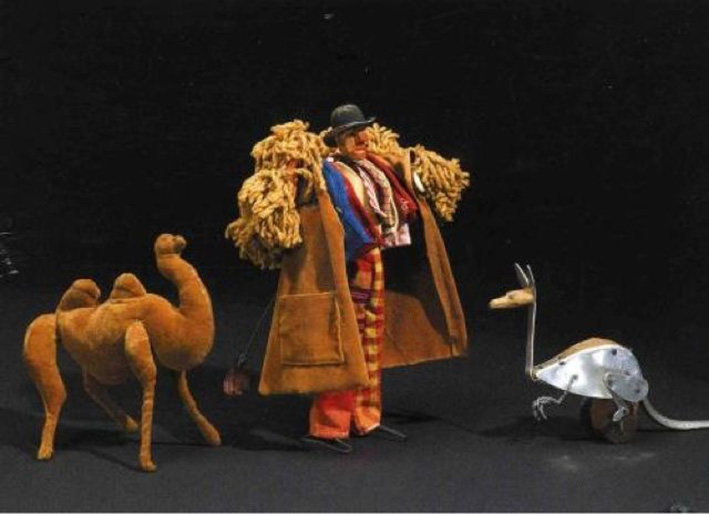
“Clown, Camel, Kangaroo”

The clown (10.5’’x7’75’’x5’75’’) is dressed in a long brown coat with arms made of Yarn. Calder would strip off the clown’s clothes in layers until he was dressed in coveralls, and revealed to be a thin wire figure. The camel is a cloth sculpture sewn together and wired for stability (6.5’’x5’75’’x4’25’’). The kangaroo is made from shaped pieces of metal nailed to a wooden base on a wheel. When the kangaroo is pulled by an attached cord its legs appear to move, similar to a child’s pull toy. As a result of the success of his inventions, Calder went to Oshkosh, Wisconsin, in 1927, to meet with a children’s toy manufacturer. They signed a contract for his Action Toys: a hopping kangaroo, a skating bear, and a goldfish that appeared to swim, opening and closing its gills when pulled.  

“Monsieur Loyal and Lion Cage”


Standing in the center ring, ringmaster Monsieur Loyal in top hat and tails points to the lion in cage. Out of the cage for a performance, the lion completed a few tricks and then sat on a pedestal. The lion then dropped a few chestnuts as if popping, which were quickly removed. Calder planned to add scent to the performance, but he found musk perfume too expensive and abandoned the idea.
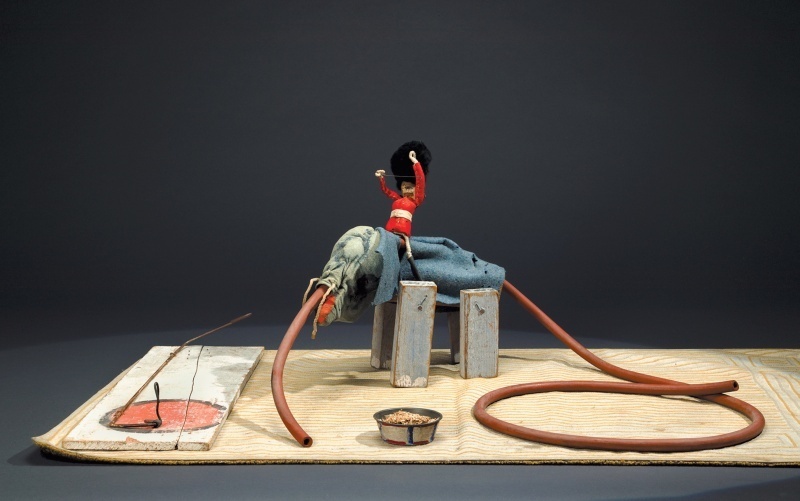
“Elephant and Rider”


Other attractions at the Calder Circus included a sword swallower, Sultan of Senegambia, who threw spears and axes, a belly dancer who gyrated, a horse and chariot, cows, seals, a tightrope act, dogs, and other acts from the circus and the side show. The rider on the elephant appears to an English Kings Guard wearing a bearskin hat and bright red tunic. The elephant has a tube running through its body. In a performance the tube/trunk hung down as if the elephant were drinking water, but when Calder blew into the tube the trunk raised up and spewed out small pieces of paper to  give the effect of  spaying water. 
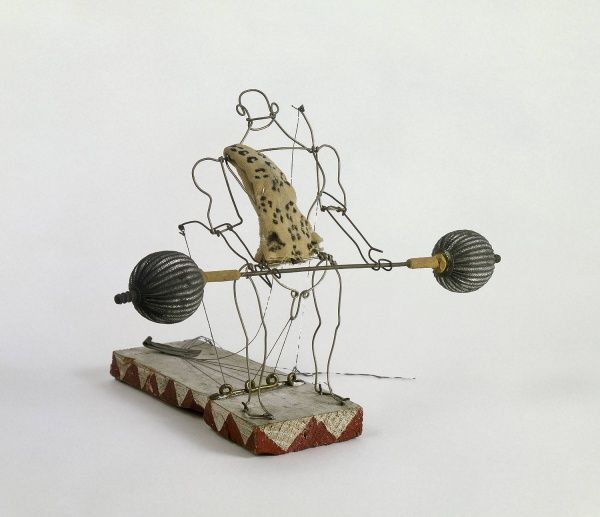
“Rigoulot, the Strong”


 Calder included well-known circus performers in his show. May Wirth, a famous bareback rider from the Barnum and Bailey circus, performed in the center ring. “Rigoulot the Strong” was a popular performer. When Calder loosened the cord, Rigoulot bent forward and picked up the barbell with his wire-hook hands. When the cord was tightened, the figure returned to the upright position and groaned. The figure then proceeded to lift the barbell backward and over his head.

During the run of the “Calder Circus” from1926 to 1931, Calder added a new dimension to the show with a series of figures constructed of wire only (1929). After meeting Piet Mondrian in 1930 and after being introduced to totally abstract art, he wrote a letter to Mondrian stating it was “the shock that converted me. It was like the baby being slapped to make its lungs start working.” It was then that Calder began to work as he said, “Just as one can compose colors, or forms, so one can compose motions.” He began creating his “Mobiles” in 1931.

Calder gave the last performance of the Calder Circus in 1961, for the filming of Le Cirque de Calder by Carlos Vilardebo. The Whitney Museum in New York City raise $1.25 million in 1932 to the purchase the Circus. The work continues on display at the Whitney.

Beverly Hall Smith was a professor of art history for 40 years.  Since retiring with her husband Kurt to Chestertown in 2014, she has taught art history classes at WC-ALL. She is also an artist whose work is sometimes in exhibitions at Chestertown RiverArts and she paints sets for the Garfield Center for the Arts.


The Spy Newspapers may periodically employ the assistance of artificial intelligence (AI) to enhance the clarity and accuracy of our content.

Filed Under: 1A Arts Lead, Arts Portal Lead

Design with Jenn Martella: “Barnacle Bungalow”

May 31, 2023 by Jennifer Martella Leave a Comment


Whenever I drive to Tilghman to visit friends, I always glance at a one-story house that captured my eye several years ago. It is a great example of how breaking out of the box by adding porches, bay projections and details can transform a simple rectangular shape from Plain Vanilla to Neapolitan. The house is divided into two sections. One part contains the side facing garage and primary suite and is slightly offset from the other section; the other part contains the open plan living-dining-kitchen area, laundry, two other bedrooms and one bath. Taking advantage of the offset, a wide gable was added over the  living room and a shorter gable projects farther to emphasize the front entrance. Then a deep shed roof was added to create an open porch that extends to the corner of the house and wraps around to meet the screened porch at the side elevation.

Insert pix #2-front elevation

I also write a bi-weekly column for Bohl Architects and a recent column addressed my architectural “Pet Peeves.” I was very pleased to see here that instead of plain posts masquerading as columns, this house has Craftsman columns of stacked stone bases below tapered wood columns that greatly enhances this elevation. I also admired the shake siding that infills the gable fronts to contrast with the house’s lap siding, the 6/1 windows and the light aqua shutters that I soon discovered were a preamble to the visual delights within.  

Before going inside, I walked around the house and saw the screened porch at the side of house that is a delightful outdoor room. The end gable is also clad in shake siding to match the gables at the front of the house. Inside the screened porch, the sloped roof rafters are exposed and the wide spacing of the openings frames panoramic views. At the rear elevation is a box bay projection and a deck off the mud room with views of the woods.

I opened the front door into the open plan layout and I was greeted by Hollace Kutay, a Marine Artist and Coastal Designer who reimagined every room of this house. She offers her coastal homes fully furnished and decorated with accessories and art to give each home its own distinctive personality. She explained how the living room was once the primary bedroom and how she reworked the interior layout to create vistas through the “L” shaped open plan living-dining-kitchen. She relocated the primary suite between this area and the garage for privacy from the other two bedrooms off the screened porch. To add spatial volume, she removed the flat ceiling to create a pitched ceiling plane over the dining-kitchen area. I admired her “Coastal Casual” design scheme with white walls that were the perfect backdrop for the splashes of color and texture from upholstery, colorful accessories and art that celebrates both waterfowl and sea creatures.

I coveted the kinetic and colorful design of the living room’s rug design of vibrant and whimsical oversize fish and the large octopus artwork over the fireplace, both of which are Kutay’s designs. The seating is grouped around the electric fireplace between built-in millwork and the triple window unit floods the space with sunlight. 

The focal point of the dining room’s wood table and rattan chairs is a large artwork featuring a giant Blue Osprey. Being a July Crab, I coveted the dinnerware set on the dining table with its crab design centered below a colorful border around each plate. 

.

The kitchen’s island is centered on the double window at the rear wall with a stunning countertop of “Vetrazzo” fabricated from recycled sea glass/crushed oyster shell. The combination of white cabinetry, stainless steel appliances, aqua tile backsplash with open wood shelves matching the wood band around the stove hood, shiplap accents in the stove hood and end wall of the island create a fresh and sleek look. The long wood hunt table on the opposite wall is an accent as well as a buffet table for the dining area. 


The kitchen extends to the pantry’s galley layout due to the box bay projection that widened the space. The pantry is outfitted with a second sink, built-in microwave and beverage fridge, deep aqua cabinets, and live-edge butcher block countertops. A tall cabinet separates the pantry area from the washer and dryer and the hall to the primary suite. Next to the hall is the mudroom opposite the glass sliding door to the deck. The mudroom wall has a wide live-edge wood slab at a bench height for storing wellies below with hooks above for jackets against a full width and height wall of deep aqua shiplap. At the end of the panty/mudroom is the door to the attached garage.

The luxurious primary suite has a spacious bedroom with a double unit window and ample space for a bed with nightstands, an upholstered bench at the foot of the bed and a long dresser. The light aqua and blue colors create a serene retreat. Barn doors close off the bedroom from the spacious walk-in closet. 


The primary bath has double vanities with dual mirrors framed with shells, a tile floor and a large shower with deep sea green tile. A recessed area in the shower wall is tiled with the same polygonal tile in soft green shades that matches the floor tile.

The two guest bedrooms are located at the opposite end of the house from the primary suite and are side by side with exterior doors opening onto the screened porch. One bedroom has a delightful octopus theme with a blue padded headboard, blue chest of drawers below an octopus artwork, and an accent pillow with an octopus perched on top. 


The other guest bedroom has a light blue padded headboard and accent pillows of colorful seaweed and coral matching the panels of the armoire and  a light blue side table for guest luggage.

One House of the Week last year had a bath with delightful mermaid wallpaper-this bath’s wallpaper has a background of floating octopuses that complements the color of the lavatory cabinet and the white shiplap walls add texture. 

This two acre property in a water privileged community also includes a two-car attached garage, large deck, storage shed and broad expanses of lawn for play. High marks for a stylish exterior and interior renovation and the delightful interior design inspired by the sea and its creatures by Hollace Kutay who reimagined every room. This is the perfect time of year to claim this turn-key property for your summer sojourn or contact Hollace Kutay to enhance your existing home with special touches that remind you of the sea. I left “Barnacle Bungalow” smiling and humming the Beatles song that begins-

“I’d like to be 

Under the sea

In an octopus’ garden 

In the shade….”

For more information about this property, contact On Design sponsor Tiffany Cloud with Meredith Fine Properties at 410-822-2001 (o), (570) 751 8637  (c) or [email protected]. For more photographs and pricing visit www.meredithfineproperties.com, “Equal Housing Opportunity.”

Interior Design by Hollace Kutay, whose background as a marine artist and her childhood summers on Grand Cayman Island influences her designs. Her paintings and whimsical ceramic sculptures of sea creatures have won her national recognition. Contact Hollace Kutay at 717-341-0518 or [email protected],  www.hollacekutay.com.

Photography by Atlantic Exposure LLC, 310-973-7325, www.atlanticexpoaure.com.

Lyrics to “Octopus’s Garden” by Richard Starkey

Jennifer Martella is an architect with Bohl Architects’ Annapolis office and a referral agent for Meredith Fine Properties. Jennifer is an integral part of Bohl Architects’ design team for projects she brings to the firm. She is also the writer of  Bohl’s website’s  bi-monthly blog “Tango Funhouse” where she highlights the firm’s vision and other fun aspects of life by design. Her Italian heritage led her to Piazza Italian Market, where she hosts wine tastings every Friday and Saturday.


The Spy Newspapers may periodically employ the assistance of artificial intelligence (AI) to enhance the clarity and accuracy of our content.

Filed Under: Design with Jenn Martella, Spy Highlights

Chesapeake Lens: Sand Ripples by Chase Morgan

May 27, 2023 by Chesapeake Lens Leave a Comment

At low tide, all is revealed. “Sand Ripples” by Chase Morgan.

The Spy Newspapers may periodically employ the assistance of artificial intelligence (AI) to enhance the clarity and accuracy of our content.

Filed Under: 3 Top Story, Chesapeake Lens

Delmarva Review: Girls and Dolls by Marda Messick

May 27, 2023 by Delmarva Review Leave a Comment

Author’s Note: “When I saw an old ‘Visible Woman’ in a battered box at a yard sale, vivid memories of the one I received for Christmas arose and prompted this poem. Having access to the nude anatomy of a grown-up woman felt thrillingly transgressive back then, though I had parental approval. The transparent plastic model was a sort of key to unlock the mystery of my own changing body, even as the prevailing model of womanhood was being questioned and disassembled.” 

Girls and Dolls

The anatomical model of the female body
Santa left when I was ten was no Barbie doll. 

The plastic lady came boxed with a skeleton,
vital organs, and the (optional) “miracle of creation”
transparent uterus complete with baby
that I could click in and take out,
although I didn’t know how a real baby
got in and out, or what to call a vagina and vulva,
parts I vaguely had but she didn’t:
she was plastica intacta down there. 

The see-through Visible Woman
wasn’t visible at all except for her insides.
She (totally) could have opened the door
wearing Saran Wrap and a glassy look
of biological destiny on her non-face,
but like Barbie with those working girl outfits
the VW wasn’t intended to show me
a person to be reckoned with,
or to model the actual real
doing disagreeing choosing
the-hell-you-say visible woman
her bold title prophesied
and who was coming into view
the year I was ten. 

Nevertheless she showed me
the sturdy bones of my durable body;
she showed me breasts and ovaries
and female embodiment;
from then on, from ten on
I was learning that it is vital
—listen, Invisible Girl—
to put in and take out,
to investigate and create,
to stand and show up in
my own visible, my own
miraculous self. 

⧫

Marda Messick is a poet and theologian living in Tallahassee, Florida on land that is the traditional territory of the Apalachee Nation and other indigenous peoples. Her work has appeared or is forthcoming in The Christian Century and Literary Mama. 

“Girls and Dolls” was published in the Delmarva Review Volume 15, a nonprofit literary journal that selects the most compelling new poetry, nonfiction, and short fiction from thousands of submissions during the year. It is available from Amazon.com and other bookstores. The review is designed to encourage outstanding new writing from authors everywhere. Support comes from tax-deductible contributions and a grant from Talbot Arts with funds from the Maryland State Arts Council. Website: www.DelmarvaReview.org.

The Spy Newspapers may periodically employ the assistance of artificial intelligence (AI) to enhance the clarity and accuracy of our content.

Filed Under: 3 Top Story, Delmarva Review

With a Little Help from the Avalon, Easton Elementary Turns into Living History Museum

May 26, 2023 by Henley Moore Leave a Comment

Easton Elementary School in Easton has brought history to life with a remarkable living history museum in its cafeteria. Spearheaded by fourth-grade teacher Joanna Morris, with the assistance of the Avalon Foundation, students immerse themselves in their chosen historical figures, conducting their own research and biographies of their favorite GOAT.

The Spy spent a few moments with Joanna, her crew of dedicated volunteers, and a cast of famous heros.

This video is approximately three minutes in length. For more information about the Avalon Foundation please go here.

The Spy Newspapers may periodically employ the assistance of artificial intelligence (AI) to enhance the clarity and accuracy of our content.

Filed Under: 1A Arts Lead, Arts Portal Lead

The Monster of Gunpowder River: A Chat With Author Michael Stang

May 26, 2023 by James Dissette Leave a Comment

One thing the hardships of the pandemic forced us to do was to determine how to spend our time during its long months of self-isolation and monotony. For creatives, the long blocks of time held a silver lining—time to explore their art form.

For retired emergency room physician Michael Stang, the pandemic’s mandatory partitioning of life offered a chance to rekindle his lifelong affection for writing. 

That love for writing, meditative walks along the Gunpowder River north of Baltimore, and a fascination with regional history led to a series of ideas Stang began to shape into stories.

The result was The Monster of Gunpowder River and Other Fabrications, a collection of seven short stories Visionary Art Museum director Rebecca Hoffberger calls “seven wonder stories, each structured upon a skeleton of geographic and historic truths…and gifted breath by the pure power of imagination.”

Michael Stang will share his stories on Wednesday, May 31, at 6 m at The Retriever Bar as part of the Bookplate ongoing Authors and Oysters series. 

For more event details, contact The Bookplate at 410-778-4167 or [email protected]. This event is free and open to the public, and reservations are not required, however the event on 6/14 with Smithsonian curator, Eleanor Harvey, will require reservations to guarantee a seat. Reserve your space by calling the shop at 410-778-4167. The next Authors & Oysters is scheduled for 6/7 with local favorite Jamie Kirkpatrick. All events are held in the back room of The Retriever, located at 337 ½ High Street in Chestertown, Maryland. 

This video is approximately five minutes in length.


The Spy Newspapers may periodically employ the assistance of artificial intelligence (AI) to enhance the clarity and accuracy of our content.

Filed Under: 1A Arts Lead, Arts Portal Lead

Looking at the Masters: Hung Liu – Part 4

May 25, 2023 by Beverly Hall Smith Leave a Comment

Hung Liu had many talents. She was a painter, photographer, video maker, and a printer. Since 2006, several of her paintings have been chosen to be woven into tapestries. In 2004 she attended the Tamarind Workshop at the University of New Mexico in Albuquerque, established in 1960 to advance the art of printmaking in America. There she developed a unique style of printmaking that involved layers, also in her paintings. Hung Liu won in 2011 the SGC International Award for Lifetime Achievement in Printmaking. 


“Dandelion with Mallard” (2016) (32’’x31’’) (monoprint with hand leafing and hand coloring) is from a series titled Drifters. On a road trip with her husband in the summer of 2014, Hung Liu began to photograph dandelions.  Large paintings from the series are titled by location: “Deadwood,” “Little Big Horn,” and “Mt. Rushmore.” Hung Liu appreciated the fact that dandelion seeds are migratory, they cross all earth and water barriers, and then multiply in new lands. The painting and prints depict dandelions past their prime, their blossoms going to seed. Their life is ending but is regenerated by the seeds.

The familiar Hung Liu circles and drips continue in this print. She also adds a brightly colored Mallard duck, in Chinese tradition a symbol of prosperity, abundance, and good luck.

“Migrant Mother” (2015)

Hung Liu visited the Oakland County Library in California in 2015 to study the archives of Dorothea Lange and the other photographers of the WPA (1939-43) who documented the Great Depression in America.  “Migrant Mother” (2015) (66”x66”) (oil) was one of the first of many paintings and prints in Hung Liu’s exhibition American Exodus. She commented,“This landscape of struggle is familiar terrain, reminding me of the epic revolution and displacement in Mao’s China. Only, now I am painting American peasants looking for the promised land.” 

Although the Dorothea Lange image is familiar to most viewers, Hung Liu said she finds “true inspiration…to discover, to excavate, to peel off the layers and try to find out what was there that got lost, for there is always something missing.” In “Migrant Mother” the face is the same as Lange’s photograph, but the poses of both mother and child are slightly altered, and a background is added. The figures are placed in a room, its dreary grey-brown color resembling a tent, not a house. A kerosine lamp and a bowl are placed on the table,

To offer hope in an atmosphere of despair, Hung Liu has painted a pink square on the wall, and the image of man’s hand holding a bouquet of freshly picked daisies. Daisies are an international symbol of purity and innocence. They represent new beginnings, and they bring joy. She said, “We can adopt each other’s children, so why can’t we adopt each other’s ancestors.”

“Tobacco Sharecropper” (2017)

“Tobacco Sharecropper” (2017) (monoprint with silver leaf) (33”x33”) depicts a barefoot and bare legged little girl helping her father pick tobacco. Hung Liu’s introduction of metal onto the surface of the print achieves a unique multicolored, mirror-like surface that reflects light. Her art education in China included painting of Russian Icons where precious metals, particularly gold leaf, were layered onto the image to increase its spirituality. Hung Liu’s inclusion of silver and gold leaf serve the same purpose. The images of the past are not lost, but brought back from history and preserved for the future.  

Hung Liu states: “With this new body of paintings, I would like to summon the ghosts from Dorothea Lange’s brilliant [black and white] photographs…I personally identify with Ms. Lange’s photographs since I am myself an immigrant from China and was caught up in wars and famines…forcing my family to migrate elsewhere. As an American citizen, I am very passionate about how painting American subjects remind me so much of those of my homeland.”

An exhibition of Hung Liu’s work was scheduled to open on December 6, 2019, at the Center for Contemporary Art in Beijing. The exhibition was abruptly cancelled in November.  Hung Liu had agreed to remove a few of her paintings that were considered too controversial, but the reason for the cancellation was suspect, permits to bring her work into China were denied. In an interview with Art News (2019) Liu stated, “The message is anti-war so I thought it was OK. When I talked with my Chinese artist friends about it, they just said one word: Hong Kong.” Hung Liu held a cancellation party on the day the show was supposed to open.

“Sanctuary” (2019) (72”x72”) (oil with gold leaf) depicts a Mexican mother and her baby boy. Hung Liu’s concern for immigrants included those Mexican, Guatemalan, and Central American migrants arriving in large numbers at the American border. She visited the Texas border and talked with and photographed many migrants. The expression on the face of this mother displays a mixture of emotions: joy, thankfulness, relief, and many more. Previously, Hung Liu painted Madonna-like figures in different forms, both Chinese and African American. In “Sanctuary,” Hung Liu placed a solid gold leaf circle behind the woman’s’ head. It is a reference to the Virgin Mary, to the Mexican Virgin of Guadalupe, to the halo always around the head of the Buddha, and it represents the sun and hope.  

Hung Liu retired from Mills College in 2014, but she never stopped working. She died on August 7, 2021 as the result of pancreatic cancer. She was 73 years old. She was an internationally respected and beloved artist, and her work was exhibited in over fifty solo exhibitions.  Memorial exhibitions continue to be scheduled world-wide. Her paintings remind us that everyone, no matter the race, religion, or place in the world, should be respected and honored. Having come from an authoritarian country, she loved American democracy. She remarked: “The story of America as a destination for the homeless and hungry of the world is not only a myth. It is a story of desperation, of sadness, of uncertainty, of leaving your home. It is also a story of determination, and—more than anything—of hope.” (Hung Liu, 2017)

Beverly Hall Smith was a professor of art history for 40 years.  Since retiring with her husband Kurt to Chestertown in 2014, she has taught art history classes at WC-ALL. She is also an artist whose work is sometimes in exhibitions at Chestertown RiverArts and she paints sets for the Garfield Center for the Arts.


The Spy Newspapers may periodically employ the assistance of artificial intelligence (AI) to enhance the clarity and accuracy of our content.

Filed Under: 1A Arts Lead, Arts Portal Lead

Delmarva Review: Remembering Stranathan’s by Chris Arthur

May 20, 2023 by Delmarva Review Leave a Comment

Author’s Note: “Stranathan’s was the name of the barber’s shop in the town where I grew up in Northern Ireland. My essay is, in part, a recollection of this fondly remembered place, where my brother and I were regularly taken for haircuts throughout our childhood. But it’s also a meditation about something that has fascinated me for years – the nature of memory, and the relationship between remembering and imagining.”

Remembering Ramathan’s 

Memories are all we get to keep from our
experience of living, and the only perspective
that we can adopt as we think about our lives
is therefore that of the remembering self. 

Daniel Kahneman,

Thinking, Fast and Slow 

IT’S MAY 2020 IN ST. ANDREWS, SCOTLAND. I’m sitting in my kitchen on a sunny morning in the middle of the COVID-19 lockdown. My wife is cutting my hair, grown longer than accustomed—or wanted—over these weeks of seclusion and social distancing. Her barbering prompts a memory I wasn’t expecting. Instead of making me remember how she used to cut my hair when we were students or think of the plight of my usual hairdresser—business closed and undertaking strict shielding measures because of an elderly parent’s vulnerability to the virus—the rhythmic clipping of the scissors summons something far more distant. I picture Stranathan’s, the barber’s shop in Lisburn, the town in Northern Ireland where I grew up. My brother and I were regularly taken there throughout our childhood. The hair that fell around me then was dark, undusted by the gray that now runs through it. It’s hard to believe how long ago it was that those two little boys used to delight in feeling the prickly stubble on the back of their heads as they emerged, newly shorn, from the shop. 

I don’t remember the name of the man who used to cut our hair—in fact, I’m not sure we ever knew it. He comes back to me in fragments. Much of him is missing. He’s full-lipped—his most memorable feature—with black hair slicked back in a brilliantined wave. The breast pocket of the white coat he invariably wore is filled with razors, combs, and scissors. Once, when he stooped to pick up a bottle-top, they all fell with a clatter on the lino floor. He said nothing but simply knelt and picked them up one by one, carefully brushing and blowing the hairs off them before replacing them in the same pocket. His complexion is sallow yet overlaid with the pallor of indoors. He wears more rings than most men did back then, and his shoes are sufficiently pointed and polished to qualify as “winkle-pickers.” His style suggests Teddy boy, though he’s in his early thirties and should therefore be, as my mother put it, disapproval of him evident in her voice, “old enough to know better.” 

These remnant details only add up to a partial picture. If it were a portrait, most of the canvas would be blank. Such incompleteness is tantalizing—it offers a sense of this individual, but one that won’t come into proper focus. Alongside this patchy recall of my boyhood barber, a much clearer image comes to mind that sums up the nature of the fragmented memories I have of him. I think of the candyfloss accumulations of spiders’ webs that fur the windows of my garden shed. Their nets of dirty gossamer strands are like cotton wool thinned and soiled, flecked with an array of insect debris, a record of predation presented in a kind of dry pointillism worked in tiny body parts. What I can remember about my first barber is like these dried-up bits of insect—antennae, wings, mandibles—a peppering of particles caught on memory’s web. There’s not much left, yet the pieces still manage to conjure echoes of the living person, in the same way as the shards held in the woolly ossuary that crusts my shed’s windows still summon whispers of the butterflies, moths, bees, and flies they came from. 

Trying to reconstruct from these fragments a fuller picture of Stranathan’s barber shop and the full-lipped, white-coated man who used to cut my hair reminds me of a scene from Homer’s Odyssey. Descending to the underworld, Ulysses meets the souls of the dead. Before they can regain their memory and recognize him, he needs to provide them with the blood of sacrificed animals. Only after drinking this life-imbued liquid can the dead be parleyed with. The blood restores a level of consciousness that allows them, albeit temporarily, to communicate again, recalling enough of life to connect with the concerns of those still living. 

Given the mnemonic potency accorded to blood in the Odyssey, it’s ironic that the memories awoken by my wife’s lockdown cutting of my hair are focused on a barber’s shop. Stranathan’s had one of those red-and-white-striped poles outside the shop,  

an internationally recognized sign of a barber (see Note). Theirs was a modern version of this ancient symbol. It was fixed like a flagpole above the shop’s front door. Encased in a kind of elongated bell jar of glass or plastic, the red and white spirals must have been electrically powered. Turning endlessly, even when the shop was closed, the moving helix drew the eye with the illusion of infinite repetition, the prospect of perpetual continuance, red and white appearing, disappearing, reappearing without end.

[Note: Red and white are the traditional colors for barbers’ poles in Europe. The addition of blue in America is variously explained. Some suggest it stemmed from patriotic motives—introducing blue so that the pole echoes the colors of the US flag. Others say it’s an extension of the original symbolism with blue representing the color of veins opened during bloodletting.]


The reason for the red-and-white-striped spirals on a barber’s pole is all to do with blood. The poles are often capped at the end with a kind of bowl-shaped cup—Stranathan’s glass bell jar was topped with just such a device. It, too, is blood related. Only a few centuries ago, barbers didn’t just deal in coiffure. They offered surgery, bone setting, and tooth pulling. Bleeding was relied on as key therapeutic measure in the 

treatment of many ailments; barber-surgeons used to bleed their customers as routinely as they tended their hair and beards. The pole represents the stick customers gripped tightly as they underwent this procedure. The red in the spiral stands for blood, the white for bandages. The shape that tops the pole represents the bowl into which the blood was drained. Some poles have a second bowl shape at their base, representing the container in which medicinal leeches were kept. 

Though bloodletting has long been abandoned by barbers, something curiously elemental still attended our visits to Stranathan’s. Perhaps the skillful wielding of sharpened metal implements at close quarters suggested something less quotidian than cutting hair. Or perhaps the strange mix of intimacy and distance conferred a special quality—the way the hands of someone scarcely known touched our heads, those warm receptacles of what we thought and felt. I find an almost elegiac note accompanying the realization that the full-lipped barber used to touch the head that, all these years later, is writing about him and still holds fragments of him in the invisible embrace of memory. I can’t help wondering how many other minds he’s held in. If I could access the way in which all the little boys whose hair he cut stored him in the mazes of their minds, would that bring back a fuller picture or just further fragments? And how did he see us? My brother and I were just two among droves of little boys brought in for haircuts (girls were taken to an upstairs salon). He may scarcely have distinguished one from another in this crowd of juvenile customers, or perhaps he remembered via a kind of phrenology, his memory holding a whole array of contour maps for the different shapes of heads he felt beneath his fingers. 

Is there any equivalent to Ulysses’ sacrificial blood that I could offer to the fragmented shades from Stranathan’s that roam the underworld of my remembrance, something that might make more whole the memories they represent? I don’t think there’s anything straightforwardly efficacious, no magic pill, no obvious medicine to take, though perhaps writing this kind of reflection is a type of self-bloodletting that makes an incision in the psyche’s store of what has passed and collects what flows in its bowl of words. I’m not sure how seriously to take that conjecture. But whatever’s made of it, there are two more prosaic strategies that can help. 

The first involves an almost meditative focusing and disciplining of the mind as I imagine myself returning to that point in childhood. I think through the years, reach back and back again, try to discount distraction, let the noise of the present fall away until I’m there again in spirit. I hope the spectral touch of this kind of concentrated attention can nudge some of the particles of remembrance into new alignment, send a pulse of voltage through them so that they can come together, cohere into more viable patterns, even jerk back into momentary life. 

The second strategy is more straightforward. It simply involves asking my older brother what he remembers. We were always taken to Stranathan’s together, which means I can tap into a second perspective, access another set of memories to lay beside my own and see what tallies. Using the whetstone of his independent recollection offers a way of sharpening my version of the past, giving it a keener, truer edge so that it can cut through the years more cleanly and see those vanished days again, cleared of the overlay of time that’s passed since they were present. 

Putting these two strategies into play has helped me to imagine going through the door to Stranathan’s again, passing under the endlessly turning barber’s pole. My brother and I are ushered in by a parent—we don’t agree whether it was our mother or father who most often accompanied us. The three of us sit down, side by side, in the row of chairs arranged against the back wall, waiting for our turn. There’s a warm, sweet smell of perfumed oils and lotions. As for noises, the snip-snip of scissors, the buzz of electric clippers, and the sporadic conversation don’t quite blot out the sound of clumps of hair falling on the floor in featherlight swishes. If you listen closely, you can hear this gentle 

punctuation every now and then, making a sound that’s reminiscent of wire-brush drumsticks touched gently to a cymbal. The single window in this back room of the shop is always closed. Its lower half is net-curtained, its upper half is misted with the heat of the muggy salon atmosphere, blurring the view of nearby buildings. On the windowsill sits a large valve radio. Is it switched on? Is there music playing? My memory is of it being tuned to a sports channel with commentary on horse racing. But my brother doesn’t remember there being a radio at all, so perhaps my mind has conjured it from somewhere else, and those excited cadences of the commentator’s voice as the horses near the finish line are not part of the aural background of Stranathan’s at all but have strayed here from some other fragment caught on remembrance’s candyfloss web of pieces. 

We both agree that there were three red leather swivel chairs with silver levers for adjusting their height and angle. Each chair is facing a large, rectangular mirror. The mirrors are fixed to the wall by screws at their corners. Each screw is covered by the small domed globe of a shiny, gold-plated head. I’m fascinated by the missing screw at the bottom left of the center mirror. It reveals a small dark hole that I imagine some secretive insect creeping out of once the shop is quiet. Perhaps there’s a whole warren of tunnels hidden behind the mirror’s surface. When customers sitting in the red leather swivel chairs look at their reflections, they can also see the row of chairs behind them where my brother and I—and often one or two others—sit fidgeting, waiting for our turn. Under the line of mirrors, there’s a shelf that runs the full length of the room. It’s littered with combs and brushes, scissors and clippers, shaving brushes, cutthroat razors and the leather strops used to sharper them, bottles and tubes of hair oil and brilliantine, all the tools of the trade. 

Of the three barbers who worked in Stranathan’s, we remember the full-lipped Teddy-boyish one so much more clearly than the others that it’s almost as if he’s in color while his two colleagues are in washed-out sepia or black and white. He always worked at the middle chair, between an older, balding man—possibly called Billy—whose station was the chair beside the window, and a younger man about whom all that we can summon now is the fact that he was younger, and of slighter build, than the other two. He was so quiet that the silence could be uncomfortable on those rare occasions when he cut our hair. 

Is it possible to be sure what’s accurately remembered and to distinguish it from what may have been invented? By “invented,” I don’t mean something deliberately fabricated in order to deceive, but rather something generated automatically by the mind in passing, without thinking, as it strives to complete the patterns that are hinted at, finding the missing pieces in the jigsaw of recall. I’ve tried to reconstruct a picture of place and people from the traces of them that remain in memory. But for all my sense of being there again, there are many gaps in what comes back, and I know that it is exactly these kinds of spaces that the imagination is quick to fill and gloss over, supplying absent detail that may not match the way things actually were. 

I wonder what befell my full-lipped barber. In one sense, I already know the answer. Since he was in his thirties when he cut our hair, he’d be a very old man now or more likely dead. A common fate awaits us all. In that sense, there’s no mystery, no enigma. I can be quite certain about the outcome. What I wonder about is not so much the inevitable conclusion of his life as its unique texture. What twists and dips and camber marked the unfolding of his days? I’m interested in the specifics draped over the generalities we all encounter—desire, pleasure, pain, fear, regret, longing, satisfaction – our whole repertoire of feelings— the particular weave of one person’s fabric of experience that results in the precise contours of the peaks and troughs that shape the map of who they are, the seismograph that marks the meanderings and undulations of the paths they followed. And this is precisely what’s lost—or what, in truth, was never known. For even as we watched him in the mirror as he cut our hair, we knew little more about him than what’s suggested by the fragments lodged in memory, fragments that seem so hollowed out and substance-less that they recall the husks of insects in a spider’s web. Memory has preserved a sliver of what only ever was a sliver. The intimate texture of his life was invisible to us then and is now vanished beyond hope of any full-blooded retrieval. 

How memory operates is something that has fascinated me for years. It’s easy enough to see why some things are retained— they fall upon us with such force that we’re permanently imprinted with their signature—but with others, there’s often no obvious reason why the mind has latched on to them and preserved them from forgetting. Clearly, it would be impossible—and undesirable—to remember everything. We’d soon capsize under the weight of such a cargo. But it’s often hard to fathom what criteria have been applied so that some things are salvaged and others cast aside. What algorithm was in play to result in the few details of my full-lipped barber being kept while everything else about him was let go? 

As I’m writing these reflections, I remember the expression “harking back.” It means to turn back to an earlier topic or circumstance, to go back to something as origin or source. It stems from “hark,” an ancient word meaning “listen.” Originally, it was a call used in hunting. The master of a hunt might shout “Hark forward!” or “Hark Back!” directing hounds and hunters to where it seemed the quarry’s trail was strongest. The cries became set phrases. A hark back is a retracing of a route, a turning back along the course a hunt has followed to try to find the scent again. From its use in hunting, figurative meanings soon developed. I’ve directed the hounds of memory to hark back to Stranathan’s. But the dogs are tired. Beside them run the unruly mongrels of the imagination. The scent has all but gone, and I worry that I’ll end up chasing something that was never there. 

If I’m not to end up with a hybrid—a chimera—where garden shed cobwebs and the barber of my childhood merge into a single macabre figure, I need to keep apart the strands of memory from those woven by the imagination to create a metaphor that shows what this particular instance of remembering is like. The full-lipped, Teddy-boyish barber is remembered. The open fibrous sarcophagus of the garden shed cobwebs is something pressed into service as an image that represents the nature of the remembering in which he’s held. Or, to use a different image, what’s left of him is like shrapnel created by the detonation of moments exploded long ago as they came into what was then the full glare of my present experience. I’m not sure how feasible it is to reconstruct from these fragments an accurate sense of the force of the present as it lit my youthful consciousness back then. Can I regain anything of the luminescence of its immediacy, the bright light of its passing, as it struck me all those years ago? However much I reach back through the psyche’s store of memories, however much I check the details against what my brother recalls, there’s a sense of an elusive something that has slipped away or that perhaps was never there in the way I now imagine it. 

We know so little of each other. What did my full-lipped barber feel when he woke in the middle of the night and looked out at the stars? What did he most desire? What was his idea of a perfect day? What was he proud of? What made him ashamed? Who was the person he loved most in all the world? Was the gap between how he wanted his life to unfold and how it did unfold, such as to allow contentment to warm his psyche, or did it breed the acid of resentment, regret, and disappointment? How far could he be trusted, relied upon? Had his heart ever held hatred in it? Was he loved? Had he ever written a poem? Listened to Beethoven? Read James Joyce? What favorite places soothed his spirit and made him feel at home? What was the last dream he ever dreamed? Who was the last person he ever thought of? 

Stranathan’s has long closed. Its premises have seen various other businesses come and go. A gap of decades yawns between now and when the full-lipped barber cut the hair of the little boy I was. Thinking myself back, and talking with my brother, has led to a sense of the place flickering into the light of consciousness again. A great deal has, of course, been lost; there are many gaps in the picture I can summon, and I have no sacrificial blood to revive the shades that stir in memory’s underworld. Yet despite this, I find, to my surprise, that underlying all the loss and absence and forgetting, all the uncertainty, I can still savor the feeling of being there. A sense of the place’s atmosphere has been rekindled; I can feel its notes playing out excerpts of a signature tune I recognize, sounding in the same register I used to hear back then. In the end, the strongest image that remembering Stranathan’s leaves in mind is of a barber’s pole, turning and turning without end, bright with the possibility of retrieval and meaning. 

⧫

Chris Arthur is an Irish essayist currently based in St. Andrews, Scotland. He is the author of several books of essays, most recently Hummingbirds Between the Pages (2018). A new collection, Hidden Cargoes, was published in 2022. His awards include the Sewanee Review’s Monroe K. Spears Essay Prize. Website: www.chrisarthur.org.  

Delmarva Review is a nonprofit, independent literary journal that selects the most compelling nonfiction, fiction, and poetry from thousands of unpublished, new submissions during the year. Designed to encourage outstanding writing from authors everywhere. Support comes from tax-deductible contributions and a grant from Talbot Arts with funds from the Maryland State Arts Council. Website: www.DelmarvaReview.org. 


#  #  #


The Spy Newspapers may periodically employ the assistance of artificial intelligence (AI) to enhance the clarity and accuracy of our content.

Filed Under: 3 Top Story, Delmarva Review

Chesapeake Lens: Day Break by Steve Fair

May 20, 2023 by Chesapeake Lens Leave a Comment


Looks like we’re headed for another fine spring day on Dark Head Creek, near Wilson Point Park. “Day Break” by Steve Fair.

The Spy Newspapers may periodically employ the assistance of artificial intelligence (AI) to enhance the clarity and accuracy of our content.

Filed Under: 3 Top Story, Chesapeake Lens

Looking at the Masters: Hung Liu – Part 3

May 19, 2023 by Beverly Hall Smith Leave a Comment

“When I got the United States, I had already lived half my lifetime in China. I did not really think about this; I just got on with my studies and trying to make a success of my painting career…. But I always felt I should be doing more, because of the Cultural Revolution and so on.”  Since her arrival in San Francisco in 1984, Hung Liu’s paintings have dealt with the cultural history she uncovered in old photographs. “I use historical photographs, they’re already grainy and really blurry–so it’s like memory, like our sense of perception, out of focus over time.”

‘Refugees – Woman and Children” (1999)

Another of her frequently represented themes is the struggle of so many Chinese people who were displaced as a result of disruptions caused by famine and war. “Refugees: Woman and Children” (1999) (80’’x120’’) is from a series titled Refugees. Everyone, from the very young to the very old, is affected. The old woman has become responsible for two babies placed in large woven baskets.  Sadly, Hung Liu also recognized the photograph might have depicted a mother desperate to sell her infants, not uncommon in China at the time. Her ability to communicate to the viewer sensitive facial expression is remarkable. 

To counteract desperation of the mother, she includes images of hope for the future. In China the crane and sparrows are powerful symbols of happiness. Lotus blossoms grow from the mud and muck at the bottom of ponds, but the flower rises above to bring great beauty and happiness into the world. It is a symbol of resurrection. The images of the Buddha bring a message of hope and a blessing to guide the family to a better life. Hung Liu’s emotional connection to the people, and her painting of the events, is sensitive and strong.  Viewers can easily connect to the people and their circumstances.

“Arise Ye Wretched on the Earth” (2007)

“Arise Ye Wretched of the Earth” (2007) (80”x80”) was the cover painting for the exhibition catalog Daughters of China. Hung Liu titled the exhibition after a Chinese propaganda film she had seen in 1948. “Arise Ye Wretched of the Earth” is a photograph of eight paramilitary women who threw themselves into the river rather than be taken prisoner during the Japanese invasion of Manchuria in 1931.

“Tis the Final Conflict” (2007)


Among the paintings in Daughters of China, several were titled “Tis the Final Conflict” (2007) (66”x66”). The paintings feature the incredibly expressive faces of individual Chinese warrior women, in groups, alone, and some with their fallen comrades. They are a compelling reminder of the terrors of war.

Hung Liu witnessed the Wenchuan earthquake in 1976 that killed 240,000 people. She painted “Richter Scale” (2009) (80”x160’’) in response to the 8.0 earthquake on May 12, 2008 in Sichuan. The quake killed 90,000 people, including the children attending an elementary school, largely as a result of the soddy construction of the building. She was in China in May 2008 for two solo exhibitions of her work in Beijing and to paint landscapes when the earthquake occurred. 

Building materials and bits and pieces of destroyed items are piled high in this thirteen-foot-long painting. A young girl and her little sister sit amidst the devastation. White birds, like angels, fly over the debris but can do nothing. At the upper right an animal’s eye, orange and black, looks out from the pile of wood. 

“Apsaras – White” (2009)

Hung Liu’s exhibition titled Apsaras (2009) was installed in 2009 at the Nancy Hoffman Gallery in New York City. “Richter Scale” and other paintings of victims of the earthquake were included. Many of the portraits were simply titled Apsaras and a color. Many are of children with bandaged faces. “Apsaras – White” (2009) presents a poignant image of an old woman’s response to what she has seen. The Apsaras, the swirling female figure in blue, tries to bring what comfort she can to the grieving woman. The Apsaras is a beautiful heavenly maiden found in both Buddhism and Hinduism. The Apsaras sings and dances, a much-needed presence bringing calm and hope.

“Grandfather’s Rock” (2013)

Hung Liu and her husband Jeff Kelley visited Qianshan in the summer of 2006. The province encompasses almost one thousand mountain peaks and forests where Buddhist and Taoist monasteries continue to function. Liu Weihua, Hung Liu’s beloved grandfather, was the foremost Chinese authority on the temples, stone steles engraved with carvings, caves, and carved stairways that populate the area. He photographed them for years; his book Qianshan was published posthumously in 2002. Hung Liu’s exhibition Quinshan: Grandfather’s Mountain (2013) included 14 paintings based on his photographs. “Grandfather’s Rock” (2013) (48’’x60’’) is one of her paintings. Grandfather Liu, a large stone stele from which water flows into a stone basin, and a cluster of yellow chrysanthemums, and the trees in the foreground, all carefully painted, occupy the center of the composition. The distant trees with cloudlike foliage dissolve into the sky. Hung Liu uses two styles of painting, realistic and abstract, to focus viewers’ attention on the transition from earth to sky.  

The cluster of yellow chrysanthemums, a symbolic element in the painting, represents longevity, wealth, and tranquility. The flower is native to China and important for 3000 years. The plant grows in the early spring, but does not bloom until fall. It is a popular flower in Chinese gardens, and in paintings, pottery, and poetry. It is treasured for its medical qualities.

“The Botanist” (2013)

“The Botanist” (2013) (96’’x54’’) is a portrait of Hung Liu’s grandfather. He was a major influence on her life. Liu Weihua focused his life-long study of Qianshan ecology as well as the religious shrines. Hung Liu commented, “I remember a lot of things: his face, his demeanor, his body language. He had hands that were very soft and big. So those kinds of things were very important for me as part of these paintings.”

“Silver River” (2013)

“Silver River” (2013) is a mural Hung Liu painted on a long wall in the San Jose Museum of Art for her exhibit Questions for the Sky. The brochure accompanying the exhibition states that it is “A meditation on the fleeting nature of life and death, the work itself is ephemeral by design: it will disappear forever when the exhibition ends on September 29, 2013.” Climbing ladders and scaffolds, Hung Liu painted the mural in just one week. 

 Hung Liu painted “Sliver River” (2013) (detail) using traditional black paint in the style of historical Chinese scrolls. Her personal symbols, circles, lotus flowers, and an Asparas, are painted in color.  A video of the work in progress was accompanied by three other Hung Liu videos titled Black Rain, Candle, and Between Earth and Sky.  The videos contained photographs taken by Hung Liu each day with her iPhone the year after her mother died. 

The series of articles on Hung Liu will conclude in the next issue of the Spy.

In my work, my experience as a Chinese immigrant to the United States is quite important, and I also discovered some very important historical photographs, both in the U.S. and in China. We were never allowed to see such photographs when I was in China.

Beverly Hall Smith was a professor of art history for 40 years.  Since retiring with her husband Kurt to Chestertown in 2014, she has taught art history classes at WC-ALL. She is also an artist whose work is sometimes in exhibitions at Chestertown RiverArts and she paints sets for the Garfield Center for the Arts.


The Spy Newspapers may periodically employ the assistance of artificial intelligence (AI) to enhance the clarity and accuracy of our content.

Filed Under: 1A Arts Lead, Arts Portal Lead

  • « Previous Page
  • 1
  • …
  • 58
  • 59
  • 60
  • 61
  • Next Page »

Copyright © 2026

Affiliated News

  • Chestertown Spy
  • Talbot Spy
  • Cambridge Spy

Sections

  • Sample Page

Spy Community Media

  • Sample Page
  • Subscribe
  • Sample Page

Copyright © 2026 · Spy Community Media Child Theme on Genesis Framework · WordPress · Log in