
MENU

Sections

  • Home
  • Education
  • Donate to the Centreville Spy
  • Free Subscription
  • Spy Community Media
    • Chestertown Spy
    • Talbot Spy
    • Cambridge Spy

More

  • Support the Spy
  • About Spy Community Media
  • Advertising with the Spy
  • Subscribe
March 12, 2026

Centreville Spy

Nonpartisan and Education-based News for Centreville

  • Home
  • Education
  • Donate to the Centreville Spy
  • Free Subscription
  • Spy Community Media
    • Chestertown Spy
    • Talbot Spy
    • Cambridge Spy
1C Commerce

Colen Sisters making their Mark on the Mid-Shore with Hippocratic Growth

September 17, 2025 by Dennis Forney Leave a Comment

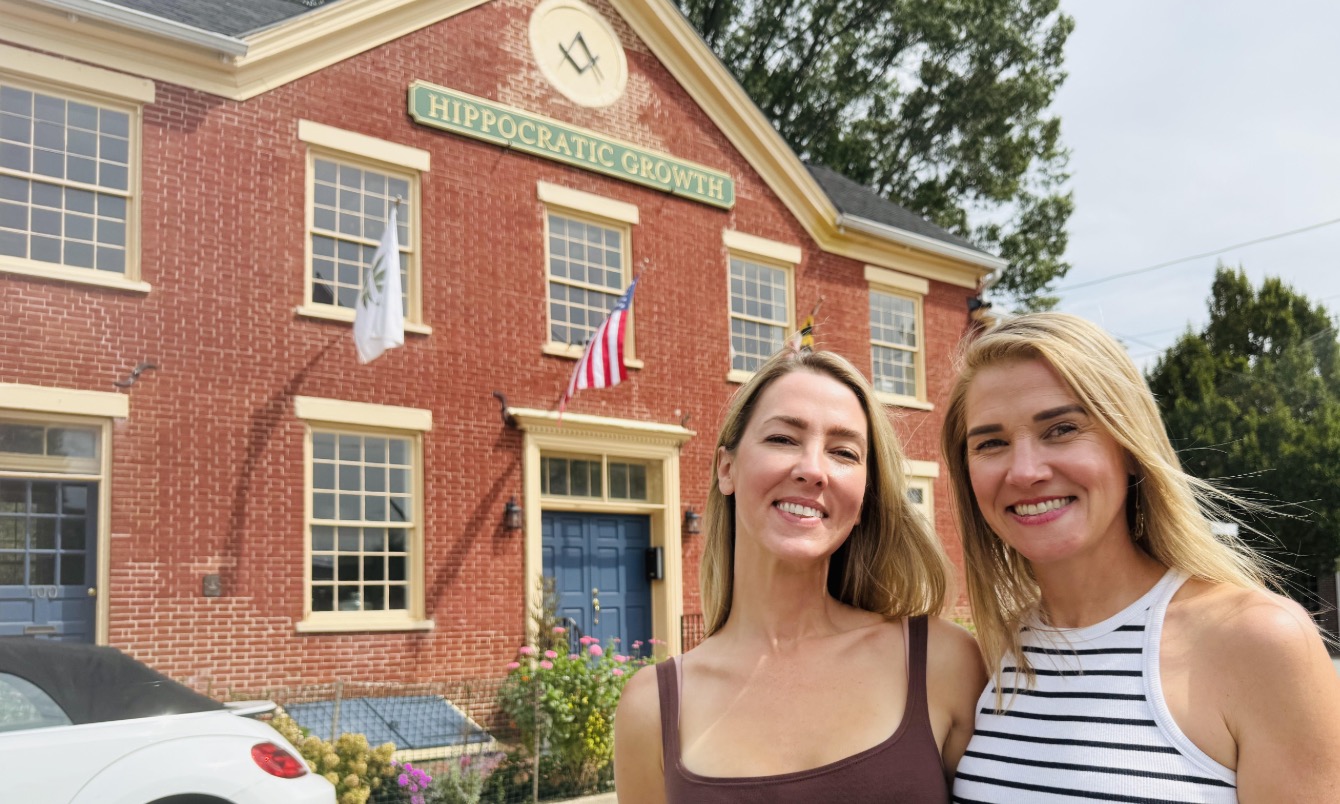
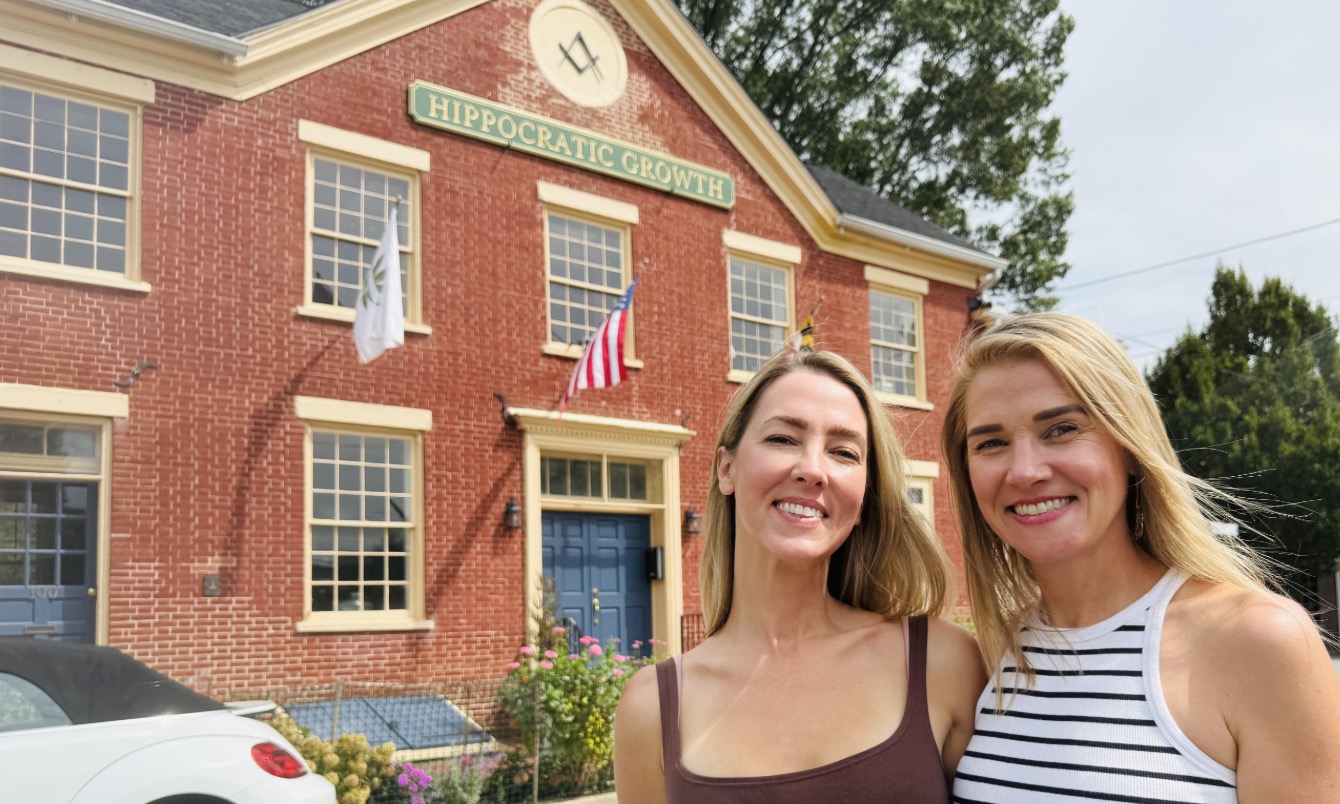
Sisters Paige Colen, left, and Ashley Colen purchased what is now the Hippocratic Growth building in downtown Chestertown in November, 2024. The original structure was completed in 1826 as a Masonic temple. Photos by Dennis Forney

Hippocratic Growth. It’s a philosophy; an intention; a corporation.

And now, in large letters, beneath an iconic Masonic Temple symbol, the simple phrase emblazons the front of one of the most prominent and historic commercial buildings in downtown Chestertown.

The 19th-century red brick building at the corner of Monument and Court streets serves as corporate headquarters for Hippocratic Growth. Its primary business is sales and distribution of cannabis, known most commonly as marijuana, or, in its humblest form, weed.

Ashley and Paige Colen formed the company in 2015.  As chief executive officer and chief operation officer, respectively, the sisters began selling cannabis at its current location in Centreville in 2017, following legalization in Maryland. Ashley says there will be no retail sales at the Hippocratic Growth building in Chestertown.

The name is a play on the Hippocratic Oath title which has guided the medical profession since its earliest times. “When we first started,” said Ashley, “the only legal cannabis sales in Maryland were for medical purposes. The Hippocratic Oath instructs first and foremost to do no harm. Our intention from the start was to grow, process and sell cannabis and to do no harm.  So the name we chose after bouncing lots of ideas around evolved as a hybrid.”

She said they are still in the process of procuring a license from Maryland to grow cannabis. “Our goal is still to grow cannabis, mindfully, ethically and helpfully.”

In the meantime, they acquire all of the 96 different cannabis products they sell at their Ash and Ember Centreville dispensary–from marijuana buds to gummies, tinctures and more–from other Maryland licensed growers and processors. All aspects of cannabis growth and processing in Maryland have to originate within Maryland’s borders. Federal law currently prohibits interstate sales.

Originally a Masonic Lodge completed in 1826, the building has been known by many different names as it nears its 200th anniversary in 2026.  Most recently it was the Hogans Building, and previously the Rasin Building.  In the late 1800s and until 1933, according to a written history, it was known as the Kent News building, owned by the Usilton family. Family members printed and published the Kent News in the building during those years.

“We wanted to make our own mark with the building. Planting, painting, scraping, tearing out walls, strengthening the structure–it’s a good thing, and using cannabis too. Just trying to make a point.  You can do it all.”

This former, now vacant, bank building near exit 43B on the eastbound side of Route 50 in Grasonville will be the new location for Ash and Ember’s cannabis dispensary now located in Centreville. Its opening is scheduled for the end of October.

While the Colen sisters continue to repurpose their entire Chestertown building for administration, conferencing, testing packaging ideas, creative thinking and brainstorming, they have taken their community improvement philosophy to Grasonville as well.

There, at exit 43B on the eastbound side of Route 50, they purchased a vacant bank property where they will relocate their Centreville Ash and Ember dispensary. They have painted the building’s bricks white and are converting the interior for cannabis sales.  “Three drive-through lanes will allow us to run more people through,” said Ashley. “We plan to be open by the end of October.”

She said getting proper permits for the relocation has been laborious. “Permitting is difficult for anything, but with fortitude and determination–and two-plus years–we’re getting it done.  The new location will give us more visibility. We will be our own billboards now.”

To meet state regulations, they are adding a vault to the former bank where products have to be secured when the business is closed. “Everything we’re bringing in has to be tracked,” said Paige. ”The display bins have to be portable and collapsible for putting away, and designed for showing people what they want to see and are interested in. Every single thing matters. And the regulations and how things actually flow in the operation don’t always mesh.”

“We’ve learned a lot about how the government works,” said Ashley. “There’s a lot of streamlining that could be done.  We used to get upset when something didn’t go our way. Now we just pivot and figure out a different way.”

So what does the future hold?

“We’re just going to keep biggering. Expand to other states as that becomes available,” said Ashley.

In Portland, Oregon, the sisters have formed another company called Mush To Do. The state of Oregon has legalized the use of therapeutic psilocybin for medical purposes and Mush To Do–referring to the mushrooms that produce the psychoactive substance psilocybin–focuses on the production and sales of those items.

“The use of psychedelics for medicinal purposes was unfortunately set back for a long time by government restrictions,” said Ashley.  “Now it’s taking off with lots of trials underway again.”
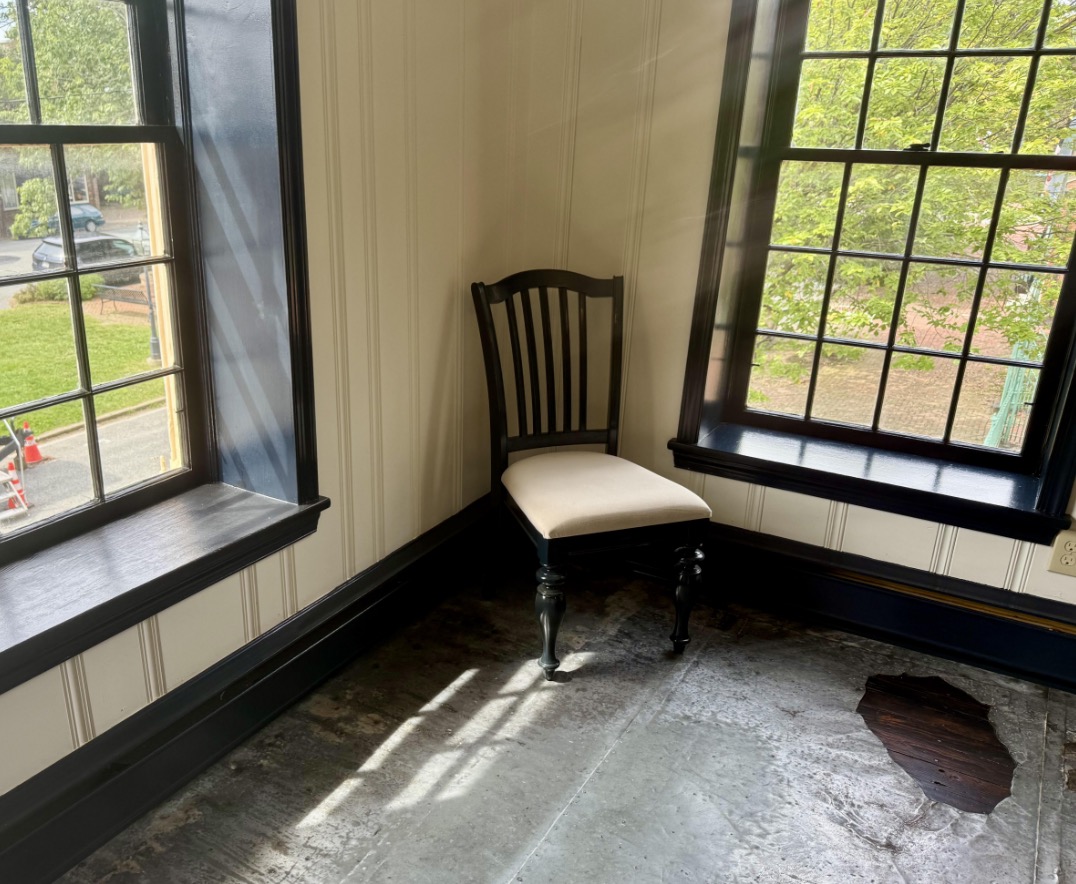
This second floor corner room in the Hippocratic Growth building once was home to the printing operations of the Kent News in the late 1800s and early 1900s.  Its wooden floor was lined with lead sheets to protect it from molten lead used for setting type in the printing process.

This second floor corner room in the Hippocratic Growth building once was home to the printing operations of the Kent News in the late 1800s and early 1900s. Its wooden floor was lined with lead sheets to protect it from molten lead used for setting type in the printing process.

Extensive reporting on the medical use of psychedelics has illuminated their value in helping break drug addictions, addressing PTSD issues, and easing stress in individuals coping with terminal illnesses.

“I have personally witnessed a terminal patient, using these drugs, shifting from terrified and frantic to a sense of it’s going to be OK. It flies in the face of logic not to use these drugs for beneficial purposes,” said Ashley.

She is currently working with state legislators and others on a psychedelics task force exploring their potential as a legal medical option in Maryland.

Dennis Forney has been a publisher, journalist and columnist on the Delmarva Peninsula since 1972.  He writes from his home on Grace Creek in Bozman.

The Spy Newspapers may periodically employ the assistance of artificial intelligence (AI) to enhance the clarity and accuracy of our content.

Filed Under: 1C Commerce

Poll Finds Majority Concerned that Increases in Food Costs are Outpacing Income

September 3, 2025 by Maryland Matters Leave a Comment

More than eight in 10 Marylanders said increases in the cost of food are outpacing their income, according to a poll released Tuesday.

The poll conducted for No Kid Hungry found that 96% of those surveyed said child hunger should not exist in the state. More than eight in 10 want elected officials to do more to end child hunger. Ninety-three percent said ending childhood hunger in Maryland should be a shared, bipartisan goal for lawmakers.

“This poll paints a stark picture of how Maryland families are suffering. No one should have to choose between purchasing food and paying your rent, but that’s an all-too-familiar choice our neighbors find themselves having to make,” Ayesha Holmes, No Kid Hungry Maryland director said in a statement. “With impending cuts to SNAP and Medicaid on the way, Maryland families will continue to face a future impacted by hunger and undue worry.”

The poll found that 65% of those surveyed said they had to choose between buying food or paying for gas or a car repair, rent or mortgage, or medical treatment. Within that survey, 71% of families said they had to make that choice, according to the poll. Nearly six in ten people said their mental health has suffered in the last 12 months due to the cost of food, according to the poll.

More than six in 10 said they worry about their ability to buy groceries if they were to be hit with an unexpected expense of $500.

The online survey conducted for No Kid Hungry sampled 1,054 Maryland residents between July 22-29. The margin of error is 4%.

The poll followed the passage of federal legislation that makes permanent tax cuts made in 2017. The cuts are offset, in part, by cuts to Medicaid and SNAP, the Supplemental Nutrition Assistance Program.

Advocates say passage of the bill could deal “a devastating blow” to the 680,000 state residents who currently receive SNAP benefits.

Currently, the state and federal government split administrative costs for SNAP 50/50, while the federal government pays for 100% of the benefit.

That changes next year. States will pay 75% of the administrative fees. The cost to Maryland will approach an estimated $173 million. In 2027, Maryland will pick up 15% of the cost of the benefit on top of administrative costs -— about $240 million.

Nearly 370,000 Maryland residents could lose part or all of their benefits, according to a recent report by the Urban Institute.

The poll found that nearly six in 10 people had a favorable view of the SNAP program. More than 80% said Maryland should continue a summer program to ensure children have access to food when schools are closed.


by Bryan P. Sears, Maryland Matters
September 2, 2025

Maryland Matters is part of States Newsroom, a nonprofit news network supported by grants and a coalition of donors as a 501c(3) public charity. Maryland Matters maintains editorial independence. Contact Editor Steve Crane for questions: [email protected].

The Spy Newspapers may periodically employ the assistance of artificial intelligence (AI) to enhance the clarity and accuracy of our content.

Filed Under: 1C Commerce

Why Prices are Soaring in the Country’s Largest Grid Region, Explained in 5 Charts

September 2, 2025 by Maryland Matters Leave a Comment

 The Conowingo Dam in Maryland is a 550-megawatt hydroelectric power station on the Susquehanna River operated by Constellation Energy. It feeds the PJM Interconnection grid serving Pennsylvania and 13 other states. (Photo by Peter Hall/Pennsylvania Capital-Star)

This article originally appeared on Inside Climate News, a nonprofit, non-partisan news organization that covers climate, energy and the environment. Sign up for their newsletter here.

PJM Interconnection, the nonprofit that manages the country’s largest electricity grid region, is barely known by the general public and almost never mentioned by elected officials — except when something bad happens.

Well, something bad has happened. For two years in a row, PJM’s process for ensuring the grid has sufficient power plant capacity has resulted in record high prices, which will get passed on to consumers. The results are tied to rising electricity demand for data centers and a bottleneck in approving grid connections for new projects.

Almost everything about these events is bound up in layers of complexity.

To explain what’s happening, my colleague Rambo Talabong put together some charts and I spoke with energy policy experts. Together, we aim to make this situation understandable.

PJM, based in Valley Forge, Pennsylvania, oversees the grid and electricity markets in a territory that stretches from New Jersey to Chicago. The organization has roots in a 1920s partnership between utilities in Pennsylvania and New Jersey.

“It’s a bunch of utilities who have come together and said, ‘We can provide more reliable, less expensive electric service to customers if we work together and have a mutual aid pact,’” said Abe Silverman, an energy research scholar at Johns Hopkins University who has a background working in utility regulation and the energy industry.

“When a customer in New Jersey can buy power from a power plant in New Jersey, or a power plant in Pennsylvania or a power plant in Ohio, it’s going to be cheaper than if they were just buying from power plants from New Jersey,” Silverman said.

One of the ways PJM manages its system is by holding an auction in which power plant owners compete to see who will offer the lowest prices to be available to the grid at all times.

The result is a “capacity price,” which is the price set to ensure that there are enough resources to meet the region’s needs on the hottest days of summer. The price sets the level of payments to participating power plants, which is an important income source for them in addition to what they make from selling electricity.

Here are the results of the last decade of auctions, and you can see why electricity consumers are feeling the sting.

 (Graphic by Rambo Talabong/Inside Climate News)

Last year, the auction produced a result so unusual that this topic, usually reserved for the business press, became general news. The new price, which took effect two months ago, was $269.92 per megawatt-day, an increase from $28.92 per megawatt-day in the previous delivery year.

The most recent auction was last month, yielding an even higher price, $329.17 per megawatt-day. This price will take effect next June.

Since a megawatt-day (which is 24 megawatt-hours) is a unit that most people don’t use or understand, it’s easier to put these results in terms of how many billions of dollars power plant owners stand to receive in aggregate. The change from two years ago is dizzying, going from a low of $2.2 billion to the most recent result of $16.1 billion.

Governors across PJM territory have voiced their displeasure. Maryland Gov. Wes Moore, a Democrat, said, “What PJM has laid out is a slap in the face.”

Why did costs go up so much? There are many reasons, but the main one is that electricity demand is soaring, largely due to the development of data centers. The upward curve in PJM’s long-term forecast is in contrast to the prior decade-plus of flat growth.

“Supply and demand,” said Daniel Lockwood, a PJM spokesman, when asked about the reasons for rising costs. “Unprecedented and continuing growth in demand from the proliferation of high-demand data centers in the region.”

Silverman from Johns Hopkins agreed that this is, by far, the leading factor.

 (Graphic by Rambo Talabong/Inside Climate News)

When demand is flat, old and inefficient power plants often struggle to compete, leading plant owners to close the plants that are losing money or barely profitable. Since 2000, PJM has seen a shift as coal-fired power plants reached the end of their lives and were replaced by natural gas plants and some renewables.

The retirement of old coal plants was good for the environment, but the rapid loss of those plants has helped to intensify the supply crunch that’s now happening.

 (Graphic by Rambo Talabong/Inside Climate News)

But plant retirements are only part of the picture.

One of the reasons PJM is struggling to secure enough power plant capacity is the organization’s challenges in connecting new plants to the grid.

PJM has an online queue in which owners of prospective power plants get in line to gain approval to hook up to interstate power lines. Ideally, this would be a fast process, but the queue has turned into a quagmire of long waits, meaning the grid isn’t getting some of the new power plants that would otherwise be ready.

Most of the affected projects are solar arrays, the results of a solar boom across much of PJM territory.

Some caveats: Some of the projects in the queue are highly speculative and unlikely to get built, so the numbers can be misleading. Also, some projects are held back by more than just PJM, with challenges getting local permits and other factors.

As of June, there were 63 gigawatts of projects waiting in PJM’s interconnection process that should be completed by the end of 2026, according to Lockwood, the PJM spokesman. He noted that there are 46 gigawatts of projects that have agreements to plug into the grid today, but some aren’t being built because of factors beyond PJM’s control, such as siting, permitting and financing.

 (Graphic by Rambo Talabong/Inside Climate News)

Clean energy and consumer advocates have said PJM often acts as an obstacle to reducing dependence on fossil fuels.

“The power grid operator’s policy decisions too often favor outdated, expensive power plants and needlessly block low-cost clean energy resources and battery projects from connecting to the grid and bringing down prices,” said Sarah Moskowitz, executive director of the Citizens Utility Board of Illinois, in a statement. “This extended price spike was preventable.”

Here are some of the wait times broken down by technology.

(Graphic by Rambo Talabong/Inside Climate News)

So, how much is a household’s electricity bill rising because of all this?

I asked several of the largest utilities in PJM for specifics. Their answers had wide variations, which helps to show differences in rate structures, state regulations and other factors that affect how and when the PJM charges reach consumers.

PSEG, the largest utility in New Jersey, notified customers in February of an impending 17 percent rate increase that was largely due to the rise in PJM charges. As of June, a household using 650 kilowatt-hours per month now paid $183, which was $27 more than before.

ComEd, which serves the Chicago area, has increased its residential bills by roughly 10 percent because of the surge in PJM charges that took effect in June. A typical household, which uses 609 kilowatt-hours per month, is paying $117, which is $11 more than before.

Dominion, which is the largest utility in Virginia and also has PJM customers in North Carolina, said its customers were largely insulated from PJM costs because the company gets most of its electricity from power plants that it owns. This is different from most large utilities in PJM, which do not directly own power plants and use market-based systems to obtain electricity for customers.

The total monthly cost for PJM capacity, even after the increase, would be less than $2 per month, according to a Dominion spokesman.

Just like PJM’s capacity prices have gone up, they can come back down. But for that to happen, some of the market fundamentals will need to change. I don’t expect that to happen any time soon.

So you’re probably going to keep hearing about PJM in the context of explanations for high electricity prices.

Inside Clean Energy is ICN’s weekly bulletin of news and analysis about the energy transition. Send news tips and questions to [email protected].

Maryland Matter
By: Dan Gearino and Rambo Talabong – September 1, 2025 8:27 am

The Spy Newspapers may periodically employ the assistance of artificial intelligence (AI) to enhance the clarity and accuracy of our content.

Filed Under: 1C Commerce

Rural Maryland Council Announces Fiscal Year 2026 Grant Recipients

August 19, 2025 by Rural Maryland Council (RMC) Leave a Comment

“Despite limited resources this year, the Rural Maryland Council remains committed to investing in  projects that strengthen our rural communities. We are inspired by the dedication of so many  organizations working to improve the quality of life across rural Maryland, and we are proud to  support their important efforts” -Susan O’Neill, Board Chair 

The Rural Maryland Prosperity Investment Fund (RMPIF) supports the operating activities of the Rural  Maryland Council, including the administration of the Maryland Agricultural Education and Rural  Development Assistance Fund (MAERDAF) and funding for the State’s five rural Regional Councils. The  RMPIF grant program is designed to make strategic investments in key economic and community  development initiatives while fostering regional and intergovernmental collaboration. 

The MAERDAF grant program provides capacity-building support to rural-serving nonprofit organizations  and community colleges. These grants strengthen efforts that advance statewide and regional planning,  economic and community development, youth engagement and leadership development, energy, and  agricultural and forestry education. 

The Rural Maryland Council was allocated $6,000,000 in the Fiscal Year 2026 state budget. However, this  represents a $3 million reduction to their competitive grant programs. As a result, grant decisions were  particularly challenging this year due to the limited available funding and the highly competitive pool of  applicants. 

Fiscal Year 2026 Grant Awards 

Total Requested  170 Applications  $14,147,476
Total Awarded  62  $5,468,485


Regional Councils: 5 Grants = $1,925,000 

Per Statute, one-third of the RMPIF fund is distributed to the State’s five rural regional planning and  development councils: 

Awardee  Total Award
Mid-Shore Regional Council  $385,000
Tri-County Council for the Lower Eastern Shore  $385,000
Tri-County Council for Southern Maryland  $385,000
Tri-County Council for Western Maryland  $385,000
Upper Shore Regional Council  $385,000

“A Collective Voice for Rural Maryland  

Regional Council activities funded through RMPIF, include:  • Equity lending 

  • Transportation software and systems 
  • Regional agricultural development and  

education 

  • Economic and small business  development activities 
  • Summer Career Enrichment • Rural economic research 

Rural Maryland Prosperity Investment Fund: 33 Grants = $2,873,359 The RMPIF grant program has three focus areas- Entrepreneurship, Infrastructure, and Rural Health. RMPIF  Entrepreneurship includes Workforce Development, Cooperative Development and Agricultural Development.  In FY2025, this program received 78 applications totaling $9,248,088 in requests. Of these requests, 33 grants  totaling $2,873,359 were awarded. 

RMPIF Entrepreneurship (includes Workforce Development, Cooperative  Development, and Agricultural Development): 10 Grants = $1,160,076  

Awardee  Total Award
Affiliated Sante Group  $94,500
Asian American Center of Frederick  $103,500
County Commissioners of Caroline County  $250,000
Evergreen Heritage Center Foundation  $68,800
Fort Ritchie Community Center, Inc.  $34,549
Hagerstown Community College  $197,045
Maryland Rural Water Association  $55,000
Mount St. Mary’s University  $115,182
Shore Legal Access  $60,000
The Patuxent Partnership  $181,500


RMPIF Infrastructure: 7 Grants = $732,133 

Awardee  Total Award
Adkins Arboretum  $49,025
City of Frostburg  $43,000
Habitat for Humanity Choptank, Inc.  $75,000
Habitat For Humanity of Wicomico County, Inc.  $321,360
Maryland Broadband Cooperative  $102,248
Robotics and Engineering in Allegany County-Together, Inc.  $41,500
The Foundation of H.O.P.E., Inc  $100,000


RMPIF Rural Health: 16 Grants = $981,150

Awardee  Total Award
Allegany County Human Resources Development Commission  $12,500
CalvertHealth Foundation  $63,040
Cecil Transit  $34,310
Charles Regional Medical Center Foundation  $60,000
Chesapeake Housing Mission Inc.  $50,000
Compass Regional Hospice  $30,000
Friends Aware, Inc.  $30,000
Garrett County Health Department  $132,978
Health Partners Inc.  $93,317
Ivy and Pearls of Southern Maryland Community Charities, Incorporated  $8,000
NAMI Maryland  $39,000
Safe Ride Foundation Inc.  $45,000


“A Collective Voice for Rural Maryland  

The Benedictine School for Exceptional Children Foundation Incorporated  $85,505
The Jude House  $45,000
University of Maryland School of Medicine  $172,500
Veteran and Military Support Alliance Inc.  $80,000

Maryland Agricultural Education and Rural Development Assistance Fund: 24 Grants =$670,126 

The MAERDAF grant program has five focus areas-Agricultural and Forestry Education, Community and Economic  Development, Energy, and Youth Engagement and Leadership Development. In FY2026, this program received 87 applications totaling $2,974,388 in requests. Of these requests, 24 grants totaling $670,126 

were awarded. 

MAERDAF Agricultural and Forestry Education: 6 Grants = $170,586 

Awardee  Total Award
Community Trust Foundation  $45,000
Delmarva Chicken Association  $17,086
Ladies of Charity Calvert County, Inc  $8,500
LEAD Maryland Foundation, Inc.  $40,000
Maryland Agricultural Education Foundation  $25,000
MPT Foundation, Inc.  $35,000


MAERDAF Community Development: 5 Grants = $163,705 

Awardee  Total Award
Bayside Community Network, Inc.  $27,500
Community Foundation of the Eastern Shore  $17,205
Day Care, Inc.  $45,000
Rebuilding Together Eastern Shore  $45,000
Wor-Wic Community College  $29,000


MAERDAF Economic Development: 7 Grants = $159,133 

Awardee  Total Award
Appalachian Community Capital Development Foundation  $40,000
Chamber Orchestra of Southern Maryland, In Concert  $26,175
Chesapeake College  $13,512
Junior Achievement of the Eastern Shore  $20,000
Rose Hill Cemetery  $9,446
Technology Council of Maryland, Inc.  $45,000
Visit St. Mary’s MD, INC  $5,000


MAERDAF Energy: 1 Grant = $45,000

Awardee  Total Award
Alliance for Green Heat  $45,000


MAERDAF Youth Engagement & Leadership Development: 5 Grants = $131,702 

Awardee  Total Award
Building African American Minds, Inc  $45,000
Habitat for Humanity Susquehanna  $45,000
Howard County Conservancy  $12,535
Maryland Association of Soil Conservation Districts  $8,000
ShoreRivers  $21,167


Rural Maryland Council: Operating Budget – $650,000 

Organization  Funds Utilized
Rural Maryland Council  $650,000


Founded in 1994, the Rural Maryland Council (RMC) serves as the state’s federally designated rural development  council and functions as a voice for Rural Maryland – advocating, educating, and helping rural communities and  businesses across the state to flourish and to gain equity to its suburban and urban counterparts. The Council  administers the Rural Maryland Prosperity Investment Fund (RMPIF) and the Maryland Agricultural Education and  Rural Development Assistance Fund (MAERDAF) grant programs. Additionally, the Council conducts research  activities to understand rural challenges and outreach to engage rural residents in developing solutions to these  challenges and convenes groups to identify solutions through consensus and coalition building.  

RMC operates under the direction of a 40-member Executive Board in a nonpartisan and nondiscriminatory  manner. The Council’s vision is a future where all of Rural Maryland is prosperous with thriving resources, vibrant  economies, and healthy, connected communities. The organizational goals are to:  

  • Encourage healthy, connected communities throughout Rural Maryland through convening stakeholders,  education, public relations, and advocacy;  
  • Support the development and growth of vibrant economies in Rural Maryland;  
  • Foster stewardship of Maryland’s natural resources; and, 
  • Maximize outreach, resources, and mission through financial and organizational development. 

The Spy Newspapers may periodically employ the assistance of artificial intelligence (AI) to enhance the clarity and accuracy of our content.

Filed Under: 1C Commerce

University of Maryland Eastern Shore Names Judy Diaz General Manager of Delmarva Public Media

August 12, 2025 by UM Shore Regional Health Leave a Comment

The University of Maryland Eastern Shore (UMES) is proud to announce the appointment of Judy Diaz as the new General Manager of Delmarva Public Media—a collaborative network of public radio stations WSCL, WESM, and WSDL, licensed by the University of Maryland Eastern Shore and Salisbury University. The stations offer a diverse lineup of news, jazz, R&B, blues, classical, and adult album alternative programming across the Delmarva Peninsula.

Judy brings a distinguished career in media and innovation to the role. She was instrumental in launching PBS KIDS in 1999 and later led brand and audience strategy across PBS. She founded PBS Next Avenue, a digital platform serving adults 50+, and later joined AARP to lead strategy and operations for the digital initiative Life Reimagined. She also served as Vice President of Marketing at POLITICO and worked with Paul Allen, founder of Ancestry.com, on a number of start-ups.

Since relocating to Maryland’s Eastern Shore in 2021 with her husband Kevin Diaz, a journalist who now freelances for Delmarva Public Media, Judy has focused on strengthening local media. As General Manager of WHCP in Cambridge, MD, she secured funding to transition the community station into a full-power NPR affiliate. Following the retirement of Delmarva Public Media’s previous General Manager in 2024, she served as interim GM, leading a number of key initiatives.

During her interim GM tenure, Judy expanded local news and locally-produced music programming, upgraded production and broadcast infrastructure, launched Intergenerational Beats which pairs experienced journalists with journalism students to cover pressing topics for Delmarva listeners, revamped the station’s website for improved access to content and information, and built an emergency alert system infrastructure in Princess Anne to now have emergency alerts throughout Delmarva.

“Judy brings the ideal blend of media and startup experience for this pivotal moment in public media,” said Robert Vickers, Vice President for Strategic Communications and Marketing at UMES. “It’s exactly what these stations need—respect for their legacy, with a clear eye on the future of public media.”

“I feel like all of my career has led to this role,” said Diaz. “It’s incredibly important and meaningful to ensure that local, independent, and non-commercial public media not only survives but thrives on the Eastern Shore, even in the face of the recent federal funding cuts. The dedicated team at Delmarva Public Media built a strong foundation, and we’re all committed to carrying it forward.”

We are excited to welcome Judy into this permanent leadership role and look forward to the continued growth and impact of Delmarva Public Media under her guidance.

For more information about Delmarva Public Media go to delmarvapublicmedia.org.

The Spy Newspapers may periodically employ the assistance of artificial intelligence (AI) to enhance the clarity and accuracy of our content.

Filed Under: 1C Commerce

Qlarant Foundation Launches Strategic Partnership with Catchafire to Support Nonprofit Growth

July 15, 2025 by The Spy Desk Leave a Comment

The Qlarant Foundation is announcing a new partnership with Catchafire that will extend access to transformative capacity-building resources for selected nonprofit organizations.  Through Qlarant Foundation, invited organizations will receive one year of complimentary access to Catchafire’s acclaimed platform designed to strengthen operational effectiveness and long-term sustainability for nonprofits.

This initiative expands Qlarant Foundation’s commitment to supporting organizations that serve vulnerable and underserved populations. By connecting nonprofit leaders with Catchafire’s online network of over 100,000 experienced professionals, the Foundation is offering access to capacity building support in areas such as marketing, fundraising, technology, HR, finance and more. Since 2009, Catchafire’s unique model has contributed over one million hours of pro bono work to nonprofit organizations, valued at over $200 million.  Qlarant Foundation is proud to offer the selected nonprofits an entire year of access to resources they might otherwise never have.

“We are absolutely thrilled to launch this partnership with Catchafire,” said Amanda Neal, Executive Director of the Qlarant Foundation. “So many nonprofit organizations are doing incredible work in their communities but lack the infrastructure or resources to fully thrive. By teaming with Catchafire, we are investing in the long-term impact and resilience of these terrific organizations.”

This new partnership marks a major milestone in the Qlarant Foundation’s strategy to go beyond traditional grantmaking and invest in the long-term success and sustainability of community-based organizations.


About Qlarant

Qlarant is a not-for-profit, nationally respected leader in fighting fraud, waste, and abuse, improving program quality, and optimizing performance. The company uses subject matter experts and innovative data science and technology to help organizations see risks, solve problems, and seize opportunities. Qlarant provides customized solutions for state, federal and commercial industries across the nation.

The Qlarant Foundation— the mission arm of the organization—has provided over $7 million in grants to charities around the country. Qlarant has a 50-year record of accomplishment improving the performance of some of the Nation’s most important programs. Headquartered in Easton, MD, Qlarant has offices throughout the country and employs over 600 people. Qlarant is a five-time winner of the Best Places to Work award. For more information, visit www.qlarant.com or contact [email protected]


About Catchafire

Catchafire, a certified B Corporation, is the leader in volunteering and social impact software, sitting at the intersection of employee experience, grantmaking, and corporate philanthropy. Catchafire partners with hundreds of foundations and companies facilitating connections between 13,000 nonprofits and over 300,000 volunteers. After more than a decade of expertise, Catchafire has created over $200 million dollars in value, with over 1 million volunteer hours donated in service of supporting communities.

The Spy Newspapers may periodically employ the assistance of artificial intelligence (AI) to enhance the clarity and accuracy of our content.

Filed Under: 1C Commerce

Roots of Classic Rock Coffee House Performance by Kathy Jones July 31

July 4, 2025 by James Dissette Leave a Comment

Back by popular demand, Church Hill Theatre’s own Kathy Jones will take us on a journey through rock’s transition from Folk music and early Rock ‘n Roll to the Classic Rock era. Kathy performs with her guitar on a riser in the middle of the theatre, creating a cozy, warm vibe that’s interactive with the audience, even taking on a few requests. Her coffeehouses are pop-up, one-night only, and short notice events. This one is free to the public but donations to CHT will be accepted.

Kathy’s last coffeehouse sold out, so please make a reservation quickly. Table seating is available for small groups, but these go fast. Refreshments, including coffee, will be available for purchase. The show begins at 7:00 pm and will last approximately two hours. Ticket reservations for Thursday, July 31 are available at the CHT website: churchhilltheatre.org.  The theatre is located at 103 Walnut Street in Church Hill, MD.  Call the office at 410-556-6003 if you have questions.

Kathy has serious singing chops, from years with Sweet Adelines groups, gigs in Key West and St. Augustine and lead roles in musicals such as Matilda, the Musical, Fiddler on The Roof, and The Little Shop of Horrors. You can catch her with other CHT favorites singing for CHT’s supper at a Ram’s Head Give Back Night in Stevensville on July 16 from 4 to 6 pm. Kathy is the Chairperson of the Church Hill Theatre. She resides on Kent Island with her husband, Bruce.

For more about Church Hill Theatre go here.


The Spy Newspapers may periodically employ the assistance of artificial intelligence (AI) to enhance the clarity and accuracy of our content.

Filed Under: 1A Arts Lead, 1C Commerce, Senior Notes

Qlarant Foundation Announces Grant Recipients and Expanded Geographic Reach

July 2, 2025 by The Spy Desk Leave a Comment

Qlarant Foundation, the mission arm of Qlarant, proudly announces the recipients of its 2025 grant awards program. This year, a total of $450,000 will be distributed among 16 nonprofit organizations dedicated to supporting health and human service programs.   In a significant expansion of its geographic reach, Qlarant Foundation awarded grants in 3 new states – Florida, Georgia, and Texas – in addition to Maryland and the District of Columbia.

This year’s cycle attracted a record number of applicants, with 160 highly qualified organizations submitting proposals.  After a thorough review process, 16 outstanding organizations were selected to receive grants ranging from $4,000 to $50,000 in support of their impactful work.

“We are thrilled to expand our grantmaking into new states this year,” said Amanda Neal, Executive Director of the Qlarant Foundation.  “Every year the Foundation is honored to support nonprofit organizations dedicated to addressing the needs of underserved populations in their communities.”

This year’s grants will enable nonprofits to launch or grow critical programs that provide direct care, improve outcomes, and strengthen community well-being.

“Each of these organizations reflects the mission of the Qlarant Foundation: to improve the health of individuals and communities,” said Qlarant Foundation Board Chair Lamont Thompson, PT. “We are especially proud to empower new grantees in Texas, Florida, and Georgia while we continue our strong support in Maryland and our nation’s capital.”

Qlarant Foundation will formally recognize the 2025 grantees during its annual awards ceremony later this year. Those nonprofits include: BREM Foundation, Calvary Women’s Services, Chesapeake College Foundation, Child Resource Connect, Community Free Clinic, Georgia Lions Lighthouse, Good Samaritan Health Centers of Gwinnett, Key Point Health, Light of the World Clinic, Maryland Foundation of Dentistry, Mission of Mercy, NAMI Collier County, Partners in Care Maryland, Pathway Homes, Shepherd’s Hope, and Talbot County Empty Bowls.


About Qlarant

Qlarant is a not-for-profit, nationally respected leader in fighting fraud, waste, and abuse, improving program quality, and optimizing performance. The company uses subject matter experts and innovative data science and technology to help organizations see risks, solve problems, and seize opportunities. Qlarant provides customized solutions for state, federal and commercial industries across the nation. Qlarant has a 50-year record of accomplishment improving the performance of some of the Nation’s most important programs. Headquartered in Easton, MD, Qlarant has offices throughout the country and employs over 600 people. Qlarant is a five-time winner of the Best Places to Work award.

The Qlarant Foundation— the mission arm of the organization—has provided over $7 million in grants to charities around the country.

For more information, visit www.qlarant.com or contact [email protected]

The Spy Newspapers may periodically employ the assistance of artificial intelligence (AI) to enhance the clarity and accuracy of our content.

Filed Under: 1C Commerce

Mid-Shore Real Estate with Chuck Mangold: 2025 Looking Pretty Darn Good

June 24, 2025 by Dave Wheelan Leave a Comment

Editor’s Note: For many on the Mid-Shore, particularly in Talbot Couty, Chuck Mangold is the go-to guy to turn to when real estate comes up. For over two decades. Chuck at Benson and Mangold, the multi-generational real estate giant on the Shore, has seen the local market in good and bad times, enjoying the remarkable highs and surviving the low moments. So, when the Spy was thinking of an ongoing series devoted to one of the region’s most important economic sectors, Mr. Mangold was our first choice. And we are particularly grateful Chuck has agreed to participate.

In our quarterly with check-in with Chuck last week, we were surprised (and delighted) to hear his upbeat summary of the real etate market, both commerical and residentail, in the Mid-Shore region. Even more interesting was Chuck’s overall forecast for 2025 despite the voloilitty found in other parts of the country.

This video is approximately nine minutes in length. For more information about Chuck Mangold please go to his website here. 

The Spy Newspapers may periodically employ the assistance of artificial intelligence (AI) to enhance the clarity and accuracy of our content.

Filed Under: 1C Commerce

Richard Bodorff named Chair of Maryland Public Broadcasting Commission

June 17, 2025 by Spy Desk Leave a Comment

Edward H. Kaplan, since 2007 the chair of the Maryland Public Broadcasting Commission, will retire from that post effective June 30, 2025.  Governor Wes Moore has appointed Richard J. Bodorff, current vice chair of the commission, to succeed Mr. Kaplan as chair.  The commission is the governance board for Maryland Public Television.

Richard Bodorff

Kaplan, a Potomac, Maryland, resident, was first named to the commission in 1996.  The real estate developer and entrepreneur steered the commission through some of MPT’s most tumultuous times including the 2009 change from analog to digital broadcasting; the 2017 introduction of four distinct channels emanating from the network’s Owings Mills headquarters; the 2016 launch of MPT Passport video streaming; and the periodic challenges to federal funding for public television.

Together with his wife, Irene, Edward Kaplan became the single-largest individual donor to MPT.  The 8,500-square-foot Irene and Edward H. Kaplan Production Studio was named for the couple in 2019.

MPT’s next commission chair, Richard Bodorff – the ninth in commission history – was appointed to the commission in 2020.  A year earlier, he was elected as the chair of the MPT Foundation, Inc., the 501 (c)(3) fundraising arm of MPT.  A communications law practitioner in Washington, D.C., he has been associated with the law firm Wiley Rein, LLP, for more than 35 years, where he has served as counsel to broadcasters on matters pertaining to the Federal Communications Commission.

The Easton, Maryland, resident is a current or former board member for a number of national and local nonprofit and industry organizations, ranging from the New York City-based Broadcasters Foundation of America to the Chesapeake Bay Maritime Museum and the advocacy organization America’s Public Television Stations, based in Washington, D.C.  He is a graduate of Denison University and the Vanderbilt University School of Law.  Richard and his wife, Ellen, are also major donors to Maryland Public Television.

Commenting on the retirement of Chair Kaplan, Bodorff, chair-elect, said, “Eddie Kaplan’s 18-year tenure at the head of our commission is the longest and most distinguished service by any chair since this governing body was established in 1966.  His service spanned a remarkable period of growth for MPT, and his calm hand at the helm certainly contributed to the success of the network over nearly two decades.”

The commission chair change coincides with the June 30, 2025, retirement of Maryland Public Television President and CEO Larry D. Unger.  He will be succeeded by Steven J. Schupak, MPT’s current executive vice president and station manager, who was selected after a national search earlier this year.

Addressing the change in Maryland Public Broadcasting Commission leadership, Unger noted, “Maryland Public Television is fortunate indeed to have had the management expertise and insights of Eddie Kaplan during his remarkable 29 years of commission service, and I’m delighted that Dick Bodorff will take over the reins to keep our mission in the forefront and our service ethic strong.  I am deeply grateful for the legacy of Eddie and the vision of Dick.  The best years of MPT are, as they say, yet to come!”

The Spy Newspapers may periodically employ the assistance of artificial intelligence (AI) to enhance the clarity and accuracy of our content.

Filed Under: 1C Commerce

  • « Previous Page
  • 1
  • 2
  • 3
  • 4
  • …
  • 10
  • Next Page »

Copyright © 2026

Affiliated News

  • Chestertown Spy
  • Talbot Spy
  • Cambridge Spy

Sections

  • Sample Page

Spy Community Media

  • Sample Page
  • Subscribe
  • Sample Page

Copyright © 2026 · Spy Community Media Child Theme on Genesis Framework · WordPress · Log in