MENU

Sections

  • Home
  • Education
  • Donate to the Centreville Spy
  • Free Subscription
  • Spy Community Media
    • Chestertown Spy
    • Talbot Spy
    • Cambridge Spy

More

  • Support the Spy
  • About Spy Community Media
  • Advertising with the Spy
  • Subscribe
December 29, 2025

Centreville Spy

Nonpartisan and Education-based News for Centreville

  • Home
  • Education
  • Donate to the Centreville Spy
  • Free Subscription
  • Spy Community Media
    • Chestertown Spy
    • Talbot Spy
    • Cambridge Spy
2 News Homepage Ecosystem Eco Portal Lead News News Portal Highlights

Meet the 572-megawatt Gorilla of the Chesapeake Bay

October 20, 2023 by Maryland Matters Leave a Comment

A view of the Susquehanna River from the Conowingo Dam, looking south. Photo by Bryan P. Sears.

It was early morning on a patio just outside the Conowingo Dam, and Mike Martinek was looking at hundreds of juvenile eels that had been suctioned from the Susquehanna River into a giant freshwater pool. Martinek, a fisheries biologist for an environmental consulting firm, and a couple of colleagues were planning to truck the eels a couple of hours north into Pennsylvania, past Harrisburg, and dump them near spawning grounds upriver.

“We’re the eel Uber,” Martinek laughed.

Many of these eels, who are generally 2 to 4 years old, were hatched in the Sargasso Sea, in the Atlantic, and have been propelled by tides to the Conowingo Dam, almost randomly.

“They could be from Georgia or Norway,” Martinek said. “It’s a mixing bowl. You just don’t know.”

Some 200,000 eels will pass through the dam this year, many using a chute that simulates a creek.

“We’re the only eel collection facility on the Susquehanna, and one of the biggest on the East Coast,” said Andrea Danucalov, manager of regulation and licensing at the dam — in short, the environmental compliance officer.

That this daily activity is the first thing that Constellation Energy officials showed a couple of reporters who had come recently for a tour of the mighty Conowingo Dam may not be a coincidence.

Throughout the three-hour visit, company executives repeated over and over how important environmental stewardship is to Constellation, especially at the dam, a pressure point for myriad marine and animal species. In fact, the tour guides said, environmental considerations go into every decision the company makes about the operation of the dam. And Conowingo, they say boldly, is at the cutting edge of the fight to address climate change in the state: it’s far and away the largest producer of renewable energy in Maryland.

Up and down the corporate food chain, company officials at Constellation and its predecessor entities have made the same assertions for years. It’s almost as if the main purpose of the dam — generating hydropower at Conowingo for the past 95 years — is an afterthought. But maybe that’s to be expected.

In the broad debate over the health of the Chesapeake Bay, Conowingo Dam is in many ways the 800-pound gorilla in the conversation — or to put it more precisely, the 572-megawatt gorilla, the maximum level of electricity the dam can generate on an annual basis, which is enough to power about 165,000 homes. That prevents 867,000 metric tons of carbon emissions from going into the atmosphere every year, the company estimates — the equivalent of taking 186,000 cars off the road.

But recently, Constellation’s environmental performance is back in the news, after the state of Maryland, responding to a court order, reopened the process for issuing a clean water operating permit for the dam, which Constellation needs to be granted a new 50-year operating license from the federal government. After taking public comments over the past several weeks, mainly from the parties involved in prior lawsuits over the dam, but also, more informally, from everyday folks, the Maryland Department of the Environment is poised to issue a decision on the permit fairly soon.

The environmental group that monitors the health of the Susquehanna River in the vicinity of the dam believes the permitting process needed to be reopened, arguing that the administration of former Gov. Larry Hogan (R) cut corners when it reached a settlement with Constellation in 2019 — and that Constellation has to do a better job of protecting the waters that create great profits for the company.

“They have to stop being in denial,” said Ted Evgeniadis, executive director of the Lower Susquehanna Riverkeeper Association. “That’s the first step — admitting you have a problem.”

Constellation executives, however, believe that the settlement that led to the Hogan administration waiving water permits, which in turn prompted the Federal Energy Regulatory Commission to issue a 50-year license, represents a high point of cooperation between the company, government officials, environmentalists and other stakeholders.

“We know what the solutions are,” said Kathleen Barrón, executive vice president and chief of strategy for Constellation. She urged the state to preserve “the intense work” stakeholders did leading up to the 2019 agreement with the state.

Constellation executives also note that the Lower Susquehanna Riverkeeper Association is the only regional environmental group that has vocally called the company’s supervision of the dam into question (leaders of other green groups maintain they largely defer to the riverkeeper organization on matters of the Conowingo Dam).

And Constellation officials are quick to tick off the environmental and financial benefits to the state, to the Chesapeake Bay, and to the Bay watershed. Constellation, they say, does more to protect the Susquehanna, the Bay and the watershed than any other private entity. Extending the company’s license another 50 years will generate more than $700 million in financial and environmental benefits to the state, the company maintains.

When the company isn’t shepherding eels through the dam, it’s operating a fish lift that gets tens of thousands of American chad, river herring and other species through the works — and also stops many invasive species from getting into the Bay. The company also has a bald eagle management plan in place, as the area just south of the dam is one of best spots to see migrating and nesting eagles anywhere in the U.S.

Evgeniadis, at the Riverkeeper Association, predicts that the state’s upcoming decision on the water quality permit will produce one of three results: Incentives for environmentalists and Constellation to return to the bargaining table; a decision that environmentalists like and prompts the company to sue; or a decision that Constellation likes and prompts the riverkeeper association to sue.

But this battle over the water quality permit is just the latest environmental fight involving the Conowingo Dam. Though it’s not universal, there’s a general fear and loathing over the dam in the Upper Bay region, not just among environmentalists, but also watermen, local elected officials, and business and civic leaders.

Every year, the Clean Chesapeake Coalition, a loose confederation of leaders in the Upper Bay area, holds a standing room-only meeting at the Maryland Association of Counties summer conference. Every year, the participants complain about environmental regulations they consider onerous and about pollution that comes from upriver, mainly from agricultural sources, in Pennsylvania — narratives that seem almost contradictory. And they complain about the Conowingo Dam.

“When you try to find out about the integrity of the dam, the safety of the dam, you can’t really tell what’s going on,” Charles “Chip” MacLeod, general counsel for the coalition, said at the most recent meeting.

An architectural wonder 

The Conowingo Dam itself is an architectural and engineering wonder, and the craftsmanship and handiwork of the industrial era are very much in evidence everywhere, even as modern energy generation becomes more automated. Constellation has been careful to keep all of the 1920s architectural infrastructure and flourishes intact, and a visit to the dam, notwithstanding some of the technology used to run it these days, seems very much like a trip to a bygone era.

To start construction of the dam, in the 1920s, a vast concrete wall had to be sunk 40 feet below the riverbed. The dam has 11 gates with massive turbines that impact the river flow and the amount of energy the dam is generating. Only twice have all 11 gates been open — once during a storm in 1934, and again during Hurricane Agnes, considered the most damaging in the region’s history, in 1972.

Inevitably, a tour of the Conowingo Dam takes a visitor to the reservoir on the north side of the hulking structure, across U.S. Route 1, where tons of debris collects and is prevented by the dam from flowing downriver and into the Chesapeake Bay. This is undoubtedly the most controversial aspect of the Conowingo and the flashpoint for the years-long animus between various stakeholders and the company.

On a recent morning, the visible debris mainly consisted of logs, tree limbs and other natural detritus, but also included tires, balls, large plastic bins, diapers, planters, and other refuse. On this windy but pleasant day, the accumulation seemed fairly benign.

But there is a constant fear among communities downriver that violent storms or even higher than average flooding could send much of the waste tumbling down the dam, which was built at a place in the Susquehanna where there is a 200-foot elevation drop, and into the river and the Bay beyond.

“I’m not trying to be alarmist, but a catastrophic failure — there would be all kinds of impacts, including environmental impacts,” MacLeod said.

Here, the more conservative members of the Clean Chesapeake Coalition and the environmentalists who run the riverkeeper organization are basically in accord. Evgeniadis accuses Constellation of “turning a blind eye to the massive problem that’s behind them” at the dam.

The riverkeeper says the reservoir abutting the dam is supposed to be at least 100 feet deep, but now with all the silt and other debris that has accumulated through the decades, they believe it’s more like 12 or 15 feet deep in parts, increasing the threat of dangerous materials spilling over the dam and into the river below. Constellation representatives said the average depth ranges from about 15 feet to about 40 feet, with the deepest point, about 80 feet, immediately upstream of the powerhouse.

Some neighbors of the dam, including many of the leaders of the Clean Chesapeake Coalition, would like to see the reservoir dredged. They note that the silt that’s dragged from the river’s bottom could be used to reinforce coastal areas and other and waterfront communities in the region.

But Constellation executives believe the idea is impractical and expensive, and here they seem like they are in accord with the riverkeeper organization.

“It’s inevitable that the reservoir behind that dam would fill up [with silt and debris] again,” Evgeniadis said.

The debris currently bobbing in the water nestled against the dam will be collected by boom, placed on a barge, to a landfill and recycling area a few miles up the river, in Pennsylvania. Constellation estimates that it removes 600 tons of garbage and debris from the dam area every year and that its debris removal efforts, combined with ongoing research into improving ways to remove refuse from the area, produce benefits valued at $41 million.

‘A public resource for private profit’

The Conowingo Dam does not operate in a vacuum. While it’s the biggest dam on the Susquehanna — indeed it’s the biggest power-generating dam on the entire East Coast — there are three other dams upriver in Pennsylvania, owned by different companies, and what happens at those facilities can impact Conowingo. In a fact sheet on Conowingo, Constellation maintains that the dam operators upriver “have not committed to the same debris removal activities” as Constellation.

What’s more, the dam is susceptible to extreme weather, and other swift changes in natural conditions.

“I never thought when I took this job I’d become a weatherman,” said Amir Hassad, an engineer who is the dam manager.

In its efforts to be a good corporate citizen, Constellation maintains a large riverfront promenade at the base of the dam that’s popular with fishermen, bird watchers, picnickers and nature lovers, and is a gateway to hiking trails maintained by various public, private and nonprofit entities. Just up the road from the dam, the company offers a public pool, a visitors center and a history museum.

Evgeniadis does not discount the company’s good works, but notes that Constellation is “taking a public resource for private profit.”

“They’re not going to be able to operate in the same way they’ve been operating it for the last 100 years,” he said. “Things are going to have to change.”

So the battle lines are drawn, pending a decision from the Maryland Department of the Environment. Jay Apperson, an agency spokesperson, said last week that MDE did not have a timetable for issuing the new water permit.

Environmentalists and other neighbors warn that the dam presents a huge potential threat to communities, public health, the environment, marine life and wildlife. Constellation executives insist that without their environmental stewardship and vigilance, conditions throughout the region could be much worse.

After a visit to the dam and its environs, it’s easy enough to conclude that both assertions can be true at the same time.

By Josh Kurtz

The Spy Newspapers may periodically employ the assistance of artificial intelligence (AI) to enhance the clarity and accuracy of our content.

Filed Under: 2 News Homepage, Eco Portal Lead, News Portal Highlights

Tree Cover Declines, Pavement Spreads across Chesapeake Watershed

October 3, 2023 by Bay Journal Leave a Comment

Amputated tree trunks and mounds of shredded wood are all that’s left of a patch of woods off Aris T. Allen Boulevard in Annapolis that was cleared for development.  Dave Harp

When it comes to safeguarding the ecological health of the Chesapeake Bay and the rivers and streams that feed it, little is more pernicious than development and nothing more beneficial than trees.

Yet despite long-running, wide-ranging efforts to restore the Bay, high-resolution aerial survey data show that an area larger than the District of Columbia is being covered by pavement and buildings every five years. Over the same time period, an area the size of Arlington County, VA, loses tree cover, dwarfing watershedwide tree-planting efforts aimed at replacing cover already lost.

Those data, recently released by the Chesapeake Bay Program, highlight the as-yet unmet challenge of reversing the harm that development is causing to the Bay and its tributaries. The 2014 Chesapeake Bay Watershed Agreement signed by all six Bay watershed states and the District of Columbia pledges only to “evaluate policy options, incentives and planning tools” that local officials might use to curb forest loss and reduce the spread of runoff-inducing paved surfaces.

Comparing aerial imagery and other data gathered between 2013 and 2018, the nonprofit Chesapeake Conservancy, the U.S. Geological Survey and a University of Vermont laboratory tallied 3,012 square miles of the Bay watershed covered by buildings and pavement. Such impervious surfaces keep rainfall from soaking into the ground. Instead, the rain picks up pollutants as it washes toward local waterways. Stormwater runoff is a significant and, according to Bay Program computer models, growing source of pollution degrading the Bay.

While impervious surfaces currently cover less than 5% of the Bay watershed’s 64,000 square miles, they are spreading at the rate of 50,651 acres or 79 square miles every five years, the groups’ analysis found. The District of Columbia encompasses 68.3 square miles, by comparison.

Counties with the biggest increases in impervious cover, 2013/14 to 2017/18

  • Sussex County, DE: 3,313 acres*
  • Lancaster County, PA: 2,424 acres
  • Loudoun County, VA: 2,222 acres
  • Chester County, PA: 2,002 acres*
  • York County, PA: 1,770 acres
  • Cumberland County, PA: 1,763 acres
  • Kent County, DE: 1,746 acres*

(Source: Chesapeake Bay Program, 2023)

*Only partly in the Chesapeake Bay watershed

The analysis found that buildings accounted for a little less than a third of the increase in impervious surfaces, while roads added 4%. Nearly two-thirds of the spread represented the cumulative impact of new driveways, parking lots, runways, rail lines and the like.

The aerial surveys found that 8,307 acres of trees had been planted across the Bay watershed from 2013 to 2018, with efforts in Maryland accounting for more than 80% of that. Yet communities throughout the watershed lost more than 25,000 acres of canopy, three times what was planted, for a net loss of about 16,000 acres, or 25 square miles. Arlington County, VA, covers 25.8 square miles, as a comparison. While Maryland had the largest acreage in tree plantings, it also had the greatest net loss of trees in that period, the groups found.

Trees provide a panoply of ecological and health benefits. They soak up rainfall, stabilizing soil and preventing runoff of nutrient and sediment pollution that harms water quality. They also reduce air pollution and provide shade that mitigates summer heat.

Examples by state of net loss of tree cover, 2013/14 to 2017/18

  • Anne Arundel County, MD: 1,710 acres
  • Albemarle County, VA: 1,427 acres
  • New Castle County, DE: 650 acres
  • York County, PA:  576 acres
  • Hampshire County, WV: 458 acres
  • Broome County, NY: 70 acres

(Source: Chesapeake Bay Program, 2023)

Bay Program participants called the data sobering but said they believed it could spur local officials to do more to curb the impacts of development.

“Data and technology can inform and empower the Chesapeake conservation movement like never before,” said Joel Dunn, president of the Chesapeake Conservancy. “In this case, land use decisions in the watershed will finally be informed by both the amount and the value of tree canopy status in every county, one of the most significant factors for water quality.”

Matt Stegman, a lawyer in the Maryland office of the Chesapeake Bay Foundation, called the data “a wake-up call for local jurisdictions to target reforestation projects and policy solutions in places most rapidly losing canopy.”

Analysis of high-resolution imagery has revealed that pavement and buildings cover about 45% more of the Chesapeake Bay watershed than had been previously identified.  Dave Harp

The data released in August by the Bay Program largely tracks with preliminary analysis of the aerial surveys first reported in 2022 by the Bay Journal. At that time, the groups said the watershed was adding more than 12,000 acres annually of runoff-inducing pavement and buildings.

They also reported in 2022 that communities in the Bay watershed cumulatively suffered a net loss of more than 29,000 acres in urban tree canopy. That’s higher than the current net loss tally of about 16,000 acres, but further analysis found that some of those losses were offset by tree cover forming on otherwise developed lands, according to Bay Program geographer Sarah McDonald.

The latest analysis doesn’t mention another significant trend. In 2022, the groups’ preliminary analysis found the watershed was losing more than 20,000 acres of forest a year. McDonald  said the overall forest loss number remains the same, but the groups chose not to report that to the public again because they are “working on better understanding land conversion,” particularly the generally permanent loss of forest to development versus the short-term but potentially replaceable loss of forest to timbering or farming.

By Tim Wheeler

The Spy Newspapers may periodically employ the assistance of artificial intelligence (AI) to enhance the clarity and accuracy of our content.

Filed Under: 2 News Homepage, Eco Portal Lead

A View of the Chesapeake Bay’s Health from its Headwaters

September 5, 2023 by Maryland Matters Leave a Comment

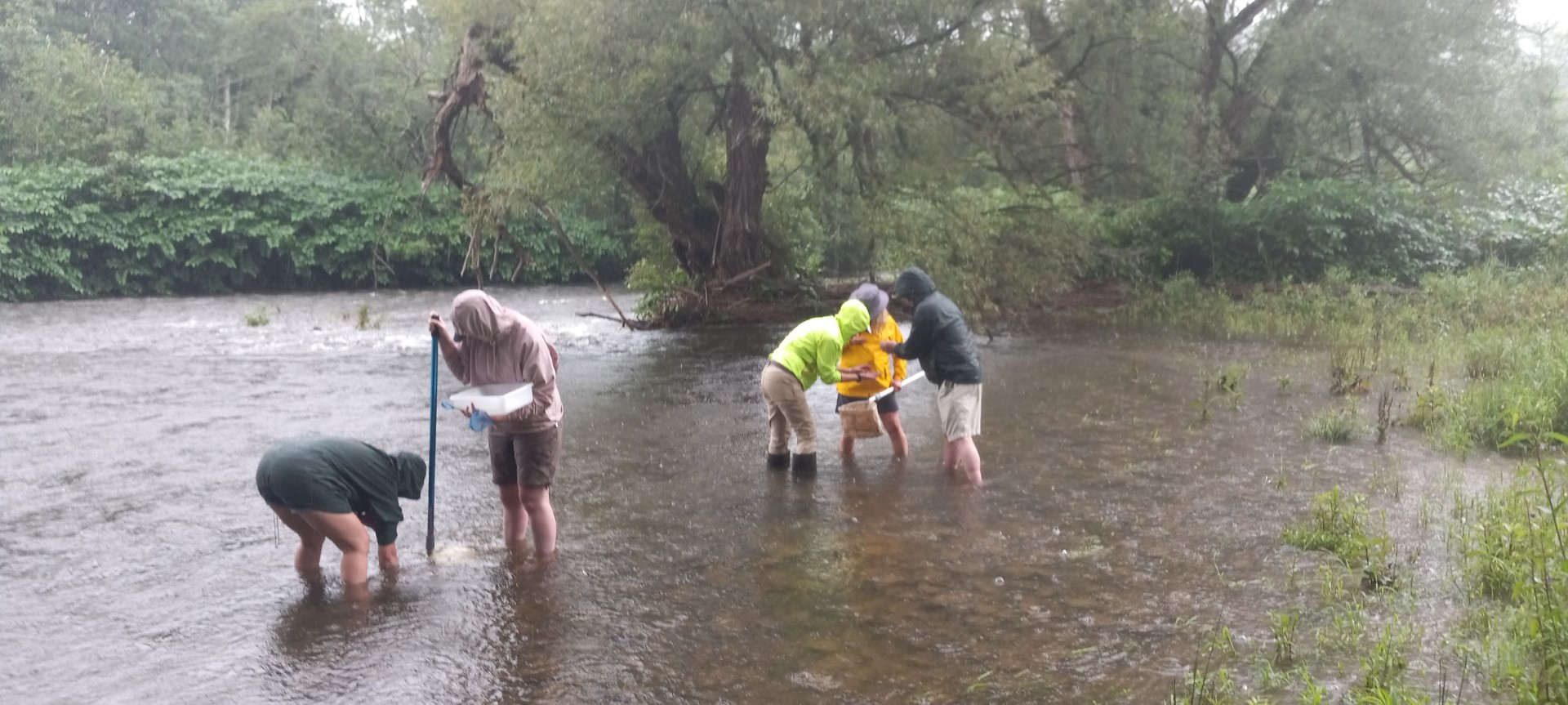
On a recent rainy afternoon, a dozen educators and environmentalists from Central New York were standing ankle deep in Charlotte Creek here, collecting water samples in test tubes, petri dishes and ice trays. As the rain pelted the group at a sideways angle, with the creek running faster than usual, Heather Grant, one of the leaders, felt compelled to offer a gentle warning.

“The teacher in me wants to say that the water is still high, so don’t go too far out by yourself,” she said. “Please don’t get washed away.”

It would not have been apparent to anyone watching, but this simple scientific inquiry, 282 driving miles from Perryville in Cecil County, the first town in Maryland to touch the Chesapeake Bay, had profound implications for the health of the Bay — and for the imperative of preparing the next generation to work to combat climate change. The creek runs into the Susquehanna River near Oneonta, about five miles east of West Davenport, and the Susquehanna, the longest river on the East Coast, is the biggest and northernmost source of the Chesapeake Bay, one of more than 150 waterways that feed into the venerated estuary.

Not that very many people know it. The Susquehanna begins at Lake Otsego in Cooperstown, N.Y., a quaint village named for James Fenimore Cooper, author of “The Last of the Mohicans” and other 19th century yarns. It’s also home to the Baseball Hall of Fame, which draws a steady stream of tourists. Brewery Ommegang, a giant and popular watering hole, restaurant and event space, is just outside of town in a corn field, its wild success surely a beacon of hope for craft brewers downriver in Maryland.

The only indication that this is the source of the Chesapeake Bay comes from a historical sign in a shady copse in Council Rock Park, which overlooks the lake, three blocks from the Baseball Hall of Fame (or the “B-HOF,” as some locals call it). “This marker signifies the point where the beautiful Susquehanna River begins its 444 mile journey to meet the Chesapeake Bay,” the sign says.

But a number of environmentalists and teachers in this part of the world are taking their responsibility as stewards of the Chesapeake Bay increasingly more seriously. And they are thinking more often about how they can incorporate Bay health into the scholastic curriculum. It can seem at times like a lonely crusade.

“Sometimes up here it’s tough to get students — or anyone — interested in the Bay, which is 400 miles away,” said Jeff O’Grady, program director at the Otsego County Conservation Association (OCCA), a leading environmental group in the area.

For the past three years, OCCA has organized a summertime training for local teachers to learn more about the Chesapeake Bay watershed and to devise strategies for teaching their students about it. Run initially by a group of volunteers, the environmental group, which has been around since the late 1960s, was launched to protect forests in the area. But its size and mission have grown exponentially over the years. Today, nine full-time staffers tackle everything from water pollution to clean energy advocacy to climate resiliency. Three years ago, the group won a grant from the National Oceanic and Atmospheric Administration to organize the teacher trainings on the Bay.

“Education is part of everything we do,” O’Grady said.

Maryland policymakers and environmentalists have long been obsessed about upstream pollution that comes into the Chesapeake Bay. But most of their ire and frustration focuses on Pennsylvania, which by all accounts and a series of lawsuits, has been lax, until recently, about its responsibilities to curb agricultural runoff and other pollution that flows to the Susquehanna and its tributaries.

New York is often missing from the conversation. In fact, environmentalists from the area joke about being left off official maps of the Bay watershed and recall a recent document from the Chesapeake Bay Foundation referring to the city of “Binghampton” — a serious misspelling to the locals. That may help explain why it’s so hard for local educators to teach their students and communities about the Bay.

“That’s how little people think about New York and the Chesapeake Bay,” said Liz Brown, OCCA’s clean energy community coordinator, who was co-leader of this summer’s teacher training. “Our portion up here is really critical to the Bay watershed, but it’s obvious why people don’t think of it, because it’s so small in proportion to all the other states.”

Grant, the other co-leader, who is a middle and high school teacher in the Morris Central School District, northwest of Oneonta, recalled fruitlessly exhorting a student to be more curious about the Chesapeake Bay.

“I don’t like oysters,” he replied.

‘We want this to be a place to not let that fleeting idea go to waste’

In Maryland, Bay education is a common and essential thing — and the state has broad benchmarks for environmental instruction that school districts are required to hit. In New York, educators were never expected to think about the Chesapeake Bay until the Empire State signed on to a multi-state agreement to reduce pollution in the Bay more than a decade ago. But there are still no standards or requirements for teaching about it.

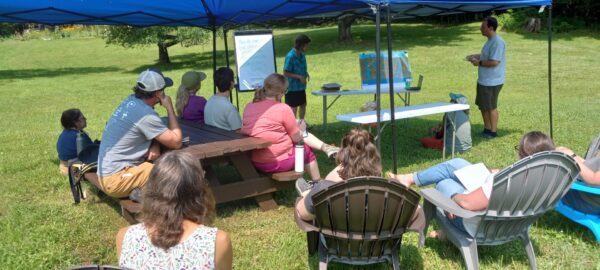
For three days teachers participating in the Otsego County Conservation Association training program met in a historic schoolhouse at the Pine Lake Environmental Campus of Hartwick College. Hartwick, a small liberal arts school in Oneonta, just down a steep hill from the bigger campus of the State University of New York at Oneonta, offers housing in small cabins at the environmental campus for students who wish to avoid the hurly-burly of typical dorm living. During the summer, the  environmental campus is used for youth summer camps — and, for the past two years, for the teacher training on the Bay watershed (it was held virtually the first year, due to the pandemic).

The nine teachers participating in the training were at different career stages and came for a variety of reasons. All were clearly committed environmentalists. On the first day, Grant wore a T-shirt that said “Teach climate science” on the front, and on the back said, “Teach climate science for…human health, food security, ecosystems, water resources, wildlife, the economy, our future.”

One member of the group, Amy Favinger, a 4th grade teacher in the Gilbertsville-Mount Upton Central School District, grew up in Baltimore County, taught in county schools, and moved with her family to Central New York during the pandemic after teaching for several years in Northern Virginia. Favinger said the training appealed to her partially out of a kind of nostalgia — she still has family in Baltimore — and partially to network with other educators, because she’s still relatively new to the area.

“Having that connection, living and growing up and teaching in that area, I wanted to figure out how I could use my previous experience to make connections for my students,” she said.

Throughout the three days, Grant and Brown were energetic and enthusiastic guides, mixing wonky science with knowing sympathy about demands and limitations teachers face in their daily lives, coupled with political realities of preaching climate action to reluctant or indifferent communities.

Teachers and environmentalists collect water samples in Charlotte Creek in West Davenport, N.Y., part of their training on how to teach about the Chesapeake Bay watershed. Photo by Josh Kurtz.

“We’ve got a lot of resources for you guys,” Grant told the teachers, later urging them to think creatively. “We want this to be a place to not let that fleeting idea go to waste.”

One of many messages group leaders attempted to drive home was that any scientific or environmental lesson or conversation, no matter how local, could be tied to broader discussions about the health of the Chesapeake Bay watershed. At one point, Brown and Grant asked each of the teachers to think about environmental challenges near their schools that could warrant academic inquiry — and could impact Bay health.

One teacher mentioned a “sketchy” visible gas pipe on the school property, leaking effluent of unknown origin. Another talked about her school being close to an old dump notorious for its methane emissions. Another talked about wanting to study microplastics in local waterways. And another wondered about the ecological impacts of the highly popular vineyards in the nearby Finger Lakes region.

They also talked about opportunities for civic action, at the school level and in their communities — everything from Earth Day cleanups to planting pollinator gardens to pulling tires out of rivers to advocating for meatless Mondays in the school cafeteria. One teacher, Chad DeVoe, a career counselor from the Onondaga-Cortland-Madison counties BOCES (a vocational educational program), said that when a school field trip was canceled in the late spring due to unhealthy air caused by Canadian wildfires, he urged his students to call the local congressman, Rep. Marc Molinaro (R), to ask his office what he was doing to fight climate change. They never got a particularly satisfactory answer, DeVoe told his colleagues, but it was still a valuable exercise. 

“We do letter-writing [to political leaders on climate change] earlier in the year,” DeVoe he said. “But this is far more effective. The kids loved it.”

Over the three days, the group of teachers took several short field trips on the wooded grounds of the environmental center’s campus, and also received visits from a range of experts and advocates: a scholar on local leaves and an authority on archaeology, as well as the director of an agricultural extension office affiliated with Cornell University, the leader of a regional environmental group that specializes in tree planting, and the district manager of the Otsego County Soil and Water Conservation District.

The quick hike to Charlotte Creek, through a piney forest, was part of an exercise to gauge water quality and monitor macroinvertebrates living near the shore. The teachers and environmentalists examined small critters in the test tubes, petri dishes and ice trays they brought with them, and discussed what they collected: mayflies, stoneflies, and two types of crayfish, among others.

The very same experiments, Brown told the teachers, can be done with their students if there is a stream nearby. “Macros are a good way, especially if you do it year after year, to assess water quality,” she said.

‘We need the next generation to participate’

Any educational endeavor, almost by necessity in modern America, comes with its own jargon and series of acronyms. The three-day teacher training was no exception.

The grant from NOAA that the Otsego County Conservation Association received came from a program the federal agency has established called B-WET, which stands for Bay Watershed Education and Training. B-WET teacher trainings have been taking place throughout the Bay watershed for several years, but the OCCA offering is the first in New York state.

More broadly, the B-WETs borrow from a teaching concept known as MWEEs — Meaningful Watershed Education Experiences, pronounced mee-wees. MWEEs can be any number of things and have existed for decades — many teachers in Maryland know a thing or two about them. The four elements they require, educators say, are issue investigation, outdoor field experience, synthesis and conclusions, and stewardship and civic action. Every conversation during the OCCA session was geared to shedding light on those goals.

New York teachers learning from a local leaf expert at a training session on the Chesapeake Bay watershed earlier this summer. Photo by Josh Kurtz.

On the second day of the three-day training, Elise Trelegan, the B-WET program coordinator for NOAA’s Chesapeake Bay Office in Annapolis, joined the meeting on Zoom from her home on the Eastern Shore. Trelegan told the teachers that the work they are doing in New York is part of a bigger effort; there are 637 school districts in the Chesapeake Bay watershed over six states and the District of Columbia, she said, and the B-WET office has an annual budget of $2.7 million — a pittance in the federal budget — to try to reach them all.

“We recognize that if we’re going to do anything on conservation and stewardship, we need the next generation to participate,” Trelegan said. “We haven’t done a lot of work in New York, so we’re really excited to have you all here. This funding catalyzes this kind of environmental literacy, environmental education, in all these school districts.”

Trelegan also explained that NOAA, like other federal agencies, is increasingly trying to emphasize equity and environmental justice as it funds climate and education programs.

“We’re looking for a long-term commitment from school districts to change the culture on environmental education,” she said. “We see this grant as the beginning of more things happening in New York.”

One teacher asked Trelegan why it took New York so long to “jump on the bandwagon” of providing education about the Bay watershed.

“I think it’s a sort of perception,” Trelegan suggested. “If people don’t see there’s a connection to the Bay, they don’t see how the upstream decisions affect things downstream.”

A teacher told a story that illustrated that very phenomenon. “It’s interesting,” she said. “I ask my students, ‘where do you think our water winds up?’ And they may say, ‘Oh, the Susquehanna,’ or ‘Binghamton.’ They don’t really know it goes to the Chesapeake. They don’t know we’re in the headwaters of the Chesapeake.”

Trelegan signed off of the Zoom, from Maryland, and expressed gratitude to the assembled teachers. “Thanks for doing these jobs and being the role models that you are,” she said.

Throughout the three-day session, there were more reminders of Maryland. At one point, the group watched a half hour video about ongoing MWEEs in three Bay watershed school districts, organized through the B-WET program. One was a high school in Lancaster County, Pa., one was a middle school in Virginia’s Shenandoah Valley, and the third was Lewisdale Elementary School, in Prince George’s County. The teachers in the room watched with great interest as a Lewisdale teacher led her students to Sligo Creek to take water samples and examine the macroinvertebrates they collected.

“Some of you are saying you have a lobster,” the teacher says in the video. “I don’t think that’s right.” Her students laugh.

Speaking to the camera, the teacher says her students’ families regularly use the park by the creek for picnics and other recreational activities and that the program makes them more attuned to their own responsibility for keeping the park and the water clean. And she praises the B-WET grant for helping to frame her lessons.

“The MWEE does not add on to all the standards that I have to teach,” she says. “To me, it frames [the lessons] in a much different way.”

When the video was over, the New York teachers remarked on the diversity of the student populations in the video they saw, especially the kids from Lewisdale, who were primarily Latino. The teachers, whose districts are small, rural and largely white, also wondered aloud about the resources which school districts in the video may have to enable them to run well-organized and successful MWEE programs.

When the three days had ended, several teachers said they learned a lot and planned to apply what they heard to their classroom instruction in the coming school year.

“It’s pretty great,” said Bryan Hill, a science teacher at Penn Yan Academy, a high school in Penn Yan, N.Y. “I think the coolest thing, apart from the litany of resources, is using hands-on activities that show kids environmental stewardship in real-world ways.”

Hill, who dropped out of medical school to teach at Penn Yan Academy, his alma mater, said he was “shocked, given that we have so many bodies of water around here,” that so little attention has been paid to the impact upriver activities have on the Chesapeake Bay. “It’s so easy to be complacent, to say, ‘I don’t know where the water goes.’”

Favinger, the 4th grade teacher who grew up in Baltimore County, was also impressed — and grateful.

“The resources are there,” she said. “You just have to know where to look and what you need to take in. It’s empowering when you get to make the decisions and set up the programs. There’s a way to do this and meet the standards of what you have to teach.”

Several teachers said the MWEEs appear to allow for a level of creativity and flexibility that many academic programs and mandates don’t have.

“This is not marked in stone,” Grant told the teachers. “We’re not going to show up in your schools in October and check back on these.”

All politics, all environmental action and all educational activities may, at a certain level, be local, but the leaders of the Otsego County Conservation Association were quick to remind the teachers about their small but vital place in a vast watershed.

“It’s important to stay focused on your waterway, but also taking a bigger look,” Brown advised. “Not just where you are, not just the Chesapeake Bay, but globally.”

By Josh Kurtz

The Spy Newspapers may periodically employ the assistance of artificial intelligence (AI) to enhance the clarity and accuracy of our content.

Filed Under: Eco Lead, Eco Portal Lead

PSC Chair Wants To ‘Lower The Temperature’ on Disputes over Renewable Energy Projects

August 30, 2023 by Maryland Matters Leave a Comment

The new leader of the Maryland Public Service Commission said Tuesday that he plans to convene meetings with interested parties over the next few months to discuss the increasingly controversial issue of where to place renewable energy installations in the state.

Testifying before a virtual hearing of the state Senate Committee on Education, Energy and the Environment, Fred Hoover, who took over as PSC chair in July, said he wanted to “get all the parties together to lower the temperature in some of these siting topics.”

The PSC is Maryland’s chief energy and utility regulatory agency, but it also has a historical role in approving proposals to build energy-generating facilities in the state. Where once that job meant considering and approving large power plants, as the industry evolves the commission now is tasked with becoming involved in decisions about where to place renewable energy installations. Those fights, especially over whether to allow solar projects on land zoned for agricultural uses or forests — and the PSC’s role in them — have become increasingly contentious.

Four years ago, the state’s highest court, then known as the Maryland Court of Appeals, ruled that the PSC can supersede local zoning laws when it came to applications to build large renewable energy installations.

Sen. Brian J. Feldman (D-Montgomery), chair of the Education, Energy and Environment panel, said in his view the court ruling suggested “the PSC is top dog” in these disputes. But he acknowledged that other entities, including the powerful Maryland Association of Counties, may have a different interpretation of the court decision.

“This issue has been very controversial over the interplay between the Public Service Commission and local governments,” Feldman said. “…This is still a muddied water kind of topic.”

Hoover pointed out that any entity applying to build a large renewable energy installation, such as a solar array on agricultural land, still must obtain relevant permits from local governments before they can proceed.

Earlier this month, Feldman, along with House Economic Matters Chair C.T. Wilson (D-Charles) and House Environment and Transportation Chair Marc Korman (D-Montgomery) wrote a letter to Gov. Wes Moore (D) seeking guidance on how the state should approach controversies over renewable energy installations given the necessity of increasing the state’s renewable energy generation to meet aggressive climate goals, among other things. Under legislation required last year, the state is required to hit a 50% renewable energy goal by 2030 and to use 100% clean energy by 2035.

“To achieve these targets, Maryland must dramatically and equitably increase its deployment of solar installations across the State and identify appropriate locations for energy storage,” the committee chairs wrote. They asked Moore to direct several state agencies to coordinate these efforts, “as well as identifying innovative policies being pursued in other states.”

Hoover told senators that his decision to convene meetings on siting was, in part, a response to the lawmakers’ query.

The Task Force to Study Solar Incentives, which was set up by state legislation this year, is also expected to examine this topic in months ahead.

So far, local governments have taken a piecemeal approach to renewable energy siting policies. In 2021 Montgomery County passed legislation effectively limiting the number of solar arrays that can be installed in the county’s vast Agricultural Reserve. Just last month, the Carroll County Board of Commissioners voted unanimously to ban large solar projects from being built on land zoned for agricultural use. Next week, the Anne Arundel County Council is tentatively scheduled to vote on amended legislation that could limit the amount of solar arrays permissible on undeveloped land.

Several stakeholders — including leaders of renewable energy companies, environmental groups, agricultural concerns, business organizations and local governments — have begun wondering openly if the state needs uniform standards on where and how to build renewable energy installations. A bill passed in this year’s General Assembly session makes it easier to install solar arrays on industrial lands, public and private rooftops, parking lots and other public facilities. Baltimore County officials, including County Executive Johnny Olszewski Jr. (D), are participating in a ribbon-cutting Wednesday for a rooftop solar project in Rosedale that will eventually provide power to 6,000 area homes.

But it’s widely acknowledged that some agricultural land will have to be set aside for renewable energy installations if the state is to hit the clean energy goals laid out in the 2022 Climate Solutions Now Act.

Hoover acknowledged the possible need for statewide legislation to quell the siting controversy when he told the senators Wednesday that he may approach them for “a legislative fix.”

The discussion about renewable energy siting came at the end of a two-hour hearing by the Senate committee that enabled lawmakers to learn more about the Public Service Commission and its myriad responsibilities. The Senate panel was renamed and given a new portfolio at the beginning of the year, so many members of the panel are still learning about energy issues. Additionally, three of the five PSC commissioners have taken office in the past few months, as Moore attempts to make the agency an aggressive partner in the administration’s desire to combat climate change.

PSC officials led the Senate committee through discussions ranging from how the commission considers utilities’ requests to raise rates, to how to read an electric bill, to whether utilities are being given too much license to beef up natural gas infrastructure, to some of the particulars on electric supply competition.

“To me it seemed like the right level of high-level and basic,” said Sen. Cheryl C. Kagan (D-Montgomery), the committee vice chair.

By Josh Kurtz

The Spy Newspapers may periodically employ the assistance of artificial intelligence (AI) to enhance the clarity and accuracy of our content.

Filed Under: Eco Lead, Eco Portal Lead

Sweet: To preserve the Bay, EPA and Hershey commit $2 million for Pennsylvania Farmers

August 24, 2023 by Maryland Matters Leave a Comment

The U.S. Environmental Protection Agency and Hershey Co. on Tuesday pledged $2 million to support Pennsylvania dairy farmers in adopting environmentally friendly practices, part of a larger conservation effort to protect the Chesapeake Bay Watershed.

They made the announcement at Central Manor Dairy in Manor Township, a 200-cow operation that has been a member of Land O’Lakes (and its predecessor) since 1943.

The Alliance for the Chesapeake Bay, in collaboration with Land O’Lakes, Inc., will use the funding as part of the ongoing “Sustainable Dairy PA” initiative that the agency and the two companies first launched in 2021.

Sustainable Dairy PA participating farmers work with the Alliance to establish best practices to reduce greenhouse gas emissions and improve Chesapeake Bay watershed water quality. At launch, the initiative prioritized 119 Land O’Lakes member-owner farms in central Pennsylvania that ship 50% or more of their milk supply to Hershey. Land O’Lakes operates as a member-owned cooperative, representing more than 1,000 farms across the U.S.

Jenna Mitchell Beckett, Pennsylvania director and agriculture program director for the Alliance, told the Capital-Star that the Sustainable Dairy PA program is voluntary for farmers who want to participate.

“The $2M funding from Hershey and EPA will help Land O’Lakes member farms accelerate their sustainability efforts by investing with them in the implementation of manure storage facilities, soil health practices, riparian forest buffers and other efforts to enhance sustainability on farms supplying to Hershey,” Beckett said in an email, “which builds farm resilience, improves water quality, and reduces emissions.” The Sustainable Dairy PA model focuses on all parts of the supply chain working together, she added, rather than the farmers managing everything themselves.

The EPA is supplying $1 million of the new round of funding, with Hershey providing a matching $1 million. The National Fish and Wildlife Foundation will administer the portion of the funds provided from EPA to the Alliance, the EPA said.

Since 2018, the Alliance has worked to develop agriculture supply chain programs, with an eye toward improving the member farms’ long-term sustainability, improving soil health, and overall efficiencies.

A report released earlier this year by the Chesapeake Bay Program found that pollution reduction efforts by states in the watershed were “more challenging than expected.”

Pennsylvania, Maryland, and Virginia are responsible for around 90% of the Chesapeake Bay’s pollution, and according to a 2022 report from the Chesapeake Bay Foundation, while the states were on track to meet their 2025 commitments for reducing pollution from wastewater, agriculture or urban and suburban runoff pollution reduction efforts lagged behind.

“States are not on track to reduce pollution to the levels needed for a healthy Bay, or implement the practices necessary to achieve them by the 2025 deadline,” according to the 2022 State of the Blueprint Report.

Under the terms of the Chesapeake Bay Agreement, Pennsylvania, Maryland, Virginia, Delaware, West Virginia, New York, and the District of Columbia have to reach specific milestones in pollution reduction.

The dairy industry is responsible for roughly 2% of the U.S.’ greenhouse gas emissions, according to the World Wildlife Fund.

“EPA’s funding commitment to Hershey, Land O’Lakes, and the Alliance for the Chesapeake Bay brings $2 million of much-needed support to Pennsylvania dairy farmers to scale up conservation practices that are good for our farms, climate, local streams, and the Bay,” EPA regional administrator Adam Ortiz said. “With this funding, we are not only investing in the current environment, but into the long-term viability of Pennsylvania farmers – our frontline environmentalists.”

By Kim Lyons

The Spy Newspapers may periodically employ the assistance of artificial intelligence (AI) to enhance the clarity and accuracy of our content.

Filed Under: Eco Lead, Eco Portal Lead

Restoring the Mighty Corsica: A Chat with Riverkeeper Annie Richards

August 16, 2023 by James Dissette Leave a Comment

For ten-thousand years the Chesapeake Bay and its tidal rivers have played a pivotal role in shaping and sustaining our surrounding environment. They are crucial components of our complex ecosystem and cultural landscape, offering a myriad of benefits that impact both aquatic and terrestrial life.

The beauty of many of the Bay’s tributaries led Capt. John Smith to write in 1612 to write, “Heaven and earth have never agreed better to frame a place for man’s habitation,” and while that praise still holds, the health of rivers—like the Bay—is a constant concern requiring long-term monitoring and preservation techniques.

Feeding in the Chester River, the six-mile Corsica River and its navigable streams have been widely popular for kayakers, canoers, paddleboarders, and fishing and maintain an active public dock at Centreville Wharf.

The river’s health, however, has been an uphill battle, but Chester Riverkeeper Annie Richards quickly notes that the whole picture is not bleak. In fact, some testing points water quality is showing a 30% recovery.

“The Corsica River, which converges with the middle Chester River at a junction of key waterways, struggles with several water quality parameters. Its relatively shallow nature poses issues with flushing and tidal flow. Unfortunately, the Corsica River ranks as one of the weakest performers in terms of water quality monitoring carried out by Shore Rivers,” Richards says.

From April to March, Richards and her Corsica River volunteers test the water quality twice a month, looking for changes in the water quality parameters, including dissolved oxygen levels, clarity, chlorophyll A (floating plant matter), nitrogen, and phosphorous levels.

“Corsica is not a surprise when we look back at Maryland Department of the Environment’s data whose series of tests in all of the sub-watersheds of the Corsica of which there are 45. 21 out of those 45 tested high high in phosphorus,” Richards says.

With science data in hand, Richards says that Shore Rivers meets in Annapolis every winter to advocate for better laws that can improve water quality and implement correct land use policies on the Eastern Shore.

Partnering with the Natural Lands Project, a program that runs out of the Center for Environment and Society at Washington College, the Annapolis meetings also provide a platform to plan for continued restoration projects, including returning native grasses to replace critical lost habitats.

The Spy recently talked with Shore Rivers Chester Riverkeeper Annie Richards about their ongoing stewardship and plans to enhance the health and quality of the Queen Anne’s river.

ShoreRivers is a nonprofit organization working to improve the health of Eastern Shore waterways through science-based advocacy, restoration, and education. ShoreRivers was created in 2017 when the Chester River Association (CRA), Midshore Riverkeeper Conservancy (MRC), and Sassafras River Association (SRA) merged.


The Spy Newspapers may periodically employ the assistance of artificial intelligence (AI) to enhance the clarity and accuracy of our content.

Filed Under: 2 News Homepage, Eco Portal Lead, News Portal Highlights

Mid-Shore Ecosystem: One Last Chance to Hold Off a Big Box at Kent Narrows

August 14, 2023 by Dave Wheelan Leave a Comment

Recent initiatives to seek critical area allocations on the Mid-Shore are finding significant pushback from citizens worried that they are contrary to the spirit of County comprehensive plans created to protect important habitats.

In one recent example, the Poplar Hill Farm development in Easton, which had plans for more than 400 homes, was withdrawn last month after the developer faced strong community opposition to using critical area allocations to build out a residential development.

And last week, there was a similar debate in Queen Anne’s County on how those allocations would be used. In this case, the question of the table was a proposal to provide allowances for a 150,000-square-foot storage facility at Kent Narrows to be built.

In the second of two formal reviews in front of the Queen Anne’s County Commissioners, the applicant sought final approval for the structure after the first review resulted in a 5-1 vote in favor of the development project.

In public comments at the August 8 meeting, Bib Zillig, a citizen advocate against the proposal, once again made his case by reminding the commissioners that the proposed land use was contrary to the spirit of the QAC Comprehensive plan. Zillig and several other environmental advocates outlined the fallout of overdevelopment, swelling traffic, and stressed infrastructure to these ambitious undertakings.

In response, the Commissioners asked QAC Department of Planning & Zoning County’s Planning and Zoning staff Amy Moredock and Stephanie Jones, who helped coordinate the latest update of the comprehensive plan, their analysis of the proposed use.

They reported that the project aligned with the comp plan, particularly concerning stormwater management. They further stated that the applicant’s proposal had minimal need for sewage capacity, and that the project documented a commitment of the developer to exceed minimum zoning standards.

It is anticipated a final decision on the application will be made at the next County Commissioners meeting.

The Spy captured both points of view to share with our readers.

This video is approximately 8 minutes in length.


The Spy Newspapers may periodically employ the assistance of artificial intelligence (AI) to enhance the clarity and accuracy of our content.

Filed Under: 2 News Homepage, Eco Portal Lead, News Portal Highlights

How a Wharf Went to the Park on a Bus by Marion Arnold

August 5, 2023 by Spy Desk Leave a Comment

When Kristen Lycett joined the Phillips Wharf Environmental Center in early 2020, the then 14-year-old non-profit was located where it got its start, on Tilghman Island. Under the aegis of founder Kelley Phillips Cox, the center ran a robust environmental program to educate the public on maintaining a healthy Chesapeake Bay.  With a focus on oyster aquaculture, the center began an oyster restoration project, planting over 835,000 oysters. The center also acquired an oyster lease and began selling oysters to local restaurants to underwrite its diverse operations which also included a visitor’s center and classroom on three acres by the Tilghman Island bridge. There was even a skipjack that took visitors out to the oyster reef.

In addition, the center housed an aquarium for up close interaction with creatures that depend on clean Chesapeake waterways—turtles, crabs, and dozens of native fish. Educational outreach was conducted by bus. Lycett, who has a PhD from the University of Maryland in marine science, was brought in to manage the center’s popular Fishmobile, a school bus colorfully transformed into a rolling aquarium for transporting tanks of creatures to local schools and community events.

Then along came COVID.

Just five weeks into her new job, the pandemic brought operations at Phillips Wharf to a grinding halt.  Lycett, said, “We closed to the public, canceled all in-person programming, and created a virtual Fishmobile program for fourth graders in Talbot County.” Going from in-person to onscreen was a big challenge. “It was definitely hard,” said Lycett.  “I have minimal video editing skills and had minimal resources at the time.” And because not all students had access to the Internet, Lycett had to come up with alternative formats for students. She said, “A lot of work went into making this program accessible.”

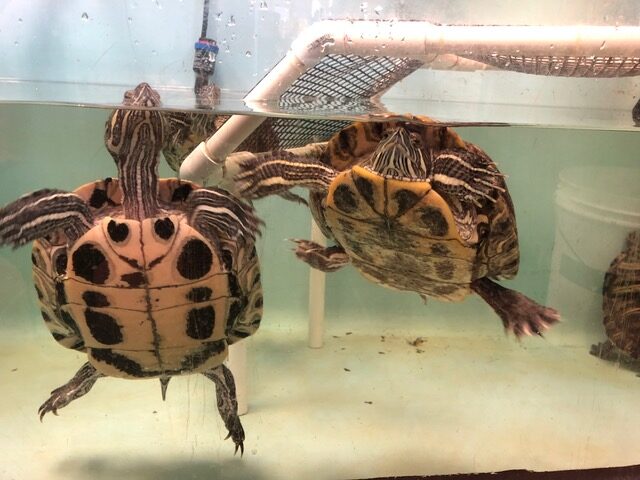
Red Eared Terrapins

But as Lycett dedicated herself to maintaining the Fishmobile program, the shutdown set off a cascade of bad news. When restaurants closed, revenue from oyster sales plummeted. A tropical storm later in the summer caused costly damage to the center’s classroom and aquarium facilities. In spring 2021 the Philips Wharf board made the hard decision to sell its assets, divesting itself of the oyster farm and then the environmental center. When Phillips Wharf closed down, all that remained was a small endowment and the Fishmobile. Heartbreakingly, in the midst of this, Kelley Phillips Cox died.

But a new door was waiting to open. As it happened, the Town of Easton had planned to move its public works facility from an industrial area on Easton Point to another location.  In its place, the town began creating a park. Back in 2009, then Mayor Bob Willey determined he could provide something residents had long asked for: access to Easton’s waterfront on the Tred Avon River. He asked newly elected council member Megan Cook to oversee park development.  Cook led the effort with a focus on environmental stewardship, using native plantings, developing a living shoreline, and favoring greenspace over hard-top and cement. From the start, the town wanted an organization to help visitors to enjoy and learn about the park’s natural resources. 

“It turned out that the town was looking for an environmental center for Easton Point Park,” said Phillips Wharf board vice-president Barbara Boyd.  “The Town of Easton was very, very accommodating.” The Phillips Wharf board had been exploring a move to Dorchester County but, she said. “We owed it to Kelley (Cox) to keep the center in Talbot County. And Easton is a much easier location to get students here for our programming.  For Easton, Phillips Wharf brings educational, environmental, and community purpose to help visitors understand how to support the Chesapeake Bay.”

It was a natural fit. Mayor Megan Cook said, “It’s a great partnership. Phillips Wharf is an asset to the community and a win-win for everyone involved.”

The Fishmobile and its menagerie rolled into the park in March 2022. Its new home consists of office spaces and open bays that the town had used for parking trucks and storing materials. As the public works moves out, the center is moving in.  “Our goal is to turn the closest garage bay to the building into additional aquarium space and aquarium prep space,” said Lycett, who is now the center’s Executive Director. By September she hopes to have access to more space to use as classrooms.

Phillips Wharf is adapting its offerings to Easton Point Park. “From the new location most of Phillips Wharf’s charter is still the same. But there’s less aquaculture and history and more emphasis on STEM (Science, technology, engineering, and mathematics),” Boyd said. At Easton Point, the center provides free onsite educational tours where children have hands-on experience with a mini oyster reef.  “They test the waters and count and measure the oyster spats,” Boyd said. “We offer this as summer programming that camps can take advantage of.”  In July came big news and a big boost for the center’s educational programming. Phillips Wharf was awarded a three-year NOAA B-WET grant, the Meaningful Watershed Educational Experience (MWEE), to teach environmental literacy to all fourth-graders in Talbot County. Lycett also hopes to eventually offer adult education programs on topics in ecology and sustainable living. In addition, the tireless Lycett manages a scaled down oyster growing program on Tilghman Island.  She has also run a very successful spring cleanup called “Tidy Up Talbot.” As Boyd put it, “We are unbelievably lucky to have Kristen onboard.”

And, of course, there’s the ever-popular Fishmobile. If you miss the bus this summer, you can always come to the park to meet Larry, the irrepressible Diamondback terrapin, and other creatures at the aquarium. “Our animal collection changes throughout our programming season as we find species in our oyster cages or go out and catch them,” notes Lycett. “We do release some animals to minimize the amount of care and food required during months when our Fishmobile program is not running (end of November through March). However, the turtles are with us for life, so we care for them year round.” In the end Lycett hopes the animal experiences are memorable. “My hope is our visitors take something from that interaction–whether that it’s OK to be excited and interested in something or a love for weird critters or just an interest in marine science and the Chesapeake Bay.”

While Phillips Wharf busily settles into its new home, Easton Point Park also continues to transform. Town Manager Don Richardson says the town is now in the planning phase to build a marina with a boat ramp and parking by the water. The building opposite to the one occupied by Phillips Wharf will be torn down to create parking space for a new entrance to the park accessed from Flood Street.  Eventually there will be trails, including a connection to Easton’s expanding Rail-to-Trails paths. There’s much to see and more to come at Easton Point Park.

 Marion Arnold is leader of the Plastic-Free Easton action committee. She lives in Easton. For more information on Phillips Wharf please go here.

The Spy Newspapers may periodically employ the assistance of artificial intelligence (AI) to enhance the clarity and accuracy of our content.

Filed Under: Eco Lead, Eco Portal Lead

Supreme Court Wetlands Ruling ‘Serious Setback’ for Bay

July 29, 2023 by Bay Journal Leave a Comment

With a recent U.S. Supreme Court decision sharply curtailing federal oversight of streams and wetlands, environmental groups working to restore the Chesapeake Bay say they’re worried about gaps in state laws and enforcement practices that now leave those waters vulnerable to unrestricted development and pollution.

In a May 25 ruling the nine justices unanimously agreed that the U.S. Environmental Protection Agency overstepped its authority in declaring part of an Idaho couple’s home site wetlands and demanding that they get a permit to fill it.

But the court’s majority went further in Sackett v. EPA and, with a 5–4 vote, drastically redefined which streams and wetlands are protected under the Clean Water Act. In doing so, it sought to settle decades of debate by removing federal regulation of activities affecting isolated wetlands and tiny streams that flow with water only after heavy rains.

“I’m not aware of anyone who predicted this,” said Peggy Sanner, Virginia executive director of the Chesapeake Bay Foundation.

She called it a “serious setback” for environmental protection efforts in general, as well as for the Bay restoration effort.

Wetlands and those periodically dry stream beds help keep water-fouling nutrients and sediment from reaching the Bay while also providing critical habitat and soaking up floodwaters.

Farmers, developers and other business organizations welcomed the ruling. The Virginia Farm Bureau’s blog called it “a major victory for farmers and property rights,” while the chair of the National Association of Home Builders dubbed it a win against “federal overreach” and for “common-sense regulations and housing affordability.”

Passed in 1972, the Clean Water Act gave the federal government jurisdiction over “navigable waters” and set up a permitting program to regulate discharges of dredged or fill material into “waters of the United States,” including wetlands.

A legal and political dispute has flared on and off since then about how far upstream that authority applies. Congress amended the Clean Water Act in 1977 to specify that it also covered wetlands “adjacent” to navigable waters, but that hasn’t quelled the controversy. The Supreme Court has weighed in repeatedly since the 1980s, with shifting and conflicting opinions.

In 2015, the Obama administration sought to clarify what’s regulated with a rule that protected isolated wetlands and “ephemeral” streams with a “significant nexus” to navigable waters.

That drew fierce backlash from farmers, developers and energy companies. The Trump administration repealed it and proposed a much narrower rule that applied federal regulations only in cases where surface water contributes to the wetland or waterway in question. States and environmental groups sued.

A court threw out the Trump rule, and the Biden administration has been working on another, more expansive version.

Environmental lawyers say the Sackett ruling appears to restrict federal jurisdiction even more than the Trump regulation. The EPA and U.S. Army Corps of Engineers, the two agencies that regulate activities affecting wetlands and waterways, had estimated that the Trump regulation would have stripped federal protection from more than half of the nation’s wetlands and roughly one-fifth of its streams.

Bob Dreher, legal director for the Potomac Riverkeeper Network, estimated that the recent court decision removes protection from as much as 65% of wetlands nationwide and more than 80% of the streams.

In the Bay watershed, the impact is somewhat muted. Five of the six states and the District of Columbia provide at least some protection under their own laws for wetlands and streams now removed from federal jurisdiction. Delaware is the only outlier, one of 24 states nationwide that rely entirely on the Clean Water Act for safeguarding their waters, according to the Environmental Law Institute.

Maryland, Pennsylvania and Virginia each have comprehensive state laws that provide protection from disturbance for their wetlands and all waters, even groundwater, noted the Bay Foundation’s Sanner.

West Virginia law also contains a broad definition of “waters of the state” but, according to the law institute’s James McElfish, the state has not always required permits for activities in wetlands and streams that fall outside the federal interpretation.

New York last year strengthened its protections for freshwater wetlands, but the state only requires permits for activities affecting wetlands larger than 7.4 acres, unless they’re deemed to be of “unusual importance.”

David Reed, executive director of the Chesapeake Legal Alliance, foresees trouble, even in states with strong legal protections on the books. State and federal agencies have jointly reviewed applications for permits to disturb a wetland or stream. Now, with the federal role shrinking, he said, there won’t be a backstop for state regulators facing intense pressure to look the other way.

“It will push them inevitably toward laxer enforcement,” Reed said of the states. “It will be this insidious direction toward less and less protection.”

Before the court’s ruling narrowing federal jurisdiction, Virginia, for instance, had relied on the Army Corps to review developers’ delineations of wetlands and surface waters when they were seeking permits.

In late June, the state’s Department of Environmental Quality announced that it would take over that task and would prioritize those applications where the delineations are performed by certified private wetlands professionals.  The agency said the change would “restore certainty in the permitting process and allow projects to move forward in a timely manner.”

The Bay Foundation’s Sanner said she was encouraged by DEQ’s “thoughtful” process for continuing to protect wetlands while ensuring efficient permitting.  But she cautioned that “many questions remain” about the state’s response to the court ruling.

Another major concern is that most states do not offer their citizens the same right to go to court to enforce their laws as the Clean Water Act does. The federal provision for “citizen suits” has allowed environmental groups to go after polluters in federal court and often prod state regulators to act when they haven’t before, Reed said.

Environmentalists say the Supreme Court decision also puts a cloud over the section of the Clean Water Act that establishes federal and, by extension, state authority to regulate discharges of stormwater and other pollutants into dry stream beds or isolated wetlands.

Activists say the Supreme Court’s ruling means they’re going to have to press for stronger state laws and for staffing and budget increases for regulatory agencies to enforce them.

“If we’re going to have hope for states to be a little of a backfill here, we’re going to have to help states get up to speed,” said Betsy Nicholas, the Potomac Riverkeeper Network’s vice president of programs.

by Tim Wheeler

The Spy Newspapers may periodically employ the assistance of artificial intelligence (AI) to enhance the clarity and accuracy of our content.

Filed Under: Eco Lead, Eco Portal Lead

Hollen and Sabanes Introduce Chesapeake National Recreation Area Act

July 28, 2023 by Spy Desk Leave a Comment

 U.S. Senator Chris Van Hollen and Congressman John Sarbanes introduced the Chesapeake National Recreation Area Act, which, if passed into law, would create the Chesapeake National Recreation Area (CNRA). The CNRA would be a land-based, 21st-century park, uniting new and existing National Park Service (NPS) sites and trails, as well as partner parks, to increase public access to the Chesapeake Bay and create a national park-worthy visitor experience for all to enjoy. Co-sponsors include Senators Ben Cardin (D-Md.), Mark Warner, and Tim Kaine (both D-Va.) and U.S. Representatives Don Beyer (D-Va.), Gerry Connolly (D-Va.), Steny Hoyer (D-Md.), Glenn Ivey (D-Md.), Jennifer McClellan (D-Va.), Kweisi Mfume (D-Md.), Eleanor Holmes Norton (D-D.C.), Jamie Raskin (D-Md.), Dutch Ruppersberger (D-Md.), Bobby Scott (D-Va.), David Trone (D-Md.), and Rob Wittman (R-Va.).

One year ago, a July 2022 public opinion poll showed profound support for National Park Service status for the Chesapeake, with 83% of Maryland, Virginia and Washington, DC respondents in favor of establishing a Chesapeake National Recreation Area. A congressional working group was formed in June 2022, and draft legislation was shared in November 2022. Hundreds of public comments were submitted.

Representatives of United4CNRA, a coalition of organizations and people advocating for the CNRA, issued the following statements celebrating this significant step toward establishing the CNRA:

“Latino Outdoors wholeheartedly endorses Senator Chris Van Hollen and Congressman John Sarbanes’ vision for the Chesapeake National Recreation Area.  It is a vision that has been thoughtfully crafted by a broad range of stakeholders, and it centers the protection of diverse landscapes, increased diverse public access, and the celebration of cultural diversity.  We applaud the efforts of Senator Van Hollen, Congressman Sarbanes, and the entire CNRA working group.  We see their actions as an affirmation of the importance of diversity, not for diversity’s sake, but rather for its potential to be a catalyst for a thriving and sustainable regional economy, community, and recreational asset. – Latino Outdoors Executive Director Luis Villa

 “Thank you, Senator Van Hollen and Congressman Sarbanes, for making a more than 30-year-long dream come true. The Chesapeake Bay is as spectacular as Yellowstone or Yosemite, as great as the Great Smokies and as grand as the Grand Tetons. Establishing the Chesapeake National Recreation Area expands resources for environmental protection and makes it clear that the United States cherishes the Chesapeake, the birthplace of American identity. As a great gift to future generations, this legislation ensures everyone’s right to visit and recreate on our nation’s largest estuary while balancing the needs of those who live here and depend on the bay for their livelihood.” – Chesapeake Conservancy President & CEO Joel Dunn

 “We appreciate the many years of hard work that Senator Chris Van Hollen, Representative John Sarbanes and the Chesapeake working group have dedicated to charting a path forward for the Chesapeake National Recreation Area.

“There is only one Chesapeake Bay, and everyone deserves a chance to experience its wonders. Working together to create a Chesapeake National Recreation Area would expand public access to the largest estuary in the world, bring economic growth to nearby communities, and help the National Park Service, native Tribes, and Chesapeake watermen interpret thousands of years of impactful history. Introducing legislation is the next step to make the dream of this park a reality.” – National Parks Conservation Association (NPCA) President & CEO Theresa Pierno

“The Chesapeake Bay has nourished Indigenous people both physically and spiritually for more than 10,000 years. The Chesapeake National Recreation Area would help educate our young people about the long-standing connection between the Chesapeake Bay and American Indians and ensure that the bay’s plants and animals, which are so essential to the sustaining power of life for everyone, are protected while preparing our next generation of leaders for the future.”  – Rappahannock Tribe Chief Anne Richardson

“The National Park Service serves as one of our nation’s foremost storytellers and steward of our rich and diverse natural and cultural heritage. The Chesapeake National Recreation Area would allow all of the American people and our international visitors to learn about our country’s history and how the Chesapeake Bay has been the landscape of Indigenous history, European exploration, colonialism, independence, slavery and freedom.” – former National Park Service Director “Bob” Robert Stanton (retired)

The Spy Newspapers may periodically employ the assistance of artificial intelligence (AI) to enhance the clarity and accuracy of our content.

Filed Under: Eco Lead, Eco Portal Lead

  • « Previous Page
  • 1
  • 2
  • 3
  • 4
  • Next Page »

Copyright © 2025

Affiliated News

  • Chestertown Spy
  • Talbot Spy
  • Cambridge Spy

Sections

  • Sample Page

Spy Community Media

  • Sample Page
  • Subscribe
  • Sample Page

Copyright © 2025 · Spy Community Media Child Theme on Genesis Framework · WordPress · Log in