

MENU

Sections

  • Home
  • Education
  • Donate to the Centreville Spy
  • Free Subscription
  • Spy Community Media
    • Chestertown Spy
    • Talbot Spy
    • Cambridge Spy

More

  • Support the Spy
  • About Spy Community Media
  • Advertising with the Spy
  • Subscribe
February 9, 2026

Centreville Spy

Nonpartisan and Education-based News for Centreville

  • Home
  • Education
  • Donate to the Centreville Spy
  • Free Subscription
  • Spy Community Media
    • Chestertown Spy
    • Talbot Spy
    • Cambridge Spy
00 Post To All Spies Education

Adkins Arboretum Mystery Monday: Guess the Photo!

February 9, 2026 by Adkins Arboretum Leave a Comment

Happy Mystery Monday! 🔎 Can you guess who is pictured in photo #1?

The answer to last week’s mystery is the dark-eyed junco, Junco hyemalis, pictured in photo #2.

The dark-eyed junco, Junco hyemalis, is one of North America’s most familiar sparrows and a true sign of Winter for many people. Often called “snowbirds,” these plump little birds breed in Canada and high-elevation mountain forests across the United States, then migrate south as temperatures drop, becoming abundant across much of the country—and sometimes feeding calmly even during snowstorms.

Juncos have a rounded head, short, stout bill, and a long, expressive tail edged in white. While their overall color varies by region, most appear gray or brown with a pink bill and bright white outer tail feathers that flash in flight. They favor forest edges, shrublands, and suburban areas with dense ground cover, where they hop along the leaf litter in search of seeds, often gathering in large flocks or mixing with other sparrows and songbirds.

During the breeding season, males perform small courtship displays, showing off their wings and tail while presenting nesting material to females. Nests typically contain three to six eggs, and pairs may raise up to three broods in a single year. Widespread, adaptable, and closely tied to seasonal change, the dark-eyed junco remains one of the most recognizable birds of North American winters.

Mystery Monday is sponsored by the Spy Newspapers and Adkins Arboretum.

#adkinsarboretum #mysterymonday #carolinecountymd
The Spy Newspapers may periodically employ the assistance of artificial intelligence (AI) to enhance the clarity and accuracy of our content.

Filed Under: 00 Post To All Spies, Education

Gunston Gearios Wrap Up Historic Robotics Season with Awards

February 5, 2026 by The Spy Leave a Comment

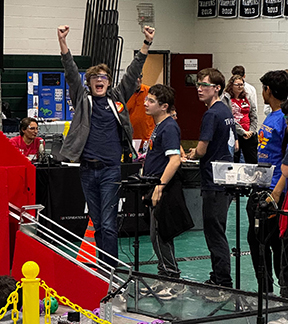
Blake Algier ’26 cheers at a recent FTC Competition, where the Gunston Gearios were honored with the Judges’ Choice Award, a prestigious nod to a team whose unique efforts and dynamics stand out beyond standard categories. Also pictured are Logan Brock ’28 and Connor Joyce ’26.

After five months of intensive engineering, coding, and strategic collaboration, the Gunston School’s robotics team, the Honey Nut Gearios (Team 9530), concluded their most successful season to date. Running from September to February, the season was defined by a record-breaking roster, a commitment to systematic engineering, and back-to-back award wins at regional qualifiers.

The team competes in the FIRST Tech Challenge (FTC), a global program where students in grades 7–12 are tasked with designing, building, and programming a robot to compete in a complex, themed game. Unlike traditional science fairs, FTC operates like a professional sports league: teams must form strategic alliances in 2 vs 2 matches, support STEM efforts in their local community, and present a professional “engineering portfolio” to a panel of expert judges. To succeed, students must master both “soft skills”—like public speaking and project management—and technical skills like Java programming and mechanical CAD (Computer-Aided Design). The Gunston Gearios are the only team from the Eastern Shore of Maryland to compete.

The Gearios tested their mettle at two major FIRST Tech Challenge (FTC) Qualifiers. In Alexandria, Va., on January 18, the team ranked 12th out of 24 teams. Their meticulous documentation earned them the 2nd Place Think Award, which recognizes teams that masterfully use an engineering portfolio to track their design and optimization process. In their final competition on February 1 at the Johns Hopkins Applied Physics Laboratory, the team climbed to 10th place out of 28 teams. They were honored with the Judges’ Choice Award, a prestigious nod to a team whose unique efforts and dynamics stand out beyond standard categories.

This year, the Robotics team expanded to 23 students, the largest group in the program’s history. Led by Team Captain and Hardware Leader Connor Joyce ’26, Software Leader Lucas Watkins ’26, and Task Manager Lia Schut ’26, the team represented a diverse cross-section of the student body. Most notably, the entire hardware team consisted of “rookies,” and the roster featured more new students—a demographic shift that promises a bright future for Gunston’s STEM initiatives. “I’m incredibly proud of what the team accomplished this year,” said lead advisor Dr. Ken Wilson. “With the entire hardware team being FTC rookies, the experience they’ve gained is invaluable for next year.”

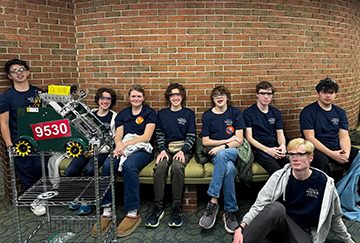
Members of the Gunston Gearios at a recent competition, from left to right, Ben Joyce ’29, Leo Forloney ’29, Kasiah Telligman ’29, Atticus Forloney ’29, Blake Algier ’26, Connor Joyce ’26, Lucas Watkins ’26, and Ben Perez ’26.

The team’s success was built on a rigorous schedule, including Dr. Wilson’s fall robotics class, dedicated homework periods, and an “After School Crew.” Most impressively, the “Weekend Crew” logged 15 weekends of work from 10 a.m. to 2 p.m., fueled by a steady rotation of donuts and pizza. The season was bolstered by a dedicated group of mentors and volunteers. Matt Joyce, P’29 provided engineering expertise, pushing the students to adopt a quantitative, systematic approach to building. Jerome Brock, P’28 assisted in preparing students for the high-pressure judges’ meetings, while Adam Grant, P’27 provided logistical support. Additionally, Technology teacher Ryan Redding and science teacher Dr. Mariah Goodall supported the team through the Science and Engineering Club.

With a solid foundation of young talent and a proven track record of award-winning documentation and design, the team is already looking toward the 2026-2027 season! Congratulations to the Gunston Gearios:

Connor Joyce ’26, Lucas Watkins ’26, Lia Schut ’26, Annie Geng ’26, Caden Quirion ’26, Willem Grant ’27, Charlie Hartman ’27, Sam Ellis ’29, Ben Perez ’29, Ben Joyce ’29, Atticus Forloney ’29, Jake Hanlon ’27, Logan Brock ’28, Maggie Lindsay ’29, Kasiah Telligman ’29, AJ Fridrich ’27, Blake Algier ’26, Leo Forloney ’29, Ben Watkins ’28, Jed Cohen ’26, Sasha Wilson ’29, Brody Schultz ’29, and Brady Luongo ’29.

Lead photo: Members of the Gunston Gearios Robotics Team include (l-r) Caden Quirion ’26, Annie Geng ’26, Charlie Hartman ’27, Lucas Watkins ’26, Lia Schut ’26, Connor Joyce ’26, and Willem Grant ’27.

•••

Founded in 1911 and currently enrolling 256 students, The Gunston School is an independent, nonprofit, nonsectarian, coeducational, college preparatory high school located in Centreville, Maryland. Visit gunston.org for more information.

The Spy Newspapers may periodically employ the assistance of artificial intelligence (AI) to enhance the clarity and accuracy of our content.

Filed Under: Ed Homepage, Ed Portal Lead

Adkins Arboretum Mystery Monday: Guess the Photo!

February 2, 2026 by Adkins Arboretum Leave a Comment

Happy Mystery Monday! Can you guess who is pictured in photo #1?


The answer to last week’s mystery is the eastern red cedar, Juniperus virginiana, pictured in photo #2.


The eastern red cedar, Juniperus virginiana, is a familiar evergreen conifer native to eastern North America, easily recognized by its year-round foliage and blue, berry-like cones. Despite its common name, it is not a true cedar but a juniper, and it plays an important ecological role across a wide range of habitats.

Eastern red cedar is dioecious, meaning individual trees produce either male or female reproductive structures. Male trees bear small, yellow-brown pollen cones clustered at the tips of branches. These cones begin forming in late Summer and mature through Winter, releasing clouds of windborne pollen when they split open.

Female trees produce small, waxy, blue seed cones that resemble berries. These cones receive pollen carried on the wind and, once fertilized, close and continue to enlarge through Fall and Winter, ripening in early Autumn. The persistent cones are an important winter food source for birds and wildlife, making eastern red cedar both a resilient evergreen and a cornerstone species in many landscapes.

Mystery Monday is sponsored by the Spy Newspapers and Adkins Arboretum.

#adkinsarboretum #mysterymonday #carolinecountymd
The Spy Newspapers may periodically employ the assistance of artificial intelligence (AI) to enhance the clarity and accuracy of our content.

Filed Under: 00 Post To All Spies, Education

Benedictine’s Next Chapter: A Chat with Executive Director Scott Evans

October 23, 2025 by The Spy Leave a Comment

It can never be said enough times how lucky the Mid-Shore is to have such a remarkable place as Benedictine in our region.  And that is the reason we continue to invite Scott Evans, its Executive Director to stop by the Spy Studio at least once a year for a check in session.
Benedictine is one of the Eastern Shore’s most impactful yet quietly integrated institutions. While many know it as the long-standing school in Ridgely, Evans reminds us it is far more than that. With nearly 400 employees and a $30 million annual budget, Benedictine is one of the region’s largest private employers—anchoring not only a school for children with developmental and intellectual disabilities but also a broad network of adult residential and employment programs across Talbot, Caroline, and Anne Arundel counties.

In our chat review, Scoott discusses how Benedictine’s mission extends beyond its classrooms and campus—helping people live, work, and thrive as part of their local communities. He also talks candidly about the challenges of staffing and funding a mission-driven organization tied to public education and state support, as well as the optimism surrounding Benedictine’s $14 million capital campaign, now nearing completion. The project, years in the making, represents a major investment in modern residential facilities designed to meet the evolving needs of students and adults with autism and developmental disabilities—an undertaking that Evans calls “the next chapter” in Benedictine’s 65-year legacy.

This video is approximately eight minutes in length. For more information or to donate to Benedictine, please visit this page.

The Spy Newspapers may periodically employ the assistance of artificial intelligence (AI) to enhance the clarity and accuracy of our content.

Filed Under: Ed Homepage

A Sea Change Expected for Pell Grant Students in Maryland

July 25, 2025 by Maryland Matters Leave a Comment

Students walk across McKeldin Mall on the University of Maryland, College Park’s campus. (Photo by Sam Gauntt/Maryland Matters)

Maryland Higher Education Commission members were warned Wednesday of a potential “huge sea change” for the state’s financial aid systems, as Pell Grant eligibility shifts as a result of changes under the “One Big Beautiful Bill” act.

Commission members were also briefed on new limits on loans for students in professional programs, and changes on the process for approving student visas. But the changes to Pell Grants, the state’s single largest source of federal student financial aid, consumed much of the meeting.

President Donald Trump’s “administration has actually called for deep cuts to education and education programs,” said Tom Harnisch, vice president for government relations at the State Higher Education Executive Officers Association. “We are working to push back against those cuts because we know those programs, be it the Pell Grant program or other federal student aid programs, are absolutely essential for students, and not only student access to higher education, but also completion and helping them throughout their college journey.”

More than 45,000 students across the University System of Maryland received a Pell Grant in fiscal 2024, totaling more than $204 million in aid. About 58,000 students across the system received any kind of federal student aid that year.

Another 6,200 students at state-aided private institutions in the state, such as Johns Hopkins University, McDaniel College or Hood College, got Pell Grants in fiscal 2024.

The total impact of the changes is still unclear — experts Wednesday even differed on who might be affected by the new rules.

Harnisch said that, according to the information he had received from the Senate, the changes in Pell Grant eligibility will mostly affect students with full-ride, athletic scholarships at Division I universities.

But the bill makes no specific mention of athletic scholarships. Rather, it says that beginning July 1, 2026, a student is ineligible for a Pell Grant for “any period for which the student receives grant aid from non-Federal sources, including States, institutions of higher education, or private sources, in an amount that equals or exceeds the student’s cost of attendance for such period.”

Commission members said that, under their reading, the state’s financial aid would now have to be calculated without first considering funds from Pell Grants.

Currently for some state aid, like the Howard P. Rawlings Guaranteed Access Grant, the formula for determining student need is “Pell first,” said Al Dorsett, of the commission’s office of student financial assistance.

“Based off this change, we’ll have to determine the students’ need before Pell is actually considered,” he said.

Commission Chair Cassie Motz said “that would be a huge sea change for Maryland.”

Deputy Higher Education Secretary Elena Quiroz-Livanis added that the timeline for Maryland to change its student aid regulations as a result of the new legislation is “just frankly insufficient.”

“But it is also unclear just exactly what it is that we’re being charged to implement, just again, because we have to go through negotiated rulemaking,” she said. “So it’s not the best place to be in, given all of the changes that we’re trying to enact here in Maryland.”

Motz emphasized that the commission must work alongside other states and with institutions within Maryland.

“We have to come together,” she said. “We need to be very tightly aligned with our institutions of higher education — two-year, four-year, public, private, all of them — because this is a big change.”

While the legislation also allocated $10 billion for the Pell Grant program over the next two years, Harnisch said, there is not enough funding for the program to continue long-term at its current level.

“We’re looking at a long-term Pell Grant shortfall that’s either going to require new investment from Congress or eligibility restrictions or reduction in the maximum Pell award,” Harnisch said. “Historically, Congress has not reduced the maximum Pell Grant award, but they have done eligibility restrictions.”

Commissioners also raised concern with new limits placed on unsubsidized federal loans for students in professional programs such as medical school or law school starting next year.

Under the new law, Harnisch said that students in professional programs will be limited to $50,000 a year in federal loans, to a lifetime limit of $200,000, in addition to their undergraduate student loan caps. Commission Vice Chair Chike Aguh said that those limits could  constrain on fields such as life sciences, which he described as one of Maryland’s “lighthouse industries.”

“Most of the doctors that I know who are borrowing fully are coming out with far more debt than that,” Aguh said. “So the question I think about is, OK, then where are they going to make up that gap?”

Harnisch said that physicians who studied at a public institution typically come out with $250,000 in loans or more — $300,000 if they went to a private school. Once they reach the cap for federal loans, they will have to look to the private market to cover the rest, he said.

Speakers Wednesday also highlighted the impact of other federal policy changes, such as new student visa rules.

“Obviously the big change here over the past six months are these visa cancellations,” said Kamal Essaheb, senior adviser and director of immigrant affairs to Gov. Wes Moore.

Essaheb added that the State Department resumed interviews for new student visas in late June, after suspending them  this spring, but subject to new rules. He said that vetting applicants social media is now “an explicit part of the process,” which also “requires applicants for these visas to both reveal what their social media accounts are, and also make them open to the public.”

Other changes the duration of student visas, Essaheb said. Instead of “duration of status” visas, that granted non-residents entry to the U.S. for as long as it took them to complete their course of study, new visas would have a set expiration date under a proposed new rule. Students who got sick or changed their program might be forced to leave the U.S. and reapply for a visa to return under the new rule.

Essaheb added that there will also be an updated fee schedule for applications. At a minimum, he said, visa applicants will have to pay $250 to receive the paperwork.

“There may be folks who are finding out about some of this information for the first time later in the process, right after they’ve received admission and accepted an offer and are then going through the requisite paperwork,” he said. “The rapidly evolving immigration policy landscape makes it hard for people to not only know their rights, but also their legal obligations.”

Maryland Higher Education Secretary Sanjay Rai said that “despite the challenges higher education may be facing due to policy changes and other external disruptions, we will continue to stand firm in our mission to keep students and their needs at the forefront of our work.”


by Sam Gauntt, Maryland Matters
July 24, 2025

Maryland Matters is part of States Newsroom, a nonprofit news network supported by grants and a coalition of donors as a 501c(3) public charity. Maryland Matters maintains editorial independence. Contact Editor Steve Crane for questions: [email protected].

The Spy Newspapers may periodically employ the assistance of artificial intelligence (AI) to enhance the clarity and accuracy of our content.

Filed Under: Education

Washington College President Michael Sosulski Steps Down

July 8, 2025 by Washington College News Service Leave a Comment

Washington College announced Monday that President Michael J. Sosulski will step down later this summer to become president of Lake Forest College in Lake Forest, Illinois. Sosulski will continue to serve through July. Trustee emeritus and former Board Chair Steve Golding ’72 will assume the role of provisional Chief Operating Officer while the Board of Visitors and Governors finalizes interim leadership plans and prepares for a national search for Sosulski’s successor.

Sosulski was appointed as the College’s 31st president in the summer of 2021, arriving at a pivotal moment. Like many small liberal arts colleges, Washington faced a challenging financial landscape, including an $11 million deficit. Under Sosulski’s leadership, the College worked to stabilize its finances and revitalize enrollment through improved recruitment and marketing strategies. Since 2021, applications have risen by 120%, and the College’s endowment has reached an all-time high of more than $330 million.

Sosulski’s tenure leaves a considerable imprint on the institution. In 2022, the College invested $20 million in first-year residence hall renovations and campus-wide Wi-Fi upgrades. Other notable campus improvement projects include the redesign of the Owings Library Terrace and student-inspired renovations to the Western Shore residence halls. The College also began the process of removing three outdated residence halls—Dorchester, Cecil, and Talbot—to make way for the new home of the Warehime School of Global Business, Economics, and Social Impact. Funded by a $15 million gift from Beth Warehime Rizakos ’13—the largest single donation from an individual in the College’s history—the facility is scheduled to open in January 2028.

In 2023, Washington College received a $54.7 million gift from the Hodson Trust, significantly enhancing its ability to make a college education more accessible and affordable to students from diverse backgrounds.

Sosulski also oversaw the launch of the Innovation Plant, an entrepreneurship center that will be located at 800 High Street in one of the former Dixon Valve Company warehouse buildings. The project—currently in the design phase—has secured approximately $5 million in public and private support. Once completed, the Innovation Plant will support both Washington College students and local entrepreneurs in launching and growing businesses on the Eastern Shore.

Other key initiatives during Sosulski’s presidency include:

  • Launching the Washington College Principles of Free Expressionto foster open dialogue and debate;
  • Reinvigorating alumni relations with initiatives such as a fall homecoming and the relaunch of Washington College Magazine;
  • Introducing a sophomore-year experience to boost student retention;
  • Strengthening civic engagement through the creation of the Thomas V. Mike Miller Jr. Director of Civic Engagementrole; and
  • Expanding athletics by adding men’s and women’s golf teams and reinstating cross country and track and field.


The Spy Newspapers may periodically employ the assistance of artificial intelligence (AI) to enhance the clarity and accuracy of our content.

Filed Under: Ed Homepage, Ed Portal Lead, WC

University Regents Approve Fiscal 2026 Budget that Cuts Spending, Raises Tuition and Fees

June 17, 2025 by Maryland Matters Leave a Comment

The University System of Maryland’s Board of Regents voted Friday to approve a fiscal 2026 budget that is 7% smaller than last year’s allocation, as well as tuition increases of up to 5% and fee hikes up to 10%.

The almost $8 billion budget, already approved by Gov. Wes Moore and the General Assembly, will trim operating costs while aiming to increase revenue to make up for $155 million in reduced funding. These reductions follow an almost 4% cut to the University System last year.

“At this extraordinary time, our universities must make some difficult decisions as they close their budget gaps,” University System Chancellor Jay Perman said Friday.

On Thursday, Perman took the unusual step of sending a video message to more than 40,000 faculty and staff members across the system, apologizing for the coming budget cuts but telling staff to brace for them. He replayed that video for the board on Friday.

While university administrators will first seek to generate new revenue and will protect employees from cuts as much as possible, the “sheer size of the cut we’re absorbing means that, for some universities, personnel actions cannot be taken off the table,” Perman said in the video.

At their previous meeting in May, the regents approved a resolution that allows presidents of individual campuses to implement furloughs and temporary salary reductions as part of their budget plans.

Senior Vice Chancellor for Administration and Finance Ellen Herbst said 60% of the system’s operating costs are personnel-related. Two-thirds of the system’s employees are funded by state support, Herbst said, while about a quarter are funded by federal grants and contracts.

She said though universities are looking to low-impact actions to address personnel costs first, such as eliminating vacancies and allowing “natural attrition” to reduce payrolls, those actions alone may not be enough.

“We will take these actions with great care, but we will need to take some further actions,” Herbst said. “We cannot address the shortfall in state funding without addressing personnel costs.”

Patrick Moran, president of the American Federation of State, County and Municipal Employees Maryland Council 3, which represents more than 6,000 University System employees, said the union and system need to work together to defend their shared values and protect employees as they face “very real and critical threats.” Moran said the system must evaluate its use of costly vendors, reduce reliance on contractual employees, and listen to feedback from staff on how things can be better run.

“All of these things can be done before deciding to make devastating cuts to your personnel, especially those on the front lines,” he said.

Katherine Wasdin, a representative of the University of Maryland, College Park’s American Association of University Professors chapter, expressed the importance of shared governance as the system makes its budget decisions.

“Faculty and university senates must be involved in making these difficult budgetary decisions, as well as in how to respond to changing federal policies on education and research,” Wasdin, an associate professor of classics, said. “It is thus imperative that all parts of the USM system promote the involvement of faculty in university management, rather than trying to thwart it.”

Under the budget plan, the University System will receive 29% of its funding from state appropriations, while 27% will come from tuition and fees. The next largest contribution comes from restricted funds, which consist mostly of federal contracts and grants, and will cover about 24% of the budget.

In addition to the reduction in state funding, the system estimates that the federal government’s significant cuts to research grants and contracts could cost up to $150 million across its campuses, Herbst said.

To increase revenue to offset the losses in funding, tuition will increase across the system by 2-4% for in-state residents. The University of Maryland, College Park will see the highest increase at 4%, while the rest will see increases of 3% or less.

Tuition for nonresident undergrads will increase by 5% at Towson and UMBC, and 2% at the system’s other institutions.

Student fees, such as housing, dining and parking, will see bigger increases. Housing will see increases from 2% at Towson to 10% at Bowie State University, while board fee increases range from 2.2% at Salisbury University to 10.5% at College Park.

Bowie State University and the College Park campus will also raise parking fees by 3.8% and 5%, respectively.

The regents also voted Friday to approve extending the University of Maryland Global Campus’s contract with UMGC Ventures, the university’s former in-house information technology services unit which it turned into an independent business.

The online university will spend $69 million on the 18-month contract extension while it works to reintegrate Ventures and AccelerEd, a subsidiary of Ventures, back into the university. The reintegration comes after an August 2024 audit from the state’s Office of Legislative Audits that found the spin-offs were too costly and appeared to bypass the school’s normal procedures.

Herbst said that staff across the University System are continuously drawing up contingency plans for budget scenarios they could face later in the year, such as lower-than-expected enrollment, further federal funding cuts or change to eligibility for federal financial aid.

Pell Grants, the system’s largest source of financial aid, covered more than $204 million in aid for about 45,000 students in fiscal 2024. More than 58,000 students in total received some form of federal student aid, Herbst added, and any significant eligibility changes could potentially impact enrollment numbers.

“All we know for sure about budgets is they’re simply a plan, and then the year starts and we have to actually manage,” she said. “This year will probably prove to be more challenging than many.”


by Sam Gauntt, Maryland Matters
June 13, 2025

Maryland Matters is part of States Newsroom, a nonprofit news network supported by grants and a coalition of donors as a 501c(3) public charity. Maryland Matters maintains editorial independence. Contact Editor Steve Crane for questions: [email protected].

The Spy Newspapers may periodically employ the assistance of artificial intelligence (AI) to enhance the clarity and accuracy of our content.

Filed Under: Education

Wetlands 101: Sultana Education Foundation Presents an Evening of Interactive Science

June 9, 2025 by Sultana Education Foundation Leave a Comment

The Sultana Education Foundation (SEF) will host its monthly Third Thursday Speaker Series on Thursday, June 19 from 6-7PM when John Mann and Jackie Doerr present Wetlands 101: An Evening of Interactive Science.  The pair of Sultana educators will team up to teach about the vital role that wetlands play in the health of the Chesapeake Bay.  There will be a brief discussion inside the Harwood Nature Center discussing wetlands in general as well as the steps that have been taken to both improve the health of the Lawrence Preserve as well as make it accessible to visitors.  Attendees will then be invited to participate in some of the hands-on science lessons (catching critters, sampling water quality, and walking the trails) that Sultana students enjoy on field trips.

The Lawrence Wetland Preserve is a walk-in facility (no onsite parking) located at 301 South Mill Street in Chestertown.  Visitors are encouraged to park in the public lots on the 300 block of Cannon Street or on the surrounding streets.

These events are free and open to the public.  For more information about the Third Thursday Speaker Series or the Sultana Education Foundation, please visit www.sultanaeducation.org.

The Spy Newspapers may periodically employ the assistance of artificial intelligence (AI) to enhance the clarity and accuracy of our content.

Filed Under: Archives, Ed Homepage, Ed Portal Lead

Washington College Commencement Recap

May 20, 2025 by Washington College News Service Leave a Comment

“Under a bright spring sky, Washington College celebrated the 209 members of the graduating Class of 2025. The event was a vibrant culmination of years of hard work, discovery, and community building, filled with inspiring speeches and heartfelt congratulations. While the broader political and economic landscape cast a shadow of concern for the first class to have attended courses in-person all four years since the Covid-19 pandemic, the day was primarily marked by joyous celebration of academic achievement and the promise of new beginnings.”

For a complete recap of the commencement proceedings from Sunday as well as Jonathan Karl’s keynote address, go here.

(Text and images form Washington College News & Media Relations)

The Spy Newspapers may periodically employ the assistance of artificial intelligence (AI) to enhance the clarity and accuracy of our content.

Filed Under: Archives, WC

‘Blueprint’ Bill That Avoids Some of the Most Severe Education Cuts is Signed into Law

May 7, 2025 by Maryland Matters Leave a Comment

Even as changes to the state’s education reform act were being signed into law Tuesday, state officials and advocates were already talking about changes they want to see next in the Blueprint for Maryland’s Future.

The debate over House Bill 504 – the Excellence in Maryland Public Schools Act – was among the sharpest in the 2025 General Assembly session, with the governor and lawmakers, particularly the House, split over changes to the expensive plan that were needed as the state grappled with a $3 billion budget deficit.

But Gov. Wes Moore (D) on Tuesday, standing next to Senate President Bill Ferguson (D-Baltimore City) and House Speaker Adrienne Jones (D-Baltimore County), thanked them, several lawmakers and education officials for their work on the bill, which passed on the last day of the 90-day session last month.

“While this legislation is an important step forward, it cannot be the last step that we take on education,” Moore said at Tuesday’s bill signing ceremony. “While we refine our strategy to ensure we aren’t just spending more, but that we’re spending smart, I will continue to use every option available to me as governor to improve our schools and deliver for our students.”

The final bill did not contain some of the deepest cuts that were offered to try rein in spending on the 10-year, multibillion-dollar Blueprint plan. But it also did not include some of the flexibility for local schools boards that some administrators had been pushing for.

State Board of Education President Joshua Michael, who attended the bill signing ceremony, said the governor and legislature helped to improve the Blueprint plan through their negotiations. But Michael said it would have helped if they had included funding for a teacher coaching program, a recommendation made by a nonprofit’s report last month on reading.

“We’re pleased that the legislature authorized the program, but we need resources,” Michael said. “We’re going to continue to press forward with the tools that we have around the literacy policy and the math policy, and we’re going to work with the legislature and the governor to see what we can do in the future.”

Moore in January proposed a Blueprint reform plan that called for a four-year pause in the expansion of teacher “collaborative time” – hours when teachers are not in the classroom but are planning for meeting. State education leaders have said at least 12,000 new teachers would have to be hired to fully implement collaborative time. The governor also proposed a decrease in funding for special education, low-income and English language learners, and keeping funding for community schools – those that receive concentration of poverty grants – at current levels for two years.

Lawmakers pushed back hard against reductions in funding that would affect those students in most need. Legislators were ultimately able to preserve most of the funding for students in need, and advocates praised lawmakers like Del. Vanessa Atterbeary (D-Howard) for not backing down over funding for underserved students.

Atterbeary, who chairs the House Ways and Means Committee that assesses education policy, said Tuesday the legislature may need to assess education funding in the near future, especially “with the climate” in the federal government led by President Donald Trump (R).

“Why should we say to our most underserved communities, to our minority communities that at the national level when our president is saying, ‘We don’t care about you,’ and WE’RE going to double down and cut their funding. No. Absolutely not,” said Atterbeary, who didn’t attend Tuesday’s ceremony.

“I couldn’t do that as a mother. I couldn’t do that as a woman. I couldn’t do that as an African American and I absolutely couldn’t do it as a legislator,” she said. “Ultimately, the legislation in terms of that aspect passed as we wanted.”

‘Give faith’

Advocates such as Riya Gupta remain pleased the Blueprint bill passed, but she said more money is needed for mental health, behavioral and other wraparound services for students in the upcoming 2025-26 school year.

Under the Consortium on Coordinated Supports, which is part of the Blueprint plan, the governor proposed to fund those services at $130 million for next fiscal year. The House proposed just $40 million, but ultimately Senate language was adopted that allocated $70 million next year and $100 million a year thereafter.

Gupta, interim director for the advocacy group Strong Schools Maryland, which focuses on protecting the Blueprint for Maryland’s Future, said Monday that the state cannot make a habit of analyzing Blueprint funding, as it did this year.

She also said parents, students, advocates and community leaders should be given ample opportunities to become involved in any policy discussions for next year’s legislative session.

“We have to bring them to the table,” she said. “We have to give the faith to listen to their ideas that are also in line with the vision of the Blueprint.”

Sen. Mary Beth Carozza (R-Lower Shore), who voted against the bill last month, agrees more local input is needed. Carozza said she will continue to push for recommendations offered in December by a superintendent’s association.

Several of the association’s proposals became legislation sponsored by Sen. Karen Lewis Young (D-Frederick), and later amendments offered by Carozza, but none of the proposals advanced beyond a Senate committee.

“There were too many missed opportunities to do more on Blueprint revisions and to give our local school systems the flexibility they need…” Carozza said Monday.

Carozza and other Republican lawmakers expressed concerns about future funding for the multibillion-dollar plan, now in its third year. Some have said future budgets will not only affect school systems, but also county governments, which may not be able to pay for increases in transportation, special education or other programs.

Although the Blueprint is funded in the next two years, the subsequent years are slated to shift to the state’s general fund with projected deficits up to $3 billion by fiscal 2030.

“Which translates to new and even bigger taxes,” Carozza said. “We cannot move forward with the Blueprint by doing major cost shifts to the counties.”


by William J. Ford, Maryland Matters
May 7, 2025

Maryland Matters is part of States Newsroom, a nonprofit news network supported by grants and a coalition of donors as a 501c(3) public charity. Maryland Matters maintains editorial independence. Contact Editor Steve Crane for questions: [email protected].

The Spy Newspapers may periodically employ the assistance of artificial intelligence (AI) to enhance the clarity and accuracy of our content.

Filed Under: Education

  • 1
  • 2
  • 3
  • …
  • 10
  • Next Page »

Copyright © 2026

Affiliated News

  • Chestertown Spy
  • Talbot Spy
  • Cambridge Spy

Sections

  • Sample Page

Spy Community Media

  • Sample Page
  • Subscribe
  • Sample Page

Copyright © 2026 · Spy Community Media Child Theme on Genesis Framework · WordPress · Log in