
MENU

Sections

  • Home
  • Education
  • Donate to the Centreville Spy
  • Free Subscription
  • Spy Community Media
    • Chestertown Spy
    • Talbot Spy
    • Cambridge Spy

More

  • Support the Spy
  • About Spy Community Media
  • Advertising with the Spy
  • Subscribe
December 7, 2025

Centreville Spy

Nonpartisan and Education-based News for Centreville

  • Home
  • Education
  • Donate to the Centreville Spy
  • Free Subscription
  • Spy Community Media
    • Chestertown Spy
    • Talbot Spy
    • Cambridge Spy
Education Ed Homepage

Benedictine’s Next Chapter: A Chat with Executive Director Scott Evans

October 23, 2025 by The Spy Leave a Comment

It can never be said enough times how lucky the Mid-Shore is to have such a remarkable place as Benedictine in our region.  And that is the reason we continue to invite Scott Evans, its Executive Director to stop by the Spy Studio at least once a year for a check in session.
Benedictine is one of the Eastern Shore’s most impactful yet quietly integrated institutions. While many know it as the long-standing school in Ridgely, Evans reminds us it is far more than that. With nearly 400 employees and a $30 million annual budget, Benedictine is one of the region’s largest private employers—anchoring not only a school for children with developmental and intellectual disabilities but also a broad network of adult residential and employment programs across Talbot, Caroline, and Anne Arundel counties.

In our chat review, Scoott discusses how Benedictine’s mission extends beyond its classrooms and campus—helping people live, work, and thrive as part of their local communities. He also talks candidly about the challenges of staffing and funding a mission-driven organization tied to public education and state support, as well as the optimism surrounding Benedictine’s $14 million capital campaign, now nearing completion. The project, years in the making, represents a major investment in modern residential facilities designed to meet the evolving needs of students and adults with autism and developmental disabilities—an undertaking that Evans calls “the next chapter” in Benedictine’s 65-year legacy.

This video is approximately eight minutes in length. For more information or to donate to Benedictine, please visit this page.

The Spy Newspapers may periodically employ the assistance of artificial intelligence (AI) to enhance the clarity and accuracy of our content.

Filed Under: Ed Homepage

Washington College President Michael Sosulski Steps Down

July 8, 2025 by Washington College News Service Leave a Comment

Washington College announced Monday that President Michael J. Sosulski will step down later this summer to become president of Lake Forest College in Lake Forest, Illinois. Sosulski will continue to serve through July. Trustee emeritus and former Board Chair Steve Golding ’72 will assume the role of provisional Chief Operating Officer while the Board of Visitors and Governors finalizes interim leadership plans and prepares for a national search for Sosulski’s successor.

Sosulski was appointed as the College’s 31st president in the summer of 2021, arriving at a pivotal moment. Like many small liberal arts colleges, Washington faced a challenging financial landscape, including an $11 million deficit. Under Sosulski’s leadership, the College worked to stabilize its finances and revitalize enrollment through improved recruitment and marketing strategies. Since 2021, applications have risen by 120%, and the College’s endowment has reached an all-time high of more than $330 million.

Sosulski’s tenure leaves a considerable imprint on the institution. In 2022, the College invested $20 million in first-year residence hall renovations and campus-wide Wi-Fi upgrades. Other notable campus improvement projects include the redesign of the Owings Library Terrace and student-inspired renovations to the Western Shore residence halls. The College also began the process of removing three outdated residence halls—Dorchester, Cecil, and Talbot—to make way for the new home of the Warehime School of Global Business, Economics, and Social Impact. Funded by a $15 million gift from Beth Warehime Rizakos ’13—the largest single donation from an individual in the College’s history—the facility is scheduled to open in January 2028.

In 2023, Washington College received a $54.7 million gift from the Hodson Trust, significantly enhancing its ability to make a college education more accessible and affordable to students from diverse backgrounds.

Sosulski also oversaw the launch of the Innovation Plant, an entrepreneurship center that will be located at 800 High Street in one of the former Dixon Valve Company warehouse buildings. The project—currently in the design phase—has secured approximately $5 million in public and private support. Once completed, the Innovation Plant will support both Washington College students and local entrepreneurs in launching and growing businesses on the Eastern Shore.

Other key initiatives during Sosulski’s presidency include:

  • Launching the Washington College Principles of Free Expressionto foster open dialogue and debate;
  • Reinvigorating alumni relations with initiatives such as a fall homecoming and the relaunch of Washington College Magazine;
  • Introducing a sophomore-year experience to boost student retention;
  • Strengthening civic engagement through the creation of the Thomas V. Mike Miller Jr. Director of Civic Engagementrole; and
  • Expanding athletics by adding men’s and women’s golf teams and reinstating cross country and track and field.


The Spy Newspapers may periodically employ the assistance of artificial intelligence (AI) to enhance the clarity and accuracy of our content.

Filed Under: Ed Homepage, Ed Portal Lead, WC

Wetlands 101: Sultana Education Foundation Presents an Evening of Interactive Science

June 9, 2025 by Sultana Education Foundation Leave a Comment

The Sultana Education Foundation (SEF) will host its monthly Third Thursday Speaker Series on Thursday, June 19 from 6-7PM when John Mann and Jackie Doerr present Wetlands 101: An Evening of Interactive Science.  The pair of Sultana educators will team up to teach about the vital role that wetlands play in the health of the Chesapeake Bay.  There will be a brief discussion inside the Harwood Nature Center discussing wetlands in general as well as the steps that have been taken to both improve the health of the Lawrence Preserve as well as make it accessible to visitors.  Attendees will then be invited to participate in some of the hands-on science lessons (catching critters, sampling water quality, and walking the trails) that Sultana students enjoy on field trips.

The Lawrence Wetland Preserve is a walk-in facility (no onsite parking) located at 301 South Mill Street in Chestertown.  Visitors are encouraged to park in the public lots on the 300 block of Cannon Street or on the surrounding streets.

These events are free and open to the public.  For more information about the Third Thursday Speaker Series or the Sultana Education Foundation, please visit www.sultanaeducation.org.

The Spy Newspapers may periodically employ the assistance of artificial intelligence (AI) to enhance the clarity and accuracy of our content.

Filed Under: Archives, Ed Homepage, Ed Portal Lead

MD Senate Panel’s vote on Blueprint bill straddles House, Administration Versions

March 22, 2025 by Maryland Matters Leave a Comment

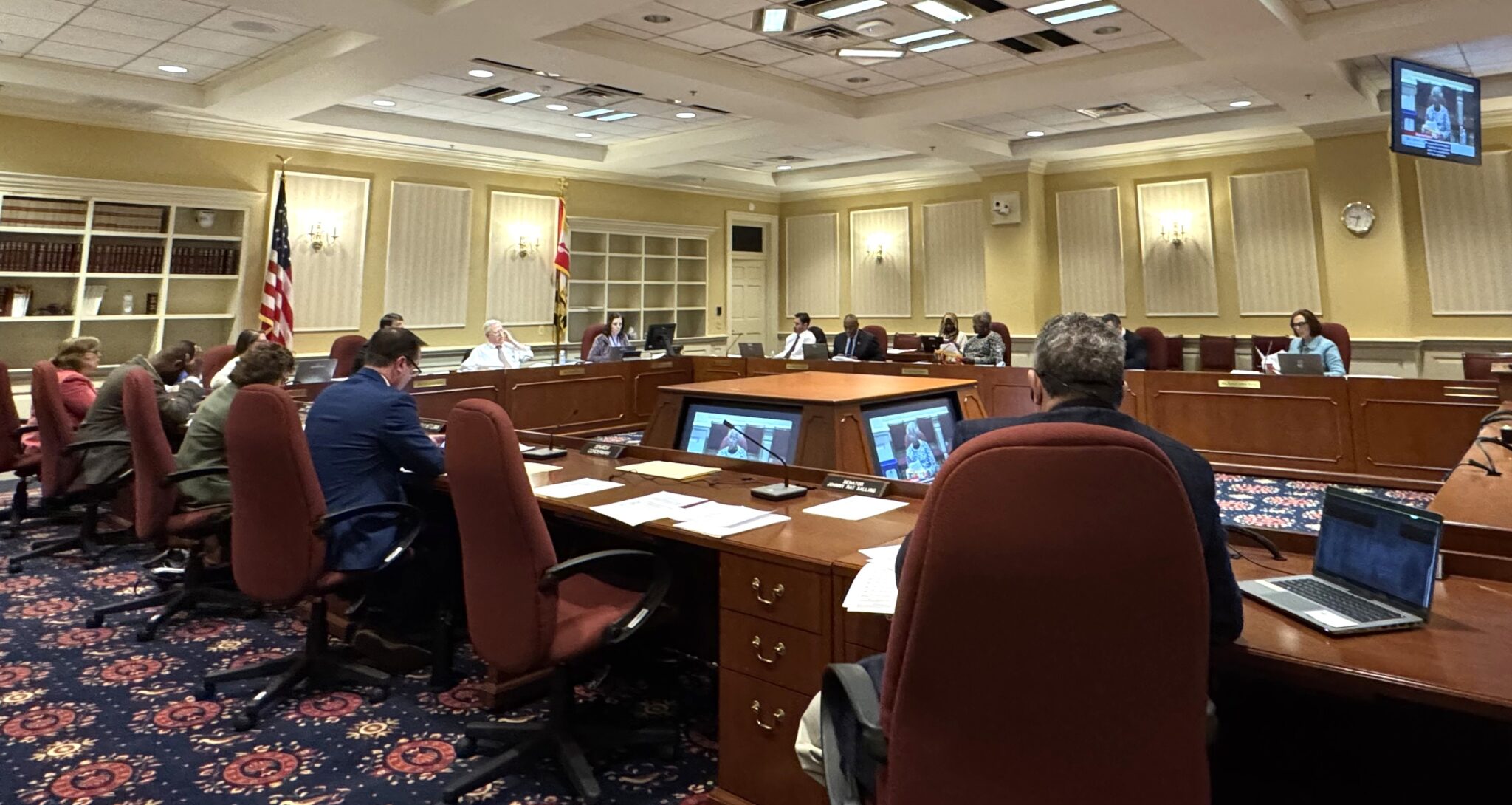
Senate Budget and Taxation Committee voted Friday for amendments to the Blueprint for Maryland’s Future that splits the difference between House and administration versions. (Photo by William J. Ford/Maryland Matters

A Senate committee advanced parts of Maryland’s sweeping education reform plan Friday, splitting the difference between versions of the bill advanced by the House and the Moore administration and setting up a showdown in the waning days of the legislature.

The Senate Budget and Taxation Committee approved a four-year pause in the start of funding for teacher “collaborative time” — something the administration supports — but also voted to keep funding for community schools — something the House insisted on.

Senate Bill 429 still needs to be taken up by a second Senate panel, the Education, Energy and the Environment Committee, which is scheduled for Monday. That gives lawmakers just two weeks to approve a Senate bill and hammer out differences with the House before the April 7 end of the General Assembly session.

The so-called “Excellence in Maryland Public Schools Act” was sparked by the state’s fiscal crisis and by the repeated call from local school officials for flexibility in the implementation of the Blueprint for Maryland’s Future, the sweeping 10-year, multibillion-dollar education reform plan.

Gov. Wes Moore introduced a bill that keeps the goals of the plan largely intact, but delays funding and implementation of some portions.

One portion is the proposal for an increase in teacher “collaborative time,” or time that teachers spend on planning, training and working with individual students, as opposed to time in front of a classroom. The Blueprint calls for teachers’ classroom time to be cut from 80% of their day to 60%; the administration bill would delay the start of that for four years, in part because it would require the hiring of at least 12,000 new teachers at a time when the state faces a teacher shortage.

The House rejected that plan, and set collaborative time to begin in 2026. But the Senate went with the governor’s version in what Budget and Taxation Committee Chair Guy Guzzone (D-Howard) called a “pacing” of the initiative.

“Whenever you don’t extend the full amount, if, in fact, you want to get to the full amount, by definition, it has to go out further,” Guzzone told reporters after the committee’s vote.

The committee did agree with the House version and rejected the administration’s call for a two-year freeze on funding for community schools, those located in low-income neighborhoods Sen. President Bill Ferguson (D-Baltimore City) has said such a delay would negatively affect students.

The Senate committee also agreed with the House to “hold harmless” funding for multilingual learners, students in poverty and those in special education — exempting those students from any per pupil funding reductions that might come down. The committee on Friday also added students at the Maryland School for the Blind, Maryland School for the Deaf and the SEED School of Maryland.

The committee was more generous than either the House or the administration when it comes to Consortium on Coordinated Community Supports, a part of the Blueprint plan that deals with mental health, behavioral and other wraparound services for students. The House agreed with the governor that it should be cut from $130 million this year to $40 million in fiscal 2026, but senators want to cut the fund to $70 million next year and raise it to $100 million in fiscal 2027 and each year after.

But senators sided with the administration on “foundation” funding, or per pupil spending. Under the Blueprint, it was slated to grow from $8,789 per pupil this year to $9,226 next year, but the administration proposed reducing the growth to $9,063 next year and slowing the pace of growth for several years after. The Senate committee agreed, but the House voted to keep the original Blueprint funding levels.

With an eye toward looming cuts to the federal government, another Senate amendment made Friday would freeze funding increases if federal funds or revenue projections by the state’s Board of Revenues in December decrease by 3.75%.

Senate Majority Leader Nancy King (D-Montgomery), a member of the Budget and Taxation Committee, earlier this week defended delays in Blueprint goals for the time being.

“There’s a lot of good that’s already come out of the Blueprint, and a lot more that is going to come as we go,” King said Tuesday. “I don’t think it would be a bad thing if we just slowed it [collaborative time] down a bit.”

The Senate Education, Energy and the Environment will review, and possibly vote on, the other parts of the bill Monday that deal with teacher programs, initiatives and other incentives before sending it to the full Senate for consideration and then back to the House.

Del. Vanessa Atterbeary (D-Howard), chair of the House Ways and Means Committee, said during a press conference Thursday to announce a framework for the overall fiscal 2026 budget, that negotiations on the Blueprint are ongoing. But Atterbeary said she and Del. Ben Barnes (D-Prince George’s and Anne Arundel), chair of the Appropriations Committee, have made their positions “pretty clear.”

“Where we stand and where the House stands in … protecting those that are most vulnerable, particularly those in community schools,” she said. “So we’ll see what the Senate does, and we’ll link up with them and negotiate that in the days to come.”

By William J. Ford
Creative Commons License

The Spy Newspapers may periodically employ the assistance of artificial intelligence (AI) to enhance the clarity and accuracy of our content.

Filed Under: Ed Homepage, Ed Portal Lead

Gunston celebrates Class of 2025 college-bound athletes 

January 24, 2025 by The Spy Leave a Comment

The Gunston School is pleased to announce that four members of the class of 2025 have signed their letters of intent to play sports at the college level. (l-r) Alex Bent of Queenstown will be rowing for La Salle University, Aidan Watson of Centreville will be playing lacrosse for SCAD, Riley Walker of Chestertown will be playing lacrosse for Lebanon Valley College, and Grace Shepherd of Church Hill will be playing field hockey for the University of Central Michigan.

The Gunston School is pleased to announce that four members of the class of 2025 have signed their letters of intent to play sports at the college level. At a recent signing ceremony this past Thursday, January 23, students and their families along with coaches and faculty gathered in the Alice R. Ryan Family Library to celebrate their accomplishments. Nationwide, a little over 7% of high school athletes (about 1 in 13) go on to play a varsity sport in college and less than 2% of high school athletes (1 in 57) go on to play at NCAA Division I schools.

Riley Walker of Chestertown, Md. will be playing lacrosse for Lebanon Valley College. While playing lacrosse for Gunston, the team earned back-to-back second place finishes in the ESIAC (Eastern Shore Independent Athletic Conference) Championships in 2023 and 2024. Coach Millicent Sheets spoke of Walker’s versatility on the field, “We asked a great deal of him—playing midfield, jumping in the goal on EMO [extra man offense], sometimes playing on the field for EMO and running plays on attack. He never balked at anything we asked him to do and he gives 100% all the time at any position.” Walker played in numerous leagues outside of Gunston and even helped to organize a winter indoor league for the school. “By the end of the season, we were depending on him more and more in the goal. Goalie is the hardest position to play and it is very difficult to just jump in the goal at any given moment. In that position, Riley was focused, commanded the defense, and came up with key saves for his team. He finished the season with almost 50 saves which is extremely impressive for only playing about a quarter every game.” Walker plans to study business at Lebanon Valley.

Aidan Watson of Centreville, Md. will be playing lacrosse for Savannah College of Art and Design. Picking up lacrosse in his sophomore year at Gunston, Watson proved to be a quick study. Coach Millicent Sheets recalls, “In ninth grade, Aidan was in my honors geometry class. He was smart, witty, and an impressive artist. Art I knew was in his future, but I did not expect him to turn out to be an aggressive, fierce, and strong long pole defender. Fall of his tenth grade year, Aidan told me he was going to come out for the team. I was thrilled and a little surprised. Aidan turned out to be a quick study of the game, he worked hard to learn how to sub through the box effectively, he learned both man and zone defense, and even played long pole middie on face offs. Playing alongside very seasoned defenders, Aidan had to learn to take direction from his peers and put up with some fierce competition. Over the two years I coached Aidan, he was committed to getting stronger and faster and it really showed by the end of his second season.” Watson will be studying art at SCAD.

Grace Shepherd of Church Hill, Md. will be playing field hockey for the University of Central Michigan. Shepherd played for Gunston all four years, earning ESIAC All-Conference honors in 2021, 2022, 2023, and 2024. She served as one of the captains this year and the team again made it to the ESIAC Championship, earning second place for the third year in a row. In addition to playing for Gunston, Shepherd also plays for Team Chesapeake Shore year-round and has earned multiple awards from the Field Hockey Coaches Association of Maryland (FHCAMD) including All Mid-Shore Team Field Hockey in 2022, 2023 and 2024, All Eastern Shore Team Field Hockey in 2022 and an All State Honorable Mention in 2023. Recently, Shepherd represented Gunston at the 2024-2025 Susan Pusey FHCAMD Senior All-Star Game this past fall. “From her first preseason practice, we could see that Grace was a special player,” said Coach Yvonne Gazelle. “She has had a remarkable career, scoring 29 goals and notching 16 assists. She’s been a dependable player, playing nearly every minute of every game throughout her four years. She’s been a leader, serving as Captain for the 2024 season. She served as an outstanding role model and example to her teammates, arriving early to every practice, being the first to pick up balls and cones after a drill, and the first to offer assistance to players in need.” Shepherd is currently undecided in her course of study at Central Michigan but is leaning toward studying biology.

Alex Bent of Queenstown, Md. will be rowing for La Salle University. Bent rowed for Gunston’s varsity team in 2022 and 2023 before joining the Annapolis Junior Rowing organization. He also competed in the Crash B indoor world championships in 2023, placing third in the Mens U17 2K row. He also was the first Gunston student to compete in the Mid Atlantic Youth Rowing Championships in 2023, placing seventh. Bent’s former rowing coach, Carter Law commented, “Alex has given his all, balancing academics, training, and some serious personal growth, all while demonstrating leadership and perseverance.” Bent has dreams of competing in the Olympics one day. At La Salle, he’ll be studying business administration.

Visit gunston.org for more information.

The Spy Newspapers may periodically employ the assistance of artificial intelligence (AI) to enhance the clarity and accuracy of our content.

Filed Under: Ed Homepage

Wood Foundation awards $100K grant to Radcliffe Creek School

January 24, 2025 by Spy Desk Leave a Comment

: RCS student, Hazel Joiner, learning to spell through hands-on, multisensory instruction

Radcliffe Creek School (RCS) was recently awarded a generous grant from the Kathy and Jerry Wood Foundation to support needs-based scholarships for deserving students. The $100k grant award will remove significant financial barriers for area families who struggle to access the school’s individualized educational services, ensuring area children—who have learning differences such as dyslexia, dysgraphia and ADHD—can receive the academic interventions they rely upon to be successful in the classroom.

Each year, more than half of Radcliffe Creek’s student body receives some form of financial aid to attend the School. This year alone, over $526,000 in assistance has been committed to help families in need whose children learn differently. Head of School, Peter Thayer, explained, “Many of our students haven’t succeeded in traditional learning environments and need the small class sizes, daily interventions and customized instruction we provide here at RCS every day. However, accessing our services can be an enormous challenge for area families, who never expected to send their children to a private school. The generosity of the Kathy and Jerry Wood Foundation to provide this substantial support for scholarships will be a life-changing gift for many families. We are profoundly grateful to the Wood Foundation for making a Radcliffe education possible for these children.”

The Kathy and Jerry Wood Foundation, established in 2006, supports youth in attending nonprofit and educational institutions that aid in the intellectual, physical and moral development of American students. Through scholarship support, the foundation works to advance learning throughout the United States.

The foundation, based in Annapolis, Maryland, was also the area Kathy and Jerry Wood called “home.” Before their deaths, Jerry founded the Annapolis Sailing School and together, the couple transformed the school into the largest commercial sailing school in the United States. Later, the Woods established the sailboat show and the powerboat show, revolutionizing the boat show industry. For this work, the couple was credited with helping to shape the modern recreational boating industry and build broad recognition for the City of Annapolis as the “Sailing Capital of America.”

As the only K-8 school on Maryland’s Eastern Shore specialized in educating children with learning differences, Radcliffe Creek School (RCS) continues to stand out as a critical resource for area families. RCS students hail from eight counties, from Prince George’s County in Maryland to Sussex County in Delaware. To learn more about the immersive, individualized education program offered at Radcliffe Creek School, visit www.radcliffecreekschool.org or call 410-778-8150.


The Spy Newspapers may periodically employ the assistance of artificial intelligence (AI) to enhance the clarity and accuracy of our content.

Filed Under: Ed Homepage

Morgan State professor fined for presenting himself as licensed architect

December 18, 2024 by Spy Desk Leave a Comment


The Baltimore Banner reported yesterday that Professor Dale Glenwood Green at Morgan State University was not a licensed architect and had forged his credentials. Green is well known for his work on the historic Hill neighborhood in Easton.


Read the full story here.

The Spy Newspapers may periodically employ the assistance of artificial intelligence (AI) to enhance the clarity and accuracy of our content.

Filed Under: Ed Homepage

Slight increases on Maryland’s annual report card, but changes could be coming

December 6, 2024 by Maryland Matters Leave a Comment

Baltimore City pre-K instructor Berol Dewdney, the 2022-2023 Maryland teacher of the year, uses an interactive video with her students at the beginning of the school day. File photo by Shannon Clark/Capital News Service.

Maryland’s 1,303 public schools saw slight gains on the state Department of Education’s annual report card, which rates schools on measures including academic achievement, school quality and progress in English language proficiency.

The report card, released this week, grades schools on a scale of one to five stars, with five stars going to schools that earn a score of at least 75% on a formula that measures overall school performance. The report said 91 schools earned five-star status in the 2023-24 school year, up from 85 schools the year before.

About 41% of schools received a four- or five-star rating last year, compared with 38% in the 2022-23 school year.

Twenty Baltimore County schools earned five stars on this year’s report card, the most of any county. The county’s Eastern Technical High School received the most points in the state with 91, edging out the Academy of Health and Sciences at Prince George’s Community College and its 90.7 points.

Baltimore County Schools Superintendent Myriam Rogers said the county’s broad gains are “are evidence of the effectiveness of the targeted and comprehensive resources and supports we put in place to fast-forward student achievement.”

“We are encouraged by the growth our schools are making on key markers of progress and achievement,” Rogers wrote in a message to the school community. “We will continue to use multiple and frequent measures to evaluate student progress and assess where we need to intensify efforts to meet the needs of our students and bolster achievement.”

Montgomery County, the state’s largest school system, had the second-most five-star schools at 18, and about half of its schools scored either four or five stars. But the school system called the overall performance “disappointingly flat” in a statement, with schools receiving at least three stars increasing by less than 1%.

Approximately nine of Worcester County’s 11 schools received a four-star rating, in which schools scored at least 60 out of 100 points on the grading formula. Ocean City Elementary received five stars and Pocomoke Middle three stars.

“I continue to be in awe of our schools’ positive trajectory in Maryland’s accountability system,” Worcester County Superintendent Louis H. Taylor said in a statement. “Worcester continues to outperform our counterparts across the State, and today’s [Dec. 3] release is just another example of how we are delivering dividends on the investment our community has made in our educational system.”

The state began the star system in 2018 in response to the federal Every Student Succeeds Act. The state released a second report card in 2019, but the reports were suspended in the 2019-20 and 2020-21 school years due to the COVID-19 pandemic.

Although 83% of schools recorded at least three stars in the latest report card, compared with 80% in the previous report card, there could be changes to assess overall performance.

Superintendent Carey Wright announced in April the creation of a task force to assess student achievement after disappointing scores on the Maryland Comprehensive Assessment Program, the state’s standardized tests known as MCAP. At the time of her announcement, only 47% of students in third through eighth grades scored “proficient” in English language arts and nearly 25% in math.

A graphic shows a slight increase in Maryland schools that received a five-star rating, the highest rating available, from 85 schools in the 2022-23 school year to 91 in 2023-24. Graphic courtesy of the Maryland State Department of Education.

With the current MCAP contract set to expire in December 2026, Wright said at Tuesday’s State Board of Education meeting that it’s time to either search for a new assessment vendor, or retain the same vendor “with new requirements.”

“There were a lot of questions that were being raised about the assessment itself,” Wright said. “I’m a firm believer in accountability, always have been. This task force moved with a great deal of speed to get this done.”

The task force presented a report Tuesday with options that include revising the current ratings system, creating a system that meets federal requirements and reflects state priorities, and refining the framework on career and college readiness, which is one of the priorities in the Blueprint for Maryland’s Future education reform plan.

“We reject the theory of action that simply reporting information and hoping that people make good decisions is complete,” said Chris Domaleski, the task force facilitator and associate director of the National Center for the Improvement of Educational Assessment based in New Hampshire. “We think a more appropriate theory of action is that these systems integrate with the kinds of treatments that change curriculum, instruction and support that really uplift students in the state.”

The board voted to accept the report and continue to review it and assess any possible future changes.


by William J. Ford, Maryland Matters
December 5, 2024

Maryland Matters is part of States Newsroom, a nonprofit news network supported by grants and a coalition of donors as a 501c(3) public charity. Maryland Matters maintains editorial independence. Contact Editor Steve Crane for questions: [email protected]. Follow Maryland Matters on Facebook and X.

The Spy Newspapers may periodically employ the assistance of artificial intelligence (AI) to enhance the clarity and accuracy of our content.

Filed Under: Ed Homepage

Radcliffe Creek School awarded grant to support students with ADHD and anxiety

November 20, 2024 by Spy Desk Leave a Comment

RCS students Addison and Emma using Sensory Resource items during instruction time with Mrs. Simon, English and Orton-Gillingham Teacher at Radcliffe Creek School.

Radcliffe Creek School (RCS) was recently awarded a grant from the Queen Anne’s County Mental Health Committee (QACMHC) to provide the School’s faculty and parent community with resources to support students with Attention-Deficit/Hyperactivity Disorder (ADHD) and anxiety in the classroom and at home. This grant will fund a new Sensory Resource Room at RCS, expand the School’s Social-Emotional Learning (SEL) Library, continue the SEL program for older students, as well as support a full day of training with parents and teachers on ways to support mental health in neurodivergent children.

The new Sensory Resource Room at RCS will be filled with tools and equipment for teachers to check out for their classrooms as needed, helping students calm and regulate their sensory systems. When a child is in a heightened state due to an issue like anxiety, it can interfere with a student’s ability to be present in the classroom setting. Depending upon whether a child’s body is overly sensitive to sensory stimuli or seeking more sensory input, this equipment will help students regulate their bodies to be more available for learning. Debbie Cohee-Wright, a special education learning specialist at RCS, explained, “At Radcliffe Creek School, we recognize the needs of our students and how sensory integration will enhance their learning experience based off their own individual needs and strengths. The new Sensory Resource Room will enable our teachers to have the appropriate tools at their fingertips for ease and accessibility throughout their day.”

Equipment in the Sensory Resource Room will include noise-canceling headphones, weighted lap and shoulder pads, indoor hanging sensory chairs, bean bags, chair bands, fidgets, white noise machines and sound-absorbing wall panels. The integration of these resources will support students by addressing their fine motor skills, gross motor skills, social skills, cognition and play skills.

Additionally, this grant will allow the expansion of the School’s SEL library and continued SEL curriculum for older students, as well as a speaking event to be hosted for RCS parents and teachers in early 2025 with Dr. Vincent Culotta, an expert in mental health and neurodivergent children. Head of School Peter Thayer explained, “We remain grateful to QACMHC for their continued support of our school and for making these important educational and therapeutic mental health resources available to our parents, faculty and students.”

This is the second year in a row that QACMHC has awarded a grant to Radcliffe Creek School. “The Queen Anne’s County Mental Health Committee is excited to see Radcliffe Creek School utilizing the grant funds from us to reach the goal of maintaining their social-emotional learning program “Brain Talk” as well as faculty training, supplying the sensory room, and adding to their social-emotional learning library,” stated QACMHC President, Kelly Phipps. “The scheduled visit of Dr. Vincent Culotta to train faculty in helping students with ADHD and anxiety in the classroom will further enrich Radcliffe Creek’s program. The committee is proud to be a part of the school’s dedication in educating their students on achieving and maintaining sound, positive mental health.”

To learn more about the immersive, individualized education program offered at Radcliffe Creek School, as well as the school’s robust transportation program, visit www.radcliffecreekschool.org online or call 410-778-8150.


The Spy Newspapers may periodically employ the assistance of artificial intelligence (AI) to enhance the clarity and accuracy of our content.

Filed Under: 7 Ed Notes, Archives, Ed Homepage

Prekindergarten Expansion For Private Providers Off To A Slow Start

September 25, 2024 by Maryland Matters Leave a Comment

Shayna Cook, left, assistant state superintendent in the state Department of Education’s Division of Early Childhood, gives a presentation on prekindergarten expansion. Sitting next to Cook is Tara Phillips, executive director of operations, policy and strategy in the early childhood division. Photo by William J. Ford

One of the requirements for the Blueprint for Maryland’s Future 10-year education reform plan was to expand prekindergarten, but it’s off to a slow start.

None of the state’s 24 school districts came anywhere close in the past two school years to the Blueprint’s requirement that at least 30% of pre-K students should be in privately run facilities, according to data presented Tuesday to the state Board of Education.

Because no one reached the mark, it was lowered to 10% for this school year, a level that only four counties were able to achieve last year.

The Blueprint plan requires school districts to provide a mixed-delivery system, serving young students in both public and private child care centers. But local school districts said in Blueprint plans that some private providers find it challenging to participate in the state’s prekindergarten expansion due to lack of space, finding qualified personnel and other challenges.

However, state Department of Education officials said Tuesday that the state is actually moving faster on pre-K when compared to other states.

One benchmark is allowing families earning incomes at or below the 300% federal poverty level, said Shayna Cook, assistant state superintendent in the department’s Division of Early Childhood. Cook said other states chose 100% or 200% of the federal poverty level.

And the 31,873 students enrolled in pre-K in the 2022-23 school year — 30,718 public and 1,155 private — grew to nearly 33,000 in the 2023-24 school year, with 31,381 in public and in 1,601 private facilities.

“This growth demonstrates the state’s commitment to expanding access to quality pre-K education and reflects efforts to begin to lay the foundation for the mixed delivery system,” Cook said.

Even with that increase of slightly more than 1,100 more seats added, nine of the state’s 24 jurisdictions had zero private providers to begin the 2022-23 school year.

A Maryland State Department of Education graphic to show number of prekindergarten students enrolled in 2023-24 school year that includes percentage of private providers in the state’s 24 jurisdictions. Screenshot.

Only Howard and Worcester counties were able to record double-digit percentage of private providers that year, with 14% and 13%, respectively. Howard County’s share was unchanged last year, but Worcester County’s percentage of private providers rose to 18% last year.

After being in single digits in the 2022-23 school year, Carroll and Wicomico counties exceeded double figures last school year at 12% and 11%, respectively.

Five counties still had no private providers last school year: Garrett, Kent, St. Mary’s, Somerset and Talbot counties.

Cook said there remains a lack of communication between private providers and local school districts.

One plan is for the department to promote its “Push to Pre-K Initiative,” which provides technical assistance on the prekindergarten expansion program. In addition, providers can also receive grants to help expand their business.

State Superintendent Carey Wright said during a briefing with reporters Tuesday that it’s difficult to “get a business off the ground,” especially in rural counties.

“Reach out to us. We’re here to help,” she said to private pre-K providers. “We can help you as much as we possibly can to get your feet on the ground. That’s the resource that we bring, so use us.”

More time needed

The board deferred action Tuesday on a controversial literacy policy that could result in third-graders being held back if they do not meet reading standards.

One reason for the delay was the presence of three new board members participating in their first meeting – Kenny Clash, Kimberly Lewis and Xiomara V. Medina. A decision on the policy will how be pushed back for at least another month.

“We decided that it was better for us to take more time to consider this policy, to give our new members an opportunity to get up to speed [and] take into account the best feedback we’ve received from stakeholders that’s guiding our additional development,” said board President Joshua Michael.

Xiomara V. Medina listens to opening remarks from Board President Joshua Michael at her first board meeting Sept. 24. Photo by William J. Ford.

The board last month considered a revision to the policy that would let parents and guardians allow their children to advance to the fourth grade, but they would have to agree that their children enroll and participate in a supplemental reading support program.

But reading intervention and other literacy programs would start in kindergarten for students who need additional support.

A few minor changes that could be made include an emphasis on local school district control with guidance from the department and to ensure support for all students in kindergarten through third grade.

“What was initially in the media as a retention policy is not a retention policy. It is really a parent-choice policy,” Wright said Tuesday. “It is not a finger-pointing exercise. It’s the ability for us to see what schools need the most help.”

Medina, an associate director of clinical training and field placement at Bowie State University’s Department of Counseling and Psychological Studies, said she would like the policy to reflect more cultural awareness.

“This whole thing has reduced our children to numbers. There’s not a single cultural consideration you’ve told me,” she said after state officials completed a brief summary of the policy. “I’m missing people in all of this.”

If approved, the policy wouldn’t be implemented until next school year. However, the retention portions wouldn’t begin until the 2026-27 school year.

Nikki Woodward, vice president of the Maryland State Education Association, said the union recommends delaying implementation of the entire policy until the start of the 2028-29 school year.

“This timeline allows for adequate training of educators and families on new curriculum and requirements,” she said to the board. “It also ensures enough time for data collection and tracking the success of interventions.”


by William J. Ford, Maryland Matters
September 25, 2024

Maryland Matters is part of States Newsroom, a nonprofit news network supported by grants and a coalition of donors as a 501c(3) public charity. Maryland Matters maintains editorial independence. Contact Editor Steve Crane for questions: [email protected]. Follow Maryland Matters on Facebook and X.

The Spy Newspapers may periodically employ the assistance of artificial intelligence (AI) to enhance the clarity and accuracy of our content.

Filed Under: 7 Ed Notes, Ed Homepage, Education

  • 1
  • 2
  • 3
  • …
  • 6
  • Next Page »

Copyright © 2025

Affiliated News

  • Chestertown Spy
  • Talbot Spy
  • Cambridge Spy

Sections

  • Sample Page

Spy Community Media

  • Sample Page
  • Subscribe
  • Sample Page

Copyright © 2025 · Spy Community Media Child Theme on Genesis Framework · WordPress · Log in