
MENU

Sections

  • Home
  • Education
  • Donate to the Centreville Spy
  • Free Subscription
  • Spy Community Media
    • Chestertown Spy
    • Talbot Spy
    • Cambridge Spy

More

  • Support the Spy
  • About Spy Community Media
  • Advertising with the Spy
  • Subscribe
February 8, 2026

Centreville Spy

Nonpartisan and Education-based News for Centreville

  • Home
  • Education
  • Donate to the Centreville Spy
  • Free Subscription
  • Spy Community Media
    • Chestertown Spy
    • Talbot Spy
    • Cambridge Spy
3 Top Story Point of View Angela

Science on the Shore: Evaluating oyster substrates by Angela Rieck

January 23, 2025 by Angela Rieck Leave a Comment

We need oysters in our Bay and rivers. We don’t have enough. But one of the major impediments to restoring oysters is the availability of substrates. Substrates are what oyster larvae latch onto while they are mobile (e.g., other oyster shells, piers).

Oysters begin their lives as free-swimming larvae. Oyster parents release eggs and sperm into the water, and once the eggs are fertilized they become larvae. The larvae are mobile for two to three weeks before they attach onto a substrate (this attachment is called settlement), become immobile, and metamorphose into juvenile oysters which are referred to as spat.

If the larvae are unable to attach to a substrate they will not survive. So, finding the right substrate and enough of it is crucial to the success of oysters in the Chesapeake Bay and its rivers. 

Oysters are essential to the health of the Bay because they can filter up to 50 gallons of water daily, cleaning the water and increasing the oxygen levels. Oysters clean the water by consuming micro algae and suspended particles, and they can also mediate nitrogen and carbon by removing and depositing any excess nutrients. Oyster reefs also serve as homes to fish and other filter feeders like mussels and barnacles. 

Oyster larvae need a hard surface (e.g., shells and stones) to latch onto so that they can grow. In the wild, oyster larvae naturally attach to other oyster shells, which is why oyster shells are a preferred substrate. However, the availability of shells is limited and adding it is expensive due to decades of harvesting without shell replacement. There are attempts to recycle as many shells as possible, for example, the Oyster Recovery Partnership has a collection program for oyster shells. 

Another way to get oyster shells is to dredge old oyster reefs buried in the silt. There are also fossilized shells that are available from the West Coast where there are literally mountains of shells that were discarded by shucking houses. 

The demand for substrates will only increase as fisheries and aquaculture grow. Commercial fishermen, aquaculture lease holders, and oyster restoration partners are also interested in using alternative substrates, both to put out directly on the Bay bottom to catch wild larvae or to use in an oyster hatchery that produce “spat on shell” (which is larvae that are attached to oyster shells.) 

Shells are limited and expensive, so more substrate is needed to expand the oyster industry. So, scientists have been evaluating alternatives to oyster shells for use in Maryland

Scientists must find other substrates that are as effective as shells that don’t leach dangerous chemicals into the water. 

Potential substrates that have been used for oysters in this region and in other states can be grouped into three categories:

  • Biogenic: oyster shell (fossilized, fresh, dredged), other species’ shells (whelk, clamshell)
  • Geologic: granite, stone (river rock), amphibolite (used for paving or crushed stones), limestone marl
  • Anthropogenic (human produced): concrete and recycled concrete.

In Havre de Grace, amphibolite rock is quarried, and restoration efforts have used the rock to build oyster reefs in sanctuaries (e.g., Harris Creek).

Other states also use alternative materials for oyster substrate. In Texas, limestone marl, river rock, and crushed concrete are common. North Carolina uses limestone marl, a state resource. Virginia uses granite chips in addition to fresh and dredged Eastern oyster shell. Often larger stones are used in sanctuaries and restoration sites, but smaller is better for harvest sites.

Engineered reefs are structures formed from molded concrete, such as reef balls, reef castles, or fish havens. These structures can be placed on the bottom of the river or bay to allow spat to settle naturally or can be placed in tanks at hatcheries to be settled with hatchery-reared oyster larvae. The composition of the concrete can be tailored to improve settlement (larvae attaching to the substrate) by adding calcium or pieces of shell to the mix. The majority of engineered reefs placed in our Bay are in oyster sanctuaries or on MARI (Maryland Artificial Reef Initiative) sites. The use of engineered reefs is not effective for harvesting because oysters can only be harvested by divers.  

Large scale construction demolition projects can provide appropriate concrete materials. Crushed, recycled concrete is recovered from demolition sites and its toxic elements (e.g., rebar) removed.

The need for substrates is getting more attention. The DNR (Department of Natural Resources) submitted a permit to USACE (US Army Core of Engineers) and MDE (Maryland Department of the Environment) to plant hatchery reared spat on substrate other than shell. 

Recently, the public fishery has expressed interest in utilizing alternative substrates on its bars. A permit was obtained from MDE and USACE to plant alternative substrates on a public fishery bar in Pocomoke Sound (Somerset County) and another site in Broad Creek (Talbot County). The Broad Creek site was just approved in late 2023 and will soon begin planting crushed, recycled concrete.

In July 2023, Governor Moore created a Shell and Substrate Task Force. The principal functions of the task force were to: 

  • Identify strategies and solutions to retain shell, increase its abundance and use more substrate across the Chesapeake Bay.
  • Evaluate strategies to meet the demand from public fishery, aquaculture, and restoration.
  • Evaluate the economic impacts of substrate and develop recommendations.
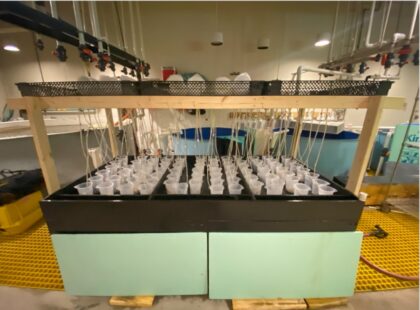
But it is important to know which substrates perform most effectively. Drs. Elizabeth North, Matt Gray, and Monica Fabra at University of Maryland Center for Environmental Science Horn Point Laboratory (HPL) are evaluating the efficacy of 9 different substrates. They are scientists with expertise in marine biology and experience with research on oysters. 

The HPL team is evaluating the effectiveness of different substrates on (a) settlement (larvae latching onto the substrate and growing), (b) toxic leaching (verifying that there are no toxic chemicals leaching from the substrate), and (c) biofilm formation (determining the microorganisms that grow on the substrate that are important for larval settlement). It is part of a grant from the state of MD and is legislatively mandated by the 2023 senate bill SB830.

The 9 substrates are: (1) dredged Eastern oyster shells, (2) weathered Pacific oyster shells, (3) clam shell pieces, (4) whelk shells,(5) recycled concrete, (6) limestone marl, (7) granite, (8) river rocks, and (9) amphibolite. Fresh Eastern oyster shell (our Maryland oyster) was also used in the study.

To conduct the laboratory study, Dr. Fabra released oyster larvae into beakers and waited six weeks to count the number of spat that had latched onto each substrate. While results are preliminary and are from the laboratory only, the team found that spat successfully settled and grew on all of tested substrates. 

Preliminary results suggest that, overall, shells did better slightly than rocks. By a small margin, the highest spats per beaker were dredged Eastern oyster shell and weathered Pacific oyster shell. Fresh Eastern oyster shell, whelk shell, concrete, and amphibolite also performed well.

She and her team are also evaluating these substrates to verify that they do not leach heavy metals. Another evaluation will be related to the formation of biofilms that are important for larval settlement on substrate. 

In the late spring of 2025, the HPL team will test these substrates in our rivers using cages and trays at wild sites.

In evaluating the overall value of a substrate, it is important to consider the cost, weight, size, transportation costs, ease of handling as well as settlement and toxicity. Fresh oyster shells are expensive and the ability to find substrates that are local and cost-effective can be a leap for commercial fisheries, aquaculture and oyster restoration. 

This is an exciting study, done right in our backyard, with benefits that will last for generations.

Dr. North will be discussing the HPL team’s research on Tuesday, March 4 at 5:30 at the Talbot Community Center. Check the Horn Point Laboratory website, www.umces.edu/hpl or their social media for more information about registration.


Angela Rieck, a Caroline County native, received her PhD in Mathematical Psychology from the University of Maryland and worked as a scientist at Bell Labs, and other high-tech companies in New Jersey before retiring as a corporate executive. Angela and her dogs divide their time between St Michaels and Key West Florida. Her daughter lives and works in New York City.

The Spy Newspapers may periodically employ the assistance of artificial intelligence (AI) to enhance the clarity and accuracy of our content.

Filed Under: 3 Top Story, Angela

The polar vortex by Angela Rieck

January 9, 2025 by Angela Rieck Leave a Comment

The recent snowstorm on the Eastern Shore is just the beginning of freezing temperatures due to the polar vortex. These temperatures from the Arctic are forecast to hit a large portion of the United States. The Arctic blast is being driven by large-scale pressure changes and an expansion of the polar vortex. 

Temperatures could be 30 degrees Fahrenheit below average temperatures as far south as Florida. In Key West, we need to look out for falling iguanas, not a weather condition that is experienced in most of America. Iguanas go into a temporary state of paralysis when they get cold, and they can’t hold onto tree branches. That thud we hear is another loathsome creature hitting the pavement (but unfortunately surviving).

While it’s too early for precise temperature forecasts, the weather websites warned that this could be the coldest January in more than a decade. The expansion of the polar vortex is expected to last at least until the middle of January and possibly for the entire month.

What is the polar vortex? While it is an ominous sounding phenomenon, in fact it is a large area of low pressure and cold air surrounding both of the North and South poles. The vortex strengthens in winter, which is why we are typically not impacted by it in the summer. The term “vortex” refers to the counterclockwise flow of air at wind speeds of 155 mph that helps keep the colder air near the Poles. It is not uncommon for the polar vortex to expand in winter, sending cold air southward with the jet stream. Major polar vortex disruptions occurred in 2014, 1977, 1982, 1985 and 1989. The most recent polar vortex event in 2019 sent a massive cold front across the Midwest.

Polar vortexes are not new, it is just the term that has been popularized. Weather forecasters study the polar vortex by looking at conditions tens of thousands of feet up in the atmosphere. And cold air due to a polar vortex is not confined to the United States, portions of Europe and Asia experience similar cold surges. 

Polar vortexes occasionally reverse, but not this year. 

So bundle up, this will be with us for a while. Enjoy the snow, while I step over gross, paralyzed iguanas on my deck.


Angela Rieck, a Caroline County native, received her PhD in Mathematical Psychology from the University of Maryland and worked as a scientist at Bell Labs, and other high-tech companies in New Jersey before retiring as a corporate executive. Angela and her dogs divide their time between St Michaels and Key West Florida. Her daughter lives and works in New York City.

The Spy Newspapers may periodically employ the assistance of artificial intelligence (AI) to enhance the clarity and accuracy of our content.

Filed Under: 3 Top Story, Angela

New Year’s Resolution 2025 Edition by Angela Rieck

December 26, 2024 by Angela Rieck Leave a Comment

Well, it is time for New Year’s resolutions. While I am not particularly good at keeping them, I am skilled at making them.

I am not alone in my lack of commitment. Eighty to ninety-one percent of New Year’s resolutions don’t last more than six months. Twenty-three percent of those who make New Year’s resolutions quit them by the end of the first week and 43% quit by the end of January.

So, I count myself in the majority.

This year I made my usual resolution to lose weight. I am consistent about making this resolution…and some year I hope to keep it. Twenty percent of New Year’s resolutions are to lose weight. It is no surprise that commercials about weight loss programs are ubiquitous. But this year I notice a change. Most of the commercials are about GLP prescription solutions. Even traditional diet or behavior-based programs are offering this option. Let’s face it, most diets and willpower solutions don’t work.

My second resolution is to become more technologically savvy. My phone is my lifeblood and my nemesis. There is an app for everything, and I am expected to use all of them. My phone contains apps for my bed, my oven, my vacuums, my heating and cooling systems, my Wi-Fi’s, my refrigerator, transit trains, flights, hotels, UBER, LYFT, money, banking, email, calendar, music, calculator, flashlight, credit cards, Starbucks, Walmart, eBay, weight loss, Target, Instacart, grocery stores, messenger services, games, social websites, Internet phone, Internet services, texting, cable, television, streaming services…and more. I cringe every time I hear the phrase, “you need you to download our app.” But this is the world that we live in and ignoring it will not make it go away, no matter how hard I try. So, I am resolved to use my phone instead of my computer and to purchase most tickets on the phone. I suspect that this will be my hardest New Years’ resolution, even harder than my weight loss resolution.

And finally, I am resolving to be more active on social media. I am an intensely private person and have no social Internet presence. But I need to add social media apps so that I can enjoy the postings of others.

I know that I will not be successful unless I develop a plan. I need to set milestones and ways to measure incremental success. Experts say not to rely on will power. But let’s face it, if New Year’s resolutions did not require will power, we wouldn’t need to set them. 

Another way to be successful is to set a routine or schedule. For example, one of my plans is to access social apps for an hour three times a week. 

Another tactic to increase chance of success is to use groups. Classes also offer both expertise and group support. 

Of course, resolutions are a marathon and not a sprint; and because of that, I have to be willing to accept setbacks. I can accept the slip, but not to use it as permission to quit. 

And finally, there is SHAME. 

Which is why I put my resolutions in a column every year to hold myself accountable. Clearly, a desperate attempt.


Angela Rieck, a Caroline County native, received her PhD in Mathematical Psychology from the University of Maryland and worked as a scientist at Bell Labs, and other high-tech companies in New Jersey before retiring as a corporate executive. Angela and her dogs divide their time between St Michaels and Key West Florida. Her daughter lives and works in New York City.

The Spy Newspapers may periodically employ the assistance of artificial intelligence (AI) to enhance the clarity and accuracy of our content.

Filed Under: 3 Top Story, Angela

Living in Paradise by Angela Rieck

December 19, 2024 by Angela Rieck Leave a Comment

I have retreated to the warm sunshine of Key West. I know that the weather has been unpleasant at times up North, with cold temperatures and torrential rain. I am fortunate enough to live in Key West, where this time of year chilly days are in the high sixties; and most days are in the 70s. In Key West, the palm trees sway to the tune of the trade winds that gently surround the island. 

To many, Key West is paradise. I found 283 novels that were set in Key West on Amazon, and 516 nonfiction books about it. There are duplicates in this list, but it shows you how intriguing Key West can be. Writers have tried different devices to capture Key West. One used street names, another treated Key West as his companion; still another tried to use a traditional history. Each time they fell short. 

Key West is known for its sunsets. Mallory Square takes on a carnival atmosphere at sunset. But I prefer its sunrises. The contrasting colors of the aqua, turquoise and jadeite ocean against the changing colors in the sky of warm pink, yellow, and pale blue are portraits in pastels. At sunrise, pelicans occupy the piers and sea gulls commence flight. Great blue herons perch motionless on the shoreline and the ibis stalk insects in the grass. On the pier, the observers are silent, appreciating the artistry that nature has created. 

What makes Key West a place that people consider paradise? It can be many things:

  • The acceptance and quirkiness. There is no dress code.
  • Living outdoors. Eight months out of the year the weather is wonderful; the other four months it is tolerable only to locals (called Conchs).
  • Its raw beauty…The colors of the ocean and sky, sunrises, and sunsets have inspired many artists.
  • The lifestyle…two wheels (or some similar representation of them) are the best way to get around the island.
  • The sounds…the rustling of palm trees, roosters crowing; and at night, the bands and drunk patrons weaving through Duval Street.
  • The tastes…thanks to the tourists and guests, its restaurants rival any large city in their diversity and quality.
  • The animals…cats and chickens live on the streets in harmony, dogs have their own beach, gawky pelicans glide gracefully over the ocean, the ibis wanders through lawns, the eerie anhingas stretch out their wings to dry. 
  • The architecture… There are a few graceful Victorian and Queen Anne homes, but many homes are eyebrow or simple Conch houses, structures that can easily be rebuilt after the hurricane sweeps them away.
  • There is always something to do.

Key West has no clock; it recycles and reinvents itself. Boom and bust cycles, hurricanes, winds, fires & floods, full and part-time inhabitants, drugs, fishing. Somehow you get the impression that despite climate change, hurricanes, scoundrels, tourists, and politics, Key West will endure. 

But as magical as Key West can be, it is not paradise. 

The dictionary defines paradise as an ideal or idyllic place or state. To me, paradise is a what not a where. Paradise is a moment when I experience pure joy. 

Paradise is that moment that you snuggle with your child, the time you realize that you have met someone who completely understands you, and the holiday parties where you connect with close friends and family. So, while I am soaking up the warmth in Key West, those in the chilly weather have equal opportunity to experience paradise.

I wish that the holidays bring you paradise in the touch of a loved one, the beautiful holiday displays, the festive shops, and restaurants. And most of all, I hope that you can recognize your paradise when it appears. 

I want to thank all of my readers, knowing that you are reading my columns and getting feedback is my paradise. I wish for paradise-filled holidays to all.


Angela Rieck, a Caroline County native, received her PhD in Mathematical Psychology from the University of Maryland and worked as a scientist at Bell Labs, and other high-tech companies in New Jersey before retiring as a corporate executive. Angela and her dogs divide their time between St Michaels and Key West Florida. Her daughter lives and works in New York City.

The Spy Newspapers may periodically employ the assistance of artificial intelligence (AI) to enhance the clarity and accuracy of our content.

Filed Under: 3 Top Story, Angela

Soup’s on by Angela Rieck

December 12, 2024 by Angela Rieck Leave a Comment

It is hard to be positive about the cold weather that is gripping a large part of the nation. It is unpleasant at best and dangerous at worst. It even affects us in Florida, although there are few sympathizers in the northeast. Key West is not built for cold temperatures. Most of our transportation is on bicycles and some of our homes don’t have heat. Of course, the cold is felt most acutely in the north. 

But I can think of one benefit of this cold weather. Soups and stews become a welcome addition to the home. My mother prepared many soups and stews. I remember the aroma of vegetable, chicken soups, and beef stews wafting through our home. Our home was filled with the scent of these wonderful meals. And since the soups and stews take a while to cook, the whole day promised a warm and comfortable meal.

Like my siblings, I have taken on the tradition of making soups and stews. In many cases following my mother’s recipes, in others adding my own twist.  

Not only do soups and stews evoke fond memories, but they are also very healthy. They contain vitamins and minerals, which are important for fighting diseases and viruses. Soups are an easy way to meet the daily vegetable quota and cooking vegetables in soups, stews, or curries helps them retain many of their vitamins. 

Soups have the advantage of being low in calories and are a healthy option for those of us who are watching our weight. 

Soups are satisfying and good for weight conscious people because they are mostly water, but we perceive them as food. It was found that eating the same number of calories in soup as in pretzels increased weight loss by fifty percent.

Let’s face it, soups and stews are the ultimate comfort food. 

Lentil soup is regarded as the healthiest soup, but all vegetable soups are healthy. The only soups that do not fit in this category are cream based soups, such as New England clam chowder and Vichyssoise (sorry).

Not only western culture prizes these foods. Chinese medicine utilizes soups and cooked vegetables for healing.

So, soups and stews are the silver lining to this miserable weather. A warm memory and savory, healthy food. Time to get out the crock pot.


Angela Rieck, a Caroline County native, received her PhD in Mathematical Psychology from the University of Maryland and worked as a scientist at Bell Labs, and other high-tech companies in New Jersey before retiring as a corporate executive. Angela and her dogs divide their time between St Michaels and Key West Florida. Her daughter lives and works in New York City.

The Spy Newspapers may periodically employ the assistance of artificial intelligence (AI) to enhance the clarity and accuracy of our content.

Filed Under: 3 Top Story, Angela

The tyranny of dinner by Angela Rieck

November 28, 2024 by Angela Rieck Leave a Comment

Years ago, I was congratulating a mother whose youngest child had graduated from high school with honors. She was gracious, and said that she was looking forward to the end of the “tyranny of dinner.” 

I love that phrase.

But we have learned that the tyranny of dinner didn’t necessarily end when the children leave. Many of my friends report that they still feel, the old “what’s for dinner” approaching around 2 p.m. Fortunately, we are blessed with a number of different restaurants and fast-food chains that can satisfy those who do not want to prepare dinner…but it remains the same…what to do about dinner?

One would think that being retired means that it is easier, but unless there is someone in the family that has taken on cooking as their retirement challenge, the “what’s for dinner” challenge still looms. 

One of the few advantages to being single is that I do not have to worry about what is for dinner. I eat when I want to, and I have found that I tend to eat my large meal at lunchtime. 

Research has shown that it is healthier to eat early, especially for those of us who are watching our weight. A 2022 study found that people who ate dinner around 5 PM burned more calories than those who ate later. Eating later also increased the chances of obesity. Among dieters who were taking in the same caloric intake, they found that those who consumed their calories earlier lost 2 ½ times more weight than those who consumed the bulk of their calories after 5 pm. Early eating is associated with less heartburn and better sleeping.

But what you eat is more important than when you eat. And that gets back to the tyranny of dinner. 

I looked up ways to avoid the tyranny of dinner and all recommended planning. One writer planned her meals for a month, now that is a planner! Another suggestion was to make the meals a week in advance, to be consumed later. 

The few times that I planned ahead (such as starting a crock pot), it felt good to go home knowing that I had answered the question “what’s for dinner.” When I started a crockpot in the morning, I would come home to comforting smells of stew waiting to be served. 

Another way of looking at this is that the tyranny of dinner is a reminder of how blessed we are. We have options and do not have to worry about going to bed hungry (unless we choose to).

So, when the annoying “what’s for dinner” arises, maybe we should take a breath and remind ourselves how lucky we are to be able ask that question.


Angela Rieck, a Caroline County native, received her PhD in Mathematical Psychology from the University of Maryland and worked as a scientist at Bell Labs, and other high-tech companies in New Jersey before retiring as a corporate executive. Angela and her dogs divide their time between St Michaels and Key West Florida. Her daughter lives and works in New York City.

The Spy Newspapers may periodically employ the assistance of artificial intelligence (AI) to enhance the clarity and accuracy of our content.

Filed Under: 3 Top Story, Angela

A new Rx: Friends and Family by Angela Rieck

November 21, 2024 by Angela Rieck Leave a Comment

I am blessed with a number of friends and a close family. I enjoy our conversations and gatherings. Over the years, I have relied on them for support and advice. I can’t imagine life without them. I am not alone in my view of the importance of friends and family; healthcare professionals know that friends and family are critical for physical and mental health.

Yet today 1 in 3 people report chronic loneliness. Many people also report feelings of social isolation. Loneliness and social isolation are viewed differently. Social isolation is an objective measure of the number of people someone interacts with on a regular basis, whereas loneliness is a subjective feeling reported by individuals. For example, someone may not be socially isolated, but still report feelings of loneliness. Social isolation depends on the individual. Some can have few friends and not feel socially isolated, while others may need a larger friend group.

In 2023, the US Surgeon General issued an advisory about the national problem of loneliness and isolation, describing it as an epidemic. Loneliness and isolation have been linked to both mental and physical health. There is some evidence to suggest that isolation is more predictive of physical health outcomes, whereas loneliness is more predictive of mental health outcomes. 

Friendships protect us by improving the way we respond to stress. For example, blood pressure reactivity is lowered when talking to a friend.

The consequences of not having a supportive friend group can be serious. The absence of a close network of friends and family has been linked to anxiety and depression, dementia, infectious diseases, blood pressure, addiction, and hospitalization. Loneliness, social isolation, or living alone are risk factors for early mortality. Recently, the American Heart Association reported a direct association between social isolation and coronary heart disease and stroke mortality. Loneliness and isolation have also been linked to the onset of Type 2 diabetes and Parkinsons diseases. 

People with no friends or poor-quality friendships are twice as likely to die prematurely, according to a meta-analysis of more than 308,000 people. The risk factor is greater than the risk of smoking 20 cigarettes per day. 

The need for friends and socializing is so important that some European doctors have introduced “social prescribing.” Social prescribing is when doctors actually prescribe a group activity, regular visits, or regular telephone conversations to improve health.

Why are friends so important? Scientists have found that friends not only prevent loneliness and isolation, but they provide other mental health benefits including:

  • Increased sense of belongingness
  • Improved happiness and reduced stress
  • Increased self-confidence
  • Support in coping and putting problems in perspective
  • Encouragement for healthy lifestyle habits
  • Feelings of security 
  • Support for emotional issues

Friends are so important that professionals recommend that we continuously nourish friendships and make new ones. As we age, we may lose friends, and it is important to be open to building new relationships.

Our friends and family offer us joy, support, and better health. But we are important to our friends and family as well. Not only do friends and family improve our health, but we also improve their health. 

In friendships, everybody wins.


Angela Rieck, a Caroline County native, received her PhD in Mathematical Psychology from the University of Maryland and worked as a scientist at Bell Labs, and other high-tech companies in New Jersey before retiring as a corporate executive. Angela and her dogs divide their time between St Michaels and Key West Florida. Her daughter lives and works in New York City.

The Spy Newspapers may periodically employ the assistance of artificial intelligence (AI) to enhance the clarity and accuracy of our content.

Filed Under: 3 Top Story, Angela

Horn Point Oyster Hatchery by Angela Rieck

November 14, 2024 by Angela Rieck Leave a Comment

The University of Maryland Center for Environmental Science’s (UMCES) Horn Point Laboratory (HPL) is probably best known for its oyster hatchery, which has been operating since 1974. The director of the oyster hatchery is Stephanie Alexander who has been working at the hatchery for 28 years and has been its director for six. There are 8 full-time employees and up to 20 interns starting in late spring.

Blue crabs may be the showmen of the Eastern Shore, but oysters are its lifeblood. Called the vacuum cleaners of the Chesapeake Bay, this keystone species can filter up to 50 gallons of water daily, cleaning the river and increasing the oxygen levels. Oyster reefs become homes for fish and other filter feeders like mussels and barnacles. Oysters clean the water by consuming algae and packaging the sediment into bundles which fall to the bottom of the riverbed. It takes two to three years for an oyster to reach adulthood. 

Oysters are so critical to the bay that Horn Point Laboratory’s hatchery has increased its oyster production. In 2005 Horn Point Laboratory opened the new Aquaculture and Restoration Ecology Lab (AREL) and in 2011 it built a new Setting Pier. AREL is used for producing oyster larvae and the Setting Pier is where the oysters attach to a shell and become spat (spat are baby oysters that have attached and are no longer mobile). 

The state-of-the-art facility produced 1.76 billion (yes, that’s billion!) oysters in 2023. Since many of the processes are now automated—including feeding, filtration, and water temperature—key components can be adjusted quickly to improve results. Equipment such as the Coulter Counter counts larvae, eggs, and algae particles. Auto-titration measures calcium carbonate in water. (Oysters need calcium carbonate to build their shells.) 

The process for raising oysters begins with the moms and dads. The hatchery isolates these oysters and provides warm water to stimulate the production of eggs and sperm (both are referred to as gametes). The oyster parents feed on the nutrients from the Choptank river. The hatchery places the eggs in water containing sperm, and they are fertilized and become larvae. While larvae are mobile, they are placed in a tank and fed algae produced by the hatchery. After 14-20 days, the baby oysters (larvae) are placed in a tank filled with oyster shells. Within 48 hours they will have attached to the oyster shells and subsequently are given a few extra days for their shells to harden. Once they attach, they are called spat. After their shells have hardened, the spat are ready to be placed in restoration areas and sold to aquaculture.

The hatchery has four primary roles: restoration, aquaculture assistance, supporting research, and education.

Restoration of the bay and its tributaries is a key mission of the hatchery, and 75% of the oysters that it produces are used for restoration. Horn Point works with partner organizations putting diploid oyster spat into the bay. Through a partnership with the state, local government and federal agencies; Maryland Waterman’s Association; other hatcheries; scientists; and nonprofits (such as the Oyster Recovery Project); over thirteen billion spat have been placed in the bay and its tributaries. The newest bodies of water that will be targeted for oyster replenishment are the Nanticoke River, Heron Bay, Cooper Strait, and the Eastern Bay. 

There are two primary strains of oysters, diploid and triploid. A diploid oyster has two sets of chromosomes, and a triploid oyster has three sets. Triploid oysters are essentially sterile while diploid oysters reproduce naturally. Since triploid oysters are not expending energy on reproduction, they tend to grow larger and faster. For obvious reasons, diploids are used for restoration work. Aquaculture frequently utilizes triploids because of their rapid growth.

The Horn Point hatchery provides 25% of its oysters to the aquaculture industry, including spat, seed, and larvae. Aquaculture businesses can purchase several strains of larvae (diploid and triploid), seed, and spat on shell.

Horn Point Laboratory works closely with its aquaculture customers. Through a Demonstration Oyster Farm at UMCES, new and existing aquaculture growers can learn grow-out and management techniques. In collaboration with partners including the Maryland Seafood Cooperative and Oyster Recovery Partnership, they provide a Remote Setting Training Program for setting larvae and aquaculture.

The hatchery also supports research. Research projects include studying the causes of hatchery crashes, evaluating oyster reefs and castles in living shorelines, and making oysters more resistant to stress. For the latter project, scientists are adding stressors to baby oysters to determine if that will make them more resilient. Other research projects focus on algae production (which feeds the larvae), water recirculation in tanks, and measuring oyster feeding and respiration rates.

It is clear that Alexander’s passion is education, she loves connecting with children and letting them see that even small actions can make a difference. 

According to Alexander, one example of an action that we can take is recycling oyster shells. The bay is suffering from the lack of oyster shells The Oyster Recovery Partnership has a list of restaurants that participate in oyster shell recycling and a map of local recycling centers where individuals can take oyster shells to be recycled. There is work to be done, in Talbot County there are only three restaurants that participate in oyster shell recycling.

While enormously successful, the hatchery is not without its challenges. One challenge is funding. The director depends on grants and funding to keep the hatchery running. Any system upgrades await future funding.

But Alexander’s greatest challenge in the oyster hatchery? Good old Mother Nature. Since they use water from the Choptank, the variation in salinity, temperature, PH, and issues with algae blooms must be managed regularly. Mother Nature fluctuates, every year is different, and the hatchery (and aquaculture) must adapt. 

Because of its emphasis on education, the hatchery provides many opportunities for us to see it in operation. The hatchery is open to tours throughout the summer months, and Horn Point Laboratory hosts an open house in October. Campus tours, which include the oyster hatchery, are offered weekly from Memorial Day to Labor Day. 


For more information about Horn Point Laboratory, contact Claire Otterbein at [email protected]

Angela Rieck, a Caroline County native, received her PhD in Mathematical Psychology from the University of Maryland and worked as a scientist at Bell Labs, and other high-tech companies in New Jersey before retiring as a corporate executive. Angela and her dogs divide their time between St Michaels and Key West Florida. Her daughter lives and works in New York City.

The Spy Newspapers may periodically employ the assistance of artificial intelligence (AI) to enhance the clarity and accuracy of our content.

Filed Under: 3 Top Story, Angela

Signs by Angela Rieck

November 7, 2024 by Angela Rieck Leave a Comment

One day an orange tabby cat showed up on our doorstep. He seemed friendly and hungry, so I fed him some chicken. No surprise, he came back and kept coming back, so I bought some cat food and started feeding him. I asked around the neighborhood and no one was missing a cat. As he started hanging around our yard, I noticed how sweet he was to my 2 ½ year old daughter. When she fell or cried, he raced into her lap and snuggled with her. He watched her, almost as if he was guarding her. He had such a sweet disposition that I decided to adopt him, my first and only cat. My daughter, disappointed that he was a boy, named him Jesse, in hopes that he would become a girl, perfectly logical to a 2 ½ year old. Jesse lived happily with us for 16 years.

A year after adopting him, I remembered a conversation with my late mother when I was young girl. My mother loved children, but she never liked animals. But she told me that if she had an animal she wanted an orange tabby cat that she would name Jesse.

Was that a sign from her from beyond the grave? 

Since I don’t have much experience with cats, maybe all of them are sweet with children. Orange tabbies are not rare, and my daughter had been exposed to a cat named Jessie.

Years before, I remembered the moment my mother died. I was at home and before I got the news, a cardinal flew onto the deck right next to the sliding glass door. Cardinals were her favorite birds, this one stayed on the deck and just looked in for about 15 minutes then flew away. I got the call a few minutes later. Cardinals had never been on my deck before or since.

Was that sign?

Many people report these types of signs from deceased loved ones. Some authors estimate as many as 20% of people report signs such as apparitions, hearing voices, sensing presences, smelling fragrances; often in a dream or alpha state. Others report more visceral signs such as telephone calls and energy changes (e.g., lights turning on and off).

Are they real?

For the most part, it depends on an individual’s religiousness or belief in an afterlife. Some people dismiss these signs as coincidences coming from the desire to have a connection. In fact, these signs are common during grief. During my grief over my husband’s death, I experienced several such “connections.” Was it my intense grief, or was it real?

The good news, we get to decide.


Angela Rieck, a Caroline County native, received her PhD in Mathematical Psychology from the University of Maryland and worked as a scientist at Bell Labs, and other high-tech companies in New Jersey before retiring as a corporate executive. Angela and her dogs divide their time between St Michaels and Key West Florida. Her daughter lives and works in New York City.

The Spy Newspapers may periodically employ the assistance of artificial intelligence (AI) to enhance the clarity and accuracy of our content.

Filed Under: 3 Top Story, Angela

Science on the shore—Horn Point Laboratory

October 31, 2024 by Angela Rieck Leave a Comment

In future columns, I am going to write about local scientists and how their research applies to our environment on the Eastern Shore. 

I begin this series at Horn Point Laboratory. Horn Point is one of four laboratories of the University of Maryland Center for Environmental Science (UMCES). Horn Point currently has 20 professors, and 30 Master and PhD candidate students. It also offers a summer program for undergraduate students. The goal is to educate future scientists to use their experience and knowledge to expand the influence of environmental science. 

I met with Dr. Mike Sieracki, the director of Horn Point Laboratory for an overview of the work being done at Horn Point. Dr. Sieracki’s area of expertise is plankton. Plankton can be plants (phytoplankton) or animals (zooplankton), and refers to organisms that are carried along by the water’s currents. Dr. Sieracki studied plankton ecology, and the effects of climate change on plankton and the marine food webs they support. 

The overall mission of Horn Point Laboratory is to conduct research that solves problems in the environment, with a special focus on the local ecosystems. It is a joint mission to push the boundary of knowledge and then apply that knowledge to real world problems. 

The research is both vast and varied. While Horn Point scientists do a lot of different types of research, most of the work can be categorized into six categories: Biogeochemistry, Ecology, Physical oceanography, Computer modeling, the Oyster Hatchery, and Restoration Ecology.

Biogeochemistry is the study of how chemical elements cycle through our ecological systems. For example, an element of most concern is nitrogen. Scientists study how it moves, gets filtered, and transformed within the ecosystem. Nitrogen is important because our rivers contain high levels of it from fertilizer run off. Too much nitrogen causes eutrophication, which is the accumulation of nutrients resulting in an increased growth of microorganisms. This growth creates low oxygen zones (sometimes called “dead zones”) in the Chesapeake Bay and its estuaries. (The Chesapeake Bay and the rivers in our local watershed are actually estuaries because at different points, they contain fresh and saline water.) Horn Point scientists study, advise, and set policy about nutrient use, cycling, and removal from our rivers, bays, and streams (estuarine systems) and how to manage those systems. 

The ecology team is studying the ecosystem as well as identifying restoration materials that will not negatively impact the environment. One ecosystem is Poplar Island. The island was created from clean dredge materials to provide a wildlife habitat and a waystation for migratory birds. UMCES scientists, the State of Maryland, and the Army Corp of Engineers participated in its design. Horn Point researchers are monitoring the island to learn more about how it is functioning. Their research will assist with plans to build three more islands called the Mid Bay islands. The goal of these islands is to restore an ecosystem and study the impact of the restoration efforts on the environment.

Physical oceanography is the study of water movement such as tides, storm surges, currents, waves and sea level. All of these affect our coastlines and can contribute to erosion, flooding, and saltwater incursion into groundwater. By researching coastal dynamics, scientists can develop solutions to support shoreline resilience, which ultimately protects vulnerable regions and communities.

Computer models are developed by Horn Point scientists to predict and evaluate the impact of sea level rise, forecast harmful algal blooms and bacteria levels, nutrient cycling, and food web interactions. Computer modeling is used to predict the potential impacts of environmental changes on the ecosystem. Reliable modeling is critical to determining effective strategies to mitigate these impacts.

In the oyster hatchery scientists study the best processes to operate a hatchery including addressing hatchery crashes, when the majority of larvae die. The oysters from the hatchery are used for the Chesapeake Bay oyster restoration project and aquaculture. It is currently one of the largest hatcheries in the world. The hatchery produces oyster larvae, seed (baby oysters attached to ground-up shells), and spat (baby oysters) on shell. The hatchery is crucial for the restoration of oyster populations, and evaluating the effectiveness of efforts to restore oyster habitats.

In restoration ecology, Horn Point is part of the program that is replenishing the oyster population throughout the Bay. There already are a number of locations where oyster populations have been re-established and this program is beginning for the Eastern Bay. Horn Point has put billions of oysters into the Chesapeake Bay and its tributaries.

Another focus in restoration ecology is providing and evaluating the impact of living shorelines. Living shorelines are “green” solutions that use plants, animals such as oysters, and other natural materials to stabilize the shoreline in a natural, sustainable way. Living shorelines have the added benefit of providing a habitat for marine life. In Cambridge, Horn Point scientists are supporting the design and will evaluate the impact of a large living shoreline on rising sea levels and flooding.

Horn Point researchers provide their expertise for policy decisions that protect the health of our watershed. In the 40 years since the scorecard began, great progress has been made in removing nitrogen from sewage treatment plants.

There are many areas of new research happening at Horn Point. One is studying cable bacteria in sediments. These newly discovered bacteria use electricity to acquire and transfer energy at microscopic scales. 

Another is the ecological performance of living shorelines. For example: Do they enhance commercially important species? Do they reduce greenhouse gases? Do they mitigate storm surge and flooding? Are they good or bad for nearby seagrasses or oyster reefs? 

A key research project that impacts us is the study of the impact of rising sea levels on the quality of riverine drinking water supplies.

Subsequent columns will offer an in-depth review of this research as we embark on the journey to explore local science.


For more information about Horn Point Laboratory, contact Claire Otterbein at [email protected]

Angela Rieck, a Caroline County native, received her PhD in Mathematical Psychology from the University of Maryland and worked as a scientist at Bell Labs, and other high-tech companies in New Jersey before retiring as a corporate executive. Angela and her dogs divide their time between St Michaels and Key West Florida. Her daughter lives and works in New York City.

The Spy Newspapers may periodically employ the assistance of artificial intelligence (AI) to enhance the clarity and accuracy of our content.

Filed Under: 3 Top Story, Angela

  • « Previous Page
  • 1
  • …
  • 4
  • 5
  • 6
  • 7
  • 8
  • …
  • 13
  • Next Page »

Copyright © 2026

Affiliated News

  • Chestertown Spy
  • Talbot Spy
  • Cambridge Spy

Sections

  • Sample Page

Spy Community Media

  • Sample Page
  • Subscribe
  • Sample Page

Copyright © 2026 · Spy Community Media Child Theme on Genesis Framework · WordPress · Log in