
MENU

Sections

  • Home
  • Education
  • Donate to the Centreville Spy
  • Free Subscription
  • Spy Community Media
    • Chestertown Spy
    • Talbot Spy
    • Cambridge Spy

More

  • Support the Spy
  • About Spy Community Media
  • Advertising with the Spy
  • Subscribe
March 1, 2026

Centreville Spy

Nonpartisan and Education-based News for Centreville

  • Home
  • Education
  • Donate to the Centreville Spy
  • Free Subscription
  • Spy Community Media
    • Chestertown Spy
    • Talbot Spy
    • Cambridge Spy
1 Homepage Slider 3 Top Story Point of View Laura

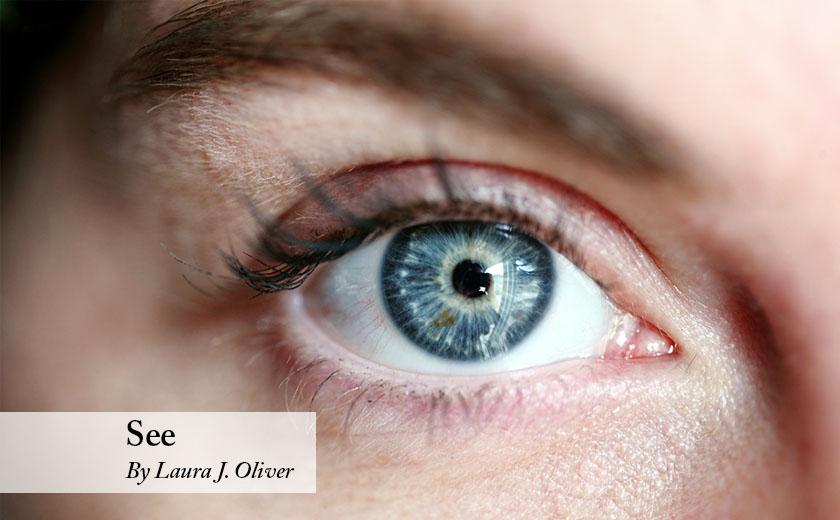
See by Laura J. Oliver 

May 21, 2023 by Laura J. Oliver Leave a Comment

I had a crush on my last ophthalmologist. He seemed very tall, striding into the small confines of the exam room, dark hair contrasting with his crisp, white lab coat. He was exceedingly charismatic, popular with patients and staff, and had a French surname which didn’t hurt a bit. I began to think of him as America’s Boyfriend, which I know is supposed to be Anderson Cooper but is really Dr. Barreau. 

I was sorry when Dr. Barreau left the practice and neutral, if not a bit wary, about his replacement. My new doctor appears humorless, pretty tightly wound, and alarmingly young. 

He’s been advising me to get some surgery ever since he joined this group of physicians, but he seems like a baby. He mentions it yet again as I gaze at his youthful left ear inches away on the other side of the autorefractor, and I think… baby wants practice. 

He leaves the room, encouraging me to watch a video extolling the virtues of his new laser, and I think… baby has a new toy. Then his tech comes in with a questionnaire that asks, “On a scale of one to ten, how easygoing are you?” To paraphrase, on the left, the choice is: “I’m an unreasonable perfectionist,” and on the right, the choice is, “It’s five o’clock somewhere.” I consider this a minute and think…baby wants wiggle room because the context of this question makes no sense. I mean, I’m laid back about traffic backups, but I wouldn’t be cool with, for instance, surgery on the wrong eye.

I’m thinking this over, stuck in traffic when I notice the SUV in front of me has a bumper sticker that says, “Angry Mob.” Intrigued, I ease cautiously closer and see it actually says, “Angry Mom.” A little closer and I realize it says, “Army Mom,” and I think, Oh, geez, baby knows what he’s talking about. I schedule surgery. 

My physician does a fabulous job; I’m sorry I doubted him. He was right, he was skilled, and I no longer need glasses to read the menu in dimly lit restaurants. In fact, I no longer need glasses at all. But even with eye surgery, I can’t see the forest for the trees. The energy I spend living out each day’s obligations doesn’t allow me to plan ahead, to consider what these days look like if I gather them all in my arms and call them a life? Doctor, can you fix that? 

I’m so immersed in getting chores done, editing others’ work, walking the dog, doing the laundry, transplanting the perennials, studying astronomy, scrubbing the kitchen, doing what feels good in the moment with no regard for the long run (oops), that the big stuff, the reason-you’re-here-stuff just stumps me. Doctor, can you fix that?

I think about the people who drew the Nazca lines 2500 years ago–the geoglyphs on the desert plateau in southern Peru. The hummingbird, the spider, and the monkey are so massive their shapes are unrecognizable from the ground, where you can only see about 3 miles, hindered by the curvature of the planet and the atmosphere. Drawn on the earth, they are only discernible from the sky. 

I’m standing on my life’s Nazca lines. How can I see the big picture when I can see only the past as a shadow and the present in parts? (Why didn’t we take more vacations? Have I watered the hanging basket on the porch?) 

From where I stand, I can only see to the end of the street. But from the perspective of the stars, I’d see all the roads in my neighborhood, all the intersections. All the signs instructing me to yield or to merge, perhaps to change lanes or to get off the road altogether. I’d know which streets are one-way, where to make a U-turn. Maybe I’d see my destination and the most efficient way to get there, or the most scenic route. But the Nazca had no access to the sky. How did they create art for the ages that they couldn’t see? 

We have a theory now that sounds plausible. The Nazca carefully and incrementally scaled up a smaller drawing. Maybe that’s all we need to do: Scale up love itself.

One day without criticizing others becomes two, and then ten. One spontaneous act of kindness becomes a hundred, then a habit. One day lived with authenticity becomes all our remaining years, the pattern of our lives a rendering observable only from the height of heaven.

Where there is a plan so big, we can’t see it. 

Laura J. Oliver is an award-winning developmental book editor and writing coach, who has taught writing at the University of Maryland and St. John’s College. She is the author of The Story Within (Penguin Random House). Co-creator of The Writing Intensive at St. John’s College, she is the recipient of a Maryland State Arts Council Individual Artist Award in Fiction, an Anne Arundel County Arts Council Literary Arts Award winner, a two-time Glimmer Train Short Fiction finalist, and her work has been nominated for a Pushcart Prize. Her website can be found here.


The Spy Newspapers may periodically employ the assistance of artificial intelligence (AI) to enhance the clarity and accuracy of our content.

Filed Under: 1 Homepage Slider, 3 Top Story, Laura

The Motherlode of Grace by Laura J. Oliver

May 14, 2023 by Laura J. Oliver Leave a Comment

I don’t remember the last time I saw my mother cry, but I remember the first occasion. 

My mother and father were downstairs, the door of their room closed. I was upstairs in my blue bedroom with the circus animal-print curtains edged in ball fringe, trying to stay off the radar. Hot and bored, I gave up and headed downstairs, taking the last three steps in one giant jump wishing someone had seen me.                        

Every Fourth of July, our family picnicked down by the river at dusk. We’d gather driftwood for a bonfire, roast hotdogs until they blistered and dripped onto the sputtering flames, and watch the fireworks shot from the yacht club across the channel. My father would strum his guitar singing “Kingston Town,” and my mother would harmonize on “Moon River,” but alert to nuance, as all children are, I knew there was no harmony here. I decided my role was to protect us from danger. My contribution to the evening would be a first aid kit. 

I chose my Madras purse as the container and began to look for items to fill it. In the downstairs bathroom, I balanced on the edge of the green porcelain tub to reach the medicine cabinet and selected a crimped, almost-empty tube of Bacitracin. Behind the toothpaste, I discovered a red-brown bottle of mercurochrome, and after opening it to admire the tiny glass wand attached to the cap, I twisted it closed and dropped the bottle in as well. I added tweezers in case someone barefoot got a splinter on the pier and syrup of ipecac in case someone was poisoned.

I wandered into the living room where the picture window framed the river, but today it was flat and featureless, held in custody by the summer sun. 

As my parents’ voices rose from their bedroom, I added a sewing needle and thread in case someone were to tear her shorts. As their voices grew more urgent, I slipped into the kitchen, where I added two Popsicle sticks for a finger splint, and baking soda for bee stings. The more items I added, the better I felt. 

My parents’ bedroom door opened abruptly, and my mother walked past me barefoot, a hint of Chanel No. 5 in the air as she passed. In the kitchen, she returned to making brownies, thrusting a wooden spoon through the dough like she was furious with it. She stopped yanking the spoon in half-circles to tap two brown eggs against the rim of the bowl. Dropping the yolks in the batter, she tossed the whites into the sink. I stood on my toes to peer over the edge. The egg whites looked like two jellyfish.

“What are you up to?” my mother asked, but she did not even look at me, so I placed my Madras purse on the counter so close to the brownie bowl that they were touching and told her about the first aid kit.

“Is someone planning to get hurt?” she asked, and I said what I knew to be true.

“You never know.” 

After spooning the thick chocolate batter into a greased pan, she thrust the brownies into the oven and turned, cupping my small cheeks in her cool palms.

“Stop scowling. Your face could freeze that way.” I thought I was wearing my regular face, so I held the look and walked over to the hall mirror. I moved as if balancing a book on my head—as though my expression might fall off if suddenly jarred. I saw serious blue-green eyes beneath straight brows. More freckles on my nose in July than there had been in June. I wouldn’t have called my expression a scowl, but I did look worried, so I forced a big smile, which, with my frowning eyes, now looked a bit deranged. Without moving my head, I slowly turned my entire body to show my mother.

There was a crash behind me and a shout. A glass milk jug had been knocked to the floor, and my mother had instinctively tried to break its fall with her bare foot. The thick glass jar lay unbroken on the linoleum, milk chugging out its mouth and running beneath the cabinets, but my mother had crumpled to the floor, where she rocked back and forth, grasping her ankle. I ran to her, righted the milk jug, then tried to tug her hands away.

“Mommy?” I said, crouching down, “Let me see.” But she continued to rock, forehead pressed to her raised kneecap. 

“Move your hands,” I commanded, but she continued to sway, so I softened my voice and laid my hand on her back. “You’re okay, you’re okay, you’re okay now.” I sang the words softly as if she were the child. My first aid kit, I noted, had fallen from the counter as well, its useless contents in the path of the seeping milk.

I patted her now as she gave voice to her pain, sobbing softly. When she finally raised her face to me, I was more afraid than sympathetic. I had never seen my mother cry, and my heart had never broken for someone else. It pounded against the small wall of my chest like a felt mallet on the surface of a drum, and we both looked down at her slim ankle as she finally lifted her hands. 

There was no cut or bruise other than that caused by her own grip. I stood up, abruptly backing away. “You’re not that hurt,” I said as if she had tricked or betrayed me. “That’s too many tears,” I claimed in a loud, authoritative voice as if there were rules for such things. Finally, I shouted, “Get up!” I sounded angry, but I couldn’t breathe. 

This was a moment in my childhood after which nothing was ever the same. And that is where all stories start. And some end. But not this one.

I don’t think I ever saw her cry again. Not in all the subsequent years of being a single mother, poet, therapist, grandmother, or friend. 

But in the year before she died, when she could no longer speak and there were no more memories over which to cry, I knew just what to say when I visited her.

I’d find her in the recreation room of her assisted living facility, seated in her wheelchair, listening to someone explain an art project for which she had no comprehension. I’d slip into the room, hug her close and whisper in her ear, “All is well, all is well, all is well.” Her shoulders would drop, and her countenance soften as if she’d just put a lifetime of worry down. And then I’d add, “You were the best mother in the whole wide world.” 

Whether or not she knew it was me, I don’t know, but she’d smile and lean into my arms, embraced for all time.

You had a mother. Your mother had a mother. As did hers, and hers, and hers. You, in fact, have had not one but a thousand mothers.

An infinity of love lands in you. 

Happy Mother’s Day.

Laura J. Oliver is an award-winning developmental book editor and writing coach, who has taught writing at the University of Maryland and St. John’s College. She is the author of The Story Within (Penguin Random House). Co-creator of The Writing Intensive at St. John’s College, she is the recipient of a Maryland State Arts Council Individual Artist Award in Fiction, an Anne Arundel County Arts Council Literary Arts Award winner, a two-time Glimmer Train Short Fiction finalist, and her work has been nominated for a Pushcart Prize. Her website can be found here.


The Spy Newspapers may periodically employ the assistance of artificial intelligence (AI) to enhance the clarity and accuracy of our content.

Filed Under: 1 Homepage Slider, 3 Top Story, Laura

  • « Previous Page
  • 1
  • …
  • 12
  • 13
  • 14

Copyright © 2026

Affiliated News

  • Chestertown Spy
  • Talbot Spy
  • Cambridge Spy

Sections

  • Sample Page

Spy Community Media

  • Sample Page
  • Subscribe
  • Sample Page

Copyright © 2026 · Spy Community Media Child Theme on Genesis Framework · WordPress · Log in