
MENU

Sections

  • Home
  • Education
  • Donate to the Centreville Spy
  • Free Subscription
  • Spy Community Media
    • Chestertown Spy
    • Talbot Spy
    • Cambridge Spy

More

  • Support the Spy
  • About Spy Community Media
  • Advertising with the Spy
  • Subscribe
December 28, 2025

Centreville Spy

Nonpartisan and Education-based News for Centreville

  • Home
  • Education
  • Donate to the Centreville Spy
  • Free Subscription
  • Spy Community Media
    • Chestertown Spy
    • Talbot Spy
    • Cambridge Spy
Point of View Op-Ed Point of View Opinion

An Educational Imperative by Washington College President Mike Sosulski

September 26, 2023 by Opinion Leave a Comment

For much of the early part of my life, politics was marked by centrists in both political parties working to craft legislation that would benefit wide swaths of their constituencies. Many individuals considered themselves centrists and, though they affiliated with a particular party, it was not uncommon to vote across party lines in elections. And political discussions among neighbors and coworkers with differing views were not something to be avoided for harmony’s sake, but part of the fabric of American democracy.

The last 20-30 years, however, have been more notable for the rise of the culture wars and the drive to divide. We have seen political parties adopt a win-at-all-costs mentality that encourages American citizens with differing perspectives to not work through differences but instead reject other ways of thinking. Of the many casualties wrought by this divisiveness, civility and engaged citizenship have suffered considerably. More and more, we are tempted to retreat into bubbles of information that feed and reinforce our preconceived notions and beliefs and make us more resistant to listening and understanding.

Early in September we witnessed the result of this shift at Washington College when Princeton Professor Robert George came to our campus to give a lecture. George is a noted legal scholar and political philosopher who often speaks on free expression. He is also known for his outspoken opposition to same-sex marriage and for questioning the legitimacy of transgender people and their rights. During the speech, students gathered outside the venue for a peaceful protest. Unfortunately, a small group of students later chose to disrupt the event, bringing it to an early end. Since then, I have heard from many people, with some praising Washington College for its handling of the situation and others decrying the institution. This event demonstrates the critical nexus between divisiveness and openness that small colleges occupy.

The lecture was announced broadly on campus three days ahead of the event. I quickly received feedback from some community members asking me to cancel the event. I shared a message with campus saying that canceling the event would not be consistent with the core values of liberal learning to which Washington College is dedicated:

“Challenges concerning free expression are not new to college campuses and they raise complicated questions, especially for a campus that values diversity, equity, and inclusion like ours. However, inviting a speaker to campus is not an endorsement of their viewpoint. The very foundation of a Washington College liberal arts education is committed to informed, critical inquiry and the exploration of a wide diversity of perspectives—indeed, we could not be true to our mission to challenge and inspire emerging citizen leaders if we did not uphold this commitment. It is incumbent upon us as a community to create and maintain an environment in which everyone feels safe to share their ideas, even those that may be controversial or offensive. And as a community, we must examine and, when necessary, challenge those ideas, but we cannot insulate ourselves from differing viewpoints.”

Campus leaders also understood that students, faculty and staff members identifying as LGBTQ+ would be experiencing a range of feelings about this particular speaker being on campus, including anger, anxiety and fear. The College proactively facilitated alternate events for concerned students to express their reaction to the speaker’s presence on campus. These included opportunities for peaceful protest and locations for both group and individual conversations with professional and trained staff and students to allow campus community members to express their feelings and concerns and to be cared for appropriately.

At the lecture, about 140 students, faculty, alumni, and friends of the College joined us. Approximately 20 minutes into George’s lecture, a small group of protestors entered the room making noise with music and whistles for about one minute. Thereafter, two protestors were responsible for the remainder of the disruption. Faculty and student affairs staff intervened to try to reason with the protestors, insisting that they must permit the speaker to conclude his talk, after which there would be ample time for questions or rebuttals. Unfortunately, the two students disrupting the speaker—who had both been warned that they would face consequences for violating the student honor code—refused to end their protest and I made the reluctant decision to call an end to the event to prevent further escalation.

We have been asked why we did not forcibly remove the protestors. I understand that some may disagree, but as a private institution of higher learning, we must take responsibility to handle student issues individually and with discretion. Washington College is a place for students to learn, experiment, fail, and grow. We have guidelines and rules that are intentional in encouraging growth and learning in all our students—including when they make mistakes. It is through this approach that we foster a strong teaching environment and emphasize the value of citizenship. Our campus cannot become a bubble intended to shield students from differing viewpoints, but rather a place where they can be free to learn from mistakes and grow into responsible citizen leaders. We strive to instill in our students the ability for reasoned disagreement, and I am proud that so many of our students attended the lecture prepared to listen to the speaker, ask questions and even challenge his views.

As with any incident, it is a moment for the College to reflect and learn how to improve our processes. But the value of a small college is our ability to act with nuance in the best interests of fulfilling our mission. Washington College and other top liberal arts colleges sit in a unique and ever more difficult position—we are committed to creating engaged citizen leaders who are open to different perspectives and have both the passion and compassion to care for their communities, and we must do all of this within a larger cultural environment that is trying harder than ever to force them to choose sides. Now, more than ever, colleges and universities must maintain space where civil discourse can thrive, even when it concerns topics of existential import. If we fail to do this, no less than the values of citizenship and democracy will be at stake.

Mike Sosulski, Ph.D.
President, Washington College
The Spy Newspapers may periodically employ the assistance of artificial intelligence (AI) to enhance the clarity and accuracy of our content.

Filed Under: Op-Ed, Opinion

One Day in September of 1861 by Paul Callahan

September 23, 2023 by Spy Daybook Leave a Comment

September 12, 1861, began with the entire front page of the New York Herald dominated by a map that meticulously detailed the advance positions of the Confederate army along the Potomac in preparation for an attack upon the Nation’s Capitol. The headline read – Over Three Hundred Thousand Armed Men – Scene of the Coming Decisive Conflict. The Nation’s North was not caught off guard by this development, as they had been reading about the rebel forces’ impending attacks for weeks. 

A series of internationally published articles had detailed how the Maryland Legislature was cooperating with Confederate forces in that they would issue an ordinance of secession and simultaneously Confederate Generals Johnston and Beauregard would cross the Potomac to “liberate” Maryland and attack Washington from the flank. The internationally disseminated articles detailed how a rebel army had been amassing in Accomac on Virginia’s Eastern Shore and was to be led up the Delmarva by General Tench Tilghman of Talbot county who had been disposed of his commission by Governor Hicks that May.  

This force of rebels would be used to support both the Legislature’s secession and the attack upon Washington by acting as a blocking force to isolate Washington from reinforcements. At the commencement of the operation, Baltimore Mayor George W. Brown was to conduct a demonstration in Baltimore City as a tactical diversion to draw Union troops away from Washington. General Beauregard was assigned the attack upon Washington while General Johnston was to capture Rockville which was to be the rallying point for Maryland secessionists to join with Johnston’s forces.  The Maryland secessionists were to be armed with the guns of the Maryland militia that had been secretively hidden from the federal forces who had been searching for and confiscating the arms of Maryland all summer. If Beauregard did not require reinforcement for his attack upon the Capitol, Johnston was to continue to Baltimore to liberate that city. 

The rebel plans had been uncovered by the War Department weeks prior and preparations had been made to foil the secessionist’s plot. The Lincoln administration established “secret police” mainly consisting of Pinkerton Detective Agency personnel. These agents had infiltrated Baltimore, gathering intelligence and were ready to act. On September 11, Secretary of War Simon Cameron issued the order and the “modus operandi” was coordinated between Union Generals McClellan and Banks. Around midnight on September 12, the arrests began which included eleven members of the Maryland Legislature who resided in Baltimore, Baltimore Mayor George Brown and United States Congressman Henry May. 

Two editors of Baltimore’s “secessionist” papers, Thomas W. Hall, editor of The South and Frank Key Howard, editor of The Daily Exchange were also arrested. Frank Key Howard was the grandson of Francis Scott Key, the author of our national anthem and thought it an “odd and unpleasant coincidence” that he was imprisoned at Fort McHenry on the forty-seventh anniversary of when his grandfather wrote in praise about the “land of the free.”The arrests continued and culminated on September 17, when the Third Wisconsin regiment arrested members of the Legislature as they returned to the city of Frederick to continue their legislative session. 

Those who were not immediately captured went into hiding, leading to the Third Wisconsin surrounding the city and conducting house-to-house searches to capture the remaining secessionists. In all, 33 members of the Legislature were arrested which included members of the House and Senate’s administrative staff.  Many of those arrested joined Baltimore’s Police Chief, George P. Kane and the Baltimore Police Commissioners who had been arrested in June and were imprisoned at Fort Lafayette in New York harbor.  

The Northern Press immediately reported how these arrests “foiled” the Confederate attack plans against the Capitol in that they dared not cross the Potomac without the Maryland Legislature first issuing their secession ordinance. The Northern Press reported the discovery of ordinances of secession amongst the traitorous Legislative members and that other evidence was found revealing that their complicity in their cooperation with the rebel army and their intent to take Maryland out of the Union was without question.  A statement by President Lincoln was published in the Baltimore American, where the President asserted that due to “public safety” the grounds of the arrests cannot be made public at this time, but he assured the people of Maryland that “…in all cases the Government is in possession of tangible and unmistakable evidence, which will, when made public, be satisfactory to every loyal citizen.”

It has now been 162 years and that evidence has never been provided. There has been no ordinance of secession found, nor has it been shown that a rebel army had amassed in Accomac Virginia to be led by General Tilghman.  Research of military records reveals that the Confederate army did not have 200,000 men amassed along the Potomac and Union Generals had no concern that there was about to be an attack.  There has been no evidence that the Maryland Legislature was contemplating secession or were coordinating with the Confederate army in an attack upon the Capitol.  General Tilghman, Mayor Brown, Frank Key Howard, and numerous members of the Legislature all attested that there were no such secessionist activities and pointed to the Legislature’s Proclamation to the People of Maryland issued that April which proclaimed they had no “constitutional authority” to issue a secession ordinance.  All the aforementioned internationally disseminated reports, originating from Washington, are assessed as “fake news” designed to control national and world opinion. 

The U.S. Civil War was the first conflict where the confluence of two major technologies were used in the conduct of war.   By the start of the war, over fifty thousand miles of telegraph wire had been installed to instantly transmit information across the Nation.  With the advent of the steam-driven presses the costs to print newspapers greatly decreased.  These factors, combined with a literacy rate amongst voters that is close to our modern era, caused newspaper readership to expand exponentially.  

Modern historians such as Harold Holzer and Elizabeth Mitchel have uncovered President Lincoln’s compulsion in using the press to control public opinion and quoted Lincoln as stating “Public sentiment is everything, with it nothing can fail; against it nothing can succeed.  Holzer and Mitchel document how Lincoln secretly purchased a German newspaper to support his Presidential campaign and how he wrote “ghost articles” that either supported his candidacy or criticized his opponents. 

It is now discovered that the Third Wisconsin were specifically instructed to arrest only the members of the Maryland Legislature that had voted “yay” on what became known as the “Wallis Report,” and were ordered to find and destroy all copies.  The “Wallis Report” was named after Severn Teackle Wallis, the Chairman of the Legislature’s Joint Committee on Federal Relations.   The report and resolutions were passed by a vote of 54 – 13 and the names of each Legislative member were attached which recorded their vote.  The report was the Legislature’s protest against the constitutional violations committed by the Lincoln administration against the State of Maryland and her citizens and called for an immediate cessation of all hostilities between the beleaguered states. The intent was to take their protest and calls for peace directly to the American public, ordering 25,000 copies to be printed and distributed throughout the Nation.  

The majority of the Maryland Legislature desired peace and maintained a political view of “constitutional” Unionism where they did not want Maryland to leave the Union but held the U.S. Constitution superior to the policies enacted by the federal government that violated its articles.  This placed many Marylanders at odds with the administration’s policies and were thus considered “sympathetic” to the Southern cause and were included within the labels of “Southern sympathizers” and “secessionists.”  The majority of the Maryland Legislature, specific newspaper editors and many Marylanders inappropriately fell into this group of the “disloyal.”  

The Lincoln administration viewed the protests of Maryland’s Legislature as more powerful than all the men and arms Maryland could have mustered, even if Maryland had not been disarmed.  By September 1861, Maryland had been disarmed as federal forces, with the cooperation of Governor Hicks, had aggressively confiscated state arms and deposited the same at Fort McHenry.  The state was overwhelmingly occupied by federal troops and Baltimore was strongly intimidated by the guns of Fort McHenry and those on Federal Hill trained upon her inhabitants.  By written instructions to his General, President Lincoln had already directed his military that if Maryland took arms against the United States, they were to “bombard their cities.”

It was not just the suppression of dissent that was desired, the administration wanted Maryland to be controlled by “unconditional” unionists that would fully support the war effort. The imprisonment of the Legislature eliminated “disloyal” members from public office or from influencing public opinion in Maryland.  Their imprisonment created vacancies that needed to be filled and their imprisonment was a strong deterrent against anyone maintaining a dissenting political view from running for elected positions in Maryland.  

Historians never understood why the Baltimore Police Commissioners had been imprisoned on the personal orders of Secretary Simon Cameron.   The commissioners had protected the 6th Massachusetts during the Baltimore riots on April 19 and provided security to thousands of federal troops afterwards right until their removal from office.  It now becomes clear that their removal was due to an important function that had been assigned to them by the Maryland Legislature – to conduct the elections in Baltimore.  The federal provost marshal appointed to replace the commissioners was tasked to oversee not just Baltimore’s police, but the city’s elections as well.  With this appointment, the city’s police and 120 election judges quit in protest and were subsequently replaced by men of the provost marshal’s choosing.  Baltimore accounted for one-third of the voting population of Maryland and the November election was for half of the state’s Senate, all of the House Delegates and the governorship of Maryland. 

With the elections of Baltimore under federal control and with election judges appointed by the provost marshal, a policy was implemented to ensure the “disloyal” were discouraged from voting.  During the morning of the statewide election, a large number of arrests were made of the voters who attempted to vote a disloyal ticket or who showed any indication of disloyalty.   The police station’s jails were filled to capacity and word quickly spread throughout the city keeping all who desired to vote any ticket other than the “unconditional” union ticket away from the polls.  With the voter intimidation, almost all positions, including the governorship of Maryland, went to “unconditional” unionists. 

The manipulation of the Maryland elections would not have been possible with a legislative body and a free press willing to report and publicize these violations of democracy to the American public and the world.  The Maryland Legislature and the free press became victims to the “necessity” that only voices supporting the war effort would be heard and only “unconditional” unionists would dominate the Maryland government.  

The suspension of constitutional liberties quickly expanded north and ultimately over 14,000 civilians were imprisoned, three hundred newspapers suppressed, and all remaining newspapers were highly intimidated and censored.  Without a free press or the ability for Americans to voice dissent, the government became more brazen in manipulating elections of the border states.  During the Maryland elections of 1863, voters had to pass through an armed gauntlet of soldiers while holding color-coded tickets that revealed which party they were supporting.  

Many were denied their right to vote, and some were beaten and physically removed from the polls. Election judges who dared to protest the interference were arrested, and non-resident Union soldiers voted freely. Even the “unconditional” Unionists who were now governing the state of Maryland were aghast and protested against the violations of Maryland’s democracy.   

“Fake news,” a divided Nation, election fraud, the overreach of presidential power, and the desire to imprison political opponents, is not new to our modern times.  Considering the challenges we see to our democracy today, we now more than ever, need to heed the lessons of Civil War Maryland – When Democracy Fell. 

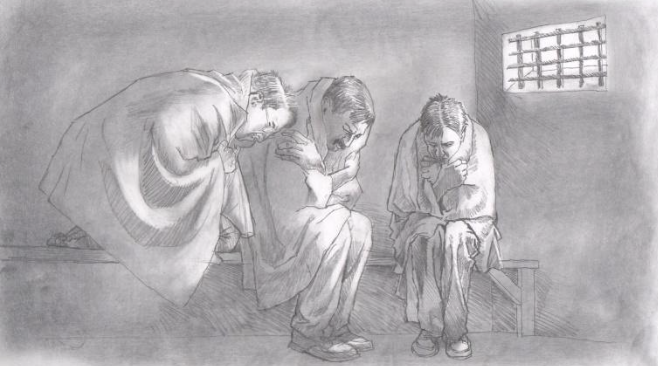
Paul Callahan is a native of Talbot County Maryland, a graduate of the Catholic University of America and a former Marine Corps officer. When Democracy Fell is due for release on October 3, at all major retailers to include Amazon. Image of prisoners courtesy of “The Local History Channel.”

The Spy Newspapers may periodically employ the assistance of artificial intelligence (AI) to enhance the clarity and accuracy of our content.

Filed Under: Op-Ed, Opinion

The Morning After: Reflections on 9/11 by Margaret Andersen

September 11, 2023 by Opinion Leave a Comment

Like all generation-defining moments, people of a certain age can remember exactly where they were on 9/11/2001 when the first planes hit the World Trade Center in New York…and later the Pentagon and the field in Shanksville, Pennsylvania. I was teaching at the University of Delaware. It was the second week of class. Amid my own existential fears as the 9/11 attacks unfolded, I had to prepare for the next day’s class—an introductory level class with many first-year students in it. How were they feeling? What were they thinking? What should I say?  How could I be the “adult in the room” when I felt like the world I knew could be coming to an end? 

After the first plane struck, faculty were coming out of their 9 o’clock classes and reporting that some students were running from classrooms and crying. Because it was only the second week of the semester, many students were away from home for the first time. Most University of Delaware students came from Delaware, New York, New Jersey, Pennsylvania, and Washington, DC. Many were desperate to reach family and friends in the affected areas. 

Like many Americans, I was gravely concerned about what would happen next. Would more attacks follow? Was I safe? The eerie quiet on the afternoon of 9/11 only added to my unease. Like many, I stayed glued to the televised news throughout the afternoon and evening of 9/11. My usual nervousness about commanding the attention of over 150 young people paled in comparison to my worry about how to teach the next morning. 

The next day attendance in class was high, but the usual din and chatter as students entered the classroom and took their seats was eerily absent. I asked students to take a moment of silence to remember those lost and honor those still missing. I then asked them to write a brief statement about what they were thinking, how they felt, and any questions they had. More than two decades later, those papers are a quaint reminder of the days before laptops and cellphones in the classroom and they are, most importantly,  poignant reminders of the immediate impact of 9/11 for those young people. 

Foremost on student’s minds on the morning after 9/11 were great fears of war—of possibly being drafted into military service or seeing family members or loved ones drafted. Students wanted answers to who, what, why…and they were deeply concerned whether this lead to nuclear extinction. “Being a military dependent, I have worried all my life about going to war and losing my dad. Now I am more concerned than ever about the use of nuclear weapons,” wrote one student .Another wrote: “I am most concerned about the decisions that will be made by a president and government in the days to come. Will going to war and killing foreign civilians bring back the dead?” 

Many wrote that they were very scared for their parents and relatives—many of whom worked in New York City. Some had relatives who worked for the New York City Fire Department. One wrote, “Forefront in my mind is the fact that my best friend lives in Manhattan and has not yet been accounted for.” Many students had grown up frequently visiting New York City and they worried they might never be able to do that again. 

In their brief reflections, students expressed deep empathy for the many victims of 9/11. It is difficult to convey the raw emotion found by reading the actual reflections. A few expressed concerns for the fate of Muslim Americans after the attack. One wrote, “I pray that who did this is not a Muslim because I’m a Muslim and who did this is not a Muslim because Islam does not say to kill. And I feel as if people are staring at me, thinking all Muslims are like this, I pray and hope that, if it is a Muslim who did this people should realize that not everyone or a group is the same.” 

One of the strongest themes I found in these reflections is that students just could not understand why this had happened to the United States. “I never thought that someone would be able to hurt our country—which is the most powerful in the world.” Just as frequently, they worried about what this would mean for their personal freedom—to get on airplanes, to travel to cities, to go to school: “I feel threatened in many places that I have never felt threatened in before. I am scared to go to school thinking that maybe terrorists will decide to destroy the future of our country by bombing universities.” Or, “I cannot ever imagine feeling safe in my own home again.” Their innocence was shattered: “I was aware that terrorism existed around the world, but not in the United States. Our home instantly was no longer safe. A level of innocence and idealist optimism left me that day.” Another simply said, “I feel as if everything I have ever known is slipping away.”

And now? 

Much has happened since 9/11, but I wonder how this tragedy has influenced the 9/11 generation of young people. The students who wrote those thoughts in my 2001 September class are now in or approaching their forties. What do they say now? Luckily, with the aid of social media—Facebook and LinkedIn, in particular—I have located a substantial number of those students. Many have established marriages, borne children, and grown into careers. Has 9/11 been a defining moment for this generation of young people and how have their thoughts developed since?

At this point, I can only speculate about how 9/11 has defined this generation. But in 2001, as 

I prepared for my class during the evening of 9/11, I felt I had to provide a sociological perspective for what was happening. I hastily drafted a list of “Lessons Learned from Sociology in the Aftermath of a Disaster,” included below. These pieces of sociological wisdom resonated then with my students. I find them still meaningful today as we encounter other disasters—environmental ones, political ones, and local emergencies. 

  • Even under tragic conditions, human beings form meaningful relationships with each other.
  • All religions have produced fanatical extremists. One should not generalize to all people of a given faith, even if the behavior of some is reprehensible.
  • Prejudice is a negative attitude toward a social group and toward individuals who are members of that group who are then perceived to have the presumed negative characteristics associated with the group. Prejudice results in many false depictions of otherwise good people.
  • Ethnocentrism is the belief that one’s group (or culture) is superior to all others. It can distort one’s objective view of events.
  • In situations of social conflict, people and groups tend to demonize perceived enemies, based on group prejudice. Individuals (and groups) can be held responsible for their actions without condemning all members of the stereotyped group.
  • Don’t jump to conclusions in the absence of empirical evidence.
  • People’s biographical experience is situated in given historical moments. One of the founders of sociological thinking, C. Wright Mills wrote, “the sociological imagination enables us to grasp history and biography and the relations between the two in society.” Your biographies have been forever altered by these events and will shape your lives for years to come.
  • Technological change had made us highly depend on devices like cell phones, the internet, television, and so forth. These new technologies are profoundly shaping our social relationships. 
  • Social order is usually something we can take for granted. When it is disrupted, people work to re-establish social norms (thereby recreating social order).
  • In the aftermath of a disaster, people search for information to make sense of what they have experienced. Rumors abound in such a context.
  • In a disaster, people tend not to panic, but engage in social behavior by trying to help others, connect with others.
  • There will be many individual acts of heroism, tragedy, and triumph over the next few days, but remember that there are hundreds of thousands of people whose labor is an essential part of meeting people’s needs. These workers are diverse in age, gender, race, ethnicity, nationality, and other social factors, though their work often remains invisible, unacknowledged, and undervalued.
  • The United States is a highly diverse society, including citizens of different races, genders, nationalities, sexual orientation, religious faith, ethnicity, and other sources of diversity. Although these are factors that often divide us, we can work to create positive intergroup relationships and we can unite across these differences.
  • There are few “degrees of separation” between any two random people in the United States. Be aware of this in your interaction and comments over the next few days since it is highly likely that someone near you will have lost a loved friend or family member.

Dr. Margaret Andersen is the Edward F. and Elizabeth Goodman Rosenberg Professor Emerita at the University of Delaware


The Spy Newspapers may periodically employ the assistance of artificial intelligence (AI) to enhance the clarity and accuracy of our content.

Filed Under: Op-Ed, Opinion

Opinion: Talbot County’s Joe Trippi on the No Labels Threat in 2024

September 6, 2023 by The Spy Leave a Comment

While political consultant Joe Trippi is the first to admit that he and his family are “come heres” it should be noted for the record that his “come here” took place more than 25 years ago. In fact, Trippi, who first hit national attention with his out-of-the-box management of Howard Dean’s 2004 presidential campaign, has been so local that for many years, he and his wife, Cathy, owned and operated Justine’s Ice Cream Parlour in St. Michaels.

With those credentials in mind, The Spy was eager to get a uniquely qualified opinion about the No Labels movement and the possibly tragic consequences of a third-party candidate for the country in 2024. As noted in our conversation with Joe, he considers a 3rd party candidacy a direct threat to democracy since it would open the door for a Trump victory. Consequently, he and other veteran political leaders (including Spy Columnist Al From) have formed Citizens to Save Our Republic to avoid this kind of predicted outcome.

We talked to Joe by Zoom this week.

This video is approximately seven minutes in length.

The Spy Newspapers may periodically employ the assistance of artificial intelligence (AI) to enhance the clarity and accuracy of our content.

Filed Under: Op-Ed, Opinion

My involvement in the March on Washington by Stan Salett

August 29, 2023 by Stan Salett Leave a Comment

Editor’s Note: This is an except from Stan Salett’s The Edge of Politics: Stories from the Civil Rights Movement, the War on Poverty and the Challenges of School Reform.

The origins of the March actually went back to 1941, when A. Philip Randolph, the leader and founder of the Brotherhood of Sleeping Car Porters, conceived of it as protest against employment discrimination. Randolph had built the Brotherhood into the most powerful African-American labor organization, with the capacity to seriously affect the operation of the nation’s rail system. Randolph called off the march only when Roosevelt agreed to issue an executive order establishing the first Fair Employment Practices Commission. But the idea of a March on Washington had taken root and 22 years later was being actively considered again. But Randolph himself had not been a leading figure in the civil rights movement of the late 1950s and early 1960s. When he suggested in the fall of 1962 that there be a march on Washington to be called the “Emancipation March for Jobs,” to take place on January 1, 1963, the civil rights organizations were not interested.

For many of us the action was not in Washington, D.C. (except what we were doing locally) but in communities all around the country. For the Southern Christian Leadership Conference (SCLC) and Martin Luther King, Jr., the struggle was focused on Birmingham, Alabama (or as we called it in those days, “Bombingham”). Birmingham was still the most segregated and racially hostile city in the country. CORE was focusing on cities nationwide. The other major civil rights groups, the National Association for the Advancement of Colored People (NAACP) the Student Nonviolent Coordinating Committee (SNCC) and the National Urban League similarly had their own agendas. Working together did not come easily. Yet the events in the spring and summer seemed to do exactly that—force us to work together.

Bull Conner and the Birmingham police became more violent in their attempts to suppress the non-violent demonstrations led by Reverends Fred Shuttlesworth and Martin Luther King, Jr. The NAACP field secretary in Mississippi, Medgar Evers, was assassinated by white racists in Jackson. On June 19 President Kennedy proposed a new civil rights bill. Now there was a reason to come to Washington. King called A. Philip Randolph to tell him that he was ready to discuss a march.

Gradually, and not without pressure, the other groups came into line and met on July 2 in New York City. Randolph urged the others to accept Bayard Rustin as the chief organizer. Rustin was a controversial figure to several of the organizations. Openly gay and a former member of the Communist party, Rustin had some obvious downsides as the public face of the march. The assembled groups, pressed by Randolph, accepted Rustin as the March coordinator and scheduled the event for August 28. They also agreed that their local D.C. organizations would do much of the planning and March logistics.

Washington–CORE would represent the national organization on the planning committee, and Julius Hobson asked me to join him on the committee. The Reverend Walter Fauntroy represented SCLC and Reverend King, Sterling Tucker represented the Urban League and several people represented the NAACP. The SNCC was the least involved. Our meetings were relatively free of conflict. Maybe it was because the logistical issues were so enormous. At first we estimated that about 100,000 people would participate. As we got word of the growing numbers of bus charters, our estimates increased and increased and increased. About 450 buses were scheduled to leave from the 143rd Street Armory in New York City. Another 80 buses supplied by CORE were scheduled to leave from 125th Street. Special trains were chartered from Penn Station in New York, Chicago, Detroit, Jacksonville and Philadelphia. Eventually, 2,200 buses would come.

With this size of a crowd, security would be a major problem. Among the participating groups CORE was assigned the heavy responsibility of providing security for the March (the “big six” civil rights organizations became the “top 10” with the addition of the National Conference for Interracial Justice, the National Council of Churches of Christ, the American Jewish Congress, and the United Auto Workers). My job within the coalition was to help prepare the security for the March. From the outset, we assumed that the Washington, D.C. police would be of little help. After all, we knew them. These were the folks who were arresting some of us every weekend and throwing us with unconcealed hostility into their wagons and cells. This was a predominantly white, racist police force that we hoped would not stand in our way.

The solution to providing security for the March was to supplement our own efforts with off-duty policemen. The main outside force was drawn from an African-American association of New York City police called the Guardians. These officers would not be in uniform and would not carry weapons, but they would carry handcuffs. Rustin insisted that the off-duty police not be involved in preventing assaults by any right-wing white groups. These problems would be left to the D.C. police, the FBI and our own internal security force led by CORE. Part of my role was to help train our people and assign them to positions on the Mall. Our plan was to have 10 sections, with 50 trained people in each section. CORE’s response to potential violence was to reply with nonviolence. We, of course, would carry no weapons. We would surround any threat with our bodies. This was no philosophical construct. It was something we practiced night after night in July and August.

The March was to take place on the Mall, beginning at the Washington Monument and ending at the Lincoln Memorial, one mile away. Bayard Rustin set up his offices in Harlem. His immediate focus was to raise money to pay for buses and signs and leaflets. Each local affiliated organization was to be responsible for their group. Rustin sent out instructions that each bus would have a captain who would be responsible for seeing that their marchers stayed together and knew where the bus was parked for the return trip. People were urged to wear their Sunday best: men in suits, women in dresses. There would be none of the casual attire that marchers in subsequent years would wear. We were determined to show the American public that we were as main stream as they were even if we were willing to be beaten and jailed and worse for our beliefs. Everyone would be urged to leave Washington after the March. This would be a demonstration, not an invasion.

The day of the March, August 28, 1963, was warm and humid, but not as stifling hot as late summer Washington days could be. This would prove to be fortunate, for a hot day would have caused great strain on our untested medical facilities. I had assigned myself a security group to cover the area immediately to stage right of the Lincoln Memorial and stretching back to the edge of the reflecting pool.

We all arranged to meet at the base of the Washington Monument at 6 a.m., so I could run through final instructions. The Washington Monument that day was a scene of great confusion, with many groups, including the American Nazi Party, trying to get organized. I had led my group through the basic elements of our training in the nights leading up to this day. We planned how we would identify and surround anyone wanting to do harm to the marchers, how we would communicate through walkie-talkies and messengers and where my station would be.

Just after I finished and my group was dispersing, an NBC television crew rushed up and asked me to bring the group back together and repeat what I had said because they hadn’t been able to film all of it. With a few choice swear words, I told them that this wasn’t being done for their benefit and to “bug off.” Thinking about this incident years later, I suppose in some ways the entire March was being done for TV so that the country as a whole could see the mass movement we had become. But these were later thoughts; at the time I just wanted to get my people into position before the marchers arrived at the Lincoln Memorial.

By 7 a.m. there were fewer people than we had expected. Was this really going to happen? But the trains and buses began to arrive and by 9:30 a.m. there were more than 40,000 people gathered at the Washington Monument. By 11 a.m. the crowd had grown to more th ver the country, what has never been fully understood is that most of the marchers did not come from far out of town. The majority came from the greater Washington/Baltimore area. As we were setting up at the Lincoln Memorial, we later heard that an informal event was happening back between the Washington Monument and the Ellipse where Odetta, Josh White and many others were singing to the growing crowd. Burt Lancaster and other Hollywood celebrities gave short speeches. But the marchers were ready to march and, without any of the known civil rights leaders in attendance, the crowd began to move toward the Lincoln Memorial. The “top ten” had been meeting with President Kennedy and had to be rushed through the moving crowd along Constitution Avenue in order to get to the front.

From my vantage point, under a stand of trees at the Lincoln Memorial, I could see the thickening crowd and the main body of speakers appear at the front stage. The speaker system was not functioning completely. The original system had been sabotaged the night before and had been replaced with the help of the Army Signal Corps. I learned later that there was conflict among the sponsoring organizations over the speech John Lewis, SCLC’s representative, was about to give. Archbishop Patrick O’Boyle objected to what he believed was violent language. Walter Reuther of the United Auto Workers was concerned that Lewis would be too critical of President Kennedy. All of this was resolved hurriedly behind the stage and unknown to the growing crowd in front.

My immediate concerns were to look for signs of threat and disturbance. Fortunately, there were no incidents of violence throughout the day. In my sector, we had some people fall out of the trees. We tried, not successfully, to keep people from dipping into the reflecting pool, and we had some people pass out from the heat and excitement of the day. I didn’t hear all of the speeches. Jim Farmer, who was scheduled to speak for CORE, was in jail in Plaquemine, Louisiana. Farmer refused to be bailed out while 230 others remained in jail. He asked Floyd McKissick, CORE’s national chairman, to represent him and read his message, which read in part:

“I wanted to be with you with all my heart on this great day. My imprisoned brothers and sisters wanted to be there too. I cannot come out of jail while they are still in; for their crime was the same as mine—demanding freedom now. Some of us may die, like William L. Moore [a white postman from Baltimore, Maryland, who had been shot to death in northeastern Alabama on April 23, 1963, while carrying a sign urging ‘Equal Rights for All,’ during a walk from Tennessee to Mississippi] or Medgar Evers, but our war is for life, not for death, and we will not stop our demand for FREEDOM NOW. We will not stop till the dogs stop biting us in the South and the rats stop biting us in the North.”

The day was now getting long, and many of us were feeling the effects of too little sleep. The tensions we had felt in steeling ourselves to face violence or whatever unpredictable disruptions our opponents could throw at us had subsided. Mahalia Jackson sang the moving spiritual, “I Been Buked and I Been Scorned,” which seemed to move the crowd again. Rabbi Prinz, whose son was a classmate of mine at Brandeis, then spoke about the Holocaust and how all of us must learn from that experience and not become a nation of onlookers and stand by while some of our citizens were being denied their basic rights and are beaten and murdered. Prinz declared, “It [our nation] must speak up and act, from the president down to the humblest of us, and not for the sake of the Negro, not for the sake of the black community, but for the sake of the image, the idea, and the aspiration of America itself.”

During most of the speeches I was not playing close attention to the words. My job was to watch the watchers. But when Martin Luther King, Jr., began to speak, I tried to divide my concentration. I had heard King speak a few years earlier in Boston at the Ford Hall Forum. He had spoken then about the Montgomery bus boycott, but with such erudition and classical references in his rhetoric that I felt both emotionally moved and intellectually impressed. The speaker system still was not completely effective in my section. But when King said, “We will not be satisfied until justice rolls down like waters and righteousness like a mighty stream,” I heard it and saw the crowd responding. There were “amens” and “you tell ‘em.”

King had broken through the exhaustion that many were feeling so late on that long day. He had planned to end his speech with a call to the audience to return to their communities and continue the struggle. The others in the coalition also had given King a time limit for his remarks, wanting to show themselves as a broad-based group with no single figurehead. King decided on the spot to go beyond any limits and deliver what became the most moving speech of our lives. He slowed down his cadence and talked about his dream for America and for his own children, “where they will be judged not by the color of their skin, but by the content of their character. I have a dream today.” He talked about freedom and faith and said finally,

“And when we let freedom ring from every village, and every hamlet and every city, we will be able to speed up that day when all of God’s children— black men and white men, Jews and Gentiles, Protestants and Catholics—will be able to sing in the words of that old Negro spiritual, ‘Free at last, free at last, thank God Almighty, we are free at last.”

And then the day ended, but not for me. There was the cleaning up to do. The trash of 250,000 people, tons of it, had to be picked up. All of the cable lines, the portable bathrooms and banners had to be removed. We were determined to leave this special place as if we had never been there at all. And we did. We returned to our work in our communities inspired yet mindful that the struggle for full civil rights had to continue—a reminder made all too real when less than three weeks later “Bombingham” again tragically erupted. On Sunday, September 16, four 14-year-old girls were murdered during a bombing at the 16th Street Baptist Church in Birmingham. In D.C., CORE went out into the streets and brought out more than 7,000 people. The struggle would continue.

Stan Salett has been a policy adviser to the Kennedy, Carter, and Clinton administrations. He now lives in Kent County, Maryland. 

The Spy Newspapers may periodically employ the assistance of artificial intelligence (AI) to enhance the clarity and accuracy of our content.

Filed Under: Op-Ed, Opinion

Let’s Wipe the Slate Clean. A Girl Can Dream by Maria Grant

August 27, 2023 by Maria Grant Leave a Comment

According to several polls, most Americans do not welcome an instant replay of the 2020 election—Trump versus Biden. An overwhelming majority of Americans want the country to move on for a variety of reasons—age, indictments, too much baggage and more. I agree.

The philosopher John Locke coined the term “tabula rasa” which means a mind as a blank slate with no preconceived ideas—a mind which has not begun to process ideas from outside forces. 

So, here’s a concept. Let’s wipe the 2024 presidential candidate slate clean and start over. Let’s select two sane reasonable moderate Republicans and two sane reasonable moderate Democrats and give those currently running their walking papers. 

You say it sounds farfetched. You say it’s not going to happen. You’re probably right, But a girl can dream. Here’s my dream scenario. Some well-respected legal scholars claim that Trump is not eligible to run because he violated the 14th Amendment by inciting an insurrection. What if they are right? What if the case goes before the Supreme Court and five Supreme Court Justices agree that this is so? That would mean Trump could never run for public office again. 

Then, maybe, just maybe, if Trump were out of the picture, Biden wouldn’t feel compelled to run. Maybe, just maybe, he would step aside and encourage younger, more vibrant, more articulate leaders who are prepared to support future generations to run. 

And maybe, just maybe, if Trump were out of the picture, some sane Republicans would step up to the plate and call for a reset to normalcy and promote civil discourse, compromise, and fiscal responsibility. 

And were this dream to continue, who would those candidates on my wish list be?

On the Republican ticket, perhaps former Ohio Governor John Kasich as president and our own former Governor of Maryland Larry Hogan as Veep. These are two sane reasonable men who have tons of experience, know how to reach across the aisle, and who have appealed to both Republicans and Democrats. There are many more combos to consider—New Hampshire Governor Chris Sununu and Alaska Senator Lisa Murkowski as cases in point. 

On the Democratic side, how about Michigan Governor Gretchen Whitmer as a presidential candidate and California Governor Gavin Newsom as Veep? Both these governors have garnered votes from the other party, and both are young, vibrant and support climate change, Ukraine, sound economic policies and more. There are many other such Democrats waiting in the wings—Minnesota Senator Amy Klobuchar, Secretary of Transportation Pete Buttigieg, Pennsylvania Governor, Josh Shapiro, Secretary of Commerce, Gina Raimondo come to mind. (I would be most excited if a qualified woman were the Presidential candidate as it is past time for a woman to be president of the United States.)

You may ask why not consider some of the Republican candidates who debated last week? Why? Because six of the eight said they would support Trump if he were the nominee. They did not qualify their support and say unless he was convicted of a felony. They just blindly said they would support him. Chris Christie and Asa Hutchinson did not raise their hands. But Christie has a ton of baggage, and Asa Hutchinson has his own age issue. 

Wiping the slate clean is sometimes the right answer. When workplaces become toxic, or a Board is unethical, wiping the slate clean makes good sense. 

Therapists who use the tabula rasa theory in their practices claim that patients who have anxiety, for example, suffer from that malady because of learned behaviors. Their therapies focus on unlearning those “target situations” and imagining “target situations” differently and therefore reactions become different as well. Basically, they focus on unlearning learned behaviors.

I say we as Americans should unlearn some of our past learned behaviors and react differently to some “target situations.” Let’s stop the vindictiveness, name calling and crude behavior and once again try civility, try listening to the other side, try compromise when appropriate, and try dealing with issues with a sense of compassion, kindness, and humility.  

And remember as Buddha once said, “No matter how hard the past is, you can always begin again.”

Maria Grant was principal-in-charge of the federal human capital practice of an international consulting firm. While on the Eastern Shore, she focuses on reading, writing, piano, kayaking, gardening, and nature. 

The Spy Newspapers may periodically employ the assistance of artificial intelligence (AI) to enhance the clarity and accuracy of our content.

Filed Under: Op-Ed, Opinion

Is America’s Political System Adrift? By Tom Timberman

August 26, 2023 by Tom Timberman Leave a Comment

In 2004 and 2005, a total of 8,250,401 new Americans were born.  Millions of them, will be voting for the first time on November 5, 2024 to elect, among others, the president of the United States. 

From my  senior citizen perspective, the 2 years and 8 months since the 2020 election have been variably depressing, extremely weird and deeply concerning, They have included: the violent 1/06/21 insurrection,  a failed complex effort to overturn America’s democratic electoral process and on 1/20/2021, the first non-peaceful transfer of power in US history. What a contrast to those halcyon politics and elections of long ago.

More recently, a former US president and current 2024 candidate, has been indicted in 4 courts for 80+ allegations of criminal conduct. Some or all of the trials will be held before the 2024 election  Opinions on this litigation have contributed to today’s deep chasm between Americans view of the current health and viability of the United States and its future. 

The confluence of our sociopolitical seismic eruptions with the Covid-19 pandemic, severe global warming disasters, American domestic violence, the ongoing war in Ukraine and China’s belligerence to the US over Taiwan, lends something of an apocalyptic aura to the 2024 election season. And possibly reinforcing this more cosmic quality, is a  campaign theme introduced by President Biden when he characterized next November’s choice for American voters as between authoritarianism and democracy. 

And then there’s Social Media, blogs, chat rooms and special apps offering thousands of interpretations of all this for hundreds of millions of people, including many if not most, of first time American voters.  I’m sure some of them follow (on-line) the Federal Reserve minutes, the Congressional Research Service (CRS)  reports and  the Council on Foreign Relations publications. Probably, most don’t.

This large number of first time American voters confront violence, dysfunction, confusion, sharply divided opinions and beliefs, suffused with high emotions. Not to mention a former US president running in the 2024 election who’s facing an array of criminal trials and strongly maintains election fraud stole his reelection. And millions of Americans agree.  Some or all of this turmoil is no doubt present in their or their friends’ families, among peers and is inescapable on Social Media.

When I cast my first ballot, there were two dominant parties each with well known policy positions and attitudes towards governance. Easy and comfortable choices. If the 2023/24 political environment had existed then, I probably would not have voted. And I would guess this will be the decision of a number of new voters as well. Another possible option would be to maintain the peace and go with the family or friends’ flow. 

What follows is a description of the formidable puzzle of issues facing those among them who want to make independent choices, not affected by fear mongering, alternative facts and loud voices.  

Recent polling reveals large numbers of American adults already are or should be, in group therapy to address mass depression.  And many of 2024 first-time voters live with, are taught by, or work for or know, these people. The likely impact on their 18 year-old children, students, bosses or parents’ friends is to discourage them from voting.  Why bother trying to save a sinking ship?. Or maybe give it a shot.  

Miasma: Unwholesome or foreboding atmosphere 

Adult American Views on the State of the USA

Who? In danger of failing, Not in Danger, but Bad Problems

All registered Voters 37.00% 26.00%
Republicans 56.00% 28.00%
Democrats  20.00% 25.00%
Republican Men 50.00% 34.00%
Republican Women 65.00% 21.00%
Democratic Men 11.00% 27.00%
Democratic Women 25.00% 24.00%

NYT/Siena College Poll 7/2023

But, What does all this Mean?

If I were a shrink, which I’m not, but just based on the results of this poll, I would vote for all Democratic male candidates, including their much more successful and optimistic current president, seeking reelection. His major Republican competitor is a former president, who describes the US as failing and himself as the only salvation. 

Also, on the Republican side, I was not surprised to find that the smallest member of the Party’s coalition (8%) called the “New Comers”,is the one with with the most young people (18-29); 59% are white and 18% Hispanic. They are solidly behind Mr. Trump and opposed to President Biden. 

The article goes on to describe them, surprisingly, as overwhelmingly in support of immigration reform and social acceptance of transgender people. Not exactly in line with the Freedom Caucus or the 52% of the Party, labeled either Traditional Conservatives (Rick Perry-like) or Right Wing (Ted Cruz-like).  

The  New Comers (Vivek Ramaswamy-like) are said to be deeply unhappy with the state of the country and 90% believe the US economy is poor.  They agreed they would support candidates focused on fighting the radical “Woke” rather than those targeting law and order. 

I have no idea what America’s first time 2024 voters will do. However, given the environment they now inhabit, I wish them God Speed. However, I do offer, for reflection, three quotes from two founding fathers expressing their views on future American elections. 

Alexander Hamilton: 

“American elections provide a moral certainty that the office of president will seldom fall to the lot of any man, who is not in an eminent degree, endowed with the requisite qualifications.”  

James Madison:

“The people will have the virtue and intelligence to select men of virtue and wisdom to lead their Republic.  If not, then Americans are in a wretched situation”

“Knowledge will forever govern ignorance; and a people who mean to be their own governors must arm themselves with the power knowledge gives.  Wherever there is interest and power to do wrong, wrong will generally win.”

Tom Timberman is an Army vet, lawyer, former senior Foreign Service officer, adjunct professor at GWU, and economic development team leader or foreign government advisor in war zones. He is the author of four books, lectures locally and at US and European universities. He and his wife are 24 year residents of Kent County.

The Spy Newspapers may periodically employ the assistance of artificial intelligence (AI) to enhance the clarity and accuracy of our content.

Filed Under: Op-Ed, Opinion

The value of MACo and Some Suggestions for Improvements by Josh Kurtz

August 24, 2023 by Maryland Matters Leave a Comment

The parking lot at the Roland E. Powell Convention Center in Ocean City was two-thirds empty at 11:15 on Saturday morning, just as Gov. Wes Moore (D) was beginning his closing address to the Maryland Association of Counties summer convention.

The lightly attended speech highlighted one of the major flaws of the four-day MACo conference — an annual event that has become the Woodstock of Maryland politics, in the best and worst ways.

To average Marylanders, MACo must seem like a taxpayer-funded junket at the beach for their local and state leaders — and in some ways, that’s just what it is. So taxpayers are right to view the conference skeptically when they are subsidizing registration fees, meals and exorbitant Ocean City hotel room bills for government employees.

But the information provided at the MACo sessions, and the intel exchanged in the convention center’s hallways and at the countless receptions around town, are invaluable. It’s not an exaggeration to say that many of the conversations, official and unofficial, will lead to meaningful legislation, policy initiatives and changes in government management practices in the months and years ahead. Not to mention that they can cement enduring personal relationships and political alliances.

Moore summed up the MACo vibe pretty well during his speech Saturday.

“We come to MACo to celebrate Maryland,” he said. “To soak in the beauty of our communities. To prove that business casual can actually mean flip-flops! I’ve never seen more county executives rock shorts in my entire life. Even the ones who shouldn’t!

“But if there’s one thing I’ll take away from my first summer MACo as governor, it’s this: In every meeting — in every session — I’ve witnessed a tireless spirit of partnership. We are a state that doesn’t just welcome partnership, we need it. We thrive on it. And I’m grateful for it.”

Some of the value of attending MACo is incalculable and hard to define, if someone were demanding an audit of the public benefits and what elected officials and government bureaucrats — and by extension, the taxpayers — are getting for the investment.

Like all others, this year’s MACo was chock-full of interesting and beneficial panel discussions on every conceivable topic that government leaders need to know and think about, from broadband to the opioid crisis to climate resiliency, and everything in between.

But like so many aspects of Maryland government, MACo has also become another opportunity — a prime opportunity — for corporate interests to get themselves in front of policymakers.

The convention center’s Exhibition Hall, with almost 250 contractors, vendors and government agencies peddling their dizzying array of products and services, is one thing. In fact, visiting each and every booth during the course of the conference and trying to absorb what they are pitching could occupy a convention-goer’s entire time at MACo.

But more subtly, some of the panel discussions are now sponsored by special interests, and those can at times turn into infomercials rather than frank discussions. They at least seem like an attempt to steer a policy conversation in a way most favorable to the sponsors. These are often entities that already have robust lobbying corps in Annapolis and at the local levels, and MACo has become just another entrée to powerbrokers and policymakers.

No doubt these sponsorships have helped make MACo the robust organization it has become. But it means some of the policy discussions have to be viewed with a jaundiced eye.

Then there are the more than two dozen parties, receptions and political fundraisers that took place in Ocean City separate from the official conference program. Many of these are sponsored by lobbying firms and their clients.

There is a FOMO quality to all the social events at MACo, and it’s apparent that some people flock to Ocean City during MACo week just to do the party circuit, without ever registering for the conference or visiting the convention hall.

But let’s be clear: it’s rarely the hardworking bureaucrats and county administrators who are hitting all these parties. It’s the elected officials, who want to see and be seen, who have become a little too used to being catered to during the 90-day legislative session in Annapolis, who are the regulars at these gatherings, racing from one function to another, even though they all tend to blend together.

An ambitious party-goer would have to have the superpower of time travel to make it to every last social gathering. That’s why the ones that take place at the end of the night in Ocean City are so well attended: because there’s nowhere else to be and there’s one last open bar to savor.

Baltimore County Executive Johnny Olszewski Jr. (D) — who is in line to become the next MACo president at year’s end — tried something novel this year, hosting a reception on Tuesday night, before the conference even started, at a pizza place fittingly called Johnny’s. The well-attended reception effectively stretched the conference by several hours.

Olszewski may have been on to something. The conference as it’s structured now stuffs a lot until into a relatively short period of time — both with the official program and the displays in the Exhibition Hall and all the extracurricular activities. Does it make sense to make the conference a day or two longer, even with the added expense of an extra night or two in an Ocean City hotel?

Clearly all the partying — which as recently as 20 years ago was not a staple of MACo — contributes to the sparse attendance at the governor’s Saturday morning speech. When there were just a couple of evening receptions in the course of the week, the governor’s speech was much better attended, and convention-goers were a lot less burned out.

Or is it time to dispense with that tradition and give the governor the keynote slot on Thursday morning? That would effectively enable the governor to set the tone for the bulk of the conference — keeping people buzzing and keeping donors, who are now a regular presence in Ocean City during MACo week, ever more engaged. It may not be a perfect solution, but more than a few conference attendees mentioned it last week as a possible alternative.

No administration wants to have the governor deliver their message to a half-empty room where gubernatorial aides serve as claques and others are nursing a hangover, pining for the beach, thinking about their tee time, or plotting their exit from Ocean City.

For years, national political pundits have wondered why Republicans and Democrats continue to hold their quadrennial national conventions, even though all the drama and uncertainty was drained from them 50 years ago. Yes, they have become slick television productions spotlighting the presidential nominees and other rising stars. But behind the scenes, there is still something of value going on.

Just as there is value to any mass gathering of professionals in a specific field, there is something affirming, uplifting and informational in a mass gathering of the nation’s political clan, however antiquated the national conventions themselves have become.

In that respect, MACo has the same value and charm. But just as the cookie-cutter, Brutalist and moldy hotels of decades past in Ocean City are slowly giving way to hipper and airier alternatives, is it time to retool the MACo summer conference, if only a little?

Josh Kurtz is the founding editor of Maryland Matters.


The Spy Newspapers may periodically employ the assistance of artificial intelligence (AI) to enhance the clarity and accuracy of our content.

Filed Under: Op-Ed, Opinion

Rob is OK, Roberta is Not and Romeo and Juliet couldn’t have Sex by Tom Timberman

August 19, 2023 by Tom Timberman Leave a Comment

I recently read an article about a state’s fresh approach to public schools and parental rights and started laughing.  My wife told me I should be outraged, not amused and said it just confirms my advanced age.  And she’s doubtless right. My much younger relatives remind me repeatedly that I don’t get it.  To which I silently think: “Thank God”. 

The year is 2023 and in this American state, elected legislators and their governor have passed and signed laws threatening districts with a $10,000 fine if they do not enforce the following legal requirement: visitors, students, teachers, staff and trans must use school restrooms corresponding  to their birth sex OR use a special one-stall facility. And there’s more.

Gender: 

  • State law defines a person’s sex/gender by “…the external genitalia present at birth”.
  • Parents must fill out a form that provides their child’s nickname or new name that doesn’t correspond to legal name, e.g. Rob is OK, but Roberta is not. However, in some counties, parents can give permission for their child to use Roberta instead of Rob.
  • Teachers are not permitted to ask students what their preferred pronouns are. If one does,s/he can lose their teaching certificate.
  • A new teacher in a county public school was told recently  how to address a trans colleague: instead of using Mr. Ms or Mrs, use “teacher” 

Sex Ed: 

  • Before these restrictive state laws were passed, county school districts had some discretion over how and what was taught. 
  • The state has now asserted superior authority over county districts sex ed and wants to review all curricula and materials.
  • The state wants the sex ed message to be: “abstinence” 
  • The state’s guidance on sex ed is that students must be taught that “…the male and female reproductive roles are binary, stable and unchangeable”.

Books:

  • Any member of the public can challenge any book in a school library. The bulk of those books are about LGBTQ experiences or structural racism. “Romeo and Juliet” was challenged and briefly removed, because Shakespeare’s implication was the two had sex
  • State certified media specialists review books in classroom libraries for appropriateness. .
  • One county requires parents to fill out a “Media Access Form”.  The options for their children are: (1) Unrestricted, (2) Prevent access to (list) and (3) Access to Books: except those that have been challenged and reviewed (regardless of decision) 

After laughing at what seemed to me the absurdity of an intrusive government layering on bizarre rules about bathrooms, gender and sex, I began to think about their impact on students. It became clear that essentially, these law/regs excluded opportunities for students to be challenged, even shocked and ask questions, discuss issues with peers, parents and teachers and learn.  That’s what my friends and teammates did every day usually generating clashing conclusions and intense arguments that taught more lessons.  

Tom Timberman is an Army vet, lawyer, former senior Foreign Service officer, adjunct professor at GWU, and economic development team leader or foreign government advisor in war zones. He is the author of four books, lectures locally and at US and European universities. He and his wife are 24 year residents of Kent County.

The Spy Newspapers may periodically employ the assistance of artificial intelligence (AI) to enhance the clarity and accuracy of our content.

Filed Under: Op-Ed, Opinion

The Chess Match by Bob Moores

August 12, 2023 by Bob Moores Leave a Comment

It was early Sunday morning in the park. A refreshing breeze wafted from the foggy river as the sun rose above the horizon. Joe was setting up his chess board at his usual bench, hoping to engage someone in a friendly match.

Soon enough, another old-timer comes along and asks Joe if he wants to have a game.

Joe: Sure. What’s your name?

Old-timer: Call me Don. I should warn you, though. I’m the best chess player that’s ever been. The only way I can lose is if you cheat. 

Joe: Well, I’m not sure how one can cheat in this game, but I can’t miss the opportunity to play the best that has ever been. What’s your rating?

Don: 5000.

Joe: Really?! I’ve never heard of a rating for a human player above 2900. 

Don: The international chess community has conspired to ignore me because I make all other players look like amateurs.

Joe (shaking his head): White or black?

Don: I prefer white.

Joe: Have a good game.

Don: Pawn to king four.

Several passersby ask if they can watch the match. No problem.

It’s forty-five minutes later.

Joe: Knight takes bishop, Checkmate. Can’t believe I’ve beaten the best that’s ever been.

Don: You didn’t win.

Joe: Your king is under attack, with no square to move to where he would not be under attack. Game over. How can you say I didn’t win?

Don: You cheated.

Joe: How?

Don: You must have made a couple of moves while I wasn’t looking.

Bystanders 1 and 2: Sir, we were watching the whole time, and we didn’t see him make any extra moves.

Don: You’re friends of his, aren’t you?

Bystanders 1 and 2: No, this is the first time we’ve visited this town.

Don: You took too long to move.

Joe: This was an informal game with no time limit for moves.

Don: I never agreed to that. You rigged the game. 

Joe: Have you ever heard the words “sportsmanship” or “fair play”?

Don: I’ve heard of them. They’re words for losers.

Joe: Good grief! I didn’t know I was playing a nut case.

Don. You all heard that. I’m suing this guy for defamation. Joe, you old bag of bones, I’ll see you in court.

Bob Moores retired from Black & Decker/DeWalt in 1999 after 36 years. He was the Director of Cordless Product Development at the time. He holds a mechanical engineering degree from Johns Hopkins University

The Spy Newspapers may periodically employ the assistance of artificial intelligence (AI) to enhance the clarity and accuracy of our content.

Filed Under: Op-Ed, Opinion

  • « Previous Page
  • 1
  • 2
  • 3
  • 4
  • 5
  • Next Page »

Copyright © 2025

Affiliated News

  • Chestertown Spy
  • Talbot Spy
  • Cambridge Spy

Sections

  • Sample Page

Spy Community Media

  • Sample Page
  • Subscribe
  • Sample Page

Copyright © 2025 · Spy Community Media Child Theme on Genesis Framework · WordPress · Log in