MENU

Sections

  • Home
  • Education
  • Donate to the Centreville Spy
  • Free Subscription
  • Spy Community Media
    • Chestertown Spy
    • Talbot Spy
    • Cambridge Spy

More

  • Support the Spy
  • About Spy Community Media
  • Advertising with the Spy
  • Subscribe
February 15, 2026

Centreville Spy

Nonpartisan and Education-based News for Centreville

  • Home
  • Education
  • Donate to the Centreville Spy
  • Free Subscription
  • Spy Community Media
    • Chestertown Spy
    • Talbot Spy
    • Cambridge Spy
3 Top Story Point of View Maria Spy Journal

Valuing form over substance is a dangerous game by Maria Grant

October 8, 2024 by Maria Grant Leave a Comment

Judging a book by its cover. Putting lipstick on a pig. A wolf in sheep’s clothing. The emperor has no clothes. The snake oil salesman. Whatever you want to call it, we as a society are guilty of valuing form over substance. Style over content. Perhaps social media is to blame. But a reckoning is in order because Judgment Day is less than a month away. 

Management scholars developed theories of charismatic leadership several decades ago. They concluded that charismatic leaders inspire followers to enthusiastically give unquestioned obedience, loyalty, commitment and devotion to such leaders and the causes they represent. They also claim that charisma can cause emotional manipulation and lead followers to distort reality, thereby hindering sound judgment. 

Speeches and debates offer cases in point. Martin Luther King motivated his followers to call for social change. Hitler motivated his followers to commit evil acts. 

Remember the Kennedy/Nixon debate when Kennedy reportedly asked for the heat to be turned up on debate night because he knew Nixon was prone to sweat? In contrast, Kennedy came off cool as a cucumber. 

And then there was the charm and charisma of Ronald Reagan in his debate against Mondale when he quipped, “I want you to know that also I will not make age an issue of this campaign. I am not going to exploit, for political purposes, my opponent’s youth, and inexperience.”  

Romney pummeled Obama in their first debate of that election cycle because it was clear that Obama assumed he could just show up and win the day. Romney was confident and self-assured and was declared the victor by all who watched the debate even though, with a closer look, it was clear that Romney spewed forth a pile of lies about inflation, the national debt, and more. 

Many critics claim that Vance won last week’s debate against Walz because of his smooth and slick delivery. NPR fact-checked Vance’s statements and claimed that he lied about guns, healthcare, taxes, China, and immigration. 

Donald Trump reportedly selected Mike Pence as his running mate because he thought he looked the part. He also likes the Lincolnesque looks of J.D. Vance. So, another part in this form-over-substance issue is optics. 

Social scientists say our brains process emotions more quickly than thoughts or facts. We receive input and then attach an emotion to it before we actually think through the information. 

In business, social science experts advise organizations to “avoid the charisma or optics trap.” Instead, they urge organizations to use unbiased assessment tools. 

When judging candidates, the League of Women Voters stresses the importance of looking past the superficial optics or “form” and asks voters to do the challenging work of uncovering the facts. The League suggests that voters do a deep dive on the positions that candidates take. It encourages voters to use voter guides and sample ballots to learn as much as possible about the candidates. It suggests voters assess candidates’ takes on critical issues and then assess each candidate’s honesty, integrity, and intelligence. The League encourages voters to recognize distortion tactics such as name-calling, rumormongering, and loaded statements. It also asks voters to spot phony issues such as passing the blame and promising the sky. Finally, the League encourages voters to make democracy work and get involved in the process.

The political philosopher Edmund Burke once said, “Hypocrisy can afford to be magnificent in its promises, for never intending to go beyond promise, it costs nothing.” Something to think about.

Maria Grant was the principal-in-charge of the Federal human capital practice of an international consulting firm. While on the Eastern Shore, she focuses on writing, reading, piano, and nature.



The Spy Newspapers may periodically employ the assistance of artificial intelligence (AI) to enhance the clarity and accuracy of our content.

Filed Under: 3 Top Story, Maria, Spy Journal

Delmarva Review: Dry Eye by Jean McDonough

October 5, 2024 by Delmarva Review Leave a Comment

Editor’s Note: Jean McDonough’s personal essay, Dry Eye, was nominated for a Pushcart Prize in Nonfiction and was selected for inclusion in the forthcoming anthology “The Best of the Delmarva Review.” 

Author’s Note: While I was suffering from the effects of a chronic dry eye condition during the last few months of my father’s life, I often felt emotionally detached from him. It wasn’t until I turned my attention to the weeping woman in Pablo Picasso’s Guernica, as well as the testimonies of those who suffered during the Spanish Civil War, that I was finally able to express my sorrow.

Dry Eye

I SEE GHOSTS. I see them early in the morning and late at night when restless spirits shift between life and death. I see ghosts in the bright lights of oncoming traffic and through the branches of trees that sway back and forth in the wind. They lurk behind the shivering words in books and mirror the shadow hands of clocks. These ghosts that I see—with their undefined boundaries between the living and the dead—exhaust me. I want them to go away. Fortunately, at least, I only see them with my left eye and the cause is not life-threatening—not a brain tumor, stroke, or aneurysm, for example—as is often the case with these sightings. 

My optometrist calls my ghost sightings double vision, or— in my situation where I only see ghosts with my left eye— monocular diplopia. When I complained about these visions a few years ago—the year I returned home from Spain only to find the edges of everything blurred and my father months from death—my eye doctor focused a high-intensity light on the surface of my left eye and discovered something that he had never seen in one of his patients. I had developed a dividing line—a deep aberration—across the center of my cornea, that once clear and now fragile window into my soul. This aberration—a failure of light rays to converge at a single focal point because of a defect in a mirror or lens—appears as a wrinkled ridge on the surface of my eye. It completely spans my field of vision, in effect giving me a ghost image or doubling of everything I perceive, despite my strong prescription for nearsightedness. Essentially, I have a textbook case of cornea damage that affects my sight and is the result of chronic dry eye disease. There is no cure for this affliction that I developed in middle age, though—strangely—it is something that I recognize having always endured in a similar way, even as a young child. I have always viewed the world differently. 

EVENTUALLY I LEARNED to live with the idiosyncratic right side of my brain—the creative side that naturally dominates my thinking and controls the left side of my body, including my left eye—the side where I understand life best through metaphor, the comparison of one thing to another in order to identify their similarities. I am more compassionate because of these parallels that I see in otherwise uncommon things, but I am also more sensitive and prone to depression. Life is much easier when there are clear lines that divide one thing from another, and so the left side of my brain—that rational and logical part of my being—has always worked hard to correct the erratic and unpredictable thinking of my right side. It corrects the double vision of my flawed left eye and the tendency that I have toward metaphor. It wants to see everything with crisp edges, absolute boundaries, and insurmountable border walls between countries. In a fraction of a second my brain receives images from both my eyes—one flawed and the other normal—processes them, and then creates for me a three-dimensional awareness of my surroundings where I perceive length, width, and depth so that I can determine where I exist in the world. 

During this process, the ghost images of my left eye are mostly suppressed by my more dominant right eye—the logical side—and so I can manage through life without too much of a problem. I can still drive a car. I can usually read a book and thread a needle. Except on a few rare occasions, I move through life without bumping into the corners of tables or stumbling down the stairs. I can pour hot coffee without worrying I will miss my cup and spill on the table. I can even survive for years without seeing the similarities between two otherwise very different things, such as my dark childhood and Pablo Picasso’s Guernica, the famous painting about a city that was destroyed during the Spanish Civil War. 

In essence, I can effectively blend into a crowd. 

GHOSTS SURROUNDED ME even before I developed dry eye disease. When the priest presiding over my baptism poured water on my head as a newborn, I am told that I did not cry out in fear, but most likely my neural cells—the cells of my brain responsible for receiving sensory input from the external world—were already dividing in an unusual way; eventually I would see the duality of most things in life. Water would become for me not life through baptism, but death: the cold glacial lake in which my uncle accidentally drowned and the quiet river in which my aunt intentionally drowned herself. Water filled and overflowed the sink basins of my obsessive-compulsive mother who cried without ceasing and was unable to stop washing her hands. It is probably no surprise, then, that in the few remaining photographs of my baptism, we are all double-exposed. My mother stands next to my father, tightly cradling me—she was still willing to touch me at that point—as if I were about to pass through a wall or float away in my long white sheath. In these double-exposed photographs—a phenomenon that once occurred with old cameras where film would fail to properly advance after exposure to light, resulting in two different images overlapping on the same frame—we are all ghosts, which is to say that we are ourselves, but then something else that is a harbinger for death. 

WHILE I COULD GIVE all sorts of other examples of my double vision, I will focus on the weeping woman in Pablo Picasso’s Guernica, the haunting masterpiece that reflects the death and destruction of the Spanish Civil War. I have chosen to focus on this painting because, at the time that I viewed this masterpiece in Spain, my father began to die, and—in that moment of witnessing the weeping woman in the corner of the canvas—the edges of my life and his death blurred. I found myself bumping 

into corners and stumbling down the stairs in this strange country where even a painting seemed more real to me than all the unfamiliar emotions I was experiencing. I needed to find a place, a thing—anything—where I could safely feel these emotions, and so Guernica, with its exploding bombs, broken bodies, and ghostly figures trapped in burning buildings, became my refuge. 

ON APRIL 26, 1937, during the Spanish Civil War, the Basque city of Gernika was attacked by German and Italian aircraft as a show of support for the military revolt led by Francisco Franco against the legitimate Republican government. In little more than three hours, the small town of Gernika was leveled to the ground by incendiary bombs. Internationally condemned as one of the first aerial attacks against innocent civilians, the event inspired Pablo Picasso to paint Guernica. Joseba Elosegui, a survivor of the bombing, recalls his experience when he helped a distraught woman whose home had just been destroyed by the sudden assault on their small town. 

I ran into a woman covered with dust and with dingy hair who couldn’t say anything but, “My son, my son.” She dragged me to a pile of ruins that had been her house. I started to work furiously to take away the stones and heavy beams. I scratched my nails until I broke them. Bombs were falling but I didn’t pay any attention to them. I only felt the presence of that woman behind me. She would not let me rest. Then I found the child. He wasn’t more than three years old. I touched his clothes. My hands came back covered in blood. It was still hot. Finally I removed the body. It was broken and lifeless. I raised him toward the mother. For many years I have been seeing that woman’s eyes. She took her son and emitted a horrifying shriek. Then she disappeared among the ruins, carrying the dead boy. (See Smallwood, 2012) 

ANOTHER EFFECT of my chronic dry eye condition is that I often experience tears streaming down my face in the morning. Because my eyes are not receiving enough lubrication in the thin hours of dawn—the hours when ghosts frequently roam—they send distress signals through my nervous system. In response, my brain floods my eyes with emergency tears. These fake tears, though—like those of weeping stone statues or professional mourners hired at funerals—are not productive. They neither heal my soul nor coat the surface of my eye with nourishment because their composition is primarily water and lacking the necessary oils for proper lubrication; a healthy tear film is constructed of three complex layers: fatty oils, aqueous fluid, and mucus. I also lack the vital mucus that helps spread tears across the surface of the eye, as well as specific proteins that reduce the likelihood of infection. Because of these deficiencies, I experience none of the nourishing richness of normal tears that allow humans to fully express their emotions. 

Even though I am no longer able to cry real tears, I still do everything that I can to soothe my dry eyes. I store bottles of artificial tears in nearly every room of my house and use them like vials of holy water to ward off evil spirits. I stay hydrated and frequently consume seafood high in omega-3 fatty acids, such as raw tuna and grilled salmon. During the dry winter months, I run humidifiers and hover over pots of boiling water. I practice guided meditation to ease eye strain and apply lavender oil to my tender trigger points. While I am at work, I take frequent breaks from computer screen time and try to remember to blink. In every aspect of my life—as a matter of course—I rely on my insatiable desire for knowledge, believing that it gives me an edge on the human condition; if I can understand the complexity of my emotions through the chemical composition of human tears, for example—with all their enzymes, lipids, metabolites, and electrolytes—then, perhaps, I will not need to feel them. 

When each one of these interventions fail—as is often the case when my sight narrows and my perception of time collapses—I quietly and discreetly decrease the interval between acceptable doses of pain medication, but nothing curbs the migraines. Behind my closed bedroom door and alone from the demands of life—alone in a room of my own—I close the curtains. Then I gently lay warm compresses across my eyes to calm my central nervous system—or is it my hurting soul that I need to soothe?—because it is now critical that I accomplish two objectives in direct opposition. I must in a single fleeting moment—that millisecond between stimulus and response— replicate the richness of authentic tear production while also dulling—even deadening—all sensory perception, and so I cannot possibly feel anything more; I am bedridden. 

These repressed emotions that I have from a lifetime of sightings—all the tenuous overlap of life and death, all the ill- defined borders of metaphor merging to a single focal point in my field of vision—are so powerful that I cannot easily regulate their flow. It is easier to not allow them at all, and so the emergency response of my nervous system comes at a high price. 

I am no longer able to cry. 

IN A SMALL DARK ROOM, I remove my eyeglasses and carefully place them on my lap. My doctor instructs me to lean forward in the chair until I can comfortably rest my chin on the plastic cup of my optometrist’s phoropter, a steel and glass instrument used to determine refractive error in eyes and the corresponding prescription. My hands are cold and clammy. My breath is shallow. I cover my right eye with the handheld occluder—a black plastic patch effectively blocking messages to the logical left side of my brain—and attempt to focus on the blurry black-and-white images on the other side of the room. 

My doctor slides a corrective lens in front of my flawed left eye. 

He asks me which is clearer. 

One? 

Then he slides a different lens in front of my eye. It clicks into place. 

Or two? 

When I hesitate—ghosts now overwhelm my field of vision and I am afraid, but the tears will not come—my doctor tries again, his voice softer and slower this time. He is patient with me, sensing a struggle. He sees that I am on the edge of panic. I can no longer differentiate between what is real and what is a ghost image. I can no longer determine what is real and what is metaphor. Perhaps my doctor should ask me a different question. 

How do you best express your emotions? There is life and there is art.

Which is sharper?

One? 

Two? 

I tell him to do it again.

IN PICASSO’S GUERNICA, there is the unmistakable agony of the mother holding her dead child. The weeping woman raises her head to heaven in bitter accusation. God—grown indifferent to human sin and suffering—recalls his promise. He will never again drown the earth with his tears. He will never again unleash the floodgates of heaven to destroy every living thing with anger, sorrow, and vengeance. The woman collapses on the ground with no one to weep with her in the darkness. In the chaos of broken bodies and burning buildings, in the disorienting smoke that blinds her vision, the woman’s ghost sightings are coming at her so quickly and so intensely now—all those ill-defined borders between life and death—that they will not let her rest. She desperately wrings her stinging eyes until they are painfully twisted, but her tears refuse to fall. If those tears were to fall— the tears of the weeping woman—they would drown every living thing on earth. When the mother sees that the eyes of her dead child are without light, she can only hold her son in her arms and emit a horrifying shriek. Then she disappears among the ruins, carrying the dead boy. 

MY MOTHER DID NOT CRY when her brother drowned in a boating accident. Instead, she filled the basins of sinks with stagnant pools of water that originated from some deep well, a dark place where her brother still gasped for air in the underworld. Then she wailed and wept over the things that did not matter to her soul, and—attempting to control her grief with the turn of a lever—washed her hands until the skin on her fingers fell away in shreds. My mother sobbed while scrubbing—with dish soap and scalding water—car keys, tennis shoes, hairbrushes, and screwdrivers, but then wrapped her feet in plastic bags when she showered. If I placed a toy that she considered unclean around her vinyl placemat on the dining room table, she wept inconsolably and so my mother rarely touched objects directly; most of the time she placed a paper towel—cold and damp from her nervousness—between her hand and a chair or table. Other than in the photographs of my mother holding me as a tightly swaddled newborn, I do not recall her ever touching me, even with a paper towel. She often wailed and wept if someone greeted her with an embrace and, once—during an encounter with my grandmother—emitted a series of horrifying screams before disappearing into the bathroom to wash her hands. 

When my quiet aunt—who saw things that no one else could see—walked from her mental institution into a river, she never returned. My mother, though, did not cry when her sister drowned. Instead, she doubled her efforts to remove all that death from her hands, scrubbing farther and farther up each arm until she reached the bony bend of her elbow. Mineral deposits from our hard well water—all those calcium and magnesium flakes— appeared like newly fallen snow around the perimeter of our sinks. The plumbing of our house clogged with so much soap scum—so many tears festering in the bottom of basins—that my father had to call a professional to clean out the pipes so that our water could properly drain. 

All those displaced tears, though—the ones that my mother cried when she faced overwhelming tasks, such as assembling my school lunches, retrieving a dish towel that had fallen on the floor, or rescheduling an appointment—were not the authentic tears that richly nourish the soul. It is probably no surprise, then, that as my mother grew older, the challenges of her life became insurmountable. She remained in the bathroom when her mother was near death and then later refused to attend her funeral. Many years later, after I returned from Spain and my father was near death, my mother again disappeared into the bathroom to wash her hands. Even though I sat at my father’s bedside each week and begged my mother to visit him, I was unable to influence her behavior. My mother only left the house to visit her husband twice during the last six months of his life, despite having been married to him for over fifty years. Then, when my father finally died, she refused to attend his burial. Instead, she spent the day washing her hands. 

WHEN PICASSO COMPLETED Guernica in 1937, the artist had a private showing of the painting for more than a dozen friends and artists in his Paris studio. While the group stood in reverence before the black-and-white mural, Picasso repeatedly approached Guernica, and—with a flair for the dramatic—removed from the painting small pieces of red paper shaped like drops of blood falling from the eyes of his anguished characters, including the weeping woman. While it is unclear why Picasso performed this theater, he may have been trying to illustrate the fickleness of human emotion. Perhaps the artist understood that humans are sometimes limited in their capacity to express emotion, especially in moments of great crisis, and certainly during war. 

Whatever the artist’s motivation, Picasso continued to remove the teardrops—each at a time and place of his choosing—until only one remained under the eye of the infant that was cradled in the arms of his mother, the weeping woman. When the artist finally removed the last tear from Guernica—that red drop of blood beneath the eye of the dead child—the audience burst into applause. Spanish writer José Bergamín later asked Picasso if he wanted to permanently adhere the paper teardrops to the black-and-white figures in Guernica. Instead, the artist decided to discard all of the tears except one that he saved in a small box. Once a week, Picasso and Bergamín took the box to the World’s Fair Exposition in Paris where the painting was displayed in the Spanish Pavilion. Each day of their visit, they temporarily placed that single drop of blood below the eye of the bull as it coldly disregarded the weeping woman and her dead child. 

MY FATHER WAS that rare AB negative type, and so the American Red Cross called him every few months to request a blood donation. He did this with both pride and a sense of urgency as he rolled up the sleeves of his plaid flannel shirts. Perhaps he remembered as a small child the endless streams of wounded World War II soldiers requiring transfusions to restore the light in their eyes. Perhaps he believed that giving blood was a civic duty. Whatever the motivation, when my father gave blood to people in need—those suffering from car accidents, gunshot wounds, botched surgical procedures, or other circumstances when it was no longer possible to contain the body within its boundaries—he did this without expectation of receiving anything in return. 

When my father came home from donating blood, he always wore a bandage on his arm and a round white sticker on his shirt that contained a small red teardrop. The sticker usually said something like “Giving blood saves lives,” or “Proud to be a blood donor.” Sometimes my father would give me his blood donation sticker, and I would press it against my chest. Even though these stickers never stayed on my clothes for very long— eventually curling and falling to the floor while I played around 

the house—they were important to me as a child. They helped me believe that my father actually cared about people. 


YEARS LATER WHEN I was still living at home, my father’s mother suffered a series of strokes, sudden blood clots that abruptly restricted the flow of oxygen and nutrients leading to her brain. My grandmother’s circulation was eventually so severely impaired that she was bedridden during the last few months of her life and eventually died of gangrene. I only know this—not from visiting her at her bedside like most families do when one of their loved ones is near death—but from a series of answering machine messages that the long-term care facility left for my father. 

Every week they called him with a short update of my grandmother’s condition, but my parents would never answer the phone. My father would listen disinterestedly to the messages at the dining room table while he straightened his knife and fork or took a sip of water from his glass and swished it around in his mouth to dislodge food stuck in his teeth—but he never returned the phone calls from the nursing home. When each answering machine message ended, he would toss his head back and swallow—one at a time—the line of pills that he had carefully laid out on his napkin. 

Because my parents had no interest in friends and had estranged themselves from our family, when the phone did ring at our house, the individual who was trying to reach them was usually only a telemarketer selling an extended warranty, a dental office receptionist, or an automobile repair shop. My parents never picked up the phone when it was ringing, even when they were in the same room. Instead, they would wait for the answering machine to record each disembodied voice, including my own as a grown child when I lived miles from home. Then later, at a time and place of their choosing, they would return the phone call. This usually happened the next morning in the comfort of their easy chairs, but sometimes—in the case of my dying grandmother—never, and so the phone calls from the long- term care facility grew more and more urgent, each confused voice begging my father to visit his mother before she died. Eventually, the nursing home left one final message regarding the condition of my grandmother, and—a few days later—my father attended her funeral. 

A FEW MONTHS AFTER viewing Pablo Picasso’s Guernica in Spain, my father died. He lingered in the ghost realm—that blurry boundary between the living and the dead—for an unusually long time. His hospice worker, drawing from her experience with hundreds of deaths, had only seen this ability a few times in her career. Despite having never known my father, she declared with confidence, “He has unresolved issues and is unable to let go.” 

Eventually, though—nearly two months later—the hospice worker called to tell me that my father would most likely pass away that evening. I did not leave my phone on my nightstand before going to bed. Instead, I placed it in another room of the house—both unplugged and on silent mode—with a dangerously low battery level that I knew would drain away before morning. In my bedroom, I replaced the phone at my bedside with a bottle of pain medication and braced myself for the sightings. They came to me in the bright lights of cars that passed on the road in front of my house. Why are you not going to see him? The headlights shone through the trees swaying back and forth in the wind, scanning—like my optometrist’s beam of light to identify disease—the wall of my bedroom, searching for a sign—any sign, however infinitesimal—of compassion. When I could no longer see straight, I closed my curtains—or was it the window to my soul?—and slipped under the cold sheets of my bed. Whose bed was this really? Was it the thin mattress and iron frame of my dying father or was it my own deathbed? 

The sightings came at me so quickly then—all those ill- defined borders between life and death—that I could no longer regulate their flow. I could not possibly feel anything more, and so I closed my eyes and slept through five voicemail messages from the hospice worker. Early the next morning—while my nervous system fired off distress signals and my eyes flooded with fake tears—I listened to the first message informing me that my father had died. Each message thereafter—from that same disembodied voice—grew increasingly more demanding. 

Why are you not picking up the phone? 

MY FATHER DIED ALONE. He died on July 17, 2019—the same fateful day when General Francisco Franco led a military coup d’état that unleashed the Spanish Civil War in 1936—and so a smaller war of great pain and suffering was also unleashed within me. This strange day—the day of my father’s death—was somehow in another time and place from the rest of my life, the beginning of an endless flow of blood and tears in one country, and then—inexplicably—the end of my own ability to mourn. 

Sometimes I am able to convince myself that my parents felt too much love. Sometimes I really do believe that each one of their sensitive nervous systems was so overwhelmed with love that they simply could not function in a way that most people are able to care for others by attending the bedsides of the dying and mourning them at funerals. Perhaps my parents suffered from the same affliction that I also endure, relentless ghost sightings until they were so exhausted that all they could do was close the curtains and cover their eyes with something warm and soothing—anything that was close at hand, even a damp and dirty dish towel fallen on the floor—before slipping silently into bed. Sometimes I am able to convince myself that I also feel too much love. Sometimes I am certain that I feel nothing at all. Which is it then? 

Do I feel too much or not enough? Which lens is clearer? 

MY REMAINING TEARS are safely preserved in a small box of sacred relics, a reliquary. I place these relics—the real tears that I have hidden—below the eyes of the characters in Pablo Picasso’s Guernica. I place one tear beneath the lidless eyes of the bull—the Spanish state—that is condemned to stare endlessly at death from this single point in history. The bull turns away from the radiance of a single light bulb—the eye of God—that dangles from the dark ceiling of the painting. It refuses to mourn with the weeping woman, even though—mouth to mouth—they share the same breath. Both the woman and the bull will die—as do all humans and nations in the course of history—and so neither will be able to fully express the vastness of their emotions in time and space. Guernica, then—with its enormous canvas stretched like a burial cloth across its thin pine frame—is a shallow coffin for paupers; I am the poorest of them all, moving my tears wherever and whenever I please in the dark places of the painting. I press them against the cold faces of the dying, the weeping mother and her child with the light gone out from behind his eyes, but my tears seem to dry up wherever I place them. They curl and fall to the ground like torn pieces of paper. The wind blows them away. 

WHEN I RETURNED from viewing Guernica in Spain—the year when my father died and the edges of everything blurred— I struggled to answer basic questions that my optometrist asked me during his evaluation of my visual acuity. I was even uncertain how to answer my own questions about life and art. How do you best express your emotions? Through which lens? Which is sharper? I could say that I developed double vision. I could say that my body stopped producing normal tears, that my physical ability to express sadness was a gift of my youth and something that I never should have taken for granted. I could even say that the black-and-white images I saw during my exam were not the shivering characters that swayed back and forth on the eye chart, but the dying souls in Guernica. When my optometrist evaluates me now, though—years later in that same dark room with so many complex machines to accurately assess
how I view the world—and asks which lens is clearer—one or two?—life or art?—I can finally give him an answer. 

I DID NOT CRY when my father died. I went to the grocery store and purchased my tears, the ones with a built-in plastic applicator and extra protection for the most severe cases. The milky white solution—composed primarily of mineral oil with trace amounts of hydrochloric and boric acids added to balance pH levels and prevent infection—is manufactured in a sterile environment, poured into a 15-milliliter bottle, and packaged in a small cardboard box. The morning of my father’s death, though, these ingredients and the method in which they were assembled did not matter to me. I only wanted relief. The morning of my father’s death—at a time and place of my choosing, which happened to be behind the closed door of my bathroom—I carefully removed my eyeglasses. Then I took a long hard look at myself in the mirror, as I have done every morning since fleeing Spain, and wrung my dry eyes until they were so painfully twisted, I could not see straight. The tears would not fall—the ones that would drown every living thing on earth—and so I raised my head to heaven. Then I gently squeezed the plastic bottle of emollient and carefully placed a single tear—a single drop of ice-cold ecstasy— on the bone-dry surface of each of my eyes. In that fleeting moment—the millisecond between stimulus and response—I told myself that there was nothing more that I could do—but blink. Then I waited for the milky white solution—the swirling ghost of my father—to fade from my field of vision. 

♦ 

Jean McDonough is a school librarian who is working on a collection of nonfiction inspired by Pablo Picasso’s Guernica. Essays within this series have been published in journals such as Colorado Review, Water~Stone Review, and Catamaran. Several of her Guernica essays have also received writing awards, including finalist for Ruminate’s 2022 VanderMey Nonfiction Prize; notable in The Best American Essays, 2023; 2024 Pushcart Prize nominations, and selection in the forthcoming The Best of Delmarva Review, 2024.

The Delmarva Review, published in St. Michaels, MD, selects the most compelling new nonfiction, fiction, and poetry from thousands of submissions nationwide (and beyond) for publication in print, with an electronic edition. It is produced  at a time when many commercial  publications (and literary magazines) have closed their doors or are reducing literary content in print. Selection is based on writing quality, and almost half of the writers have come from the Chesapeake region.  As an independent literary publication, it has never charged writers a reading or publishing fee. The review is available worldwide from major online booksellers and specialty regional bookstores. As a 501(c)(3) nonprofit, support comes from tax-deductible contributions and a grant from Talbot Arts with funds from the Maryland State Arts Council. Website: www.DelmarvaReview.org

The Spy Newspapers may periodically employ the assistance of artificial intelligence (AI) to enhance the clarity and accuracy of our content.

Filed Under: 3 Top Story, Delmarva Review, Spy Journal

Delmarva Review: Cadence by K. Alma Peterson

September 28, 2024 by Delmarva Review Leave a Comment

Author’s Note: I wrote the poem “Cadence” with recollections of mythology where a small bird sits on our shoulders to remind us of our death. I had also been diagnosed with an aortic thoracic aneurysm which seemed like a small bird caged, waiting to break free, where death is the freedom it seeks. These two images intersected in an expression of mortality, the beauty in its inevitability. The title references the brevity of our lives, punctuated by pleasurable and worrisome “modulations.”

Cadence

Befriended wren, you sit
on my shoulder, and every day
I am reminded of how weightless
my life is, how little Death
will gain when it takes me
to the top of your coniferous tree,
releases me to winter clouds.

 Now, guardian bird, you reside
within my rib cage, uncertain
when you might burst free —
your wingbeats with a power
equal to Death’s —to tear yourself out
of the bars that are my view, my
awareness, of the final rhyme, my terror. 

♦ 

Alma Peterson is the author of two books of poetry, published by Blaze Vox Books, Was There No Interlude When Light Sprawled the Fen (2010) and The Last Place I Lived (2015). She is a graduate of the MFA program for writers at Warren Wilson College. Having recently moved to Florida from Minnesota, she enjoys the tropical environs of the Gulf Coast. In addition to her writing, Peterson is a painter in abstract and surrealist styles of art. 

The Delmarva Review, published in St. Michaels, MD, selects the most compelling new poetry. fiction, and nonfiction from thousands of submissions nationwide (and beyond) for publication in print, with an electronic version available. It is produced  at a time when many commercial  publications (and literary magazines) have closed their doors or are reducing literary content in print. Selection is based on writing quality, and almost half of the writers have come from the Chesapeake region. The review is available worldwide from major online booksellers and specialty regional bookstores. As a 501(c)(3) nonprofit, support comes from tax-deductible contributions and a grant from Talbot Arts with funds from the Maryland State Arts Council. Website: www.DelmarvaReview.org


The Spy Newspapers may periodically employ the assistance of artificial intelligence (AI) to enhance the clarity and accuracy of our content.

Filed Under: 3 Top Story, Delmarva Review, Spy Journal

From and Fuller: The Pennsylvania Challenge and is it the End of the Harris Honeymoon?

September 26, 2024 by Al From and Craig Fuller Leave a Comment

Every Thursday, the Spy hosts a conversation with Al From and Craig Fuller on the most topical political news of the moment.

This week, From and Fuller discuss the complex politics of the Commonwealth of Pennsylvania as Kamala Harris and Donald Trump attempt to win over undecided voters in one of the country’s largest Electoral College states. Al and Craig also debate whether Vice President Harris’s honeymoon might be over as election day approaches.

Al From and Craig Fuller will appear live at the Avalon Theatre in Easton on October 16th for a town meeting, a fundraiser for the Avalon Foundation and Talbot Spy’s public affairs coverage. Tickets are available here.

This video podcast is approximately sixteen minutes in length.

To listen to the audio podcast version, please use this link:

Background

While the Spy’s public affairs mission has always been hyper-local, it has never limited us from covering national, or even international issues, that impact the communities we serve. With that in mind, we were delighted that Al From and Craig Fuller, both highly respected Washington insiders, have agreed to a new Spy video project called “The Analysis of From and Fuller” over the next year.

The Spy and our region are very lucky to have such an accomplished duo volunteer for this experiment. While one is a devoted Democrat and the other a lifetime Republican, both had long careers that sought out the middle ground of the American political spectrum.

Al From, the genius behind the Democratic Leadership Council’s moderate agenda which would eventually lead to the election of Bill Clinton, has never compromised from this middle-of-the-road philosophy. This did not go unnoticed in a party that was moving quickly to the left in the 1980s. Including progressive Howard Dean saying that From’s DLC was the Republican wing of the Democratic Party.

From’s boss, Bill Clinton, had a different perspective. He said it would be hard to think of a single American citizen who, as a private citizen, has had a more positive impact on the progress of American life in the last 25 years than Al From.”

Al now lives in Annapolis and spends his semi-retirement as a board member of the Medill School of Journalism at Northwestern University (his alma mater) and authoring New Democrats and the Return to Power. He also is an adjunct faculty member at Johns Hopkins’ Krieger School and recently agreed to serve on the Annapolis Spy’s Board of Visitors. He is the author of “New Democrats and the Return to Power.”

For Craig Fuller, his moderation in the Republican party was a rare phenomenon. With deep roots in California’s GOP culture of centralism, Fuller, starting with a long history with Ronald Reagan, leading to his appointment as Reagan’s cabinet secretary at the White House, and later as George Bush’s chief-of-staff and presidential campaign manager was known for his instincts to find the middle ground. Even more noted was his reputation of being a nice guy in Washington, a rare characteristic for a successful tenure in the White House.

Craig has called Easton his permanent home for the last eight years, where he now chairs the board of the Chesapeake Bay Maritime Museum and is a former board member of the Academy Art Museum and Benedictine.  He also serves on the Spy’s Board of Visitors and writes an e-newsletter available by clicking on DECADE SEVEN.

With their rich experience and long history of friendship, now joined by their love of the Chesapeake Bay, they have agreed through the magic of Zoom, to talk inside politics and policy with the Spy every Thursday.

The Spy Newspapers may periodically employ the assistance of artificial intelligence (AI) to enhance the clarity and accuracy of our content.

Filed Under: From and Fuller, Spy Highlights, Spy Journal

Looking At The Masters: American Autumn

September 26, 2024 by Beverly Hall Smith Leave a Comment

Autumn began on Sunday, September 22 this year. In Greek mythology, Persephone, the daughter of the goddess of the harvest Demeter, had returned to live in the Underworld. She had been abducted in the Spring by Hades, God of the Underworld. In response, Demeter stopped everything from growing on Earth until she found out where her daughter had been taken. She appealed to Zeus and Aphrodite on Mt Olympus and a bargain was reached. Persephone would live in the Underworld for half the year and with her mother on earth for the other half. This myth explained why they Earth was bountiful in Spring and Summer, and barren in Autumn and Winter.


“View of Mt Washington from North Conway, New Hampshire” (1860-65)

“View of Mt Washington from North Conway, New Hampshire” (1860-65) (14”x19’’) was painted by Albert Bierstadt (1830-1902). He was born in Germany but immigrated with his parents to New York when he was two. As an artist, he was a member of the Hudson River School. He went on several expeditions to explore the western territories to California. Bierstadt always was interested in representing the seasons and the time of day in his work.  An avid outdoorsman, he also found opportunities to include animals in his painting. Fall foliage dominates this painting, with three cows quietly drinking from the lake, and Mt Washington’s peaks clearly visible in the distance. The setting is a calm Autumn day with no rain, no rainclouds, and no wind. All of Bierstadt’s paintings were landscapes, and all evidence his strong feelings for the America’s landscape.


“Autumn Oaks” (1873)

“Autumn Oaks” (1873) (21”x30’’) by George Innes (1825-1894) represents work during the middle of his career. Born in Newburgh, New York, he became interested in art at an early age. He studied at the National Academy of Design in the mid-1840s, and traveled to Europe and was inspired by French art from the 17th Century through the Barbizon school of landscape painting. He was member of the Hudson River School. “Autumn Oaks” is typical of his middle style with dramatic clouds and strong coloring. Innes’s autumn trees range in type and color from fiery orange, bright yellow, and green turning to brown. Cattle graze, with a bull in the foreground watching over them. A farmer is harvesting hay in the field at mid-ground. Sunlight streaks across the scene in several places and draws the viewer’s attention into the distance. Threatening dark clouds roll in, while five white birds fly through the clouds. Innes has caught the intensity of colors that precede an Autumn storm. 


“Lake George, Autumn” (1927)

“Lake George, Autumn” (1927) (17”x32”) is by Georgia O’Keeffe. She and Alfred Stieglitz spent the Summer and Fall seasons at the family estate in Lake George, New York, from 1918 until 1934. The 36-acre estate was located by a 30-mile glacial lake. She had her own studio where she could paint in peace and quiet. Georgia painted several scenes of Lake George. “Lake George Autumn” was a departure from her usual approach, because she eliminated the lake shore and included only the essentials. A practice she continued for the rest of her career. Her painting approaches the abstract with the use of bold color shapes for the autumn trees, the deep blue for the glacial lake, and the bold orange for the distant mountains. 

In a letter in 1923 to the writer Sherwood Anderson, O’Keeffe described her emotions concerning her work: “I wish you could see the place here–there is something so perfect about the mountains and the lake and the trees. Sometimes I want to tear it all to pieces–it seems so perfect–but it is really lovely–and when the household is in good running order–and I feel free to work it is very nice.”


“Fall Plowing” (1931)

“Fall Plowing” (1931) (24’’x39’’) is by Iowa born painter Grant Wood (1891-1942). He was one of three American Regionalists, including John Steward Curry and Thomas Har Benton, whose style was popular from the 1930s until the1940s. The panoramic scene begins with a walking plough and a steel ploughshare, used by Midwestern farmers at that time. Plowed fields are ready for new planting. Already harvested fields and wheat stacks cast shadows across already harvester fields. Simply designed yellow and orange Autumn trees are dotted over the landscape of rolling green fields that lead to a small red barn and white farmhouse. The composition is formed by diagonals that are painted with simple hard edges. The day is sunny. Regionalism became popular in the Great Depression and the Dust Bowl in the 1920s through the mid1920s. The three midwestern artists wanted to illustrate life on their beloved prairie, with its good and bad aspects. 

“Fall Plowing” hangs in the John Deere headquarters in Moline, Illinois. John Deere, a blacksmith from Grand Detour, Illinois, invented in 1938 the walking plough made of molded steel. At that time, the farmers rejected the metal plough because they thought the metal would reduce the fertility of the soil, encoumraging growth of weeds.  Wood’s painting illustrates that farmers came to use and appreciate the metal plough. 


“Corn Shocks in October Sunshine” (1954-59)

“Corn Shocks in October Sunshine” (1954-59) (30”x40”) is a watercolor by Charles Burchfield (1893-1967). Born in Ashtabula, Ohio, Burchfield was an American modernist whose paintings reflected his sensitivity to nature: its sights, sounds, colors, times of day, and seasons of the year. 

He assimilated all these images into his own vision of nature. This watercolor depicts not only three corn shocks but also the yellow and white energy radiating from the field and the corn shocks. Two ears of corn and three blue flowers are placed in the foreground to create a triangular composition. Green is repeated on the flowers and on the edge of the distant road. Hazy fields lead to distant trees and sky. Burchfield keeps viewers’ attention on the grain stacks. He recorded his thoughts in a daily journal: “An artist must paint not what he sees in nature, but what is there. To do so he must invent symbols, which, if properly used, make his work seem even more real than what is in front of him.” 


Beverly Hall Smith was a professor of art history for 40 years. Since retiring to Chestertown with her husband Kurt in 2014, she has taught art history classes at WC-ALL and the Institute of Adult Learning, Centreville. An artist, she sometimes exhibits work at River Arts. She also paints sets for the Garfield Theater in Chestertown.

The Spy Newspapers may periodically employ the assistance of artificial intelligence (AI) to enhance the clarity and accuracy of our content.

Filed Under: Looking at the Masters, Spy Journal

Grace Creek Almanac: Spanish Coast

September 25, 2024 by Dennis Forney Leave a Comment

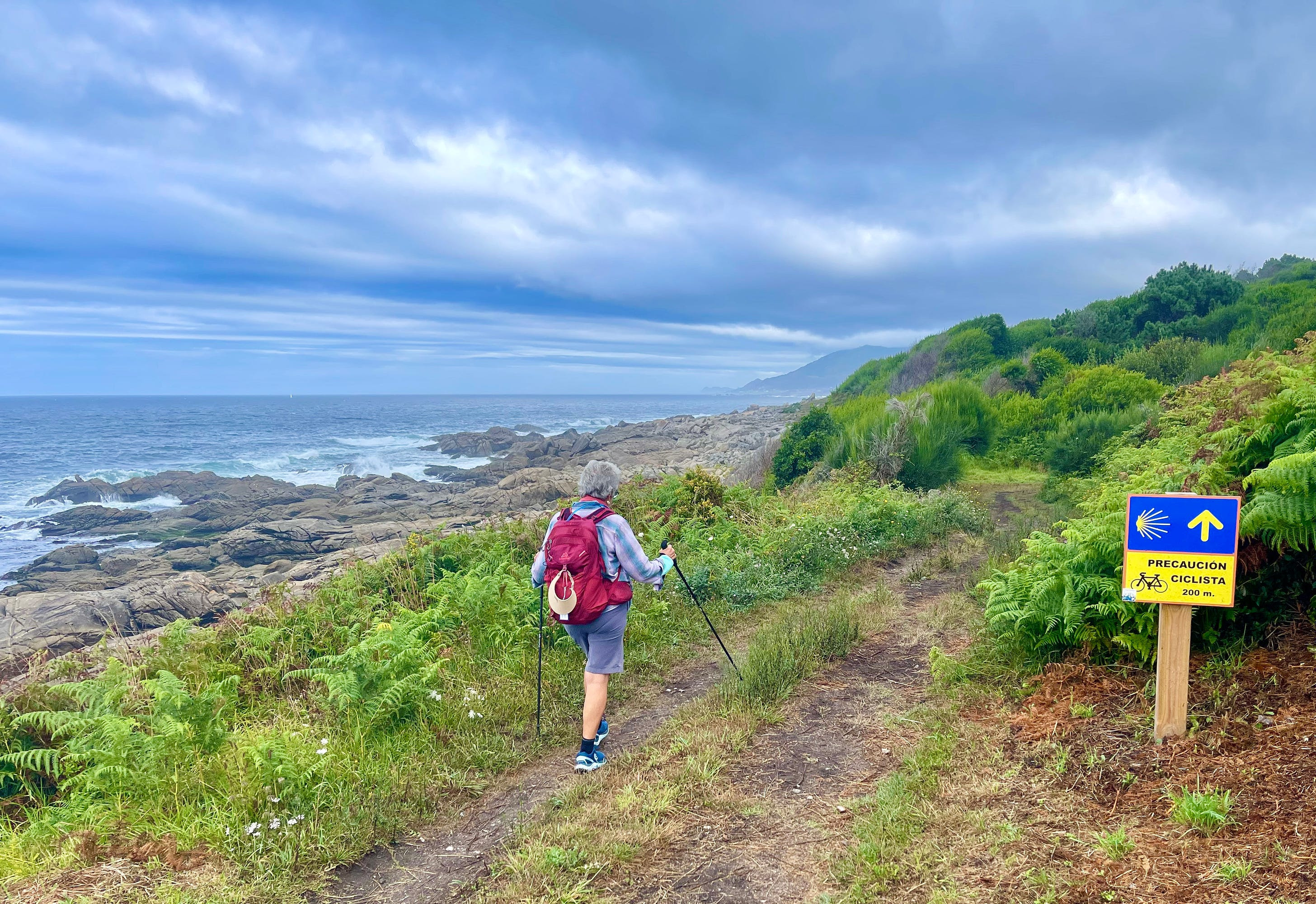
Here’s Becky on Camino Santiago’s coastal route. The path follows the rocky shores of the North Atlantic, just about due east of the Delmarva Peninsula by a few thousand miles.

SPANISH COAST – Our early September hiking along Camino Santiago’s coastal route carried us northward from A Guarda, near the border with Portugal. About 120 miles over seven days to Santiago de Compostela. Lots of rocky outcroppings and patches of beach, small vacation estates overlooking the Atlantic and nestled in tall dune grasses, clean and narrow stone-paved streets in small villages strung up against the sea.

Little churches and chapels of stone, houses and businesses of old stone construction–everything is built of stone and concrete including the landscape. It’s almost as if talented builders and the Tao Te Ching’s Master Carpenter planted magical stone seeds in the rocky underpinnings where they took root and grew and transformed in all kinds of minerally ways to become windows, walls, floors and roofs.

That’s right, they just grew up out of the ground that way.  (Strong coffee folks, that’s all I can tell you.) All stone except for the terracotta roof tiles.  I guess they burned up all the wood centuries ago for heat and cooking.

Entropy.  Taking the energy stored in wood and converting it for other uses. Entropy.  Releasing energy stored in walls protecting our egos so it can move to other parts of our brain for creative expression and understanding.

The Camino took us up and down coastal terrain through thick natural shrubbery and–closer to the paralleling coastal highway–across asphalt parking lots for touristy hotels, cafes and restaurants.

With August and vacation season behind us though, this was a quieter time. Also, at this distance from the final destination, not as many pilgrims greeted us with the ubiquitous Buen Camino! salutation.

Of course the closer we came to Santiago, the more populated the path became with the convergence of other Camino routes.

Halfway in the first day’s 18-mile hike, a red lighthouse perched high on a mountainous rocky outcropping in the distance north of us. While cautioning the maritime trade, the lighthouse for us also served notice that our way was about to turn eastward into Spain’s interior.

Clearly, ancient travelers afoot wanted to go eastward around that forbidding mountainous impediment as much as wary mariners wanted to stay westward of its dangers slinking down in hiding beneath the waves.

That interior section of the Camino over the much-less elevated pass imprinted the age of this journey deep and viscerally on my mind. Despite its rockiness, millions of travelers over thousands of years have helped level this often-steep section.

We picked our way over everything from gravel-sized stones to the rounded tops of vehicle-sized boulders. At one point I found myself staring at and mesmerized by wooden cart wheel-width ruts worn inches deep into solid granite. The agreeable scent of bordering tracts of cultivated eucalyptus forest further stayed my step as I considered the ruts.

If you’re thinking the same as I am, yup, you obviously know I was in a rut. But it was a pleasant rut I was in no hurry to shed.

Here was slightest but primary communication with ancients, like discovering an arrowhead in a freshly plowed field, holding it in your hand and thinking about the last hand that held it.  Communication was there in as common a thing as a rut. Ego melted in that consideration, melding my soul with countless others across the almost limitless scope of human experience.

Roman legions and their traveling communities eventually evolved into steadily northward flowing currents of pilgrims seeking a different form of treasure and higher authority.

John Denver sang about it with the Nitty Gritty Dirt Band: “Mountains may disappear, rivers will dry up, and so it goes with everything but love.”

But what about the rain-punctured egos I promised in the previous post? They’re up next but I’ve asked enough of you today.  If you’ve stayed with me this far, thank you for reading.  And don’t forget to spread a little love around.  A little by lots of us goes a long way.

Buen Camino!

Please notice the wooden wagon wheel ruts worn into the granite through ages of travel over this pass along the Camino Santiago. 


DENNIS FORNEY PHOTOS

Dennis Forney has been a journalist, editor, publisher and photographer on the Delmarva Peninsula since 1972. He writes from his home on Grace Creek in Maryland’s Talbot County.

The Spy Newspapers may periodically employ the assistance of artificial intelligence (AI) to enhance the clarity and accuracy of our content.

Filed Under: 3 Top Story, Spy Journal

Delmarva Review: You Learn Transaction, Before Anything Else by Marlowe Jones

September 21, 2024 by Delmarva Review Leave a Comment

Author’s note: This poem spurred several conversations among my classmates about the ethics of writing about one’s family. To me, it’s about nostalgia and childhood innocence, how innocence is another word for ‘ignorance’, and how childhood nostalgia doesn’t discriminate between negative and positive experiences. I attempt to communicate this disconnect between reality and memory with my lack of capitalization and my choppy line breaks and enjambments. As for the ethics, I landed on this: where else can I say what happened, if not a poem?

You Learn Transaction,
Before Anything Else

this is the game
this is how it works

dad dares you you
do the dare dad 

pays you money
the first dare is small 

eat the hot peppers
in the bottle in the diner 

booth you get five bucks
you swallow six peppers 

ask him if that means you
get 30 he laughs which means 

not this time but you keep
that in mind the next dares 

go quick you squeeze small body
into even smaller spaces you 

get ten bucks you lick
the frozen bus stop 

pole that’s fifteen would’ve
been twenty but your tongue 

didn’t stick the game has
one rule this is the rule 

you follow above all
don’t tell mom don’t 

tell mom any of this
and you don’t his money’s 

good the last dare the very
last but you don’t know 

that yet is out in the nowhere
by the railroad tracks dad 

says lay down you say how
long he says til i say get 

up you say how much
he says fifty you lay 

down close your eyes
spread hands on warm 

wood and wait for his
words or the rumble 

you lay still and dead
or close enough you think 

you hear a whistle three
stops off you wait for him he 

waits til the gates go ting
ting ting and pulls you off 

you say nothing you hold
out your hand he gives you 

the money you walk home
still saying nothing 

when mom asks if you had fun
you still follow the one rule 

and when he leaves three
weeks later for good this time 

you can only
think to yourself 

my god i should’ve
asked for more 

⧫

Marlowe Jones is a student in the Northeast Ohio Master of Fine Arts Program (NEOMFA)  through Cleveland State University. His poems have been published in Green Blotter, Sink Hollow, and The Courtship of Winds under a previous name. His interests outside poetry include horror movies, folklore, and birdwatching. 

The Delmarva Review, published in St. Michaels, MD, gives writers a desirable home in a printed edition (with an electronic version) for their most compelling new prose and poetry. Available to all writers for their best work, the review has been produced  at a time when many commercial  publications (and literary magazines) are closing their doors or reducing literary content. For each annual edition, the editors have read thousands of submissions to select the best  new poetry, fiction, and nonfiction. Almost half of the writers are from the Delmarva and Chesapeake region. As a 501(c)(3) nonprofit, support comes from tax-deductible contributions and a grant from Talbot Arts with funds from the Maryland State Arts Council. Website: www.DelmarvaReview.org


The Spy Newspapers may periodically employ the assistance of artificial intelligence (AI) to enhance the clarity and accuracy of our content.

Filed Under: 3 Top Story, Delmarva Review, Spy Journal

From and Fuller: Politics and Rhetoric After 2nd Attempt on Donald Trump and Andy Harris’s Freedom Caucus

September 19, 2024 by Al From and Craig Fuller Leave a Comment

Every Thursday, the Spy hosts a conversation with Al From and Craig Fuller on the most topical political news of the moment.

This week, From and Fuller discuss the political consequences of the second attempt on Donald Trump’s life and the potential for his security to become a campaign issue. Al and Craig also chat about Rep. Andy Harris’s appointment as the new chair of the Freedom Caucus this week.

This video podcast is approximately sixteen minutes in length.

To listen to the audio podcast version, please use this link:

Background

While the Spy’s public affairs mission has always been hyper-local, it has never limited us from covering national, or even international issues, that impact the communities we serve. With that in mind, we were delighted that Al From and Craig Fuller, both highly respected Washington insiders, have agreed to a new Spy video project called “The Analysis of From and Fuller” over the next year.

The Spy and our region are very lucky to have such an accomplished duo volunteer for this experiment. While one is a devoted Democrat and the other a lifetime Republican, both had long careers that sought out the middle ground of the American political spectrum.

Al From, the genius behind the Democratic Leadership Council’s moderate agenda which would eventually lead to the election of Bill Clinton, has never compromised from this middle-of-the-road philosophy. This did not go unnoticed in a party that was moving quickly to the left in the 1980s. Including progressive Howard Dean saying that From’s DLC was the Republican wing of the Democratic Party.

From’s boss, Bill Clinton, had a different perspective. He said it would be hard to think of a single American citizen who, as a private citizen, has had a more positive impact on the progress of American life in the last 25 years than Al From.”

Al now lives in Annapolis and spends his semi-retirement as a board member of the Medill School of Journalism at Northwestern University (his alma mater) and authoring New Democrats and the Return to Power. He also is an adjunct faculty member at Johns Hopkins’ Krieger School and recently agreed to serve on the Annapolis Spy’s Board of Visitors. He is the author of “New Democrats and the Return to Power.”

For Craig Fuller, his moderation in the Republican party was a rare phenomenon. With deep roots in California’s GOP culture of centralism, Fuller, starting with a long history with Ronald Reagan, leading to his appointment as Reagan’s cabinet secretary at the White House, and later as George Bush’s chief-of-staff and presidential campaign manager was known for his instincts to find the middle ground. Even more noted was his reputation of being a nice guy in Washington, a rare characteristic for a successful tenure in the White House.

Craig has called Easton his permanent home for the last eight years, where he now chairs the board of the Chesapeake Bay Maritime Museum and is a former board member of the Academy Art Museum and Benedictine.  He also serves on the Spy’s Board of Visitors and writes an e-newsletter available by clicking on DECADE SEVEN.

With their rich experience and long history of friendship, now joined by their love of the Chesapeake Bay, they have agreed through the magic of Zoom, to talk inside politics and policy with the Spy every Thursday.

The Spy Newspapers may periodically employ the assistance of artificial intelligence (AI) to enhance the clarity and accuracy of our content.

Filed Under: 1A Arts Lead, From and Fuller, Spy Highlights, Spy Journal

A Second Assassination Attempt on Trump by J.E. Dean

September 18, 2024 by J.E. Dean Leave a Comment

The 2024 presidential election keeps getting uglier and uglier. Last week, we heard more about immigrants eating pets than about school children who don’t get lunch. We also read that Donald Trump took a conspiracy theorist who speculated that the September 11 terrorist attacks were an “inside job” to events memorializing those attacks. 

I was reading about Ms. Loomer when the news about the assassination attempt was posted. I was relieved that it was immediately clear that Trump was not hurt. 

Fortunately, police spotted the shooter in time and eventually apprehended him. We should be grateful for the excellent work of the Secret Service and other law enforcement officers involved.

The suspect, Ryan Wesley Routh, is now in custody. Unlike the shooting in Butler, Pennsylvania, authorities will be able to fully understand why Routh sought to kill Trump. That information will be useful but could also be dangerous if it motivates more political violence. 

Trump, like Kamala Harris, Joe Biden, and dozens of other political figures, is hated by some. That hate, some of it reflecting policy disagreements on issues like immigration, reproductive rights, civil rights, education, and foreign policy, and some of it reflected in race-hate, misogyny, or even the way a candidate looks, is a fact of life for candidates. You cannot run for office in the United States without experiencing it.

Running for public office involves receiving threatening letters, including death threats, efforts to produce damaging information to use in campaigns, and the risk of assassination. As a result, many people who would be outstanding candidates for public office do not run. The risks outweigh the benefits, especially the possibility of assassination.

After the first assassination attempt on Trump on July 13, I was appalled when the ex-president’s campaign launched fundraising efforts intended to monetize the event. I was disgusted when Trump and other suggested that God had intervened to save Trump—if God wanted to save Trump, he would have prevented the shooter from taking a shot at him. Right?

I was equally appalled at sick humor suggesting it was unfortunate that the assassin’s bullet missed. I heard, “He had it coming” and “violence begets violence.”  I do not subscribe to the eye for an eye principle. 

Everyone should condemn both attempts on Trump’s life and pray that another would-be assassin does not make a third attempt on Trump, Harris, or anyone else. That risk is higher than ever now.

Political violence is an attack on democracy. Had either assassination attempt against Trump been successful, I would be denied my opportunity to vote against him. The entire 2024 election would also have been thrown into chaos. Given Trump’s dominance in the Republican party, there is nobody to replace him on the ticket. Certainly not J.D. Vance.

If Harris won the election (against who?), many people would not accept her presidency as legitimate, especially Republicans who, regardless of what police uncovered about the assassination, would blame the Democrats.

Hate can kill democracy, not only because democracy does not work without civil discourse between candidates, but because hate injects fear into voters and candidates. Hate distracts everyone from talking about America’s future and how government should serve the people. And hate makes us question whether we are human enough to be able to govern ourselves.

J.E. Dean is a retired attorney and public affairs consultant. He writes on politics, government, and, too infrequently, other subjects.


The Spy Newspapers may periodically employ the assistance of artificial intelligence (AI) to enhance the clarity and accuracy of our content.

Filed Under: 3 Top Story, J.E. Dean, Spy Journal

My Five Favorite Books I Have Read this Year by Maria Grant

September 17, 2024 by Maria Grant Leave a Comment

As an active member of three book clubs, I read a lot of books. Since I assume you are all caught up on political news, I thought I would share my top five favorite books I’ve read so far this year. 

No. 5. Absolution. The setting for Alice McDermott’s book is Saigon, 1963. The focus is on the “wives” whose husbands have important jobs in Vietnam—foreign service, military, big corporations. The wives are portrayed as “helpmates.” The story is told in retrospect from decades later by letters from one “helpmate” to and from the daughter of another “helpmate” whose mother had died. McDermott was motivated to draft this novel after reading Graham Greene’s The Quiet American. It made her think about Greene’s so called “unimportant characters” perhaps not being so “unimportant.” When considering a title, McDermott met with a good friend of hers, a monsignor in New York. She told him she was thinking of calling her novel Absolution. The monsignor explained that most people do not understand the true meaning of that word. They think it means a get-out-of-jail-free card. But he explained that if you look at the Latin root of the word absolution, it means one who is set free and one who sets free. McDermott then said, “That’s perfect. That’s what I will name my book.”

As an aside, when I was researching information about this book for my Eastern Shore book club, I discovered that McDermott lives in Bethesda. I emailed her and asked if she would have any interest in coming to our book club meeting. She wrote me back that she would love to but was in New York that week. She asked that I let her know how the book club discussion went. I sent her a return email, summing up our discussion which was very favorable. She then replied with a substantive email reviewing some major themes and quoting Flannery O’Connor and more. I thought that was amazing! So is this book.

No. 4. The Situation Room. In this book, George Stephanopoulos details how 12 different presidents dealt with crises during their administrations in the situation room. He tracks events ranging from the defeat of Vietnam, to the defeat of the Soviet Union, to 9/11, to capturing Osama bin Laden, to January 6 and more. The book gives fascinating information about the origins of the room, the improvements that were made to the room over the years and details the numerous ways different presidents used the room. For Jimmy Carter, it was a place he went each day. For Donald Trump, not so much. The book is insightful, entertaining, well-researched and a must-read for those who want to learn more about exactly what transpires when momentous events occur. 

No. 3. Tom Lake. Ann Patchett’s Tom Lake takes place in a cherry orchard in Northern Michigan. The story revolves around a mother and father and their three adult daughters who are thrown together at the family’s cherry orchard during Covid. While they pick cherries, the mother tells them about her short-lived career as an actress while playing Emily in Thorton Wilder’s play Our Town. Her co-star in the play goes on to become a famous actor. Much of the story revolves around their relationship and the decisions that they make that form the trajectories of their lives. Patchett expertly weaves in themes from Chekov’s Cherry Orchard, and Wilder’s Our Town. You will learn a lot about cherries and the fact that, “Sweet cherries must be picked today and every day until they are gone.” In other words, it is important to take time to enjoy life’s simple pleasures. I loved this book. Meryl Streep reads the audio version, and she is, of course, spectacular. 

No. 2. Demon Copperhead. Barbara Kingsolver’s Demon Copperhead reimagines Dicken’s David Copperfield. She places her story in poor and opioid-addicted rural Appalachia. This novel deals with the shortcomings of American education, the plight of true poverty, and the fact that big pharma contributed mightily to the opioid crisis through its aggressive marketing of Oxycontin.

The first line of David Copperfield is, “Whether I shall turn out to be the hero of my own life, or whether that station will be held by anybody else, these pages will show.” The first line of Copperhead is, “Save or be saved, these are questions.” 

A brilliant masterpiece, Demon Copperhead won the Pulitzer Prize in 2023. 

No. 1 James. James by Percival Everett is my favorite book this year. Everett is a Renaissance man in the true sense of the word. He teaches writing at USC, as well as a course in the American Western film genre. He is an abstract painter. He is an avid fly fisherman who makes his own lures. He is married to Danzy Senna who is also a professor and author who recently published the acclaimed novel Colored Television (It was reviewed in Sunday’s NY Times Book Review.) And he is a prolific writer who has written more than 30 books. (His novel Erasure was turned into the Oscar-nominated film American Fiction—one of my favorite movies last year.)  This year, James has been nominated for the Booker Prize, the Pulitzer Prize, and the National book Award. Similar to Kingsolver basing her story on David Copperfield, Everett based his story on the slave Jim, in Mark Twain’s Huckleberry Finn. 

In Everett’s novel, James expertly gives white folks what they want. That means that White folks have no idea that James can read and write and often has conversations in his head and in his dreams with Locke, Rousseau, and Voltaire. What I loved most about James is Everett’s depiction of a deep-thinking James who grapples with complex concepts about race, the bible, philosophy, justice, hypocrisy and, of course, freedom. It is a stunning expose about how the White man has consistently underestimated the Black man throughout history. 

For those of you who attended last week’s book talk at the Avalon Theater hosted by Shore Lit founder Kerry Folan and featuring Christopher Tilghman and his new book On the Tobacco Coast, prolific writer and professor Carole Boston Weatherford and her son, as well as Jason Patterson, an African American history-based artist, you will recall that these same concepts were discussed. The four speakers talked about how much history just “got wrong” and how few historians and authors have delved deep into the cerebral depths of many slaves. 

In James, a pencil and a notebook are symbols for freedom—freedom of thought. They represent the concept that thoughts and ideas are something no White man can take from him. It made me think about the book banning going on in today’s world–an effort to squelch the freedom to think about things in a different light—to let the darkness prevail. 

By the way, we held our book club meeting at Book Hounds, a delightful and cozy new bookstore in St. Michaels. Be sure to check it out.

Here is a quote from the author Roald Dahl. “Oh please, oh please we beg, we pray. Go throw your TV set away, and in its place, you can install a lovely bookshelf on the wall.”  Yes indeed. 

Maria Grant was principal-in-charge of the federal human capital practice of an international consulting firm. While on the Eastern Shore, she focuses on writing, reading, piano, kayaking, and nature. 


The Spy Newspapers may periodically employ the assistance of artificial intelligence (AI) to enhance the clarity and accuracy of our content.

Filed Under: 3 Top Story, Maria, Spy Journal

  • « Previous Page
  • 1
  • …
  • 6
  • 7
  • 8
  • 9
  • Next Page »

Copyright © 2026

Affiliated News

  • Chestertown Spy
  • Talbot Spy
  • Cambridge Spy

Sections

  • Sample Page

Spy Community Media

  • Sample Page
  • Subscribe
  • Sample Page

Copyright © 2026 · Spy Community Media Child Theme on Genesis Framework · WordPress · Log in