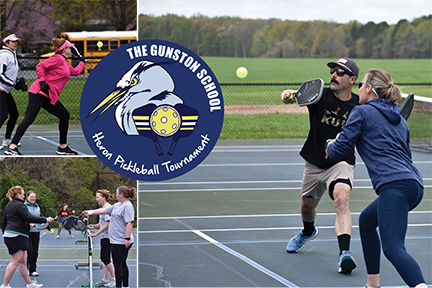

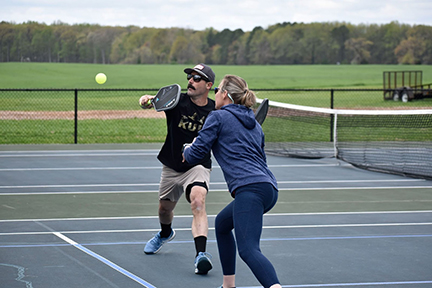
Heron Pickleball Tournament Event Chair Megan Owings, P’29 (right) teamed up with Ben Herr, P’28. This year’s event will be held on Gunston’s waterfront campus in Centreville, Md. on April 18 beginning at 9 a.m.
The Gunston School is once again hosting its Heron Pickleball Outdoor Tournament on Saturday, April 18 at its waterfront campus in Centreville, Md. beginning at 9 a.m. The format will be round-robin or double elimination, depending on the number of registered teams, with men’s doubles, women’s doubles, and mixed doubles teams playing on Gunston’s tennis courts. Beginners will compete in the morning followed by intermediate then advanced players will compete in the afternoon with a detailed schedule to follow their registration.
All funds raised support Gunston’s 21 varsity sports teams, along with select junior varsity programs that comprise Heron Athletics. Check in opens at 8:30 a.m. with Gunston celebrity guest and long-time faculty member Mr. Ben Dize, who will be flipping his famous chocolate chip pancakes for participants. Those who wish to participate and do not have a partner will be paired with someone of a similar skill level.
“This is a great opportunity to come onto a beautiful campus, play pickleball, and help support athletics at Gunston,” says Chair of the Event, Megan Owings, P’29.
The cost to participate is $40 per player. Current students and faculty/staff can participate for a reduced rate of $25 and alumni pay $35.
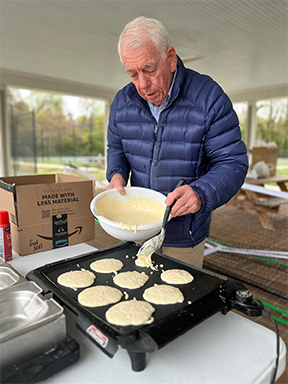
Longtime faculty member, Mr. Ben Dize will be kicking off the Heron Pickleball Tournament on April 18 at Gunston by making pancakes, beginning at 8:30 a.m.
Registration closes on Monday, April 7. Sponsorships are available starting at $150 up to $2,500 for a premier event sponsorship. Registration and sponsorships are available at http://gunston.org/
Heron Pickleball Tournament sponsors include Grand Slam sponsors Fred Frederick Chrysler Jeep Dodge Ram of Easton (Janell & Jeffrey Frederick, P’23’25), Court sponsors Joyce & Associates, LLC (Kevin & Christine Joyce, P’26’29), Easton Dermatology Associates, LLC (Brigitte & Dr. Donald Stranahan, P’25’27), and Dr. Horace K. Wood, DMD, PA – Oral & Maxillofacial Surgery (Leigh & Dr. Horace K. Wood, P’24’27).
Volley sponsors include McCallister, Detar, Showalter, & Walker (Adele & Ryan Showalter, P’25’27 and Melissa & Doug Walker, P’25’27), Paul Ewing’s Contractor Supply (Pam & Charlie Andrews, P’26), Eastern Shore Vacation Rentals, P’23’27) and Friends of Gunston.
Paddle Sponsors include PepUp (Melanie & Nash McMahan, P’27’28), Molly’s (Nick & Katie Shajwani, P’26), The Dreeke Family, P’28, David A. Bramble Inc., (The Owings Family, P’29), Ebb Tide Tent & Party Rentals, The Malone Family, Wye Gardens (Will Gordon, P’28’29), Ash & Ember (The Herr Family, P’28), Parker Counts Law Firm (Lee Gordon, P’28’29), ShoreGate Partners (Chesley & Justin Nonemaker, P’27’29), Building System Solutions, Smith & Weston Construction, The Shifrin Family, P’21’21, and Dr. Laurie & John Lewis, P’29.