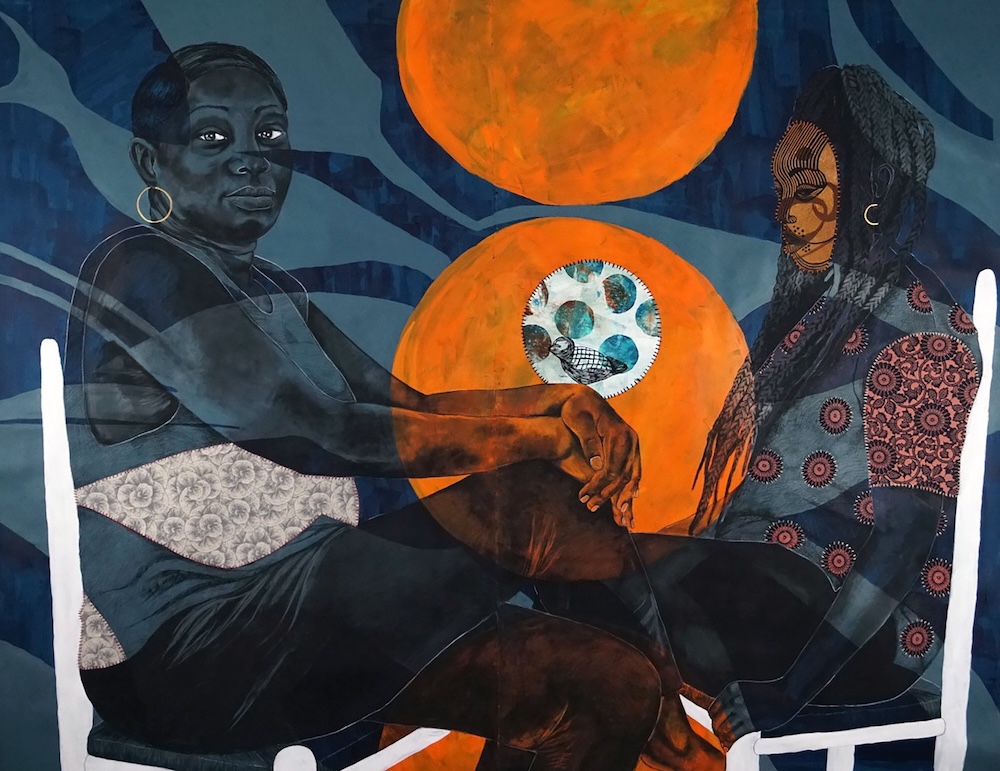


Delita Martin was born in 1972 in Conroe, Texas, near Houston, and continues to live and work in nearby Huffman. She says, “Everybody in my family made art. We would paint, we would draw, we’re storytellers. I was whining because I wanted to go to art school, and I didn’t realize I grew up in an art school! Quilters, storytellers, writers. And this was something that we did every single day. We just woke up and did it.”
She recalls that starting when she was five years old, her parents would introduce her to people and “always add that I was going to be an artist when I grew up, so it never really occurred to me to have a plan B or to consider that being an artist wasn’t a possibility.” A major influence on her and her family was their friendship with John Biggers (1924-2021), a prominent artist in the Haarlem Renaissance.
Martin received a BFA in drawing in 2002 from Texas Southern University and an MFA in printmaking in 2009 from Purdue University. She opened her studio, the Black Box Press, in Houston in 2008. She served as a part-time faculty member at the University of Arkansas in Little Rock from 2008 until 2012, and she was promoted to full-time in 2013. Her work became nationally recognized in 2011 when she was chosen for the College of Liberal Arts Emerging Voice Award. In 2015, the International Review of African American Art referred to Martin as one of sixteen “African American Artists to Watch.”
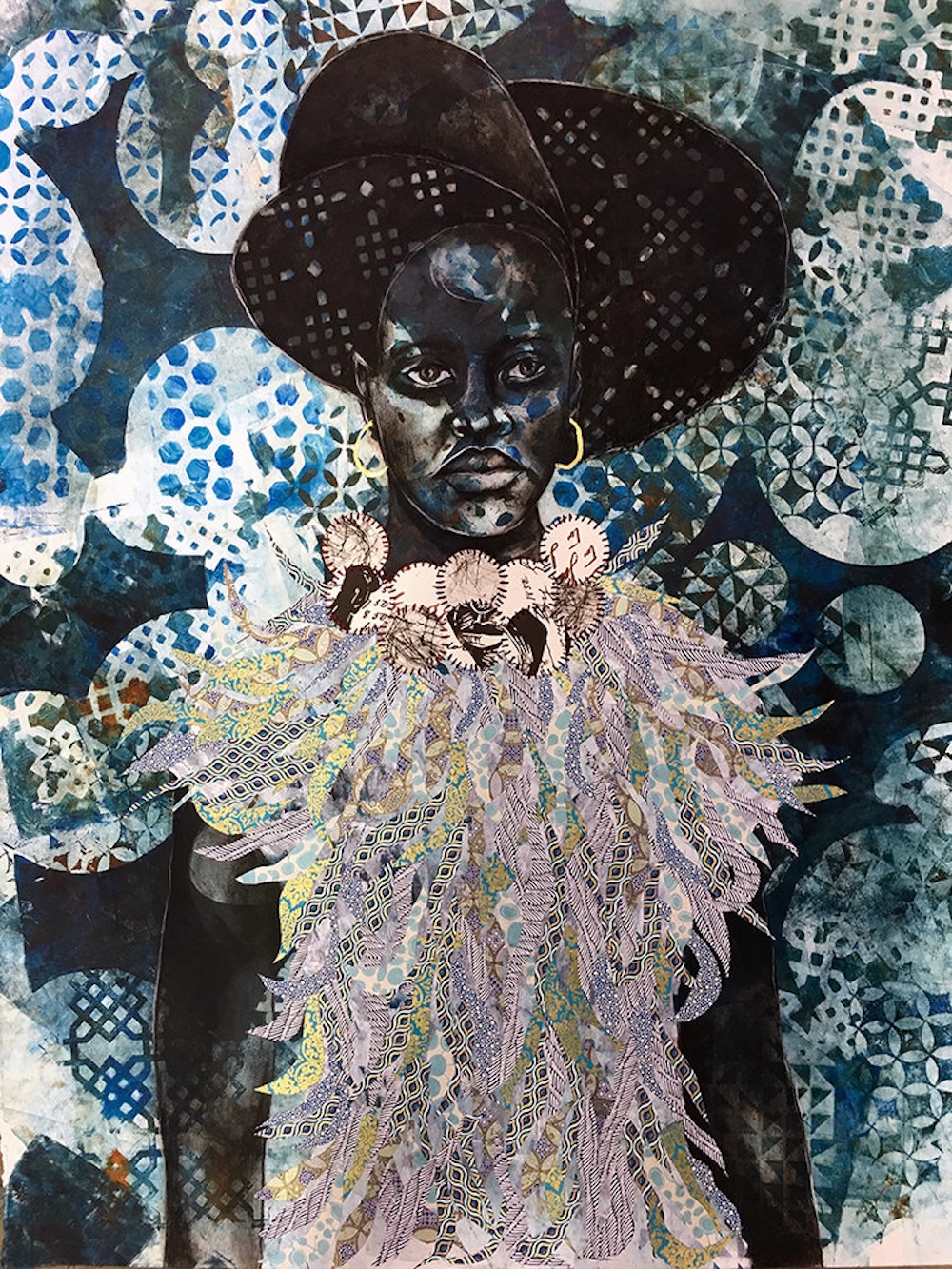
“Black Bird” (2016)
From the beginning, Martin was clear about her work: “The pieces are about my discovery of who I am as a person, an artist and a woman and how all the components come together to make me who I am.” She deals with the exclusion of African American women in the past and in the present. Her works are mixed media that begin with her photographs of family and friends. The process can include acrylic paint, relief print, lithography, charcoal, hand stitching, and anything she decides to attach to complete the story.
“Black Bird” (2016) (50’’x39’’) (Daughters of the Night series) is a photograph of herself, identifiable by the gold hoop earrings. “My ears were pierced when I was six months old with tiny gold hoops. The style of earring has become a symbol of inclusion in my work. Not only is it a circle, thus symbolizing the female, but it represents notions of totality, wholeness, the infinite, eternity, timelessness, and all cyclic movement.” Behind the figure are black circle shapes that enclose the blue and white honey comb patterns. Several different pattern pieces are cut in the shape of feathers provide the black bird’s garment. She stares out at the viewer, making eye contact and announcing her presence. No longer in the darkness, no longer invisible, she is present in today’s conversation.
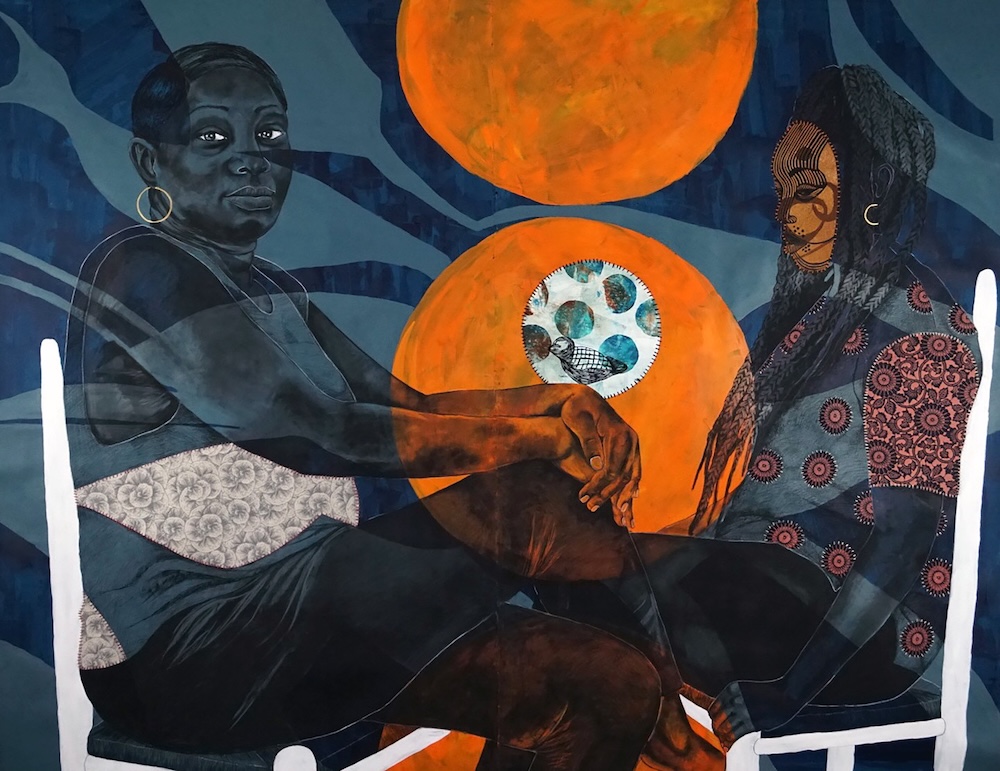
“The Moon and Little Bird” (2018)
“The Moon and Little Bird” (2018) (79”x102”) (gelatin printing, collagraph printing, relief printing, decorative papers, hand-stitching, and liquid gold leaf on heavyweight papers) (Between Spirits and Sisters series) is influenced by Martin’s interest in the dual worlds, the physical and the spiritual. She refers to her sitters as spirit women. Her interest in her African origins led her to research the roles of African women. In Sierra Leon, West Africa, the women of the Sande society wear black helmet Sowei masks as shown on the woman at the right side of the work. The masks represent the ideal of ancestral beauty along with the elaborate braided hair styles. Rings around the neck represent the water through which women enter the physical world from the spirit world. Sande society, managed only by women, is responsible for enforcing the moral code. The mask is worn during initiations of young women into adulthood which involves their role in the community.
Martin, wearing her gold hoop earrings, sits calmly opposite the mask wearer and looks directly at the viewer. Sande society women are the only women in Africa that wear masks. Men are excluded in this space. Martin explains that this space is private and secret where women can express and exchange ideas freely. She describes the use of large scale works as making a “connection on a more intimate level…labor intensive…large scale to be seen and felt.” The question the work inspires is, “Are you the viewer or are you being viewed?”
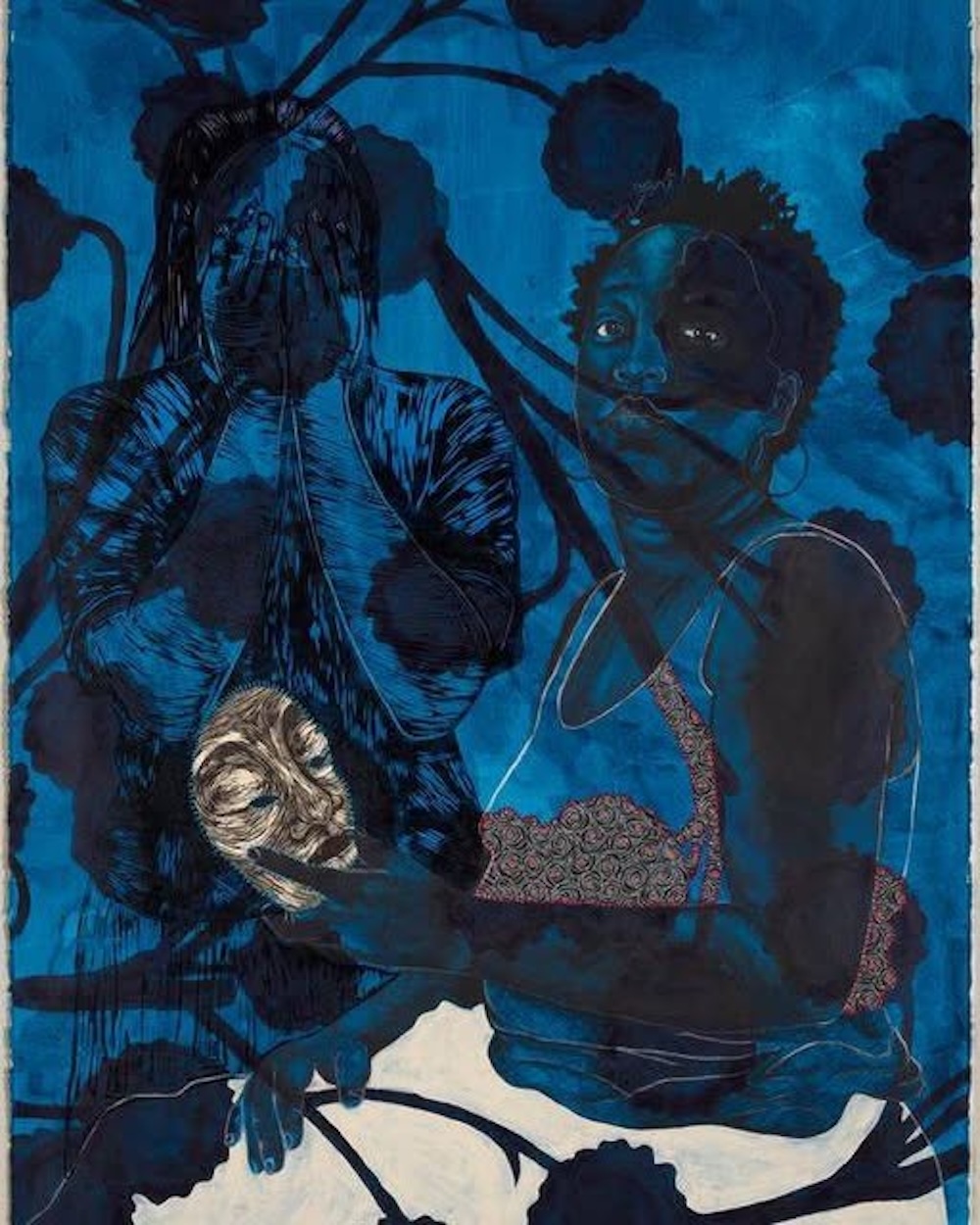
“The Soaring Hour” (2018)
In “The Soaring Hour” (2018) (71”x51”) (Between Spirits and Sisters series) Martin again places herself in a vibrant blue night setting. Blue is symbolic of spirituality in many cultures, including Christianity, for example, in the Virgin’s blue gown. Martin holds a Sande mask, a symbol of a woman’s dual existence in one body. She calls these images a “veil state, the state between waking life and the spirit life.” Flowers and vines surround her. The painting is meant to inspire women to reach for and to achieve new experiences and new heights. “Flying isn’t always about escape, it’s also about freedom,” says Martin.
“Guardian” (2019)
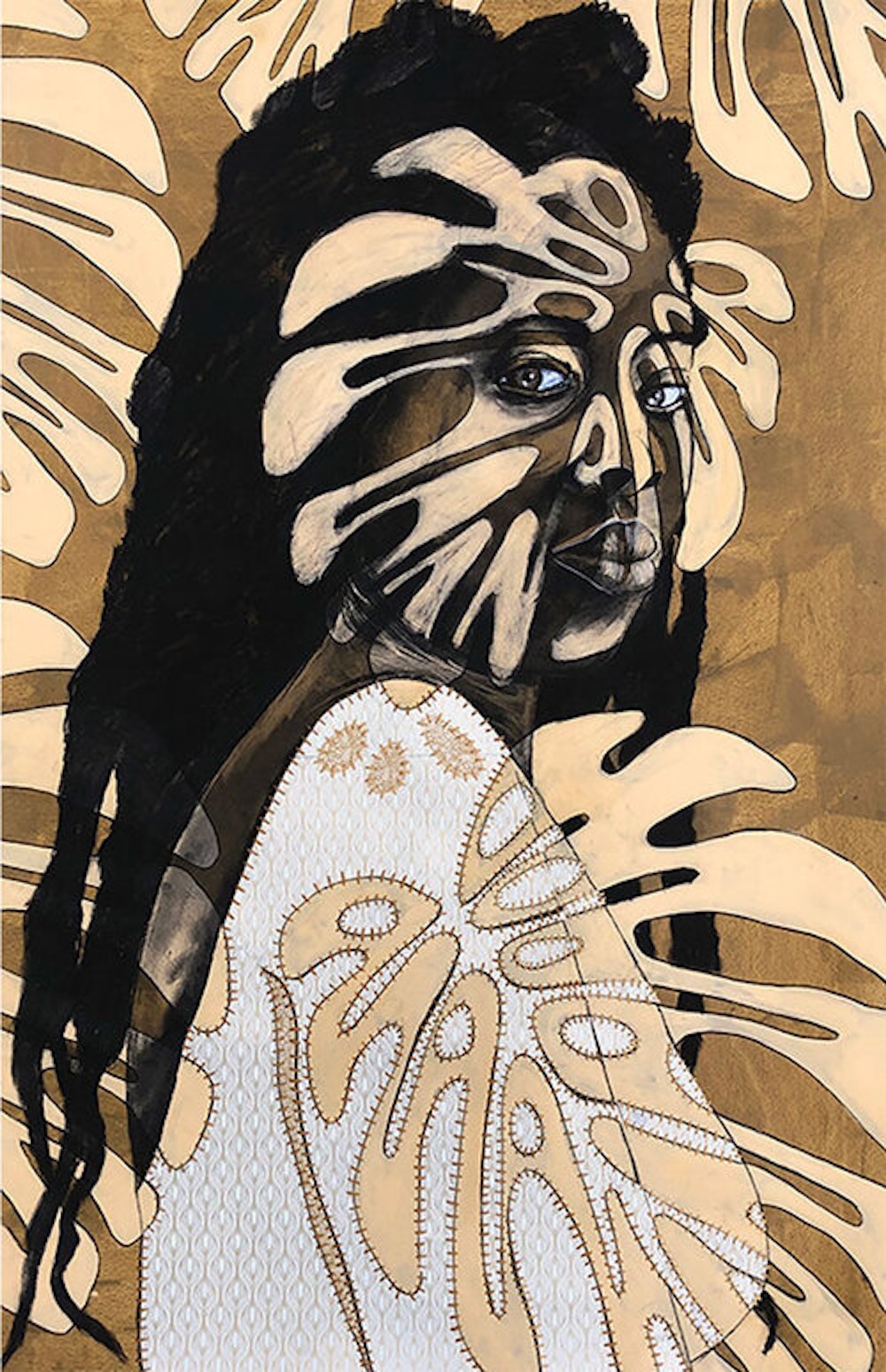
“Guardian” (2019) (44”x30”) is an image Martin chose for her book Shadows in the Garden (2019). “I grew up surrounded by gardens and all kinds of farm animals. I often reflect on getting up early in the morning to pick fruits and vegetables with my grandma, my mama, and other women in my family. The seeds of these experiences working with land, tilling the earth, and being engaged with the elements of my environment have bloomed into what you’re recognizing in my work with the integration of birds, plants, and flowers.”
“Blue is the Color We See Before We Die” (2021)
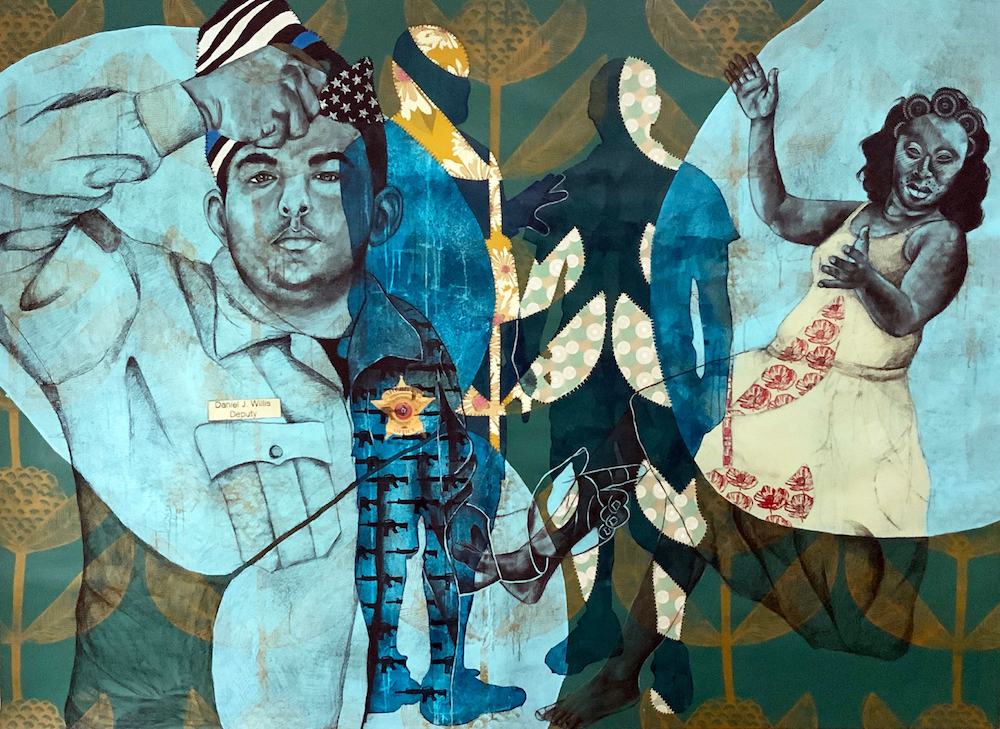
“Blue is the Color We See Before We Die” (2021) (8’x6’) is a depiction of Yvette Smith, wearing the Sande mask, who was killed on the doorstep of her friend’s house in Texas on February 16, 2014, by Sheriff’s Deputy Daniel Willis. Her pose suggests she might be dancing. Her white dress is decorated with red poppies, where the fatal shots entered her body. Willis, in light blue, is removing his mask. His badge stands out against dark blue and black images of assault rifles on legs. The central figure composed of geometrical shapes is Smith’s neighbor Willis Thomas. The background consists of flowers and leaves on tall stems.
“Blue is the Color We See Before We Die” was commissioned in 2021 by the Law Enforcement Accountability Project (LEAP), ARRAY, and Ava Vernay. It was “dedicated to empowering activists as they pursue narrative change around the police abuse of Black people.” (LEAP)
The National Museum of Women in the Arts sponsored “Calling Down the Spirits,” an exhibit of Martin’s work in 2020. Her work was included in the 2022 Venice Biennale. Recent exhibitions include “Gathering of Bones” (Germany in 2022), “Sometimes My Blues Change Colors” (Massachusetts in 2024), and “What the Night Knew” (Texas in 2024).
“Mythologies” (2024)
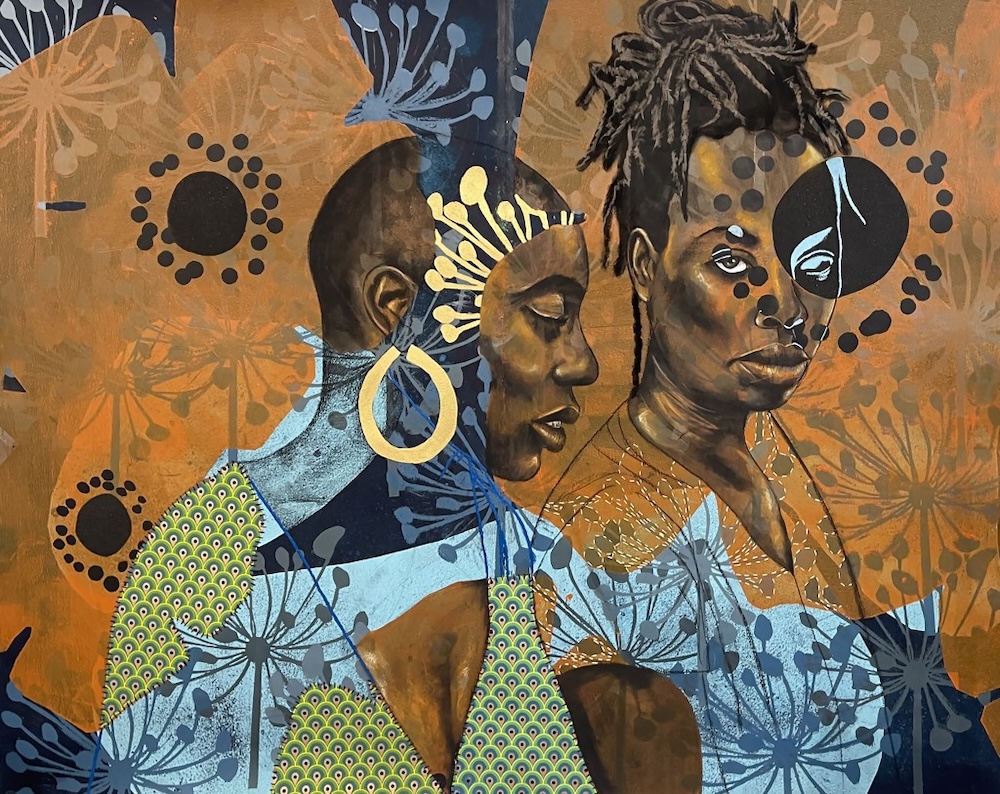
“Mythologies” (2024) (60”x80”) was included in the exhibit “What the Night Knew.” The two female figures are the principal element in this work. The gold circle earring, the black circles, the large flowers with seed pods, and the mixture of patterns are Martin’s signature images.
“I think what I’m most excited about is how Black Women, themselves are reframing how they see themselves and other Black Women when they view my work. One of the most political subjects to date is the Black female body. When you, as a Black Woman, can take ownership of your body image, present a narrative that you know to be true and present it to the world, it can be very powerful and impactful. My answer to the white gaze has been simply not to entertain it. I understand that in the art world certain levels of success require an unspoken validation from the white gaze. I have never felt I needed that type of validation. I have always subscribed to just making good art and being prepared to be a good steward of the success that it would bring.” (Delita Martin interview)
Note: Martin is represented by Galerie Myrtis in Baltimore.
Beverly Hall Smith was a professor of art history for 40 years. Since retiring to Chestertown with her husband Kurt in 2014, she has taught art history classes at WC-ALL and the Institute of Adult Learning, Centreville. An artist, she sometimes exhibits work at River Arts. She also paints sets for the Garfield Theater in Chestertown.
Write a Letter to the Editor on this Article
We encourage readers to offer their point of view on this article by submitting the following form. Editing is sometimes necessary and is done at the discretion of the editorial staff.