

Expressionist painter Edvard Munch (1863-1944) was born in Loten, Norway. He perhaps is best known for “The Scream” (1893), a painting that reveals his anxiety, alcoholism, and depression. He was weighed down by family members’ deaths when he was very young. Additional factors were his poor health and his father’s religious zeal and harsh discipline. As an expressionist he almost always chose emotion over realism. Munch also painted many portraits and landscapes. He spent his life in Norway, with trips to Paris and Germany.

“Winter in the Woods, Nordstrand” (1899)
This article on Munch’s lesser-known landscapes, winter settings in particular, explores a unique side of his work. By the time “Winter in the Woods, Nordstrand” (1899) (24”x 35”) (oil on cardboard) was painted, Munch had become known internationally. From 1899 through 1901, he painted several winter landscapes of the fjords at Nordstrand, south of Oslo. The setting of this piece is a dark spruce forest in the snow. No people are present, but footprints in the snow indicate that people recently had come this way. The heavy clumps of snow on the trees are fresh. The wind has not yet dislodged them. Munch used thick strokes of paint, but he let the tan cardboard show through in places. Like the Impressionists, whom he admired, he painted shadows in shades of blue. However, he also had a heavy hand with black. He was creating his personal style.
The painting, often described as melancholy, is a close-up view of the forest, the sky not included in the scene. But the sun shines across the exposed ground and causes the snow to glow. Munch depicted nature as raw and powerful with his use of broad sweeping brushstrokes. He explained, “Painting picture by picture, I followed the impressions my eye took in at heightened moments. I painted only memories, adding nothing, no details that I did not see. Hence the simplicity of the paintings, their emptiness.”
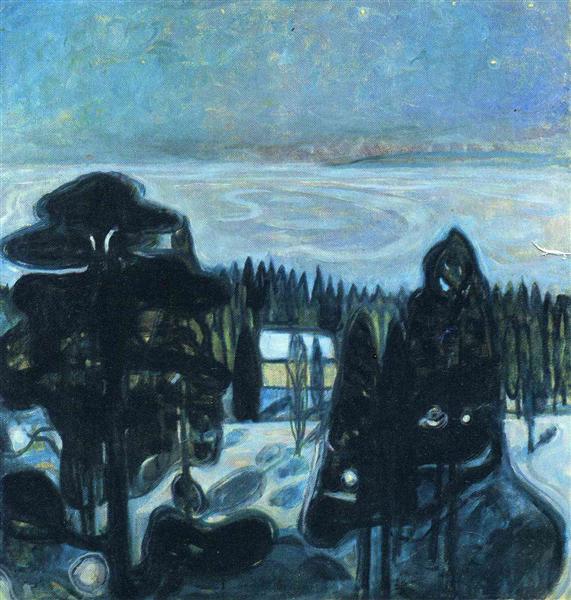
“White Night” (1901)
In winter in Norway, “polar night,” the scientific term for the phenomena, occurs when the Sun remains below the horizon. The title of the painting, “White Night” (1901) (45’’x44”), actually refers to the same phenomenon that occurs during the summer. The whiteness of the snow prevents the winter polar night from becoming completely dark. Munch painted the dark silhouette of the trees in the foreground, the snow and tree shadows in the middle ground, a tan barn with a snow-covered roof, another stand of spruce trees, and the swirling waters of the fjord and coast in the distance. The sky is sunless, but not dark. Munch’s use of black and cool blue colors produces the chill of the scene. Not at all depressing, the work is an expression of the beauty, power, and vast scope of nature’s many attitudes.

“Winter Landscape” (1901)
Munch painted numerous winter scenes, and like music, they are a theme and variations. “Winter Landscape” (1901) (32”x48”) focuses more on the field of white snow and the blue shadow cast by the spruce tree. Large red, brown, and black rocks stand out against the white snow. A row of shorter and taller trees in the distance also calls attention to the stars in the blue sky. Munch never tired of painting winter scenes
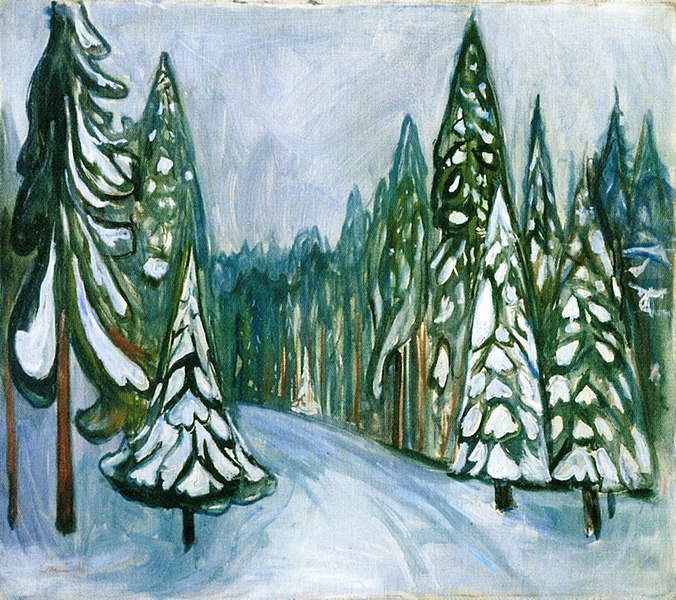
”New Snow” (1900-01)
“New Snow” (1900-01) (29’’x23’’) presents another view of a spruce forest. A wide road leads the viewer’s eye through the forest. It was well-used, but covered in fresh snow. Brown tree trunks are scattered through the forest and the spruce trees are painted fresh green. The stylized trees have just been covered by the stylized clumps of snow. Munch transformed the forest into something dreamlike, poetic, and timeless.
Munch suffered a physical and mental breakdown sometime during the period of 1908 through 1909, and he checked himself into a private sanitarium. On recovering, he declared he had become a teetotaler and a vegetarian. He returned to the town of Kragero and settled in there. He wrote, “I am now working full time, I feel, it now seems as if I am at my artistic peak. Never has my work given me so much joy.” He was honored in a Sonderbund exhibition in Copenhagen that included works by Van Gogh, Gauguin, and Picasso. Munch wrote, ”All the wildest things that have been painted in Europe are collected here–I am practically a pale classicist.”
Munch moved in 1916 to a country home in Ekely, near Oslo. The house, with a view of the city, sat on 11 acres that included an apple orchard. He built several studios. He lived a fairly isolated life and continued to paint landscapes. He nearly died during the 1919 Spanish flu epidemic. During that time, he had several exhibitions in major European cities.
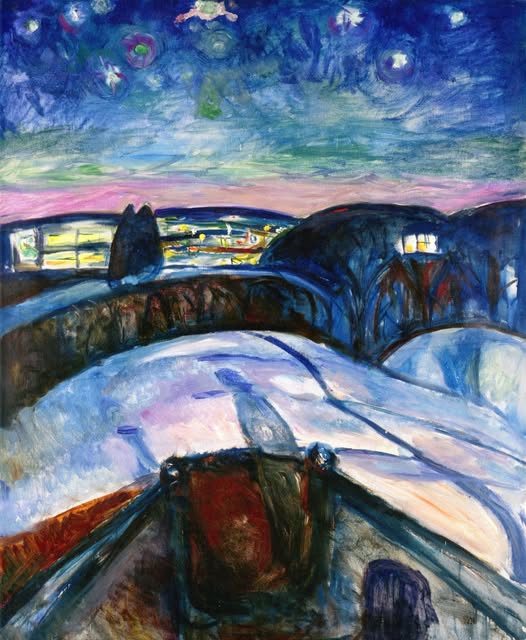
“Starry Night” (1922-24)
“Starry Night” (1922-24) (47”x39”) was one of the night sky series Munch painted from the top steps of his veranda. He often depicted himself as a lone shadow on the snow as he does here. Munch, the only figure in some of his paintings, is interpreted as loneliness and solitude which he preferred. He does include a view of the distant city. It is in the vastness of nature that human fragility, his own and humans in general, can be felt. There is a sense of life and time passing.
In this later style, Munch used more varied and more vivid colors. The color red carries through the work: the red of the veranda in the foreground, the red in the bridge, the red house with the white windows in the middle ground, the pink sky created by the Sun’s position below the horizon, and the reds and pinks in the stars set in the dark blue heaven. He often depicted the constellations of Jupiter or the Pleiades that intensified his sense of the celestial world.
The expressionism of Van Gogh’s “Starry Night” (1889) and Munch’s “Starry Night” often have been compared. Both works are considered masterpieces.

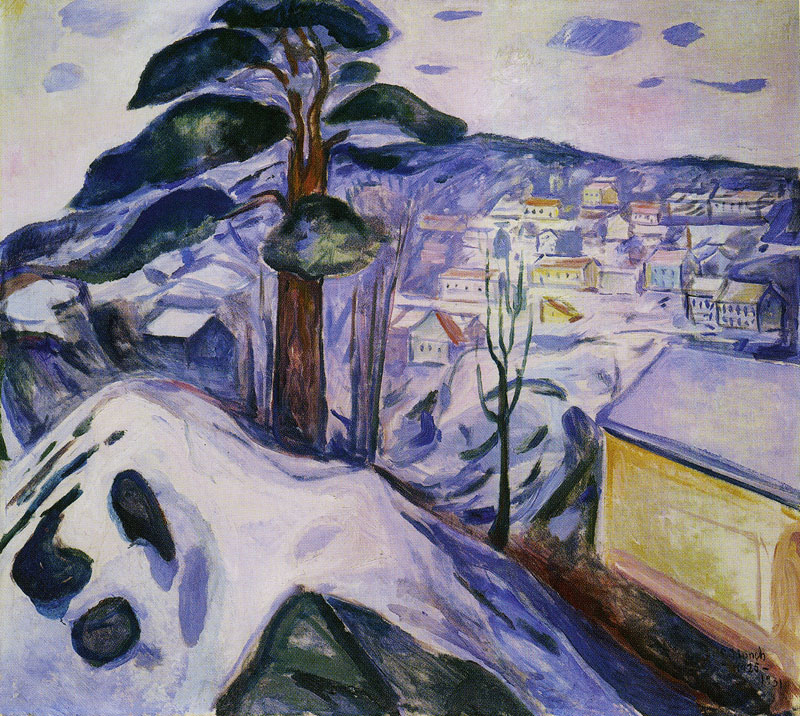
“Winter in Kragero” (1925-31)
Munch moved to Kragero in 1908 after his nervous breakdown. He found the light and environment stimulating. He began painting urban scenes in 1909. “Winter in Kragero” (1925-31) (54”x59”) is a depiction of the city from a distance. The large yellow building at the right of the canvas is set next to the snow-covered roof of a house, neither painted in detail. A tall tree and a very slim tree stand on the diagonal slope that leads to the city. Kragero’s buildings rise up the hillside, and behind them are mountains. Although he frequently included scenes of towns in his work, these later paintings place the town at a distance.
The Nazis designated Munch’s work as “degenerate art” in 1937, seized 82 of his paintings, and sold them to raise money. The paintings were taken from German museums and Jewish collections. A lost and then found Munch work “Dance on the Beach” (1906) sold at auction in 2023 for $22 million. Munch painted until he died on January 23, 1944. He willed to the city of Oslo his artwork and his collection of texts: 1150 paintings, 17,800 prints, 4,500 watercolors and drawings, 13 sculptures, his notebooks, and the plays and poems that he had written. The writings were unavailable to the public until January 1, 2015. Munch was a major catalyst in the development of the Expressionist style that continues to be of major significance in the progress of 20th and 21st Century art.
“Nature is not only all that is visible to the eye…it also includes the inner pictures of the soul.” (Edvard Munch)
Beverly Hall Smith was a professor of art history for 40 years. Since retiring to Chestertown with her husband Kurt in 2014, she has taught art history classes at WC-ALL and the Institute of Adult Learning, Centreville. An artist, she sometimes exhibits work at River Arts. She also paints sets for the Garfield Theater in Chestertown.
Write a Letter to the Editor on this Article
We encourage readers to offer their point of view on this article by submitting the following form. Editing is sometimes necessary and is done at the discretion of the editorial staff.