MENU

Sections

  • Home
  • Education
  • Donate to the Centreville Spy
  • Free Subscription
  • Spy Community Media
    • Chestertown Spy
    • Talbot Spy
    • Cambridge Spy

More

  • Support the Spy
  • About Spy Community Media
  • Advertising with the Spy
  • Subscribe
December 17, 2025

Centreville Spy

Nonpartisan and Education-based News for Centreville

  • Home
  • Education
  • Donate to the Centreville Spy
  • Free Subscription
  • Spy Community Media
    • Chestertown Spy
    • Talbot Spy
    • Cambridge Spy
00 Post to Chestertown Spy 1 Homepage Slider

A Local Odyssey: One Woman’s Life with Breast Cancer – Part 4

December 8, 2025 by Val Cavalheri Leave a Comment

This next part of the series, dealing with Beth Anne Dorman’s breast cancer diagnosis, takes place on the eve of her mastectomy. Beth Anne admits she’s tired — not just physically, but that kind of tired that comes from too many thoughts and not enough sleep. She talks honestly about the fear that settles in at odd times, and equally honestly about the support that keeps showing up. Family. Friends. Coworkers. Neighbors. People who didn’t have to step in but did. And for the first time in her life, she’s saying yes to it.

Dr. Roopa Gupta from Lotus Oncology and Hematology sat next to her, the calm in the room. Beth Anne still smiles about her surprise at finding someone like Dr. Gupta “on this side of the bridge,” but she’s not really joking. There’s a steadiness to Dr. Gupta. Her approach is straightforward: “You do the living; let me do the worrying,” she tells her patients. She also speaks about getting clear information to newly diagnosed patients as quickly as possible, before fear fills in all the blanks.

The conversation didn’t follow any structure. It wasn’t meant to. It was simply two women — one heading into surgery, one guiding her through the maze — talking about what this moment actually feels like. A little messy. A little funny. Very real.

This video is approximately 10 minutes in length. For more information about breast cancer, please go here. For information about Lotus Oncology, please visit here.

The Spy Newspapers may periodically employ the assistance of artificial intelligence (AI) to enhance the clarity and accuracy of our content.

Filed Under: 00 Post to Chestertown Spy, 1 Homepage Slider

A Local Odyssey: One Woman’s Life with Breast Cancer – Part 3

December 1, 2025 by Val Cavalheri Leave a Comment

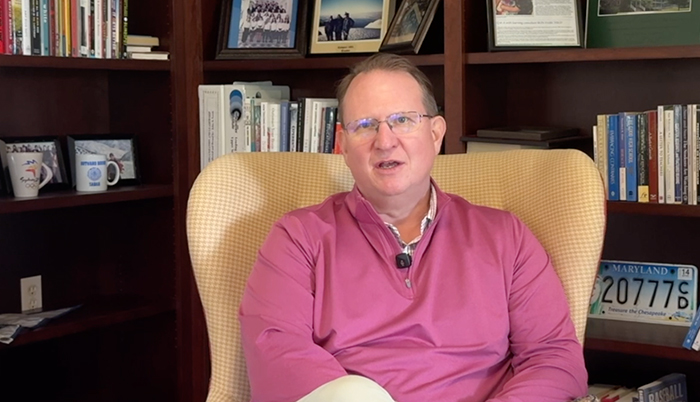
By this point in our conversation with For All Seasons CEO Beth Anne Dorman, it’s clear that breast cancer demands emotional decisions as much as medical ones. Here, Beth Anne walks us through the choice that weighed on her most — continuing with endless scans and unanswered “what ifs,” or moving forward with a double mastectomy that offered genuine peace of mind.

She speaks with a mix of practicality and vulnerability. Her breasts, she says, were organs that served their purpose. Now comes reconstruction, tissue expanders, hormone therapy, and an early menopause she never anticipated. She’s candid about the emotional terrain, too — the unknowns, the shift in body image, and the relief of choosing a clear path.

What stands out is the community around her: survivors offering tips, friends and family stepping in, and the reminder that no two journeys look alike.

If the first part was about the shock and the second about weighing options, this one is about settling into a decision — not because it’s easy, but because it’s hers.

This video is approximately 10 minutes in length. For more information about breast cancer, please go here. For information about Lotus Oncology, please visit here.
The Spy Newspapers may periodically employ the assistance of artificial intelligence (AI) to enhance the clarity and accuracy of our content.

Filed Under: 00 Post to Chestertown Spy, 1 Homepage Slider

Rauschenberg at 100: An Eastern Shore Connection By Val Cavalheri

November 26, 2025 by Val Cavalheri Leave a Comment

You don’t expect a garbage bag in Easton’s dormant downtown storefront windows to be the reminder of a major museum exhibition, but that’s exactly the point. People walked by, puzzled. “Is it an antique shop? What is this?” For the Academy Art Museum’s Executive Director Charlotte Potter Kasic, the bag wasn’t trash. It was a playful nod to Robert Rauschenberg.

“Our team has had fun with the downtown ‘takeover.’ The windows have continued to evolve, and we’ve been going in and changing things each week.” For her, that storefront prop is an easy entry point to the man himself—a way of saying that he used everyday objects on purpose, making art people recognized.

But most people walking past Easton’s storefront windows have no idea that this was Rauschenberg’s language—or that he has a real connection to this area. And that is why the Museum is opening Rauschenberg 100: New Connections on December 11, an exhibition that will remain on view through May 3, 2026 and place Easton right in the middle of his worldwide centennial celebration.


Robert Rauschenberg

“Do you know who Robert Rauschenberg is?” Kasic asked as we began talking. “It’s interesting. A lot of people in our community do not understand what a powerful artist, change-maker, and influencer he was.”

“Rauschenberg was an incredible sculptor, artist, collaborator, printmaker—and, turns out, photographer,” she said. “He was one of those essential culture makers at Black Mountain College. He worked with John Cage. He worked with Merce Cunningham. He and Jasper Johns were lovers. He had a marriage and a son. He was a really interesting guy.”

His work, she said, grew out of a desire to re-ground abstract expressionism into things people recognized. “He wanted to make everyday art for the everyday person. Things had gotten so abstract people didn’t understand it anymore.”

From there, Kasic shifted to what the exhibit means for the Museum itself. “One of the things I’ve been saying about our identity is that, to do good things, there has to be a trinity. We need to be honest with our origin story—founded by artists, for artists. We need regional specificity, and we need excellence.”
And that’s when the local connection comes into focus.

Rauschenberg worked closely with artist, art historian, and master printmaker Donald Saff, known for his collaborations with Roy Lichtenstein, James Turrell, and others. After an illustrious career at the University of South Florida, Saff moved to Talbot County and continued working with these major artists at Saff Tech Arts, his studio in Oxford. “Rauschenberg was making this work right here in Talbot County, which is insane to me,” Kasic said.

That history leads directly to the centerpiece of the show: Chinese Summerhall, the hundred-foot-long color photograph Rauschenberg made during a 1982 trip to China.

“It was a cultural exchange,” Kasic said. “He was trying to mend the woes of society through understanding one another through art. And that also happens to be very timely right now.”

Apparently, Rauschenberg isn’t new to the Museum; they’ve had pieces connected to this project for years. Their Rauschenbergs include more than twenty related works—test prints, studies, and editions that show how the project developed. “Our work is really only interesting when you realize in context that, yes, they’re limited editions in their own right, but really it was all leading up to this monumental piece,” she said.

Bringing that piece to Easton, however, was not simple. There are only four of the hundred-foot works in existence: one at the Guggenheim, one in Florida, one with the Rauschenberg Foundation, and one at the National Gallery.

“We went to the University of South Florida, because that’s where it was made,” she said. “They agreed to loan it to us. We were full ahead for the show. And then the main contact person suddenly no longer worked there, and the loan fell through.”

That changed the entire exhibition plan. “Without the 100-footer, this story falls flat,” she said. “Everything was leading to that.”

Curator-at-large Lee Glazer then stepped in. “Lee wouldn’t take no for an answer,” Kasic said. “She went to the Rauschenberg Foundation and told them, ‘Our loan just fell through, and the National Gallery and the Guggenheim said no. Will you loan us yours?’ So it was like our last chance. And she got it.”

And that’s how the rarely exhibited photograph will now be seen in Easton. It documents Rauschenberg’s first journey to China and his creative partnership with Saff.
Another piece of the exhibit is the documentary the Museum commissioned, featuring local Talbot residents Saff and George Holzer, walking through how Chinese Summerhall came to be—starting with Saff nervously driving Rauschenberg around Tampa and getting lost.

“I finally got up enough nerve and said, ‘Would you consider working with me?’” Saff says in the film. He then recalls Rauschenberg rejecting the fine French art paper Saff offered and choosing the custodians’ garbage bags instead. (Which makes the Easton storefront prop feel very on point.)

The film moves from those small moments into the larger story: the China trip—the scrolls, the colors, the fifty rolls of film—and finally the darkroom marathon, where five enlargers were moved by hand to build the image eight to ten feet at a time. “All it took was one exposure to be off on one enlarger, and it’s trash,” Holzer says. “We were down to the last chance.” And time was tight: the work was due at the Leo Castelli Gallery on New Year’s Eve.

Eventually, they ran it through the processor and hoped.

It worked.

The film ends with Saff’s move to the Eastern Shore and to a small building on Oxford Road, where, as one voice in the film puts it, “artists make the dreams of other artists come alive.”

The film is only part of the experience. Around the exhibition, the Museum is offering what Kasic describes as “a lot of different ways to engage with it over time.”

There will be classes inspired by Rauschenberg’s techniques, including China ink painting on Xuan paper; a performance of John Cage’s music; mixed-media workshops; a lecture by Don Saff; and a February 21 talk by Rauschenberg’s son, photographer Chris Rauschenberg.

There is also a strong community component tied to sponsorship.

Those who join by December 1 receive tickets to the VIP preview party on December 10, the first official unveiling of the exhibition. They’ll also be entered to win a signed Rauschenberg print from the same series, made with Saff, along with access to private programs, behind-the-scenes events, and the exhibition publication.

It won’t end there. The Museum’s Spring Gala will serve as the closing celebration of the show. “The whole gala is going to be Rauschenberg-themed,” Kasic said.
As we wrapped up, Kasic underscored what she’d love to see. “I hope everybody brings their whole family here,” she said. “Between Christmas and New Year’s—when everybody’s in town and feeling like we’ve stared at each other enough—now let’s get out of the house. I want them to come to the Museum. We’re free. We’re open to the public.”

“I’m so proud of this show,” she said.

Since it’s his birthday, I thought Rauschenberg should have the last word. In the film, he’s asked why he kept pushing himself into new places and collaborations. This is how he responded: “I want my work to make you proud of yourself and make you care about the world and everything that is in it. I care. I care. I’m paying the world back for having been born. That’s my rent.”

A hundred years on, the sentiment still holds.

For more info:
https://academyartmuseum.org/rauschenberg-100-new-connections/

The Spy Newspapers may periodically employ the assistance of artificial intelligence (AI) to enhance the clarity and accuracy of our content.

Filed Under: 00 Post to Chestertown Spy, 1 Homepage Slider, Archives

A Local Odyssey: One Woman’s Life with Breast Cancer – Part 2

November 24, 2025 by Val Cavalheri Leave a Comment

When a breast cancer diagnosis hits, the questions pile up faster than the answers. In this second part of our conversation with For All Seasons CEO Beth Anne Dorman, she picks up the story after the shock — when the real decisions begin. Surgery or radiation? Reconstruction or not? Second opinions? Side effects? How do you balance medical advice with the need for some sense of control?

Beth Anne talks through her choices with her usual honesty. For her, a bilateral mastectomy offered the clearest path forward — a way to lower risk and be here for her boys. Reconstruction was also a personal decision tied to identity, even while she recognizes that every woman’s choices look different.

The support around her shapes much of this discussion: a husband at every appointment, sons learning more about cancer than they expected, and a community that quietly showed on the sidelines, some in small, meaningful way with pink socks and wristbands. She also shares the private decisions — closing the browser instead of Googling worst-case scenarios, sending late-night questions through the patient portal, and trusting the experts close to home.

In the end, Beth Anne reminds us that no one navigates this alone. And while fear is the constant companion, so is the power of clarity, connection, and choosing the next right step.

This video is approximately 17 minutes in length. For more information about breast cancer, please go here.

The Spy Newspapers may periodically employ the assistance of artificial intelligence (AI) to enhance the clarity and accuracy of our content.

Filed Under: 00 Post to Chestertown Spy, 1 Homepage Slider

A Local Odyssey: One Woman’s Life with Breast Cancer – Part 1

November 17, 2025 by Val Cavalheri Leave a Comment

For most of her career, Beth Anne Dorman has been the one whom other people turn to in their hardest moments. As the CEO of For All Seasons and a clinician by training, she’s spent decades helping families navigate fear, trauma, and uncertainty. But when she found a lump this spring and received her cancer diagnosis in the middle of an ordinary July afternoon—parked at a baseball field beside her son—the roles reversed with dizzying speed.

In a conversation with Val Cavalheri, Beth Anne speaks with the kind of honesty that catches you off guard. She walks us through the punch-in-the-stomach moment of hearing the word “cancer,” the long week she waited before telling her children, and the careful balance of being vulnerable at home while steadying an 85-person staff at work. There are flashes of humor, too, the kind that families reach for when the ground shifts beneath them, along with the complicated truth that even without chemo, a bilateral mastectomy and a decade of hormone therapy remake your sense of self.

What emerges is not just a medical timeline but a portrait of leadership and humanity—how you let people in, how you accept help, and how you learn to live with a diagnosis that never fully leaves the room. It’s also a reminder, as Beth Anne says, that talking openly about illness and mental health isn’t a weakness. It’s the thing that keeps us connected.

This video is approximately 16 minutes in length. For more information about breast cancer, please go here.

The Spy Newspapers may periodically employ the assistance of artificial intelligence (AI) to enhance the clarity and accuracy of our content.

Filed Under: 00 Post to Chestertown Spy, 1 Homepage Slider

A Waterfowl Weekend with Artist Sandy Alanko

November 13, 2025 by Val Cavalheri Leave a Comment

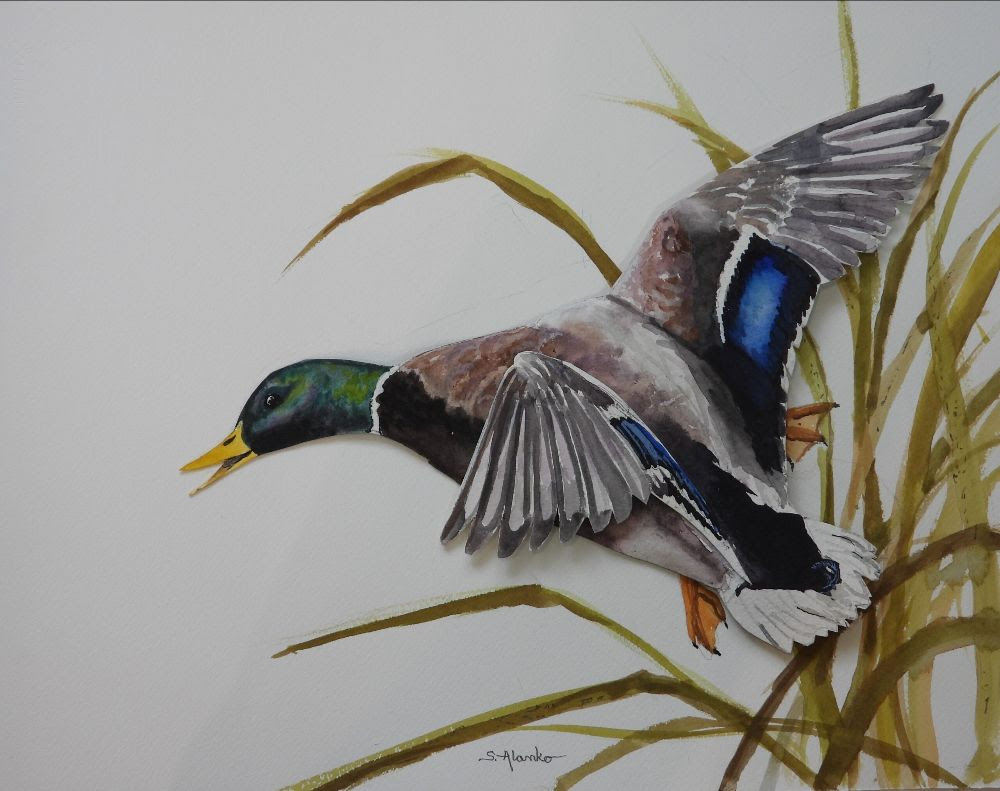
“Flying Mallard” by Sandy Alanko

If it’s November in Easton, you can’t help but notice that the streets are busier, tents are appearing throughout town, and talk is all about the upcoming Waterfowl Festival. Inside Studio B Art Gallery, featured artist Sandy Alanko’s work fits the moment—paintings of water, marsh, and the wildlife that define the Shore. Watercolors that catch early light, wings over water, and the quiet places that define the festival.

“It’s my favorite show of the year,” Alanko said. “I’ve been coming for about eight years, and I love nature, conservation, and painting animals. It fits me so well. The fact that the proceeds go for conservation makes it even more meaningful.”

Her ties to that mission run deep. “I visit a lot of wildlife refuges, especially Blackwater,” she said. “They’ve benefited from Waterfowl Festival support over the years, and that makes me feel like we’re all part of the same circle—artists, collectors, and the environment we all care about.”

Her paintings grow from that connection.. One of her newest shows an osprey nest perched on Taylor’s Island. “You can see it from the back window of the little restaurant there,” she said. “It’s built on the pole that holds the fire siren. People wondered what would happen when the siren went off, but the ospreys just ignore it. For me, the painting was complex with all those twisted branches—but I loved it.”

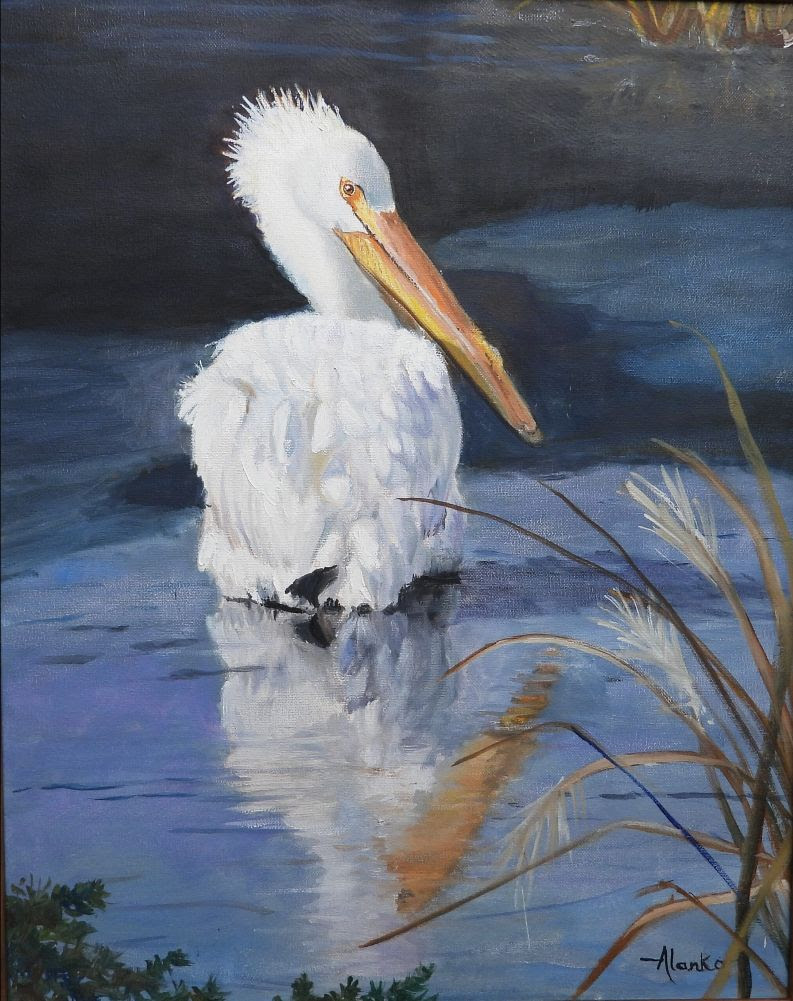
“White Pelican on Ice” by Sandy Alanko

Her interest in the natural world began long before she called herself an artist. “When I was a little girl in Illinois, I made it my mission to learn the names of everything in the backyard—birds, insects, reptiles,” she said. “By fifth grade, I could identify all the local birds.”

That curiosity led her to spend several years working with the Smithsonian Museum of Natural History on a coral island off the coast of Belize, along with her husband. “We hosted scientists from all over the world,” she said. “Because of the research done there, the island and surrounding reef were declared a World Heritage Site. The biodiversity was extraordinary.”

It also changed how she looks at a subject. “I’ve always had a sensitivity for habitat restoration,” she said. “Painting is a way of paying attention—to light, to movement, to balance. It’s my way of showing respect.”

Alanko works in several media but sees herself primarily as a watercolorist. “It’s so transparent,” she said. “When it’s used right, light bounces between the pigment and the paper and gives the painting a glow. That’s what creates atmosphere. When I want a painting to feel airy and alive, watercolor is what I reach for.”

For landscapes, she paints on site when she can. Wildlife is different. “Animals don’t pose unless they’re asleep,” she said. “So I take photos and work from them. It’s still about watching and noticing.”

Her return to Studio B for Waterfowl Festival weekend brings her back into a familiar circle of artists and collectors. “I was honored when Betty Huang asked me to come back as a guest artist,” she said. “My work looks beautiful there. I can’t wait for people to stop in during the festival and talk about what they see. That’s what makes this weekend special.”

The feeling is mutual. Gallery owner Betty Huang is thrilled to have Alanko back. “Sandy, other than being a fabulous human being and a fabulous artist, does such beautiful work,” Huang said. “She brought paintings in oil, pastel, watercolor, and gouache, and they’re all amazing. She has always painted such beautiful waterfowl-related pieces, and that’s why I wanted to feature her again.”

Huang sees Alanko as part of the fabric of the gallery. “She’s a member of the Working Artists Forum, she’s local, and she’s so willing to share her techniques. It’s wonderful to be able to promote our own artists during an event that’s so much a part of Easton.”

She added that the Working Artists Forum, of which both she and Alanko are members, will also hold its annual Waterfowl Festival show at Christ Church. “It’s such a great partnership,” she said. “The Festival and Christ Church have supported the arts community for so long, and it gives people another chance to see what our local artists are doing.”

Even with artists from across the country represented, Studio B keeps a strong local focus. “I have award-winning artists from Maine, California, Texas, and Florida, but it’s important to highlight the incredible talent right here,” Huang said. “These artists aren’t only accomplished; they’re generous people. That’s just as important to me.”

That spirit carries through the town each November. The days leading up to the Waterfowl Festival are among Huang’s favorites. “Along with Plein Air Easton, Waterfowl is when the town really comes alive,” she said. “The streets are busy, the galleries are full, and everyone is talking about art. Easton is a charming, historic town, but it also has a cosmopolitan side. We really do have the best of both worlds.”

Alanko feels the same. “Easton is the hub of the Mid-Atlantic for art,” she said. She would know. Besides the Working Artists Forum, she’s part of the St. Michaels Art League and the Academy Art Museum community. “There are so many ways to grow and share your work,” she said. “It’s a very supportive place to be an artist.”

When she isn’t painting, she’s often on the water. “My husband and I belong to a kayaking group,” she said. “We go out every Wednesday to explore the tributaries that feed into the Chesapeake. I love reflections on the water and the vegetation along the shore.”

Sailing has been another lifelong thread. “We once took our boat to Bermuda and back,” she said. “So yes, I’m comfortable on the water.”

Her new work includes a series of large water birds that look ready to lift from the paper. “Watercolor is flat compared to oil,” she said. “So I started painting the bird on another sheet, then layering it—sometimes three layers deep—so a wing or a beak comes forward toward the viewer. It gives the impression that the bird is about to fly right out of the frame.”

She’s also discovered a way to display her watercolors without glass. “I found a spray that makes them UV-protected and waterproof,” she said. “It means people can see the work directly. There’s no reflection, no barrier.”

Her goal is simple. “I hope people see the beauty of the animal or the landscape,” she said. “And maybe it makes them want to preserve it.”

Huang believes that respect is what makes Alanko’s paintings stand out. “Her work reminds people what’s worth protecting,” she said. “You can see her love for nature in every piece. When people come into the gallery and see her paintings, they feel that.”

The Waterfowl weekend is an important time for Easton, and Studio B on Goldsborough Street is bringing Sandy Alanko’s world of water and wings into the heart of the festival.

Studio B Art Gallery is located at 7B Goldsborough Street in Easton.

The Spy Newspapers may periodically employ the assistance of artificial intelligence (AI) to enhance the clarity and accuracy of our content.

Filed Under: 1A Arts Lead

The Bay to Ocean Journal 2025: A Mirror to the Shore’s Creative Heart

October 18, 2025 by Val Cavalheri Leave a Comment

Emily Rich still gets a thrill when the newest Bay to Ocean Journal lands in her hands.

“It’s always exciting to see the finished book,” she said. “You see all that work, all those voices, come together. It feels like a community in print.”

Now in its seventh year, the annual literary collection from the Eastern Shore Writers Association (ESWA) brings together poets, essayists, and fiction writers from across Maryland and beyond. This year’s edition once again captures the range of creativity connected to the Shore—work that is personal, place-based, and deeply human.

Like any good story, the journal’s own beginnings are part of what makes it special.

Sc

The journal was first published in 2018 under then-ESWA President Ron Sauder, who wanted to give local writers a dedicated outlet for their work. “Ron started the Bay to Ocean Journal, and I took it over the following year,” Rich said. “I’d already spent many years editing literary magazines like *Little Patuxent Review* and *Delmarva Review*, so I was excited by this new challenge.”

For Rich, who now serves as both editor and president of ESWA, the journal is about far more than publication. “We felt local writers really needed a space where they could all get together,” she said. “And it’s more than just being able to be published. It’s the community that forms by all being part of this journal.”

That sense of connection runs through the 2025 edition, which—without anyone planning it—ended up circling around the idea of time. “With each edition, a theme seems to rise,” Rich said. “They’re not chosen in advance.This year, a lot of people wrote about the concept of time and the way it blurs—when you lose someone, when you reconnect with someone, a lost child, or an elderly parent. Some people discovered secrets about their own heritage. Both the poems and the prose touched on that. It’s really interesting how, for whatever reason, themes will emerge. It wasn’t like the judges were looking for those pieces,” she said. “That’s just what we got.”

And what they got, she said, was strong. “Since we started the journal, the quality of submissions every year has gone up. That makes me feel really good,” Rich said. “When you have to look at pieces several times to decide if they make the cut—that’s a good feeling. It means the journal is really succeeding.”

Each year, she and a small team of volunteer editors read through dozens of submissions, looking for what she calls *the spark. “I hate to be a literary editor stereotype,” she said, “but it really is just something that strikes you. It’s got an emotional spark, a good story arc.”

To keep things fair, the editorial process is blind. “Everything comes to me, but when I send it to my staff, it’s all blind,” she said. “That really helps because we’re a small community. My poetry editor has even said, ‘I know who this is—they’re in my writing group.’ So reading blind helps you focus only on the work.”

Among this year’s standouts is the opening poem, On a Path Austere and Certain, by Diana Fusting.“She talks about how, in the process of going from a child to an adult, she’s learned to quantify everything—from her weight to her GPA—and how she’s longing to get back to that spark of not having to worry about those things,” said Rich. “It really set the theme.”

The poem is followed by a short story about “a man at the end of his life who’s lost his daughter and wife,” she said. “Instead of focusing on the loneliness of that, he finds a place of peace where he feels their presence. It’s really very heartwarming.”

Though the journal welcomes submissions from across the Mid-Atlantic, its roots stay close to home. “There’s no requirement that your piece be about the Shore,” Rich said. “But people love this place, so often their work reflects that love of place. You do have to be a member of the Eastern Shore Writers Association to submit, so everyone has some connection with the community.”

Even the cover stays true to that mission. This year’s artwork by Naomi Clark Turner depicts a view of Oxford. “We always look for local artists,” Rich said. “Naomi lives outside of Oxford, and it just felt right.”

Inside, readers will find everything from poignant essays to pure fun. “There’s one really sweet love story,” she said. “And one hilarious story that starts with a woman describing being on an academic quiz show. She grew up outside Cambridge and tells this story about how she and her teammates tried to get away with saying crazy things on air—like claiming she was a snake handler. It was just so funny to see that side of someone I know as a serious professional.”

For Rich, those discoveries are the best part. “Writing is such a vulnerable endeavor,” she said. “You’re putting yourself out there to be read and judged. That willingness to open up and be part of something—it binds you. It’s a common experience every writer has to go through.”

That shared vulnerability is what fuels the broader ESWA community, including the annual Bay to Ocean Writers Conference, held each March at Chesapeake College. Many contributors discover the journal through the conference and later return to submit their own work.

For those hesitant to take that leap, Rich keeps it simple. “You’re never going to find out unless you do,” she said. “Being a writer without getting rejections is like being a boxer and not wanting to get hit. That’s just part of the game.”

Of course, the writing has to be polished. Her advice to anyone thinking of submitting: “Always have someone else read it—someone who’s going to be honest with you.”

Editing, she admits, has changed her own writing. “The one thing I’ve learned is that you can always cut,” she said. “People think, ‘I can’t get rid of this,’ but you can. You don’t need all the backstory. Just jump right in and get people hooked. You can always fill things in later.”

Outside of the journal, Rich continues to write and teach. Lately, she’s been digging into her family’s history. “My great-grandfather was a gold miner in the 1870s,” she said. “He traveled all over the West—from Virginia City to Helena to Mazatlán. I found his grave—it’s just a metal plaque in the Masons’ cemetery, and he’s there by himself. So I’m trying to piece together that story.”

She also teaches memoir workshops. “Everybody has a story, and that’s what I love about it,” she said. “For memoir, you’re supposed to keep it real, but you can bring in dreams, musings, conjecture. There’s room to play with memory.”

If there’s a thread connecting all of it—editing, teaching, writing—it’s her belief that storytelling builds community. “This is really a labor of love for me,” she said. “It was important to me to work on something that gives space to local writers. I’d really like to encourage those writers out there—join ESWA and submit.”

This year’s Bay to Ocean Journal will officially launch with a book party in Berlin this December, followed by sales at the Bay to Ocean Writers Conference at Chesapeake College next spring. Copies are also available on Amazon and at ESWA events throughout the Shore.

Submissions for the 2026 edition will open in March 2026.

“When you see it all come together,” she said, “it feels like holding up a mirror to our community. You see the heart, the humor, the grief, the love—all of it. That’s what writing is for.”

For additional information, go to: https://www.easternshorewriters.org/


The Spy Newspapers may periodically employ the assistance of artificial intelligence (AI) to enhance the clarity and accuracy of our content.

Filed Under: 1A Arts Lead

Who Framed You: A New Chapter on Harrison Street

October 15, 2025 by Val Cavalheri Leave a Comment

It started with a bit of Beatles memorabilia:

“My strongest recollection,” said Richard Marks, “was ages ago walking into Easton’s premier framing shop, Lu-Ev Gallery, mostly known for framing Waterfowl Art with lithographs signed by John Lennon. The prints were from one of the 300 sets made as a wedding gift to Yoko. Lu-Ev framed five from the set beautifully”.

And, up until a few years ago, despite other framing choices, Lu-Ev was where you went to have things framed—artists preparing for Waterfowl, museum shows from across the Shore, or neighbors carrying in photos from graduations, anniversaries, and fishing trips. The faces behind the counter never changed much, and neither did the feeling. “To me, it was an anchor downtown,” Marks said. “And you knew the work there would be done professionally”.


The anchor began in 1946, when Lucille and Everett Henry opened Lu Ev Gift Mart, a tidy white storefront near the bank on Dover Street. “Framing wasn’t even part of the equation,” said Wayne Johnson, who would take over the business decades later. “They sold engraved invitations and greeting cards.” Everett, always tinkering, added framing a few years later, working out of a small shop near Hill’s Drug Store and carrying finished frames back across town for pickup.

It was a different Easton then—small, local, and stitched together by family businesses whose names everyone knew. After the war, Lu Ev was one of them.

By 1973, the Johnson family took over. They were not experienced framers. In fact, they ran a bus company. “My great-grandfather started our transit company in 1921,” Johnson said. “We had 500 buses on the street in the district area.” When the Washington Metro absorbed the private lines in the early ’70s, the family looked for a new start. “Dad came up to Easton, walked into Lu Ev, met Everett Henry,” Johnson said. “Dad expressed interest, and Everett told him he wanted to retire.”

They bought the shop. “We knew nothing about it,” Johnson said. But his father loved finish carpentry, his brother Bobby could fix anything, and Wayne handled customers. They kept the invitations for a while, sending the engraving work out, but framing soon became the heart of the business.

“We bought molding by the length—twelve-foot sticks stacked along the wall—and cut every frame ourselves,” Johnson said. “With forty or fifty styles in stock, we could move fast. If the size was right, a customer could drop off a picture and we’d have it ready in a day.”


When suppliers began offering pre-cut molding—”chops,” as they were called—the business changed again. “There’s almost no waste in a chop,” Johnson said. “With length molding, there’s a lot of waste because there are imperfections.” The shop’s sample wall grew, and so did its reputation. Within a decade, Lu Ev needed more room.

“In less than ten years, we moved across the street,” Johnson said. “We went from about 1,500 square feet to 7,000.” The new space brought better tools—pneumatic nailers and pinners that turned 24-hour jobs into two-hour ones, a vacuum press, and the capacity to handle major projects for the Waterfowl Festival and the Academy Art Museum, as well as custom work for collectors and homeowners throughout the Shore.

“When we moved across the street, we became a legitimate art gallery,” Johnson said. “We had room to expand.”

Marks remembered that era. “When I moved here in 1976, most art was either a duck print or a decoy,” he said. “Waterfowl weekend was probably a month’s business in one weekend.”

Lu Ev became part of Easton’s rhythm. “We were approached once to close our store during Waterfowl weekend,” Johnson said. “I told them, we’re here 365 days a year—and you’re here for one.” He smiled. “This is Easton. We stay open.”

The people made the place. “We had Joanne—she worked 27 years,” Johnson said. “Another lady was Chris Barr, she worked 25.” Marks agreed. “Joanne was wonderful and helpful and knowledgeable,” he said. “She always gave great advice on mattes and frames and called to let me know when the work was finished.”

For 50 years, the sound of saws and the smell of fresh mat board never stopped. Then life changed. “In 2017, my youngest brother died,” Johnson said. “In 2022, my other brother died. We went from three down to one. Age catches up.”

By 2023, it was time. “I wanted something to happen to the business before something happened to me,” he said. “I did not want to sell it piece by piece.”

That’s when Marks stepped in.

He hadn’t planned to run a ‘shop.’ “The original intent of getting the equipment was knowing we needed another frame shop,” he said. “I can acquire the equipment and figure out the rest later.” Then local artists started calling. “They asked, could you carry art supplies?” Marks said. “A lot of them have special brands they like—quality they prefer that’s not always available. Some of it can be found online, but not all of it. People wanted more than just the big box stores; they asked for the local touch.”

That changed everything. If they were going to carry art supplies, they needed a visible storefront. When the former Trade Winds boutique closed, the space became available. “Alice Ryan and her family, who owned Trade Whims, were wonderful in helping with the transition,” Marks said. “Even some of the furnishings they left behind were useful.”

He also had help from the man who came before him. “We didn’t just buy the equipment from Lu-Ev,” Marks said. “Wayne came with the equipment—helping us get things set up, showing us how to operate it. He made the transition smooth.”

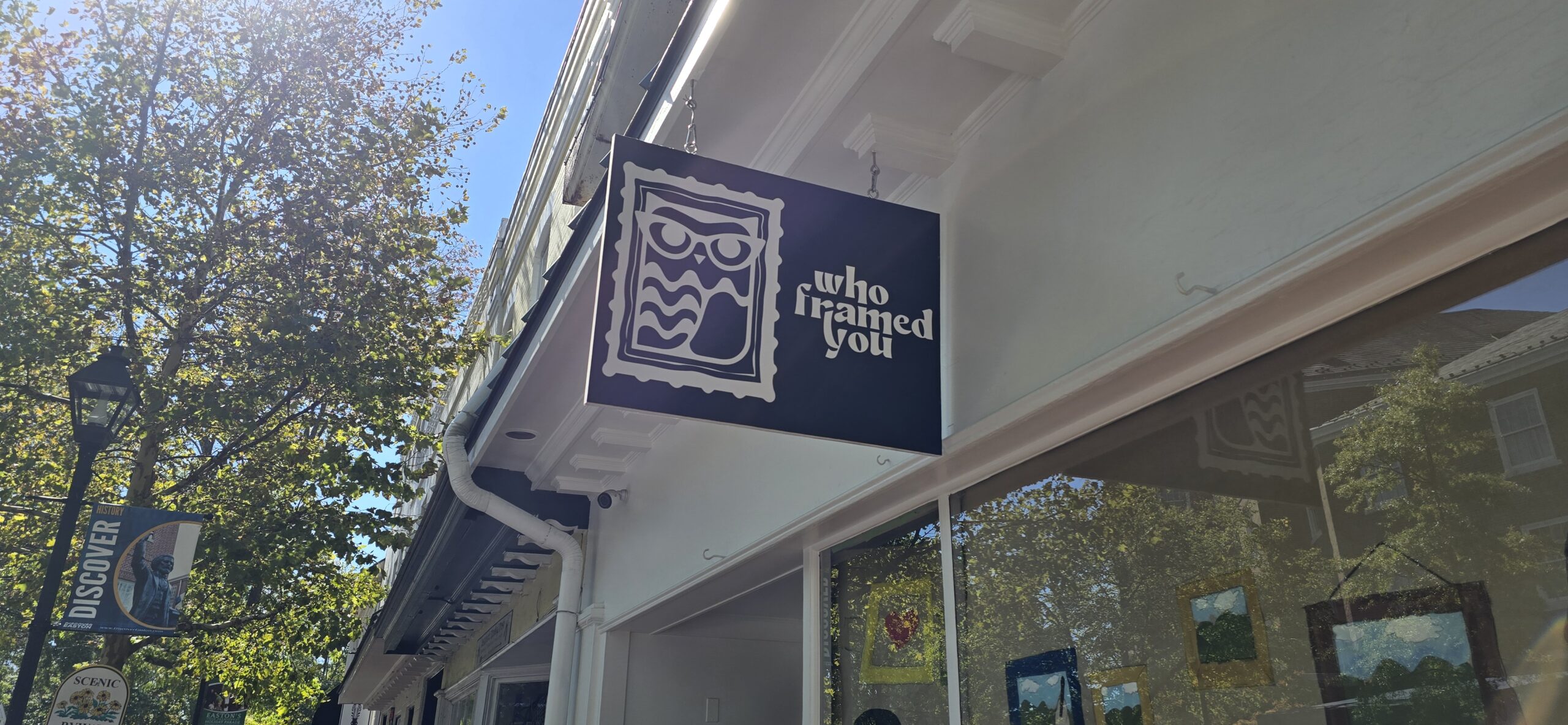
The new shop will open as Who Framed You, a name suggested by artist Shelton Hawkins. “My niece’s husband, a graphic designer in Asheville, did the logo,” Marks said. “I told him an owl would be cool, and I sent a picture of Amy wearing these funky glasses. The result fits perfectly.”

Marks’s team includes familiar faces. “Artist Cheryl Southwick is amazing—she framed for years at the Academy Art Museum,” he said. Also joining are Taylor Wheatley and Kearson Harnon, both former Michaels managers who know the ropes. “We could not be more fortunate to have assembled such an incredible team.”

The shop is now open, with a ribbon-cutting ceremony planned for October 20. “Even though we do not have a complete art supply inventory yet, we want to be ready for Waterfowl and the holidays,” Marks said. “Our focus will be on custom framing, curated art supplies, and quick turnaround. We hope folks recognize that small business is part of the fabric of the community and are banking on the loyalty small towns still have for small stores, but know we still need to be competitive.”

If there’s a thread running from 1946 to today, it’s continuity—of craft, of people, of care. Johnson put it: “We were very fortunate to have good people. That’s what kept it going.” Marks agreed. “Good things come together when good people work together,” he said.

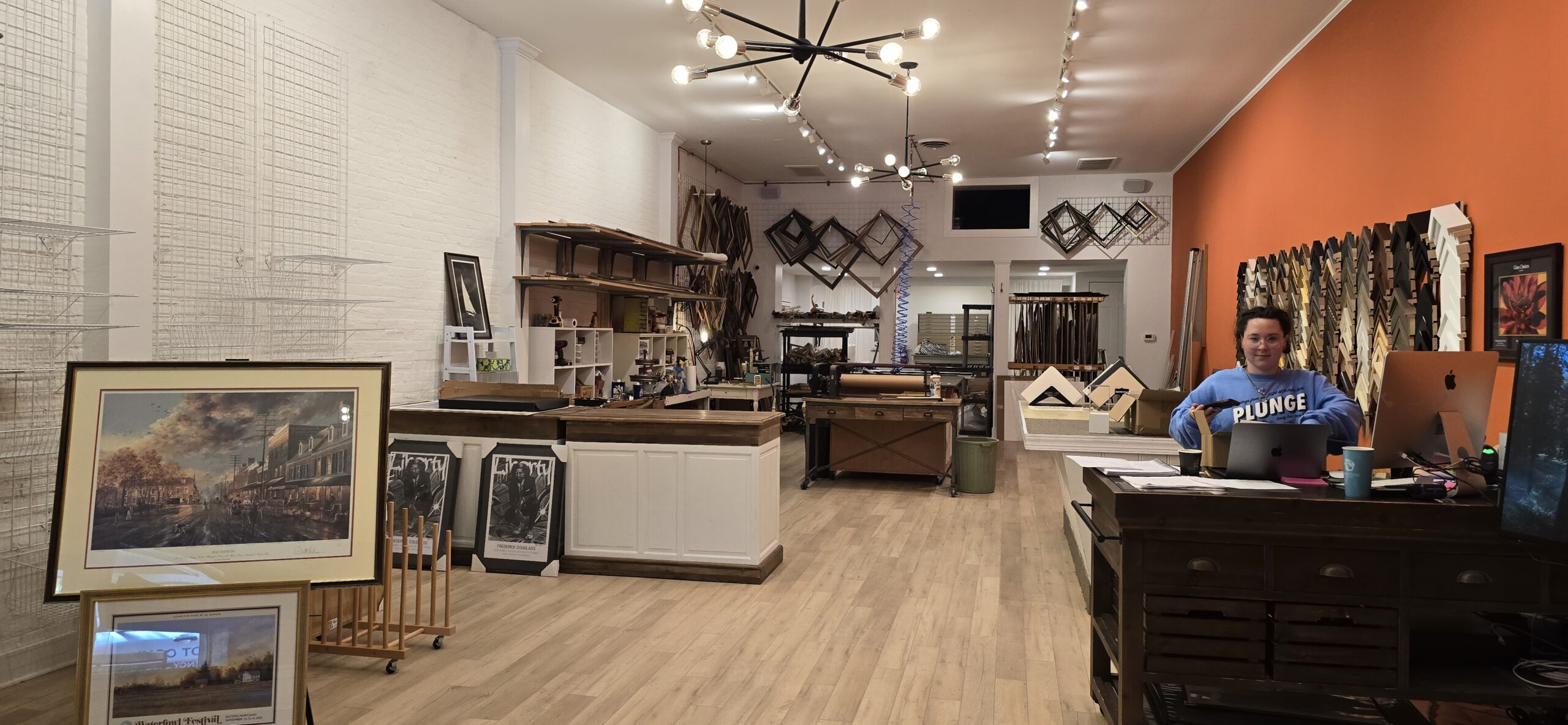
The framing lights are on again, though not in the old Lu Ev building. Who Framed You has opened around the corner at 11 North Harrison Street. New space, but with the same tools, the same craft, and the same care that framed Easton’s history for nearly fifty years. Inside, the scent of fresh matte board returns. Hands accustomed to the craft are at work. The name on the door is new, but the soul of the business endures.

Val Cavalheri is a writer and photographer. She has written for various publications, including The Washington Post.  Previously, she served as the editor of several magazines, including Bliss and Virginia Woman. Although her camera is never far from her reach, Val retired her photography studio when she moved from Northern Virginia to the Eastern Shore a few years ago.. She and her husband, Wayne Gaiteri, have two children and one grandchild.

The Spy Newspapers may periodically employ the assistance of artificial intelligence (AI) to enhance the clarity and accuracy of our content.

Filed Under: 1 Homepage Slider

New Voices, New Vision at the Water’s Edge Museum

July 29, 2025 by Val Cavalheri Leave a Comment

There’s a quiet transformation happening in Oxford, Maryland—one that you might miss if you’re only passing through. But step inside the Water’s Edge Museum and it’s clear: things are changing. New leadership, new projects, and a bold new commitment to telling untold stories.

“We’re not just preserving history,” said Ja’Lyn Hicks. “We’re building on it.”

Hicks and Sara Amber Marie Park were named Co-Directors of the Water’s Edge Museum at the start of this year. Both had previously interned and worked closely with founder and curator Barbara Paca. Now, they’re steering the museum into its next chapter, bringing fresh energy and new perspectives to its mission of elevating African American history on the Eastern Shore.

Their focus? More visibility, more interactivity, and more connections between past and present.

The biggest news is the museum’s leadership role in a multi-year initiative to create a Middle Passage Port Marker sanctuary at the Oxford ferry dock—the only documented site of disembarkation for enslaved Africans on Maryland’s Eastern Shore.

The project is being led entirely by people of African descent—a first for any Middle Passage marker nationwide.

“The history here is heavy,” said Hicks. “Oxford was a receiving point. From here, people were sent to places like the Lloyd estate, where Frederick Douglass was enslaved. A lot of people don’t know that.”

That educational gap is exactly what the Water’s Edge Museum is working to change. As Hicks put it, “People hear ‘Middle Passage’ and they still say, ‘What is that?’”

The sanctuary space itself is being designed to be physically accessible and emotionally resonant. “We’re not just putting a plaque on a dock,” said Hicks. “We’re creating a path. A place to walk, sit, reflect.”

Among those helping bring it to life are:

-Dennis Howland II, a civil engineer who recently completed the Frederick Douglass Memorial Bridge in Washington, D.C.

-Jeffrey Moaney, Design Director and Senior Associate at Gensler.

-Mia Matthias, Curatorial Advisor and Mentor.

-Dr. Sarah E. Vaughn, Environmental Anthropologist at UC Berkeley.

At the kickoff meeting on July 1, the team gathered in Oxford to walk the site and brainstorm ideas. “Someone suggested footsteps in the path that slowly disappear,” said Hicks. “It represents the people who arrived here—people whose stories weren’t recorded, whose names we may never know.”

Accessibility was a top priority in the planning. “Dennis and I both have family members who use wheelchairs,” said Hicks. “We want the space to be welcoming for everyone, not just physically but emotionally, too.”

While the Middle Passage project is getting a lot of attention—and rightly so—it’s just one part of a broader wave of new work happening at the museum. Another major initiative underway is Black Watershed, a museum-led book project that will serve as both an interpretive companion to the sanctuary and a powerful storytelling platform in its own right.

“Each chapter focuses on something tangible—an oyster shell, a fishing boat, a plant—and tells the story of how people have formed relationships with the Chesapeake through their engagement with the landscape and the waterscape,” said Park, who serves as the book’s editor-in-chief. “It’s about culture, identity, and memory—all rooted in the landscape.”

Also happening this summer is a new exhibit on Black watermen and crab pickers being curated by Hicks. “You see these figures in Ruth Starr Rose’s paintings,” she said. “But we’re going deeper—sharing oral histories, environmental struggles, stories from the segregation era.”

To help younger visitors connect with the material, the museum is introducing an interactive iPad feature that allows children to explore Rose’s artwork while listening to the gospel music that inspired her. “We’re using tech to make history come alive,” said Hicks. “And we’re keeping it authentic—we chose recordings by Black choirs to keep that spiritual connection.”

The museum is also continuing its education outreach with local camps and schools. Park recently led an art exercise with Oxford Kids Camp where children painted scenes of their favorite outdoor spaces. “It helped us start a conversation about environmental justice and how we relate to nature,” she said.

That dual lens—history and environment—is central to Park’s approach. With a degree in geography and political science from Syracuse University and a background in environmental policy, she brings a spatial and cultural perspective to everything the museum does. “I think about place,” she said. “We’re asking: ‘Who lives there? What happened there? Who got erased?”

Those questions are at the heart of the work being done now, and will also be at the heart of future work. Park and Hicks will travel to Pea Island, North Carolina, in August to begin a research initiative documenting endangered African American communities in the Tidewater and Chesapeake regions. That work will eventually be included in Black Watershed.

But for now, the focus is here. In Oxford. On the Middle Passage. On building something lasting.

“We’re still in the early stages,” said Hicks. “We’re surveying the land, working w ith the town, figuring out what we can build and where. But the momentum is real.”

That momentum is also visible inside the museum. The gallery is shifting. The exhibits are evolving. And the stories being told are more layered, more inclusive, more connected than ever before.

“We want people to know that history is not frozen,” said Park. “It’s alive. And we’re shaping how it’s remembered.”

What’s happening at the Water’s Edge Museum isn’t just a redesign or a new exhibit—it’s a reimagining. A way of telling history that doesn’t separate the past from the present or the environment from the community. A place that centers Black stories not as sidebars, but as the heart of the Chesapeake.

And it’s all happening right now.

———————————-

For additional information, go to https://www.watersedgemuseum.org/

The Spy Newspapers may periodically employ the assistance of artificial intelligence (AI) to enhance the clarity and accuracy of our content.

Filed Under: Spy Highlights, Spy Journal

From One Generation to the Next: A Community Mural Reimagined by Val Cavalheri

July 15, 2025 by Val Cavalheri Leave a Comment

In 2011, more than thirty kids—participants in a summer camp run through the Academy Art Museum—came together to create a large mosaic mural on the side of a building then known as Eastern Market Square. The site, now home to Tiger Lily and Harrison’s Liquors, still displays the mural, which includes references to a marketplace that no longer exists.

The idea for a mural came from artist Jen Wagner, who by 2011 had already spent several years creating community mosaics across Dorchester and Talbot counties. In Easton alone, she’d led projects like the farm scene mosaic that now hangs at the public library (installed initially at the Red Hen), and the heron mosaic on the side of what used to be the blind store on Harrison Street.

What started as a conversation with Cathy Witte, who managed the Eastern Market Square building at the time, helped spark this particular project. “There was just a synergy,” Wagner said. “We started talking, and the project came together fast.” At the time, Easton didn’t even have a formal process for approving public art. “That had to be created for this project,” she said.

Fast forward 14 years, and even though the mural has held up well over time, Wagner says it’s due for a refresh. “Some of the panels are obsolete,” she said. “For one, it’s not called Eastern Market Square anymore.” So she is returning to the wall—this time teaming up with Lauren Dwyer, Early Childhood and Youth Education Coordinator at the Academy Art Museum (AAM), to bring in a new generation of young artists. Through a series of summer camps, kids will not only be learning the mosaic process—they’re actually designing and building the new panels themselves: drawing, cutting glass, placing tile, and grouting, just like the kids did back then.

But unlike the original, which unfolded as a full-on street production beside Route 50, this time the work will happen in the comfort of Wagner’s studio. “There’s a little disappointment that we won’t be outside,” she said. “That first one was a spectacle. We had 30 kids in each camp, the younger ones one week and the older ones the next. I’d show up on Saturdays during the farmer’s market, and people would stop and say, ‘Can I help?’ And they’d add a piece. It became a community thing.”

Dwyer is helping coordinate the 12 youth art camps AAM will run this summer, three of which are specifically focused on mural mosaics. “We’ve done one in June, and have one in July, and one in August,” she said. “Each camp has new registrants, so there’s potential for 36 different kids to be part of this.” The mosaic camps are open to children ages 8–12. “This is their moment. It’s been 14 years since the last one. I really don’t want this opportunity to slip by.”

The panel replacement will focus on the middle sections of the mural, with the flower and market scenes from the original preserved on either end. “We’re thinking about doing more of an Eastern Shore scene in the center,” Wagner said. “We’ve been discussing design ideas. It won’t be a carbon copy of what was there.”

She jokes about being a tough instructor, yet Wagner is clear about the value of what these young artists are gaining. The mural-making process is collaborative and fast-paced, which means kids learn more than just art techniques. “You have to make a lot of decisions quickly,” Wagner said. “And we’re on a deadline. That’s a valuable thing to go through—dreaming big, turning it into reality, sometimes reining it in based on the project. There’s a lot of creative problem-solving baked in.” There is also the responsibility she feels to the community. “We approach it as real work. These kids put in a full day’s work in a few hours.”

From Dwyer’s perspective, the mural project isn’t just about art—it’s the kind of collaborative learning she believes leaves a lasting impact. “It’s true problem-solving,” she said. “Not on a worksheet—real collaboration. These kids are working with others who have different ideas and different backgrounds. That’s what sets them up to be successful adults. And they get to say, ‘I did this. I had a part in this.’”

Each of the three mural camps will run for five days, with the kids working together to complete as many panels as possible. “We don’t know how fast they’ll go,” Wagner said. “One group might get two panels done. Another might only finish part of one. But the most important thing is that the work is good. We’ll set a realistic goal and go from there.”

And if they don’t finish? That’s by design, too. The team plans to open the project to the broader community once the camps wrap up. “We’ll create some workshop opportunities where anyone can come in and add their mark,” said Dwyer.

It’s a fitting continuation of how the first mural came together, through layers of community involvement and connection that stuck. “Almost all of the kids from 2011 are still in touch,” Wagner said. “They’re all over the world now. They have families and careers. But we’ve been sharing stories. It’s been wild watching them grow up. They’ve taken their engagement photos in front of that mural. It’s been a part of their lives. And I get to be a little part of their lives too, which is fun.”

She’s hoping the next chapter adds a new layer. “It would be great if some of those original kids—now parents—bring their own children to be part of this one.”

And for Wagner’s stepping back into the process feels meaningful. “It feels good to come back and do another big one,” she said. “And I’ve matured a little too.”

To follow along with the project, updates will be posted on the Academy Art Museum’s social media channels and Jen Wagner Mosaics’ page. If the project runs past the August 8 camp deadline, opportunities for the community to join in will be announced there as well.

As for the final unveiling, it’s still a ways off—but there will definitely be one. “We’ll have a splash,” Wagner promised. “And maybe we’ll get some of the kids to come talk about it, too. They’ll blow your mind. They really will.”


Val Cavalheri is a writer and photographer. She has written for various publications, including The Washington Post.  Previously she served as the editor of several magazines, including Bliss and Virginia Woman. Although her camera is never far from her reach, Val retired her photography studio when she moved from Northern Virginia to the Eastern Shore a few years ago.. She and her husband, Wayne Gaiteri, have two children and one grandchild.

The Spy Newspapers may periodically employ the assistance of artificial intelligence (AI) to enhance the clarity and accuracy of our content.

Filed Under: 1A Arts Lead

  • 1
  • 2
  • 3
  • …
  • 6
  • Next Page »

Copyright © 2025

Affiliated News

  • Chestertown Spy
  • Talbot Spy
  • Cambridge Spy

Sections

  • Sample Page

Spy Community Media

  • Sample Page
  • Subscribe
  • Sample Page

Copyright © 2025 · Spy Community Media Child Theme on Genesis Framework · WordPress · Log in