
MENU

Sections

  • Home
  • Education
  • Donate to the Centreville Spy
  • Free Subscription
  • Spy Community Media
    • Chestertown Spy
    • Talbot Spy
    • Cambridge Spy

More

  • Support the Spy
  • About Spy Community Media
  • Advertising with the Spy
  • Subscribe
March 4, 2026

Centreville Spy

Nonpartisan and Education-based News for Centreville

  • Home
  • Education
  • Donate to the Centreville Spy
  • Free Subscription
  • Spy Community Media
    • Chestertown Spy
    • Talbot Spy
    • Cambridge Spy
Archives Food and Garden Notes

Adkins Arboretum’s Mystery Monday: Guess the photo

April 14, 2025 by Adkins Arboretum Leave a Comment

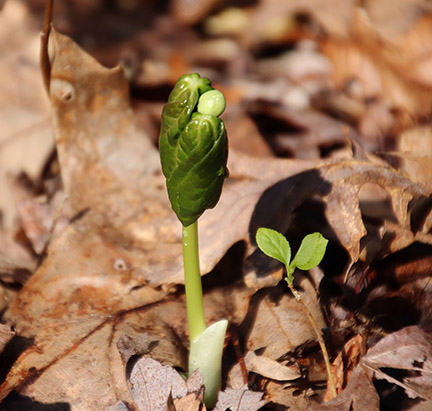
Happy Mystery Monday! Can you guess what is pictured in the photo below?
The answer to last week’s mystery is red maple flowers, Acer rubrum, pictured in the photo below:
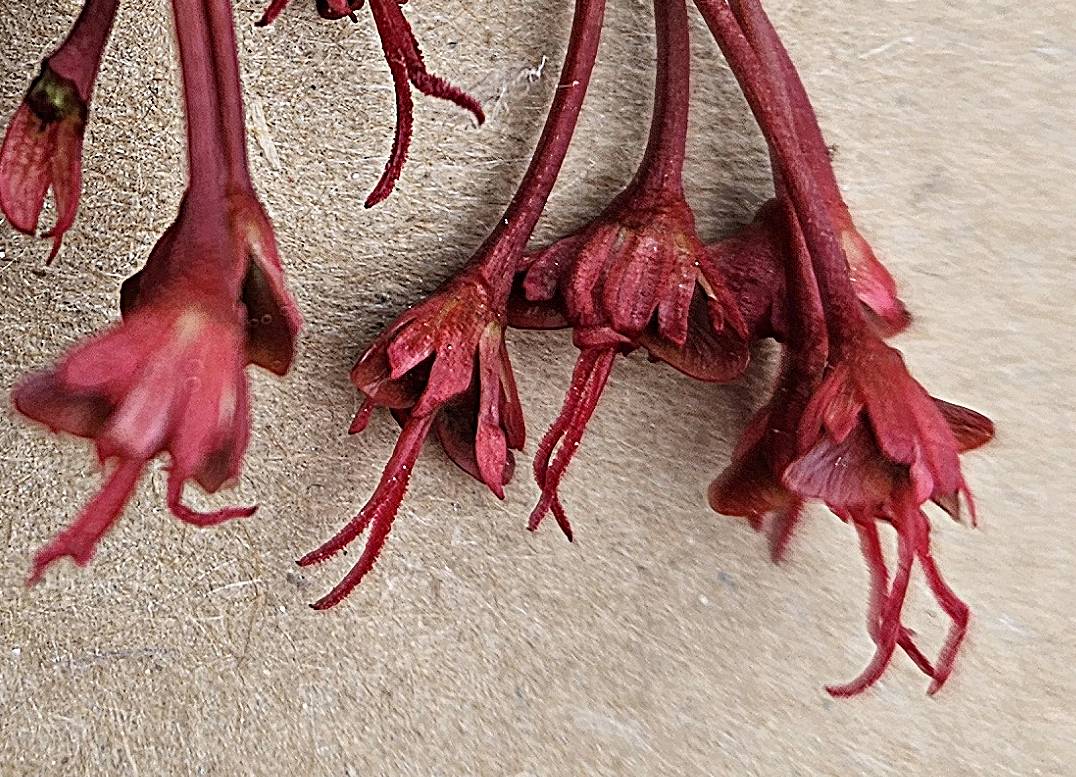
The red maple flowers shown here are female. They are dark, deep red with sticky, fuzzy stigmas that extend past the petals and catch pollen floating by. Clusters of red maple flowers are especially striking against a clear, blue Winter sky.
Maple tree flowers are primarily wind-pollinated. As the flowers fade, the fruit – which is often showier than the flowers – appears. The fruit, botanically classified as a schizocarp, is split into two-winged structures called samaras. The samaras dangle on the ends of branches by thin pedicels, or stalks. They remain on the tree for about a month after the Spring foliage emerges and until the wind disperses them.
Mystery Monday is sponsored by the Spy Newspapers and Adkins Arboretum.
The Spy Newspapers may periodically employ the assistance of artificial intelligence (AI) to enhance the clarity and accuracy of our content.

Filed Under: Archives, Food and Garden Notes

Magnified By Laura J. Oliver

April 13, 2025 by Laura J. Oliver Leave a Comment


Every morning, when I get ready for my day, I sit at my dressing table, known as a vanity by the judgy, and check out my face in a mirror that lights up and magnifies by a power of 15.

“Why do you do that?” my mother asked when she was alive. And “Stop doing that!” my former dermatologist groaned. “No one expects perfection!”

I smiled at him sadly. He was, of course, a man.

“You’ll never see anything better than you saw the day before!” Mom predicted, but it’s not that I think I’ll discover I’ve gotten younger-looking overnight; it’s that I am searching for the newest sign of deterioration. Stemming the tide requires grand-scale scrutiny. And if you have fair skin and blue eyes, it also requires pretty vigilant screenings by a dermatologist as you pay in spades for those days before sunscreen when you grooved to tunes on your beach towel in the Outer Banks.

But a magnifying mirror would not have saved me this Monday when I visited my new dermatologist after a weekend hiking through the woods of the Blue Ridge. I was chatting with the doctor as she updated my records when I felt something itchy about two inches above my hairline on the back of my neck. Without thinking, I slipped an exploratory hand up to touch the place and discovered a small bump.

Dr. Aguh was still studying the computer screen while I sat there, semi-horrified to realize that the itchy bump was a tick I must have picked up over the weekend. Now, I would have to dislodge the critter and offer it up like a creepy present. “I’m meticulously clean! I wash every day! And, oh yeah, here’s a bug I just found in my hair.”

So when Dr. Aguh beamed her bright smile on me at last, I was perched on the edge of my hardback chair in my gray jeans and white sweater, pinching my new friend with his tiny flailing legs between my thumb and index finger.

“I can’t believe this,” I confessed, “but I just found this tick …

“(I know! Gross!)

“And he was attached… (I know! Grosser!)

“Right here.” I pointed at the back of my neck with my other hand.

She didn’t look.

“A tick?” Dr. Aguh stepped backward involuntarily.

“Put it in here,” she suggested, handing me a specimen cup at arm’s length.

“I was outside all weekend,” I called after her as she abruptly exited the room. I peered in the cup at my new friend, left to ponder our effects on each other’s lives.

I walked over to the window, put my captive on the sill, and immediately googled “ticks that cause Lyme disease” on my cellphone. A nasty lineup of the usual suspects appeared. I began comparing mugshots. “Number One. Dog tick, step forward.” By the time the doctor returned, I was fairly certain this was not a Lyme disease perp but a harmless imposter. Still, we weren’t sure, so I was told that if I wanted an antibiotic after further research at home, I could call.

In my office, I taped the defendant to a piece of white paper, took his photograph, and then enlarged it. Which brings me back to things we size up and how this is not a good thing most of the time. Very little benefit comes from looking at something way larger than it appears to the naked eye. Or that is normally hidden. You think your dog is cute? Ever pulled back those lips and had a look at those teeth? Who’s cute now? How about your horse? So beautiful, so noble, but pull up those lips and call in the clowns.

Likewise, the person speaking on Zoom! You can change your zoom settings to automatically enlarge the speaker, you know. Please don’t do this in my workshops. I like to think you are seeing me as I’m seeing you—very small, with little detail, from a galaxy far, far away.

What else suffers from magnification?

Anxiety enlarges my impatience, makes me snap at the dog, say bad words to inanimate objects. I sound mean, but I’m really worried; about injured children in warzones I long to hold to my heart, about rising tides and temperatures. About my vanishing savings. And fear magnifies my inclination to criticize. I sound judgmental, but I’m scared. For my children, their children. For humanity. You.

But we can also magnify the moon, the Milky Way, and the light from distant stars. And magnification makes things appear closer, like age, but they are not really closer. In fact, they are not even right-side up!

All cameras, telescopes, and even the corneas of your eyes bend incoming light to produce an image that is upside down. It is your brain that receives those signals, decodes and interprets them, then constructs an image of the world right side up.

Sometimes it feels as if I’m seeing the world upside down from very far away, and my brain has not yet righted it, but it could.

The primal brain is ego-centric. There is only self. So, giving love feels like receiving love; extending compassion, feels as if we have been enfolded in loving arms. Praying for another feels like blessings raining down. A conversion accomplished by the brain but experienced in the heart.

When mom wanted me to feel the consequences of a questionable decision, say accelerating through a yellow traffic light, she’d ask, “What if everybody did that?”  Well, what if?

What if everybody did that?

Gave away, relentlessly, what we want to receive. Justice. Empathy. Mercy.

When that is the light by which we see, it will right the world.

Laura J. Oliver is an award-winning developmental book editor and writing coach, who has taught writing at the University of Maryland and St. John’s College. She is the author of The Story Within (Penguin Random House). Co-creator of The Writing Intensive at St. John’s College, she is the recipient of a Maryland State Arts Council Individual Artist Award in Fiction, an Anne Arundel County Arts Council Literary Arts Award winner, a two-time Glimmer Train Short Fiction finalist, and her work has been nominated for a Pushcart Prize. Her website can be found here.


The Spy Newspapers may periodically employ the assistance of artificial intelligence (AI) to enhance the clarity and accuracy of our content.

Filed Under: 1 Homepage Slider, Archives, Laura

Chesapeake Bay Week Film Festival returns to CBMM in April

March 28, 2025 by Chesapeake Bay Maritime Museum Leave a Comment

The Chesapeake Bay Maritime Museum is proud to partner with Maryland Public Television (MPT) to host the second annual Chesapeake Bay Week Film Festival with a series of four screening events in the Van Lennep Auditorium next month. 

This edition of the film festival will feature a family-friendly screening, a film-inspired tasting event, and showings of two films premiering on MPT during this year’s Chesapeake Bay Week.

 In sharing these films alongside panel discussions, expert talks, and related programming, the events are designed to offer a deeper look at these important Bay stories while inspiring a passion for this treasured waterway. All five featured films will be shown during MPT’s 21st annual Chesapeake Bay Week, which runs April 20-26.

To learn more and buy tickets, including a package ticket option that offers a $5 savings, visit cbmm.org/SpeakerSeries.

“We are delighted to continue our partnership with Maryland Public Television to celebrate Chesapeake Bay Week” CBMM’s Vice President of Education & Interpretation Jill Ferris said. “We had a great response from our community last spring. We’ve grown the film festival to four events this time, and we’re excited to share some new ways to experience and explore these tremendous films.”

The Chesapeake Bay Week Film Festival begins Saturday, April 5, at 2pm with a family screening of the MPT documentary “Creatures of the Chesapeake.”

This fast-paced, half-hour film offers an intimate look at some of the most fascinating species in the Bay, making it a must-see for kids, adults, and anyone with an innate curiosity about life in the deep. After the film, guests will get an up-close look at some Miles River oysters and the critters that live with them.

This event is free for CBMM members and general admission guests. Learn more and register at cbmm.org/CreaturesOfTheChesapeake.

On Monday, April 7, at 5:30pm, Chesapeake cuisine will be in the spotlight during the “Eatin’ the Chesapeake” Film Screenings and Tasting. Participants will watch MPT’s films “Eatin’ Blue Catfish: Chesapeake Style” and “Eatin’ the Chesapeake: The Five Feasts” while enjoying a film-inspired tasting plate from local caterers Garden & Garnish.

It’s a chance to explore new and time-honored Chesapeake food traditions on screen and on your plate with a tasty menu that includes Oysters Rockefeller Dip with French bread croutons, baked blue catfish cakes with okra, scallions, & roasted red peppers, and ham rolls stuffed with cabbage, kale & onions.

The cost is $45 per participant with a 20% discount for CBMM members. Learn more and buy tickets at cbmm.org/ChesapeakeTasting.

The Chesapeake Bay Week Film Festival continues Thursday, April 10, at 5:30pm, with a “Resurrecting Poplar Island” film screening and discussion with MPT Producer/Director Sarah Sampson and scientists from the University of Maryland Center for Environmental Science.

Poplar Island, like so many other islands in the Chesapeake Bay, was steadily sinking into ever-rising water before its resurrection through an ambitious environmental engineering project involving extraordinary collaboration among state and federal agencies.

This new film, which has its MPT premiere on Sunday, April 20, at 7:30pm, explores the island’s past and present—and what its successful restoration could mean for the future of the other disappearing islands in the Bay and beyond.

The cost to join the screening and discussion is $10. Learn more and register at cbmm.org/ResurrectingPoplarIsland.

The festival wraps Wednesday, April 16, at 5:30pm, with a “Chesapeake Rhythms” film screening and discussion with filmmakers Tom Horton, Dave Harp, and Sandy Cannon-Brown.

“Chesapeake Rhythms” conveys the beauty and mystery of the Bay by chronicling its essential rhythm: wind, tides, and migrations of tundra swans, monarch butterflies, shorebirds, and eels. After the screening, the celebrated filmmakers will share the inspirations for their latest project and offer insight into its production.

The cost is $10 per participant to join screening and discussion of “Chesapeake Rhythms,” which debuts on MPT on Tuesday, April 22, at 8pm. Learn more and register at cbmm.org/ChesapeakeRhythms.

With its Chesapeake Bay Week, MPT invites viewers to discover the unique ecosystems and culture of our nation’s largest estuary. CBMM has long supported MPT in the creation of this programming by sharing its campus, collections, and staff expertise.

This year, Chesapeake Bay Week features more than 18 hours of Bay-focused programming, with even more compelling content available for streaming through the free PBS App. There are four new programs in total debuting during this edition. More information, including a full schedule, is available at mpt.org/bayweek.

For the latest on upcoming CBMM programming, stay tuned to the calendar at cbmm.org/events.


The Spy Newspapers may periodically employ the assistance of artificial intelligence (AI) to enhance the clarity and accuracy of our content.

Filed Under: Archives

Adkins Arboretum Mystery Monday: Guess the photo!

March 24, 2025 by Adkins Arboretum Leave a Comment

Happy Mystery Monday!  Can you guess what is pictured in the photo below:
The answer to last week’s mystery is the northern crane-fly orchid, Tipularia discolor, pictured below:

The crane-fly orchid is one of the most common orchids in North America. Spring is when the plant’s green leaves begin to emerge. They appear as a single leaf, often with raised purple spots and a fully purple underside. The leaves disappear in late Spring–early Summer, before the orchid blooms. The flowering stem is leafless and reaches 15–20″ tall.

In late Fall to early Winter, each crane-fly orchid plant will produce a single green leaf. The leaf is called a hibernal leaf because it is present only during the Winter when many other plants are dormant

The orchid’s dull yellow–purplish brown flowers bloom on a reddish-brown stem in Summer. In the Fall, oval-shaped pods containing seeds form up and down the dried stem. Each pod is the size of a pinto bean and houses thousands of dust-like seeds that scatter in the wind across the surrounding leaf litter.

Crane-fly orchids do not transplant well, so it’s best to enjoy them in their natural woodland setting.

Mystery Monday is sponsored by the Spy Newspapers and Adkins Arboretum.


The Spy Newspapers may periodically employ the assistance of artificial intelligence (AI) to enhance the clarity and accuracy of our content.

Filed Under: Archives, Food and Garden Notes

Should America Disarm? By Al Sikes

March 19, 2025 by Al Sikes Leave a Comment

The overlap was notable. The college basketball tournament called March Madness arrived at the peak of some of Donald J Trump’s critics calling his Executive Orders “madness”. One reason for calling the basketball tournament “madness” is one loss and your out—“one and done” as it is said.

In the matter of the President, he is protected from the voters by a four-year term. Not from the critics, but from the voters. He is doing his best to suppress the critics. If our First Amendment to the Constitution, guaranteeing free speech, was not so tenaciously protected by the Courts, Trump critics would be on mute.

In the meantime, and inexplicably, Trump wants to defund the Voice of America (VOA)—our country’s international voice. What is this all about?

In 1992, President George H.W. Bush asked me to lead a delegation to selected countries in the Eastern Bloc, as it was then called. The countries had been liberated from the Soviet Union. I gave speeches and held meetings in Hungary, Romania, and Czechoslovakia. My themes were free speech and privately owned broadcasting stations, which were a key part of America’s strength. In the Communist Bloc, the government-owned and operated the radio and TV stations.

Before leaving Washington, I learned that Vaclav Havel, the Czechoslovak head-of-state, on his first visit to America, went out of his way to visit VOA studios, thanking reporters for those late-night broadcasts he had listened to in secret. They kept him up-to-date on what was happening and gave him hope. Recall Havel’s dissident status had resulted in surveillance and imprisonment. Between 1979 and 1983, he spent four years in prison. As I made my way through the Eastern Bloc, I spoke of Havel’s experience to accentuate American principles.

In the last week, the Trump Administration has sought to zero out the Voice of America. The only reason I could find was an ally of Trump saying he had a “grudge” against the VOA due to how he was covered in his first term.

I am not a student of today’s VOA. I suspect some reform is needed and like most of government my guess is they can do their job with less money. Given the expanded and enriched capacity of todays media a more effective job can be done. What about providing an Artificial Intelligence application?

But to zero out the organization and to give the pink slip to its employees without explanation is what the basketball gods call a flagrant foul.

Reflect: China and Russia have aggressive programs to hack, block and refute. They are armed. Should we disarm? At the most basic level dictators dictate. They don’t ask for feedback and fear of consequences squelches critics.

Maybe the difference this time is pride in America. Former President Ronald Reagan, recalling John Winthrop, saw America as a “shining city on a hill.” President Reagan knew America was far from perfect, but took pride in our successes and liked to talk about them.

President Trump, unless Americans go silent, will at some point need to explain his attitude toward the Voice of America and whether we need an international voice. As many have written, President Trump’s strategy has been to flood the zone hoping that critics can be diverted and divided. The issue of what’s next after quashing the Voice of America is not going away. Nationalism cannot suppress Internationalism.

Al Sikes is the former Chair of the Federal Communications Commission under George H.W. Bush. Al writes on themes from his book, Culture Leads Leaders Follow published by Koehler Books. 

The Spy Newspapers may periodically employ the assistance of artificial intelligence (AI) to enhance the clarity and accuracy of our content.

Filed Under: 3 Top Story, Al, Archives

Why, Mr. President, Why? By J.E. Dean

February 26, 2025 by J.E. Dean Leave a Comment

While many Trump supporters party on as the Trump/Musk team continues its assault on the federal government, its employees, and the beneficiaries of its programs, some of the rest of us have one question for the President:  Why? 

We know the official answer: It is to end government waste, fraud, and abuse while reducing the cost of government and regulations at the same time. Forgive me, Mr. President, but I don’t believe you. 

Most of Mr. Musk’s shocking discoveries of “fraud” and “waste” are nothing more than programs and expenditures with which he and, presumably, the President disagree. There are no 250-year-old people receiving social security.

And then there is the elephant in the room—the President wants to extend and expand his 2017 tax cuts. The cost is $4.2 trillion over 10 years, according to the Treasury Department. Mr. President, billionaires don’t need another tax cut. 

By the way, the Committee for a Responsible Budget says the 10-year cost is between $5 and $11.2 trillion. That is a lot of money.

So, let’s not pretend that the Trump administration has anything to do with a balanced budget or reducing the federal debt, even if Elon Musk’s DOGE is successful in finding $2 trillion in “waste, fraud, and abuse.”  The federal debt will increase in the next four years. Mr. President, I know that you know that is true—that is why the House Republican budget resolution raises the debt ceiling.

Unfortunately, the Trump administration’s first five weeks in office wasn’t just about budget accounting. More worrisome is the absence—I will say complete absence—of any sign of empathy for the thousands of federal employees who have been fired or who are terrified of what Elon Musk and Trump have planned for them.

Setting aside the legal questions regarding the authority of the President to implement wholesale firings and “terminations” of federal agencies without Congressional authorization, there has not been a clue or sign that the administration cares about the impact of the human beings involved. (Federal employees are, without exception, human beings who have feelings and who had, before January 20, 2025, an expectation of being treated with dignity and respect.) 

There are hundreds of examples of people who have been fired from their federal jobs and who now face economic crises as a result. There is rent to be paid, food purchases necessary to survive, and new employment to be found. Unfortunately for the summarily fired employees, the job market is flooded with former co-workers.

In the coming months, we will read about some former civil servants becoming homeless, of divorces, and other evidence of despair. I have seen no sign that anyone working for the new administration cares. Have you?

Administration spokespeople will tell you that Americans should celebrate because a burden is being lifted from their shoulders. That message would be easier to accept if the Trump administration did not appear to enjoy the purges now underway. 

Did you see Elon Musk dance with a chainsaw, celebrating the work of DOGE, at the Conservative Political Action Committee meeting? Any president other than Trump would have fired him on the spot. Instead, Trump posted that Musk is doing a great job, and he would like to see him become “more aggressive.”  

The employee purge now underway is only one of the subjects prompting me to ask Trump, “Why?”  The others include his controversial cabinet picks. Trump officials, without a single exception, are “not the best.”  

I also wonder about increasing signs of coming “retribution” against the President’s perceived enemies. Will Attorney General Bondi, aided by FBI Director Kash Patel, work to indict former President Biden? I expect it. How about former Special Counsel Jack Smith? 

What is going on with this administration? Why aren’t more of us raising our voices and asking “Why?” and urging the president to rethink what he’s doing?

One final thought:  Ukraine. President Trump has switched sides in the war. He now calls Ukrainian President Zelensky a dictator and accuses him of starting the war. Trump envoys are working on making Vladimir Putin a friend of the United States. Mr. President, Putin will never be my friend.

And then there is Trump’s attempt to pressure Ukraine into surrendering half its mineral rights. I have a question for you, Mr. President:  What sort of person proposes something like that? Sounds like extortion to me. Why, Mr. President, Why? What is wrong with you? 

J.E. Dean writes on politics, government, and, too infrequently, other subjects. A former counsel on Capitol Hill and public affairs consultant, Dean also writes for Dean’s List on Medium and Dean’s Issues & Insights on Substack.

The Spy Newspapers may periodically employ the assistance of artificial intelligence (AI) to enhance the clarity and accuracy of our content.

Filed Under: Archives

Adkins Arboretum Mystery Monday: Guess the photo!

February 24, 2025 by Adkins Arboretum Leave a Comment

Happy Mystery Monday! Can you guess what is pictured in photo below?

The answer to last week’s mystery is river birch, Betula nigra, pictured in photo below:

Native to the eastern United States, river birch is found in Maryland along stream banks and in moist locations. It’s a fast-growing, highly adaptable tree, especially in its tolerance to heat and flooding.

River birch is a pioneer species, meaning it rapidly colonizes exposed, bare stream banks and gravel bars, stabilizing the soil and developing a forest for other trees to succeed. It tolerates deer, drought, clay soil, wet soil, and is very resistant to air pollution.

River birch is the only Spring-fruiting birch tree species. Female river birch flowers develop in the Spring as shorter, upright catkins on spur-shoots develop into cone-like structures containing winged seeds. Male flowers develop in the Fall as drooping catkins at the tips of twigs.

Unlike most birches, the seeds of this species mature in late Spring to early Summer, and are distributed immediately. The seeds are winged and are distributed to some degree by wind, but also rely significantly on water for distribution.

River birch seeds are eaten by songbirds and mice, while the twigs are eaten by deer, and beavers use it to make their lodges. Birch bark is an incredibly versatile material. It has been used as a form of paper, as a building material, and even clothing. Break a twig during the growing season, and you’ll smell a sweet wintergreen odor. And yes, birch beer has been made from these trees!

Mystery Monday is sponsored by the Spy Newspapers and Adkins Arboretum.

The Spy Newspapers may periodically employ the assistance of artificial intelligence (AI) to enhance the clarity and accuracy of our content.

Filed Under: Archives, Food and Garden Notes

Adkins Arboretum Mystery Monday: Guess the picture

February 17, 2025 by Adkins Arboretum Leave a Comment

Happy Mystery Monday! Can you guess what is pictured below?


The answer to last week’s mystery is partridge berry, Mitchella repens, pictured below:

Partridge berry is a delicate, creeping vine that does not climb. Instead, it forms a low mat of evergreen leaves. Indigenous to the woodlands of eastern North America, partridge berry looks very much like teaberry.

Partridge berry plants produce flowers with both male and female parts, but they are arranged in pairs, where each flower needs to be pollinated by the other to produce a berry. There are two types of partridge berry flowers, those with long stamens and short styles, and those with short stamens and long styles. However, only one type of flower can be found on any individual plant.

Pollination happens via insects. Each flower pair produces one red berry. There is a pair of shallow dimples toward the tip of each berry, an identifiable feature of the plant.

Partridge berry fruits are eaten by various birds, including ruffed grouse, northern bobwhite, sharp-tailed grouse, prairie chicken, wild turkey, and the now-extinct passenger pigeon. Mammals also enjoy the berry, including raccoon, red fox, eastern skunk, eastern chipmunk, white-footed mouse, and woodland deer mouse. The plant’s foliage is also eaten by deer.

Mystery Monday is sponsored by the Spy Newspapers and Adkins Arboretum.

The Spy Newspapers may periodically employ the assistance of artificial intelligence (AI) to enhance the clarity and accuracy of our content.

Filed Under: Archives, Food and Garden Notes

Rescue Them By Laura J. Oliver

February 16, 2025 by Laura J. Oliver Leave a Comment

A quick review before we get to why I am telling you this story.

I worked for five years as a volunteer dog walker at the SPCA before I met Leah.

She was a grossly neglected, 17-pound, black-and-white terrier mix. Her original owner, overwhelmed by the needs of three kids under the age of seven, had recognized his limitations and surrendered the puppy on her first birthday. I’ll always be grateful.

She suffered a bloodborne disease she’d contracted from a tick bite, was on antibiotics, had just been spayed, and had never been groomed, so her hair hung in her eyes and draped from her black, triangular ears like a bat. It was difficult to see her face in the oversized cone placed on her little head to keep her from licking her incision, but a kind heart, one that seemed unconditionally forgiving of her own neglect, radiated from two shiny, bright eyes. As I’ve said before, with a lot of reasons to expect the worst from this life, Leah was love with her high beams on.

I entered the run, and she immediately put her front paws on my knee, stretching as high as she could in her unwieldy headgear to lick my face. She was so sweet and so grateful, but I didn’t fall in love.

I know! I can’t believe it either!

I couldn’t take her on the creek trail because of her stitches, so we just jogged around the admin building and back into the dark and noisy run assigned to her. A week later, I chose her off the walk board again, and we made our second circuit of the admin building. Once again, she climbed my knee, balancing on her hind legs, in an effort to land a grateful lick on my face.

Sometimes, I am soooo slow to hear the universe calling.

The third time I chose Leah off the walk board, a light went off in my head. Small, young, female, dog needs loving home. I’d been dogless for five years. What was I waiting for?

I asked about her availability and was told I had exactly two hours to commit to adopting her. Two hours. At lunchtime that day, I took home a breed I knew nothing about and a companion I was pledged to serve until death do us part. Mine or hers—whoever leaves first.

Here’s what I discovered about her.

She can run 38 miles an hour. She was bred to hunt.

She barks at everything from the Netflix logo to the doorbell.

She hides things, then waits for me to find them. Usually in my bed.

I also discovered that dogs form a unique attachment to one person, even within a loving household. It is not me, and I am not complaining. Love is not a feeling. Love fronts up. I am not the one who feeds her and walks her in the sleet, in 27-degree weather, and I don’t begrudge loyalty to the one who does, though I do my share.

I was walking her in the linger light; the official term is civil twilight—when the sun is no more than 6 degrees below the horizon but going fast. When we were just a few yards from the front steps, I unleashed her so she could run the rest of the way home. She took off on a tear for the brick steps as she always does, but for the first time ever she just kept going.

In an instant, she was beyond my ability to catch up and had disappeared behind a private residence. I chased her, calling, “Leah! Come!” which, let’s face it, sounds a lot like “Leah! Run!” Suddenly, she reappeared—on the fly—airborne, racing out of the first yard and into the next one, clearly on the hunt—taking off down driveways to disappear in neighbors’ mysterious backyard spaces ringed with security cameras and warnings to trespassers.

She was working her way methodically, yard by yard, toward the busiest traffic artery in town. If she got there without me, she’d be a dead dog—no doubt about it—she had tried to bite the rolling wheels of the Fed Ex truck on numerous occasions.

I kept running but was uncertain of my direction because it was longer and longer between sightings. She was now a comet—a shooting star—sightings of this black and white rocket whizzing by a neighbor’s woodpile or garage were becoming less predictable, less frequent. Panicked, I turned back and ran for my car. My car can go 38 mph indefinitely. I cannot.

My neighbor Steve stopped raking leaves, and positioned himself in the road to direct the posse. He pointed silently and emphatically up the next street—She went thataway!

I turned and glimpsed her flying down the hill into yet another stranger’s yard, so I threw the car in park and ran for her. By now, a little boy, maybe 11, sensing the excitement, had joined the pursuit on his scooter. He was following her into neighbors’ yards, one by one, trying to flush her out to where I was now positioned like a goalie between her last known location and the deadly intersection. We became a team, this child and I.

Suddenly, a rabbit raced out of a neighbor’s yard and took off down the sidewalk, Leah in hot pursuit. The boy cut them off as cleanly as if he’d been on a quarter horse. She veered, heading straight toward rush hour traffic and me at a dead run.

As she flew through a patch of ivy, I managed to snag her safety harness. Overwhelmed with relief, I snatched her up in my arms. The boy on the scooter glided up, grinning.

“You watch football?” he asked, navy ballcap over his eyes, one sneakered foot on the scooter, one on the sidewalk.

“Some,” I said.

“Well, that’s what you call ‘escaping the pocket.’”

I glanced down at Leah, now incarcerated in my arms, then back to the boy. “My hero, thank you,” I smiled, thinking my goodness, I love you; I had a boy like you once.

I carried my jailbreaker to the car. And here, at last, is why I am telling you this and why now. At civil twilight, though the sun is gone, you don’t need artificial light yet to see clearly and this is what I saw.

Love is not a feeling. Love is not what you say, no matter how well you try to say it. (This kills me; you know it does.)

Love is that wild, primal instinct to help anyone and everyone. To find the lost. Shelter the injured. Protect the vulnerable. We help the panicked mother who has lost sight of her child at the mall. We offer an arm to the elderly man feeling faint waiting in line. We leave a note on the windshield warning a driver that his tire is flat before he drives off.

We give in the context in which we live, so in the grand scheme, our offerings are small. That’s how fortunate we are. But this is the same instinct ignited by the nightly news. If you could, you would save every injured child in Gaza, shelter every starving refugee, protect every Ukrainian hospital from bombing, and save every hostage the world over. This is the part of you that would hold the world in your arms if you could. The part of you that prays.

Sometimes I think we are nothing more than love looking for an opportunity to express itself.

Maybe love has no gradations. There is no big love and little love. There’s just us, giving what we can.

Laura J. Oliver is an award-winning developmental book editor and writing coach, who has taught writing at the University of Maryland and St. John’s College. She is the author of The Story Within (Penguin Random House). Co-creator of The Writing Intensive at St. John’s College, she is the recipient of a Maryland State Arts Council Individual Artist Award in Fiction, an Anne Arundel County Arts Council Literary Arts Award winner, a two-time Glimmer Train Short Fiction finalist, and her work has been nominated for a Pushcart Prize. Her website can be found here.


The Spy Newspapers may periodically employ the assistance of artificial intelligence (AI) to enhance the clarity and accuracy of our content.

Filed Under: 1 Homepage Slider, Archives, Laura

The Reformer By Laura J. Oliver

February 9, 2025 by Laura J. Oliver Leave a Comment

My smart older sisters have blazed a trail through life for me by example. If I hadn’t received my driver’s license on my first try, for instance, I’d have failed tradition. So, having recently discovered that they both love Pilates, I tried it, too. Things went well until they went horribly wrong.

The trial class proved to be a uniquely pleasant way to exercise– working out flat on my back a great deal of the time– sliding against resistance springs on the moving frame of the bed-shaped apparatus called the “reformer.”  German-born Joseph Pilates, who invented this exercise protocol and patented the reformer, became interested in physical fitness as a teenager and even more so during internment by the British in WW I. At that time, he worked as a nurse, experimenting with attaching springs to hospital beds so patients could start toning muscles while bedbound. In 1923, after years of study and experimentation, he came to New York and began teaching his method, which was an enormous success.

The trial class went by quickly because listening to instructions and correcting my form was a good distraction from watching the clock. Also, the instructor talked to us as if we were very, very young. “No Elvis in the pelvis,” she admonished. “Watch your shoulders; we don’t want grumpy shoulders.” The kindergarten vibe was pleasant—no thinking required. Mama’s got you.

So, I signed up for three months—agreeing to have the fee extracted from my bank account every month and registering for one class a week at the one day and time I could attend.

For the first few weeks, it was fun. I made a new friend. We both showed up weekly in ponytails, read the same science books, and laughed a lot. Then, one day, we entered class, and neither of our names appeared on the electronic check-in tablet. Perplexed because we had signed up and paid at the same time, we told the front desk clerk something was wrong with the system, put on our grip socks, and went on into the workout room. If you are more than 5 minutes late, you forfeit your place, and we are both rule abiders.

Assuming the front desk would resolve the glitch, we laid down on our reformers and started warming up, bending our knees to bring the carriage down, stretching to fully extend it and back again. But about 5 minutes into my stretches, I looked up to find the front desk lady staring down at me. She is very short with a curly gray bob. She is usually a very smiley person. “You’re not registered for this class,” she said, “And” pointing to a lady she had in tow also staring down at me, “she is.”

It’s very hard to have a dignified conversation from flat on your back, but I tried. “Of course, I’m registered! You registered me and took the fee out again just today.”

“You’re not registered,” she repeated as if this was the only sentence she had learned in a foreign language.

I could feel myself getting frustrated, confused, and embarrassed. The whole room was gliding back and forth, listening, and the implication that I had somehow broken a rule and was not part of the group was disorienting. They say the greatest trigger for anger is injustice. I was going there fast.

“But I am registered,” I insisted. “That’s my teacher!” I waved at Miss Mandy, who didn’t acknowledge me. “I’ve been here every week for a month,” I protested as I slid by. I didn’t want to lose my momentum. My replacement stared down at me without expression.

“You are not registered,” the front desk lady repeated.

We were devolving into “am too,”/ “are not.”  I had no recourse but to pack my things and leave the class.

In the vestibule, as Miss Mandy continued to exhort my former classmates to enjoy the “delicious” stretches only a few feet away, my entire afternoon wasted, the front desk clerk explained that although no one had told me when I joined, at this particular club, when you pay for three months, you have not reserved a place in a class for three months. You must re-select your class every 4 weeks. And it’s competitive. You might not get into the class you requested.

So, she was not wrong. I thought I had reserved the 12 class spots I paid for, when in fact I had paid for 12 but only reserved four.

I went home and used my words. I wrote about the embarrassment of having not been informed. About the inelegance of the system. It was a polite letter, not a grumpy letter and I got a very reasonable response. We were all well-intentioned and I really liked the staff. So, I picked up where I had left off and everything was going great again.

But this happened.

The day after being kicked out of class, I received an email requesting that I post an online review of the class I had been required to leave. I demurred. A very vulnerable family member had just been hospitalized, and between worrying and working, and still feeling a bit stung, I just didn’t have the motivation to write the requested glowing corporate promotion. I was lucky I could even get myself to class.

I got another email. Then another. Many, many emails, and then a text. The text said something like, “Hi Laura! This is your Pilates instructor, Mandy! Just hit this link to share a review. (And if it’s not complimentary, don’t post it; just tell us privately how we can help.)”

I was so frustrated by then I thought, all-right all-ready! If Mandy is now asking me personally, I’ll write a review! Anything to make these things stop!

So, I replied to the text. “Hi, Mandy, I have had a family member scary-sick in the hospital, and I work full time, but I am happy to take a moment to share that class has been a pleasant respite from a day at my desk, and you are an excellent instructor.” I hit send and got back a version of this: “This is not really Mandy! You can’t reply to this text; your message was not delivered to anyone.”

Pilates enthusiasts say that in 10 days, you’ll feel better, in 20 days, you’ll look better, and in 30 days, you’ll be a new person.

A new person.

That one gets me every time.


Laura J. Oliver is an award-winning developmental book editor and writing coach, who has taught writing at the University of Maryland and St. John’s College. She is the author of The Story Within (Penguin Random House). Co-creator of The Writing Intensive at St. John’s College, she is the recipient of a Maryland State Arts Council Individual Artist Award in Fiction, an Anne Arundel County Arts Council Literary Arts Award winner, a two-time Glimmer Train Short Fiction finalist, and her work has been nominated for a Pushcart Prize. Her website can be found here.


The Spy Newspapers may periodically employ the assistance of artificial intelligence (AI) to enhance the clarity and accuracy of our content.

Filed Under: 1 Homepage Slider, Archives, Laura

  • « Previous Page
  • 1
  • 2
  • 3
  • 4
  • 5
  • 6
  • …
  • 21
  • Next Page »

Copyright © 2026

Affiliated News

  • Chestertown Spy
  • Talbot Spy
  • Cambridge Spy

Sections

  • Sample Page

Spy Community Media

  • Sample Page
  • Subscribe
  • Sample Page

Copyright © 2026 · Spy Community Media Child Theme on Genesis Framework · WordPress · Log in