
MENU

Sections

  • Home
  • Education
  • Donate to the Centreville Spy
  • Free Subscription
  • Spy Community Media
    • Chestertown Spy
    • Talbot Spy
    • Cambridge Spy

More

  • Support the Spy
  • About Spy Community Media
  • Advertising with the Spy
  • Subscribe
January 6, 2026

Centreville Spy

Nonpartisan and Education-based News for Centreville

  • Home
  • Education
  • Donate to the Centreville Spy
  • Free Subscription
  • Spy Community Media
    • Chestertown Spy
    • Talbot Spy
    • Cambridge Spy
00 Post to Chestertown Spy Arts Chesapeake Lens

Chesapeake Lens: “Morning Mist” by Richard Shanks

November 29, 2025 by Chesapeake Lens Leave a Comment

It’s a misty morning in the Blackwater National Wildlife Refuge, peaceful as can be. “Morning Mist” by Richard Shanks.

The Spy Newspapers may periodically employ the assistance of artificial intelligence (AI) to enhance the clarity and accuracy of our content.

Filed Under: 00 Post to Chestertown Spy, Chesapeake Lens

Design with Jenn Martella: “Friendship House”, circa 1782

November 27, 2025 by Jennifer Martella Leave a Comment

Originally the back of the home, the north façade of “Friendship House,” showcases pristine 18th-century Quaker vernacular architecture.

“Friendship House” is aptly named, for its original owners were members of the Society of Friends, or Quakers. In the mid-17th century, Quakers were encouraged to leave Pennsylvania and claim this part of Maryland for William Penn. in 1695, Pearce Lamb answered the call and built his house, “Lambs Meadow” in the Georgian Colonial style of that time.  

Native Americans sold him their finest farmland because Quakers had a reputation of religious tolerance and were also abolitionists. In 1858, one of Pearce Lamb’s descendants, James Lamb Bowers, paid a heavy price for his anti-slavery stance. He and the Free Black Preacher Harriet Tillison had been helping enslaved people escape via a network of other Quakers’ stations along the Underground Railroad. A pro slavery mob tricked James out of his house and tar and feathered him. Then they went to Chestertown and Harriet Tillison suffered the same treatment. The mob ordered the Lambs to leave Maryland and they relocated to  Camden, DE, until the end of the Civil War. James’ and Harriet’s valor is illustrated on a tile mural at the Harriet Tubman Museum and Education Center in Cambridge, MD. 

The Lamb Family also co-founded and constructed the Cecil Meeting House that was built next door to “Friendship House”. At that time, this area was part of Cecil County. The Pearce Lamb family later subdivided their farmland and several homes were built by their descendants, including this house that was built in 1782 by Daniel Lamb and his wife Harriet Bowers. Historians consider “Friendship House” to be one of the finest example of 18th century Quaker vernacular architecture on the Eastern shore, if not all of Maryland.  This north façade was originally the back of the house; the south façade faced a colonial road and that was the main access to the house.  

The stoop reflects 1792 expansions, marked by artifacts left by Harriet and Daniel Lamb, blending history with timeless colonial charm.

“Friendship House” began its life as a two story, one-bay kitchen with a dirt floor next to a two-story, one bay living room; each room had a fireplace on the west facing walls. The vertical line on this north side marks the 1792 expansion of the house that added a foyer and living room to create a four-bay, center hall floor plan. The bricks for the house were probably fabricated by brick makers who traveled the countryside seeking work during the time this house was built. 

Daniel and Harriet Bowers Lamb left clues about their house’s timeline. The initials “DL” on a date brick was salvaged when the original chimney in the kitchen was reconstructed in 1985. Between two windows in the attic, another brick inscribed with “H DL 1792” for Harriet Bowers and Daniel Lamb was discovered. The last clue was the discovery of “Harriet” signed on one of the ceiling beams of the second floor middle bedroom, by a young daughter named for her ancestor.

Dormers added in 1830 enhance symmetry and light while remnants of whitewashing preserve the home’s layered architectural history.

“Friendship House” endured an 1830 renovation when the next generations of Lambs preferred the Federal architectural style. Dormers were added in the attic to augment the side windows flanking each chimney; the house was whitewashed; layers of lathe and plaster were applied to the ceilings; doors were upgraded from plank to paneled styles; the windows were made taller and shutters were added; fireplace mantels were also updated to the current style.

I prefer the house’s look as it is today because it is in keeping with the earlier Lamb family members wish for their house to embody simplicity, domestic equality and function. I also like how remnants of the whitewashed period remain as they are both part of the house’s life and the facades are more interesting than a monochrome colored brick facade. 

The mid-20th-century additions complement the home’s massing, while restorations bring the historic south façade to life.

In the mid 1950’s, the house acquired modern necessities, including electricity and indoor bathrooms. The kitchen’s fireplace and chimney breast were removed for the kitchen’s redesign and a mud room was added at the south facing exterior door. The house entered a new phase of being a rental property for much of the rest of the century. 

In 1985, “Friendship House” was fortunate to have new owners, Reverend David LaMotte and his wife Liz, who oversaw the house’s restoration. They enlisted the knowledge, expertise and workmanship of artisans, architectural historians, and experts in restoration to restore “Friendship House to its 18th century appearance; an effort that lasted for many years and the house’s interiors today are the result of their herculean efforts. 

As an architect, I especially admired how the massing of the frame additions of the kitchen and the sunroom respect the existing house and the “Chestertown Buff’ color, chosen by the current owners is simply perfect. Prior to selling “Friendship House” in 2007,  the LaMottes renovated the kitchen. Unfortunately, the buyer was unable to keep the house up and the house was shuttered for almost ten years. The current owners came to the rescue of “Friendship House” when it was a short sale due to the sorry state of both the grounds and the house. The current owners slightly modified the kitchen but the majority of their focus was to save and update the house for the next steward of this exceptional house.

Pumpkin pine floors and a black walnut staircase reflect the home’s commitment to beauty and Quaker simplicity.

On the day of my tour with the Listing Agent, one of the Owners graciously joined us; due to his being an architectural historian, I could not have asked for a better guide. I am indebted to his passion about “Friendship House” and for sharing his research material with me. I admired the beautiful wood floors that I learned were yellow pine, sometimes referred to as “pumpkin pine ” because of the lovely color it turns into as it ages. I also discovered he and I share a passion for the Arts & Crafts movement, when I saw the exquisite umbrella stand in the corner of the stair hall. 

Both the front and rear doors align with each other for symmetry, ventilation and for vistas to the landscape from each door. Wide doorways lead from the stair hall to both the living and dining rooms. I admired the black walnut stair and its simple design in keeping with the simplicity of Quaker interiors.

Textures of paneled wood walls and ceilings highlight craftsmanship alongside the understated geometry of the stair design.

Before exploring the living and dining rooms, I walked past the wide doorways to both rooms to admire the simple geometry of the stair as it winds its way to the second floor as the Owner pointed out the pegs at the top of the stair’s newel post. I also admired the texture of the wood paneled walls and ceiling that is so much more interesting than an expanse of drywall. 

The hand-hewn Linden wood joists and Stickley settee enrich this historic room rooted in Tidewater traditions.

Like other Tidewater houses of the late 18th century, a thin wood wall separates the stair hall from the living room. The Owner pointed out the ceiling/second floor joists that were hand hewn from Linden wood, a species known for its long and clear grain. The Quakers added their signature beaded edge to the side edges of each joist as the joists were never expected to be covered. I coveted the Owner’s  Stickley settee, which he discovered at the Crumpton auction near Chestertown.

Exposed ceiling beams complement bespoke millwork around the fireplace, creating a space for quiet evenings and music.

Bespoke millwork flanks the working fireplace and the rhythm of the exposed ceiling’s stained beams creates charming interior architecture for one to read by the fire or listen to someone playing the grand piano.  

Wide doorways reflect Quaker egalitarian values, while custom tin sconces and paneled elements honor 18th-century design.

As I passed through the wide doorway into the dining room, the Listing Agent pointed out another historic clue, the patch in the SE corner of the room. This patch covered up the stair to the original second floor. Unlike most houses of this period that had a clear distinction between the dining room and the kitchen, the wide doorway to the kitchen reflected the Quakers’ belief in everyone participating in daily domestic tasks that was key to their integrated and egalitarian lifestyle. The simple interior design of the paneled mantel and adjacent cupboard were installed during the 1985 restoration by the LaMottes, after much research to find the best example for “Friendship House”. Custom tin sconces by John Ramsey’s Deep Landing Workshop in Chestertown are the finishing touches.  

Reconstructed fireplace features hand-hewn walnut mantel and brick remnants from the 1782 structure, preserving its historic essence.

Steps leading down from the dining room to the former kitchen give the family room extra ceiling height. The kitchen probably had a dirt floor and the owners did not find any evidence to the contrary in the 1985 renovation/restoration of this room. Its historic focal points are the fireplace, chimney and steep stair that are all conjectured reconstructions. Amazingly, the original bricks that had been discarded during the 1955 renovation were found in the wooded dell at the rear of the property, including the 1782 date brick, which now has a pride of place in the side of the chimney next to the bespoke millwork. A black walnut tree that was removed during the 1985 restoration and the construction of the kitchen and sunroom additions, now lives on as the fireplace’s mantel, proudly showing her hand hewn marks. I could easily be quite content sitting on the simple rocker by the fire in this exquisite room so filled with history!


Craftsman cabinetry, granite countertops, and wide pine flooring anchor this updated kitchen in the home’s colonial history.

The addition of the spacious kitchen was designed for today’s lifestyle with an “L” and island arrangement. The exposed brick and window in the original exterior wall of the house grounds it to the history of “Friendship House”. The flooring of wide pine planks could easily be thought of as original to the house. I am quite partial to the simplicity of Craftsman style cabinets and they are befitting for a Quaker house too. The warmth of the wood cabinetry and the granite countertops that complement the color of the cabinet doors make the kitchen the hub of the house where everyone wants to be.

The repositioned sink and island promote modern flow, while wide counters offer space for casual dining and entertaining.

The current owners modified the kitchen layout slightly and one of their changes was to relocate the sink and dishwasher to the island. Now the cook is in center of the action and the island is a great buffet for entertaining or for perching on the bar stools to catch up on emails. 

Bright windows and tapered table legs mirror the simplicity of Quaker design in this cozy breakfast nook.

The corner of the kitchen is a delightful dining space for breakfast or informal meals. Daylight steams in from the south and west windows for panoramic views of the landscape and the potted plants look very happy in this charming location. I admired the simple table design with its slightly tapered legs that match the color of the Windsor chairs and the table top that matches the floor color. Opposite the informal dining area, a discrete powder room is tucked against the side wall of the sunroom with a window to allow light to filter into the space from one of the sunroom’s skylights.  


The sunroom’s brick floor and skylights harmonize historic materials with abundant daylight and dynamic ceiling geometry.


The open French door in the informal dining area beckoned me into this exquisite  sunroom that spans across the stair hall and the dining room. I admired the space’s interior architecture with its sloped ceiling with skylights to augment the daylight/moonlight from the five pairs of sliding doors that embrace the space. The brick floor is the perfect transition from outdoors to indoors. The mix of brick sizes and colors on the wall was fascinating as it told the history of the house’s construction periods. 

The low windows whose sills are just above the floor look into the basement below that is accessed by steps from the family room. In the early days, the space was also used for cold storage and for a respite from the warm weather. The bases of the two chimneys end at the basement floor. Arched openings inside the chimneys both distribute the structural load and provide space for shelving to keep items cool since the enclosure of the thick brick walls maintained an even temperature (also worked well for wine storage too!)


Period hardware meets discrete modern closets along the landing’s expanded hall connecting guest bedrooms above.

To begin my tour of the second floor, I went up the second set of steps in the sunroom that led me back to the stair hall. My hand glided over the walnut cap rail of the banister as I went upward to the expanded landing that blended into a short hall connecting the two guest bedrooms. Opposite the hall is a large bathroom serving both guest bedrooms. Closets with period hardware and paneling that replace historic armoires have been carefully inserted into the hall and both bedrooms. 


Exposed beams and rustic vertical paneling frame this inviting guest retreat, accented with handcrafted quilted bedding.


If I were a lucky guest, I would choose this charming room over the living room at the corner of the house.  The interior architecture of the exposed beams, accent wall of vertical paneling, and the beautiful wood floors and the quilt by Helen Maenner-Clark in the give and take pattern would be hard to resist!


This expansive bedroom highlights a working loom and a fireplace while retaining original architectural clues and charm.

Across the hall from the corner guest bedroom is this spacious guest bedroom with its own fireplace. I was astounded to find this loom that is the size of a canopy bed and I learned it is very much a working loom for one of the owners. This room is accessed from both the stair hall and steps down to the primary bedroom, so it could have myriad uses. 

This room was once divided into two bedrooms. Near the door into the adjacent primary bedroom is another historic clue. Past the exposed beam near the door is an early cursive signature “Harriet Lamb” on another beam.  The architectural historian owner explained that is was common for children in the 18th and 19th centuries to mischievously add their signatures on walls and furniture; some homes show initials scratched onto the windowpanes!

Exposed masonry walls and thick beams create a tranquil corner overlooking the property’s picturesque landscape.

The sumptuous primary suite is located at the other corner of the house and spans over the family room and the kitchen. During the 1985 restoration, the La Mottes left the exterior masonry walls exposed so the thickness of the wall can be appreciated at its depth creates a ledge when the  first floor wall transitions to the reduced wall thickness of the second floor’s wall due to the latter’s  lighter structural load. 

The room is bathed in sunlight from the rear south facing window and the two small windows flanking the chimney at the east wall. The textures of the exposed wood beams below the ceiling’s wide white decking and the colors of the rug, bedspread and the red enclosure for the stair to the family room below create a restful haven for sleep.


A clever multi-use space with historic details where Reverend LaMotte once crafted sermons at a desk by the window.

Between the primary bedroom and the primary bath is this spacious dressing room that also contains the laundry area and closets and storage under the eaves. The wood chest is located at the spot where Reverend LaMotte would sit at his desk to write his Sunday sermon.

Vaulted ceilings follow the roof’s lines, framing bright gabled views amidst period-inspired cabinetry and warm tones.

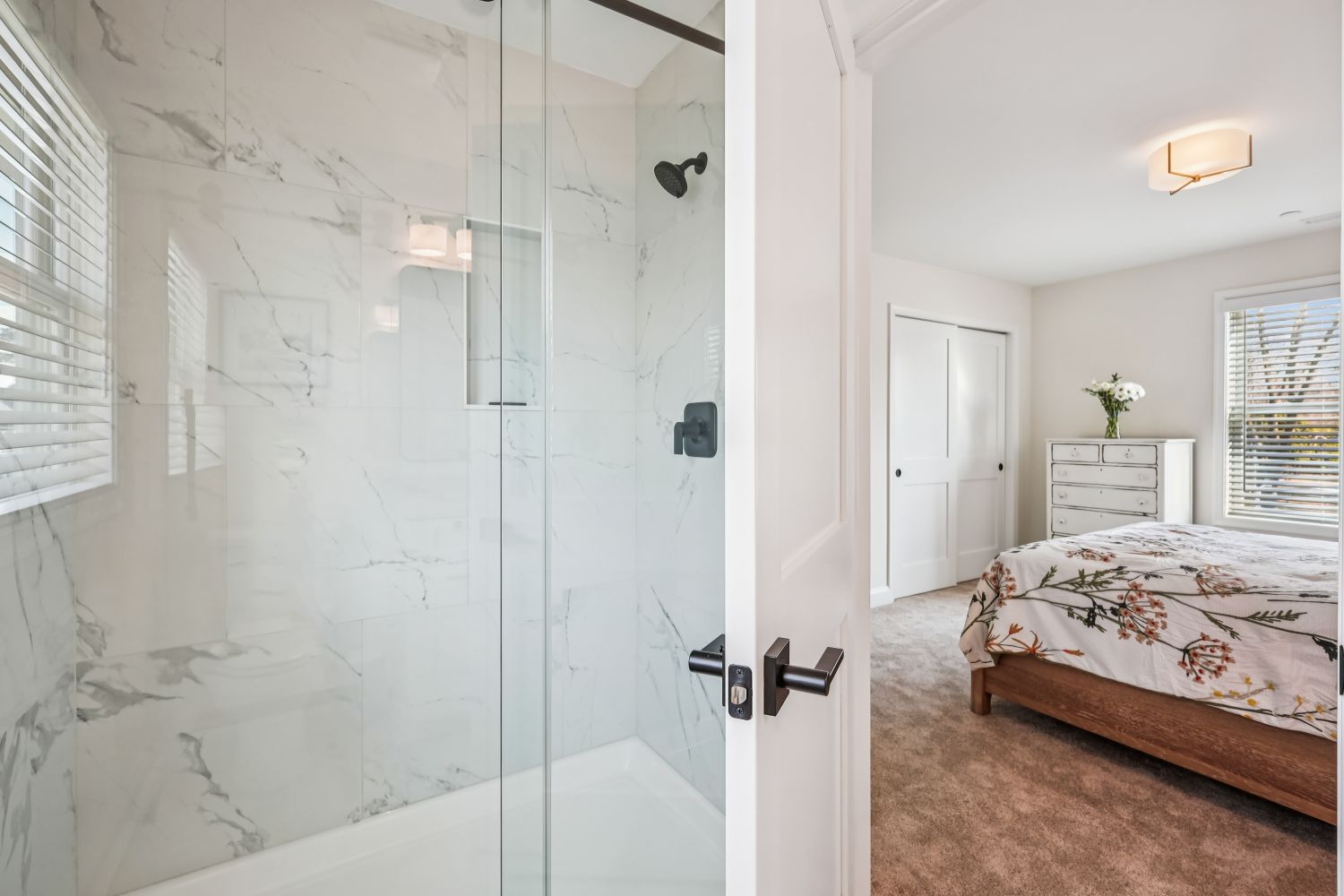
Off the dressing room is a large bath with high knee walls and a ceiling plane that follows the outline of the gable roof rafters above to meet the bottom of the collar beam above. The yellow wall accentuates the fixtures and cabinetry. 


The 6.8-acre property offers lush paths, boxwood hedges, and a modernized studio barn that blends utility with heritage.

The property’s 6.8 acres offer peace and privacy with mature boxwood hedges, mature evergreen and deciduous trees, perennials that return in the spring  and wildflowers that bloom in the summer to add color to fallow pastures. Enjoy a daily stroll on the paths that meander throughout the grounds or sit and relax to savor the quiet, broken only by the songs of birds. 

The property also has a studio barn that is accessed by its own gravel drive and parking pad. The barn contains a two-bay garage next to a workshop that has its own access and has been updated with insulation and finished in drywall. It also has its high voltage electric, fiber optic internet lines, its own water system and a pellet stove for heat in the winter.

“Friendship House” mid 1898’s restoration that included installation of handcrafted oak windows and mahogany doors with period hardware has been lovingly maintained with materials and preservation sensitive practices by its current owners. They also installed new HVAC units, preservation sensitive insulation, professionally restored windows and two new wood stoves for a turn-key home that offers low maintenance for the next very lucky steward of this remarkable piece of Maryland’s historic residential architecture. As we celebrate Thanksgiving today, I thought it was fitting to feature a house that was built less than 100 years since the Pilgrims landed at Plymouth Rock that has been so magnificently restored-Bravissimmo!! 


For more information about this property, contact Liddy Campbell at TTR Sotheby’s International Realty, 410-673-3344 (o), 410-708-5433 (c) or [email protected]. For more photographs or pricing, visit  bit.ly/LiddyCampbellRealtor,  “Equal Housing Opportunity”.

Photography by Janelle Stroop, 410-310-6838, [email protected] 

The Author is indebted to both the Listing Agent and the Owners for sharing their treasure trove of historic documents and photos of the renovations of this property that certainly shows “Friendship” belongs on the National Register of Historic Places!

Contributor Jennifer Martella has pursued dual careers in architecture and real estate since she moved to the Eastern Shore in 2004. She has reestablished her architectural practice for residential and commercial projects and is a real estate agent for Meredith Fine Properties. She especially enjoys using her architectural expertise to help buyers envision how they could modify a potential property. Her Italian heritage led her to Piazza Italian Market, where she hosts wine tastings every Friday and Saturday afternoons.

The Spy Newspapers may periodically employ the assistance of artificial intelligence (AI) to enhance the clarity and accuracy of our content.

Filed Under: 00 Post to Chestertown Spy, Design with Jenn Martella

Looking at the Masters: Grandma Moses

November 27, 2025 by Beverly Hall Smith Leave a Comment

Anna Mary Robertson Moses was born on September 7, 1860, in Greenwich, New York.  Her family worked on farms, and she described herself as a life-long farm woman. She attended a one- room school where she began to learn to draw. Her father encouraged all his children to draw. When she was 27, she married the “hired man” Thomas Salmon Moses, and they worked on local farms from Virginia to Eagle Bridge, New York. They had ten children; five survived into adulthood. In each location, Moses decorated the family’s home with her embroidery. When Thomas died in 1927, their son Forrest helped her on the farm. In 1936, at the age of 76, Moses developed arthritis, and she turned to painting because it was easier work. She told reporters that she turned to painting to make a Christmas gift for the postman, because it “was easier to make than to bake a cake over a hot stove.” At 92 she wrote, “I was quite small, my father would get me and my brother’s white paper by the sheet. He liked to see us draw pictures. It was a penny a sheet and lasted longer than candy.”


“Catching the Thanksgiving Turkey” (1943)

“Catching the Thanksgiving Turkey” (1943) (15”x19”) is a depiction of a subject Moses returned to several times. Thanksgiving was declared a holiday by Abraham Lincoln in 1863, but the day of celebration was left up to each President. It was not until 1941 that Congress declared the fourth Thursday of November to be Thanksgiving Day.

Moses painted “Catching the Thanksgiving Turkey” with four colors: red, white, black, and blue. The ground is covered with snow, and it is still snowing. Moses did not study perspective or anatomy, but she had a keen eye for details. The two-story white farm house is detailed with a light grey-blue paint. She used red and black blocks of paint to depict the brick chimney. Three figures stand outside the open front door. The one in red seems to be waving. Another with the white hair and wearing the black coat, stands next to the well. In front of the blue barn, others in red jackets and black pants try to catch the turkeys. Some head out in a horse drawn sleigh, and a hunter stands at the center and looks on. A figure stands in front of the open barn door. Beyond the barn, a man drives two horses by the fence. Two other men stand under a tree. 

The scene is a panoramic landscape. The fence draws the viewer’s eye from the lower left, past another farm structure and some trees, and beyond the barn into the distance. It is November, but all the leaves have not fallen from the trees. A forested hill stands out against the white snow in the middle distance. Another farm, more fences and houses can be seen in the distance. The blue mountains are covered in snow. The scene is dotted with large, white snowflakes. 

“Sugaring Off” (1943)

Moses began by selling paintings for three or five dollars. The Museum of Modern Art in New York included her work in its 1939 exhibit “Contemporary Unknown American Painters.” Her painting caught the attention of several influential people. One was Otto Kallir, founder of Galerie St Etienne in New York. He organized in 1940 an exhibition of Moses paintings that was titled “What a Farm Wife Painted.” The New York Herald nicknamed her Grandma Moses. She spoke at a Gimbels Department store, and she was an instant success. 

“Sugaring Off” (1943) (36”x45’’) is a depiction of another November activity and a theme Moses returned to 35 times. She described her process: “First the sky, then the mountain, then the hills, then trees, then the houses, then the cattle and then the people.”  Native Americans taught the process of sugaring off to the colonists. The painting includes the entire process of making maple syrup and candy from the sap. The leafless maple trees are tapped and the sap is caught in buckets. The sap is placed in large iron kettles over a fire, and it is boiled down to form a dark syrup that is put into molds and containers. Some of the syrup is poured onto the snow to make sugar candy.  Adults work or watch, while the children play. Horse drawn sleighs, groups of cattle, and snow-covered houses and barns are included in the composition, with a church and villages in the distance. The snow in the foreground has been trampled by the people and animals, but in the distance it is pristine. Moses painted hills, trees, and distant mountains to create the panoramic view. She shaded the entire scene with blue to create the impression of a cold November day. 

“Sugaring Off” (1943) sold at Christie’s New York for $1.36 million in 2006, setting a record for a Moses painting. 

“Turkeys” (1958)

In 1939 the Museum of Modern Art called the paintings by Grandma Moses “modern primitive.” Primitive artists lack formal training, generally use simple shapes, bright colors, and the work often appears childlike.  The piece often is a depiction of everyday activities, and it is intended to connect to nature and something that is culturally and spiritually significant. All of these things were true of her work. She avoided modern things like tractors and telephone poles. Contemporary art in the 1940s and after WWII in the 1950s was largely Abstract Expressionism, to many viewers confusing and morbid. Moses said, “I’ll not paint something we know nothing about, might just as well paint something that will happen a thousand years hence.”

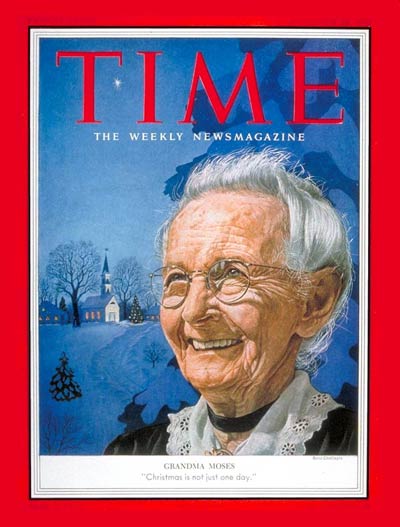
Her paintings were and continue to be tremendously popular. Exhibitions of her paintings broke attendance records. President Truman gave her The Women’s National Press Club Trophy Award for outstanding accomplishments in art in 1949.  She was on the cover of Time Magazine in 1953. Her autobiography My Life’s History was published in 1952. A documentary about her was nominated for an Oscar in 1950. Exhibitions of her work were held throughout America and Europe. She was awarded two honorary doctoral degrees, in 1949 by Russell Sage College in Troy, New York, and in 1951 by Moore College of Art and Design in Philadelphia. When Moses turned 88 in 1948, Mademoiselle magazine named her “Young Woman of the Year.” Norman Rockwell and Moses lived near each other and were close friends.  

When she painted “Turkeys” (1958) (16’’x24’’) (SAAM), Moses said, “The very first Thanksgiving I remember was about the year of 1864,” and she never stopped remembering the holiday and making paintings of it to viewers’ delight.  The setting of “Turkeys” is viewed from a different angle. The road and house are closer, the village and church are just down the road, and the landscape is covered with snow. A man runs down the road with an axe, and another figure in the field has caught the turkey by its tail feathers. The turkeys at the lower right are painted in a new variety of feather colors. Moses commented, “Poor turkey. He has but one life to give for his country.”

The writer of her obituary in 1961 in the New York Times noted that the “simple realism, nostalgic atmosphere and luminous color with which Grandma Moses portrayed simple farm life and rural countryside won her wide following.”

President John Kennedy spoke of her: “The death of Grandma Moses removed a beloved figure from American life. The directness and vividness of her paintings restore a primitive freshness to our perception of the American scene…All America mourns her loss.”

“I look back on my life like a good day’s work. It was done and I feel satisfied with it. I was happy and contented. I knew nothing better and made the best out of what life offered. And life is what we make it, always has been, always will be.” (Anna Mary Robertson Moses)


Beverly Hall Smith was a professor of art history for 40 years. Since retiring to Chestertown with her husband Kurt in 2014, she has taught art history classes at WC-ALL and the Institute of Adult Learning, Centreville. An artist, she sometimes exhibits work at River Arts. She also paints sets for the Garfield Theater in Chestertown.

The Spy Newspapers may periodically employ the assistance of artificial intelligence (AI) to enhance the clarity and accuracy of our content.

Filed Under: 00 Post to Chestertown Spy, Looking at the Masters

Spy Poetry: Touch Me by Stanley Kunitz

November 22, 2025 by Spy Poetry Leave a Comment

Editor’s Note: I have always loved this poem, and I was privileged to hear Kunitz read it at the Dodge Poetry Festival many years ago. His voice is lost to us now, but not this poignant, lovely tribute to a love sustained over the years. 

Summer is late, my heart.
Words plucked out of the air
some forty years ago
when I was wild with love
and torn almost in two
scatter like leaves this night
of whistling wind and rain.
It is my heart that’s late,
it is my song that’s flown.
Outdoors all afternoon
under a gunmetal sky
staking my garden down,
I kneeled to the crickets trilling
underfoot as if about
to burst from their crusty shells;
and like a child again
marveled to hear so clear
and brave a music pour
from such a small machine.
What makes the engine go?
Desire, desire, desire.
The longing for the dance
stirs in the buried life.
One season only,
and it’s done.
So let the battered old willow
thrash against the windowpanes
and the house timbers creak.
Darling, do you remember
the man you married? Touch me,
remind me who I am.

Stanley Kunitz (1905-2006) was a highly acclaimed American poet who served as the U.S. Poet Laureate Consultant in Poetry twice, in 1974-1976 and again in 2000-2001. He won a Pulitzer Prize for his poetry collection, Selected Poems, 1928-1958. Kunitz also served as the New York State Poet from 1987-1989 and was a dedicated educator, teaching at multiple universities. 

The Spy Newspapers may periodically employ the assistance of artificial intelligence (AI) to enhance the clarity and accuracy of our content.

Filed Under: 00 Post to Chestertown Spy, Spy Poetry

Rembrandt Comes to America: Masterpieces in Black and White—Prints from the Rembrandt House Museum by Anke Van Wagenberg, PhD

November 22, 2025 by The Spy Desk Leave a Comment

I recently attended the opening of the exhibition Rembrandt: Masterpieces in Black and White—Prints from the Rembrandt House Museum G. It was great to be part of the opening events of the American Federation of Arts & the Rembrandt House exhibition now on view at The Gibbes Museum of Art in Charleston, SC. 

A fellow Dutchman, Rembrandt Harmenszoon van Rijn (1606-1669) is widely regarded as one of the greatest artists of all time. Apart from his atmospheric paintings, he also produced more than 300 etchings. Ranging in scale and detail, these etchings exemplify Rembrandt’s mastery of print.

Rembrandt, known by his first name (like modern-day Madonna or Sting) was a master of innovation. As an artist, he constantly sought out new possibilities and new solutions for making art. This is evident not only from his paintings, but also from the more than three hundred etchings that he made in his career. Rembrandt: Masterpieces in Black and White—Prints from the Rembrandt House Museum presents the full range of Rembrandt’s etching output, alongside prints by select forerunners and contemporaries. It also demonstrates Rembrandt’s centuries-long impact on the field of printmaking through a select group of etchings by later nineteenth and twentieth-century artists.

A Dutch Baroque painter and printmaker, Rembrandt was one of the greatest storytellers in the history of art, possessing an exceptional ability to render people in their various moods and dramatic guises. Today he is widely regarded as one of the two most important printmakers in history, along with Albrecht Dürer. From his earliest etchings, Rembrandt created original compositions oriented towards the specific character of the medium. As a result, his prints range widely from large to small, and from summary sketches to laborious and elaborate works. He addressed an equally varied set of subjects, including Biblical stories, portraits, depictions of exaggerated or characteristic facial expressions called “tronies,” observations of everyday life, landscapes, nude model studies, and even sheets packed with small sketches.

Rembrandt’s printmaking style changed over his career, and he honed his style across a wide variety of subjects. Both his progress and the variety of his output will be traced in a number of thematic sections in this exhibition. These sections will cover everything from Rembrandt’s masterful skills as a visual narrator, his bold exploration of light and dark, and how he used self-portraits to fashion his own visual identity and explore the complexity of aging. The exhibition also includes select comparative works by Rembrandt’s forerunners and contemporaries, including his teacher Pieter Lastman and his pupils, Ferdinand Bol and Govert Flinck, which will contextualize his work and shed light on his specific innovations, such as his repeated experiments with etching, tonal effects, and the dramatic portrayal of his subjects.

The exhibition is accompanied by a free educational brochure developed by the AFA with an introduction by Epco Runia, Head of Collections at the Rembrandt House Museum, and with me as editor.

Following Birmingham, UK, the exhibition will be on view at the
Gibbes Museum in Charleston, SC October 24, 2025 – January 11, 2026;
the Taft Museum of Art in Cincinnati, OH, February 7 – May 17, 2026;
Naples Art Institute, Naples, FL, October 10, 2026 — January 17, 2027.  

Rembrandt: Masterpieces in Black and White—Prints from the Rembrandt House Museum is co-organized by the American Federation of Arts and the Rembrandt House Museum.

Anke Van Wagenberg, PhD, is Senior Curator & Head of International Collaborations at the American Federation of Arts in New York and lives in Talbot County, MD. 

The Spy Newspapers may periodically employ the assistance of artificial intelligence (AI) to enhance the clarity and accuracy of our content.

Filed Under: 00 Post to Chestertown Spy, Arts

Chesapeake Lens: “Cooper’s Hawk” By Mike Dougherty

November 22, 2025 by Chesapeake Lens Leave a Comment

Maybe not the king, but surely a prince of the Blackwater National Wildlife Refuge.
“Cooper’s Hawk” by Mike Dougherty.

The Spy Newspapers may periodically employ the assistance of artificial intelligence (AI) to enhance the clarity and accuracy of our content.

Filed Under: 00 Post to Chestertown Spy, Chesapeake Lens

Design with Jenn Martella: Sherwood Style

November 20, 2025 by Jennifer Martella Leave a Comment

Sherwood’s historic village displays diverse architectural styles framed by mature trees and nestled around Harris Creek.

Sherwood’s historic village displays diverse architectural styles framed by mature trees and nestled around Harris Creek.

The picturesque unincorporated village of Sherwood between Tilghman Island Road and Waterhole Cove to Harris Creek was established in 1928 by developer William F. Cochran. He named the community for the legendary Sherwood Forest of Robin Hood and his Merry Men. The community’s Methodist Church is still active and is surrounded by charming cottages and larger houses of diverse architectural styles that, along with the mature trees, give the community its charm. I have featured several houses in Sherwood and it is always a pleasure for me to revisit this special place.

This corner-lot home balances farmhouse-inspired architecture with vibrant metal roof accents and thoughtful siting for yard space.

Today’s featured property sits on a corner lot with off street parking at the side street.  The house was sited as close as possible to the setback from the side street to create a larger yard on the other side of the house. The front façade’s stoop is covered by a pitched roof that adds both shelter and character to the house’s farmhouse vernacular architecture and the low slope metal roof over the side porch adds a splash of color.  

Privacy is achieved through dense landscaping while original wood siding restoration highlights period authenticity.

Privacy is achieved through dense landscaping while original wood siding restoration highlights period authenticity.

The house enjoys privacy from the dense grouping of tall trees and shrubbery along the side street. As I walked around the grounds, another dense row of viburnum becomes a natural fence along the curve of Sherwood’s main street for total privacy. I was quite impressed to see that the original wood siding has been both meticulously scraped and freshly painted as part of the owner’s meticulous restoration. In colonial and post-colonial architecture, window pediments were scaled down to become low-pitched headers for windows like these that are found throughout the Eastern Shore.  

The stepped massing flows to a porch featuring screened and open sections for seamless indoor-outdoor living.

The stepped massing flows to a porch featuring screened and open sections for seamless indoor-outdoor living.

The house’s massing steps down from the front two-story wing to the rear one-story wing. The side elevation facing the grounds opens up to the landscaping with a porch that is half open, half screened for great indoor-outdoor flow from both the kitchen door and the dining room’s pair of French doors. The soft neutral palette of the siding and trim makes the house seem larger than it is.  

A versatile outbuilding complements the detail-rich rear elevation, including stylish window panels and skirt boards.

A versatile outbuilding complements the detail-rich rear elevation, including stylish window panels and skirt boards.

The side driveway ends at the open porch to the one-story wing of the kitchen. Beyond the lawn is an outbuilding that is currently used as a workshop for the house’s restoration; other myriad uses could be an office, studio, etc.  I admired the detail of the panels beneath the kitchen window-much more stylish than extending the lap siding below the window and both the corner and skirt boards are the perfect finishing touches.

Shiplap walls, ceiling molding, and timeless wood floors create texture and elegance in the compact living space.

Shiplap walls, ceiling molding, and timeless wood floors create texture and elegance in the compact living space.

I opened the front door to a foyer opposite the stair that is partially open to the living room. The large closet next to the stair defines the edge of the foyer. Beautiful wood floors and moldings that span across the ceiling and the accents of shiplap walls adds texture. The floor plan is compact so rooms flow into each other without halls. 


Tall windows infuse the living room with light, while the gas stove brings warmth to crisp autumn evenings.

Tall windows infuse the living room with light, while the gas stove brings warmth to crisp autumn evenings.

On the day of my visit, the sky was slightly overcast but the living room’s tall windows that rise to the ceiling flooded the space with daylight. In front of the chimney breast, a gas stove stands ready to take the chill off our fall nights.

Wide openings connect spaces, while long windows enhance the dining room’s serene views of private greenery.

Wide openings connect spaces, while long windows enhance the dining room’s serene views of private greenery.

A wide wall opening connects the living room to the dining room. The living room’s shiplap and ceiling molding continues around the chimney’s projection into the dining room and the wall of the full bath. Two long windows make window treatments unnecessary since the side yard’s dense evergreen and aucuba shrubbery provide privacy. I admired the artisanal wood table and the wood chairs that reminded me of Shaker simplicity.

French doors reveal a picturesque vista through the screened porch to the secluded garden beyond.

From the dining table, there is a long and serene vista through the screened porch to the private garden. Since the dining room is spacious, one could orient the table perpendicular to the French doors so all diners could have a garden view.

Thoughtfully designed with cherry cabinets and granite countertops, the kitchen opens to lush side yard views.

Thoughtfully designed with cherry cabinets and granite countertops, the kitchen opens to lush side yard views.

The kitchen’s cherry cabinets, granite countertops, stainless steel appliances pleased this cook and the wood floors add warmth. The double window unit over the sink has a view of the side yard’s dense foliage.

An exterior door leads to an airy porch perfect for al-fresco dining, complemented by vintage furniture and smart layout solutions.

The closet in the kitchen corner contains the washer and dryer which leaves space under the rear window for a small seating area to keep the cook company or a breakfast area. I admired the antique wall hung cabinet and the lovely antique table with angular sides under the side window. The wood square shape with a ring inset into the floor is the access to the encapsulated crawl space below. The exterior door leads to the open portion of the porch for al-fresco dining.

Open rafters and detailed columns enrich the porch, while separate screened and open spaces expand outdoor living opportunities.

Open rafters and detailed columns enrich the porch, while separate screened and open spaces expand outdoor living opportunities.

The porch is a delightful outdoor room with a wall separating the screened part at the dining room from the open part at the exterior door to the kitchen. The sloped ceiling is open to the roof rafters above and the rhythm of the sloped rafters and the horizontal beams creates a lively ceiling pattern. I especially liked the notched details of the porch’s columns. 


Shiplap detailing, exposed beams, and large windows shape the character of this inviting upper-level retreat.

Shiplap detailing, exposed beams, and large windows shape the character of this inviting upper-level retreat.

After exploring the main floor, I climbed the stair to the second floor whose layout includes a short hall connecting two large bedrooms with the hall bath. At the top of the stair, I looked back to the stair’s opposite wall that had an opening to the wall of the bath. This clever detail brings filtered daylight from the bath’s window into the stairwell. 

The primary bedroom is located above the dining room with windows on each side wall and the bedroom’s detailing of shiplap on the window wall, the exposed stained beams and the wood floors give the space character. 


Hand-hewn rafters and clever alcove storage preserve history while enhancing functionality in the primary suite.

Hand-hewn rafters and clever alcove storage preserve history while enhancing functionality in the primary suite.

The primary bedroom has ample storage from the two closets and the freestanding wood storage units in the alcoves. I especially liked how the marks on the underside of the original exposed rafters were not sanded down but left alone to show the hand hewn workmanship. 

A clawfoot tub and repurposed wood dresser bring distinct charm to the updated hall bathroom.

A clawfoot tub and repurposed wood dresser bring distinct charm to the updated hall bathroom.

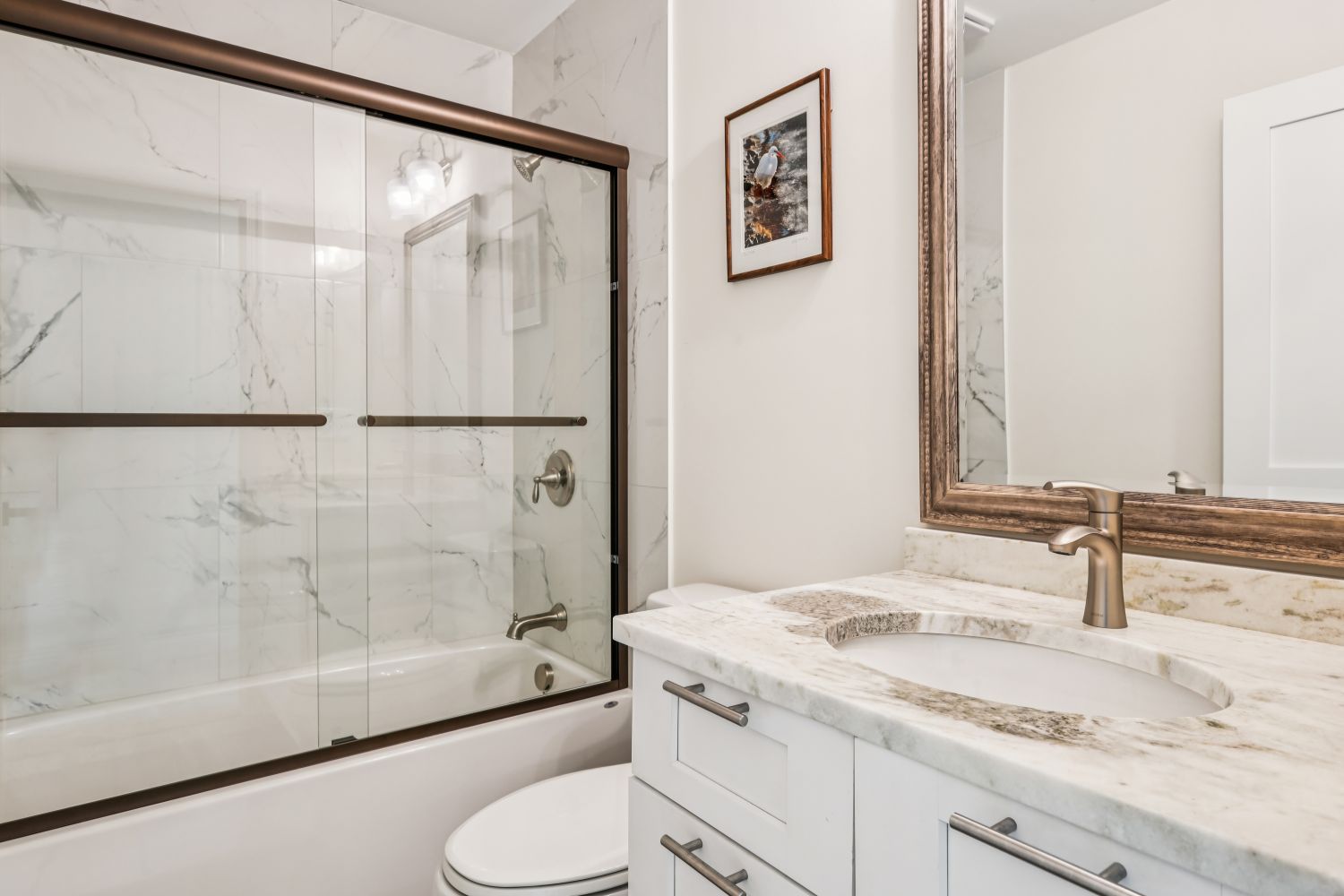
The hall bath has both a shower and a clawfoot tub and the wood dresser now has a new life as a lavatory cabinet. The vertical four-panel style wood door is typical for the doors that are original to the house. 

The community dock invites neighbors to gather and enjoy stunning sunsets over Harris Creek’s expansive views.

The bonus of living in Sherwood is the community dock with multiple slips, a floating dock and a kayak landing. The dock has become a neighborhood gathering space, especially in the late afternoon when neighbors gather to savor the expansive views as the sun sets over Harris Creek. 

Location, location, location-this charming Eastern Shore vernacular house on a corner lot in one of Talbot County’s most picturesque unincorporated communities is close to the both Tilghman Island’s and St. Michaels’ restaurants and attractions. The Community Dock is both for launching boats and kayaks, but it is also a neighborhood gathering space for “Merry Men and Maid Marians” to  watch the sun set over the wide expanse of Harris Creek. The house has been meticulously restored and lovingly maintained including updated kitchen and baths as well as an encapsulated crawl space, septic system with a new BAT system, new well, new Renai hot water heater and new HVAC.    The compact floor plan with minimal halls maximizing room sizes for furnishings. The outdoor room of the porch with both open and screened areas overlook the private back yard outlined by a dense viburnum “fence”. This move-in ready house would be a perfect weekend/summer home, first time home or retirement home. My compliments to the Owner for his design and construction work!


For more information about this property, contact Cornelia C. Heckenbach, Associate Broker at Long and Foster Real Estate, 410-310-1229 (c) or [email protected] . For more pictures and pricing, visit www.StMichaelsMdWaterfront.com,  “Equal Housing Opportunity.”

Aerial Photography by Robert Thayer, www.thayerfilm.com , 443-253-1716

 Interior and Exterior Photography by HomeVisit, www.homevisit.com ,703-953-3866

Contributor Jennifer Martella has pursued dual careers in architecture and real estate since she moved to the Eastern Shore in 2004. She has reestablished her architectural practice for residential and commercial projects and is a real estate agent for Meredith Fine Properties. She especially enjoys using her architectural expertise to help buyers envision how they could modify a potential property. Her Italian heritage led her to Piazza Italian Market, where she hosts wine tastings every Friday and Saturday afternoons.

The Spy Newspapers may periodically employ the assistance of artificial intelligence (AI) to enhance the clarity and accuracy of our content.

Filed Under: 00 Post to Chestertown Spy, Design with Jenn Martella

Looking at the Masters: Christi Belcourt

November 20, 2025 by Beverly Hall Smith Leave a Comment

Christi Belcourt, a Metis and First Nations of Canada artist, was born in 1968 in Scarborough, Ontario. She now lives in Lac Ste Anne, Alberta. 

Belcourt depicts traditional designs of the Metis people. They are of mixed race whose progenitors were First Nations women and European men, fur traders from France, England, and Scotland. They developed a language, government, and culture distinct from that of other indigenous people. The Manitoba Act of 1870 made the land of the Metis part of Canada. Belcourt’s paintings capture the Metis people’s appreciation of the beauty of the natural world and their deep concern for its preservation.

“Water Song” (2010-11)

The Metis people were known as the Flower Bead People. “Water Song” (2010-11) (80’’x231”) (acrylic) was inspired by one of their crafts.  The canvas is covered with approximately 250,000 dots, applied with the tip of the paint brush. Clusters of roots in the water surround the lower edge of the composition. Burdock root flowers, their green leaves and small red berries are in the lowest and central section of the work. They are used for cleansing and women’s medicine.  Plants included are the wild rose, trillium, blueberry, plantain, sundew, clubmoss, Indian pipe, shrink cabbage, lady’s slipper, yarrow, thistle, chokecherry, tamarack, maple, clover, nettles, red clover, maples, oak, pinecones, and strawberries, the first fruit of spring. Birds included are the downy woodpecker, barn owl, nuthatch, and northern flicker. Two warblers sing at the top of the painting.  The small white flowers of a milkweed plant are placed at the center, with monarch butterflies at either side. Milkweed is a major food source for monarch butterflies, now an endangered species.

“Water Song” (detail)

This detail of the right side of the composition includes a yellow warbler singing. Beneath are pine cones and needles, and a barn owl.  At the far left are the white dots of the milkweed and the monarch butterfly. 

The painting attracted the attention of Dior designers Maria Grazia Chiuri and Pierpaolo Piccioli. With Belcourt’s permission, some of the 2016 Resort Collection featured designs from the painting. Belcourt explained that “A lot of the beadwork tradition and imagery that I work with was originally put on items that were for use of some sort, including clothing.  And then in my painting practice, I took that imagery and practice of beadwork and transferred it into paint and put it onto canvas. So then to take this artwork that was done in paint and put it back onto clothing was almost like it had come full circle. That was exciting.”

“Giniigaaniimenaaning (Looking Ahead) (2012)

“Giniigaaniimenaaning (Looking Ahead) (stain glass window) (2012), located in the Centre Block of the Parliament Building of Canada, represents the 2008 apology of the Canadian government to the indigenous people of Canada for the policy of placing children in Indian residential schools. The top panel includes the date 2008 and a female shape that integrates the Canadian maple leaf and feathers. The left panel includes the image in white of Phil Fontaine, the Grande Chief of the Assembly of Manitoba Chiefs, holding a drum and drum stick. In 1990, he was the first to speak out about his life in the residential school. Others began to speak out, and reconciliation began, represented by the white dove holding the olive branch. The shattered glass represents the lives that were shattered. The middle section, largely created in black and white glass, represents life in the schools. The top right side of the window commemorations the Apology to former students offered by Canadian Prime Minister Stephen Harper on June 11, 2008: “I am filled with optimism… a new day has dawned, a new day heralded by a commitment to reconciliation and building a new relationship with Inuit, Métis and First Nations.”  The lines represent rays of sunshine.  Doves and an eagle fly upward as if toward the future. A tribal elder wearing a “jingle dress” represents healing. The colors yellow, black, white, red, green, and blue are the colors used in medicine wheels, the sun dance, and lodges. The grandfather sings a traditional song to signify the restoration of the songs, dances, ceremonies, and languages of the people. The mother and child illustrate the return to traditional child rearing. At the bottom of both panels, the circle has been connected and is complete. Grandmothers sit in their lodges and smoke peacefully as traditions are restored. The strawberries hold a significant place in Metis culture as they are the first fruits of a new spring and represent a new beginning.

“Wisdom of the Universe” (2014)

Belcourt received the Ontario Arts Council Aboriginal Arts Award in 2014. “Wisdom of the Universe” (2014) (67×111’’) represents plants and animals that are on the endangered species list: Dwarf Lake Iris, Eastern Prairie Fringed Orchid, Karner Blue Butterfly, West Virginia White Butterfly, Spring Blue-eyed Mary, Cerulean Warbler, and Acadian Flycatcher. Belcourt writes stories or comments to go with many of the works. She wrote about this piece: “Globally, we live in a time of great upheaval. The state of the world is in crisis. We are witness to the unbearable suffering of species, including humans. Much of this we do to ourselves. It is possible for the planet to return to a state of well-being, but it requires a radical change in our thinking. It requires a willingness to be open to the idea that perhaps human beings have got it all wrong. All species, the lands, the waters are one beating organism that pulses like a heart. We are all a part of a whole. The animals and plants, lands and waters, are our relatives each with as much right to exist as we have…Perhaps it’s time to place the rights of Mother Earth ahead of the rights to Mother Earth.”  

Belcourt is an advocate for other social and environmental causes. She initiated in 2011 the Walking with Our Sisters project, inspired by seeing too many posters about missing indigenous women: “One day, I saw one that hit me harder than usual, because the girl on the poster looked like my daughter.” In response to her Facebook appeal for 600 beaded moccasin tops for an exhibition to represent these women, 1,723 pairs were sent from all over the world, and 65 beading circle projects sprung up in Canada, United States, and Europe. The moccasin tops, called vamps, tongues, or uppers, were not sewn onto the moccasins to represent the unfinished lives of the missing women. The project toured in 30 Canadian and US locations from 2012 until 2019. Each exhibition was created specifically for each location. 

From 2010 until 2013, Belcourt organized with Jon and Kerry Butler and Sophie Edwards an art project to protect Willisville Mountain, where several famous Canadian artists had made art history with their paintings. The Mountain, owned by a mining company, was under threat of being quarried, thus the destruction of the beauty of the famous area. The pressure of 45 artists caused the cancellation of the development, and the beauty of the mountain was preserved. She co-founded the Onaman Collective in 2014 to preserve traditional knowledge and language and to teach it to the young. The Collective raises awareness of the need to protect the Great Lakes and other bodies of water. Since 2017, proceeds from her works and awards have been donated to Nimkii Aazhibikong, a year-round camp to revitalize the Anishinaabemowin language among indigenous people. She is the author of at least four books, one on native medicines and another on Beadwork. She received in 2016 the Premier Arts Award and a Governor General’s Award for Innovation. 

“Offerings to Save the World” (2017)

Belcourt continues to paint in her unique style, and she continues to add text for the viewer. In “Offerings to Save the World” (2017) (72’’x55’’) her focus once again is on water, and this time the painting takes on a mystical theme. Water spouts arise from the bottom of the canvas to reach the sky. Interwoven with the blue sky and water are stars, fish, and frogs. Two spiritual indigenous figures are placed on either side of the water. They bring offerings and pray.  They sit and stand upon an abundance of flowers. A dark female figure appears to rise from the water. 

The accompanying text: ‘’Quick! Drop everything. The future will look as the past. The Elders have foretold. Quick! Give everything. For every baby to be born. Of every species forever to come. Born into water. Born onto an earth of water. Quick! Go to the River. Bring your shaker. Sing to save the world. Quick! Go to the Water’s edge. Bring feast food. Give offerings to save the world. Mother Earth is the almighty.’’

“The Earth is My Government” (2017)

“The Earth is My Government” (2017) (51’’x72’’) expresses another of Belcourt’s responses to the world in which she finds herself. The deep blue of the water and sky contain stars, birds, and fish. The spirit of the buffalo that had provided for many of the needs of indigenous people over hundreds of years also resides in this blue world. The buffalo shape contains the flower beading of the Metis. The Metis people were not recognized by Canada as indigenous peoples until 1982 in Section 35 of the Constitution Act. They finally obtained the right to self-government in 2019. Belcourt’s saying that the earth is my government can be understood better in these circumstances.

Remaining true to her strong beliefs, she protested that her name should be removed from the Metis Nation of Ontario registry because she disagreed with the deals that were being made with Energy East, Nuclear Waste Management Organization, and others. She was involved in establishing the 150 Acts of Resistance to counter the government’s “Canada 150” to celebrate the 250th anniversary of Canada in 2017. She said they were “ignoring basically all of the First Nations, Métis Nations and Inuit people that have been here for 15,000 years…The other thing is that we wanted to be able to showcase the good things that are happening in our nations that we should really be celebrating. We wanted to feature examples of history, of resistance, resilience and resurgence. All the restoration work being done on the grassroots level is really inspiring.” In 2023 she received an Honorary Doctorates in Visual Arts from Algoma University, Sault Ste. Marie, Ontario, and Doctor of Letters from Wilfrid Laurier University, Waterloo, Ontario.

“I Envy Their Freedom” (2020)

“I Envy Their Freedom” (2020) (31”x31’’) reminds viewers how important water is to the world. The title is understandable in light of Belcourt’s continued battle to save the future of Earth. Rest is needed to continue the fight. Her process is a type of meditation. Each painting is meticulously executed with tiny dots, requiring an extraordinary amount of time and concentration, resulting in calm. 

“I want all human beings to feel connected to the earth, because ultimately, we are all of this earth, and in becoming connected to the earth and to the waters, we are more likely to want to protect those for future generations. It is a form of expression of who I am that also, at its fundamental core, relates to all of us as human beings, who are living on this planet, with other beings who deserve to have a clean environment.” (Christi Belcourt)


Beverly Hall Smith was a professor of art history for 40 years. Since retiring to Chestertown with her husband Kurt in 2014, she has taught art history classes at WC-ALL and the Institute of Adult Learning, Centreville. An artist, she sometimes exhibits work at River Arts. She also paints sets for the Garfield Theater in Chestertown.

The Spy Newspapers may periodically employ the assistance of artificial intelligence (AI) to enhance the clarity and accuracy of our content.

Filed Under: 00 Post to Chestertown Spy, Looking at the Masters

Spy Poetry: Delores Jepps by Tim Seibles

November 15, 2025 by Spy Poetry Leave a Comment

Editor’s Note: Such a charming paean to first love and that innocent time before the “real world” sets in and the mystery of the “other sex” is dispelled by familiarity.

It seems insane now, but
she’d be standing soaked
in schoolday morning light,
her loose-leaf notebook,
flickering at the bus stop,

and we almost trembled

at the thought of her mouth
filled for a moment with both
of our short names. I don’t know
what we saw when we saw
her face, but at fifteen there’s
so much left to believe in,

that a girl with sunset
in her eyes, with a kind smile,
and a bright blue miniskirt softly
shading her bare thighs     really
could be The Goddess. Even
the gloss on her lips sighed
Kiss me    and you’ll never

do homework again. Some Saturdays
my ace, Terry, would say, “Guess
who was buying Teaberry gum
in the drugstore on Stenton?”
And I could see the sweet
epiphany still stunning his eyes

and I knew that he knew
that I knew he knew     I knew—
especially once summer had come,
and the sun stayed up till we had
nothing else to do but wish
and wonder about fine sistas

in flimsy culottes and those hotpants!
James Brown screamed about: Crystal
Berry, Diane Ramsey, Kim Graves,
and her. This was around 1970: Vietnam
to the left of us, Black Muslims
to the right, big afros all over my

Philadelphia. We had no idea
where we were, how much history
had come before us—how much
cruelty, how much more dying
was on the way. For me and Terry,
it was a time when everything said

maybe, and maybe being blinded
by the beauty of a tenth grader
was proof that, for a little while,
we were safe from the teeth
that keep chewing up the world.
I’d like to commend

my parents    for keeping calm,
for not quitting their jobs or grabbing
guns    and for never letting up
about the amazing “so many doors
open to good students.” I wish

I had kissed
Delores Jepps. I wish I could
have some small memory of her
warm and spicy mouth to wrap
these hungry words around. I

would like to have danced with her,
to have slow-cooked to a slow song
in her sleek, toffee arms: her body
balanced between the Temptations’
five voices and me—a boy anointed

with puberty, a kid with a B
average and a cool best friend.
I don’t think I’ve ever understood
how lonely I am, but I was

closer to it at fifteen because
I didn’t know anything: my heart
so near the surface of my skin

I could have moved it with my hand.

The Spy Newspapers may periodically employ the assistance of artificial intelligence (AI) to enhance the clarity and accuracy of our content.

Filed Under: 00 Post to Chestertown Spy, Spy Poetry

Chesapeake Lens: Autumnal Splendor by Harry Greenspun

November 15, 2025 by Chesapeake Lens Leave a Comment

All the glorious colors of autumn… We’re sure glad we don’t have to rake all those leaves!
“Autumnal Splendor” by Harry Greenspun

The Spy Newspapers may periodically employ the assistance of artificial intelligence (AI) to enhance the clarity and accuracy of our content.

Filed Under: 00 Post to Chestertown Spy, Chesapeake Lens

  • « Previous Page
  • 1
  • 2
  • 3
  • 4
  • 5
  • …
  • 59
  • Next Page »

Copyright © 2026

Affiliated News

  • Chestertown Spy
  • Talbot Spy
  • Cambridge Spy

Sections

  • Sample Page

Spy Community Media

  • Sample Page
  • Subscribe
  • Sample Page

Copyright © 2026 · Spy Community Media Child Theme on Genesis Framework · WordPress · Log in