MENU

Sections

  • Home
  • Education
  • Donate to the Centreville Spy
  • Free Subscription
  • Spy Community Media
    • Chestertown Spy
    • Talbot Spy
    • Cambridge Spy

More

  • Support the Spy
  • About Spy Community Media
  • Advertising with the Spy
  • Subscribe
January 20, 2026

Centreville Spy

Nonpartisan and Education-based News for Centreville

  • Home
  • Education
  • Donate to the Centreville Spy
  • Free Subscription
  • Spy Community Media
    • Chestertown Spy
    • Talbot Spy
    • Cambridge Spy
Ecosystem Eco Lead Ecosystem Eco Portal Lead

Sweet: To preserve the Bay, EPA and Hershey commit $2 million for Pennsylvania Farmers

August 24, 2023 by Maryland Matters Leave a Comment

The U.S. Environmental Protection Agency and Hershey Co. on Tuesday pledged $2 million to support Pennsylvania dairy farmers in adopting environmentally friendly practices, part of a larger conservation effort to protect the Chesapeake Bay Watershed.

They made the announcement at Central Manor Dairy in Manor Township, a 200-cow operation that has been a member of Land O’Lakes (and its predecessor) since 1943.

The Alliance for the Chesapeake Bay, in collaboration with Land O’Lakes, Inc., will use the funding as part of the ongoing “Sustainable Dairy PA” initiative that the agency and the two companies first launched in 2021.

Sustainable Dairy PA participating farmers work with the Alliance to establish best practices to reduce greenhouse gas emissions and improve Chesapeake Bay watershed water quality. At launch, the initiative prioritized 119 Land O’Lakes member-owner farms in central Pennsylvania that ship 50% or more of their milk supply to Hershey. Land O’Lakes operates as a member-owned cooperative, representing more than 1,000 farms across the U.S.

Jenna Mitchell Beckett, Pennsylvania director and agriculture program director for the Alliance, told the Capital-Star that the Sustainable Dairy PA program is voluntary for farmers who want to participate.

“The $2M funding from Hershey and EPA will help Land O’Lakes member farms accelerate their sustainability efforts by investing with them in the implementation of manure storage facilities, soil health practices, riparian forest buffers and other efforts to enhance sustainability on farms supplying to Hershey,” Beckett said in an email, “which builds farm resilience, improves water quality, and reduces emissions.” The Sustainable Dairy PA model focuses on all parts of the supply chain working together, she added, rather than the farmers managing everything themselves.

The EPA is supplying $1 million of the new round of funding, with Hershey providing a matching $1 million. The National Fish and Wildlife Foundation will administer the portion of the funds provided from EPA to the Alliance, the EPA said.

Since 2018, the Alliance has worked to develop agriculture supply chain programs, with an eye toward improving the member farms’ long-term sustainability, improving soil health, and overall efficiencies.

A report released earlier this year by the Chesapeake Bay Program found that pollution reduction efforts by states in the watershed were “more challenging than expected.”

Pennsylvania, Maryland, and Virginia are responsible for around 90% of the Chesapeake Bay’s pollution, and according to a 2022 report from the Chesapeake Bay Foundation, while the states were on track to meet their 2025 commitments for reducing pollution from wastewater, agriculture or urban and suburban runoff pollution reduction efforts lagged behind.

“States are not on track to reduce pollution to the levels needed for a healthy Bay, or implement the practices necessary to achieve them by the 2025 deadline,” according to the 2022 State of the Blueprint Report.

Under the terms of the Chesapeake Bay Agreement, Pennsylvania, Maryland, Virginia, Delaware, West Virginia, New York, and the District of Columbia have to reach specific milestones in pollution reduction.

The dairy industry is responsible for roughly 2% of the U.S.’ greenhouse gas emissions, according to the World Wildlife Fund.

“EPA’s funding commitment to Hershey, Land O’Lakes, and the Alliance for the Chesapeake Bay brings $2 million of much-needed support to Pennsylvania dairy farmers to scale up conservation practices that are good for our farms, climate, local streams, and the Bay,” EPA regional administrator Adam Ortiz said. “With this funding, we are not only investing in the current environment, but into the long-term viability of Pennsylvania farmers – our frontline environmentalists.”

By Kim Lyons

The Spy Newspapers may periodically employ the assistance of artificial intelligence (AI) to enhance the clarity and accuracy of our content.

Filed Under: Eco Lead, Eco Portal Lead

How a Wharf Went to the Park on a Bus by Marion Arnold

August 5, 2023 by Spy Desk Leave a Comment

When Kristen Lycett joined the Phillips Wharf Environmental Center in early 2020, the then 14-year-old non-profit was located where it got its start, on Tilghman Island. Under the aegis of founder Kelley Phillips Cox, the center ran a robust environmental program to educate the public on maintaining a healthy Chesapeake Bay.  With a focus on oyster aquaculture, the center began an oyster restoration project, planting over 835,000 oysters. The center also acquired an oyster lease and began selling oysters to local restaurants to underwrite its diverse operations which also included a visitor’s center and classroom on three acres by the Tilghman Island bridge. There was even a skipjack that took visitors out to the oyster reef.

In addition, the center housed an aquarium for up close interaction with creatures that depend on clean Chesapeake waterways—turtles, crabs, and dozens of native fish. Educational outreach was conducted by bus. Lycett, who has a PhD from the University of Maryland in marine science, was brought in to manage the center’s popular Fishmobile, a school bus colorfully transformed into a rolling aquarium for transporting tanks of creatures to local schools and community events.

Then along came COVID.

Just five weeks into her new job, the pandemic brought operations at Phillips Wharf to a grinding halt.  Lycett, said, “We closed to the public, canceled all in-person programming, and created a virtual Fishmobile program for fourth graders in Talbot County.” Going from in-person to onscreen was a big challenge. “It was definitely hard,” said Lycett.  “I have minimal video editing skills and had minimal resources at the time.” And because not all students had access to the Internet, Lycett had to come up with alternative formats for students. She said, “A lot of work went into making this program accessible.”

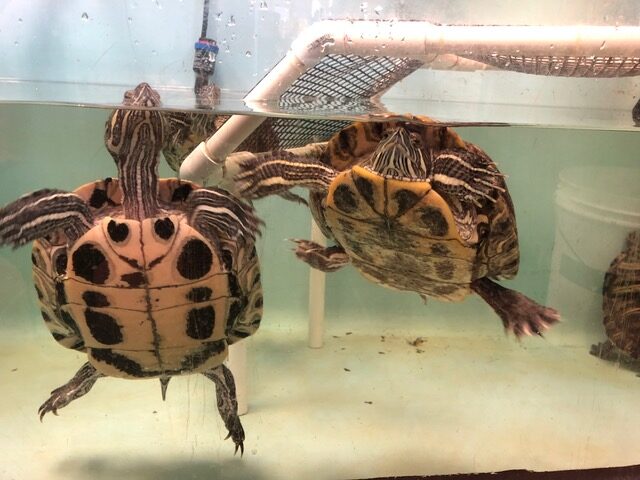
Red Eared Terrapins

But as Lycett dedicated herself to maintaining the Fishmobile program, the shutdown set off a cascade of bad news. When restaurants closed, revenue from oyster sales plummeted. A tropical storm later in the summer caused costly damage to the center’s classroom and aquarium facilities. In spring 2021 the Philips Wharf board made the hard decision to sell its assets, divesting itself of the oyster farm and then the environmental center. When Phillips Wharf closed down, all that remained was a small endowment and the Fishmobile. Heartbreakingly, in the midst of this, Kelley Phillips Cox died.

But a new door was waiting to open. As it happened, the Town of Easton had planned to move its public works facility from an industrial area on Easton Point to another location.  In its place, the town began creating a park. Back in 2009, then Mayor Bob Willey determined he could provide something residents had long asked for: access to Easton’s waterfront on the Tred Avon River. He asked newly elected council member Megan Cook to oversee park development.  Cook led the effort with a focus on environmental stewardship, using native plantings, developing a living shoreline, and favoring greenspace over hard-top and cement. From the start, the town wanted an organization to help visitors to enjoy and learn about the park’s natural resources. 

“It turned out that the town was looking for an environmental center for Easton Point Park,” said Phillips Wharf board vice-president Barbara Boyd.  “The Town of Easton was very, very accommodating.” The Phillips Wharf board had been exploring a move to Dorchester County but, she said. “We owed it to Kelley (Cox) to keep the center in Talbot County. And Easton is a much easier location to get students here for our programming.  For Easton, Phillips Wharf brings educational, environmental, and community purpose to help visitors understand how to support the Chesapeake Bay.”

It was a natural fit. Mayor Megan Cook said, “It’s a great partnership. Phillips Wharf is an asset to the community and a win-win for everyone involved.”

The Fishmobile and its menagerie rolled into the park in March 2022. Its new home consists of office spaces and open bays that the town had used for parking trucks and storing materials. As the public works moves out, the center is moving in.  “Our goal is to turn the closest garage bay to the building into additional aquarium space and aquarium prep space,” said Lycett, who is now the center’s Executive Director. By September she hopes to have access to more space to use as classrooms.

Phillips Wharf is adapting its offerings to Easton Point Park. “From the new location most of Phillips Wharf’s charter is still the same. But there’s less aquaculture and history and more emphasis on STEM (Science, technology, engineering, and mathematics),” Boyd said. At Easton Point, the center provides free onsite educational tours where children have hands-on experience with a mini oyster reef.  “They test the waters and count and measure the oyster spats,” Boyd said. “We offer this as summer programming that camps can take advantage of.”  In July came big news and a big boost for the center’s educational programming. Phillips Wharf was awarded a three-year NOAA B-WET grant, the Meaningful Watershed Educational Experience (MWEE), to teach environmental literacy to all fourth-graders in Talbot County. Lycett also hopes to eventually offer adult education programs on topics in ecology and sustainable living. In addition, the tireless Lycett manages a scaled down oyster growing program on Tilghman Island.  She has also run a very successful spring cleanup called “Tidy Up Talbot.” As Boyd put it, “We are unbelievably lucky to have Kristen onboard.”

And, of course, there’s the ever-popular Fishmobile. If you miss the bus this summer, you can always come to the park to meet Larry, the irrepressible Diamondback terrapin, and other creatures at the aquarium. “Our animal collection changes throughout our programming season as we find species in our oyster cages or go out and catch them,” notes Lycett. “We do release some animals to minimize the amount of care and food required during months when our Fishmobile program is not running (end of November through March). However, the turtles are with us for life, so we care for them year round.” In the end Lycett hopes the animal experiences are memorable. “My hope is our visitors take something from that interaction–whether that it’s OK to be excited and interested in something or a love for weird critters or just an interest in marine science and the Chesapeake Bay.”

While Phillips Wharf busily settles into its new home, Easton Point Park also continues to transform. Town Manager Don Richardson says the town is now in the planning phase to build a marina with a boat ramp and parking by the water. The building opposite to the one occupied by Phillips Wharf will be torn down to create parking space for a new entrance to the park accessed from Flood Street.  Eventually there will be trails, including a connection to Easton’s expanding Rail-to-Trails paths. There’s much to see and more to come at Easton Point Park.

 Marion Arnold is leader of the Plastic-Free Easton action committee. She lives in Easton. For more information on Phillips Wharf please go here.

The Spy Newspapers may periodically employ the assistance of artificial intelligence (AI) to enhance the clarity and accuracy of our content.

Filed Under: Eco Lead, Eco Portal Lead

Supreme Court Wetlands Ruling ‘Serious Setback’ for Bay

July 29, 2023 by Bay Journal Leave a Comment

With a recent U.S. Supreme Court decision sharply curtailing federal oversight of streams and wetlands, environmental groups working to restore the Chesapeake Bay say they’re worried about gaps in state laws and enforcement practices that now leave those waters vulnerable to unrestricted development and pollution.

In a May 25 ruling the nine justices unanimously agreed that the U.S. Environmental Protection Agency overstepped its authority in declaring part of an Idaho couple’s home site wetlands and demanding that they get a permit to fill it.

But the court’s majority went further in Sackett v. EPA and, with a 5–4 vote, drastically redefined which streams and wetlands are protected under the Clean Water Act. In doing so, it sought to settle decades of debate by removing federal regulation of activities affecting isolated wetlands and tiny streams that flow with water only after heavy rains.

“I’m not aware of anyone who predicted this,” said Peggy Sanner, Virginia executive director of the Chesapeake Bay Foundation.

She called it a “serious setback” for environmental protection efforts in general, as well as for the Bay restoration effort.

Wetlands and those periodically dry stream beds help keep water-fouling nutrients and sediment from reaching the Bay while also providing critical habitat and soaking up floodwaters.

Farmers, developers and other business organizations welcomed the ruling. The Virginia Farm Bureau’s blog called it “a major victory for farmers and property rights,” while the chair of the National Association of Home Builders dubbed it a win against “federal overreach” and for “common-sense regulations and housing affordability.”

Passed in 1972, the Clean Water Act gave the federal government jurisdiction over “navigable waters” and set up a permitting program to regulate discharges of dredged or fill material into “waters of the United States,” including wetlands.

A legal and political dispute has flared on and off since then about how far upstream that authority applies. Congress amended the Clean Water Act in 1977 to specify that it also covered wetlands “adjacent” to navigable waters, but that hasn’t quelled the controversy. The Supreme Court has weighed in repeatedly since the 1980s, with shifting and conflicting opinions.

In 2015, the Obama administration sought to clarify what’s regulated with a rule that protected isolated wetlands and “ephemeral” streams with a “significant nexus” to navigable waters.

That drew fierce backlash from farmers, developers and energy companies. The Trump administration repealed it and proposed a much narrower rule that applied federal regulations only in cases where surface water contributes to the wetland or waterway in question. States and environmental groups sued.

A court threw out the Trump rule, and the Biden administration has been working on another, more expansive version.

Environmental lawyers say the Sackett ruling appears to restrict federal jurisdiction even more than the Trump regulation. The EPA and U.S. Army Corps of Engineers, the two agencies that regulate activities affecting wetlands and waterways, had estimated that the Trump regulation would have stripped federal protection from more than half of the nation’s wetlands and roughly one-fifth of its streams.

Bob Dreher, legal director for the Potomac Riverkeeper Network, estimated that the recent court decision removes protection from as much as 65% of wetlands nationwide and more than 80% of the streams.

In the Bay watershed, the impact is somewhat muted. Five of the six states and the District of Columbia provide at least some protection under their own laws for wetlands and streams now removed from federal jurisdiction. Delaware is the only outlier, one of 24 states nationwide that rely entirely on the Clean Water Act for safeguarding their waters, according to the Environmental Law Institute.

Maryland, Pennsylvania and Virginia each have comprehensive state laws that provide protection from disturbance for their wetlands and all waters, even groundwater, noted the Bay Foundation’s Sanner.

West Virginia law also contains a broad definition of “waters of the state” but, according to the law institute’s James McElfish, the state has not always required permits for activities in wetlands and streams that fall outside the federal interpretation.

New York last year strengthened its protections for freshwater wetlands, but the state only requires permits for activities affecting wetlands larger than 7.4 acres, unless they’re deemed to be of “unusual importance.”

David Reed, executive director of the Chesapeake Legal Alliance, foresees trouble, even in states with strong legal protections on the books. State and federal agencies have jointly reviewed applications for permits to disturb a wetland or stream. Now, with the federal role shrinking, he said, there won’t be a backstop for state regulators facing intense pressure to look the other way.

“It will push them inevitably toward laxer enforcement,” Reed said of the states. “It will be this insidious direction toward less and less protection.”

Before the court’s ruling narrowing federal jurisdiction, Virginia, for instance, had relied on the Army Corps to review developers’ delineations of wetlands and surface waters when they were seeking permits.

In late June, the state’s Department of Environmental Quality announced that it would take over that task and would prioritize those applications where the delineations are performed by certified private wetlands professionals.  The agency said the change would “restore certainty in the permitting process and allow projects to move forward in a timely manner.”

The Bay Foundation’s Sanner said she was encouraged by DEQ’s “thoughtful” process for continuing to protect wetlands while ensuring efficient permitting.  But she cautioned that “many questions remain” about the state’s response to the court ruling.

Another major concern is that most states do not offer their citizens the same right to go to court to enforce their laws as the Clean Water Act does. The federal provision for “citizen suits” has allowed environmental groups to go after polluters in federal court and often prod state regulators to act when they haven’t before, Reed said.

Environmentalists say the Supreme Court decision also puts a cloud over the section of the Clean Water Act that establishes federal and, by extension, state authority to regulate discharges of stormwater and other pollutants into dry stream beds or isolated wetlands.

Activists say the Supreme Court’s ruling means they’re going to have to press for stronger state laws and for staffing and budget increases for regulatory agencies to enforce them.

“If we’re going to have hope for states to be a little of a backfill here, we’re going to have to help states get up to speed,” said Betsy Nicholas, the Potomac Riverkeeper Network’s vice president of programs.

by Tim Wheeler

The Spy Newspapers may periodically employ the assistance of artificial intelligence (AI) to enhance the clarity and accuracy of our content.

Filed Under: Eco Lead, Eco Portal Lead

Hollen and Sabanes Introduce Chesapeake National Recreation Area Act

July 28, 2023 by Spy Desk Leave a Comment

 U.S. Senator Chris Van Hollen and Congressman John Sarbanes introduced the Chesapeake National Recreation Area Act, which, if passed into law, would create the Chesapeake National Recreation Area (CNRA). The CNRA would be a land-based, 21st-century park, uniting new and existing National Park Service (NPS) sites and trails, as well as partner parks, to increase public access to the Chesapeake Bay and create a national park-worthy visitor experience for all to enjoy. Co-sponsors include Senators Ben Cardin (D-Md.), Mark Warner, and Tim Kaine (both D-Va.) and U.S. Representatives Don Beyer (D-Va.), Gerry Connolly (D-Va.), Steny Hoyer (D-Md.), Glenn Ivey (D-Md.), Jennifer McClellan (D-Va.), Kweisi Mfume (D-Md.), Eleanor Holmes Norton (D-D.C.), Jamie Raskin (D-Md.), Dutch Ruppersberger (D-Md.), Bobby Scott (D-Va.), David Trone (D-Md.), and Rob Wittman (R-Va.).

One year ago, a July 2022 public opinion poll showed profound support for National Park Service status for the Chesapeake, with 83% of Maryland, Virginia and Washington, DC respondents in favor of establishing a Chesapeake National Recreation Area. A congressional working group was formed in June 2022, and draft legislation was shared in November 2022. Hundreds of public comments were submitted.

Representatives of United4CNRA, a coalition of organizations and people advocating for the CNRA, issued the following statements celebrating this significant step toward establishing the CNRA:

“Latino Outdoors wholeheartedly endorses Senator Chris Van Hollen and Congressman John Sarbanes’ vision for the Chesapeake National Recreation Area.  It is a vision that has been thoughtfully crafted by a broad range of stakeholders, and it centers the protection of diverse landscapes, increased diverse public access, and the celebration of cultural diversity.  We applaud the efforts of Senator Van Hollen, Congressman Sarbanes, and the entire CNRA working group.  We see their actions as an affirmation of the importance of diversity, not for diversity’s sake, but rather for its potential to be a catalyst for a thriving and sustainable regional economy, community, and recreational asset. – Latino Outdoors Executive Director Luis Villa

 “Thank you, Senator Van Hollen and Congressman Sarbanes, for making a more than 30-year-long dream come true. The Chesapeake Bay is as spectacular as Yellowstone or Yosemite, as great as the Great Smokies and as grand as the Grand Tetons. Establishing the Chesapeake National Recreation Area expands resources for environmental protection and makes it clear that the United States cherishes the Chesapeake, the birthplace of American identity. As a great gift to future generations, this legislation ensures everyone’s right to visit and recreate on our nation’s largest estuary while balancing the needs of those who live here and depend on the bay for their livelihood.” – Chesapeake Conservancy President & CEO Joel Dunn

 “We appreciate the many years of hard work that Senator Chris Van Hollen, Representative John Sarbanes and the Chesapeake working group have dedicated to charting a path forward for the Chesapeake National Recreation Area.

“There is only one Chesapeake Bay, and everyone deserves a chance to experience its wonders. Working together to create a Chesapeake National Recreation Area would expand public access to the largest estuary in the world, bring economic growth to nearby communities, and help the National Park Service, native Tribes, and Chesapeake watermen interpret thousands of years of impactful history. Introducing legislation is the next step to make the dream of this park a reality.” – National Parks Conservation Association (NPCA) President & CEO Theresa Pierno

“The Chesapeake Bay has nourished Indigenous people both physically and spiritually for more than 10,000 years. The Chesapeake National Recreation Area would help educate our young people about the long-standing connection between the Chesapeake Bay and American Indians and ensure that the bay’s plants and animals, which are so essential to the sustaining power of life for everyone, are protected while preparing our next generation of leaders for the future.”  – Rappahannock Tribe Chief Anne Richardson

“The National Park Service serves as one of our nation’s foremost storytellers and steward of our rich and diverse natural and cultural heritage. The Chesapeake National Recreation Area would allow all of the American people and our international visitors to learn about our country’s history and how the Chesapeake Bay has been the landscape of Indigenous history, European exploration, colonialism, independence, slavery and freedom.” – former National Park Service Director “Bob” Robert Stanton (retired)

The Spy Newspapers may periodically employ the assistance of artificial intelligence (AI) to enhance the clarity and accuracy of our content.

Filed Under: Eco Lead, Eco Portal Lead

Introducing New Washington College CES’s Director Dr. Valerie Imbruce

June 21, 2023 by James Dissette Leave a Comment

For Dr. Valerie Imbruce, the journey to becoming Director of Washington College’s Center for Environment and Society (CES) began with an undergraduate trip to the remote cloud forests of Ecuador and found its way to researching the provenance of exotic fruits and vegetables in Chinatown.

Dr. Valerie Imbruce

In Ecuador, she developed a keen interest in the local flora. “I really got interested in tropical plants and their taxonomy, so I did a study of trailside vascular plants—those that can grow large and stand up straight because they have a vascular system with hardened cellular tissue—as opposed to algae and mosses—so I learned botanical nomenclature and how to identify plants by collecting them and making pressings of them for herbarium specimens,” she says.

Her early fascination with botany resulted in a field guide of tropical plants to educate visitors at the ecotourist lodge where she did her research.

“It was satisfying. I was learning. I was sharing what I learned with others. So, I decided that I wanted to pursue graduate studies. I started off in a master’s program and was then offered other opportunities to enroll in a PhD and become fully funded, working out that piece of graduate education.”

That led her to PhD work at the New York Botanical Garden, the preeminent place in New York to study botany and eventually to study the markets of Chinatown through the lens of food justice.

“My interest in tropical plants morphed into considering the plants we eat, and how that connects us to different environments. I started thinking about the mechanics of how plants are grown and distributed and how certain types of plants become culturally important and then economically important to feed groups of people. I wound up doing an in-depth study of Chinatown in Manhattan.

Fascinated by the cultural diversity expressed in the Chinatown markets, Imbruce began to explore the connection between market and vendor produce and how they were acquired: how did they get there?

“The streets of Chinatown have tables full of fresh produce. All these different Brassica species, from the mustard family of plants, like bok choy, Shanghai choy, yu choy, right? All of these vegetable species that come from East and Southeast Asia. These were not products that you could find readily in other places, and so, what I did was follow those, use fruits and vegetables as objects to follow their pathways of travel. Where do they come from? How do they get to the city where people are orchestrating these networks of exchange?

Imbruce identified a diverse network of entrepreneurs, from street vendors to international farmers, who utilize their social connections to establish trade systems tailored to Asian American audiences and cultures. Notably, these activities are concentrated in New York, which, due to its massive trade volume, is recognized as the produce capital of the United States. Eventually, she investigated one group in Honduras that developed an Asian vegetable export business in the Comayagua Valley, a prime region for agro-exports. They cultivate crops like Chinese eggplant, bitter melon, and chives, targeting markets on the East Coast of the US.

“You might look and say, well, we’re so good at supplying all of this food. We have food at low cost everywhere, but who is “we”? Where are the access points to what kinds of foods? Are they nutritious foods? Are they culturally appropriate foods? And is the cost relative to any one person’s income for those? So that’s where the justice angle comes in, for food systems. How is food exchanged to meet our needs?” Chinatown’s food system grew out of necessity at time in the US’s history when the Chinese Exclusion Act prohibited immigration from China and there was much anti-Chinese sentiment.

Now Dr. Imbruce focuses on her work as Director of CES. Six months into her role, succeeding Dr. John Seidel’s tenure as Director, Imbruce describes her role as requiring work on several different planes combing stewardship and education.

“I have come as a steward for what has been built, which is an incredible academic center that has positions and programs in place that are very much in line with how I see undergraduate education and how I see the “environment” in society. It’s that blending that brought me here, the natural and the cultural, and I think it is important to retain. So, part of my mission right now is shoring up things we have and filling positions at CES.”

One ongoing stewardship project is Harry Sears’ gift of 5,000 acres to the College. The River and Field Campus (RAFC) is a 10-minute drive down the Chester River and includes river frontage, forest, wetlands, grasslands, and agricultural lands. The campus is intended to serve as an educational and scientific research site. Presently, it houses two significant programs: the Foreman’s Branch Bird Observatory and the Natural Lands Project. Recently, further development of the site has been underway.

“Part of what I’ve been doing over the past couple months is helping expand those programs. For example, at Foreman’s Branch, we’re going to be breaking ground on a new bird banding station within the next year, and we’ll have a new facility where we can host educational workshops and host tour groups. There are tons of students who come to learn, Washington College students as well as area K through 12 students and bird enthusiasts of all kinds.”

While immersed in academics and directorship tasks, Imbruce won’t be sidelining her years of teaching skills. Reaching beyond her love for the world of academics and intellectual ideas, the new CES Director wants to create practical applications and discover audiences who can benefit from the bridge being built between the College and “the rich natural and human resources of the region.”

Imbruce plans to teach during her directorship and to develop a community food systems class with the hope of learning more about the various organizations in Kent County that work on food security issues—from ‘how people feed themselves when they need help to the kind of restaurants and supermarkets and shops in the area.’

“I would like to take a holistic look at our food system and find community-based projects that students can engage with,” she says. “My feeling is not just saying this is what we choose to study as students or academics, but to ask the community “what do you want?”

For more about CES, go here. The Center for Environment and Society is located at 485 S. Cross Street. Contact email: [email protected]

Dr. Imbruce received her Ph.D. from the City University of New York, where she participated in a collaborative program with the New York Botanical Garden. Her dissertation focused on food systems.

The Spy Newspapers may periodically employ the assistance of artificial intelligence (AI) to enhance the clarity and accuracy of our content.

Filed Under: 1 Homepage Slider, Eco Lead, Eco Portal Lead

Maryland Restarts Water Quality Permitting Process for Conowingo Dam

June 3, 2023 by Maryland Matters Leave a Comment

Maryland environmental officials are restarting a controversial permitting process that would eventually enable Constellation Energy to continue operating the Conowingo Dam for another half century.

The future of the dam along the Susquehanna River, considered a significant source of Chesapeake Bay pollution, has been the object of regulatory wrangling and litigation for several years.

In December, a federal appeals court vacated a decision by the Federal Energy Regulatory Commission (FERC) to grant Constellation a license to keep generating hydroelectric power at the dam.

The judges in the U.S. Court of Appeals for the D.C. Circuit ruled that FERC had violated the federal Clean Water Act in giving the permit, after the state of Maryland and Constellation scrapped a water quality certification process they had originally agreed to. That agreement between the state and Constellation prompted a coalition of environmental groups, led by Waterkeepers Chesapeake and the Lower Susquehanna Riverkeeper, to sue; the court agreed with them that FERC “had no authority to issue a lease based on a private settlement arrangement” between the state and the national energy giant.

The court ordered that FERC merely grant Constellation an annual license for Conowingo Dam until the legal and procedural issues can be resolved.

On Thursday evening, officials at the Maryland Department of the Environment notified Constellation and the environmental groups that launched the lawsuits that the agency would renew the process for awarding Constellation a water quality permit. That permit, which was originally issued in 2018, is necessary for FERC to grant the 50-year license to Constellation to continue generating hydropower at the dam.

In a letter from MDE Assistant Secretary Roberta James to attorneys representing the parties in the lawsuit, the state said it was giving Constellation and the environmental groups 60 days to respond, offering them “the opportunity to supplement that information [from the 2018 review process] by providing any new, updated, and relevant information which the parties would like the Department to review.”

Separately, Maryland Matters has learned that MDE is also opening a 30-day comment period for members of the public to express their views about water quality issues at the dam in writing. The agency would then begin to assemble the feedback from the public and the parties in the lawsuit in August and would issue a renewed permit, with potentially different standards and guidelines from the original permit, at an undetermined date.

“Ensuring a revitalized Chesapeake Bay for the benefit of all Marylanders is a top priority,” Maryland Environment Secretary Serena McIlwain said in a statement. “As we move ahead with the reconsideration of the 2018 Water Quality Certification we will be transparent, we will welcome input and we will work collegially with all parties for a healthier and more vibrant Bay.”

Conowingo Dam is a major regional energy installation, but it also plays an important role in the health of the Chesapeake Bay. It is designed in part to catch much of the sediment and nutrient pollution that comes from upriver in Pennsylvania, which, according to federal and regional environmental regulators, is the source of much of the agricultural pollution that in the bay.

However, powerful storms can tax the dam’s capacity, pouring millions of pounds of pollution into the Susquehanna and the Chesapeake — potentially jeopardizing Maryland’s attempts to meet the federal government’s pollution reduction goals for the bay.

Two months ago, all 10 members of Maryland’s congressional delegation wrote to McIlwain, urging her to ensure that environmental protection measures for the Susquehanna River and Chesapeake Bay watershed are central to any new licensing agreement that FERC would consider for the dam.

“As you know, the Chesapeake Bay is both a national treasure and an economic engine for our region, and for decades the federal government and watershed states have worked together to clean up this vital resource,” the lawmakers wrote.

By Josh Kurtz

The Spy Newspapers may periodically employ the assistance of artificial intelligence (AI) to enhance the clarity and accuracy of our content.

Filed Under: Eco Lead, Eco Portal Lead

Supreme Court Rules against EPA on Wetlands Protections

May 26, 2023 by Maryland Matters Leave a Comment

The U.S. Supreme Court in a major environmental decision on  Thursday overturned the Environmental Protection Agency’s definition of wetlands that fall under the agency’s jurisdiction, siding with an Idaho couple who’d said they should not be required to obtain federal permits to build on their property that lacked any navigable water.

All nine justices agreed to overturn the 9th Circuit Court of Appeals’ ruling that endorsed the Biden administration’s broad definition of waters of the United States, or WOTUS, the term for what falls under federal enforcement of the Clean Water Act.

But they published four separate opinions that showed a 5-4 split in how far they would allow federal jurisdiction to extend, with the conservative majority ruling to significantly narrow federal agency power.

“It is a substantial change to the way wetlands have been regulated under the Clean Water Act” since the law’s 1972 enactment, said Ashley Peck, an environmental litigator and water quality adviser at Holland and Hart LLP. “It looks like it will eliminate jurisdiction for a huge amount of wetlands, particularly in the arid West.”

Conservative Justice Brett M. Kavanaugh and the court’s three liberals concurred with the ruling in favor of Idaho landowners Michael and Chantell Sackett, but objected to the majority’s narrow new standard, which they said introduced more uncertainty and would hurt water quality.

The Sacketts had sought to build on a piece of their property separated by a 30-foot road from a tributary to Priest Lake in the Idaho panhandle. Lower courts held they needed federal environmental approvals because of their land’s connection to Priest Lake.

The Supreme Court heard oral arguments in their appeal in October.

‘Continuous surface connection’ test

Writing for the court’s majority, Justice Samuel Alito said the Clean Water Act applies only to wetlands with a “continuous surface connection” to the navigable waters like streams, lakes, oceans and rivers that are indisputably covered by the law.

The Biden administration’s definition — that said an area with an ecologically “significant nexus” to a navigable waterway was subject to Clean Water Act enforcement — would put nearly all waters and wetlands in the country under federal jurisdiction, with little room for state enforcement, Alito wrote.

Wetlands must be virtually indistinguishable from the navigable waters for federal jurisdiction to apply, he wrote.

That standard would limit the EPA and Army Corps of Engineers’ authority to regulate wetlands, even in areas where no one had disputed federal power.

Alito, who was appointed to the court by President George W. Bush, praised the Clean Water Act for effectively curtailing water pollution. But he said the law “is a potent weapon” with severe penalties, and its power should be checked.

The text of the law uses both the terms “navigable waters,” which has a well-known definition, and “waters of the United States,” which does not, Alito wrote.

The EPA, Army Corps of Engineers and various courts have held that waters of the United States can include tributaries to navigable waters and even dry land with an ecological connection to those tributaries.

The inclusion in the statute of “navigable waters” means Congress was focused on the permanent lakes, rivers, streams and oceans that are generally included in that definition, even if some wetlands can also be regulated under the law, Alito wrote.

“Although we have acknowledged that the CWA extends to more than traditional navigable waters, we have refused to read ‘navigable’ out of the statute,” Alito said.

Some adjacent wetlands can still be considered waters of the United States, Alito said. But for the federal law to apply to a wetland, it “must be indistinguishably part of a” covered water, he wrote.

The ruling represents a sweeping shift in wetlands regulation, even for a conservative court with a recent history of restricting federal regulations.

“This was a broader brush than I expected,” Peck said. “This is always a possibility with this court, for certain, but I wasn’t necessarily expecting to have the whole regulatory regime upended.”

In a statement, President Joe Biden called the decision “disappointing.”

“Today’s decision upends the legal framework that has protected America’s waters for decades,” he said. “It also defies the science that confirms the critical role of wetlands in safeguarding our nation’s streams, rivers, and lakes from chemicals and pollutants that harm the health and wellbeing of children, families, and communities.”

The Chesapeake Bay Foundation said Thursday that the decision means thousands of isolated wetlands unique to the Bay watershed, which may only flow during certain seasons or after it snows or rains, lose protection from being dredged and filled without a permit.

According to the Bay Foundation, some states in the Bay watershed — Maryland, Pennsylvania, and Virginia — have state regulations that could offer some coverage for wetlands that the EPA can no longer regulate. But loopholes, waivers, and limited enforcement by state officials could leave wetlands at risk. The danger is greater in Delaware and West Virginia, which mirrored federal law in lieu of establishing their own state protections, according to the organization.

Chesapeake Bay Foundation Vice President of Litigation Jon Mueller issued a statement about the decision:

“This dangerous decision risks damaging decades-long efforts by multiple states, federal agencies, and local jurisdictions to restore the Bay and its waterways. States without strong wetlands protections could now abandon their Chesapeake Clean Water Blueprint responsibility to reduce nitrogen, phosphorus, and sediment pollution in those areas because they are no longer covered by the Clean Water Act,” he said. “…Far from clarifying which waters are protected by the Clean Water Act, this ruling only sets us up for continued litigation and uncertainty while limiting our ability to protect and preserve the natural wonder we all treasure. The Bay, its tributaries, and the 18 million people living in its watershed deserve better.”

Kavanaugh and liberals band together

Kavanaugh, with the court’s three liberals joining, wrote that a continuous surface connection to navigable waters was not strictly necessary for wetlands to fall under federal jurisdiction. Waters can be adjacent without that connection, they said.

Kavanaugh, in a notable departure from the usual alliance on the court, said the majority rewrote the law and introduced new questions about wetlands that have long been subject to federal jurisdiction.

“The Court’s new and overly narrow test may leave long-regulated and long-accepted-to-be-regulable wetlands suddenly beyond the scope of the agencies’ regulatory authority, with negative consequences for waters of the United States,” he wrote.

Kagan blasts judicial policymaking

Justice Elena Kagan wrote a separate concurring opinion with fellow liberal Justices Sonia Sotomayor and Ketanji Brown Jackson that criticized the court for policymaking.

Drawing parallels with her dissent in a decision last year that restricted the EPA’s power to regulate carbon emissions at existing power plants, Kagan wrote that the court’s conservatives simply substituted their policy preferences for what Congress actually enacted.

The majority in this case invented a standard that laws that impact private property must have “exceedingly clear language,” Kagan wrote, putting “a thumb on the scale for property owners,” and disregarding the public interest in clean water.

“A court may not rewrite Congress’s plain instructions because they go further than preferred,” she said. “That is what the majority does today in finding that the Clean Water Act excludes many wetlands (clearly) ‘adjacent’ to covered waters.”

Lengthy legal fight

The case is part of a decades-long legal conflict to define the reach of the Clean Water Act.

Alito’s majority opinion referenced the years of shifting definitions and the uncertainty provided in various court cases and agency regulations, calling it “the persistent problem that we must address.”

In general, agricultural interests, home builders and Republican officials have argued that the federal regulations impose an undue burden and should be applied narrowly.

“The Supreme Court just ruled that Biden’s overreaching WOTUS interpretation is unconstitutional,” Missouri Attorney General Andrew Bailey, a Republican, said on Twitter. “This is a huge win for farmers across America.”

Environmental groups and Democrats have argued for a broader definition that they say allows the federal government to offer important protections.

“Federal protections that don’t depend on local politics or regional polluter influence are essential to vulnerable and disadvantaged communities nationwide,” Jim Murphy, the director of legal advocacy for the National Wildlife Federation, said in a statement “The court’s ruling removes these vital protections from important streams and wetlands in every state.”

Murphy called on Congress and state governments to adopt stronger standards.

The ruling doesn’t necessarily limit the issue’s long-running uncertainty, Peck said. While it settles federal jurisdiction for now, states, especially in the West, may decide to strengthen their own clean water laws and regulations, she said.

Reaction from Congress

Several Republicans in Congress responded to the ruling with enthusiasm.

“The Supreme Court’s decision is clearly a decisive win for America’s farmers, small businesses, property owners, and those who help build our infrastructure,” U.S. House Transportation and Infrastructure Chairman Sam Graves of Missouri and Water Resources and Environment Subcommittee Chairman David Rouzer of North Carolina said in a joint statement.

“This is great news for rural America!” Minnesota Republican Pete Stauber, the chairman of the U.S. House Natural Resources Subcommittee on Energy and Mineral Resources, tweeted.

“I’m glad to see the Supreme Court rightfully and unanimously blocked Biden’s ill-conceived #WOTUS rule,” U.S. Sen. Joni Ernst of Iowa wrote on Twitter. “This is a big WIN for Iowa, where nearly every industry is impacted.”

“Kansans are best positioned to conserve our land and natural resources,” Kansas Republican U.S. Rep. Ron Estes said. “And they don’t need Biden’s bureaucrats 1000 miles away to regulate the rainwater that accumulates in ditches in rural parts of our state.”

Fewer Democrats publicly commented on the ruling, but Senate Environment and Public Works Chairman Tom Carper of Delaware said the decision undermines the EPA’s ability to effectively regulate water pollution and puts “America’s remaining wetlands in jeopardy.”

“I strongly disagree with the Court’s decision, and I am deeply concerned about the future impacts of this case on clean drinking water, coastal and flood-prone communities, and wildlife across our nation,” Carper said.

By Jacob Fischler. Danielle E. Gaines contributed to this report. 

The Spy Newspapers may periodically employ the assistance of artificial intelligence (AI) to enhance the clarity and accuracy of our content.

Filed Under: Eco Lead, Eco Portal Lead

Maryland Court finds County Erred in Waiving Forest Conservation Law

May 19, 2023 by Bay Journal Leave a Comment

An effort to prevent development of one of the last large, unprotected forests near the upper Chesapeake Bay has won a signal victory, but too late to spare some of its oldest trees from the bulldozer.

A Harford County Circuit Court judge ruled May 9 that the county’s planning and zoning officials improperly granted developers permission three years ago to remove 49 large “specimen” trees while developing a business park in a 326-acre tract known as Abingdon WoodsHarford Investors LLP and BTC III I-95 Logistics Center LLC received county approval in 2020 to clear 220 wooded acres for the construction of four large warehouses, restaurants, shops, a hotel and gas station. As part of the plan, the county also waived a requirement in its forest conservation ordinance that would have required the developers to preserve trees that were notable specimens because of their size and age.

The county allowed the removal of 49 of 85 such trees after the developers asserted that it would be a hardship to keep them.

The Chesapeake Bay Foundation and some residents living near Abingdon Woods filed suit in 2020, arguing that the county failed to follow the Forest Conservation Act, the 1991 state law on which the county’s ordinance was modeled. Harford Circuit Judge Diane Adkins-Tobin at first dismissed the case, ruling at the time that the county’s sign-off on a developer’s forest conservation plan could not be appealed until the entire project was approved.

But in 2022, Maryland’s highest court — now called the Maryland Supreme Court — ruled that a developer’s forest conservation plan could be challenged in court and sent it back for reconsideration. The Harford judge then ordered a temporary halt to construction until she could hear and decide the case, but clearing at the site had already begun.

In January, when the case came up for a hearing, the county — which had until then defended its decision — switched its position and asked the judge to send the issue back to the county to reconsider.

In her May 9 opinion, Adkins-Tobin did just that. She declared that the county had not made any findings of fact, as required by the law, to justify waiving the preservation of all specimen trees.

The Bay Foundation hailed the latest ruling as a “major victory.”

“The judge’s ruling sends a message to counties and developers that there must be a clear factual basis for granting waivers from the state’s requirements to protect forested land,” said Paul Smail, the organization’s attorney.

“Most developers won’t suffer hardship,” Smail added, “by preserving forests and large trees that benefit residents’ physical and mental health, the enjoyment of their property, and improve water quality.”

Tracey Waite, chair of the Save Abingdon Woods Coalition, said the rulings set important precedents for preserving trees and forests.

“These court actions and decisions have kept hope alive even as trees were being cut down,” she said.

Before work was stopped at the site, though, the developer felled 22 of the specimen trees.

“Families of turkeys were seen running out of the woods and through suburban neighborhoods looking for cover,” she said. Polluted runoff into the stream called Haha Branch also was observed after rainstorms, she added.

The Bay Foundation’s lawyer noted that project opponents had tried and failed to prevent the start of tree clearing until the case could be resolved. He said he and his clients are now weighing what recourse they have for the loss of those trees.

Meanwhile, the court has yet to rule on a separate related lawsuit challenging the Maryland Department of the Environment’s decision to let the developer build across wetlands and a stream.

Harford County spokesman Joe Cluster said officials are still reviewing the ruling in the Bay Foundation lawsuit and weighing their next step. That decision comes at a time when Republican County Executive Bob Cassilly, who took office in December, has expressed reservations about the environmental impacts of e-commerce-related warehouse development in the county.

At Cassilly’s behest, the county council in April approved a three-month moratorium on warehouse projects while officials weigh what if any new limits or requirements they want to place on them. That has at least temporarily held up another large warehouse project proposed on Perryman Peninsula near the Bush River, a tributary of the Chesapeake Bay.

Waite said that during the moratorium, her group and others hope to persuade the county to alter its development laws to permit distribution centers larger than 200,000 square feet only on land zoned for industry — which would prevent construction of what she called “mega-warehouses” at Abingdon Woods and Perryman Peninsula.

“There’s every reason to keep fighting,” she said.

By Tim Wheeler

The Spy Newspapers may periodically employ the assistance of artificial intelligence (AI) to enhance the clarity and accuracy of our content.

Filed Under: Eco Lead, Eco Portal Lead

  • « Previous Page
  • 1
  • 2
  • 3
  • 4

Copyright © 2026

Affiliated News

  • Chestertown Spy
  • Talbot Spy
  • Cambridge Spy

Sections

  • Sample Page

Spy Community Media

  • Sample Page
  • Subscribe
  • Sample Page

Copyright © 2026 · Spy Community Media Child Theme on Genesis Framework · WordPress · Log in