
MENU

Sections

  • Home
  • Education
  • Donate to the Centreville Spy
  • Free Subscription
  • Spy Community Media
    • Chestertown Spy
    • Talbot Spy
    • Cambridge Spy

More

  • Support the Spy
  • About Spy Community Media
  • Advertising with the Spy
  • Subscribe
January 25, 2026

Centreville Spy

Nonpartisan and Education-based News for Centreville

  • Home
  • Education
  • Donate to the Centreville Spy
  • Free Subscription
  • Spy Community Media
    • Chestertown Spy
    • Talbot Spy
    • Cambridge Spy
00 Post to Chestertown Spy 3 Top Story Point of View Angela

Autumn By Angela Rieck

October 30, 2025 by Angela Rieck Leave a Comment

Autumn season has a chaotic sequence to it. While spring is a predictable progression of flowering plants, shrubs, and trees, autumn is more disjointed. Autumn begins with warmth and ends with a cold sterility preparing us for the long winter nights and short days. In September it tries to keep its grip onto summer weather, with warm, sweet days. Then it jumps to cold mornings, frost on pumpkins, steam rising from waterways. Fall is mostly a transition from lazy summer days to cold winters that will arrive whether we like it or not.

Autumn has its own soundtrack. There is the rustle from leaves being swept across the pavement, and the crunch from dead leaves as we swish through them. There are the squirrels climbing around the trees gathering nuts. 

Canada geese honk loudly while flying in V formations to warmer climes. There are piercing blast and reverberations from shotguns and rifles. Occasionally I hear some crow caws notifying their kin of a newly harvested field. Or starlings summoning their clan to begin their spectacular, trance-inducing murmurations. In the evening and morning, the rhythmic percussion sounds of the locusts replace the chirps of birds.

The air is dryer and crisper, so the engine noises from machines are louder and more differentiated. The thumping motorcycle engines and ambulances reverberate through my home. The sounds from clattering farm equipment slowly wind through the streets. The high-pitched chatter and laughter of children at the end of the school day echoes throughout the town.

Darkness takes over light as the oncoming winter looms. Mornings are dark. I walk my dogs with my hands in my pockets. Rather than a slow meandering walk, I walk briskly, anxious to get back inside to the warmth. My dogs also feel the cold and do their business quickly. Nights arrive sooner. On occasion, a large harvest moon hovers over the horizon.

The baby animals have grown into adult animals preparing for the winter. Birds from my bird feeder have retreated to the woods or flown to warmer climes.

Bright summer colors are replaced with subtle oranges, russet reds, and yellows as plants die, and trees prepare for the oncoming winter. Evergreens take a darker tint when the sap retreats to the trunks. Instead of growing, gardening becomes cutting down flowers, now brown, and raking brown and yellow leaves. The clean landscape is replaced by messy leaves and plants going to seed.

Scents transform from floral to heavy spices, pumpkin spice, allspice, cinnamon, and cloves prevail. The dusty odor from dry leaves and mold and the smell of burning ash from newly opened fireplaces puffs through the air.

Food changes to stews, noodles, squashes, root vegetables, potatoes, and soups. Warm, soft foods replace the cool salads of the summer. Dinner scents fill the air as the time-consuming tomato sauces, stews, and soups simmer. Melons are replaced by crisp apples. Desserts transform from frozen ice cream to pies and pumpkin spiced everything.

Autumn also brings unique holidays. Halloween with its candy and costumes. Thanksgiving has the smells of home, turkey, ham and familiar scents. 

Unlike most people, I don’t care for autumn. The outside work is tedious, raking leaves and watching plants die. Everything is in preparation for closing the outdoors from the cold. But there is always football. So, enjoy the fall holidays and remember that spring is just another season away.


Angela Rieck, a Caroline County native, received her PhD in Mathematical Psychology from the University of Maryland and worked as a scientist at Bell Labs, and other high-tech companies in New Jersey before retiring as a corporate executive. Angela and her dogs divide their time between St Michaels and Key West Florida. Her daughter lives and works in New York City.

The Spy Newspapers may periodically employ the assistance of artificial intelligence (AI) to enhance the clarity and accuracy of our content.

Filed Under: 00 Post to Chestertown Spy, 3 Top Story, Angela

Looking at the Masters: The Pit and the Pendulum

October 30, 2025 by Beverly Hall Smith Leave a Comment

Edgar Allen Poe was born in Boston on January 19, 1809, and died in Baltimore on October 7, 1849. He was educated in Scotland, England, and then at the University of Virginia. Lacking funds, he left the University and moved back to Boston. He joined the army, but he was court marshalled. He then moved to Baltimore. There, he shifted from writing poetry to short stories. He published a series of them in a book titled MS. Found in a Bottle (1833). In 1835, while working as an editor of Southern Living Magazine in Richmond, Virginia, he published his first horror story “Metsengerstein.” In 1838 in Philadelphia, he published some of his best-known stories: “The Tell-Tale Heart,” “The Masque of the Red Death,” “The Pit and the Pendulum,” “The Fall of the House of Usher,” “The Murders in the Rue Morgue,” and more. Poe’s work became popular internationally, largely through the French poets Charles Baudelaire and Stephane Mallarme. 

“The Pit and the Pendulum” was published in 1842 in The Gift: A Christmas and New Year’s Present in 1843. Published annually for Christmas, it was a collection of short stories, poems, and essays with Christmas themes varying from families to the supernatural. Popular during the Victorian era, it is a beloved tradition today. 

“I saw them fashion the syllables of my name.” (1919)

“I saw them fashion the syllables of my name.” (1919) is an illustration from “The Pit and the Pendulum” in Tales of Mystery and Imagination. It was published in London by George G. Harrap and Co. and illustrated by Irish artist Henry Patrick Clarke (1889-1931), known best as a book illustrator and stained-glass artist. He created 24 images for the story. The publisher commented that “there could be little doubt but that Poe’s bizarre and gruesome fancies would offer ideal inspiration to an artist of Clarke’s particular bent.” The story takes place during the Spanish Inquisition and is told by an anonymous narrator. The crime is never disclosed, but the sentence and torture are described by Poe in excruciating detail: ”I was sick—sick unto death with that long agony; and when they at length unbound me, and I was permitted to sit, I felt that my senses were leaving me. The sentence—the dread sentence of death—was the last of distinct accentuation which reached my ear.”

“I saw the lips of the black-robed judges. They appeared to me white—whiter than the sheet upon which I trace these words—and thin even to grotesqueness; thin with the intensity of their expression of firmness—of immovable resolution—of stern contempt of human torture…I saw them writhe with a deadly locution. I saw them fashion the syllables of my name; and I shuddered because no sound succeeded.” 

“And then my vision fell upon the seven tall candles upon the table. At first they wore the aspect of charity, and seemed white slender angels who would save me; but then, all at once, there came a most deadly nausea over my spirit, and I felt every fiber in my frame thrill as if I had touched the wire of a galvanic battery, while the angel forms became meaningless specters, with heads of flame, and I saw that from them there would be no help.”

“They swarmed upon me in ever accumulating heaps.” (1919)

The monologue goes on to describe his confinement in a circular room. He is fed and he sleeps. When he awakens, he finds himself strapped to a board, and then notices something else: “In one of its panels a very singular figure riveted my whole attention. It was the painted figure of Time as he is commonly represented, save that, in lieu of a scythe, he held what, at a casual glance, I supposed to be the pictured image of a huge pendulum such as we see on antique clocks. There was something, however, in the appearance of this machine which caused me to regard it more attentively. While I gazed directly upward at it (for its position was immediately over my own) I fancied that I saw it in motion. In an instant afterward the fancy was confirmed. Its sweep was brief, and of course slow. I watched it for some minutes, somewhat in fear, but more in wonder. Wearied at length with observing its dull movement, I turned my eyes upon the other objects in the cell.” Rats were everywhere. “They swarmed upon me in ever accumulating heaps.”

Henry Patrick Clarke embraced the then popular Art Nouveau style of strong sinuous curves, asymmetrical design, stylized flowers and vines, and rejection of rigid geometry. He illustrated stories by Hans Christian Anderson and poems by John Keats, among others. Commissions were plentiful for his work in stained-glass.  

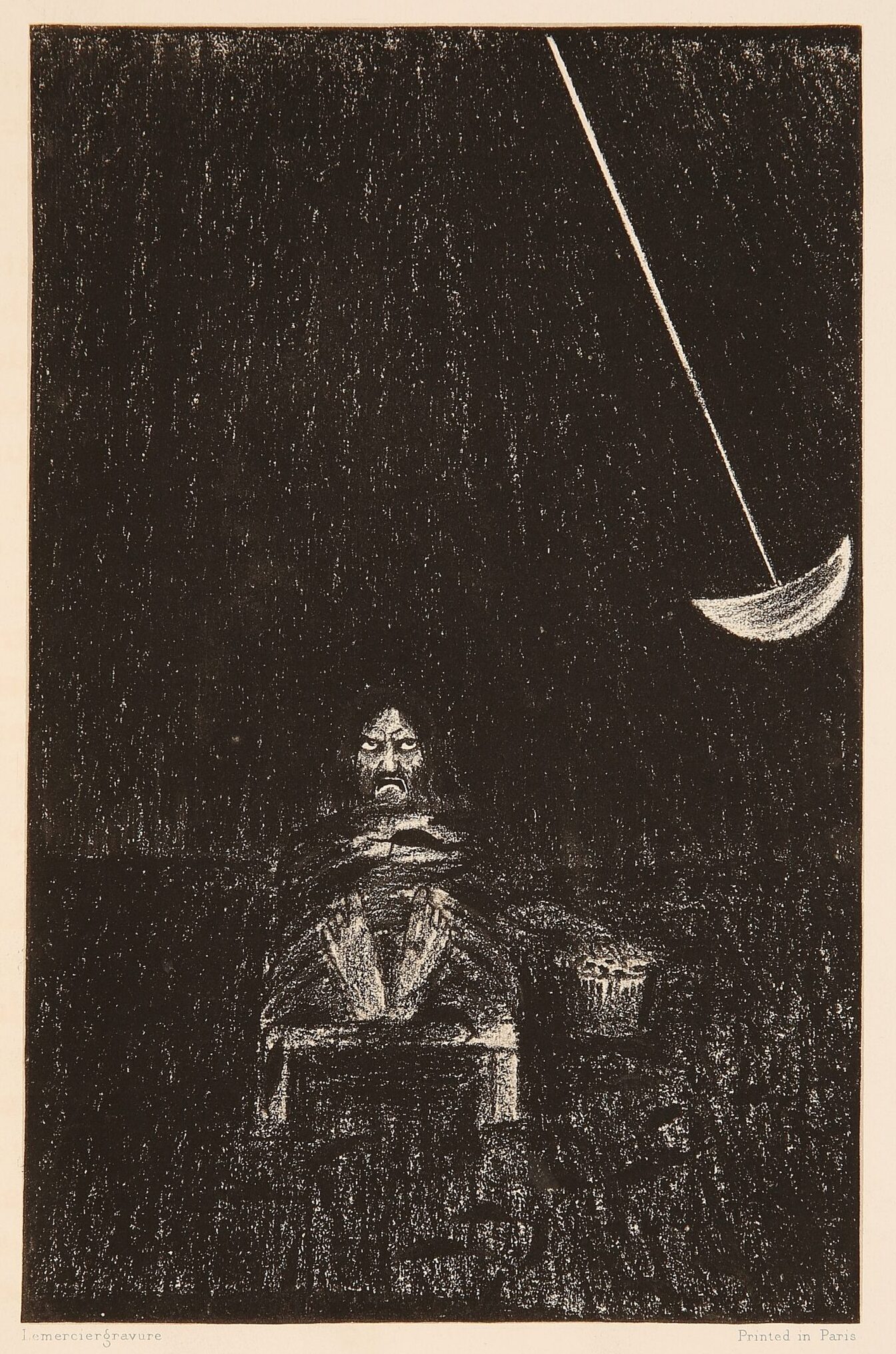
“I saw that some ten or twelve vibrations would bring the steel in actual contact with my robe.” (1899)

William Thomas Horton (1864-1919) was a Belgian-English writer and artist who studied at the Royal Academy in London. He illustrated the combined book of Poe’s “The Raven” and “The Pit and the Pendulum” that was published by Leonard Smithers in 1899. Horton was an occultist who studied the supernatural world through magic, alchemy, astronomy, and the reading of tarot cards. His drawings were left mostly unpublished during his lifetime. Horton’s illustration of Poe’s story emphasizes the darkness of the cell, the watchful and frightened look on the prisoner’s face, the menacing pendulum, and the small basket of food.

The narrator continues: “The sweep of the pendulum had increased in extent by nearly a yard. As a natural consequence, its velocity was also much greater. But what mainly disturbed me was the idea that it had perceptibly descended. I now observed—with what horror it is needless to say– the under edge evidently as keen as that of a razor…it seemed massy and heavy…it was appended to a weighty rod of brass, and the whole hissed as it swung through the air.”

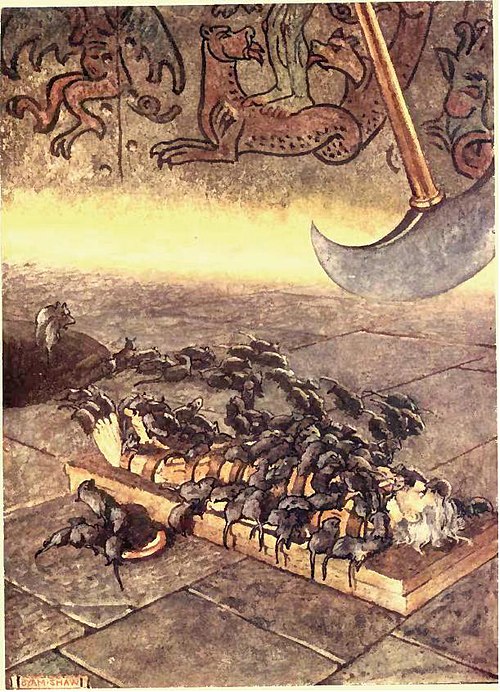
“They swarmed upon me in ever-accumulating heaps” (1909)

Poe’s Selected Tales of Mystery was published by Sidgwick & Jackson in London, and it was illustrated by John Byum Shaw (1872-1919). Shaw was a British painter, illustrator, designer, and teacher. He was encouraged by the Pre-Raphaelite painter John Everett Millais to study art at King’s College London. Shaw illustrates in some detail Poe’s description of the rats, the stone floor, and on the upper wall of the cell he painted demons of hell torturing the damned. Later the prisoner will see “for the first time, the origin of the sulphureous light which illumined the cell. It proceeded from a fissure, about half an inch in width, extending entirely around the prison at the base of the walls, which thus appeared, and were, completely separated from the floor. I endeavored, but of course in vain, to look through the aperture.”

The narrator continues: “Inch by inch—line by line—with a descent only appreciable at intervals that seemed ages—down and still down it came!  Days passed—it might have been that many days passed—ere it swept so closely over me as to fan me with its acrid breath…I wearied heaven with my prayer for its more speedy descent. I grew frantically mad, and struggled to force myself upward against the sweep of the fearful scimitar. And then I felt suddenly calm, and lay smiling at the glittering death, as a child at some rare bauble.” 

“The sentence—the dread sentence of death—was the last of distinct accentuation which reached my ear.” (1935)

Many artists have illustrated Poe’s stories and poems. One of the most famous and prolific was British illustrator Arthur Rackham (1867-1939). Among the many books are Gulliver’s Travels, Fairy Tales of the Brothers Grimm, Peter Pan, Wagner’s The Ring, and Poe’s Tales of Mystery and Imagination (1935) that included 12 color and 17 black and white plates.  In this illustration the judges of the Inquisition pronounce the sentence.  The narrator: “The sentence—the dread sentence of death—was the last of distinct accentuation which reached my ear.”

“Down–still unceasingly down—still inevitably down! I gasped and struggled at each vibration. I shrunk convulsively at its every sweep.” (1935)

The plight of the prisoner tied down is the subject that every illustrator of the story chooses. Rackham’s version illustrates the pit and the hordes of rats coming out of it to eat the food.  The narrator continues the story: “With the particles of the oily and spicy viand which now remained, I thoroughly rubbed the bandage wherever I could reach it; then, raising my hand from the floor, I lay breathlessly still.”

“At first the ravenous animals were startled and terrified at the change—at the cessation of movement. They shrank alarmedly back; many sought the well. But this was only for a moment. I had not counted in vain upon their voracity. Observing that I remained without motion, one or two of the boldest leaped upon the frame-work, and smelt at the surcingle. This seemed the signal for a general rush. Forth from the well they hurried in fresh troops. They clung to the wood—they overran it, and leaped in hundreds upon my person. The measured movement of the pendulum disturbed them not at all. Avoiding its strokes they busied themselves with the anointed bandage. They pressed—they swarmed upon me in ever accumulating heaps. They writhed upon my throat; their cold lips sought my own; I was half stifled by their thronging pressure; disgust, for which the world has no name, swelled my bosom, and chilled, with a heavy clamminess, my heart. Yet one minute, and I felt that the struggle would be over. Plainly I perceived the loosening of the bandage. I knew that in more than one place it must be already severed. With a more than human resolution I lay still.”

‘’But the moment of escape had arrived. At a wave of my hand my deliverers hurried tumultuously away. With a steady movement—cautious, sidelong, shrinking, and slow—I slid from the embrace of the bandage and beyond the reach of the scimitar. For the moment, at least, I was free.”  

Well, maybe.

“At length for my seared and writhing body there was no longer an inch of foothold on the firm floor of the prison.” (1935)

Poe and Rackham take both reader and viewer to what seems to be the very end. The narrator continues: “At length for my seared and writhing body there was no longer an inch of foothold on the firm floor of the prison…Even while I breathed there came to my nostrils the breath of the vapor of heated iron! A suffocating odor pervaded the prison!…A richer tint of crimson diffused itself over the pictured horrors of blood…“Death,” I said, “any death but that of the pit!” Fool! Could I resist its glow? or, if even that, could I withstand its pressure?…I shrank back—but the closing walls pressed me resistlessly onward. At length for my seared and writhing body there was no longer an inch of foothold on the firm floor of the prison. I struggled no more, but the agony of my soul found vent in one loud, long, and final scream of despair. I felt that I tottered upon the brink—I averted my eyes—”

“There was a discordant hum of human voices! There was a loud blast as of many trumpets! There was a harsh grating as of a thousand thunders! The fiery walls rushed back! An outstretched arm caught my own as I fell, fainting, into the abyss. It was that of General Lasalle. The French army had entered Toledo. The Inquisition was in the hands of its enemies.” 

HAPPY HALLOWEEN

Note: Quotations of Poe’s writing were taken from several on-line sources.


Beverly Hall Smith was a professor of art history for 40 years. Since retiring to Chestertown with her husband Kurt in 2014, she has taught art history classes at WC-ALL and the Institute of Adult Learning, Centreville. An artist, she sometimes exhibits work at River Arts. She also paints sets for the Garfield Theater in Chestertown.

The Spy Newspapers may periodically employ the assistance of artificial intelligence (AI) to enhance the clarity and accuracy of our content.

Filed Under: 00 Post to Chestertown Spy, Looking at the Masters

Design with Jenn Martella: “Edgemar”

October 30, 2025 by Jennifer Martella Leave a Comment

William Draper Brinckloe repurposed barns into a Spanish-inspired “country home,” merging practicality with style.

Several years ago, one of my friends suggested I become acquainted with the work of William Draper Brinckloe, who lived to Easton from 1911 until his death in 1933. He was also an author of two books, “The Small Home” and “The Volunteer Firemen”. In his book “The Small Home” he mentions that he is designing a small bungalow for his family which became known as “Dutch Cottage” that became his “City Home”. Today’s feature, which Brinckloe christened “Edgemar”, was his “Country Home” and he wrote an article “The Barn Rebuilt” about his design process. 

Prior to their move to Maryland, the Brinkloes lived in Delaware and after a visit to California, they were enchanted by the haciendas and old mission buildings they found throughout the state.  After living in Talbot County for thirteen years, the Brinkloes decided to sell their house on Peachblossom Creek and to retain 4.5 acres of the property and its old barns. They incorporated the barns into their  new 4,000 sf country home. 

The original design maximizes flow with enclosed courtyards and seamless indoor-outdoor integration.

Whenever I feature a house that was designed by another architect, I ask about their design concept since each project is unique. I was thrilled to discover an article by William Draper Brinckloe in which he describes his design process and  was illustrated by his floor plans. 

The Brinckloes reconfigured two barns perpendicular to each other, added a garage and unified the three buildings with low walls enclosing a south facing cloistered courtyard to create a harmonious whole. A new sunroom spanned across the former smaller barn with doors to the courtyard. The floor plan worked very well with easy flow among the main rooms and the outdoor rooms of the front courtyard and the side porch overlooking Peachblossom Creek. 

The house has endured many changes by later owners including closing off the door from the living room to the sunroom and the courtyard; removing the wall between the sunroom and the kitchen and dining room to create a great room and relocating the kitchen to the former garage. The last change was an addition of a main floor primary ensuite behind the kitchen.  


Repurposed hexagonal pavers and local materials unify the Spanish-style courtyard’s sustainable aesthetic.

On the day of my visit, I first explored the courtyard with its hexagonal shaped paving stones that the Brinckloes found piled in a backyard. The walk to the courtyard were repurposed “ old flagstones form abandoned pavements and partly broken bits from the old stable”. The Brinckloes were way ahead of current LEED and Shop Local endeavors by their commitment to incorporate materials from as many local sources as possible. Among many finds were “huge hand wrought hinges, great wooden and iron locks, brass knockers, quaint brass and tin lanterns, delicate wrought iron thumb latches and shutter fasteners”. Their most treasured find was an old brass fog-bell that once tolled across the Chesapeake Bay to warn ships. 


Stucco walls and a shed dormer provide character and reflect the hacienda-inspired design.

As befitting a Spanish style house, the original exterior walls were stucco and the current Owner also chose a stucco finish for the majority of the interior walls. Past owners replaced the windows with insulated glazing units. I noted the shed dormer at the side of the house that sheltered the second floor’s “sleeping room” I had admired in the historic photograph and I looked forward to exploring it during my tour.

Asymmetrical gables and varied windows create dynamic views of the lawn and Peachblossom Creek.

The rear elevation’s asymmetrical massing from the two gables of differing widths and the mix of window sizes and shapes creates a lively façade. The broad expanse of lawn slopes down to Peachblossom Creek.

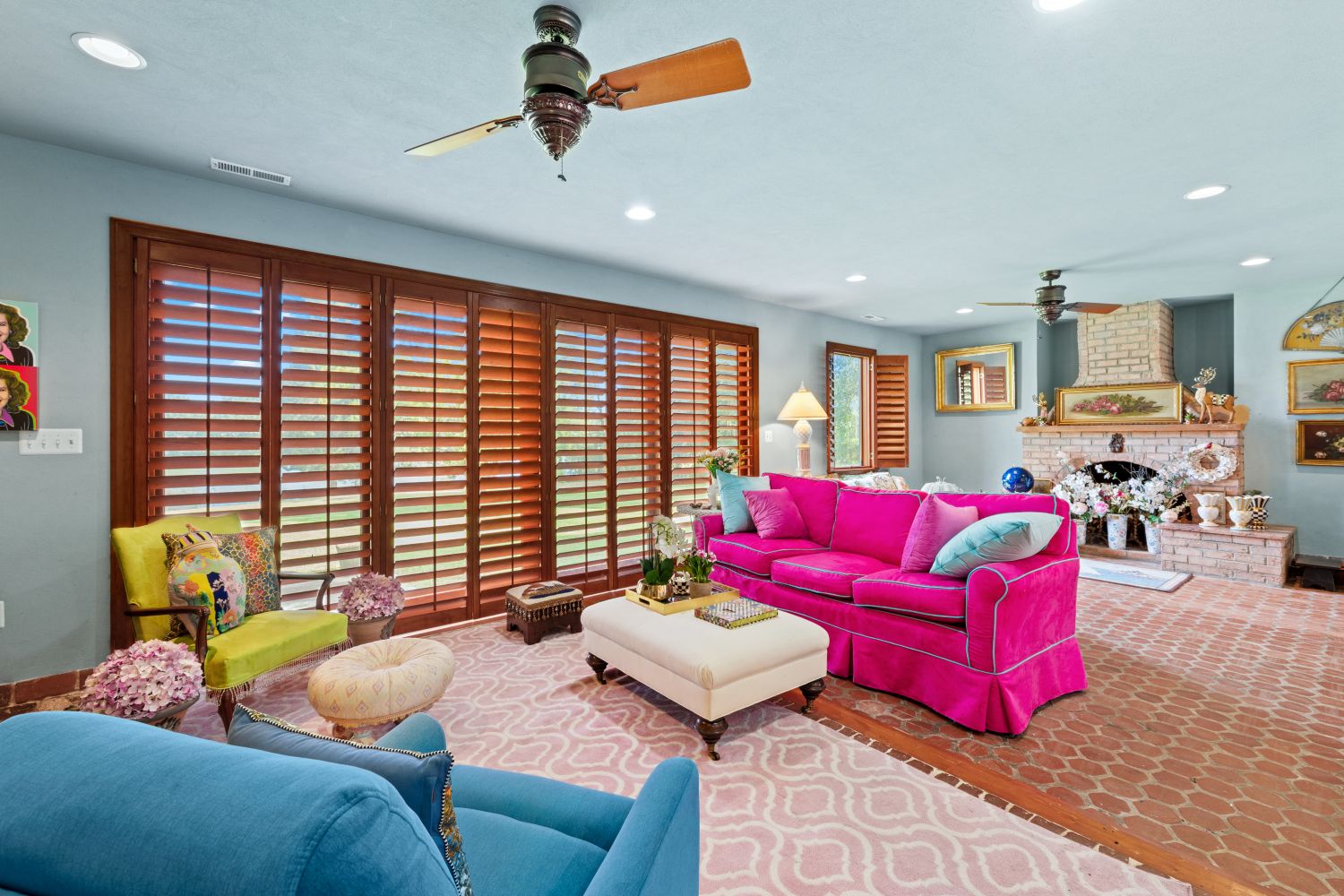
Deliciously spacious living room boasts historic tiled flooring, a central fireplace, and contrasting ceiling details.

I began my tour in the foyer that leads to the spacious living room with a fireplace on the opposite side wall.  The Brinckloes selected red, blue or green tile flooring for the first floor rooms and I especially liked this shade of green. Most of the rooms on the main floor have the same color of walls and ceiling but here the ceiling is painted white. The open glass doors beckoned me to the adjacent porch.

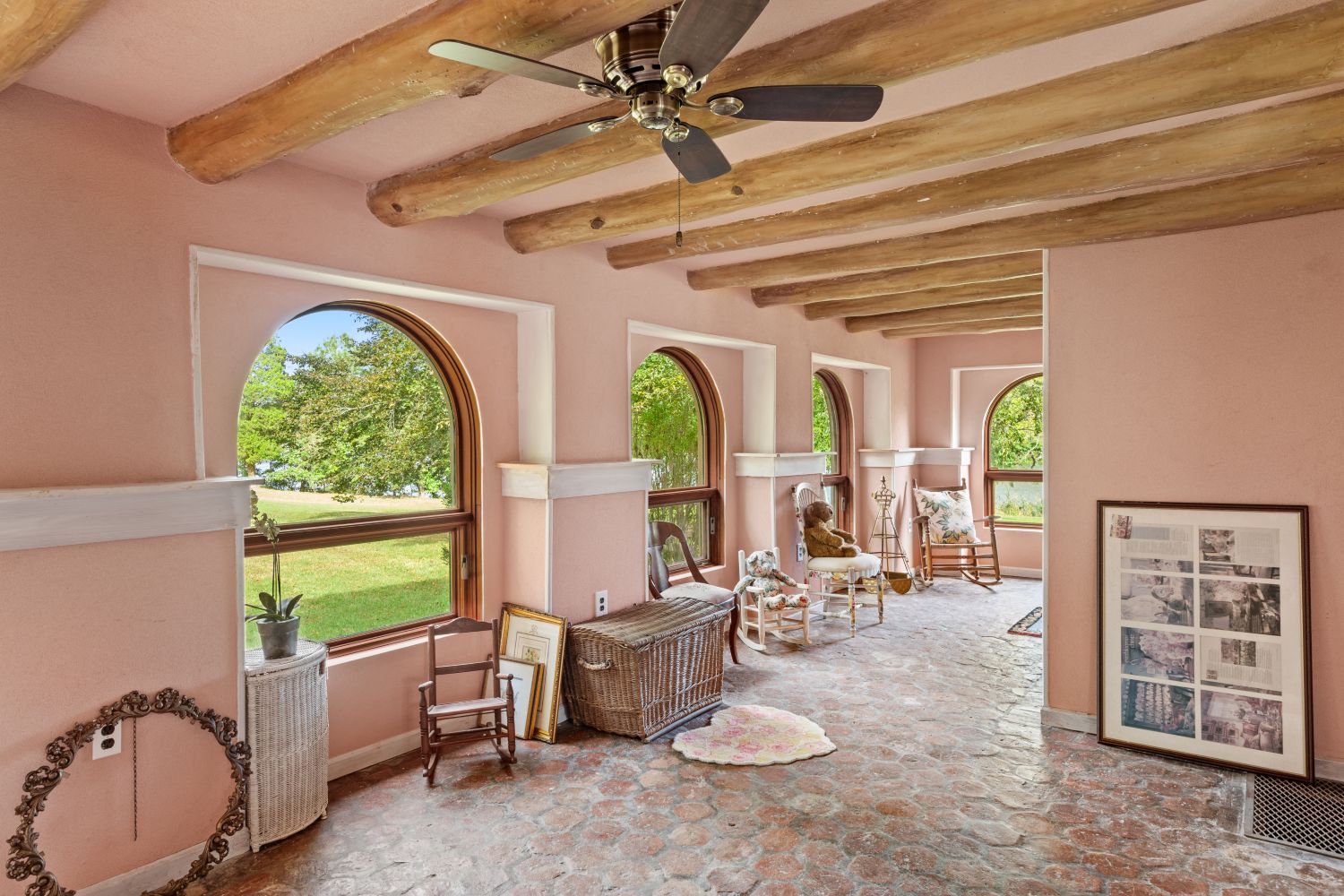
Recycled barn wood beams and warm brick floor tile pair harmonize with thoughtfully arched windows. 

The corner porch has the reddish tiles the Brinckloes selected and the wood beams that they recycled from the barn. The original openings between the wide columns were infilled when this room became a conditioned space.

The circular chimney and cozy window seat make this space a functional yet stylish retreat.

This room was the Brinckloes’ library and he designed a window seat under windows that infilled the rear walls for better views of the water. Later owners reduced the wall to wall windows with insulated units. (Adding a bay window projection for panoramic views of Peachblossom Creek would restore this exquisite room). I loved the circular chimney for the arched top fireplace that backed up to the fireplace in the adjacent living room and its stylish details of the ledge above the firebox and the sloped chimney walls above. This corner fireplace not only allows the heat to radiate into a larger portion of the room and reach more distant areas but it also frees up more wall space for windows and art.

Wide opening connects the library to porch, blending indoor-outdoor living with ease.

The wide wall opening between the library and the porch connects the two spaces and provides a view of the landscaping for the library. I especially admired the fire screen. 

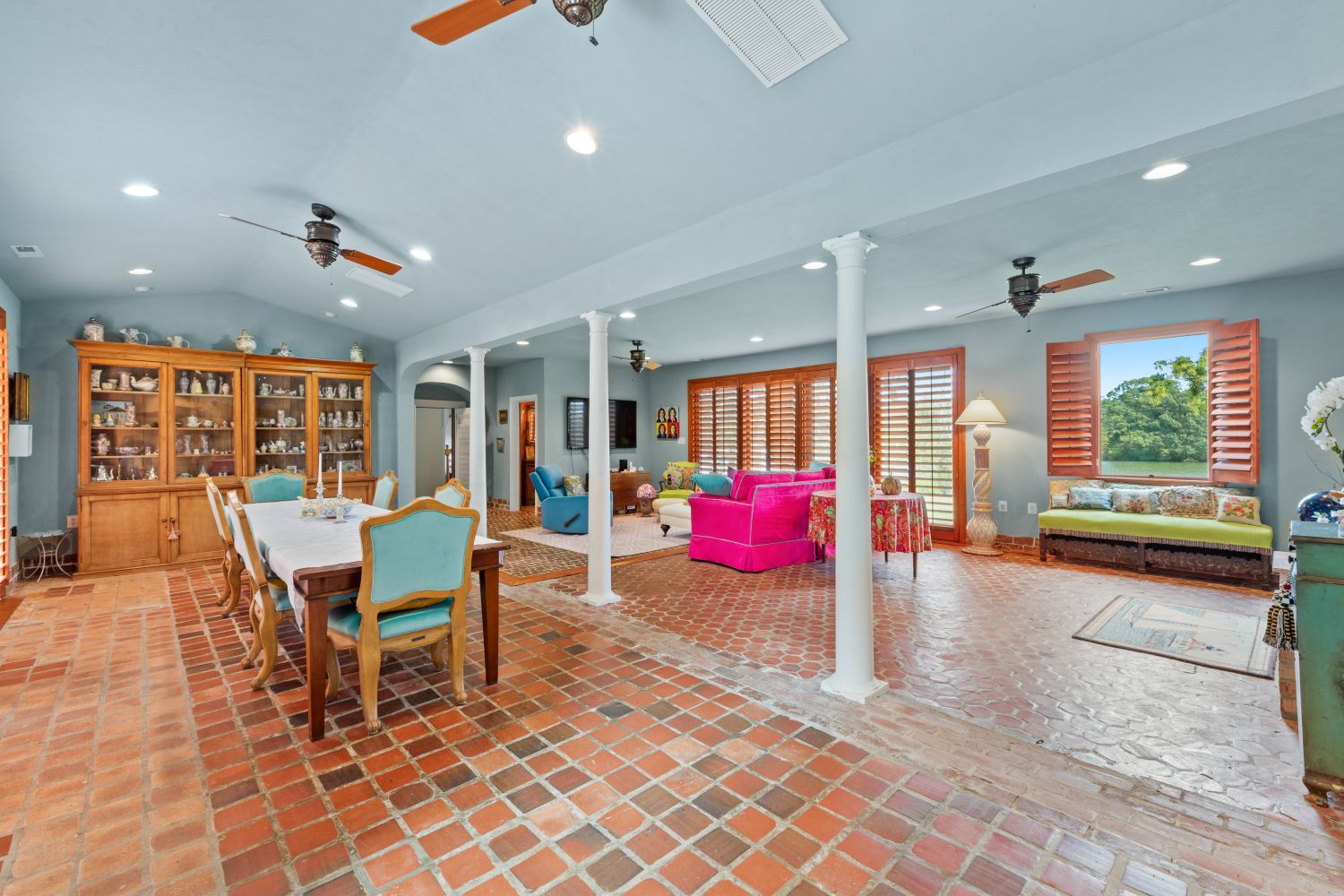
By removing original partitions, the living/dinning space takes on a “great room” role, with varied flooring anchoring distinct spaces.

Past the library and the stair to the second floor is a huge great room that was created by removing the wall between the original sunroom and the former kitchen and dining room. The different flooring act like giant rugs to define each space’s function and the low pitched ceiling in the dining area adds spatial volume to the long room.

The fireplace’s subtle stepped design turns the living area’s wide niche into an architectural focal point.

The spacious family room’s focal point is the stepped design of the arched top fireplace in a wide niche in the side wall. The wood plantation shutters on both  sides of the great room provide privacy when needed. 

Timeless trim detailing in the dining area complements the low-pitched ceiling and display cabinetry.

I was drawn to the breakfront at the end of the dining area with its collection of Mackenzie-Childs ceramics. I have a few pieces and I was delighted to learn from the owner that she literally wrote the book “Celebrating Mackenzie-Childs” about these talented artisans who are based in Aurora, NY, once the hub of other artisans including Stickley. Mackenzie-Childs is known for their iconic ceramics and home décor including its signature black and white courtly check pattern.  

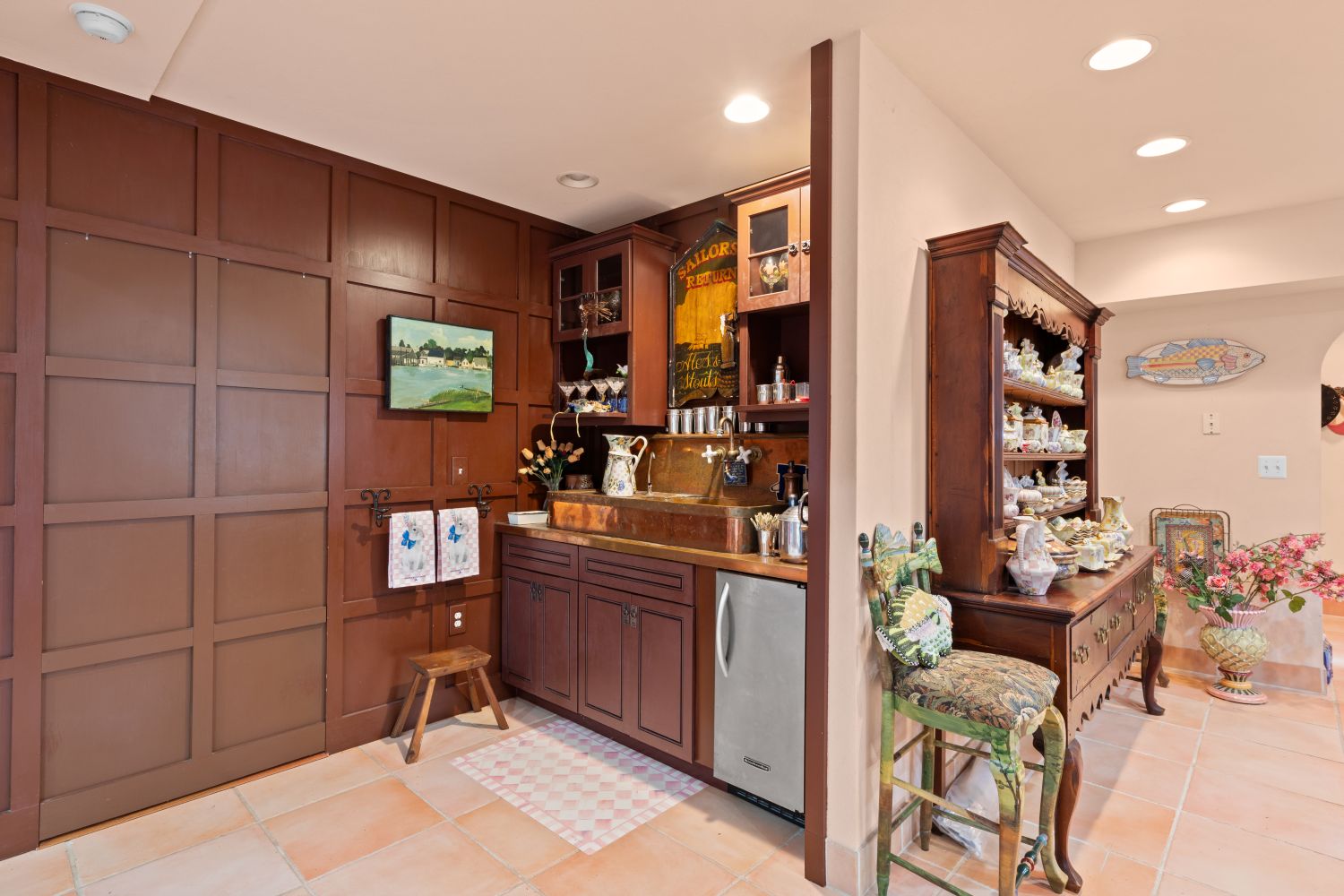
This cleverly designed bar area incorporates antique finishes and hidden doorway to primary suite.

Behind the kitchen is a bar area convenient to the great room and the courtyard with an antique copper sink and undercounter refrigerator. The paneled wall conceals a sliding “secret door” to the adjacent main floor primary bedroom. 

Owners opted for open shelving in the kitchen area, offering both enhanced storage and display options.

I prefer an eclectic interior design look, so I appreciated the beautiful Welsh dresser whose open shelves display more of the owner’s Mackenzie-Childs’ ceramics. The wood piece is a welcome counterpoint to the built-in cabinetry.

A sleek U-shaped kitchen layout features custom elements like a concrete island, Italian ceramic tile flooring and pickled cabinetry.

The current owner renovated the large kitchen with a “U” layout  that provides ample room for the custom island of concrete inlaid with a Chesapeake Bay fossil. The island’s size and overhangs accommodates bar stools and its center location is perfect for daily use or weekend entertaining. The two windows provide panoramic views of the landscape and keep the kitchen sunny all day. The large imported Italian ceramic tile flooring pays homage to the Brinckloes’ original flooring material. 

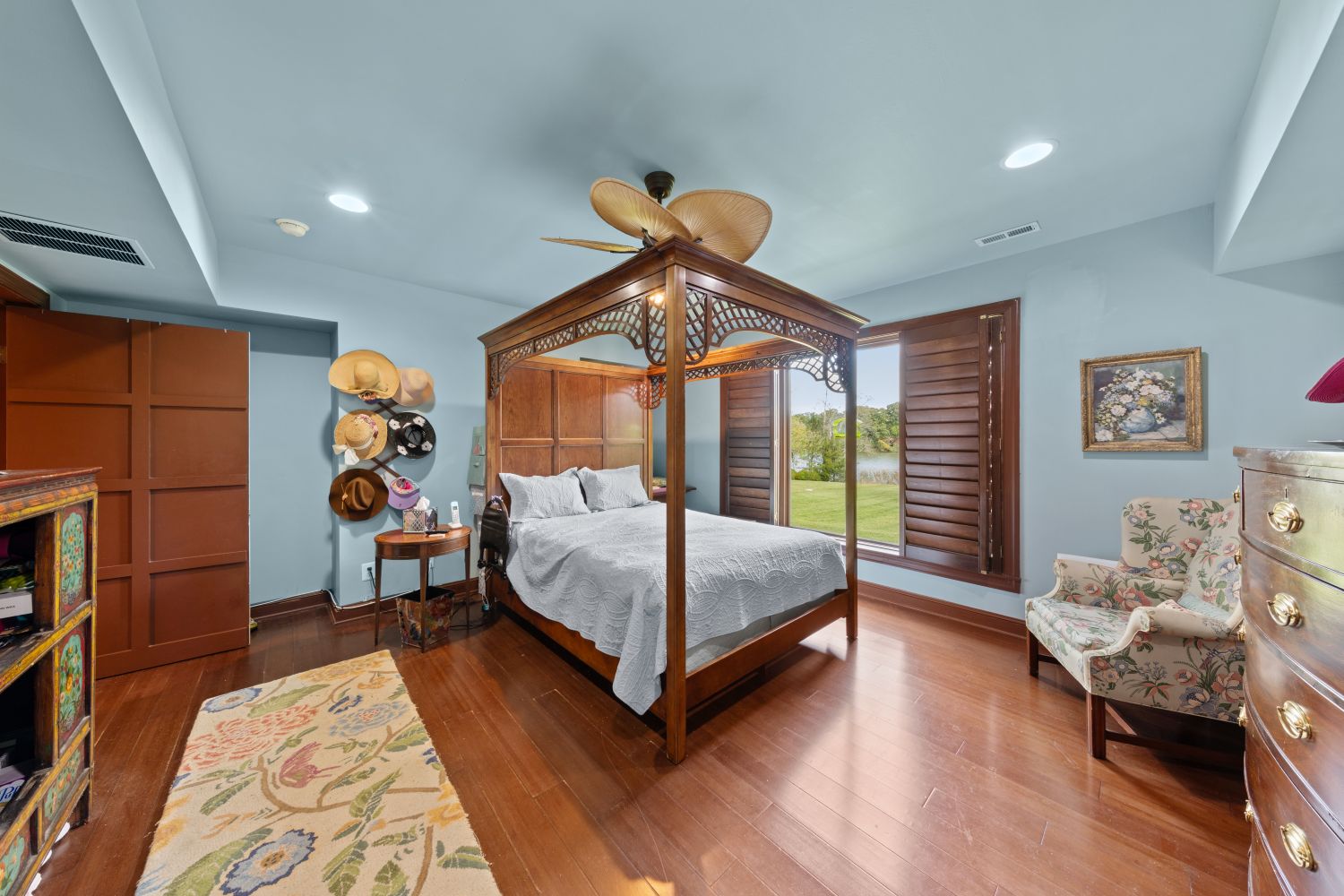
Natural light fills the primary bedroom’s tray ceilings blending with the muted tones to create a serene space enhanced by tranquil landscape views

Behind the kitchen and bar area is the main floor primary ensuite. The double bed shows how the spacious room could easily accommodate any bed size. Both the walls and the tray ceiling’s geometry are light blue to create a serene retreat with views of the lawn to the water from the canopy bed. 

Main floor primary bathroom features arched windows, a skylight, and soft finishes, creating a spa-like retreat.

The primary bath walls and ceiling continue the primary bedroom’s light blue color scheme. The jacuzzi tub is perfectly placed under the skylight for star gazing and the arched top windows with plantation shutters provide views of the landscape.  

Exposed beams and arched windows elevate the overlook from second floor landing while framing scenic views below.

The second floor original plan contained the Brinckloes’ bedrooms, baths, a sleeping porch across from the family bedrooms and guest bedrooms at the other end of the “L” shaped layout. The exposed beams and decking add extra height to the spaces and painting the beams white accentuates the rhythm of the beams’ spacing. From the landing, the arched top window and the lower stair landing offers a long view of the lawn and Peachblossom Creek.

Originally one open space, this porch retains charm and functionality with flexible options.

My fave room on the second floor was this sleeping porch that is now separated into two equal spaces. Since the wall is constructed of 2 x 4’s and paneling, it would be easy to liberate this charming room for teen slumber parties!

A reimagined playroom or studio spans the house, accented by high knee walls and arched windows.

The current owners removed the interior walls of the two adjacent guest bedrooms to create a large multipurpose room that now spans from the front to the rear of the house. The space offers myriad uses- playroom, studio, second floor sitting room, home theater, etc. The high knee walls add character to the spatial volume and the wide and long arched top windows at each gable wall keep the space sunny throughout the day.  

The 4.5-acre property blends historic landscaping with unique features like a boathouse and dock.

The aerial view of the 4.5 acre property shows how well the house was originally sited to balance the enclosure of mature trees to assure privacy with views of Peachblossom Creek. Site amenities include the dock and the highly coveted boathouse, (the latter being no longer allowed) and the natural shoreline. Lush landscaping includes both an oak tree and boxwoods that are 100 years old, flowering magnolias, hydrangeas and open lawn space for play for children of all ages and family pets. William Draper Brinckloe’s original vision and his period details and materials including original heart pine floors survived as subsequent owners added modern amenities to the historic framework. 

I don’t know if the Brinckloes were gourmet cooks but the updated kitchen would please this cook with its Miele steam oven, cooktop with a barbeque grille and two Fischer Paykal dishwashers for easy clean up after entertaining. The property also includes a detached two-bay garage with a John Deere lawnmower and a storage shed with electricity. 

Having written about the Brinckloes’ “City House”, I was delighted to feature their “Country House” that has been lovingly maintained and appreciated by its current Owner who considers herself a steward of this important part of Talbot County’s architectural heritage.  This admirer of Brinckloe will continue to find other houses designed by one of Talbot County’s best early 20th century architects, so stay tuned!


For more information about this property, contact Cliff Meredith, Broker, with Meredith Fine Properties at 410-822-6272 (o), 410-924-0082 (c), or [email protected] . For more photographs and pricing, visit www.MeredithFineProperties.com ,“Equal Housing Opportunity.” 

Photography by Atlantic Exposure LLC, www.atlanticexposure.com. 

Historic photographs and quotes are from “The Barn Rebuilt”, an article by William Draper Brinckloe for Country Living Magazine, November 1926   

“Celebrating Mackenzie- Childs” by Jo Anne P. Welsh, Schiffer Publishing  

Contributor Jennifer Martella has pursued dual careers in architecture and real estate since she moved to the Eastern Shore in 2004. She has reestablished her architectural practice for residential and commercial projects and is a real estate agent for Meredith Fine Properties. She especially enjoys using her architectural expertise to help buyers envision how they could modify a potential property. Her Italian heritage led her to Piazza Italian Market, where she hosts wine tastings every Friday and Saturday afternoons.

The Spy Newspapers may periodically employ the assistance of artificial intelligence (AI) to enhance the clarity and accuracy of our content.

Filed Under: 00 Post to Chestertown Spy, Design with Jenn Martella

University of Maryland Children’s Hospital Receives Record $50 Million Gift from Tom Golisano to Advance Pediatric Care in Maryland

October 30, 2025 by The Spy Desk Leave a Comment

In recognition of transformative gift, will be renamed University of Maryland Golisano Children’s Hospital

BALTIMORE, Md. (October 28, 2025) A landmark $50 million gift from entrepreneur, philanthropist, and civic leader Tom Golisano marks a defining moment for the University of Maryland Medical System (UMMS) and the University of Maryland, Baltimore (UMB). As the largest philanthropic contribution in their history, this transformative investment will strengthen the University of Maryland Medical Center (UMMC) and the University of Maryland School of Medicine (UMSOM) as leaders in breakthrough science, education and compassionate care – shaping healthier futures for generations of children.

In tribute to this historic gift, the children’s hospital, located inside UMMC, the flagship hospital of UMMS, becomes the University of Maryland Golisano Children’s Hospital (UMGCH). As a new member of the Golisano Children’s Alliance, it joins a growing national coalition of premier children’s hospitals dedicated to transforming pediatric medicine through collaboration, discovery and equitable access to world-class care.

At an event in Rochester, New York, Tom Golisano unveiled new gifts to six hospitals—expanding his Golisano Children’s Alliance to a 10-member national network advancing excellence and innovation in pediatric care. Senior leaders from UMMS, UMMC and UMSOM participated in the announcement. (View recording of the Rochester event here.)

“Children’s health has always been a priority for me, and it’s been deeply rewarding to see how the Golisano Children’s Hospitals are making a profound impact on the communities they serve,” said Golisano. “I am fortunate to be able to help others in this way, and I’m looking forward to seeing what these hospitals can achieve together. Also, I plan to continue making similar transformative gifts that will strengthen this new alliance.”

“For nearly 80 years, our Children’s Hospital has been caring for Maryland’s children and families right here in downtown Baltimore. Tom Golisano’s extraordinary gift will help us create a world-class facility with programs in gene and cell therapy that move us closer to cures once thought out of reach. It will allow us to attract the best pediatric specialists in these fields – the future of pediatric health care – while accelerating the growth of our existing programs in heart care, mental health, and community health. This investment will establish a lasting legacy of healing and excellence for the children of Baltimore and beyond,” said Steven J. Czinn, MD, Director of the University of Maryland Golisano Children’s Hospital. Dr. Czinn is also The Drs. Rouben and Violet Jiji Endowed Professor of Pediatrics and Chair of the Department of Pediatrics at the University of Maryland School of Medicine.

“This historic and transformational gift comes at a time of urgency and opportunity for pediatric care in Maryland. It will have lasting impact across generations of children and families. We are deeply grateful to Tom Golisano for his vision and generosity, and we are incredibly excited to build on the momentum this gift will bring to Baltimore,” added Heather S. Culp, JD, Senior Vice President for UMMC, Senior Associate Dean for Development at UMSOM, and Chief Philanthropy Officer for University of Maryland Medicine.

Impact of the Gift: Space, Programs, People
Significantly expanding the existing children’s hospital, the gift catalyzes a comprehensive pipeline for innovation in pediatric care, research, workforce development and community health – advancing bold ideas and life-changing discoveries that will benefit children and families across Maryland and beyond. Goals include:

  • A Dedicated Home for the University of Maryland Golisano Children’s Hospital
      • Move existing inpatient and outpatient pediatric services currently located in multiple areas of the medical center and downtown into a unified, child-centered space within the new Stoler Center for Advanced Medicine (under construction with completion targeted for 2026).
      • Include new facilities for specialties like oncology, advanced critical care and emerging gene therapies
  • Expansion of Advanced Clinical Programs
      • Increase surgical capacity for complex, high-volume programs in pediatric heart care and rare diseases
      • Enhance care in NICU, PICU and general pediatric units
  • Launch of Gene Therapy Services for Children
      • Establish a comprehensive pediatric gene therapy program, offering FDA-approved, potentially curative treatments for over 20 rare childhood diseases
      • Position the hospital as a regional hub for advanced, personalized pediatric medicine
  • Acceleration of Innovation and Research
      • Expand multi-site studies on rare diseases, CAR T-cell therapy and evidence-based treatments
      • Advance research on social determinants of health and community-driven care
  • Strengthen Community Outreach and Access
      • Support new models of care addressing rising pediatric mental health challenges, obesity and chronic conditions
      • Fund outreach and innovation to reach medically underserved communities
  • Recruiting and Retention of Top Pediatric Talent
    • Attract visionary leaders, specialists and researchers to drive the next era of pediatric medicine

Golisano Invests in Maryland’s Flagship for Children’s Health

The University of Maryland Golisano Children’s Hospital, a 90-bed facility with over 3,000 annual admissions and 118,000 outpatient visits, serves as a statewide leader in pediatric care. Supported by the University of Maryland Medical System and guided by the nation’s first public medical school, the hospital’s reach spans the entire state while its proximity to Washington, D.C. helps shape national health policy.

Research initiatives affiliated with the hospital – including the Center for Vaccine Development, the Brain Tissue Bank, Asthma Management, Pediatric HIV research and treatment – are driving breakthroughs in genetics, infectious diseases, and child health outcomes. In a recent example of this research leading to direct benefits for families in Maryland, studies of former neonatal intensive care patients informed the state’s decision to expand eligibility for early intervention services to hundreds more children each year. 

The hospital operates Maryland’s largest Level IV neonatal intensive care unit and recently cared for the youngest patient in its history at 22 weeks gestation. It was the first in the state to perform a pediatric double heart-lung transplant, the first to treat a pediatric patient with stem cells, and is home to downtown Baltimore’s dedicated pediatric emergency department. As a regional hub for pediatric intensive care, UMGCH co-operates a statewide transport network to ensure critically ill children receive timely, specialized treatment. Its children’s heart program, founded in 2012, is recognized as one of the top such programs in the nation.

Beyond clinical care, UMGCH fosters community through physician-led camps and annual patient reunions, strengthening connections between families and care teams.

The Heart of Why Funding Pediatrics Matters

As a registered nurse at the University of Maryland St. Joseph Medical Center, Angela Laubach sees miracles happen every day. But she’s also experienced this care in the most personal way, because her daughter Lana is one of those miracles. During Angela’s 20-week anatomy scan, she learned that her daughter Lana had a serious heart defect. 

“As a nurse, I understood the gravity of the diagnosis, but nothing prepares you to hear those words about your own baby. The team at the children’s hospital guided us through every moment – from Lana’s open-heart surgery just six days after birth to her remarkable recovery – with compassion, and constant reassurance. Today, Lana is a joyful 3-year-old who fills our home with laughter and endless ideas. Literally, her favorite thing to say is ‘I have a better idea,’” said Angela. 

Voices Across the Institutions

Mohan Suntha, MD, President and CEO of University of Maryland Medical System:

“A gift of this magnitude to our flagship children’s hospital enables us to expand pediatric expertise, improve access and strengthen care teams across our entire system. As a result, more children in more communities will receive the specialized care they need closer to home.”

Mark T. Gladwin, MD, Dean, University of Maryland School of Medicine: 

“We are so grateful for this profound and intentional gift from Tom Golisano, which comes at a critical time when children’s health in the U.S. is in alarming decline and funding for children’s health is increasingly at risk. Mr. Golisano is truly a remarkable individual who has put children’s health at the heart of his philanthropic mission. His tremendous generosity enables our Children’s Hospital to move forward as a bold leader in pediatric health across Maryland and beyond, enabling us to invest in cutting-edge technology and inspiring innovation among our pediatricians and pediatric surgeons in areas such as congenital heart care, targeted gene therapy, community health, and building new programs for curative therapies for pediatric genetic diseases and cancer.”

Bert W. O’Malley, MD, Executive Vice President for the Academic Health Division at UMMS; President of the University of Maryland Medical Center; and Professor of Otorhinolaryngology – Head & Neck Surgery, University of Maryland School of Medicine. 

“As part of a statewide academic health system, we have long had the privilege to provide Maryland children with high quality, compassionate care and advanced treatments for some of the most complex pediatric conditions. By joining the Golisano Children’s Alliance, we’re now connected to a national network of top children’s hospitals. Together, we can discover and share best practices, align on standards and launch innovative models that reach more children.”

Bruce E. Jarrell, MD, FACS, UMB President.

 “By joining the Golisano Children’s Alliance, University of Maryland, Baltimore faculty, researchers, and clinicians are further empowered to accelerate breakthroughs across all areas of childhood health and well-being. We are immensely grateful for Tom Golisano’s generosity, and we remain deeply committed to transforming the future of pediatric health here in Maryland and beyond.”

Ron V. Cummins, Jr., MBA, Senior Vice President & COO, University of Maryland Medical Center: 

“The Golisano’s historic and generous gift is an enduring investment in Maryland’s children — accelerating access to the most advanced treatments, and nurturing spaces — so that every child and family in our community receives care that honors their hopes and needs. The benefits of this gift will be felt for decades.”

To schedule an interview with one of the leaders above, please contact [email protected] or 410.328.8919. 


About Tom Golisano

Tom Golisano, entrepreneur, philanthropist, and civic leader, is the founder of Paychex, Inc., the nation’s largest human resource company for small to medium-sized businesses. Mr. Golisano’s vision, perseverance, and action have left an indelible mark on a broad spectrum of issues that touch our lives in business, healthcare, education, animal welfare, voter policies, politics, and tax reform. His investments are advancing entrepreneurship and driving the success of numerous businesses and start-ups. His philanthropic contributions to education, hospitals—including multiple children’s hospitals across the country that bear his name and numerous other organizations—exceed $1 billion. 

A fierce advocate for dignity and inclusion, in 1985 Tom Golisano applied his pioneering spirit to establish the Golisano Foundation to make the world a better place for people with intellectual and developmental disabilities. With more than $120 million in gross assets, it is one of the largest private foundations in the U.S. devoted to supporting programs for people with intellectual and developmental disabilities awarding grants to non-profit organizations in Western New York and Southwest Florida.

Mr. Golisano formed and financially supports the Golisano Institute for Business & Entrepreneurship, where students receive a high quality business certificate and write their own entrepreneurial success stories, without having to take on enormous debt.He is the author of two Books, “Built Not Born,” a Wall Street Journal best seller and “The Italian Kid Did It!”

Connect with him at Golisanofoundation.org, Facebook: @GolisanoFoundation, X: @GolisanoFdn, Instagram: @golisanofdn, YouTube: @GolisanoFoundation

About University of Maryland Golisano Children’s Hospital (UMGCH)

Located within the University of Maryland Medical Center, the University of Maryland Golisano Children’s Hospital is a leading resource for children with critical and chronic illnesses throughout Maryland and the mid-Atlantic. The hospital combines state-of-the-art medicine with family-centered care, offering more than 190 specialized pediatric physicians. Its services include Maryland’s largest Level IV neonatal intensive care unit and comprehensive programs in congenital heart conditions, asthma, epilepsy, and gastrointestinal disorders. Visit www.umms.org/childrens for more information.

About University of Maryland Medical System (UMMS) 

As an academic private health system, UMMS is focused on delivering compassionate, high-quality care and putting discovery and innovation into practice at the bedside. Partnering with the University of Maryland School of Medicine and University of Maryland, Baltimore who educate the state’s future health care professionals, UMMS is an integrated network of care, delivering 25 percent of all hospital care in urban, suburban and rural communities across the state of Maryland. UMMS puts academic medicine within reach through primary and specialty care delivered at 11 hospitals, including the flagship University of Maryland Medical Center, the System’s anchor institution in downtown Baltimore, as well as through a network of University of Maryland Urgent Care centers and more than 150 other locations in 13 counties. For more information, visit www.umms.org.

About the University of Maryland School of Medicine

The University of Maryland School of Medicine, established in 1807 as the first public medical school in the U.S., continues today as one of the fastest growing, top-tier biomedical research enterprises in the world.  The School has nearly $500 million total research funding, 46 departments, centers, and institutes, more than 2,200 student trainees and over 3,000 faculty members, including notable members of the National Academy of Medicine.  As the largest public medical school in the DC/MD/VA region, faculty-physicians are working to help patients manage chronic diseases like obesity, cancer, heart disease and addiction, while also working on cutting-edge research to address the most critical generational health challenges. In 2024, the School ranked #12 among public medical schools and #27 among all medical schools for R&D expenditures by the National Science Foundation. With a $1.3 billion total operating budget, the School partners with the University of Maryland Medical Center to serve nearly 2 million patients annually. The School’s global reach extends around the world with research and treatment facilities in 33 countries. In Maryland, the School of Medicine is spearheading new initiatives in AI and health computing and partnering with the University of Maryland BioPark to develop new medical technologies and bioengineering ventures. For more information, visit medschool.umaryland.edu.

The Spy Newspapers may periodically employ the assistance of artificial intelligence (AI) to enhance the clarity and accuracy of our content.

Filed Under: 00 Post to Chestertown Spy, Health Notes

Junkin Recognized as CFO of the Year

October 30, 2025 by ShoreRivers Leave a Comment

From left — Isabel Hardesty, ShoreRivers’ Executive Director; Tim Junkin, founder of one of ShoreRivers’ legacy organization and its former Executive Director; Kristin Junkin, ShoreRivers’ Director of Operations & Finance; and Scott Budden, ShoreRivers’ Deputy Director of Finance — are pictured at the Nonprofit CFO of the Year Awards in Washington, D.C., earlier this month, where Kristin Junkin was honored as the group’s 2025 Philanthropic CFO of the Year.

ShoreRivers is proud to announce that Kristin Junkin — the organization’s Director of Operations & Finance and a founder of one of its legacy organizations — was recognized at the Nonprofit CFO of the Year Awards, an event recognizing excellence in nonprofit financial leadership, during its annual reception on October 8.

The annual Nonprofit CFO Awards honor exceptional financial executives whose vision, operational excellence, and leadership have made a significant impact on the missions and sustainability of nonprofit organizations. Junkin was honored as the group’s 2025 Philanthropic CFO of the Year for her fiscal leadership, her key role in expanding ShoreRivers’ profile in the environmental restoration industry, and her meticulous oversight of the organization’s finances, grant work, and general operations.

“Whether it is through dogged perseverance, or working creatively with both public and private partners to accomplish goals of financial viability and improved water quality, Kristin is a shining example of how someone can serve as a catalyst for action,” said ShoreRivers’ Executive Director Isabel Hardesty. “She has been a driving force in sustaining and growing funding for ShoreRivers, and key to ensuring all grants and donations are stewarded in the best possible way for our Eastern Shore rivers and creeks. We’re eternally grateful for her leadership and hard work.”

Under Junkin’s financial leadership, ShoreRivers has grown since 2018 from $3.9M in annual revenues to $7.7M (nearly 100% growth in eight years), from 21 employees to 33; and from $1.6M in assets to $4.4M (a 175% increase). Her expert financial management has led to staff and asset growth, and has better allowed the organization to serve the public in meeting its vision of thriving rivers cherished by all Eastern Shore communities.

Kristin Junkin began her career as a lawyer for a large Washington, D.C., firm and then for many years co-owned a federal government contracting company. She was the founder and president of Outside Counsel, a legal personnel service in Washington, D.C.  She is a summa cum laude graduate of Howard University where she was elected to Phi Beta Kappa, and she has a Juris Doctor degree from the University of Virginia School of Law.

ShoreRivers’ mission is to protect Maryland’s Eastern Shore waterways through science-based advocacy, restoration, education, and engagement — all of which are possible only through excellent operational leadership and the financial support of our members and other stewards standing strong for clean water.


The Spy Newspapers may periodically employ the assistance of artificial intelligence (AI) to enhance the clarity and accuracy of our content.

Filed Under: 00 Post to Chestertown Spy, 1C Commerce

Maryland Caucus with Foxwell and Mitchell: The Children’s Hunger Crisis in Maryland

October 29, 2025 by Len Foxwell and Clayton Mitchell Leave a Comment

Every Wednesday, Maryland political analyst Len Foxwell and politcal advisor to Ed Hale for Governor campaign Clayton Mitchell discuss the politics and personalities of the State and region.

This week, Len and Clayton discuss a recent report by the country’s largest hunger-relief organization that one in every six children in Maryland experiences hunger, including in affluent areas like Talbot County, where nearly 60% of students qualify for free or reduced-price meals, as well as a child food-insecurity rate of 29.5 % of children in Dorchester County.

This video is approximately 16 minutes in length.

The Spy Newspapers may periodically employ the assistance of artificial intelligence (AI) to enhance the clarity and accuracy of our content.

Filed Under: 00 Post to Chestertown Spy, Spy Highlights

Honoring Talbot County’s Uncle Nace Hopkins: The Day Freedom Came in Trappe

October 29, 2025 by The Spy Leave a Comment

Nathaniel “Uncle Nace” Hopkins was born enslaved on the Eastern Shore, served with the U.S. Colored Troops, and came home to help build churches, schools, roads—and Maryland’s first Emancipation Day celebration in 1867. This tradition still lives on in Trappe from that moment on. In this Spy interview, volunteer leaders Dale Kevin Brown and Paul Callahan talk about why his story matters now and how the community is keeping it alive.

They preview this year’s events: Saturday, November 1, in Trappe—10:00 a.m. service at Scotts United Methodist Church, a library dedication at Nathaniel “Uncle Nace” Hopkins Park, food and activities, a 1:00 p.m. parade, and the 2:00 p.m. living-history performance, Uncle Nace: The Day Freedom Came. A second performance follows Monday, November 3, 5:30 p.m., at the Oxford Community Center (free; RSVP at oxfordcc.org).

This video is approximately four minutes in length. For more information about The Day Freedom Came events please go here.

Saturday November 1st

10:00 am – Service at Scotts United Methodist (UM) Church – 3748 Main Street, Trappe
11:30 am – Library Dedication at Nathaniel “Uncle Nace” Hopkins Park
12:00 pm – Food, Vendors and Activities at Scotts UM Church Grounds
1:00 pm – Parade – Main Street, Trappe
2:00 pm – Theatrical Performance: “Uncle Nace: The Day Freedom Came”- Scotts UM Church

Monday November 3rd

5:30 pm – Theatrical Performance: “Uncle Nace: The Day Freedom Came” – The Oxford
Community Center, Oxford – Free but Please RSVP at www.oxfordcc.org

The Spy Newspapers may periodically employ the assistance of artificial intelligence (AI) to enhance the clarity and accuracy of our content.

Filed Under: 00 Post to Chestertown Spy, Maryland News

Allegra! Women’s Chorus in Concert

October 29, 2025 by The Spy Desk Leave a Comment

Allegra! Women’s Chorus, Easton’s premier chamber choir, will be presenting a series of concerts across the Mid-Shore this November featuring fresh arrangements of beloved favorites and new compositions.  Poetry from Sappho to St. Theresa of Avila to Emily Dickinson can be heard alongside music from composers Rosephayne Powell, Elaine Hagenburg, Craig Hella Johnson, and others.  Also featured on the program is a stunning arrangement of “Shenandoah” and the original composition “Garden of Dreams,” commissioned by the ensemble in 2022 and published with Oxford University Press.  

Allegra!’s first performance will be at the Presbyterian Church of Chestertown, 905 Gateway Drive, at 3pm, with a suggested donation of $15.  Ticketed performances will be at Trinity Cathedral, 315 Goldsborough St, Easton on November 22 at 7pm and St. Paul’s, 225 S Morris St, Oxford on November 23 at 3pm.  Tickets can be purchased for $15 at the door or by visiting www.allegroacademyeaston.com.

The women’s chorus is conducted by Amy Morgan, an accomplished musician whose education includes a Bachelors degree in Piano Performance from Salisbury University and Masters Degree in Choral Conducting from Messiah University.  Morgan has extensive experience as a choral, operetta, and musical theatre director, is a member of the American Choral Directors Association, and is an active musician the Easton community.  The program will be accompanied by Lyn Banghart on piano, Ursula Encarnacion on cello, and Ali Remesch on percussion. 

Allegra! was formed in the spring of 2019 and is a program of Allegro Academy, a non-profit music conservatory located downtown Easton, MD.  Other programs of the Academy include Allegro Youth Choirs, Summer Sing choir festival, group classes and private lessons.  Allegro Academy’s mission is to offer exceptional music education and performance experiences to the greater Talbot County Area and to make these offerings affordable to all.  Programs of the Academy are supported by generous donors, Talbot Arts, and the Maryland State Arts Council.  For more information please visit www.allegroacademyeaston.com.

The Spy Newspapers may periodically employ the assistance of artificial intelligence (AI) to enhance the clarity and accuracy of our content.

Filed Under: 00 Post to Chestertown Spy, 6 Arts Notes

Choptank Health Expands Dental Team in Federalsburg

October 29, 2025 by Choptank Community Health Leave a Comment

Kendrick Lee, DMD, MS, has recently joined the Choptank Community Health System’s dental care team, bringing his expertise in dentistry and oral surgery to Federalsburg Health Center patients.

Dr. Lee’s position is funded through a grant from the Maryland Community Health Resources Commission to increase access to specialty dental care on Maryland’s Eastern Shore.

“The CHRC is thrilled to support Choptank’s expanded dental program,” commented CHRC Executive Director Mark Luckner. “We welcome Dr. Lee and look forward to working with Choptank as they implement this important program.

“Over the years, the CHRC has awarded 52 dental grants totaling $11.5 million,” he said. “These grants have collectively provided dental services to more than 76,000 residents.”

Dr. Lee’s advanced dental training and clinical skills include expertise in oral surgery, extractions, sedation, digital dentistry, implant restorations, and emergency care. He helps to meet the diverse needs of families while restoring function and confidence for patients facing barriers to dental treatment.

His honors include participation in the TUSDM Honors Periodontology Program, receipt of the National Health Service Corps Scholarship, and participation in the Tisch Fellowship Program. He was a co-recipient of the Dr. Chad Anderson Award for Innovative Methodology and Research in June 2022.

Dr. Lee completed his Advanced Education in General Dentistry (AEGD) at the Foundry Dental Center and earned his Doctor of Dental Medicine from Tufts University School of Dental Medicine. He received a Master of Science in Biomedical Sciences from Barry University and a Bachelor of Science in Biology with a minor in Chemistry from Virginia Commonwealth University.

His continued education includes completing a year-long Comprehensive Implant Residency Program, which focuses on advanced implant techniques. He additionally received an IV Parental Sedation Certification from McCracken Implant Education.

“Many children on Maryland’s Eastern Shore do not have access to oral surgery,” says Choptank Health President and CEO Sara Rich. “Having Dr. Lee’s expertise here is desperately needed to address the shortage of this specialty service.”

Choptank Community Health System provides medical and dental care services in Caroline, Dorchester, Kent, Queen Anne’s, and Talbot counties to more than 30,000 adults and children, with a mission to provide access to exceptional, comprehensive, and integrated healthcare for all.

Choptank Health’s pediatric and adult dental services include dental examinations, cleanings, x-rays, dental sealants, fluoride treatments, fillings, oral surgery extractions, root canals, dentures, and coordination of hospital-based programs.

Choptank Health’s school-based health care program also includes dental services for registered students in all five of Maryland’s Mid-Shore counties. More is at www.choptankhealth.org.

The Spy Newspapers may periodically employ the assistance of artificial intelligence (AI) to enhance the clarity and accuracy of our content.

Filed Under: 00 Post to Chestertown Spy, Health Notes

  • « Previous Page
  • 1
  • …
  • 28
  • 29
  • 30

Copyright © 2026

Affiliated News

  • Chestertown Spy
  • Talbot Spy
  • Cambridge Spy

Sections

  • Sample Page

Spy Community Media

  • Sample Page
  • Subscribe
  • Sample Page

Copyright © 2026 · Spy Community Media Child Theme on Genesis Framework · WordPress · Log in