MENU

Sections

  • Home
  • Education
  • Donate to the Centreville Spy
  • Free Subscription
  • Spy Community Media
    • Chestertown Spy
    • Talbot Spy
    • Cambridge Spy

More

  • Support the Spy
  • About Spy Community Media
  • Advertising with the Spy
  • Subscribe
February 15, 2026

Centreville Spy

Nonpartisan and Education-based News for Centreville

  • Home
  • Education
  • Donate to the Centreville Spy
  • Free Subscription
  • Spy Community Media
    • Chestertown Spy
    • Talbot Spy
    • Cambridge Spy
Spy Highlights Spy Journal

New Voices, New Vision at the Water’s Edge Museum

July 29, 2025 by Val Cavalheri Leave a Comment

There’s a quiet transformation happening in Oxford, Maryland—one that you might miss if you’re only passing through. But step inside the Water’s Edge Museum and it’s clear: things are changing. New leadership, new projects, and a bold new commitment to telling untold stories.

“We’re not just preserving history,” said Ja’Lyn Hicks. “We’re building on it.”

Hicks and Sara Amber Marie Park were named Co-Directors of the Water’s Edge Museum at the start of this year. Both had previously interned and worked closely with founder and curator Barbara Paca. Now, they’re steering the museum into its next chapter, bringing fresh energy and new perspectives to its mission of elevating African American history on the Eastern Shore.

Their focus? More visibility, more interactivity, and more connections between past and present.

The biggest news is the museum’s leadership role in a multi-year initiative to create a Middle Passage Port Marker sanctuary at the Oxford ferry dock—the only documented site of disembarkation for enslaved Africans on Maryland’s Eastern Shore.

The project is being led entirely by people of African descent—a first for any Middle Passage marker nationwide.

“The history here is heavy,” said Hicks. “Oxford was a receiving point. From here, people were sent to places like the Lloyd estate, where Frederick Douglass was enslaved. A lot of people don’t know that.”

That educational gap is exactly what the Water’s Edge Museum is working to change. As Hicks put it, “People hear ‘Middle Passage’ and they still say, ‘What is that?’”

The sanctuary space itself is being designed to be physically accessible and emotionally resonant. “We’re not just putting a plaque on a dock,” said Hicks. “We’re creating a path. A place to walk, sit, reflect.”

Among those helping bring it to life are:

-Dennis Howland II, a civil engineer who recently completed the Frederick Douglass Memorial Bridge in Washington, D.C.

-Jeffrey Moaney, Design Director and Senior Associate at Gensler.

-Mia Matthias, Curatorial Advisor and Mentor.

-Dr. Sarah E. Vaughn, Environmental Anthropologist at UC Berkeley.

At the kickoff meeting on July 1, the team gathered in Oxford to walk the site and brainstorm ideas. “Someone suggested footsteps in the path that slowly disappear,” said Hicks. “It represents the people who arrived here—people whose stories weren’t recorded, whose names we may never know.”

Accessibility was a top priority in the planning. “Dennis and I both have family members who use wheelchairs,” said Hicks. “We want the space to be welcoming for everyone, not just physically but emotionally, too.”

While the Middle Passage project is getting a lot of attention—and rightly so—it’s just one part of a broader wave of new work happening at the museum. Another major initiative underway is Black Watershed, a museum-led book project that will serve as both an interpretive companion to the sanctuary and a powerful storytelling platform in its own right.

“Each chapter focuses on something tangible—an oyster shell, a fishing boat, a plant—and tells the story of how people have formed relationships with the Chesapeake through their engagement with the landscape and the waterscape,” said Park, who serves as the book’s editor-in-chief. “It’s about culture, identity, and memory—all rooted in the landscape.”

Also happening this summer is a new exhibit on Black watermen and crab pickers being curated by Hicks. “You see these figures in Ruth Starr Rose’s paintings,” she said. “But we’re going deeper—sharing oral histories, environmental struggles, stories from the segregation era.”

To help younger visitors connect with the material, the museum is introducing an interactive iPad feature that allows children to explore Rose’s artwork while listening to the gospel music that inspired her. “We’re using tech to make history come alive,” said Hicks. “And we’re keeping it authentic—we chose recordings by Black choirs to keep that spiritual connection.”

The museum is also continuing its education outreach with local camps and schools. Park recently led an art exercise with Oxford Kids Camp where children painted scenes of their favorite outdoor spaces. “It helped us start a conversation about environmental justice and how we relate to nature,” she said.

That dual lens—history and environment—is central to Park’s approach. With a degree in geography and political science from Syracuse University and a background in environmental policy, she brings a spatial and cultural perspective to everything the museum does. “I think about place,” she said. “We’re asking: ‘Who lives there? What happened there? Who got erased?”

Those questions are at the heart of the work being done now, and will also be at the heart of future work. Park and Hicks will travel to Pea Island, North Carolina, in August to begin a research initiative documenting endangered African American communities in the Tidewater and Chesapeake regions. That work will eventually be included in Black Watershed.

But for now, the focus is here. In Oxford. On the Middle Passage. On building something lasting.

“We’re still in the early stages,” said Hicks. “We’re surveying the land, working w ith the town, figuring out what we can build and where. But the momentum is real.”

That momentum is also visible inside the museum. The gallery is shifting. The exhibits are evolving. And the stories being told are more layered, more inclusive, more connected than ever before.

“We want people to know that history is not frozen,” said Park. “It’s alive. And we’re shaping how it’s remembered.”

What’s happening at the Water’s Edge Museum isn’t just a redesign or a new exhibit—it’s a reimagining. A way of telling history that doesn’t separate the past from the present or the environment from the community. A place that centers Black stories not as sidebars, but as the heart of the Chesapeake.

And it’s all happening right now.

———————————-

For additional information, go to https://www.watersedgemuseum.org/
The Spy Newspapers may periodically employ the assistance of artificial intelligence (AI) to enhance the clarity and accuracy of our content.

Filed Under: Spy Highlights, Spy Journal

Looking at the Masters: Camille Pissarro

July 24, 2025 by Beverly Hall Smith Leave a Comment

Jacob Abraham Camille Pissarro (1830-1903) was the oldest of the Impressionist artists and considered a father figure, teacher, mentor, and supporter. He also was a prolific painter. Pissarro was born on the island of St Thomas, then part of the Danish West Indies. His father Gabriel Pissarro, a French Jew from Portugal, had moved to St Thomas to manage the hardware store owned by his recently deceased brother. He married his brother’s wife, and they had four children. The marriage was a scandal, and Camille and his siblings grew up as outsiders. All four children attended an all-black primary school. He met Danish artist Fritz Melbye in 1849, and Melbye took over Pissarro’s artistic education. He became Pissarro’s great friend and mentor. Pissarro later would do the same for the younger Impressionists. Pissarro and Melbye traveled to Venezuela and painted scenes from Caracas and St Thomas. 

Pissarro traveled to Paris in 1855 to serve as an assistant to Melbye’s brother. He studied the work of contemporary Barbizon painters Daubigny, Millet, and Corot, and realist painter Courbet, and all became friends. He was introduced to plein air painting. His first exhibit at the Paris Salon in 1868 was a success. The paintings he exhibited made his reputation, yet they were not of the Impressionist style that he would soon embrace. 

The Franco-Prussian war made it necessary for Pissarro to move to London, as was the case with several of his fellow artists. He met the art dealer Durand-Ruel and the artist Monet.  He married his mother’s maid Julie Vellary in 1871, and they had seven children, six of whom became painters. On returning to Louveciennes, outside Paris, he found that of the 1500 paintings he had made over the period of 20 years, and had to leave behind, only 40 remained.

The family moved to Pontoise in 1872 and remained there until 1884. Pissarro became one of the group of Impressionists artists who called themselves Société Anonyme des Artistes, Peintres, Sculpteurs et Graveurs. His paintings of working-class people in rural towns were fully Impressionistic. He participated in all eight of the Impressionist exhibitions. 


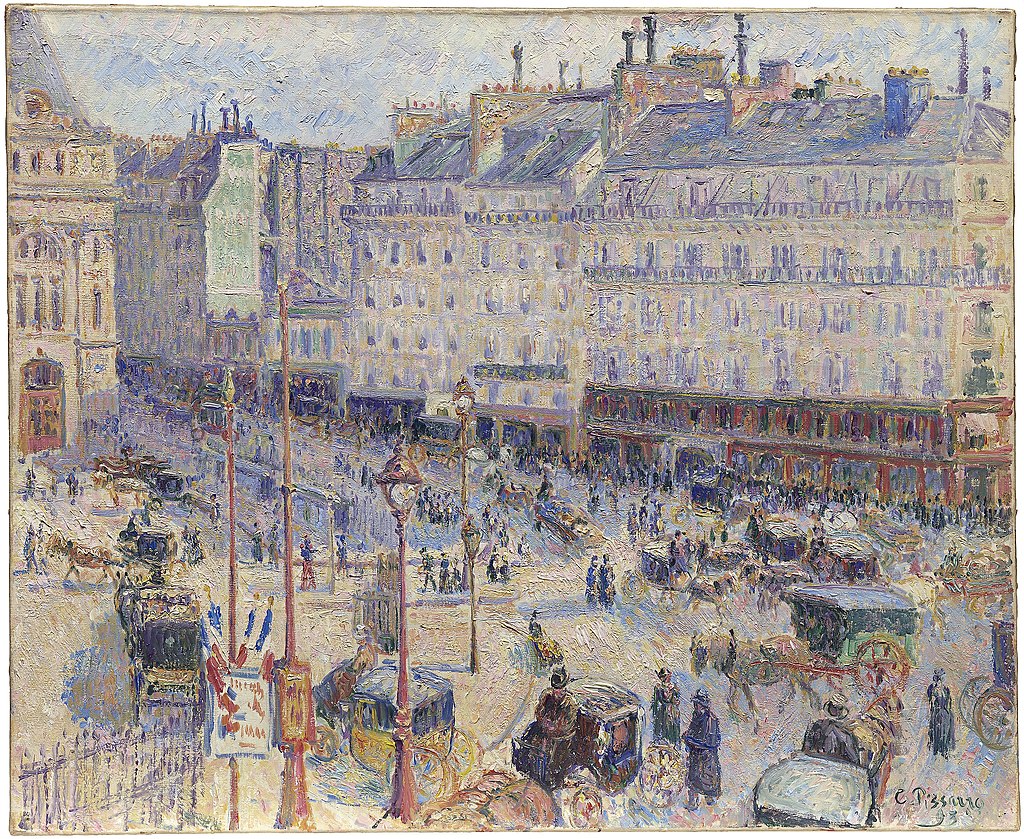
The Place du Havre, Paris” (1893)


Pissarro suffered from a recurring eye infection that became severe in 1893. It prevented him from sitting outdoors and painting en plein air. He was determined to continue to paint outdoor scenes, but from the upper rooms of hotels in the cities of Paris, Rouen, Le Havre, Dieppe, and London. His reputation by that time was well-established and as he hoped his paintings of the new the new Paris designed by Haussmann attracted buyers. Pissarro painted “The Place du Havre, Paris” (1893) (24’’x29’’) from his window of the Hotel Garner during a visit for a few weeks. The large building to the right is the Gare St Lazare train station. Renoir and Monet had painted scenes of downtown Paris, but had long since turned to other themes. Pissarro revived the interest in Paris scenes. The wide avenues, Haussmann buildings, horsedrawn carriages, gas and then electric lights, and the continuous hustle and bustle as seen from above allowed him to capture the energy of the streets. 


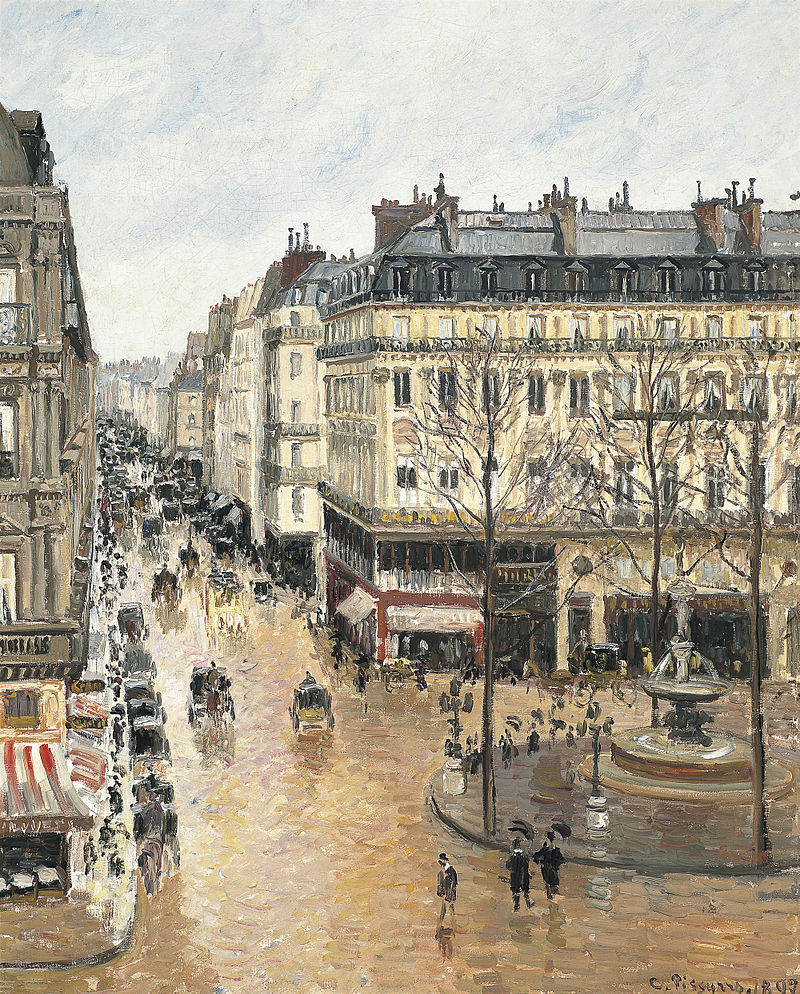
“Rue Saint-Honore, in the Afternoon, Effect Rain” (1897)


Although city scenes were not a part of his usual subject matter, he excelled in these paintings. He said he could “see down the whole length of the boulevards, almost a bird’s-eye view of carriages, omnibuses, people, between big trees, big houses that have to be set straight.” He chose to depict the most important streets in Paris, and influenced by Monet, he chose different times of day and different weather conditions.  

“Rue Saint-Honore, in the Afternoon, Effect Rain” (1897) (32”x26’’) was one of several pieces he painted before moving on. Just over one mile long, Rue Saint-Honore was the center of Paris Haute Couture. High-end fashion houses, boutiques, designer shops, and art galleries attracted wealthy Parisiennes. Several horse-drawn carriages are parked at the curb, while others ply the crowded boulevard. Haussmann buildings line the street. The restaurant on the corner has a red and white awning and tables on the sidewalk. The plaza contains trees, a large fountain, and street lights. People, most with open umbrellas, populate the scene. More awnings and decorated store fronts are across the street. Pissarro was expert at handling the wet street and the gray atmosphere.


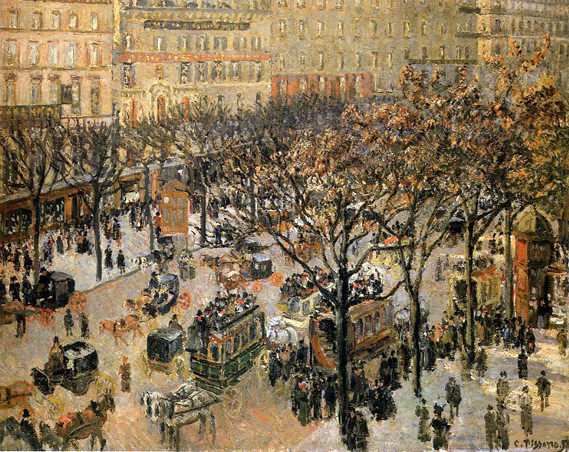
“Boulevard Italians, Morning Sunlight” (1897)

From February through April 1897, Pissarro recorded the Boulevard des Italians and the Boulevard Montmartre from his room in the Grand Hotel de Russie. He found “terribly difficult views” for his “Boulevard Italians, Morning Sunlight” (1897) (29”x36”) (National Gallery of Art, Washington, DC). 

The street was busy, with passenger omnibuses picking up and discharging passengers among the many individual carriages. Two rows of trees line the street, and the large sidewalks are full of people. Pissarro included a tall red advertising kiosk on the right sidewalk.  The kiosks were covered with flyers promoting all manner of things–theatre, opera, restaurants, the circus, cigarettes. The invention of lithography made it possible to print advertisements quicker and cheaper to promote the new bourgeois entertainments. The posters of Toulouse-Lautrec come to mind.


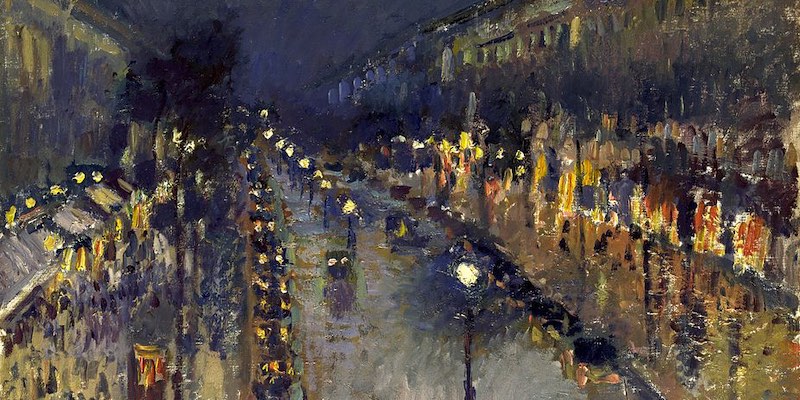
“Boulevard Montmartre at Night” (1897)


“Boulevard Montmartre at Night” (1897) (21”x26”) is considered one of Pissarro’s masterpieces, equal to Van Gogh’s “Starry Night” (1889). Painting at night was difficult, and when successful was exceptional. Gas lights lined city streets in the 19th Century, but they were replaced by the white electric lights in 1878, included in this scene. Street lights were one of Hausmann’s ideasto make Paris safer, and they made night life possible. Pissarro painted 14 scenes of Boulevard Montmartre in sunlight, snow, rain, fog, and mist, and in the morning, afternoon, and evening. Carriages are parked along the sidewalks, waiting for passengers. Shops and restaurants run the whole length of the street. Dashes and dots of brushwork suggest this active scene.


“Boulevard Montmartre at Night” – detail (1897)


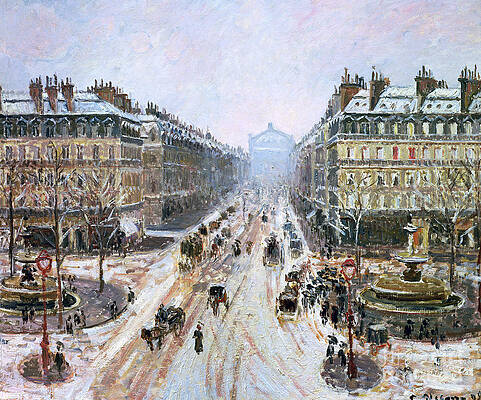
“Avenue de l’Opera, Snow Effect” (1898)


Pissarro created 15 paintings in 1898 from his room in the Grand Hotel du Louvre on the Place du Palais Royal. His room provided a view of the Avenue de l’Opera, the Place du Theatre Francais, and the Rue Saint-Honore. In “Avenue de l’Opera, Snow Effect” (1898) (26”x21”), two large roundabouts can be seen on either side of the wide thoroughfare that leads to the distant, newly constructed Paris Opera House (1861-1875). With the industrial revolution in full swing, the newly wealthy middle class formed associations to fund institutions such as the opera house. In the past, opera stages were part of royal palaces and available only to members of the ruling classes. The Paris Opera House, designed by Charles Garnier (1825-1898), is obscured by the mist in this painting, but it was and is grandiloquent. Pissarro chose to show the effects of a heavy snow fall, leaving roof tops and awnings tipped with white. The line of buildings and the tracks in the snow create a strong perspective view.

The years from 1897 until 1898 brought several tragedies into Pissarro’s life. His son Lucien suffered a stroke and another son Felix died of tuberculosis at age 23. The Dreyfus Affair concerned an Army Captain, who was Jewish and wrongfully accused and convicted of being a German spy as a result of antisemitism. Pissarro, a Jew, lost some of his friends who were antisemitic. Never political of religious in his paintings, he did write a few letters in support of Dreyfus’s innocence. He was able to separate politics from painting, and in a letter to his son Lucien to tell him of Felix’s death, he wrote: “I am delighted to be able to try to do these Paris streets, which are so often called ugly, but which are so silvery, so luminous and so lively”.

“Garden of the Tuileries on a Spring Morning’’ (1899)

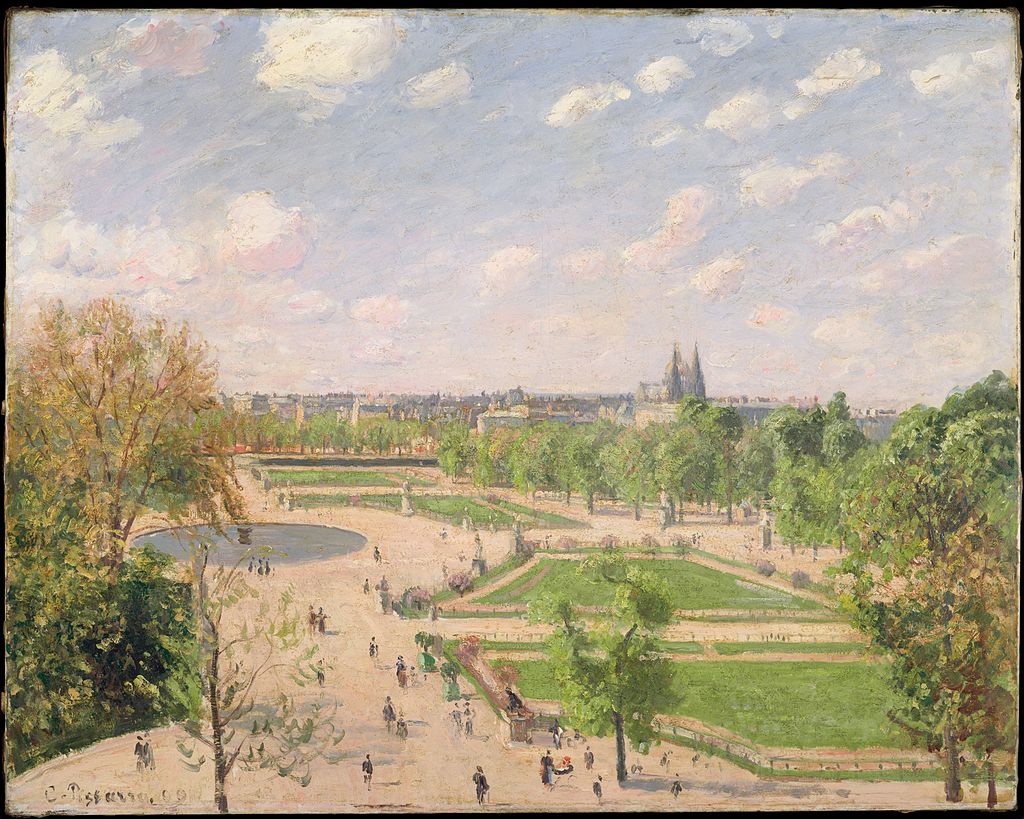
Pissarro took an apartment at 204 rue de Rivoli that faced the Jardin des Tuileries.  He painted six views of the garden. “Garden of the Tuileries on a Spring Morning’’ (1899) (29”x36”) is a depiction of the park, created by Queen Catherine de Medici in 1564, located between the Louvre and the Place de la Concorde. The garden was opened to the public in 1667. The two steeples of the church of Sainte-Clotilde can be seen in the distance.  Pissarro’s dealer Durand-Ruel happily took the paintings to sell. The paintings were so successful that Pissarro took the same rooms later in 1899. He created another 14 paintings of the garden and 8 views of the Place du Carousel. 

“The Seine at the Louvre” (1903)


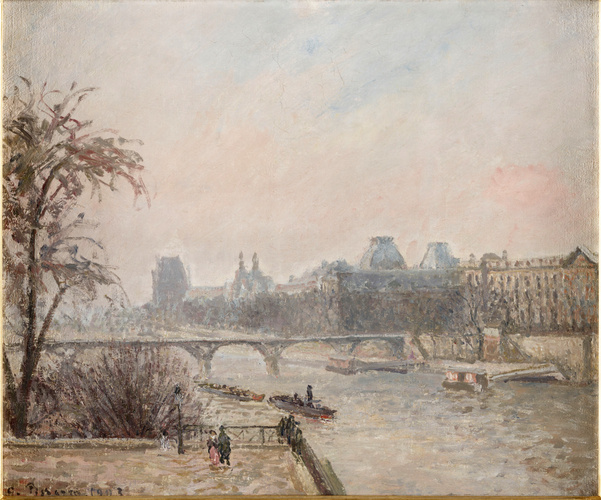
From 1900 until 1903, Pissarro painted views of the Louvre from the second floor of a house on Place Dauphine. “The Seine at the Louvre” (1903) (19’’x22”) is his last painting. It is a depiction of an overcast fall day. The buildings of the Louvre are shrouded in a blue-gray mist. Some boats ply the river. A few people are on the Square du Vert-Galant at the lower left. In summer it is a green space with a variety of trees. The Pont des Arts (1803), a pedestrian bridge between the Louvre and the Institut de France, spans the river. It was the first iron bridge in Paris. The bridge became famous in 2008 for the love locks that people attached to the rails. 

Pissarro died of sepsis on November 13, 1903. His wife and remaining children were present. Many prominent artists attended his funeral, among them Monet, Renoir, and Matisse. The next generation of French painters, the Fauves and Matisse, recognized the importance of Pissarro to Impressionism and the liberation of art for the future. Pissarro was and continues to be considered the father of Impressionism.


Beverly Hall Smith was a professor of art history for 40 years. Since retiring to Chestertown with her husband Kurt in 2014, she has taught art history classes at WC-ALL and the Institute of Adult Learning, Centreville. An artist, she sometimes exhibits work at River Arts. She also paints sets for the Garfield Theater in Chestertown.

The Spy Newspapers may periodically employ the assistance of artificial intelligence (AI) to enhance the clarity and accuracy of our content.

Filed Under: Looking at the Masters, Spy Journal

Chicken Scratch: What else is there to do? Aging, attention, and becoming — by Elizabeth Beggins

July 19, 2025 by Elizabeth Beggins Leave a Comment

It’s time for my annual pilgrimage.Not the sort a friend just made, walking blisters onto her feet and renewal into her soul on the Camino de Santiago, but with parallels, nonetheless. Something went wrong every day, she said, starting with a canceled flight, but it was still an incredible experience.
“Yes,” I think. “That.”They say aging is a test of endurance. I say, so is living. Every day, I face my demons. There are no shortcuts. And so far I’m still at it, because despite themselves, they can’t keep me from what’s miraculous, precious, or beautiful.

Picture of a path between pine trees

Pilgrimage – photo by the author

Here’s something precious:

This community loves a woman named Carol. As a volunteer managing social media for the local farmers market—an institution I helped launch 28 seasons ago—I shared a photo of her with a few simple words:

This is Carol.

Carol shops at the farmers market every week.

Even when it rains. Even when it’s hot.

Even when other people stay home and grumble about parking.

Carol is smart.

Carol is kind.

Carol has seen a lot in her years—and she still chooses joy.

She rolls up weekly, picks out the best of what the market has to offer, and always has a kind word for the farmer.

Everyone smiles when Carol is here.

Be like Carol.

The world needs more Carols. 🌻💛

The post has garnered close to 300 reactions and a flurry of supportive comments. Carol is almost 90. She wears compression socks, uses a rollator, doesn’t stand as upright as she once did. And she is utterly delightful.

Here’s something beautiful:

Last week, at the same farmers market, I approached a stand run by a couple I’ve known for many years, two people who have endured a lot. She walked away just as I arrived, her husband watching with weariness and worry, saying how unfair it is, what life has done to her. She’s been leaving with greater frequency, the result of progressive cognitive decline and imagined offenses she typically blames, without cause, on him. I offered to go after her, see if I could encourage her to come back.

I remember how my mom struggled as my dad’s capacities deteriorated, how he accused her of having an affair when she left for a meeting, or a short trip out of town.

Just as she reached the edge of the road, I met up with my wandering friend, called her name, put my hand on her shoulder.

“It’s Elizabeth,” I said. “Would you like to walk back this way with me?”

“Did he send you after me?” she asked, frowning.

“No. I just wanted to hold your hand for a little while.”

On the short but slow journey back, we talked about how she’d just as soon not be here anymore and about how we were wearing the same color. I told her how nice it felt in the shade of their tent, and how the breeze made all the difference. I asked her what she’d call the color we were wearing. We landed on peach, or salmon. By the time I moved along, she seemed to have forgotten that she was angry.

Other than good fortune, there is nothing standing between me and the end of my life. This has been true since the day I was born. That I’m still here, moving through my sixties, feels nothing short of miraculous. I’ll take all of it I can get. (I’ll get back to you on that when it hurts more to be here than I imagine the leaving will.) I know the clock is ticking, which means the chance to grow older is like winning the lottery every damn day.

A faded caution sign with the words "Watch Children"

Watch! photo by the author

So, I will live. Soften. Ripen. Practice being who I think I want to be. I will savor my days, knowing it only takes a hint of sweetness to balance the sour, the bitter, the salty. As my body fades, I’ll amplify my light. As it falters, I’ll amplify my love. Send them both to the places they’re needed most—which, of course, is everywhere. What else is there to do?

Think about that for a minute, would you? Think about the wonder of living. Of all the options, we’ve arrived here. This morning, we opened our eyes, wiped away the crust, made our way into some kind of day.

Have you looked around lately? Really looked? At the ants crossing the threshold? The plants sprouting on the doormat? The faded sign, the sagging flag, the flowers in the window? At the sloped shoulders of the guy getting home from a 12-hour shift, at the woman and the dog who go past every morning and evening? What kind of dog is it again?

Good god, we’re alive! I just had a birthday, and I’m not about to be quiet about it. What a remarkable thing it is to be born at all, to live at all.

I am on a pilgrimage. This can only ever be a solo journey, a well-traveled path curving with the pulsing current of humanity, conversations slipping over worn stones that ask how I’ve been, where I’ve been, where I’m headed.

A pair of trees, once small as wrists, stand textured and stately. In their canopies live the dreams I lifted up long ago. Looking up from the shadows, I see them pirouette overhead, responding to forces beyond their control: now rain, now bird, a blast of wind, a fallen friend.

My body is this path. My legs are these trees. My arms, branches. My dreams still dreams, but with deeper roots. I am noticing what’s here, holding what’s here, loving what’s here. I don’t know what I’m becoming. But I’m calling it wondrous.

A poem by Andrea Gibson

Andrea Gibson: August 13, 1975 – July 14, 2025


An audio version of this essay, read by the author, is available here.

Elizabeth Beggins is a communications and outreach specialist focused on regional agriculture. She is a former farmer, recovering sailor, and committed over-thinker who appreciates opportunities to kindle conversation and invite connection. On “Chicken Scratch,” a reader-supported publication hosted by Substack, she writes non-fiction essays rooted in realistic optimism. To receive her weekly posts and support her work, become a free or paid subscriber here.

The Spy Newspapers may periodically employ the assistance of artificial intelligence (AI) to enhance the clarity and accuracy of our content.

Filed Under: 3 Top Story, Spy Journal

Food Friday: Zucchini Time 2025!

July 18, 2025 by Jean Sanders Leave a Comment

It has been the hottest summer on record – but we are saying that every year now, aren’t we? As we try to walk our 10,000 steps every day, lingering under the shady trees as much as possible, Luke the wonder dog and I long to be home, in the coolth. Luke can at least lie on the floor, on top of the air conditioning vent. He also doesn’t have to worry about what to do with the sudden abundance of zucchini.

Like Homer Price’s doughnuts, ripening zucchini is everywhere. Luckily, there are just about as many recipes for zucchini as there are the ubiquitous and magically regenerating vegetables themselves.
It’s that time of year. Again. Neighbors furtively slipping their excess zucchini harvest onto your front porch, before dashing back home. These are the times that try cooks’ souls: what to do with all the excess zucchini baggage.

Luckily it’s been a great tomato season, and they provide excellent camouflage for zucchini:
Zucchini Tomato Gratin

What are we to do with all the zucchini? It doesn’t look very nice on the windowsill – summer tomatoes in varying stages of turning from green to red are much more attractive. An elegant galette is a good way to start your purge. The crust is easy and forgiving, and it is soothing to lay out all the zucchini rings in ever widening circles. You will look very competent and trustworthy. And then you can start to spring these other surprises on the unsuspecting. If you have a garden, you have been harvesting tomatoes with a greedy heart, thinking about the jars of spaghetti sauce you will enjoy this winter. But what about that ever-rising green mountain of zucchini? You need to put on your thinking cap, and find some creative culinary solutions.
Zucchini Ricotta Galette

Zucchini boat recipes are popular. I like the idea of filling hollowed out vessels of zucchini with a variety of fixings, vegetarian or not, and using up all the lingering leftovers. Zucchini Boats

Luckily, zucchini is oh, so versatile. You can find it in soups, salad, chips, galettes, casseroles, hidden in breads and cookies. You can roast it, slice it, twirl it. This is a link to a virtual compendium of Zucchini Recipes

Do not be sneaky with zucchini. You don’t want to be the formerly favorite aunt who brings zucchini ginger cupcakes to the birthday party. Kids have a different perspective on summer. They never forget so-called “gourmet” baking experiments, or deliberate kid deceptions. Zucchini Ginger Muffins Yummy icing is always welcomed.

Nobody is fooled by zucchini bread. Least of all the small children into whom you are trying to stuff healthy vegetables. They are wise to your ways. Discuss the benefits of adding vegetables to your daily diet before feeding them this delicious Lemon Zucchini Bread. We are very excited about this Chocolate Zucchini Bread.

“The trouble is, you cannot grow just one zucchini. Minutes after you plant a single seed, hundreds of zucchini will barge out of the ground and sprawl around the garden, menacing the other vegetables. At night, you will be able to hear the ground quake as more and more zucchinis erupt.”*
-Dave Barry

*This is my favorite zucchini quotation of all time, and I haul it out almost every year.

Jean Dixon Sanders has been a painter and graphic designer for the past thirty years. A graduate of Washington College, where she majored in fine art, Jean started her work in design with the Literary House lecture program. The illustrations she contributes to the Spies are done with watercolor, colored pencil and ink.

The Spy Newspapers may periodically employ the assistance of artificial intelligence (AI) to enhance the clarity and accuracy of our content.

Filed Under: 1 Homepage Slider, Food Friday, Spy Journal

Food Friday: Vacation Dogs

July 4, 2025 by Jean Sanders Leave a Comment

Mr. Sanders, Luke the wonder dog and I are off for a little holiday respite in the mountains of North Carolina for the Fourth of July holidays this week. We are planning to grill some hot dogs in honor of our national holiday. Enjoy a column from a couple of years ago, when we had moseyed up to New England for a change of scene!

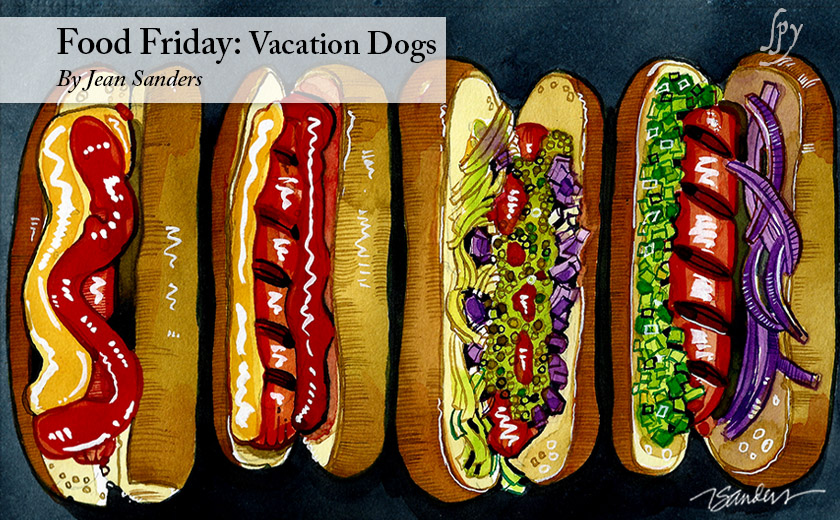
Sometimes I forget that we live in a country that is so vast and diverse that a New England hot dog is wildly different from a Chicago-style hot dog, and neither of them is like a hot dog from Texas, or from California. And this is one of the great American qualities – we are true blue and we love our regional delicacies.
In Boston, a Fenway Frank is boiled first, and then lightly grilled. (It is served in a split-top roll, which is also used for the best sort of lobster rolls: Split-top Roll) The Puritans among us prefer garnishing a Fenway Frank with just a thick wiggly trail of spicy mustard. But since this is America, feel free to pile on your own favorites.

As you travel west to Chicago, you will observe that the Chicago-style hot dog is a completely different creation. Chicago-style hot dogs are cooked in butter in a pan, and then served in warm, poppy-seed rolls, with lots of veggies on top. Chicago-style dogs are “dragged through the garden”: topped with sweet pickle relish, chopped onions, pickled peppers, tomato slices and sprinkled with celery salt. Have you been watching The Bear? You’ll know then how popular these franks are.

Then you’ll mosey down to Texas, to encounter the Hot Texas Wiener , a frank cooked in hot vegetable oil. If you place an order for a “One”, you’ll get a blisteringly hot frank topped with spicy brown mustard, chopped onions, and chili sauce. Yumsters.

As you continue west, and stop in Los Angeles for a some street food, you will encounter an L.A. Danger Dog. This frank is wrapped in bacon! I cannot imagine the state that Gwyneth and Meghan call home would do anything so decadent and audacious as a grilled, bacon-wrapped hot dog. More controversial to a hot dog purist are the toppings: catsup, mustard, mayonnaise, sautéed onions, with peppers, and a poblano chile pepper. Catsup? Mayo? But to be polite, you must eat like a local, and it will be deelish.

Common sense teaches us to not use catsup on our franks after the age of 18. You might as well make bologna sandwiches with Wonder bread, and douse them in catsup.

Have you ever seen the Oscar Meyer Weinermobile on the road? I can remember driving on a Florida highway once, and suddenly, puttering alongside us, was the Weinermobile. What a cheap thrill that was! Sadly, now it is called the Frankmobile. Time marches on.

You can follow the Frankmobile on Instagram:

July is National Hot Dog Month, and the National Hot Dog and Sausage Council says that some of the top hot dog consuming cities include: Los Angeles, New York, Philadelphia, Boston, Chicago, Phoenix, Atlanta, Detroit, Washington, DC, and Tampa. You’ll want to brush up on your hot dog etiquette https://www.kplctv.com/2019/07/03/hot-dog-etiquette-dos-donts-during-fourth-july-holiday/, I’m sure.

And here are the official rules for Nathan’s Hot Dog Eating Contest, in case you want to try this at home.

NPR 1A – Hot Dogs

“A hotdog at the ballgame beats roast beef at the Ritz.”
— Humphrey Bogart


Jean Dixon Sanders has been a painter and graphic designer for the past thirty years. A graduate of Washington College, where she majored in fine art, Jean started her work in design with the Literary House lecture program. The illustrations she contributes to the Spies are done with watercolor, colored pencil, and ink.

The Spy Newspapers may periodically employ the assistance of artificial intelligence (AI) to enhance the clarity and accuracy of our content.

Filed Under: 1 Homepage Slider, Food Friday, Spy Journal

Looking at the Masters: Tom Deininger

June 26, 2025 by Beverly Hall Smith Leave a Comment

Tom Deininger was born in Boston in 1970. He is a sculptor who works in the style known as assemblage: unrelated, found objects brought together to form a work of art. His sculptures are created with discarded objects that are not biodegradable or recyclable. His work is collected world-wide

He is dyslexic and suffers from ADHD.  School was difficult, but he was able to express himself through drawing and making things. Deininger describes himself as “very outdoorsy. I grew up in Norwell, Massachusetts, and I lived in a wooded area with ponds and a river.” He attended Salve Regina University in Newton, Rhode Island, graduating with honors in art. After college he traveled through Europe, Central America, and the South Pacific.  He surfed, and he made and sold his art. On this trip to the remote and beautiful beaches of the South Pacific, he saw piles of American plastic trash. He became acutely aware of the damage to the environment created by our consumerist society. Deininger returned to Rhode Island in 1999. He set up a studio in Fall River, Massachusetts. A visit to the Nantucket landfill gave him the idea to make his work three-dimensional, using the thrown-away waste of society. 

“Wave 1” (2012)

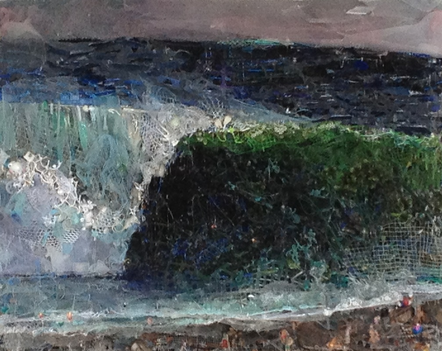
“Wave 1” (2012) (3’x4’x2.5’) was inspired by Deininger’s love of surfing. Made entirely of found plastic objects, it depicts a large white wave, curling, and pounding the beach–a surfer’s wave. Bits of plastic webbing are visible. This work is small in scale. “Wave 3” (2012) (not shown) (6’x8’x3’) and other works are even larger. He chose to depict what he loved in nature and the destructive effect of consumerism on the environment. He contributes 50% of the sale of his sculptures to the organization Narragansett, Rhode Island Save the Bay.

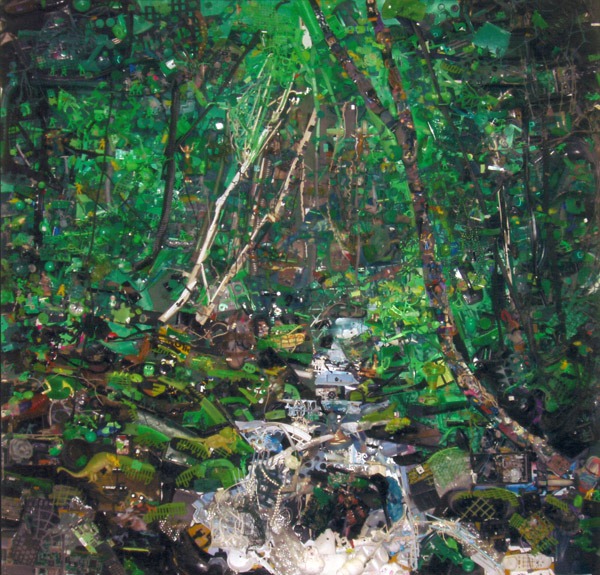
”Poland Springs” (12’x20’)

“Poland Springs” (12’x20’) (undated) was made from plastic water bottles the Maine corporation Poland Springs uses to contain its product. The waterfalls, plants, and trees of the region create a refreshing view of a heathy and pleasing environment. Pure, fresh, clean water is the product. It takes three liters of fresh water to make one liter of Poland Springs bottled water.

The organization Fortune Brainstorm Green has sponsored annual conferences beginning in 2008 to focus attention on issues of sustainability by bringing together leaders from government, business, and other organizations. Deininger was commissioned to create a 20’x10’ backdrop (not depicted) for one of the conferences. =

“Plastic Paradise”

Deininger once commented, “I go to the beach about four days a week, and I pick stuff up. It’s hunter-gatherer, to be honest. And now I’m getting donations from people on Instagram. They don’t like throwing this stuff away.”

“Plastic Paradise” (12’x20’) (undated) is a depiction of a flower-filled meadow, a tall green forest, a rocky mountain, all set under a clear blue sky. Perhaps Deininger hoped the ironic title would make people think. In a 2024 interview with Yahoo news, he stated, “I don’t think we’re alarmed enough. Everyone’s not alarmed enough, enough of the time, is my fear. We should all be petrified and willing to do whatever it takes.”

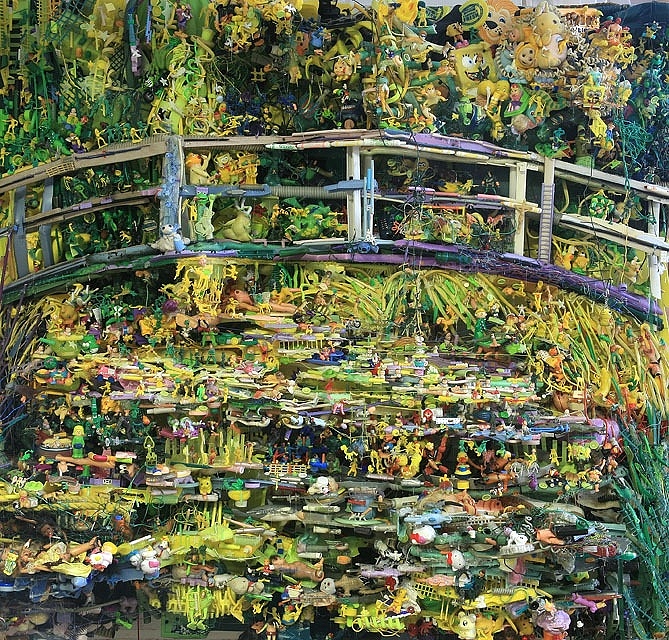
‘Stroking Monet” (2010s)

Deininger occasionally selects known works to recreate as assemblages. “Stroking Monet” (2010s) recalls Monet’s “Japanese Footbridge” (1899) in found plastic junk. Deininger dumpster dives, rummages through people’s garbage cans on trash day, and picks things up all the time.

‘Stroking Monet, detail” (2010s)

So, what is it all about? When viewers are able to look at his work up close, they experience a totally new reality. Plastic Sponge Bob Square Pants, Barbies and Barbie parts, Kermit the Frog, abandoned plastic toys, bottle caps, cassette tapes, wire, plastic syringes, plastic bags, and more, all come together to create an entirely different impression. The juxtaposition of parts is funny, sad, alarming, violent, bizarre, and sexual. 

Deininger offers his point of view: “And so you’ve got one thing up close and it coalesces into something else all together from a distance. So, just the idea of what is reality, what is truth, has everything to do with perception…. It reminds me of how slippery it can be, what is real and what is true.”

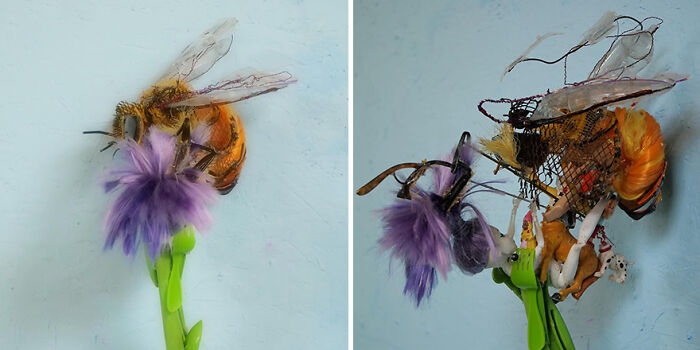
”Honeybee” (undated)

In more recent years, Deininger has begun to create his assemblages with images of birds, fish, and other animals. In his interviews he talks about his process. “Honeybee” (undated) was   made from plastic bristles, netting, wire, toy figurines, a plastic German Shepherd, a little man holding a long stick, Shaggy and Scobey-Doo figures, a doll’s head, green plastic forks, and half a pair of sunglasses to represent the eye, among other things. 

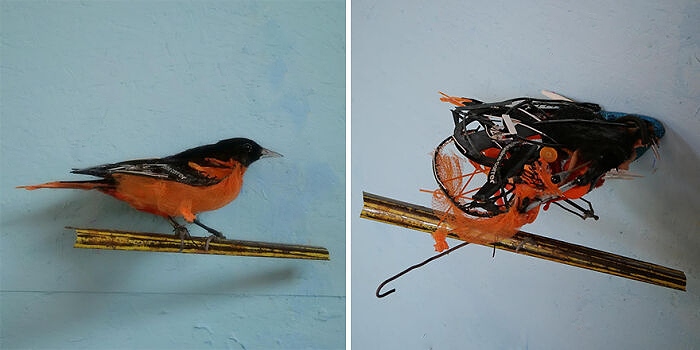
This double image captures both sides of the sculpture, similar to what a viewer would be able to see when the work is on display. Glueing, wiring, drilling, and pinning are among the processes used. Creating the basic sculpture takes about a week, with more time needed to refine the final image.

Deininger researches each animal: “To cull through hundreds of images of bees and find the one you want because you can clearly see the eye or the thorax—you get to understand the granular details of variation within a species.”

Deininger observes, “We tend to dismiss things that are inexpensive and don’t look at their beauty overall. But when you can take something out of context and put it together with a variety of other things, you can coax a new definition out of it and maybe a new purpose.”

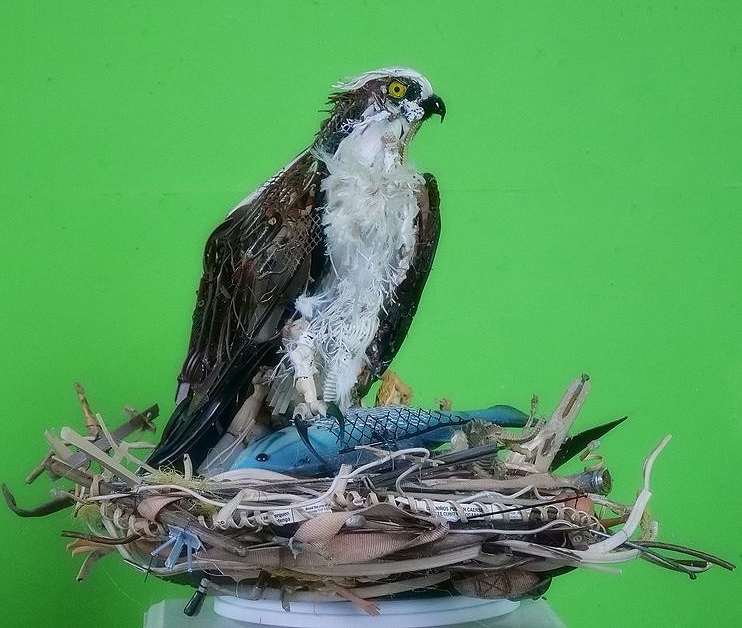
”Osprey” (2023)

Deninger talks about birds: “I’m just really fascinated with them. Fascinated by the physical engineering and also there is a wonder about birds…. It’s often about things coming down from the heavens. Birds occupy this space that isn’t available for us to occupy. I think humans have always been attracted to birds in a spiritual way.” 

The subject of the sculpture “Osprey” (2023) (18”x12”x39”) is well-known to those of us who live on the Mid-Shore. The retirement community Heron Point maintains an Osprey nest with a video camera set up so that residents can watch 24/7 during the season.  

“Baltimore Oriole” (2023) (5”x11’’x17’’)

It is possible to see both sides of another of Deininger’s sculptures, Maryland’s State bird.

In 2025, Deininger started a permaculture farm, an agriculturally sustainable and self-sufficient ecosystem, to take care of rescued animals.

In several interviews over a period of time he offered his point of view; 

“There’s so much junk around us that we can recreate the natural world.” (The Provincetown Independent, 3/212/25) 

“Yes, we can call these objects masterpieces.” (Yalik Ak, 7/9/2014)

“You know, nothing changes if we do the same thing over and over again, and just walk into an ecological crisis that is irreversible. It’s about adopting a new perspective.” (Blue Dot Living, 2025)


Beverly Hall Smith was a professor of art history for 40 years. Since retiring to Chestertown with her husband Kurt in 2014, she has taught art history classes at WC-ALL and the Institute of Adult Learning, Centreville. An artist, she sometimes exhibits work at River Arts. She also paints sets for the Garfield Theater in Chestertown.

The Spy Newspapers may periodically employ the assistance of artificial intelligence (AI) to enhance the clarity and accuracy of our content.

Filed Under: Looking at the Masters, Spy Journal

Looking at the Masters: Imogene Cunningham

May 22, 2025 by Beverly Hall Smith Leave a Comment

Imogene Cunningham (1883-1976) was the fifth of ten children born to Isaac Burns and Susan Elizabeth Cunningham. Born in Portland, Oregon, and raised in Seattle, Washington, she was inquisitive and interested in everything. She graduated with honors in 1907 from the University of Washington, having majored in chemistry. She was elected to membership in the Alpha Chapter of Pi Beta Phi. 

In 1901, Cunningham purchased for $15 a 4”x5” view camera, and she enrolled in the correspondence course to learn how to take pictures. She earned some of her college tuition by photographing plants for the botany department. With the help of her chemistry professor, she learned about photographic processes. Her graduation thesis was titled “Modern Processes of Photography.” After graduation, Cunningham worked for Edward S. Curtis (1868-1952), one of America’s premier photographers of the American West. She learned platinum printing and assisted in the production of his book The North American Indian. 


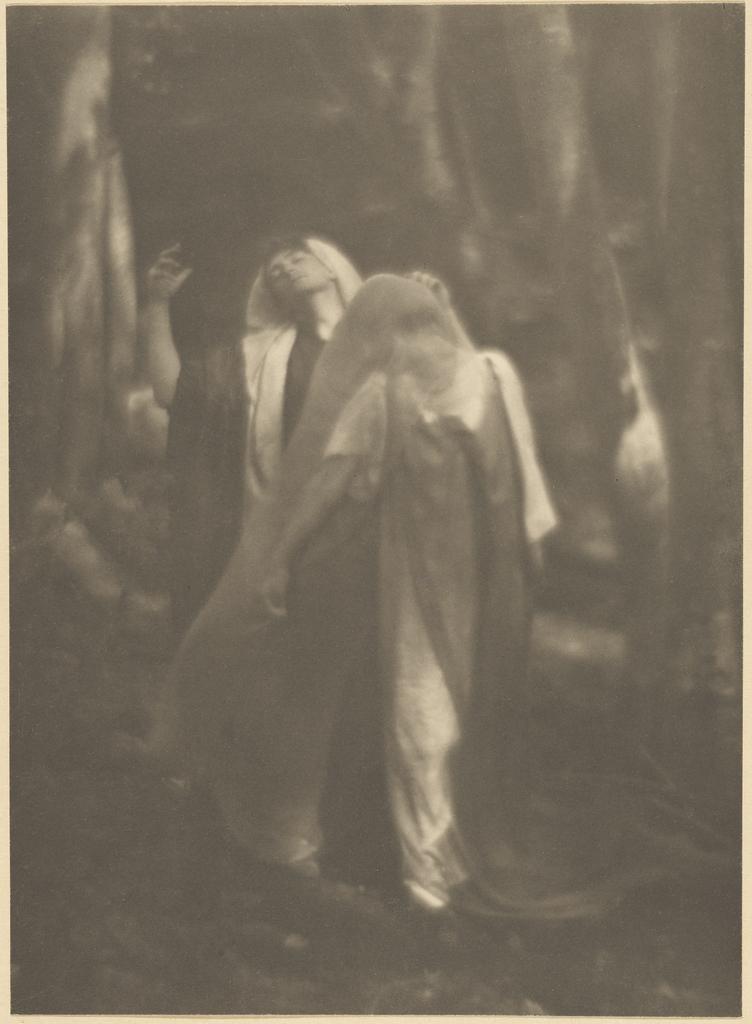
“Wood Beyond the World I” (1910)

Cunningham was awarded in 1909 a Pi Beta Phi Graduate Fellowship to study photographic chemistry at the Technical University in Dresden, Germany. Her aim was to discover a printing solution that was less expensive than platinum, then in use. Her final paper was “About the direct development of platinum paper for brown tones.” Her process increased printing speed and the clarity of highlights, and produced sepia tones. On her return home, she met noted American photographers Alvin Langdon Colburn (1882-1966) in London and Alfred Stieglitz (1864-1946) and Gertrude Kasebier (1842-1934) in New York. Cunningham opened her photographic studio in Seattle in 1910, and she quickly became successful.

“Wood Beyond the World I” (1910) (13.5’’x9’’) (gelatine silver print) likely was influenced by Kasebier’s hazy photographic images of imaginary worlds described in the legend of King Arthur. The Wood Beyond the World (1894) was a fantasy novel written by William Morris (1834-1896), the English Pre-Raphaelite artist, who established the William Morris Company that produced fabric and wallpaper prints still popular today. Cunningham’s photograph is a depiction of the enchanted wood where an unhappy husband encounters a mysterious maiden. Achieving the soft focus with just the right amount of contrast between dark and light is complicated. The photograph presents the viewer with a dreamworld.


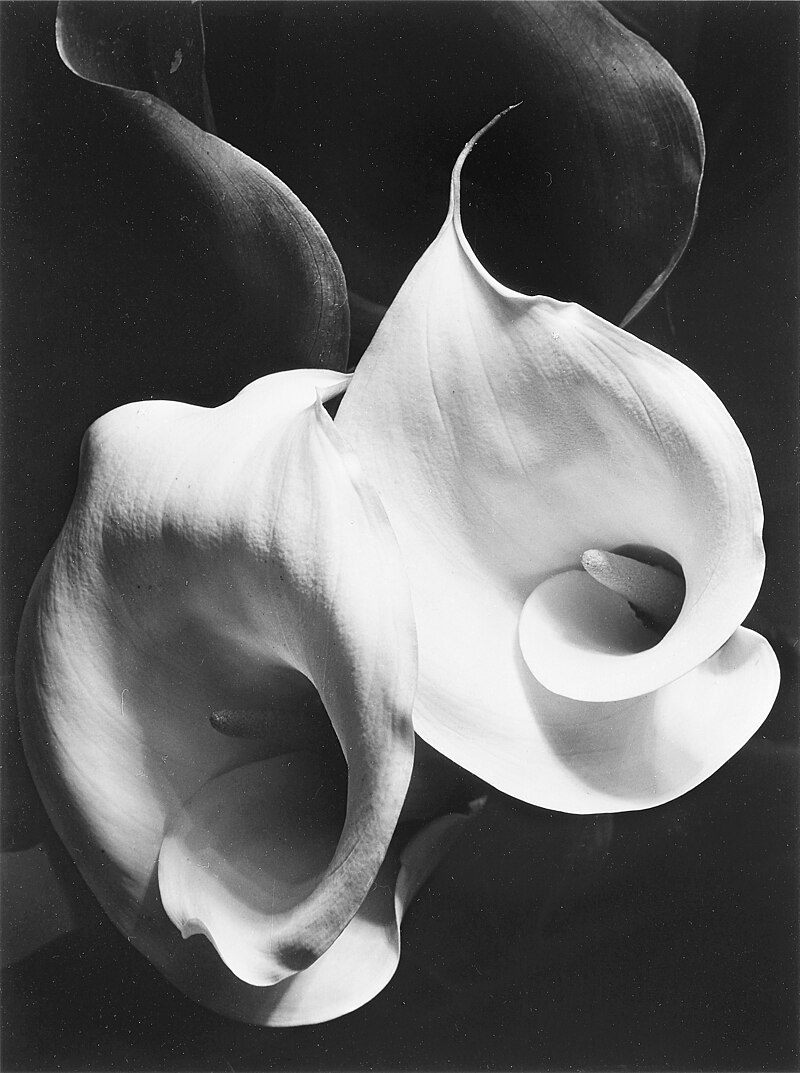
“Two Callas (1925)

Cunningham was the first woman photographer to have an exhibition (1913) at the Brooklyn Academy of Arts and Sciences. Her portraits were included at An International Exhibition of Pictorial Photography in New York in 1914. Wilson’s Photographic Magazine published a portfolio of her work.  She married Roi George Patridge in 1915, and they had three sons. They moved to San Francisco in 1917. Patridge began to teach art at Mills College in Oakland, California, in 1920.

While raising the children, Cunningham began her close-up botanical photographic series. She planted a garden in order to study various plants. “Two Callas” (1925) (20’’x16’’) (gelatin silver print) represents her transition to sharp-focused prints. She said, “The reason during the twenties that I photographed plants was that I had three children under the age of four to take care of, so I was cooped up. I had a garden available and I photographed them indoors. Later when I was free, I did other things.” At this same time, Georgia O’Keeffe was painting her large-scale, close-up flower details. Since both artists were in the Stieglitz studio, there was much speculation about the connection of their work.  Although they knew each other and each other’s work, neither artist was influenced by the other. “Two Callas” has become an iconographic Cunningham image. The negative had been lost for many years until she found it in 1973. She made several more prints before her death.


“Magnolia Blossom” (1925)

“Magnolia Blossom” (1925) (11’’x14’’) (gelatin silver print) is one of several studies of magnolia plants. The detail of the stamen and pistil is precise, and the more delicate curves of the petals provide a marvelous contrast.  

Cunningham co-founded Group f/64 with Ansel Adams and Edward Weston on November 15, 1932.  f/64 is the smallest focal aperture on a camera. Rather than moving in an abstract direction, like the New York photographers, f/64 wanted precision “pure and straight.” According to Cunningham, “f/64 is not only American, it is Western American. It isn’t even American. It’s western…This does not mean that we all used the small aperture, but we were for reality. That was what we talked about too. Not being phony, you know.” The group of eleven photographers held their first exhibition in 1932 at the De Young Museum in San Francisco. 

Cunningham founded the California Horticultural Society in 1933. Her photographs of plants were so detailed that they often were used by horticulturalists and other scientists in their work. 


“Alfred Stieglitz at An American Place” (1934)

Cunningham’s photographs during the 1930’s and until the 1960’s were mostly portraits. “Alfred Stieglitz at An American Place” (1934) was commissioned by Stieglitz (1864-1946). He established Gallery 291 in New York City, and it was the place to be if you were a modern American painter or photographer. Cunnigham and Stieglitz met in 1910. He supported her work, collaborated with her on projects, and the two formed a close working relationship. Stieglitz operated his New York City gallery, An American Place, from 1929 until his death in 1946. Stieglitz chose to stand in front of a painting by his wife, Georgia O’Keeffe.

Among the American modernist painters Stieglitz promoted were Arthur Dove, John Marin, Marsden Hartley, Charles Demuth, Paul Stand, and O’Keeffe. He also introduced Americans to the work of some European modernists such as Manet, Toulouse-Lautrec, and Matisse. 


“Martha Graham” (1935)

Her success in portrait photography resulted in an invitation to Hollywood in 1930 and in 1932 to do portraits for Vanity Fair, Sunset, and other magazines. Cunningham tried out color photography for some of the Sunset pictures. Some examples of Cunningham’s portraits are those of Frida Kahlo, Gertude Stein, Cary Grant, and Spencer Tracy.  Cunningham enjoyed capturing the motion of the human body, “Martha Graham” (1935) is one of many portraits she made of Graham.  She works here with a double negative, one a facial portrait and the other a simple dance move. The sharpness in the face is contrasted with the soft focus of the dance pose, allowing two aspects of Graham’s personality to be shown. Cunningham explained, “One must be able to gain an understanding at short notice and close range, of the beauties of character, intellect, and spirit so as to be able to draw out [their] best qualities…”


“Where Children Play” (1955)

Cunningham and her husband were divorced in 1934, and the burden of supporting herself and her three sons caused her to diversify subjects in her work. She began taking pictures of industrial sites, and she took up street photography and documentary work. “Where Children Play” (1955) (8.7”x7.1”) revealed the love of her children and her social consciousness. As always, the photograph sends a clear message. The young boy stands alone in the doorway of a shack. A ragged awning hangs from the top of the door. Trash lies on the ground. Cunningham’s ability to spot a moment in time that depicts a message was always with her. She called these street pictures her “stolen pictures” She tried to hide herself so the subject was unaware of her presence. She still was using the same small 4”x5” view camera.

Cunningham was invited by Ansel Adams to take a faculty position in the photography department at the California School of Fine Arts.  Dorothea Lange and Minor White, both photographers for President Franklin Roosevelt’s Works Project Administration, also were on the faculty. Her own work and her teaching position allowed Cunningham to travel to Paris and Europe in the1960s. The Paris “stolen pictures” were taken with her Rolleiflex.


“Self Portrait on Geary Street” (1958)

Cunningham photographed a wide variety of subjects, including herself. Her first self-portrait in 1906, when she was in college, was nude.  “Self Portrait on Geary Street” (San Francisco) (1958) (gelatine silver print) (8”x7”) captures two sides of her work. Through a glass storefront window, an assortment of objects can be seen: a curtain rod, a white glass lamp globe, and a broken chandelier. The diagonals created by the large window pane, the objects on the floor, and the sunlight through the window lead the viewer’s eye directly to Cunningham, standing behind the glass. The storefront is in sharp focus.

Cunningham stands in the doorway area of the shop, behind the glass window, placing her in softer focus. She wears a dark cloak and carries her small camera. Behind her is the other shop window that also contains an assortment of objects, including plates and a knick-knack shelf.  That side of the shop window is soft-focused. The circular shapes of objects and Cunningham are in contrast to the straight edges of the windows and doors. This found subject, as was always the case with Cunningham, contains numerous elements to ponder. 

Cunningham constantly struggled with her reputation because she was a woman, and women were considered by many not to be as good as men. She joined San Francisco Women Artists, organized to support, promote, and increase women’s role in the arts. She was a resource for women artists, offering advice and connections in the art and business worlds.

She applied for a Guggenheim Fellowship in 1964 when she was 81 years old, but she was turned down.  She was awarded the Fellowship in 1970 when she was 87. The $5000 award allowed her to make new prints from her old negatives. During these years she was awarded several honorary doctoral degrees and was given important solo exhibitions. “Imogene Cunninham Day” was proclaimed by San Francisco mayor Joseph Alioto on November 12, 1970. In 1973 the San Francisco Art Commission declared her Artist of the Year.


After Ninety (1977)

Cunninham never stopped finding new subjects to photograph. In 1975 she started what she thought would be a two-year project to publish her photographs in a book. She was getting older, but she was determined to move forward. She began seeking out older people and visited them in their homes, in hospitals, and convents. She talked with them, got to know them, and took their pictures. She completed her task. After Ninety (1977) was published the year after she died.

Imogene Cummingham was internationally celebrated. Her appearance on Johnny Carson in 1976 brought even more fame, more exhibitions, and more awards. She was inducted into the International Photography Hall of Fame in 2004.

When asked so often which of her photographs was her favorite, she replied, “The one I’m going to take tomorrow.”


Beverly Hall Smith was a professor of art history for 40 years. Since retiring to Chestertown with her husband Kurt in 2014, she has taught art history classes at WC-ALL and the Institute of Adult Learning, Centreville. An artist, she sometimes exhibits work at River Arts. She also paints sets for the Garfield Theater in Chestertown.

The Spy Newspapers may periodically employ the assistance of artificial intelligence (AI) to enhance the clarity and accuracy of our content.

Filed Under: Looking at the Masters, Spy Journal

Looking at the Masters: Renoir

May 8, 2025 by Beverly Hall Smith Leave a Comment

Pierre August Renoir was born in 1841 in Limoges, France. The town of Limoges was the center of the famous hand-painted porcelain works. Renoir’s parents were members of an active artist and artisan community. His father was a tailor and his mother a seamstress.  The family moved to Paris in 1845, and they lived near the Louvre. At age 15, Renoir served as an apprentice at the Paris Limoges Factory, earning enough money to help his parents buy their house. His initial training as an artist required mastery of intricate brushwork, attention to detail, use of rich colors, and a love of flowers.

In 1862, he attended the École des Beaux-Arts in Paris, where he became great friends with fellow students Sisley, Bazille, and Monet. Chaffing from the realism of the classic style, they searched for new techniques and subjects. They began in 1864 to work outdoors in the Forest of Fontainebleau. Discoveries about the effects of light on subjects from the development of photography spurred the artists to create what became their signature style: Impressionism.

“A Girl with a Watering Can” (1876)

In 1876 Renoir began to paint figure subjects along with landscape and flower paintings. “A Girl with a Watering Can” (1876) (39”x29’’) (National Gallery of Art, Washington, DC) is a portrait of a young girl who lived in his neighborhood. It illustrates Renoir’s fully developed Impressionist style along with lessons learned from porcelain painting. The charming, young girl is enjoying the sunny day. She holds a green watering can and two daisies. Her eyes are blue and her cheeks rosy. Her elegant blue dress is decorated with wide white bands that look like lace, the type of detail Renoir painted in Limoges. Her outfit is completed with a pair of matching blue shoes. The tops of her white stockings call attention to her lacey bloomers. Renoir used the color red to guide the viewer’s eye through the composition: red roses in the front, red lips, and red flowers in the background. The red bow in her hair draws the eye from left to right, to the group of red flowers behind her and the one red flower in the distance to her left.

Renoir used color dots of yellow, purple, red, pink, and blue, visible only up close, to portray the beige path that runs diagonally across the painting. He painted the lawn vibrant green, blue, and yellow, using visible but subtle brushstrokes. He used broader brush strokes to portray the leaves and flower petals of the plants in the foreground. In contrast, his brushwork on the flowers behind the girl does not attempt to create an individual flower or leaf. 

Renoir’s paintings of people are appealing. They also fulfill his desire to create a complex work of art. 

“La Promenade” (1876)

“La Promenade” (1876) (67”x43”) (Frick Museum, New York City) is a winter scene in a city park. The focus is on two young blond girls, who look as if they could be twins, and their older sister.  All are dressed in winter clothing. The eldest wears a blue velvet jacket with fur trimmed sleeves. The younger girls wear matching blue-green outfits trimmed with fur. One has a fur muff and the other carries a doll. Hats of flowers and fur are perched on their heads. White hose and leather boots complete their outfits.  Beyond them on the path, eleven other people are suggested.  Two black and white shapes on the path suggest playful dogs. 

Renoir grew up with a tailor and a seamstress as parents, and he fell in love and married a dressmaker. His paintings show an unusual amount of knowledge of and interest in depicting the fashion of the time.  “La Promenade” was in the second Impressionist Exhibition in 1876. Although the work did not receive much notice at that time, Renoir’s ability to present fashionable and delightful women and children eventually brought him international fame.

“Children’s Afternoon at Wargemont” (1884)

As a result of his earlier successes, Renoir gained patrons and friends from the new professional class. Paul Bernard, a banker and diplomat, became a friend and patron in 1879. “Children’s Afternoon at Wargemont” was one of his many paintings Bernard and his wife commissioned. The setting is the Chateau de Wargemont in Normandy, the Bernard’s second home outside Paris. In the painting the Bernard daughters Marguerite, Lucie, and Marthe enjoy a pleasant afternoon.

Renoir made several trips to Algeria and Italy beginning in 1881. On the trips to Italy, he studied the paintings of Raphael, Rubens, and the Rococo artists Boucher and Fragonard. Their work influenced Renoir to alter his style, and he entered what art historians call his “classical” period. “Children’s Afternoon at Wargemont” (1884) (50”x68”) is still full of bright sunlight, and the theme of a peaceful family day continues. Gone are the suggestive and flowing brushstrokes. They are replaced with precise details in clothing, furniture, wood floor, carpet and curtain patterns, wall paneling, and a pot of flowers. 

The two girls are dressed in the fashion of the time and in accord with their ages. The girl in the blue and white sailor dress holds onto her doll, and her eyes directly engage the viewer. Her sister is sewing, and her other sister, slouched on the nearby couch, reads a book. Renoir created a composition of blues and oranges, complementary colors, and complex designs.   

“Gabrielle Renard and Infant Son Jean” (1895)

Renoir suffered from arthritis beginning in 1881, and the disease became increasingly debilitating. He had the first attack of rheumatism in 1894. Renoir had married Aline Charigot, a seamstress and model he met in 1880. They had three sons, Pierre (1885), Jean (1894) and Claude (1901). “Gabrielle Renard and Infant Son Jean” (1895) (26”x21”) depicts Gabrielle, Aline’s cousin, who moved to the Renoir home in Montmartre at age 16 to act as Jean’s nanny. She often modeled for Renoir, and she helped him to paint when his hands became crippled by placing the brushes between his fingers. Renoir never stopped painting, but in his later works he necessarily returned to looser brush work. His love of his family is evident in this work and many others.

“The Artist’s Family” (1896)

“The Artist’s Family” (1896) (68”x54”) is Renoir’s largest portrait with life-size figures. The setting is the garden of the family home, Château des Brouillards in Montmartre, where the family moved in 1890. Aline stands at the center with their eleven-year-old son Pierre, standing next to her. Aline’s hat is a remarkable fashion creation of the time, and a red coat with a fur collar are draped over her arm. Pierre leans in affectionately, holding onto his mother’s arm. 

Gabrielle kneels down to support young Jean as he stands for the painting. Jean’s elaborate white bonnet and dress are certainly fashionable. The composition of the family forms a triangle that Renoir creates with Aline’s light hat and blouse at the top, the sailor suit and black skirt in the middle, and the white clothing of Jean and Garbielle at the bottom. The protruding edge of Gabrielle’s black skirt anchors the triangle. Necessary to balance the composition is the young girl in red, one of the neighbor’s children. Her red dress and pose, direct the viewer’s eye to Aline. The black sash on her dress and the black ribbon on her hat also carry through the dark elements of the composition. She carries a ball with red, yellow, and green stripes. The ball is a simple device that connects the touches of beige and yellow, and the green landscape in the distance. Renoir kept this painting for the rest of his life. 

The Renoir family moved in 1907 from Montmartre to Cagnes-sur-Mer, near the Mediterranean, to enable Renoir to take spa treatments and for better weather. Renoir tried sculpture as another outlet, but he never stopped painting no matter how disabled he became. He died in 1919. His last words were “I think I’m beginning to learn something about it.”

His painting and his family were his passion. He described his thoughts on his art: “The work of art must seize upon you, wrap you up in itself, carry you away. It is the means by which the artist conveys his passion; it is the current which he puts forth which sweeps you along in his passion.”

Happy Mother’s Day


Beverly Hall Smith was a professor of art history for 40 years. Since retiring to Chestertown with her husband Kurt in 2014, she has taught art history classes at WC-ALL and the Institute of Adult Learning, Centreville. An artist, she sometimes exhibits work at River Arts. She also paints sets for the Garfield Theater in Chestertown.

The Spy Newspapers may periodically employ the assistance of artificial intelligence (AI) to enhance the clarity and accuracy of our content.

Filed Under: Looking at the Masters, Spy Journal

Food Friday: Fiesta

May 2, 2025 by Jean Sanders Leave a Comment

Cinco de Mayo is coming already. There will be tacos, and maybe some good Mexican beer. I have to confess that I came to the taco party late. When I was growing up our cooking spices were limited to Christmas egg nog nutmeg, cinnamon for cinnamon toast, black pepper and baking powder. Garlic was an exotic commodity. Red pepper was on the tables at Italian restaurants. I doubt if my mother was acquainted with cumin. We never had Mexican food. My mother’s idea of adventurous ethnic cooking was preparing corned beef for St. Patrick’s Day. And so my indoctrination came from my peers, as do so many seminal youthful experiences.

The first tacos I ever had were at my friend Sheila’s older sister’s house, down near the beach. Margo was sophisticated and modern. We adored her and the string of characters who wandered through her tiny house. She made tacos with regularity, and we mooched often. From her I learned how to shred the cheese and the lettuce and chop the onions that went on top of the taco meat, which we browned in a frying pan and then covered with a packet of Old El Paso Taco Seasoning Mix and a cup of water. I thought it couldn’t get any better than that.

Like Tim Walz, my introduction to Mexican cuisine came via “white guy tacos” which are “pretty much ground beef and cheese.” We must have had similar upbringings: “Here’s the deal… black pepper is the top spice level in Minnesota.”

Sheila and I graduated to platters of nachos and tacos at the Viva Zapata restaurant. (I think we were actually more attracted to the cheap pitchers of sangria, which we drank, sitting outside in dappled shade under leafy trees, enjoying languid summer vacations.) And then we wandered into Mama Vicky’s Old El Acapulco Restaurant, with its dodgy sanitation, but exquisitely flaming jalapeños on the lard-infused refried beans. Ah, youth.

True confession: my children were raised on tacos made with Old El Paso Taco Seasoning, but they always had vegetarian or fat-free refried beans. None of that deelish, heart-health-threatening lard.

Beef Tacos
45 minutes, serves 4

½ cup vegetable oil
12 small 5-inch corn tortillas
1 pound ground beef
Salt & pepper
1 medium onion, chopped
1 tablespoon minced garlic
1 fresh hot chile (like jalapeño) seeded & minced, optional
1 tablespoon ground cumin
2 tablespoons tomato paste
1 cup roughly chopped radishes for garnish
2 limes, quartered, for serving

Crumble the ground beef into a frying pan, sprinkle with salt and pepper, breaking up the meat as it cooks, until it starts to brown – about 5 or 10 minutes. Add the onion and cook, until it softens and begins to color. 5 or 10 minutes more.

Add the garlic and the chile (be sure to wash your hands thoroughly after handling the chile – I didn’t and rubbed my eye and wept for a good while afterward) and cook about 3 minutes, until they soften. Add the cumin and tomato paste and cook and stir until fragrant. I added a little water, perhaps a throw back from my Old El Paso training, but the mixture just seemed too dry. Experiment for yourself.

Warm the oil in another frying pan over a medium-high heat. Lay a tortilla shell in the oil, and let it bubble for about 15 seconds before turning it over, carefully, with tongs. Let that side bubble away for another 15 seconds or so and then fold the shell in half. Turn it back and forth until it is as crisp as you want. Mr. Sanders likes a softer shell, I like explosively brittle.

Divide the meat into the lovely, crunchy shells and top with cilantro and radishes. Squeeze some lime on top. Good-bye to grated cheese. Good-bye to too much sodium. (There are 370mg of sodium in a 1 ounce packet of Old El Paso. [I still have a packet in the spice cabinet, obviously.] Plus it costs about $2.59, so just imagine how much better this recipe is for you, sodium-wise and financially.)

Open beer, pour beer, drink beer.
Other topping suggestions:
 guacamole, chopped tomatoes, shredded cabbage, chopped scallions, black beans, salsa, shredded lettuce, chopped peppers, sliced radishes, sour cream.

When my children were little, I used spinach for their tacos instead of lettuce. I don’t think they have forgiven me yet. To keep up with current trends, you could try using kale for your healthy tacos.
But don’t trust my word for it, try these excellent healthy taco recipes: Celebrate Cinco de Mayo

How to turn leftover roast lamb into mouthwatering tacos – recipe

Happy Cinco de Mayo!
“On the subject of spinach: divide into little piles. Rearrange again into new piles. After five of six maneuvers, sit back and say you are full.”
—Delia Ephron


Jean Dixon Sanders has been a painter and graphic designer for the past thirty years. A graduate of Washington College, where she majored in fine art, Jean started her work in design with the Literary House lecture program. The illustrations she contributes to the Spies are done with watercolor, colored pencil and ink.

The Spy Newspapers may periodically employ the assistance of artificial intelligence (AI) to enhance the clarity and accuracy of our content.

Filed Under: 1 Homepage Slider, Food Friday, Spy Journal

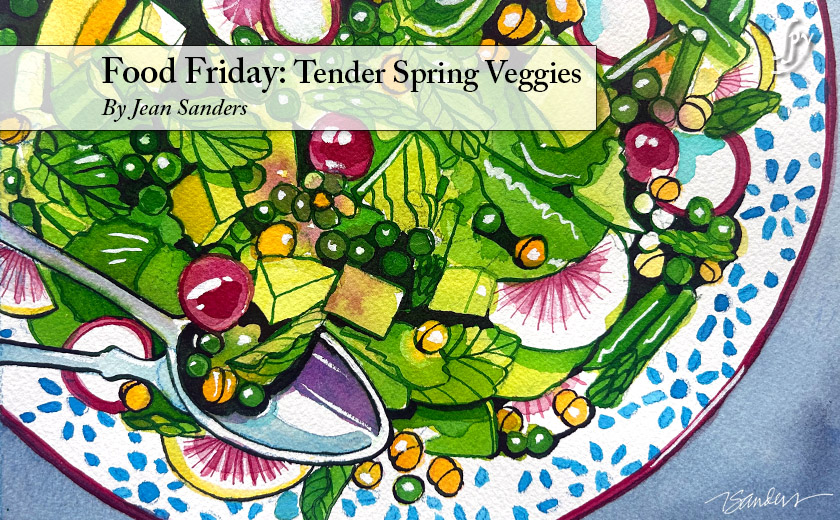
Food Friday:Tender Spring Veggies

April 25, 2025 by Jean Sanders Leave a Comment

May Day is upon us— that should put a spring in your step. I want to retire the crockpot, stash the Dutch oven, put the lasagna pan out to pasture and start digging into light, healthy, crispy fresh green salads. With crusty French bread and sweet butter and a glass or two of cool Chardonnay. In my bare feet. In shorts.
Now is a good time to get outside – whether in your own garden, or wandering around the farmers’ market. Lots of fruits and vegetables are in season again – and we should be supporting our local farmers!
In Season

We have bought four humble tomato plants, and have planted them in the raised garden bed in our side yard. There are a couple of blossoms already, which is nature’s clever way of encouraging us to believe that we will have a bountiful harvest of tomato sandwiches later this summer.

That is always the best part of gardening, seeing everything in my mind’s eye in the gauzy Technicolor future. Somehow there I am always wearing a float-y white outfit as I drop my bountiful harvest into my antique English garden trug, clipping merrily (and with surgical precision) with the vintage secateurs sourced from an obscure French flea market. Reality won’t elbow that fantasy out of my malleable brain for a couple of months…

But back to the matter at hand – salad: as usual, we are hoping that the basil container farm will be busy and bushy this summer, as well as the annual tomato exercise, which I hope won’t wither on their burgeoning vines. We are also considered trying to make our own fresh mozzarella cheese. Maybe it would be easier to just move to Italy. But that depends on the lottery officials, and I am sad to say that we don’t know anyone at the Texas Lottery Commission. Texas Lottery Scandal https://www.cnn.com/2025/04/23/us/texas-lottery-ryan-mindell-resignation/index.html We are just homegrowns.
Tender Green Salad ideas!

This will be perfect for the Friday nights when Chef Tomasso doesn’t want to fire up the oven for our weekly pizza night:

Pizza Salad
Exactly the same way you would choose your pizza toppings, free to add in your favorite toppings INTO the salad to recreate the classic flavors. Use all the extra toppings you love: olives, tuna, capers, meatballs, Nduja, onions, peppers: whatever your go-to pizza order is.

Single serving — you can do the math for more

1/2 small eggplant, diced
Handful of cherry tomatoes
1/2 red pepper
1/2 teaspoon oregano and 1/2 teaspoon garlic powder
Sliced pepperoni – your call
2 slices sourdough bread or day-old French bread, cut into cubes
2 tablespoons grated Parmesan
Handful of torn basil leaves
1/4 cup shredded mozzarella
3 ounces shredded chicken breast (if you are concerned about protein)

Garlic herb dressing
2 tablespoons Greek yogurt
Pinch oregano
Pinch garlic powder
Salt and pepper
1 teaspoon red wine vinegar
Preheat your oven to 400°F.
Toss the diced eggplant, cherry tomatoes, red pepper and pepperoni with oregano, garlic powder and salt. Spread on a baking tray. Roast for 12–15 minutes, until softened, sticky and slightly caramelized.

Scatter the diced bread cubes and a little grating of parmesan over the top, then return to roast for another 4–5 minutes until the croutons are crisp and golden.

While that’s roasting, stir together the yogurt, garlic powder, oregano, vinegar, salt and pepper for the garlic and herb dressing. Add a splash of water if you want a looser consistency.

Once everything is out of the oven, toss with the basil, shredded mozzarella and cooked chicken so the warmth starts to melt everything together. Serve warm with a generous drizzle of dressing. Take a plate, with your glass of Chardonnay, out onto the back porch, and plant yourself in the plastic Adirondack chair. Enjoy a cool Friday night, eating your veggies, smelling the breeze, and enjoying a tasty al fresco meal. Have fun streaking on May Day!

Here is an air fryer version: Pizza Salad with Garlic Herb Dressing

Fancier Salad

“A salad is not a meal. It is a style.”
—Fran Lebowitz


Jean Dixon Sanders has been a painter and graphic designer for the past thirty years. A graduate of Washington College, where she majored in fine art, Jean started her work in design with the Literary House lecture program. The illustrations she contributes to the Spies are done with watercolor, colored pencil and ink.

The Spy Newspapers may periodically employ the assistance of artificial intelligence (AI) to enhance the clarity and accuracy of our content.

Filed Under: 1 Homepage Slider, Food Friday, Spy Journal

  • « Previous Page
  • 1
  • 2
  • 3
  • 4
  • 5
  • 6
  • …
  • 9
  • Next Page »

Copyright © 2026

Affiliated News

  • Chestertown Spy
  • Talbot Spy
  • Cambridge Spy

Sections

  • Sample Page

Spy Community Media

  • Sample Page
  • Subscribe
  • Sample Page

Copyright © 2026 · Spy Community Media Child Theme on Genesis Framework · WordPress · Log in