MENU

Sections

  • Home
  • Education
  • Donate to the Centreville Spy
  • Free Subscription
  • Spy Community Media
    • Chestertown Spy
    • Talbot Spy
    • Cambridge Spy

More

  • Support the Spy
  • About Spy Community Media
  • Advertising with the Spy
  • Subscribe
February 15, 2026

Centreville Spy

Nonpartisan and Education-based News for Centreville

  • Home
  • Education
  • Donate to the Centreville Spy
  • Free Subscription
  • Spy Community Media
    • Chestertown Spy
    • Talbot Spy
    • Cambridge Spy
Arts Looking at the Masters Spy Journal

Looking at the Masters: Hendrick Avercamp

January 23, 2025 by Beverly Hall Smith Leave a Comment

A 17th Century Dutch artist, born in Amsterdam, Hendrick Avercamp (1585-1634) specialized in winter landscapes.  His father Barent Avercamp was the town apothecary of Kempen.  Hendrick was deaf, and he may not have been able to speak. He was known as the Mute of Kampen. He suffered frequent illnesses. Winter landscape became his most popular subject, although he also could paint portraits, and his sketches sold well. He was probably taught to draw and paint by the Flemish artist Gilles Conixloo (1544-1607) and the Dutch artist David Vinckbooms (1576-1632).

“Winter Landscape with Skaters” (1608)

 “Winter Landscape with Skaters” (1608) (30’’x60’’) (Rijks Museum) (oil on wood panel) is thought to be one of the earliest paintings by Avercamp. He enjoyed skating on the winter ice with his parents. The setting is the town of Kampen, with homes, other buildings, and a church. The trees are leafless; the sky is almost as white as the ice, but people are out and about, some at work, while others enjoy games on the ice. Several small boats are ice bound. Kemper was a prosperous town because it was on the trade route between the Rhine River and the Zuiderzee.

The Dutch people were Protestants and the first to believe in education for everyone. They owned their homes and land, worked hard, and prospered. The clothing they wore indicated whether they were on the day at leisure or   working. Throughout the scene well-dressed men and women walk about in groups, engaging in conversation. Others skate or play colf, an early form of golf. A figure near the center of the painting has fallen on the ice. Several horse-drawn sleds provide rides. Typical of Avercamp’s painting, so much is happening.  At the lower left corner is a bird trap, a piece of wood held up by a stick. Tucked in the corner, a dog chews on a dead carcass. At the horizon, and hard to see, are the sails of a ship setting out to sea. The Dutch used landmarks and wind to aid navigation. 

“Winter Scene with Skaters Near a Castle” (1608)

“Winter Scene with Skaters Near a Castle” (1608) (16’’ in diameter) (National Gallery, London), another of Avercamp’s early paintings, depicts a castle as the focal point. Many of the same winter activities are depicted. There is a snowball fight going on at the left, as two young boys, one in a blue top and the other in orange, chase a young girl in the open area of the painting. Birds perch in the branches of the dead tree. 

The winter scenes are attributed to the Little Ice Age, a climate phenomenon that began in the 13th Century and ended in the early 18th Century. Winter came early and lasted well into spring. Heavy snows were frequent. Temperatures during the time of Avercamp’s paintings averaged well below zero.

“Winter Scene on a Canal” (1610)

Avercamp’s “Winter Scene on a Canal” (1610) (20”x36”) (Toledo Museum, Ohio) presents much the same array of people and events. The Toledo Museum closely examined the painting and produced the next three close-up images.

Winter Scene on a Canal” (1610) (detail 1)

In the foreground at the left, the elderly man with the white beard carries a basket. He is warmly wrapped from his head to his heavy pants and thick shoes. A rooster and two hens pick at the ice where feed has been thrown.


#5 Winter Scene on a Canal” (1610) (detail 2)

Along the foreground to the right, three men stand together. One is a fisherman with a net. He has used his axe to cut a hole in the ice. He holds a long spear to reach deep into the water to catch fish, and has a net to keep them in. He talks with a second man. A third man is carrying two baskets.  The two men likely came to buy fish from the first man. Just behind this group is a man colfing.


Winter Scene on a Canal” (1610) (detail 3)

Next to the group of fishermen are two couples in traditional Dutch black clothing. The men’s cloaks reach down to their knees, and the women’s cloaks reach to the ground. The men wear white ruff collars and tall black hats. The men wear wool bouffant knee breeches, both warm and comfortable. Leather boots or hose and shoes complete their attire. The attention of the black dog has been caught by a young lady whose image is found in the full scene.


“Winter Landscape with Flask Players” (1625)

“Winter Landscape with Flask Players” (1625) is a portrait of Averkamp and his brother Lambert as they compete hitting flasks. Both men have dark beards, but we may guess that the artist wears the colorful clothing.  Looking on is a well-known fisherman, in the red hat, and his son. The tools of their trade are the hatchet and a basket to carry the fish. The son carries the net to lift the fish from the water.

Several ships and boats are placed in the background. A consequence of the Little Ice Age, landmarks necessary to carry on trade became harder to find. Sailors’ journals record a sense of placelessness, at times unable to see or sense where they were, where they were going, or how to find home. Their English, French, and Danish rivals were all looking for a trade route to Asia. 

Avercamp’s paintings show the resilience of the Dutch to enjoy, survive, and thrive in difficult times. His paintings, although generally on one theme, were popular. He painted many and he prospered.


Beverly Hall Smith was a professor of art history for 40 years. Since retiring to Chestertown with her husband Kurt in 2014, she has taught art history classes at WC-ALL and the Institute of Adult Learning, Centreville. An artist, she sometimes exhibits work at River Arts. She also paints sets for the Garfield Theater in Chestertown

The Spy Newspapers may periodically employ the assistance of artificial intelligence (AI) to enhance the clarity and accuracy of our content.

Filed Under: Looking at the Masters, Spy Journal

From and Fuller: A Middle East Cease Fire and the Legacy of the Biden Years

January 16, 2025 by Al From and Craig Fuller Leave a Comment

Every Thursday, the Spy hosts a conversation with Al From and Craig Fuller on the most topical political news of the moment.

This week, From and Fuller discuss the political ramifications of the recent agreement between Gaza and Israel for a cease-fire in the Middle East. Al and Craig also trade thoughts about Joe Biden’s four years as president and the legacy he will be leaving.

This video podcast is approximately sixteen minutes in length.

To listen to the audio podcast version, please use this link:

Background

While the Spy’s public affairs mission has always been hyper-local, it has never limited us from covering national, or even international issues, that impact the communities we serve. With that in mind, we were delighted that Al From and Craig Fuller, both highly respected Washington insiders, have agreed to a new Spy video project called “The Analysis of From and Fuller” over the next year.

The Spy and our region are very lucky to have such an accomplished duo volunteer for this experiment. While one is a devoted Democrat and the other a lifetime Republican, both had long careers that sought out the middle ground of the American political spectrum.

Al From, the genius behind the Democratic Leadership Council’s moderate agenda which would eventually lead to the election of Bill Clinton, has never compromised from this middle-of-the-road philosophy. This did not go unnoticed in a party that was moving quickly to the left in the 1980s. Including progressive Howard Dean saying that From’s DLC was the Republican wing of the Democratic Party.

From’s boss, Bill Clinton, had a different perspective. He said it would be hard to think of a single American citizen who, as a private citizen, has had a more positive impact on the progress of American life in the last 25 years than Al From.”

Al now lives in Annapolis and spends his semi-retirement as a board member of the Medill School of Journalism at Northwestern University (his alma mater) and authoring New Democrats and the Return to Power. He also is an adjunct faculty member at Johns Hopkins’ Krieger School and recently agreed to serve on the Annapolis Spy’s Board of Visitors. He is the author of “New Democrats and the Return to Power.”

For Craig Fuller, his moderation in the Republican party was a rare phenomenon. With deep roots in California’s GOP culture of centralism, Fuller, starting with a long history with Ronald Reagan, leading to his appointment as Reagan’s cabinet secretary at the White House, and later as George Bush’s chief-of-staff and presidential campaign manager was known for his instincts to find the middle ground. Even more noted was his reputation of being a nice guy in Washington, a rare characteristic for a successful tenure in the White House.

Craig has called Easton his permanent home for the last eight years, where he now chairs the board of the Chesapeake Bay Maritime Museum and is a former board member of the Academy Art Museum and Benedictine.  He also serves on the Spy’s Board of Visitors and writes an e-newsletter available by clicking on DECADE SEVEN.

With their rich experience and long history of friendship, now joined by their love of the Chesapeake Bay, they have agreed through the magic of Zoom, to talk inside politics and policy with the Spy every Thursday.

The Spy Newspapers may periodically employ the assistance of artificial intelligence (AI) to enhance the clarity and accuracy of our content.

Filed Under: From and Fuller, Spy Highlights, Spy Journal

Chicken Scratch: God freakin’ help you by Elizabeth Beggins

January 10, 2025 by Elizabeth Beggins Leave a Comment

I was at Walmart, at the customer service desk. Two peopl messing with the printer, and a woman helping another customer. The woman had to leave the desk to help a customer out in the store. As she left I heard her say, “God freakin’ help you, hon.”

So, I stood there, with my mouth hanging open, wondering WHY ON EARTH she would say that to me? I know Walmart customer service is often bad, but really? Then I turned to the guy working on the printer and saw his name tag. His name was Godfrey.

For almost a decade, I’ve laughed about this tale which belongs to my friend, Stephanie (shared with permission). We’ve all been there—hearing things that weren’t said, saying things that weren’t meant.Like the night my pseudo sous chef thought I said we were having snake for dinner.Or the story I read about someone asking a new roommate if they enjoyed watching p*rn movies when they were actually asking about foreign (“for’n”) movies. Or the long conversation I had with a woman about her Westy and how much we both loved them. It wasn’t until I told her ours was red that she gave me a funny look. She’d never heard of that color, while I thought of it as common. That was the point when we realized she’d been talking about her West Highland Terrier, and I’d been talking about our old Volkswagen Westfalia. I miss that ride.

Image of a vintage, red camper van

Our beloved (and long gone) Westy

These mix-ups ended with hearty chuckling and some great anecdotes, but can you imagine the seismic shift that might have been provoked with a subtle change in tone?

God freakin’ WHAT??!

Everyday, we stand on countless interpersonal fault lines, babbling Rings of Fire on the brink of conversational disaster. When things get wobbly, most of us manage to keep our shit together—stabilizing, soothing, regrouping. Except when we don’t. Then, shots are fired, and someone ends up getting hurt. Though we can’t predict what another person will bring to a discussion, generally speaking, we know how to play nicely in the sandbox, or how to not run with verbal scissors. It boils down to basic stuff we’ve been taught repeatedly.

Listen more. Talk less. Ask clarifying questions. Choose words thoughtfully.

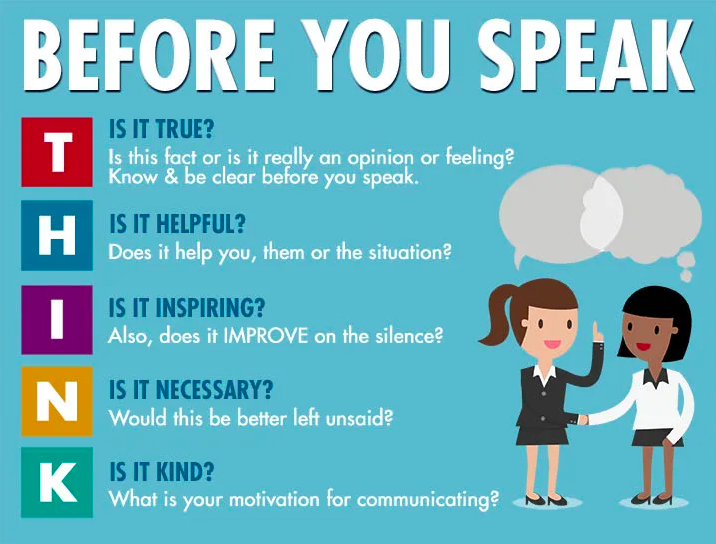
Image of a mnemonic device: Before you speak T.H.I.N.K.

From the Coaching Tools Company

Probably, we heard it first as a short axiom: Think before you speak. More recently, a version called T.H.I.N.K. has surfaced.

  • T = Is it true?
  • H = Is it helpful?
  • I = Is it inspiring?
  • N = Is it necessary?
  • K = Is it kind?

While I haven’t been able to pinpoint when it came into being or who authored it, like its older cousin, it is meant to help us help ourselves, and others by association. The newer one seems to appear most often in educational settings, LinkedIn essays, and Pinterest images. One site calls it an acronym for kinder, more effective communications. I’d argue that it’s more of a mnemonic device than an acronym, but I suppose I shouldn’t be arguing at all, considering. You see how this goes?

In truth, nothing here is new. Tenets very similar to these were set down in a Victorian-era poem in 1872, and in the Buddhist Pali Canon, nearly 2,000 years earlier.

Monks, a statement endowed with five factors is well-spoken, not ill-spoken. It is blameless & unfaulted by knowledgeable people. Which five?

“It is spoken at the right time. It is spoken in truth. It is spoken affectionately. It is spoken beneficially. It is spoken with a mind of good-will.” — Anguttara Nikaya 5.198

Think. Before. You. Speak.

It is a topic I keep coming back to. If practice really did make perfect, I’d be the shiniest, most flawless example of perfection this side of the Mississippi. Maybe both sides. In reality, nothing could be farther from the truth. With greater frequency than I wish, I am a bumbling, fumbling, foot-in-mouthed numpty. And that doesn’t count the times I’ve been utterly unaware of my blunders. I bet my husband could help me tally up some of those. I’m at expert level in the slow learner’s game.

Evidently, holding back on verbal projectiles is a lifelong lesson, for me anyway. But we all know communication can get even messier when we take it to the virtual realm. Though the ‘think first’ principle still applies, the likelihood of flawed interactions increases when we’re on an electronic device. All those typos, the lack of punctuation, disjointed timelines, and anonymity are like dropping a Mark-77 on an arsenal of dormant missiles. It’s called the online disinhibition effect which, in laypeople’s terms, means if I’m communicating through a screen, I’m much more inclined to become an asshat.

In recent past, I found myself immersed in reactions to a post on Civil Discourse with Joyce Vance. One participant took exception to parts of the original essay and to several comments that followed. They shared their disagreements repeatedly. Their name turned up so often that I started to suspect a troll. (Do we still call them that? Or is that disrespectful to trolls? Serious question.)

But there was more to this person. There was evidence of respect. There was an admission of being in post-operative pain. Amid the dissent and cynicism was an earnestness and something that felt like sadness. Several people, who only saw the former, wrote back with sharp, dismissive comments. Others tried to find points of agreement. One respondent stood out from the rest. He noted their shared experience as disabled military veterans and built his remarks from there.

The tone of the disgruntled individual shifted markedly. Finally, someone who understood! Finally, someone willing to notice and connect! The exchange nearly brought me to tears.

Respondent: Look at my profile–disabled vet like you. I “low crawl” in bed every night. I get VA counseling every week to get my head tuned up. I feel the same way you do. I see it coming. I am majorly frustrated by how any veteran or active duty can [believe that way] and how the weapon we used professionally is easily available to anyone. Or how, in a dark future, our active duty brothers and sisters will be deployed against Americans!

Please, please, don’t become a casualty a second time. WE NEED YOU! Pull it together Troop–fall in, the enemy is in the wire!

p.s. I got the cats too. They got me through a year and half total lock-down.

Respondent: Use your anger, man. That’s how I got out of my chair. The batteries are long dead, and the van is gone. I replaced it with a 25 year old pickup that somehow, by God, I get into and out of (but the bed, no way!)

There’s lots of energy in anger. Welcome Home….

Frustrated commenter…what a great couple of replies! Thanks for reminding me of the camaraderie I miss every day.

Perception changes everything. Where we notice value, we direct attention. Where we direct attention, we notice value. This is the symbiosis in civil discourse. This is the genesis of cooperation. This is how we make space for our differences and for what we have in common.

Godfrey can help us.

Image of two hands reaching for each other with sky in the background

Photo by youssef naddam on Unsplash


Elizabeth Beggins is a communications and outreach specialist focused on regional agriculture. She is a former farmer, recovering sailor, and committed over-thinker who appreciates opportunities to kindle conversation and invite connection. On “Chicken Scratch,” a reader-supported digital publication hosted by Substack, she writes non-fiction essays rooted in optimism. To receive her weekly posts and support her work, consider becoming a free or paid subscriber here.

The Spy Newspapers may periodically employ the assistance of artificial intelligence (AI) to enhance the clarity and accuracy of our content.

Filed Under: 3 Top Story, Spy Journal

The Future Of Radio on The Mid-Shore: How one station has provided what was missing

January 8, 2025 by Jason Elias Leave a Comment

The Mid-Shore area has always been an underutilized option for serving the community at large. For the past 30 years, the area was typified by the following stations: WCEI, WCEM, WTDK, and WAAI. WINX serves St. Michaels and Easton and is affiliated with WCEI.

Before the choices were broadened by a rising technology, most of the stations were institutional, all but set in stone and the allegiance was unquestioned.

In the past few years this has all changed with a maverick radio station in the heart of the Mid-Shore leading the charge. It had to happen….

A changing community brings different perspectives as well as expectations. This area is one of the most prosperous in the county and our diversity is growing everyday. That said, radio stations and what they have to offer often don’t reflect that but they will have to, to survive.

During the heyday of terrestrial Mid Shore radio, AC (adult contemporary) was the big genre in the ‘80s and ‘90s in the area, and of course, that made it attractive to certain demographics. In 1990, a town like Easton (the home of WCEI) had the following numbers to work from:

White: 73.1%
African American: 17.2%
Latino 9.8%
Native American: 0.2%
Asian: 2.1%

The median age in America in 1990 was 32. That was the perfect age to local playlists to be mainly AC as songs from the 60s to the ‘90s were on the same playlist.

During their heyday, WCEI and WCEM (which rocked a bit harder) were the go-to stations. WTDK, the Duck played “the oldies” that a station like WCEI only played during the “Oldies Lunch.” WCEI in particular had more interpersonal shifts when the disc jockeys’ distinct personalities, voices  and comments were entertainment in and of themselves.

By the late ‘90s, the AC format fell out of vogue and an aging demographic seemed to turn towards country from the ‘70s to the ‘90s. AC as a radio station format has failed to retain its 25–44 demographic and said simply the world and music styles changed.

By 2000 the numbers in Easton were as follows:

68% White
15% Black
10% Hispanic
2% Asian
4% Other

According to the 2000 demographics, The Mid Shore population started to change after the heyday of AC radio. The majority of the local radio stations acted like business as usual until the conditions became untenable. In a lot of cases, the Mid-Shore community stopped tuning in and consolidation had to be an option.

Since 2018 Draper Media has been scooping up well known stations in the area including WAAI-FM, WTDK-FM and WCEM-FM. Through these ventures, Draper Media often absorbs smaller like minded stations to create a monolithic corporate voice, for better or worse.

If local stations saved from their corporate reward due to consolidation entertaining enough, some stand-alone stations have actually tweaked the local radio paradigm and have created new fans.

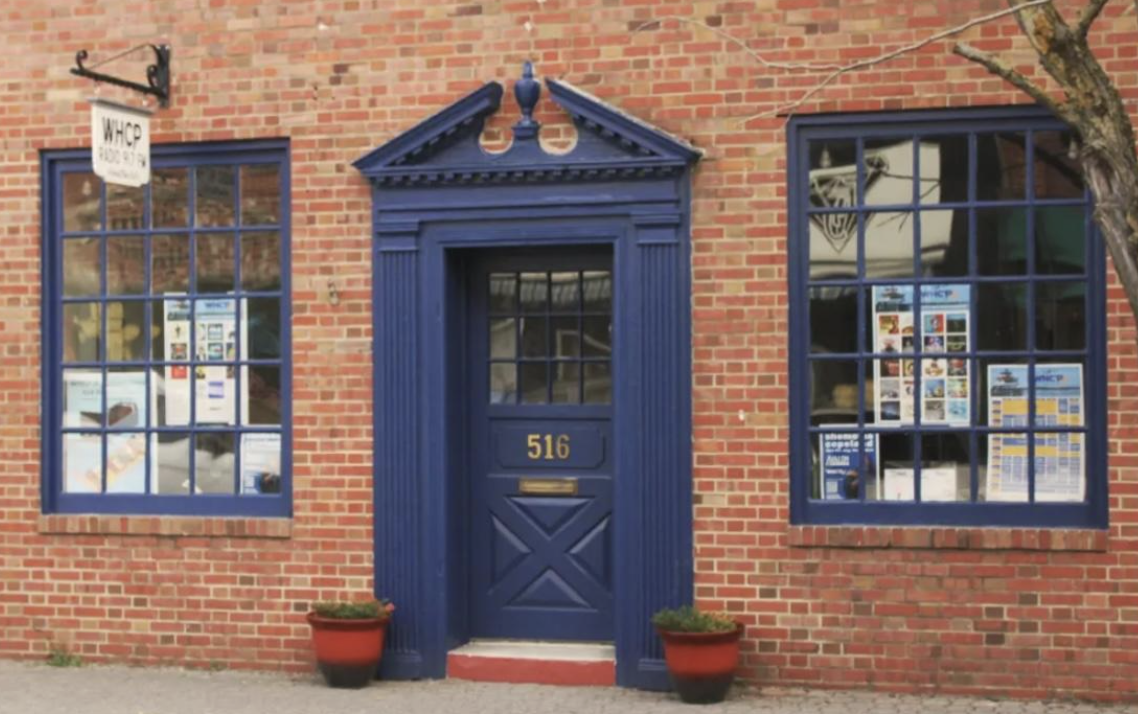
In recent years WHCP has done the impossible, it has survived and become an essential and trusted voice in a short amount of time.

WHCP has been in business since 2015. Station founder Mike Starling worked at NPR in Washington, DC. Among his achievements are being named VP at NPR and later CTO. Throughout his career Starling gained a lot of knowledge working at the local and national level of radio. WHCP at its best offers that and more to its listeners.

The WHCP-FM 91.7 which used to be (WHCP-LP 1o1.5) started out as a 71 watt enterprise reaching a total of 10,000 people in the Mid Shore area. In 2022 WHCP got a FCC license and got the signal boosted to 14,000 watts. In comparison, WCEI has 12,000 and WCEM has 6,000.

Even at its WHCP has also practiced a lot of the eclectic sensibilities that are inherent in the region that other stations have ignored.

WHCP has content from NPR, freer playlists, podcasts, podcast like chats and discussions about local events and people. It’s not afraid to alienate a “monolithic” and most likely imaginary group of listeners.

In an era when a DJ’s voice and musical imprint has disappeared from a shift, WHCP is the opposite of that.

WHCP has shows including Lady Spins The Blues with Dr. Donna, The Morning Groove with Shane Walker, and R&B, Neo Soul, and Smooth Jazz sets with DJ Kurt Kut.

Woman Wattage with Anne Watts is another popular show and WHCP also plays the late Bill Wright’s Roadtrippin’ programs.The political commentary of the Spy’s From and Fuller and Well-known Spy writer Laura Oliver’s How The Story Goes is another regular feature.

WHCP’s flagship office is based in Cambridge, and it also has an office in Easton, another town that is changing by the minute. In the meantime, WHCP is raising the challenge of serving all segments of the Mid-Shore population. This is the lay of the land according to the 2024 census:

Cambridge

44.2% Black
38.7% White
7.5% Latino
2.1% Asian

Easton’s changes were similar:

73.1% White
17.2% African American
9.8% Hispanic or Latino
2.1% Asian

In recent years, a lot of the aforementioned Mid-Shore radio stations have also had a presence on the internet. Its Yourz Radio is an internet station that has been in business since 2015 and offers hip-hop, R&B, boom bap, classic soul and interviews.

All of those mentioned above well-known local AC and country stations have an internet presence, but WHCP’s app, accessibility, and streaming make it truly set for the times.

The Mid-Shore’s audiences have often been neglected and undervalued. The good news is that the times are changing, and all of our voices are beginning to be heard.

Jason Elias is a pop culture historian and music journalist

The Spy Newspapers may periodically employ the assistance of artificial intelligence (AI) to enhance the clarity and accuracy of our content.

Filed Under: 1 Homepage Slider, Spy Journal

Food Friday: 2025

January 3, 2025 by Jean Sanders Leave a Comment

Happy New Year, gentle Spy readers! I’m feeling optimistic about the upcoming year. I should probably check back in about three months to see how these new 2025 rules of austerity are still ringing true. It’s easy today, three days into the new year to be proud of my new approach to life. But as my daughter, has observed, sagely, that all this adulting is hard work.

Luke, the wonder dog, and I have started taking two walks every weekday. It’s been easy, so far. Sure, it’s been chilly in the mornings, but bright and sunny in the afternoons. I’d like to maintain the idealistic goal of 10,000 steps a day, and so far, every day this week we have been successful. I don’t know what we will do on a rainy day, though. Luke hates to get his feet wet in the rain. Never mind that he loves pools, oceans, and rivers. No; he does not like to go out in the rain. I’ll have to leave him here while I go off trekking, virtuously.

Dry January is a little trickier. This is the fifth year that Mr. Sanders and I have participated in Dry January – no alcohol for the month. We didn’t realize how much we like that glass of cheap white wine when he comes home at night, or choosing the right wine to pair with Friday Night Pizza. This abstinence is good for the liver, pocketbook and waistband. Christmas foods included inhaling city blocks of crème pâtissière in the Christmas cream puffs, I gobbled acres of homemade peppermint bark. Plus a whole flock of Champagne; some really nice Veuve Clicquot Rosé, too. Diet-wise, it has been an excellent New Year, so far. Yes, these are the early days. I know.

My dentist is sangfroid and easy-going. She is just pleased that I wander through every year. Her martinet of a dental hygienist is another story. Every 6 months I get Miss Trunchbull’s soul-crushing assessment. She knows that I don’t floss each bloody night. Not so in 2025! 2 for 2! So far! And I replaced the head of my electric toothbrush on January 1. Who says I am not serious about oral hygiene?

Santa brought me a nice pile of books that I haven’t been able to find at the library, so I will not be indulging in any impulse buys on Abebooks for a few months. I have even tidied up the stack of waiting books on my bedside table. New among the dusty pile are: Lives of the Wives by Carmela Ciuraru, Good Material by Dolly Alderton, Lethal White by Robert Galbraith, and Secret Ingredients | The New Yorker Book of Food and Drink Books, murder, food, literary gossip, food stories and more.

Which brings us to the kitchen. For the most part our kitchen is fairly well organized. There are drawers dedicated to potholders and trivets, rolls of aluminum foil, parchment paper, and waxed paper. A drawer for baking tools: cookie cutters, measuring spoons and cups, offset spatulas and icing bags. A drawer for tea towels, another for silverware, one for matches, straws, razor blades, twist ties, and other rarefied junk. There is just one for all the key cooking utensils. Mr. Sanders and I have a lot of repeat items. There are two turners I like, thin and sleek and metal. He prefers a of clunky, unattractive black OXO silicone pancake turner. I like an old fashioned, easy-peasy cork screw – he likes a fancy battery powered one. (Luckily that isn’t an issue this month!)

We have two sets of indoor cooking tongs, and an outsized pair for outdoors. We have cheese graters, micro-planers and a nutmeg grater. We are down to one garlic press, and one can opener. Several slotted spoons. Lots of mismatched heirloom sterling serving pieces. A basting brush. Two cooking forks we got from our mothers when we each set off for college, that are exact matches, which makes us suspect they were acquired through the assiduous application of child labor pasting S&H Green Stamps into books, as we both have vague recollections of being waylaid as tots…

My New Year character improvement will include organizing this shambles of a kitchen drawer. Wish me luck. Luke says it is going to rain this weekend. Happy 2025!

“One of the advantages of being disorderly is that one is constantly making exciting discoveries.”

-A.A. Milne


Jean Dixon Sanders has been a painter and graphic designer for the past thirty years. A graduate of Washington College, where she majored in fine art, Jean started her work in design with the Literary House lecture program. The illustrations she contributes to the Spies are done with watercolor, colored pencil and ink.

The Spy Newspapers may periodically employ the assistance of artificial intelligence (AI) to enhance the clarity and accuracy of our content.

Filed Under: 1 Homepage Slider, Food Friday, Spy Journal

Looking at the Masters: A Victorian Christmas

December 19, 2024 by Beverly Hall Smith Leave a Comment

Christmas traditions we cherish were established during Queen Victoria’s reign (1837-1901).  Others are as old as the ancient Roman Saturnalia celebration held on December 17, still others were traditions from the time of the Tudors. Decorating Christmas trees was one of the earliest and most important traditions.  Germans brought cut fir branches into the house for their wonderful scent. Queen Charlotte (1744-1818) of Germany, who married George the III of England in 1760, was known by 1800 to decorate fir branches in the Queen’s Lodge at Windsor. These decorations may or may not have been complete trees. The British public was not yet aware of this practice.


“Christmas with Queen Victoria and Prince Albert” (1848)

When Prince Albert of Germany married Victoria, he decorated a full tree. “Christmas with Queen Victoria and Prince Albert” (1848), was published in the Illustrated London News, and everyone emulated the Queen. By the end of the century, the Christmas tree had become one of the most important elements of the Christmas celebration. The wood-engraving by Joseph Lionel Williams is a depiction of Victoria and Albert standing by a table that holds a decorated tree and hand-made wood figures. Five of their girls look on with pleasure. The tree is decorated with lighted candles and hanging from it are highly decorated packages and an assortment of Christmas treats. The rich and the poor of England were able to decorate their trees with paper wrapped treats. 


“First Christmas Card” (1843)

The decoration of a Christmas tree was only one of the new elements added to the celebration of Christmas. Sir Henry Cole, the first director of the South Kensington Museum, was too late to write his usual Christmas letter, and he commissioned artist John Calcott Horsley (1817-1903), a member of the Royal Academy, to design somethings for him to send. “First Christmas Card” (1843) depicts a merry middle-class family raising a glass to toast everyone as they sit down to a sumptuous Christmas dinner. A wooden grape arbor frames this central scene. At one side a poor man and his family share a meal. At the opposite side, charity is shown to a woman holding her baby. The spirit of Christmas is shared by all. 

Sending Christmas cards became popular. Victoria encouraged her children to make cards, and poor children also began to make cards. Cole had1000 cards printed, and he sold those he did not send. The first illustrated newspaper was published by 1842, and the first printed books were available by 1863, among them was Dickens’s very popular A Christmas Carol. Advances in the printing industry included the ability to print hand-colored lithographs, and then machine-colored ones. The mass sprinting of wrapping paper, cards, books, and newspapers all became possible during the time. 

“Buying Mistletoe” (1850)

Mistletoe became popular in Victorian households by the 1870s. The green leaves and white berries were symbolic of fertility and romance. The berries represented male fertility. The Romans regarded mistletoe as symbolic of peace and love, and it was hung over doorways to protect the household. Druids and Celts also decorated with mistletoe since it was native to the British Isles and to Europe.  “Buying Mistletoe” (1850), a Victorian print, shows a middle-class woman and her daughter purchasing mistletoe from a girl in the woods. Mistletoe is a parasite that grows on the tops of trees and remains green and white throughout the winter months. Popular with the serving-class, mistletoe became popular because it was possible for any man to kiss a girl under it. If the girl refused, she would have bad luck in finding a husband the following year.

“Pulling Christmas Crackers”

Christmas Crackers were invented by Tom Smith sometime between 1845 and 1850. On a visit to Paris in 1840, he saw French bon bons made of sugared almonds wrapped in a paper twist. He brought the idea back to London. He made and tried to sell bon bons that included a message wrapped with the candy. They did not sell. As he sat by a fire, the idea came to add noise to the candy. He bought a recipe for fireworks that would make a small bang. He added a cardboard tube, a strip of paper treated with a small amount of gunpowder, a short sentiment, usually a joke, and some type of paper crown or hat. When both ends of the cracker were pulled, the strip of paper ignited the gun powder. He named them “Bangs of Expectation.” They delighted young and old. 


“By Royal Warrants Tom Smith’s Illustrated Catalogue of Christmas Novelties”

The Tom Smith company expanded its Christmas Novelties collection. It was appointed by the Queen in 1847 to be the official supplier of crackers and wrapping paper 

“Children Singing Christmas Carols” (1886)

The book Christmas Carols New and Old, by Henry Ramsden Bramley and Sir John Stainer, was published in 1871. “Children Singing Christmas Carols” (1886), a Christmas carol book for children, was published by Ward Lock and Company. Various artists illustrated the book. Victorian caroling originally was called wassailing, the word meaning be well and in good health. Carolers went about the town singing and receiving cups of wassail, a hot spicey drink, for their efforts. In later years, carolers received gifts they then distributed to the poor. 

Singing songs and dancing in a circle in Europe is thousands of years old. Saturnalia is just one of the origins. The word carole is French.  Carols were written for all four seasons. Christians in Rome sang them in Latin. The carols were not popular since most people did not understand the words. St Francis of Assisi wanted Christmas songs to be sung in native languages. He also introduced pageants. Christmas carols were first introduced to England in 1426 by a Shropshire chaplain. During the age of Cromwell and Puritanism, Christmas caroling was considered pagan, and the practice was outlawed. Caroling was revived in 1880, and new carols were written, such as “Good King Wenceslas,” “God Rest Ye Merry Gentlemen,” and “We Three Kings of Orient Are.”

WASSAIL!


Beverly Hall Smith was a professor of art history for 40 years. Since retiring to Chestertown with her husband Kurt in 2014, she has taught art history classes at WC-ALL and the Institute of Adult Learning, Centreville. An artist, she sometimes exhibits work at River Arts. She also paints sets for the Garfield Theater in Chestertown.

The Spy Newspapers may periodically employ the assistance of artificial intelligence (AI) to enhance the clarity and accuracy of our content.

Filed Under: Looking at the Masters, Spy Journal

Chicken Scratch: All the Way In and Back Out Again by Elizabeth Beggins

December 17, 2024 by Elizabeth Beggins Leave a Comment

“I stand at the window looking out, trying to remember the truths that nature always brings home. That what lies before me is not all there is. That time is ever passing, and not only when I notice. That strife and pain are no more unexpected than pleasure and joy. That merely by breathing I belong to the eternal.”

― Margaret Renkl, The Comfort of Crows: A Backyard Year


This time, the weather gods mean business.

At least twice already, we harvested what we thought was the last of the fragrant and flavorful bounty of summer, only to find the host plants still upright and serviceable the next morning. But this time, the forecast leaves no room for doubt.

In anticipation, we dismantle the vegetable plots, cutting away strappy vines and woody sprigs, stacking wire cages, setting aside to save tomatoes of any appreciable size, in hopes of future ripening. Even plucked green, homegrown fruits have more potential than the road-weary options at the store. Or, we tell ourselves they do, which might be more important.

We snip incandescent marigold blossoms from weary stems, leaving some petals behind as an offering, bringing some inside to dry. Poor man’s saffron they call it, but it feels rich to me.

A fresh collection of marigold petals

After dodging a full blown freeze right up to the cusp of December, it finally arrives and unburdens itself all over everything. Begonia melts, colocasia slumps, trailing tradescantia flops in a flaccid mess. The fig, which only a day before clung resolutely to its frock, denudes itself in real time, leaves letting go like skydivers.

I’ve always been reluctant to transition my gardens from one season to the next, but it grew more noticeable when weekly market sales were no longer a driver. Professionals swap out plants proactively, knowing one is about to become less productive. The farmer can’t afford to wait until the current crop is completely spent before replacing it. She is an editor with a red pen and a looming deadline.

I’m fine with eliminating plants that have produced their last. But these days, and this day, as any day when I am in command of such life-reducing decisions, I feel twinges of guilt for ripping out these beating hearts. To compensate, I give thanks. For real. I say, “Thank you, tomatoes. Thank you, marigolds.” I follow with something truthful about how hard they’ve worked, how much they’ve provided, the elegance or ease they’ve added to my days. It is a gratitude practice that transports me from myopia to interconnection. I need it.

Creative inspiration from a few of the non-humans I coexist with

Once the space is clear, I’m able to embrace the full potential of this seasonal evolution. My husband fills the area with leaves, a father zipping up his child’s coat on a blustery day, to insulate the exposed earth from the ravages of wind and rain. Soil is the lifeblood of the garden, and we are determined to protect it.

Determination and protection are words I hear a lot right now, in the context of warding off political and cultural changes that feel threatening. The world is in turmoil and we, its human inhabitants, are both cause and cure. Resistance, we’re told, is imperative.

What we’re not told is the shape that resistance is meant to take or how we’re supposed to manifest it. How we do what we’re told we must do is entirely up to us, an opportunity for agency, and no great surprise that every process looks different. Some are leaving swords where they lie, some, while going it alone, are forging connection.

I’ve heard some people say, recently, that they’re practicing self-care as an act of resistance, as if they must maintain the pretense of fighting while they’re struggling to regroup. Friends, most of us don’t need permission to breathe all the way in and back out again. Please, practice self-care for its own sake. Dread is our constant companion, but so is delight. I can think of nothing more transformative than finding new ways to flourish, despite the times.

After the freeze, early December 2024

For me, the natural world offers guidance. Just look at it! Freed, for a time, from doing anything obvious, the garden is, nonetheless, engaged. It’s protecting an army of living creatures right where it is. It’s rebuilding from the long growing season, using the resources it has available. What it produced in its active phase continues to provide physical and emotional energy now.

The last few mornings, I’ve carried a kettle of boiling water outside to mix into the frozen bird baths I’ll maintain as best I can this winter. As I take in the garden, like the friend that it is, I don’t see resistance. What I see is resilience.

Bounty!

Elizabeth Beggins is a communications and outreach specialist focused on regional agriculture. She is a former farmer, recovering sailor, and committed over-thinker who appreciates opportunities to kindle conversation and invite connection. On “Chicken Scratch,” a reader-supported digital publication hosted by Substack, she writes non-fiction essays rooted in optimism. To receive her weekly posts and support her work, consider becoming a free or paid subscriber here.

The Spy Newspapers may periodically employ the assistance of artificial intelligence (AI) to enhance the clarity and accuracy of our content.

Filed Under: 3 Top Story, Spy Journal

Food Friday: ‘Tis cookie season!

December 6, 2024 by Jean Sanders Leave a Comment

I am thinking about the Christmas cookies I am going to bake to mail to our far-flung friends and family, and some more to give to the neighbors, and the letter carrier – not to mention even more for our personal consumption.

I like to send cookies that will evoke memories, like Proust’s madeleines, but without a multi-volume opus. Last year, just before Thanksgiving, I sent my brother a box of home-baked gingersnaps, which remind us of our mother. Store-bought gingersnaps are never as poignant, or as crisp and aromatic. He said he sat down, poured a big glass of cold milk, and immediately scarfed down three cookies. When was the last time that you ate three cookies without feeling guilt? As long as Mom kept pulling sheets of hot cookies out of the oven on cold winter afternoons, we would gobble fresh gingersnaps. Not delicate, mincing, lady-like nibbles; full-throated, passionate chomps of warm molasses-infused, sugar-crusted, pliant discs of deliciousness. Dinosaur-sized bites. Yumsters.

Gingersnaps have a spicy holiday smell that propels us back through time to our mother’s kitchen. We all crowded at the kitchen table, taking turns cracking eggs, mixing the cookie dough, rolling the dough balls in small bowls of sugar. I stood on the red wood step stool, so I could get right into the thick of the baking. I am sure I was very helpful.

Gingersnaps are dependable taste treats. They taste deelish warm from the oven, cold in a lunch bag, and even pretty good, when they are stale. Gingersnaps in a sack at the grocery store are also pretty good, in a pinch. But these are so easy to make, and so kid-friendly, that you should just bake some yourself. These are simple, round and wholesome. Live a little. Christmas is coming!

Gingersnap Cookies:
3/4 cup unsalted butter, room temp
1/2 cup dark brown sugar (pack it into the measuring cup)
1/2 cup granulated sugar
1/4 cup molasses (oil the measuring cup first, or spray a little Pam – otherwise you will be washing that cup forever, when you could be conducting cookie taste tests)
1 large egg
1/2 teaspoon pure vanilla extract
2 cups all purpose flour
1/2 teaspoon baking soda
1/4 teaspoon salt
1 1/2 teaspoons ground cinnamon
2 teaspoons ground ginger
1/2 teaspoon ground cloves
For dusting the cookies:
1 cup granulated white sugar

Preheat the oven to 350°F. Line baking sheets with parchment paper. Beat the butter and sugars until light and fluffy, I use an electric mixer. Add the molasses, egg, and vanilla extract and beat until well-mixed. In a separate bowl whisk together the flour, baking soda, salt, and spices. Add the flour mixture to the butter mixture and mix well. Cover the bowl with Saran Wrap and chill it in the fridge for about half an hour, until it is firm.

Fill a little dish with the cup (or thereabouts) of granulated sugar. When the dough is nice and chilly, roll it into 1-inch balls. Then drop and roll the dough balls in the sugar, this is the best point for expecting kid interaction and assistance. Put the dough balls on the baking sheets, and use a small flat-bottomed glass to flatten the cookies. Sometimes you will need to dip the glass back into the sugar to get the right amount of crunchy, sugary goodness. Do not squash them too thin, or the cookies will get too dark and brittle. Bake for about 12 – 15 minutes. Cool on a wire rack. You can also use a small ice cream scoop, instead of making the balls by hand, but really, where is the fun in that?

I always get too ambitious, and think that I will tirelessly bake batches and batches of adorable Christmas cookies. I have such an amusing interior life! In real life I will be exhausted after 2 batches of dough, and ready to sit down to sample the wares. There are no children here at home now, just Mr. Sanders and me, and Luke the wonder dog. And yet I believe that I must be preparing for the competitive Annual Sewall’s Point Cookie Swap, or Ms. Backnick’s Fourth Grade Holiday Party for Thirty Children. It might be time to cut back. So we will not be baking fancy schmancy Madelines, or profiteroles, or croquembouche in the Spy Test Kitchens this year. We will be sticking to the tried and true, our favorite Cookies of Christmases Past

On the other hand, there is a valid case to be made for store-bought cookies. We ran through a Trader Joe’s on our Thanksgiving trip. You could make a feast that Charlie Bucket would yearn for with all the cookies and sweets available at Trader Joe’s: Peppermint Meringues, Dark Chocolate Covered Peppermint Joe Joe’s, Ginger Cookie Thins, Lebkuchen cookies, Mini Gingerbread People, Decked Out Tree Cookies and and all that Peppermint Bark. It is good for my waistline that we live two hours away from Trader Joe’s, and I have to rely on my own baking skills. If you live near a nice bakery, consider yourself lucky, and try to buy local and support small businesses. We are rationing the Dark Peppermint Joe Joes, and only treat ourselves to one a day. I am sorry, but Mr. Sanders and I will not be sharing. We even hid them from our grandchildren at Thanksgiving. Shhh!

I always admire the folks who find all the cute baking supplies. I love the fluted paper, the shiny cellophane, dragées and colorful sprinkles, hundreds and thousands nonpareils, and seasonal glittering sugars. Nowadays you can find everything you want by way of cookie decorating supplies at Amazon – which makes the “seamless process” completely devoid of romance. But there you have it – plain, beige, prosaic practicality: Cookie Supplies

Food52, which will never steer your wrong, has Bazillions of Cookie Recipes.

Martha will drive you nuts with her perfectionism, and you will undoubtedly have the prettiest cookies at the Cookie Swap Have you watched the Martha documentary yet? You should: MARTHA

Don’t worry if you haven’t the energy for baking this year; it’s been a tough year. Rummage around for an old pan and fill it with water, orange slices, cranberries, cinnamon and cloves. I like to keep a little potpourri pot boiling away on the back of the stove during December. The house smells lovely, and you can imagine your favorite fictional cook baking up some magic: Mrs. Weasley or Marmee, Mary Poppins or Hannah Gruen. Simple homemade magic. Potpourri

“Childhood is measured out by sounds and smells and sights, before the dark hour of reason grows.”
—John Betjeman


Jean Dixon Sanders has been a painter and graphic designer for the past thirty years. A graduate of Washington College, where she majored in fine art, Jean started her work in design with the Literary House lecture program. The illustrations she contributes to the Spies are done with watercolor, colored pencil and ink.

The Spy Newspapers may periodically employ the assistance of artificial intelligence (AI) to enhance the clarity and accuracy of our content.

Filed Under: 1 Homepage Slider, Food Friday, Spy Journal

Looking at the Masters: A Christmas Carol

December 5, 2024 by Beverly Hall Smith Leave a Comment

A Christmas Carol (1843) (title page of first edition)

Charles Dickens’s A Christmas Carol was published by Chapman and Hall in London in1843. The first illustrator John Leech created four hand-colored etched plates and four black and white wood engravings. His first illustration was “Mr. Fezziwig’s Ball” from Ebenezer Scrooge’s early life when he was in love and happy. By Christmas Eve, the first edition of 6000 books had sold out. Two new editions were sold out by the New Year. The story has never been out of print. The celebration of Christmas grew in popularity, and the Victorians developed new traditions.

Leech’s etching, the first appearance of the Ghost of Christmas Past, shows the jolly and rotund Mr. and Mrs. Fezziwig leading the dance. Fezziwig’s annual Christmas parties were famous. Known for his generosity and kindness, Fezziwig has provided a feast for all. A fiddler plays music from the balcony. Fezziwig’s elderly mother sits with some children and smiles at the joyous occasion. A young couple enjoy a kiss under the mistletoe. Holly hangs    from the ceiling. 

”Marley’s Ghost” (1843)

In “Marley’s Ghost” (1843), Scrooge’s former partner who has just died is an unexpected visitor on Christmas Eve. Dressed in his burial clothes, Marley drags chains and weights, the penance for his sins. Scrooge, in his nightclothes, sits near a small fire, eating a meager dinner. Only one candle lights the room. Leech has depicted the candle flame as a ghostly light. Marley warns Scrooge of the sins they both have committed in their business, and he forecasts the arrival of three spirits that will visit before Christmas Day. Scrooge must mend his cruel and miserly ways, or he will end up like Marley.

The Ghost of Christmas Present” (1843)

Leech draws upon the popular image of Father Christmas for “The Ghost of Christmas Present” (1843). He wears a dark green robe with white fur collar and sleeves. The room is filled with hanging greens. His torch and the fire provide light and warmth. His robe does not cover his chest, and his feet are bare. He wears a holly wreath decorated with mistletoe atop his curly brown hair. Around his throne are a rabbit, plum pudding, sausages, hams, and assorted other meats. He has a bowl of warm punch ready to share with Scrooge. He says to Scrooge, “Come in! Come in! and know me better, man.” He smiles, his eyes twinkle, and his voice is welcoming. 

This image is one of the most popular in the story. The Spirit introduced Scrooge to another world. They first visit a flourishing market, where the rich are purchasing provisions for their feasts. The Spirit then takes Scrooge to a poor man’s house, and then to the home of his nephew, Fred. Every year the kindly nephew invites Scrooge to the party, but he never attends. They visit the home of Bob Cratchit, Scrooge’s poor clerk. Scrooge learns about tiny Tim and that he will not live long. The Ghost repeated Scrooge’s own words to him, “If he be like to die, he had better do it, and decrease the surplus population.”

“Ignorance and Want” (1843)

The theme of the woodcut “Ignorance and Want” (1843) was for Dickens a main element in A Christmas Carol. The Spirit shows Scrooge two starving, and poor children. Scrooge asks, “Spirit, are they yours?” “They are Man’s,” said the Spirit, looking down upon them. “And they cling to me, appealing from their fathers. This boy is Ignorance. This girl is Want. Beware them both, and all of their degree, but most of all beware this boy, for on his brow I see that written which is Doom, unless the writing be erased. Deny it!  Slander those who tell it ye! Admit it for your factious purposes, and make it worse. And bide the end!” “Have they no refuge or resources?” cried Scrooge. “Are there no prisons?” said the Spirit, turning on Scrooge for the last time with his own words. “Are there no workhouses?”

Dickens was born into the middle class. His father was a spend-thrift. He squandered the family money and was committed to debtor’s prison. Dickens was forced to sell everything. His interest in the poor was established as a result, and he visited several locations where children were forced to work in intolerable conditions. He intended A Christmas Carol to send a moral message and to expose the dire circumstances created by the Industrial Revolution. He wrote letters, gave speeches, and fought to address the deplorable conditions of children in as many ways as he found possible.

“Bob Cratchit and tiny Tim” (1878)

Dickens enlisted artists to create additional images for the early publications of A Christmas Carol.  The black and white illustrations by Fred Barnard (1846-1896) are thought to be superior to the work by earlier artists. Barnard called himself the Charles Dickens among illustrators. “Bob Cratchit and tiny Tim” (1878) was another of the popular Dickens’s images. Bob Cratchit carried tiny Tim all over town, but particularly to church. His devotion to Tim was noted by everyone, young and old, rich and poor. A young boy with his dog delivers a large platter with the Christmas bird. A wealthy woman looks askance at the poor old woman. Her well-dressed daughter looks at an urchin who reaches out her hand. The young girl discretely hands the poor child a coin. The city of London is the backdrop. The distant clock tower resembles Big Ben.

“The Last of the Spirits, The Pointing Finger” (1843)

In Leech’s “The Last of the Spirits, The Pointing Finger” (1843), the Spirit 

of Christmas Present takes Scrooge to a graveyard. Scrooge implores, “Before I draw nearer to that stone to which you point, answer me one question. Are these the shadows of the things that Will be, or they the shadows of things that May be, only?” The Ghost points downward to the grave. Scrooge responds, “Men’s courses will fore-shadow certain ends, to which, if persevered in, they may lead. But if the courses be departed from, the end will change. Say it is thus with what you will show me!” Dickens wrote, “Scrooge crept toward it, trembling as he went, and followed the finger, read upon the stone of neglected grave his own name. EBENEZER SCROOGE 

“Cratchit and the Christmas Bowl” (1843)

Leech’s illustration “Cratchit and the Christmas Bowl” (1843) presents a changed Scrooge. He shares a drink with Bob Cratchit. Dicken’s text reads: “A merry Christmas, Bob! said Scrooge, with an earnestness that could not be mistaken, as he clapped him on the back. A merrier Christmas, Bob, my good fellow, than I have given you for many a year! I’ll raise your salary, and endeavor to assist your struggling family, and we will discuss your affairs this very afternoon, over a Christmas bowl of smoking bishop, Bob! Make up the fires, and buy another coal-shuttle before you dot another i, Bob Cratchit!” 

Have a Dickens of a Christmas


Note: Quotated material is drawn from Charles Dickens’s A Christmas Carol. 

1 Samuel 7, during the end of the time of the judges, Israel experiences revival under the leadership of Samuel. The nation repents of their sin, destroys their idols, and begins to seek the Lord (1 Samuel 7:2–4). Samuel gathered the people at Mizpah where they confessed their sin, and Samuel offered a sacrifice on their behalf (verses 5–9). (1 Samuel 7:13–14). To commemorate the divine victory, “Samuel took a stone and set it up between Mizpah and Shen. He named it Ebenezer, saying, ‘Thus far the LORD has helped us’” (verse 12). Ebenezer means “stone of help.” From then on, every time an Israelite saw the stone erected by Samuel, he would have a tangible reminder of the Lord’s power and protection. The “stone of help” marked the spot where the enemy had been routed and God’s promise to bless His repentant people had been honored. The Lord had helped them, all the way to Ebenezer.


Beverly Hall Smith was a professor of art history for 40 years. Since retiring to Chestertown with her husband Kurt in 2014, she has taught art history classes at WC-ALL and the Institute of Adult Learning, Centreville. An artist, she sometimes exhibits work at River Arts. She also paints sets for the Garfield Theater in Chestertown.

The Spy Newspapers may periodically employ the assistance of artificial intelligence (AI) to enhance the clarity and accuracy of our content.

Filed Under: Looking at the Masters, Spy Journal

Food Friday: Re-eating History

November 29, 2024 by Jean Sanders Leave a Comment

This is a repeat of our almost-annual Food Friday Thanksgiving column, because we are still trying to recover from yesterday’s holiday feast. NPR still has Susan Stamberg’s Cranberry Relish recipe. Somewhere on the internet yesterday you heard Arlo Guthrie singing Alice’s Restaurant for the 57th year. (Farewell, Alice. “And flights of angels sing thee to thy rest”.) The Spy’s Gentle Readers get to enjoy the annual rite of leftovers as engineered when my son was in college. In in these fraught post-COVID times it feels reassuring to remind ourselves of the simpler times. Here’s a wish for a happier, kinder world next Thanksgiving!

And here we are, the day after Thanksgiving. Post-parade, post-football, post-feast. Also post-washing up. Heavens to Betsy, what a lot of cleaning up there was. And the fridge is packed with mysterious little bundles of leftovers. We continue to give thanks that our visiting college student is an incessant omnivore. He will plow systematically through Baggies of baked goods, tin-foiled-turkey bits, Saran-wrapped-celery, Tupperware-d tomatoes and wax-papered-walnuts.

It was not until the Tall One was in high school that these abilities were honed and refined with ambitious ardor. His healthy personal philosophy is, “Waste not, want not.” A sentiment I hope comes from generations of hardy New Englanders as they plowed their rocky fields, dreaming of candlelit feasts and the TikTok stars of the future.

I have watched towers of food rise from his plate as he constructs interesting arrangements of sweet, sour, crunchy and umami items with the same deliberation and concentration once directed toward Lego projects. And I am thankful that few of these will fall to the floor and get walked over in the dark. Of course, now there is the wonder dog, Luke, so nothing much makes it to the floor.

I have read that there may have been swan at the first Thanksgiving. How very sad. I have no emotional commitment to turkeys, and I firmly belief that as beautiful as they are, swans are mean and would probably peck my eyes out if I didn’t feed them every scrap of bread in the house. Which means The Tall One would go hungry. It is a veritable conundrum.

The Pilgrim Sandwich is the Tall One’s magnum opus. It is his turducken without the histrionics. It is a smorgasbord without the Swedish chef. It is truly why we celebrate Thanksgiving. But there are some other opinions out there in Food Land.

This is way too fancy and cloying with fussy elements – olive oil for a turkey sandwich? Hardly. You have to use what is on hand from the most recent Thanksgiving meal – to go out to buy extra rolls is to break the unwritten rules of the universe. There are plenty of Parker House rolls in your bread box right this minute – go use them up!

This is a recipe for simpletons. Honestly. And was there Muenster cheese on the dining room table yesterday? I think not.
Pilgrim Sandwiches

And if you are grown up and sophisticated, here is the answer for you. Fancy Thanksgiving leftovers for a grown up brunch: After Thanksgiving Brunch

Here are The Tall One’s ingredients for his signature Pilgrim Sandwich:
Toast (2 slices)
Turkey (2 slices)
Cranberry Sauce (2 teaspoons)
Gravy (2 tablespoons)
Mashed Potatoes (2 tablespoons)
Stuffing (2 tablespoons)
Barbecue Sauce (you can never have too much)
Bacon (if there is some hanging around)
Mayonnaise (if you must)
Lettuce (iceberg, for the crunch)
Celery stalk (more crunch)
Salt, pepper
A side bowl of potato chips

And now I am taking the dog for a walk before I consider making my own sandwich.

“Leftovers in their less visible form are called memories. Stored in the refrigerator of the mind and the cupboard of the heart.”
-Robert Fulghum

The Spy Newspapers may periodically employ the assistance of artificial intelligence (AI) to enhance the clarity and accuracy of our content.

Filed Under: 1 Homepage Slider, Food Friday, Spy Journal

  • « Previous Page
  • 1
  • …
  • 4
  • 5
  • 6
  • 7
  • 8
  • 9
  • Next Page »

Copyright © 2026

Affiliated News

  • Chestertown Spy
  • Talbot Spy
  • Cambridge Spy

Sections

  • Sample Page

Spy Community Media

  • Sample Page
  • Subscribe
  • Sample Page

Copyright © 2026 · Spy Community Media Child Theme on Genesis Framework · WordPress · Log in