
MENU

Sections

  • Home
  • Education
  • Donate to the Centreville Spy
  • Free Subscription
  • Spy Community Media
    • Chestertown Spy
    • Talbot Spy
    • Cambridge Spy

More

  • Support the Spy
  • About Spy Community Media
  • Advertising with the Spy
  • Subscribe
March 4, 2026

Centreville Spy

Nonpartisan and Education-based News for Centreville

  • Home
  • Education
  • Donate to the Centreville Spy
  • Free Subscription
  • Spy Community Media
    • Chestertown Spy
    • Talbot Spy
    • Cambridge Spy
00 Post to Chestertown Spy 3 Top Story Point of View David

Thoughts on unexpected Acts of Kindness by David Reel

January 12, 2026 by David Reel Leave a Comment

Last week, after worship at The Presbyterian Church of Easton, each attendee was given a gift by Pastor Eric Markman.

It is a simple gift, a hand-crafted cardboard star with one word painted on it, each one different.

The word on my star is appreciation.

We were asked to contemplate using that word as a North Star (also known as a guiding principle), to help us focus our perspective on and approach to life in a new year.

My initial reaction to appreciation as my North Star was negative. I told myself, I very rarely received or delivered appreciation, even when I was the recipient of unexpected acts of kindness.

I told myself privately in the world we live in, it is naïve to even think much about receiving or delivering appreciation on unexpected acts of kindness.

In such a world, we should expect nothing more than a continuation of deepening divisions based on strongly held and differing opinions on political party allegiances, the motives and the performance of elected and appointed government officials at all levels of government,  positions on issues of the day, endless wars, rumors of wars, senseless acts of violence, and the causes and effects of economic uncertainty.

Despite that negativity, one of my North Stars is – “Sometimes it pays to sit and think.”

Accordingly, I decided to take some time to sit and think about the past and the future of unexpected acts of kindness in my life.

Much to my surprise, I came to realize that I had, in fact, experienced more unexpected acts of kindness than I expected.

Some were large, many were small. Regardless of size, every one of them was worthy of appreciation and none of them should have been ignored or forgotten.

Some of the most memorable that emerged from my “sit and think” session include:

•    Neighbors clearing our driveway after it was plowed shut from a snowstorm.
•    Neighbors delivering a portable air-conditioner during an intense heat wave after ours stopped working.
•    Neighbors joining us to rake and bag leaves in our large back yard.
•    A neighbor inviting us to a neighborhood block party as a way to get to know each other better, and in some cases, meet new neighbors        for the first time.
•    A friend inviting us to her home for Thanksgiving dinner and Christmas dinner with her family members and guests after learning that,        as  empty nesters, we would be home alone on both holidays.
•    A friend fixing a windshield wiper after getting a huge estimate at a repair shop to do it.
•    A friend lending us a car for two days while our truck was in a repair shop.
•    A friend installing two new outside lights on our front porch.
•    A good Samaritan in Texas witnessing a dog pregnant with nine unborn puppies being pushed from a car and abandoned, then took her          to an animal shelter after which she was brought to Maryland for adoption by us.
•    A local veterinarian providing support and compassion beyond measure when it was time to have both of our senior dogs euthanized.
•    Volunteers at a monthly free “MY Tech Clinic” at the Talbot County Free Library, who patiently help non techies like me address technical        issues with their electronic devices.
•    The former owner of a historic and unique office desk who gave it to us and said his father would be thrilled it found just the right home.
•    A couple from Washington DC visiting our area, finding my wife’s lost wallet in St. Michael’s, hand delivering it to our home, and refusing        any reward.
•    Readers of my weekly point of view columns telling me how much they enjoy them.
•    Readers of my columns telling me they do not always agree with my point of view, but they always disagree without being disagreeable.

All these experiences had one thing in common beyond being unexpected gifts of kindness.

No provider of our unexpected gifts of kindness has ever cared about where my wife and I live, where we came from, what we do or did for a living, who we voted for, or what positions we have on local, state, and national issues of the day. Every unexpected act of kindness we have received has been spontaneous, freely given, and done without any expectation of any reward. They came from the heart.

Dr. Maya Angelou, often referred to as “America’s Poet,” has written, “Do the best you can until you know better. Then when you know better, do better.”

Now, I do know better about how often I have been on the receiving end of many unexpected acts of kindness.

As a result, I will do better… starting now.

In the spirit of “To whom much has been given, much is expected,” I will go forward searching for and responding to opportunities to provide unexpected acts of kindness with a hope the recipients may be inspired to do the same.

David Reel is a public affairs and public relations consultant who lives in Easton with his wife, one rescued dog, three rescued cats, and nine ducks.


The Spy Newspapers may periodically employ the assistance of artificial intelligence (AI) to enhance the clarity and accuracy of our content.

Filed Under: 00 Post to Chestertown Spy, 3 Top Story, David

The Perils of Blowing Up Cultural Protection by Al Sikes

January 9, 2026 by Al Sikes Leave a Comment

It would be difficult to pinpoint the moment when a banned substance—marijuana—became “recreational”. Right along there with swimming and jogging. Kudos to the marketing wizards. If you were a media editor, as the newly seductive title began to appear, you should say, “I’m sorry”.

When I grew up, marijuana was around but culturally frowned on. But of course, forbidden stuff, if it provides momentary pleasure or temporary relief, always has a following, even if it is underground. And this is regardless of warnings about adverse consequences. Warnings for some add to the allure.

Exploiting weakness, whether above or below ground, is often good business. So mind-altering drugs, the lure of easy money, pornography, and more can be expected. “Come on in,” the midway barker cries.

Societal weakness is human. Governments presumably exist to protect, but they, too, cannot avoid temptation. As taxpayers pushed back on higher taxes,  many governments got into the predator businesses. So now we have not just gambling from the TV couch, but it’s aggressive marketing. Marketing aimed at our weaknesses. Temptation wrapped in seductive visuals, music and animation. And, if there is little or no cultural pushback the seductive quickly overwhelms.   

The predator forces, now playing on a field where morals have given way to values, win. And there are few seductive activities that don’t pay the State. So “weed” becomes either recreational or medical marijuana. Dress it up.

In a perfect world, choice makes sense. RFK Jr. must think we are in that perfect world as he takes on the Centers for Disease Control (CDC). Without an evidentiary-based rationale, he states that certain vaccines used to protect children might cause threatening conditions later in life. And when the pushback comes, he says let parents decide. Let them decide whether their children, for example, should be vaccinated against Hepatitis B. Parents, not the CDC, are apparently in a better position to weigh risks and potential protection. Really?

We have a CDC because scale and patient capital is needed to do comprehensive benefit and threat assessments. And we need an agency with a thoroughly international perspective to comprehensively decide whether we should protect against risks. Back home, where few want to be jabbed, we are left to wonder and inquire of our favorite chatbot.

So let me close with this thought from Olivier Roy: “in a deculturated world, millions of young people bereft of anything resembling a tradition have been left susceptible to ideas that will leave them miserable and defeated.” What about the not-so-young?

There is certainly nothing wrong with criticizing culture. Americans are rather good at it. But when it comes to what we used to call morals, we should at least pause and ask questions. What we should ask, is the case for legalizing the “recreational” use of marijuana? What is the evidence pro and con on the lasting consequences? Recent reports are not encouraging.

And, should gambling on whether the next pitch is going to be a ball or strike, from our living room chair, be a legitimate source of government revenue?

Relatedly, who should pay for reversing the downward personal trajectory of drug users and obsessive gamblers? Much of the damage cannot be measured in dollars. Rehabilitation is a growth industry.

Or, turning back to pathology, should the top political appointee presiding over health policy urge parental judgment to supplant the CDC? Or, using Roy’s awkward word, deculturate, should the President and RFK Jr be leading the charge?

Al Sikes is the former Chair of the Federal Communications Commission under George H.W. Bush. Al writes on themes from his book, Culture Leads Leaders Follow published by Koehler Books. 

The Spy Newspapers may periodically employ the assistance of artificial intelligence (AI) to enhance the clarity and accuracy of our content.

Filed Under: 00 Post to Chestertown Spy, 3 Top Story, Al

Riding the Wind By Angela Rieck

January 8, 2026 by Angela Rieck Leave a Comment

When I selected a place to live, I chose a location that was bicycle friendly. Key West is known for cycling and St. Michaels has a nature trail and back roads to cycle on. Both offer a flat terrain. Key West has bike lanes and the strength of numbers as many people ride bicycles. I rarely use a car in Key West. I get around town and run my errands riding my bicycle.

I like cycling because it gives me time to think. The breezes flow through my hair and I feel an intimate connection with the environment. 

When the wind is at my back, it feels like I am bicycling well and fast. It is only when I face the wind that cycling becomes a burden. 

This seems to be a metaphor for life, when the wind was at my back, I didn’t notice it, I thought that I was doing great. In fact, the wind at my back represented all of the luck and support that was behind me, my friends, my relatives, my husband, people who helped me in my career. Sure, I pedaled hard, but I was aided by all of these invisible forces. And when the wind turned and was blowing against me, that is when I realized how strong the winds had been at my back. I don’t always notice how strong they were until I lost them and faced a strong wind. 

When the wind is facing me, that is when life gets tough. When my career hit a crossroad, when circumstances did not favor me, when I lost my husband and other important support systems, the wind shifted. I had to pedal hard, and I only crept forward.

In hindsight, I now realize that I knew the wind was behind me, I just thought that I was doing the most of the pedaling.

The Irish blessing says it all:

May the road rise to meet you,
May the wind be always at your back,
May the sun shine warm 
And the rains fall soft upon your fields,
And until we meet again,
May God hold you in the palm of His hand.


Angela Rieck, a Caroline County native, received her PhD in Mathematical Psychology from the University of Maryland and worked as a scientist at Bell Labs, and other high-tech companies in New Jersey before retiring as a corporate executive. Angela and her dogs divide their time between St Michaels and Key West Florida. Her daughter lives and works in New York City.

The Spy Newspapers may periodically employ the assistance of artificial intelligence (AI) to enhance the clarity and accuracy of our content.

Filed Under: 00 Post to Chestertown Spy, 3 Top Story, Angela

Enough Already with Conspicuous Consumption By Maria Grant

January 6, 2026 by Maria Grant Leave a Comment

When I do my year in review, examples of over-the-top spending at almost obscene levels come to mind. 

A case in point. Jeff Bezos. Bezos owns a $165 million mansion in Beverly Hills; a $23 million home in DC; a $500 million superyacht featuring its own support yacht and helicopter pad; a $75 million private jet. His three-day wedding extravaganza reportedly cost $55 million and involved 90 private jets and 30 water taxis for the 250 VIP guests. The couple spent the holiday in Aspen before jetting off to St, Barts for some high-end shopping and mingling with the glitterati, including Leonardo DiCaprio and his girlfriend. I could go on.

Trump spent 15 days at Mar-a-Lago in December. He played golf at least 12 times, hosted a variety of gala dinners with excessive displays of fancy food, glitz, entertainment, etc. Last week, he had his motorcade veer from its usual route to the golf course to stop at a stone and tile shop so that he could select marble and onyx for his ridiculously large White House ballroom. During these little jaunts, helicopters fly overhead and increased security surround him. 

Already Trump has spent half a billion dollars in tax funds for vanity projects such as a military parade, a statuary garden, an upgrade to Air Force One, Oval Office décor and furniture, plus all the gold and glitz he added throughout the white House. (I’ve read several articles that predict that the next President will spend a substantial sum of money getting rid of all these so-called “enhancements.”) 

Trump’s plans for his spectacular birthday party in July 2026 to mark the 250th anniversary of the Declaration of Independence are estimated to cost taxpayers $100 million.

Speaking of wasting tax-payer dollars, the National Guard deployments to L.A., DC, Portland, Chicago, and Memphis that nobody wanted are estimated to cost more than $473 million—a number that could pay for approximately 2,585 federal government employee jobs.

Meanwhile Trump has cut domestic spending by approximately $163 billion, including cuts to agencies charged with monitoring weather, scientific research, public health programs, and so much more. SNAP benefits and health care premiums have been negatively impacted and the costs to average Americans are predicted to continue to go much higher.

According to data from the Congressional Budget Office, wealth inequality has been rising steeply in the U.S. over the last 30 years. The top one percent of earners now owns nearly 30 percent of the total wealth in this country, with the bottom 50 percent owning only four percent of that wealth.

What happens when income inequality gets out of control? Social cohesion erodes, economic growth is hindered, and political polarization increases. 

Specifically, the economic impacts include slower growth, reduced mobility, and increased debt. From a societal perspective, heightened inequality breaks down community bonds and trust between different economic groups. Health for many citizens worsens, and people’s self-worth and fulfillment are diminished. 

So why is it so difficult for Americans to take steps to correct these disparities—steps such as increasing the minimum wage, taxing the rich more heavily, or providing basic income for all?

Sociologists claim that biases get in our way. Americans are often accused of zero-sum thinking—that is the belief that lifting someone else’s boat will cause their boat to sink lower. We also tend to blame personality traits rather than outside influences when people suffer from poverty. Labeling people who have not been given many privileges as lazy and unmotivated is an example of that behavior. 

There is also something called the halo effect. We credit successful people with positive qualities that may not be relevant to their success. 

So, what to do about all this income inequality? Sociologists suggest that we become more aware of our biases and understand how such thinking works against all of us. They suggest we slow down our biased thinking, imagine a better future together, and promote policy changes that drive down income inequality which would result in a happier and more cohesive society. 

Plutarch famously stated, “An imbalance between rich and poor is the oldest and most fatal ailments of all republics.” 

Let’s hope our country gets serious about addressing the inequality issue in 2026. 


Maria Grant, formerly principal-in-charge of the federal human capital practice of an international consulting firm, now focuses on writing, reading, music, bicycling, and nature. 

The Spy Newspapers may periodically employ the assistance of artificial intelligence (AI) to enhance the clarity and accuracy of our content.

Filed Under: 00 Post to Chestertown Spy, 3 Top Story, Maria

The Sunset Side By Jamie Kirkpatrick

January 6, 2026 by Jamie Kirkpatrick Leave a Comment

When one reaches a certain age, it becomes difficult, if not downright impossible, to not contemplate one’s own mortality. One minute, you’re walking along under blue skies, and the next, you’re face-to-face with a human being’s starkest reality: you will die. That’s harsh enough, but what makes it mean-to-the-bone is that there is no universal age for this phenomenon to occur. One of my writing pole stars, Norman McLean, wrote about his “Biblical allotment of years—three score and ten.” Actuaries—the professionals who make their living by calculating risks for insurance companies—have now set the bar for American men at 75.8 years, but the truth is mortality sets its own rules, has its own timetable. I’m now 77 years old, well on the sunset side of my life’s continental divide, and, maybe because I’m out in Montana, the landscape that Norman McLean loved so dearly, I’m beginning to discern my own horizon. That’s not a maudlin statement. It’s just a fact and I’m OK with it.

Before I go any farther, let me confess that in a few days, I’m scheduled to receive a new left knee. I still have all my original parts, but they’re beginning to wear out so I guess it’s time to start replacing them, or at least this particular one. Knee replacement surgery is common enough these days, but it’s still a milestone for me, so I imagine some of this mortality musing weighs more heavily on my mind than I give it credit.

But back to Montana. The West is old. Our own mark on this country is but a second gone on history’s atomic clock. Native peoples have been here much longer, but even they are relative newcomers to the mountains, rivers, lakes, and valleys that are the real time-keepers out here. Yes, they change, too, but they also endure in a way we do not. They are the sentinels and out here, they are more visible than what we see back east. In fact, it is impossible not to notice these landforms or to take them for granted. Awestruck, we pass through them, but they remain, commanding and impassive.

As far as I know, we are the only living species with the capacity to contemplate the span of our lives. On the sunrise side of our years, we don’t give a passing thought to our time together. But over here on the sunset side, I’m learning to appreciate the lost art of savoring moments: the laughter of children, the power of family, the evening light that paints these snow-covered peaks in etherial hues of pink and gold.

The irony in all this is, of course, that we only become aware of the passing of time when there is precious little left of it. I do not fear the other side of the last mountain; I just wonder what it looks like. Norman McLean didn’t write his first novel, “A River Runs Through It,” until he was 70 years old. That book defied literary norms because it blended separate genres of memoir, fiction, and narrative non-fiction. In the last decades of his life, he came to understand that writing, like life, is more about discipline than genius. He took great comfort in all that Montana had to offer him—its mountains, its rivers, its rising trout. Here is what he came to understand:

“Eventually, all things merge into one, and a river runs through it. The river was cut by the world’s great flood and runs over rocks from the basement of time. On some of the rocks are timeless raindrops—under the rocks are the words and some of the words are theirs.”

I think I’m beginning to understand.

I’ll be right back.


Jamie Kirkpatrick is a writer and photographer who lives on both sides of the Chesapeake Bay. His editorials and reviews have appeared in the Washington Post, the Baltimore Sun, the Philadelphia Inquirer, the Pittsburgh Post-Gazette, the Washington College Alumni Magazine, and American Cowboy Magazine. His most recent novel, “The Tales of Bismuth; Dispatches from Palestine, 1945-1948” explores the origins of the Arab-Israeli conflict. It is available on Amazon and in local bookstores. His newest novel, “The People Game,” is scheduled for publication in February, 2026. (It’s available for pre-order now on Amazon.) His website is musingjamie.net.

The Spy Newspapers may periodically employ the assistance of artificial intelligence (AI) to enhance the clarity and accuracy of our content.

Filed Under: 00 Post to Chestertown Spy, 3 Top Story, Jamie

What Comes Next? By Al Sikes

January 5, 2026 by Al Sikes Leave a Comment

What comes next? America’s military might confronts a really bad guy and won. America has proven over and over that we are really good at military action, and we have proven that we are not so good at what comes next.

Well, Americans were good at figuring out what came next after fighting and winning the Revolutionary War. America was blessed with geniuses, and the geniuses were on the ground. We call them the Founding Fathers. They established a governing framework, our Constitution, and the General who led the revolutionary troops proved to be good at what came next, governance.  Real good.

And George Washington did his best to avoid schismatic politics. And mostly his colleagues, Jefferson, Madison, Hamilton, Franklin, Adams and others worked with him, not against him. There were disputes to be sure, but an overarching vision tended to force a high degree of collaboration. But, as we have been reminded in recent years by the Broadway colossus Hamilton, humans will be humans—as Alexander Hamilton and Aaron Burr faced off with guns.

So what do we do in Venezuela? Who are the Venezuela patriots? Which ones are wise, not just smart? Are there generals who are also plausible civilian leaders? And who does the picking? Elections I suspect are months if not years away. Should we look back to the last election won by Edmundo Gonzalez after Maria Machado was disqualified?

We, the people, will, of course, argue about whether America should have gone in. But I suspect few welcomed President Trump’s dismissive comments about Ms. Machado. Recall his statement when asked about the Nobel Prize winner Machado’s potential: “doesn’t have the support” and “doesn’t have the respect”. Recall: her electoral strength caused the Maduro gang to disqualify her from the ballot, and she went on to receive the Nobel Peace Prize and took a harrowing land, sea, and air trip to Oslo, Norway.

American authoritarian tendencies often leave us with a puzzle. Picture puzzles are hard to put together—I watch my wife do so with admiration. Venezuela is not America, except it’s quite big and complex. It bears no relationship to Iowa, North Carolina, or Maryland. And we should not forget that millions who might be best at building a new Venezuela decamped after the ruinous dictatorships of Maduro and his predecessor, Hugo Chavez.

I worked for President George H.W. Bush and observed with interest his son, George W Bush, for eight years. When the Iraqis invaded Kuwait, President George HW Bush assembled an international counterforce and threw the Iraqis out. He then brought our troops home.

George W Bush, after 9/11, invaded Afghanistan and then Iraq and stayed to “run” both. To state the obvious, America and the two Middle Eastern countries did not work well together and in 2020 we suffered a terrible humiliation as we left Afghanistan on the run.

President Trump said in his Saturday news conference we are going to “run Venezuela” as he looked back at his Secretaries of Defense and State and his Chairman of the Joint Chiefs of Staff. Mr. President, this is not the way to win the Nobel Peace Prize.

Al Sikes is the former Chair of the Federal Communications Commission under George H.W. Bush. Al writes on themes from his book, Culture Leads Leaders Follow published by Koehler Books. 

The Spy Newspapers may periodically employ the assistance of artificial intelligence (AI) to enhance the clarity and accuracy of our content.

Filed Under: 00 Post to Chestertown Spy, 3 Top Story

Should a New Chesapeake Bay Passenger Ferry Leave the Dock? By David Reel 

January 5, 2026 by David Reel Leave a Comment

Eighteen months ago, a consortium representing Anne Arundel County, Calvert County, Queen Anne’s County, Somerset County, and Saint Mary’s County released a feasibility study on a new Chesapeake Bay passenger-only (no cars) ferry boat service. The study was funded with a $250,000 grant from the U.S. Department of Commerce, along with contributions from each of the four counties. The study concluded this new service would be used by roughly 50,000 people annually from May to September.

The grant for a feasibility study has not been the only federal money spent or approved on this matter. Another federal grant commitment of $3.9 million was approved for purchases of new “green “passenger ferry boats.

In the most recent update on this proposed initiative, a consortium spokesperson said they hope to launch this new service in 2030. The spokesperson also said, “One of the things we really try to avoid is to create studies that are just done for the sake of a study. So, where we are now is trying to follow the recommendations of this study and see if we can’t take it to the next step.” The spokesperson also said, “If it doesn’t happen, it won’t be for a lack of trying.”

Lack of trying should be the least of the consortium’s concerns.

One concern is what the results of reviews by the Army Corps of Engineers will be regarding the ferry boats’ impacts on fish, wetlands, the overall aquatic habitat, and public health.

Another concern is the short- and long-term funding for this initiative, which is competing with other transportation projects in Maryland. The consortium projects the ferry system will need an estimated $8 million to buy the ferries, $4.8 million to fund necessary docking improvements. They also project the new system will sustain a net loss of $2.5 million in the first year of operations without a subsidy at the local, state, or federal levels and $5 million annually to operate the system.

How realistic is it to expect the Trump administration to approve 100% federal funding to rebuild the Francis Scott Key Bridge as promised previously by the Biden administration? The Trump administration has already expressed concerns that the latest estimates for this essential rebuild project may cost $5.2 billion which is more than twice original estimates. There is no guarantee the Trump administration will approve any or all of those costs, nor is there any guarantee the final costs will not be even higher than the latest estimates.

How realistic is it to expect state funding for a new Bay passenger-only ferry boat service?

When the Maryland General Assembly convenes later this month, its focus will be on addressing a projected at least a $1.2 billion state budget deficit for this fiscal year, as well as projected future structural deficits. Still to be addressed by the General Assembly is a projected new revenue need of $4 billion annually to fully fund the Blueprint for Maryland’s Future, also known as the Kirwan Plan.
With regard to far too many government-funded programs, expenses very rarely come in at or lower than projected. Instead, cost overruns are standard operating procedure.

There is another grave concern about the new publicly funded passenger ferry boat service on the Chesapeake Bay.

What will be the impact on privately owned and operated tour boat operators who already offer a wide range of tours on the Bay?

These tour boat operators offer regularly scheduled Bay tours as well as customized charter trips to and from Baltimore, Annapolis, St. Michaels, Crisfield, and Cambridge, among other Bay locations. These charter tours can be customized to go anywhere in the Bay that clients want to go, whenever they want to go, and for as long a time or as short a time they want to go. For example, last summer a small business in Easton chartered a tour boat for a round-trip on the Bay between Kent Island and the Inner Harbor in Baltimore for its employees. That trip included an Orioles game. By all accounts, this outing was a great success.

One has to ask if it is necessary to launch a new publicly funded boat tour service to compete with existing and successful privately owned businesses.

This proposal is a taxpayer-funded solution searching for a problem.

If this consortium and their supporters want to help solve a real problem, they need to look no further than assisting Maryland to owners and operators of recreational fishing charter boats. They have been struggling mightily due to government regulations that put draconian limits on recreational fishing for Striped Sea Bass, also known as Rockfish. Historically, boats chartered for recreational fishing of Rockfish in the Bay have attracted recreational fishing enthusiasts from across Maryland and from surrounding states. Unless or until those limits are modified or rescinded, these charter fishing boat operators desperately need new clients. They can, and they should be helped to transition to serving the predicted public demand in the Chesapeake ferry boat consortium’s feasibility study of roughly 50,000 people for Bay boat tours.

All these concerns lead one to ask THE single most important question on this issue. Should a launch of a new Chesapeake Bay passenger ferry boat system continue to be pursued simply to meet a consortium’s goals of “trying to follow the recommendations of this study and see if we can’t take it to the next step” and “If it doesn’t happen, it won’t be for a lack of trying”.

Peter F. Drucker has observed, “There is nothing so useless as doing efficiently that which should not be done at all.”

Given the above concerns, pursuing a new Bay ferry boat system should NOT be done at all.

David Reel is a public affairs and public relations consultant who lives in Easton.

The Spy Newspapers may periodically employ the assistance of artificial intelligence (AI) to enhance the clarity and accuracy of our content.

Filed Under: 00 Post to Chestertown Spy, 3 Top Story, David

A Preview of Maryland Politics in 2026

January 2, 2026 by Len Foxwell Leave a Comment

The Christmas gifts have all been distributed, the tree now sits slumped and desiccated, and our attention now turns to seasonal matters such as postseason football, tax preparations and hearty Sunday stews.

For the political and cultural commentariat, this is the time when we can veer into one of two directions. Either we can look back at the year that was, or offer a glimpse, with speculation and predictions, at the one in the on-deck circle.

This writer cannot think of anything less appealing than revisiting a year that, from beginning to finish, has been shrouded in darkness. Rather than wasting time enumerating the American values that have been assaulted, the constitutional passages that have been shredded, the societal institutions that have lost legitimacy and the beloved souls who have been taken from us, let us just agree—if only within the confines of this space—never to speak of 2025 ever again.

Which leaves us looking ahead with trepidation to 2026. Which, potentially, will be one of the more fascinating years in the recent history of Maryland politics and government, with no end of issues, personalities and developments to watch in the coming year.

Gov. Wes Moore

As our ebullient governor heads into his re-election year, he is faced with both good and bad news. The most obvious good news is that he appears primed to win re-election by a decisive margin. The governor has sufficiently traveled throughout the state to deepen relationships with an electorate that is still getting to know him.

He has also earned intra-party plaudits for speaking out, with customary eloquence, against the poisonous policies of Donald Trump and their consequences. The only plausible GOP contender, former Gov. Larry Hogan, has done nothing to reassemble his political machine aside from occasional Facebook posts teasing a comeback.

While Republican hopeful Ed Hale’s messaging has been highly effective at tapping into the frustrations of Maryland’s minority party, he simply doesn’t possess the political experience or persona needed to upend a Democratic governor in a state where Democrats still outnumber the GOP by more than 2-1.

On the other hand, a poll conducted by UMBC’s Institute of Politics and its estimable pollster-in-residence, Mileah Kromer, indicate that while his approval ratings remained steady in 2025, his disapproval ratings have experienced a substantial uptick. The Governor’s relationship with the Democratic-dominated legislature has steadily devolved over time – over everything from reparations and redistricting to the sale of beer and wine in grocery stores – and can fairly be described as icy.

To add to this drama, a multibillion-dollar state budget deficit that had been slain in 2025 with a painful blend of service cuts and tax increases has now re-emerged, like Glenn Close from the bathtub in Fatal Attraction, to the tune of more than $1.4 billion. This, with a hefty balloon payment from the Blueprint for Maryland’s Future education plan looming a year from now.

And Marylanders were startled last month by the new cost estimates for the new Francis Scott Key Bridge, which have jumped from less than $2 billion to as much as $5 billion. This has cast a fresh round of doubts upon the commitment of the federal government to wholly finance its construction, and to do so in a timeframe under which the new bridge would be open for service within the next five years.

How will the governor manage these and other landmines?

Can he harness his once-in-a-generation political talent to unify his restive party? Will he and legislative leaders find solutions to Maryland’s resurgent fiscal challenges that jeopardizes neither his anticipated margin of victory in 2026, nor his rising star on the national political stage?

Or will this session simply be the start of a desultory campaign toward a Pyrrhic victory that inflicts lasting political wounds? As was William Donald Schaefer’s in 1990?

For that matter, will he be the latest in a long, distinguished history of Democratic incumbents and frontrunners to deal with an annoying primary challenger? One who has no chance of winning but exists merely to dredge the latent disquiet within the party’s rank and file?

Many Annapolis insiders still recall the lonely campaign waged by grocery store clerk Bob Fustero against Kathleen Kennedy Townsend in 2002 – one which raised less than $2,000 but carried 20 percent of the statewide primary vote.

The Next Madam Speaker

Joseline Peña-Melnyk, a cerebral and highly respected lawmaker from Prince George’s County, brings more than her share of “firsts” to a new position.

The Dominican-born Peña-Melnyk, 59, is the first Afro-Latina and the first immigrant to be elected speaker of the Maryland House of Delegates. She is also the first speaker to hail from the Washington suburbs since the abbreviated reign of Hyattsville’s Perry O. Wilkinson from 1959–63.

Perhaps more importantly, the new speaker offers a portent of philosophical, administrative and generational change within the “People’s Chamber.” In less than three weeks, she has already overhauled the House’s leadership ranks and rearranged its organizational chart by subdividing one committee into two.

Peña-Melnyk has also demonstrated a willingness to fly outside the Democratic Party’s prescribed V-formation. In 2016, she mounted a surprisingly energetic and appealing challenge to longtime party stalwarts Anthony Brown and Glenn Ivey for the 4th District seat in Congress. Six years later, she bucked Prince George’s County’s vaunted Democratic establishment—one of the few remaining bastions of vertical machine-politics in Maryland —to support U.S. Rep. David Trone over her County Executive, Angela Alsobrooks, in the Democratic primary for the U.S. Senate seat being vacated by Ben Cardin.

What does all of this mean for the composition and flow of Democratic House priorities in 2026? It remains to be seen. What we do know is that Peña-Melnyk takes the gavel riding a wave of genuine enthusiasm, affection and goodwill from her colleagues, one that is truly uncommon in this grim political age. We know from her personal story that she is undaunted by challenges of the moment, and we have seen from her political life that she does not feel beholden to her party bosses.

Energy Crisis

Maryland’s energy policies are a mess, an exploding meth lab of illogic and wish-fulfillment fantasy.

In the laudable pursuit of clean energy, our state leaders have depressed electricity support by closing three coal-powered electricity plants in the past five years. This, even as local growth and economic development policies, coupled with the inevitable ravages of climate change, have caused demand to spike.

As a result of a ruptured balance between supply and demand, we are now forced to import 40 percent of our state’s electricity from out-of-state. Which is literally bought at an auction and is, therefore, prohibitively expensive. In a holiday spirit, this writer was almost tempted to omit the fact that this gold-plated electricity is generated at the same type of coal-fired plants that we have shut down. Note that I said almost.

Now, BGE—financially fortified by state laws that allow it to reward its investors with record profits, pass its mandatory costs down to the ratepayers, and operate in a literal market monopoly—is under the microscope. As are the governor and General Assembly, who must now brace for angry ratepayers brandishing unprecedented monthly bills, and who don’t want to hear hollow excuses, incremental policy reforms or yet another spate of “studies” that simply confirm the obvious.

Donald Trump’s War on Maryland

Of all the uninformed, asinine political rhetoric that has infected our civic discourse over the past year, perhaps the dumbest are the utterances of those who—motivated either by legitimate fears or bad-faith partisanship—have begged Gov. Moore to please stop poking the bear, because he might just retaliate against US.

Respectfully, those who would actually say something like this in a public forum have no business managing their own finances. Indeed, one can imagine this graceless vulgarian rising out of bed and wondering how his national policies can work specifically to the disadvantage of the State of Maryland.

His DOGE-fueled crusade to dismantle the U.S. government has already cost Maryland about 15,000 federal jobs. According to one George Mason University study, as many as 50,000 public and private sector jobs have already been lost.

Trump’s war on scholarship resulted in an $800 million loss of funds at Johns Hopkins University, which in turn has led to more than 2,000 layoffs while placing lifesaving or life-changing research at risk. More than $2.3 billion was slashed at the National Institutes of Health in Bethesda, threatening jobs, careers and the fundamental mission of the agency.

His administration has reneged on a deal to build the new FBI headquarters in Greenbelt, has paused offshore wind projects in places such as Ocean City, and inexplicably refused to authorize federal disaster aid to communities in Western Maryland that were destroyed by floods last spring.

To top it off, the three most visible, highest profile victims of this administration’s ethnic cleansing, perpetrated under the rubric of immigration reform, happened to be Maryland residents – Miguel Abrego Garcia, Pastor Daniel Fuentes Espinal and Melissa Tran.

How will our state’s leaders respond in 2026?

Will there be new laws proposed to, if not curb, at least expose the barbaric behavior of sworn ICE agents on Maryland streets and in school drop-off lanes? Will they impose deep financial sanctions upon those counties that have established agreements to cooperate with ICE?

How, and to what extent, will our state, federal and local leaders challenge these and other ruinous policies in the courts?

We, The People

Amid all of this dystopia, Marylanders can be excused for their mood as we head into 2026. According to a UMBC-Kromer poll, we believe the following conditions will be even worse in the coming year than in the hellish one we are about to mercifully discard:

  • Social divisiveness

  • American democracy

  • Our quality of life

  • Our daily sense of stability

That doesn’t leave much room for optimism. And it begs a question of existential importance: Given the pervasive gloom that Marylanders feel about the current state of our politics, and the sense that things are not going to get better in the near future, how will that affect the civic engagement that is the lifeblood of any healthy system of government?

Bereft of the opportunity to vote against Donald Trump in this gubernatorial election year, will people be motivated to volunteer and vote for the local candidates? Burdened by a sense of fatalism about daily existence, will they still summon the will to advocate for legislation that will make their communities better, and challenge those bills that would have the opposite effect? Will our political leaders, many of whom have been appointed to their elected offices and are insulated by the comfort of districts that were drawn for maximum partisan advantage, do whatever they wish in 2026 simply because they can?

Or will they have the humility to have an honest conversation with constituents who simply believe the system no longer works for them – and actually listen to what they have to say?

The answers to these questions will begin to take shape in a mere matter of days, as the Maryland General Assembly will convene once again on January 14. Ready or not, business is about to pick up.

Len Foxwell is the principal of Tred Avon Strategies, a communications and political consulting firm in Annapolis.  A Johns Hopkins lecturer and HopStart director, Len previously served as Chief of Staff to Maryland Comptroller Peter Franchot. He holds a B.A. in Political Science from Salisbury University, where he also served as Special Assistant to the President.

The Spy Newspapers may periodically employ the assistance of artificial intelligence (AI) to enhance the clarity and accuracy of our content.

Filed Under: 00 Post to Chestertown Spy, 3 Top Story, Spy Journal

Fire By Angela Rieck

January 1, 2026 by Angela Rieck Leave a Comment

The new Avatar movie uses fire as its theme. Fire is a transcendent part of our culture. Without fire we wouldn’t have had light, heat, create technological advantages (e.g., chemical reactions, tools), or be able to cook foods. It was especially important to early humans who probably used fire to protect them from dangerous animals. So, I got to wondering, how long has fire been a part of the human culture?

A long time, it turns out.

Scientists unearthed sediment that indicated fire might have been used in Kenya about 1.5 million years ago. Researchers suggested a red sediment could hint at early fire use. There are two sites in Israel dated approximately 800,000 years ago that had burnt animal bones and stone tools. 

Archaeologists found evidence of burning at cave sites in France, Portugal, Spain, Ukraine and the U.K., and then more widespread use of fire in Europe, Africa and the Levant (the region around the east Mediterranean) 200,000 years ago.

But it is one thing to use fire and another to create it. For example, it is believed that the earliest humans may have gathered fire from natural sources (e.g., lightning strikes or forest fires). They may have stored it using certain fungi which can smolder and are portable, thereby keeping a fire going for a period of time.

Some scientists are convinced that Neanderthals were the world’s first innovators of using stone strikes to create fire, based on tiny specks of pyrite found at a more than 400,000-year-old archaeological site in Suffolk, England. (Of course, evidence of another method of creating fire, rubbing two sticks together, would not survive.) 

The Barnham dig site in England yielded stone tools, burnt sediment and charcoal from 400,000 years ago. In a study published in the journal Nature, the researchers revealed that the site contained the world’s earliest direct evidence of fire-making by Neanderthals.

Barnham was first recognized as a Paleolithic human site in the early 1900s after ancient stone tools were discovered. But recent excavations uncovered evidence of ancient human groups occupying the area more than 415,000 years ago. In one corner of the site, archaeologists found a concentration of heat-shattered hand axes as well as a zone of reddened clay. Through a series of scientific analyses, the researchers discovered that the reddened clay had been subjected to repeated, localized burning, which suggested the area may have been an ancient hearth.

The key discovery of a fire starter came when flecks of iron pyrite were found. Pyrite, also known as fool’s gold, is a naturally occurring mineral that can produce sparks when struck against flint. (While it is commonly believed that striking two pieces of flint together can create a spark, in fact that spark is too cool to produce a flame.) A metal such as pyrite is needed. Pyrite is rare in the Barnham area, suggesting that pyrite was brought to the site, most likely to build a fire.

While this was an important discovery, questions remain about the nature of early fire use: When did fire use become a regular part of the human behavioral repertoire? Was it ubiquitous or was usage scattered in a few groups? Were Neanderthals the first to discover it? Did they share it with Homo Sapiens? There are more questions than answers, but it makes you think more about the history of fire, something that we take for granted.


Angela Rieck, a Caroline County native, received her PhD in Mathematical Psychology from the University of Maryland and worked as a scientist at Bell Labs, and other high-tech companies in New Jersey before retiring as a corporate executive. Angela and her dogs divide their time between St Michaels and Key West Florida. Her daughter lives and works in New York City.

The Spy Newspapers may periodically employ the assistance of artificial intelligence (AI) to enhance the clarity and accuracy of our content.

Filed Under: 00 Post to Chestertown Spy, 3 Top Story, Angela

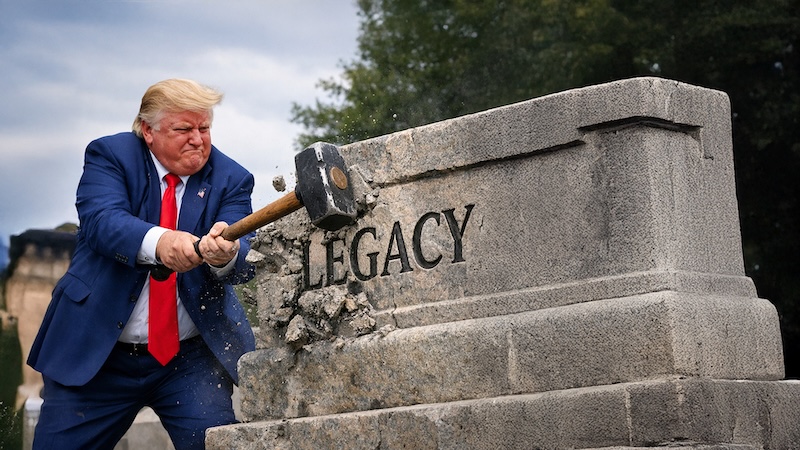
What Will Trump’s Legacy Be? By J.E. Dean

December 31, 2025 by J.E. Dean Leave a Comment

President Trump is obsessed about his legacy. He told one reporter, in an offhand comment, that he was building the White House ballroom as a memorial to himself “because nobody else will.”  Construction on a huge arch, located in front of Arlington National Cemetery and modeled after Paris’ Arc de Triomphe, already is being referred to as the “Arc de Trump,” just as I suspect the President intends. And let’s not talk more about the Trump-Kennedy Center and the self-described “Peace President” adding his name to the building that once housed the U.S. Institute for Peace, an agency DOGE pretty much destroyed.

The President has a problem. His words and actions will be more important to his place in history than whatever buildings he names after himself. Adolf Hitler named all kinds of things after himself, including one of the main streets in Berlin (Adolf Hitler Strasse). Once Germany was defeated, Hitler disappeared from streets, postage stamps, coins, buildings, and much more. There is a lesson here for Trump—you will be judged by what you did and said more than on the size of your ballroom or phony peace prizes.

In particular, future historians will dive deeper into the events of January 6, 2021, despite the President’s aggressive attempts to recast that insurrection as a protest of peaceful protesters who were upset that Trump lost the 2020 election. Historians also will study the criminal prosecutions brought against Trump, including his convictions in New York. And biographers will study how Trump made billions as President, allegedly by manipulating federal policy to enrich himself, his family, and his friends and political supporters.

Let’s not forget the issue of civility—or should we say complete absence of civility. The compendium of Trump’s offensive social media posts is perhaps the best evidence of the state of American politics in 2025. Our civil discourse is in the gutter, which is why our democracy is in danger. 

Finally, historians will ask themselves why voters chose a 78-year-old man as President, especially after that same man brutally attacked his predecessor as senile and too old to serve. With more than three years left in his second term, Trump regularly falls asleep in meetings, forgets names and facts, and appears ready to start using a wheelchair.

Some believe that Trump’s “decoration” of the White House with gold is the product of a deranged man—think what historians will say about the “Presidential Walk of Fame” and Trump’s holding a military parade to honor his own birthday—June 14th, currently Flag day, but likely to be recast as “Trump’s birthday” within the next 36 months.

I could go on and write about abuses of the pardon power, the appointments of misfits like Pam Bondi, Kristi “ICE Barbie” Noem, Ka$h Patel (yes, that is how he sometimes writes his own name), and the sinister-looking nut case, Stephen Miller.   These personalities will be remembered in the future as aberrations—ridiculous appointments that would never have been made by a sane president. 

In a word, the prospects for Trump’s future are “bleak.”  Is he the worst President in American history? Yes. And even if almost-as-bad J.D. Vance succeeds him, Trump’s place in history is secure.

Happy New Year.


J.E. Dean writes on politics, government, goldendoodles, and other subjects. A former counsel on Capitol Hill and public affairs consultant, Dean is an advocate for democracy, sanity, and the rule of law.

Special Note to Spy Readers: This is my last regular weekly column. My pieces will now appear occasionally—and hopefully will comment on good things happening in 2026 and focus more on how to make things better than on what I see as the mess we are in. Thank you to those of you who have regularly read my pieces. And I wish everyone, including my detractors, a happy and safe new year.


The Spy Newspapers may periodically employ the assistance of artificial intelligence (AI) to enhance the clarity and accuracy of our content.

Filed Under: 00 Post to Chestertown Spy, 3 Top Story, J.E. Dean

  • « Previous Page
  • 1
  • 2
  • 3
  • 4
  • 5
  • 6
  • …
  • 116
  • Next Page »

Copyright © 2026

Affiliated News

  • Chestertown Spy
  • Talbot Spy
  • Cambridge Spy

Sections

  • Sample Page

Spy Community Media

  • Sample Page
  • Subscribe
  • Sample Page

Copyright © 2026 · Spy Community Media Child Theme on Genesis Framework · WordPress · Log in